Rebuilding Life After Stroke: Inside Shirley Ryan AbilityLab’s Cutting-Edge Rehab with Holly Paczan and Caitlin Newman - Episode 152
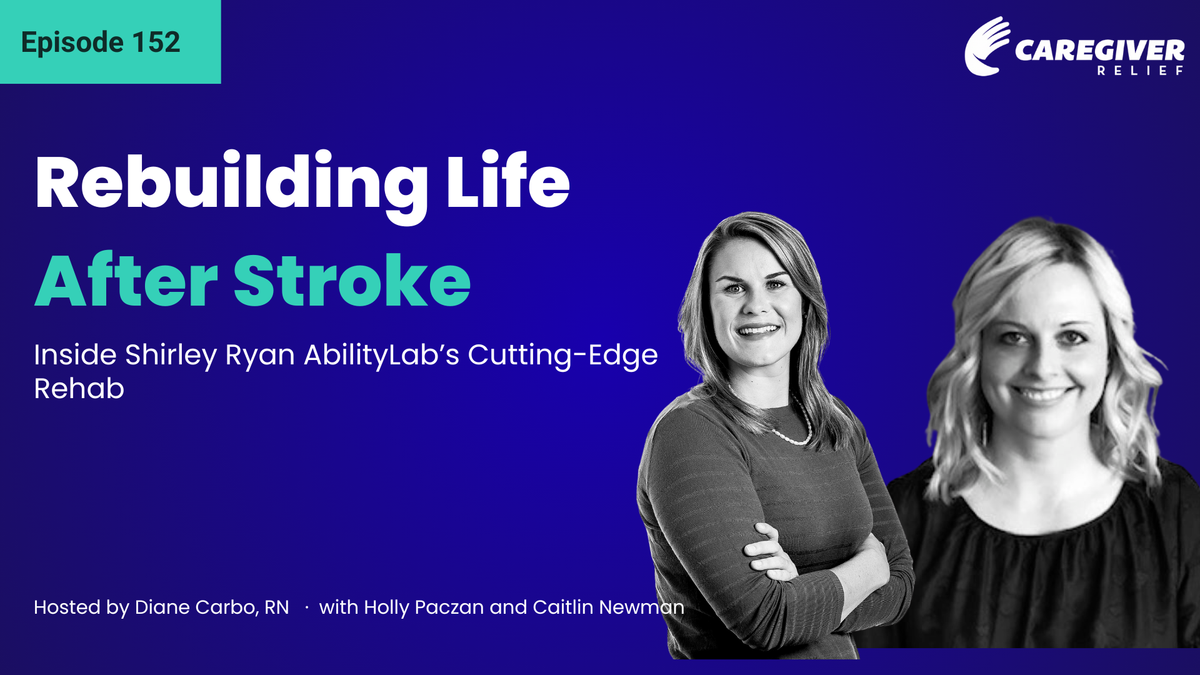
In this powerful episode of The Caregiver Relief Podcast, host Diane Carbo, RN sits down with two incredible experts from the Shirley Ryan AbilityLab—ranked the number one rehabilitation hospital in the nation.
We are joined by Caitlin Newman, an Occupational Therapist and manager of the Arms and Hands Lab, and Holly Paczan, a Physical Therapist and manager of the Legs and Walking Lab. Together, they pull back the curtain on how science, technology, and compassion are reshaping what is possible for stroke survivors.
🚀 What Makes Modern Rehab Different?
If you are familiar with stroke rehab from decades ago, get ready for a surprise. The "translational" model at Shirley Ryan AbilityLab means that clinical care and scientific research happen side-by-side in the same spaces.
Key Shifts in Recovery:
- Neuroplasticity over "Developmental" approaches: The focus has shifted from simple developmental movements to brain rewiring through high-intensity, meaningful repetition.
- Shorter Stays, Higher Intensity: With hospital stays shortening (now averaging 2–3 weeks compared to 8 weeks in the past), therapy must be smarter and faster to maximize that time.
🤖 Sci-Fi Tech Becoming Reality
This isn't just about exercises on a mat. Caitlin and Holly discuss the cutting-edge technology integrated into daily care:
- Exoskeletons: Used in the Legs and Walking Lab, these robotic suits help patients with balance issues or "pushing behaviors" retrain their brain to find their midline for walking.
- Vagus Nerve Stimulation (VNS): A groundbreaking FDA-approved implant that, when paired with therapy, sends signals to the nerve to help create new neural pathways for arm recovery.
- The "Ability Quotient": A data-driven dashboard that tracks patient progress against age-matched norms in real-time, allowing the team to pivot treatment plans instantly.
📋 What We Cover in This Episode
Here is a breakdown of the key topics discussed in today's conversation:
- Meet the Experts: Introduction to the team from the nation’s #1 rehab hospital.
- Why Therapy? Caitlin and Holly share their personal inspirations for entering the fields of PT and OT.
- Inside the Labs: A look at what happens in the specialized "Arms and Hands" and "Legs and Walking" labs.
- The Research-Clinical Link: Why putting researchers and clinicians in the same room changes patient outcomes.
- Robotics & Exoskeletons: How technology aids walking recovery and reduces caregiver burden.
- Vagus Nerve Stimulation: New hope for upper limb recovery through neuromodulation.
- How to Choose a Rehab Facility: What caregivers need to look for (specialized teams, discharge planning, and technology).
- The Future of Rehab: The emerging role of wearable sensors and remote therapeutic monitoring for home care.
- Advice for Caregivers: Why self-care is a marathon requirement, not a luxury.
💙 A Note to Caregivers
As Diane mentions in the episode, stroke rehab is a marathon, not a sprint. To maintain the gains made in the hospital, the caregiver becomes the most important part of the equation.
But you cannot pour from an empty cup. Holly and Caitlin emphasize the importance of finding support groups and taking respite to ensure you can continue to be the advocate your loved one needs.
Podcast Episode Transcript
Diane: Welcome to the Caregiver Relief Podcast, where we support, educate, and empower caregivers on every step of the journey. I'm Diane Carbo, RN, your host. Today we're diving into one of the most important and often misunderstood stood parts of stroke recovery, rehabilitation. And I'm joined today by two incredible experts from Shirley Ryan Ability Lab, the nation's number one rehabilitation hospital, and a leader in Neuroscience driven recovery.
I'm joined today by Caitlin Newman. She's an OT or occupational therapist, and she's the therapy manager for the arms and Hands lab. With more than a decade of experience, she specializes in helping stroke survivors rebuild upper extremity function, and is deeply involved in resource integration across the organization.
I am also joined by Holly Paczan, a PT is a board certified neurologic clinical specialist and therapy manager for the legs and walking lab.
With more than 18 years of experience, Holly focuses on locomotive training, vestibular dysfunction, and lower extremity. stimulation and cutting edge rehab technologies Together, they are reshaping what's possible for stroke survivors, blending hands-on therapy, advanced technology and groundbreaking research.
Whether you're a caregiver, a. Stroke survivor or a healthcare professional. This conversation will give you real insight into what modern stroke rehab looks like, how outcomes are measured, and how to choose the right rehab setting for your loved one.
Diane: Thanks ladies, for joining me today. I'm really excited about this. I'm an old rehab nurse, like from 50 years ago. So what you guys are doing is really, Exciting for me. what inspired each of you to pursue careers as a physical therapist or an occupational therapist?
Holly: Sure. I can start. growing up I always had an interest in science and was really particularly drawn to human anatomy classes When I was in my early college years, I had a close family friend that experienced a brain injury and I really witnessed firsthand the power of therapy.
I love that OT sits at this intersection of health sciences, psychology, anatomy, and neuroscience, and I get to use this kind of unique blend, my creativity and my human connection to improve quality of life for the patients that we serve. That's awesome.
Caitlin: I think, I grew up in a household.
My mom was a nurse, and so I think I was always surrounded by somebody who cared deeply about helping others. So I always knew I wanted to go into a profession that was doing, that was designed to help others. Initially I was gonna go to medical school. And then I changed paths and ended up trying to figure out what I wanted to do after I graduated college and got a job as a physical therapy rehab tech at an outpatient clinic and ended up really enjoying that patient interaction, and the work that they were doing.
And that's what led me into applying for physical therapy school.
Diane: you both are working in a highly specialized labs, which is new to me. Totally. That's why I was so excited you agreed to do this podcast with me. the Arms and Hands Lab and the Legs Plus Walking Lab, who wants to describe the focus of your work and what makes these programs unique?
Caitlin: Katelyn, do you wanna take
Holly: that one? Sure. like you mentioned, we are a rehab hospital located in Chicago and one of our models is really this translational, rehab hospital. So we really focus on clinical care and scientific research that's happening side by side. and so many times the patients that we treat.
Are also experiencing, participating in a research study or the clinicians that they're directly working with are also working closely together, with our research colleagues and really the goal of these specialized labs. Is to help apply some of that real time, learning, into our clinical care, really closely together.
so in the Arms and Hands lab, we serve patients with a variety of neurological conditions, stroke, brain injury, and spinal cord injury, being the main focus. and we specialize in the evidence-based treatment and interventions for those diagnoses.
Diane: Now for listeners who may be unfamiliar, what is Shirley Ryan Ability Lab and what makes it different from other rehab hospitals?
Caitlin: Shirley Ryan and Billy Lab is, like you said in your intro, the number one rehabilitation hospital in the country, but really in the world because there's not a lot of great rehabilitation care outside of sort of Western medicine. yes, I think what. Our hospital unique is a couple of things.
One, Kaitlyn already alluded to the fact that we have this really close relationship between research and clinical care. it's often very siloed and a lot of organizations where research and clinical care are happening in very different spaces. And we were very intentional when we moved into our new hospital in 2017 to put research.
Clinical care in the same spaces so that the researchers could see real time our patients, what was going on. Our clinicians would have access to researchers if they had a question or a problem that they kept encountering and weren't quite sure how to, address it. I think another really unique thing about our hospital is when we moved into our new building, the traditional inpatient rehabilitation care model, is that patients come in, they get usually admitted to a floor that either or has a mix of all different diagnoses, or maybe they have separate floors for different diagnoses.
They might have a floor for spinal cord injury. They might have a floor for stroke, they might have a floor for brain injury. and then those patients are seen by a physical therapist and occupational therapist and a speech and language pathologist here at Shirley Ryan. They have that, they get admitted to a diagnosis specific floor, and they get seen by those primary therapists.
But also we created this. Model. That's akin to like when you go see your primary care physician, and then if you need a specialized service, maybe you need a cardiologist or you need a neurologist, they make that referral. So we also have therapists at our organization that really, rather than specializing in a specific diagnosis, they specialize in treatment intervention.
And, maybe evidence-based treatment interventions and are really expert at that. And so sometimes these patients, when they have specific impairments, get referred to those expert clinicians and that person just becomes another member of that interdisciplinary team. So that we're really trying to give all of our patients really personalized care.
We're really trying to move towards more of a A prescription, more of a prescribed therapy model where patients, every patient is individually evaluated and really given what they need at that moment. and I think that's what makes our hospital really unique and that we try to be very up on all of the new and cutting edge research.
We also are very lucky here to have access to a lot of equipment and a lot of tools to help our patients, recover faster. and I think we also have a lot of therapists, I shouldn't say a lot. We have all of our staff here are really committed to that mission of really trying to get best patient outcomes right.
That's at the end of the day, what everybody's coming to work for, and it's hard work, but I think if everybody's driven by that, we really genuinely wanna see all of our patients get as far as they can in their recovery process.
Diane: I agree. I having done stroke rehab in the dark ages, I'm excited, about what you guys are doing and I love the enthusiasm and the knowledge that you both have.
stroke rehab has changed significantly over the years. How has the field evolved and what are the biggest shifts you both have seen?
Holly: Sure. I think when I started my career, there was already a shift that was beginning to happen where we were shifting from kind of these neurodevelopmental approaches to interventions that really target brain rewiring.
and in the early two thousands, there were some, really important research that was happening related to neuroplasticity or the brain's ability to rewire. and we really apply a lot of those principles today, to our patients that we see,we really focus on repetitive or meaningful movement that drives the changes to the brain.
And we know that early and intensive therapy leads to better outcomes. I think some of the evolution that we have certainly seen is now this idea of technology and how are we then integrating that into our treatment sessions to enhance the brain's ability to rewire itself, and really to drive patient outcomes further than maybe what we would've expected previously.
so I think technology has really been that next evolution of what we're seeing in stroke rehab.
Caitlin: I would also add to that, that, when I started my career, I'm a little bit older than Caitlin. patients had much longer lengths of stay, especially stroke patients in the inpatient rehab.
I can remember a time when some of my patients would have been there eight weeks. in an inpatient rehab facility, and the time in which stroke patients are being allowed to stay in inpatient rehab is just reduced by quite a bit. Now we have an average length of stay of two to three weeks.
So I think because this time that patients can be an inpatient rehab is really shrunken. We have to be smarter and we have to be better at what we're doing with our patients to maximize that short amount of time. So I think. In the early years, we used to spend a lot of time on sitting balance and pre walking activities and standing tolerance, and really trying to do these stepwise functional mobility, focuses.
And then now I feel like we've really had to change that thinking and try to get the most bang for our buck in everything that we're doing with our patients.
Diane: I can say from when I was in nursing in rehab, I worked at Sister Kenny Institute in Minneapolis. they stayed for months and months, so I that's, it's really gone to, you've really cut it.
the government involvement now has just cut down the re the recovery, time that they will pay for to, Like you say, two or three weeks if you're lucky. and I know technology is playing an important role in this modern rehab. what types of technology are now integrated into daily clinical care at SRA lab?
Caitlin: I would say for physical therapy,a lot of our technology is focused around walking, recovery. and so we have, an exoskeleton, so things are moving into the robotics field where we have an actual exoskeleton that we can put patients in, where they can do overground walking. and we're finding with some of our specific.
subgroups of stroke patients, particularly patients who have, a lot of pushing behaviors or a significant, midline orientation problem where they really lean to one side and can't hold themselves upright, that the exoskeleton. Is really good at retraining the brain to figure out where midline is, which is so critical to be able to keep your balance and then be able to stand and walk.
It's also critical to help caregivers, be able to transfer their loved ones safely from a, from the chair or to stand them up. and we're really utilizing that piece of technology to help reduce caregiver burden on those particular types of stroke patients. There's also a lot of movement in integrating virtual reality, trying to make rehab more meaningful.
and we have a lot of, we're also moving into the realm of. Wearable sensors and also trying to capture walking data more quickly so that the therapist can have some of that information, whether it's via wearable sensor or camera information to get more nuanced information about how the patient moves so that we can better, again, tailor our treatment interventions to what that patient needs.
And then Caitlyn. I'll pass it on to you. Yeah.
Holly: similarly for the upper extremity,we use technology like electrical stimulation to address weak muscles in the patient's shoulder, elbow, and wrist and fingers. we have a variety of different devices that we can combine that electrical stimulation with functional movement.
we know that the brain changes better when we're doing things that are meaningful to the patient's life. So we really try to pair that technology. With movement that is meaningful. being able to drink from a cup, being able to pick up their grooming items, being able to,give their loved one a hug. So those are some examples of ways that we pair that technology with that functional movement. Holly mentioned things like virtual reality, and wearable sensors, and those are things that we're also thinking about integrating, for occupational therapy as well. There are some, technology to track and understand how the upper limb moves, both in therapy and then outside of therapy using wearable sensors, which can be really important for, long-term recovery as a patient, transitions to outpatient therapy or even away from therapy.
to continue to monitor how much they're using, maybe their weaker limb after a stroke is really important.
Diane: I think that's fascinating exoskeletons and, it's just, it's encouraging. Now, what are some of the latest innovations or existing or exciting research developments Is stroke recovery that's happening at Shirley Ryan Ability Labs.
Holly: Yeah, so we have a lot of active research programs, targeting stroke recovery, things that are looking at, how much load a shoulder can take. Things like different forms of stimulation that we can use. But recently there has been a clinical study, that looked at vagus nerve stimulation, and paired vagus nerve stimulation, or VNS at its as it's commonly referred to, is the only FDA approved form of neuromodulation for upper limb recovery after stroke.
And we have an active clinical program here. For people with moderate arm weakness, it uses a small implanted device that sends a gentle signal to the vagus nerve to help the brain create these new neural pathways. And when we pair that with repetitive upper limb training in clinical trials, we've been able to show that the treatment groups had significantly better outcomes, compared to people that got the sham stimulation.
So the therapist actually triggers the stimulation, when the patient is performing these key movements. and then when the therapy ends, the patient can actually turn the stimulator on at home as well to do parts of their home exercise program. Oh, wow.
Diane: that's interesting. So how do you measure patient progress and outcomes to make sure therapy is both effective and personalized?
Caitlin: So we have a couple of different, methods here at Shirley Ryan. one, and this is common across all, inpatient rehabs, is that we have to score our patients right at initial admission and then weekly and at discharge on a standardized scoring, that looks at all of their different functional mobility.
So that's one way in which we track progress. but here we really focus a lot on individual outcome measures that are very specific to different patient's impairments. and we have a core battery of outcome measures that we try to, perform at admission or as close to admission as we can weekly to track progress.
And then at discharge, we also developed, something called the ability quotient here. Which uses all of that information. Regarding a patient's QI scores so that their sort of functional mobility scores, as well as the outcome measure scores, and somebody much smarter than me created this whole algorithm and then it spits it out into this beautiful dashboard.
We use during our team conference conversations. So weekly we, the physician, the therapy team meets the nursing team, psychologist, everybody that's part of the interdisciplinary team meets once a week to talk about how the patient's doing. And so we have this ability quotient that we put up on our monitor that shows how the patient is doing and how it should compare to somebody age match norms with a similar diagnosis.
so that gives us realtime information about how the patient is doing, and then really drives that conversation amongst the interdisciplinary team. If Mr. Smith is doing better than we expected in one area, but maybe not so well in a different area, do we need to shift our focus to giving them more specialized therapy in that particular area?
And vice versa. So it's really trying to help inform that more precision medicine model that we're trying to move towards.
Diane: Now, for caregivers listening, what should, what they, what should they be looking at or for when choosing an inpatient rehab hospital after a stroke?
Holly: Yeah, so choosing an inpatient rehab hospital is a really important decision for caregivers.
I think one of the first things to really think about and look for is that, high quality rehab starts with, a specialized interdisciplinary team. and here at Shirley Ryan Ability Lab, we offer this team-based approach that includes physical therapists, occupational therapists, speech and language pathologists.
in addition to the rehab position, the rehab nurse. We have a psychology team and a care management team, all who are working together,to provide best patient outcomes. I think some of the things that we've already mentioned, but it's important for a facility that has specialized programs and experience with the specific condition,that your loved one is experiencing.
we mentioned things like personalized goal-oriented treatment plans, that really target that intensity, and then maybe even access to some of the advanced rehabilitation technologies that we've mentioned that could help to facilitate progress for your loved one. One of the other important parts of, an inpatient rehab hospital is what the discharge plan looks like, right?
and so a care management, and social work team that really helps to facilitate a safe and effective discharge plan that includes, ongoing therapy, for continued progress. and I think one of the unique things, that we offer here at Truly Ryan Ability Lab is certainly our standalone inpatient rehab hospital.
Downtown Chicago, but we also have satellite, locations that are across our Chicagoland area that continue to offer outpatient services, to our patients who are experiencing stroke so they can continue their recovery.
Diane: Looking ahead, what possibilities or emerging technologies excite you most about the future of stroke rehab?
Caitlin: I think. We mentioned earlier, I think any technology that's really clinically applicable and very easy for clinicians to use and incorporate into their daily sessions, right? I think any technology for it to be successful and implemented regularly has to be fairly easy to implement, easy to get on patients, reliable.
And so I think. We're, really looking a lot at the wearable sensors. doing more gait analysis via some cameras in our therapy gym spaces. To be able to pull realtime data about how our patients are moving to help better inform our treatment plans. I think that's something that I think is coming fairly quickly and hopefully will be fairly easily to implement.
and I think clinicians and patients alike will really enjoy having some more nuanced information about how they're moving and what we need to work on with them.
Diane: Do you see the new innovations that they're, and technology you guys are developing and working with, moving into the home care, arena at in some time in the future?
I'm just curious because I just think it's so cool what you're doing and, it, it just seems that with the ability, with the machines and the equipment you're using, you're gonna be able to measure things and follow through so that they, it can be done in,an outpatient or home setting. I was just curious if you think that's a possibility for the future.
Caitlin: There, there is some work being done on what we call remote therapeutic monitoring. So to your point, a patient could have a set of sensors, and be wearing them at home during regular activities, and then the therapist could be monitoring, checking in, helping to inform their home exercise program or what they're doing at home.
So there's definitely movement. On that. and I do think that's gonna be utilized more and more, particularly as we're trying to improve access to good rehabilitation services for patients who maybe don't live in near Chicago, they don't live near. or they're not in a, they're in a town where they don't have a really good rehabilitation hospital or neurological rehabilitation care.
Like how do we get those patients to have access, to services? And so I do think that is gonna be a really important piece that the field continues to move into and explore.
Diane: I'm excited about all the changes. The technology is huge. I, when I did rehab in my. In my twenties and thirties.
I'm laughing now because an exoskeleton would not even have been something in my mind to even see or use. So when I hear all these things, I get excited because it's just going to make a rehab better for everybody. So for the caregivers out there that feel overwhelmed during stroke recovery, what advice would you give them as they support their loved ones through rehab?
Holly: I can take that one. so I would say that, inpatient rehab is really just the beginning of kind of that recovery process. And I think what I see from our caregivers and our loved ones who are here supporting our patients is that they are really strong advocates, for our patients and that, they really motivate them to continue with therapy.
And certainly continue with therapy as an outpatient for that long-term success. But I think just as it is important to, advocate, for your loved one, it's just as important to advocate for yourself. so it's really important to have your own self-care and your own ability to get respite, so that you can continue to be that, motivation for your loved ones.
I would say focusing on self-care and making sure that you have opportunities. to work on the things that you enjoy and the occupations that are important, for you and your life, or that bring you meaning.
Caitlin: I would also say, I know there are a lot of caregiver support groups for stroke specifically.
Maybe you don't have one like physically in your community, but certainly online. And so I think if you can tap into finding a support group, where other caregivers you can share your experiences, you can maybe vent a little bit. You can also like share resources and share knowledge. I think that's also critically important to build community 'cause it is a really hard.
Job to be a caregiver. and so I think the more support that you have, it will only make you a better caregiver as well for your loved one.
Diane: I love that you brought up the point of a caregiver taking care of themself and provi and practicing self-care because stroke rehab is a lifelong.
Journey after you've had a stroke, you have to, in order to maintain your baseline, whatever that is, you have to keep working at it. And, and if you get lazy or become ill, you slide back. So the caregiver has to be, look at it as this is a marathon, not a sprint. And it, and, you have to be able to focus and help take care of your loved one while you're taking care of yourself.
So ladies, thank you so much. I really appreciate your time. I love the fact that technology is playing such a huge role and it's only gonna improve, our outcomes in the future as we move forward. To my family caregivers out there, you are the most important part of the caregiving equation. Without you, it all falls apart.
So please learn to practice self-care every day. Learn to be gentle with yourself because you are worth it.
Caring for a loved one can be overwhelming — but you're not alone. If you have questions, big or small, our expert team is here to help.
👉 Click here to Ask the Expert
Our Resource section can help you find the information and tools that you need. We have courses, videos, checklists, guidebooks, cheat sheets, how-to guides and more.
You can get started by clicking on the link below. We know that taking care of a loved one is hard work, but with our help you can get the support that you need.
Click here to go to Resource Section now!
You might also like this article:
 Diane Carbo
 Diane Carbo
 Diane Carbo
 Diane Carbo