Caregiver Burnout Is Real: How to Heal Your Body, Mind, and Soul Naturally with Dr. Lynn Anderson - Episode 194
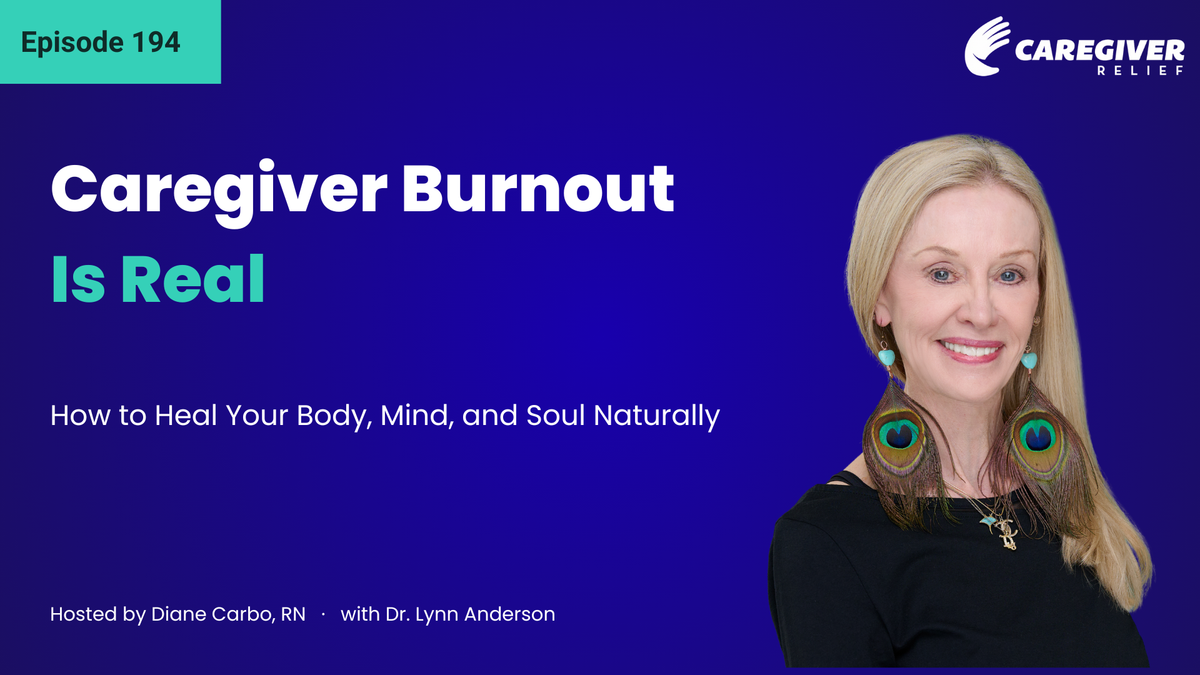
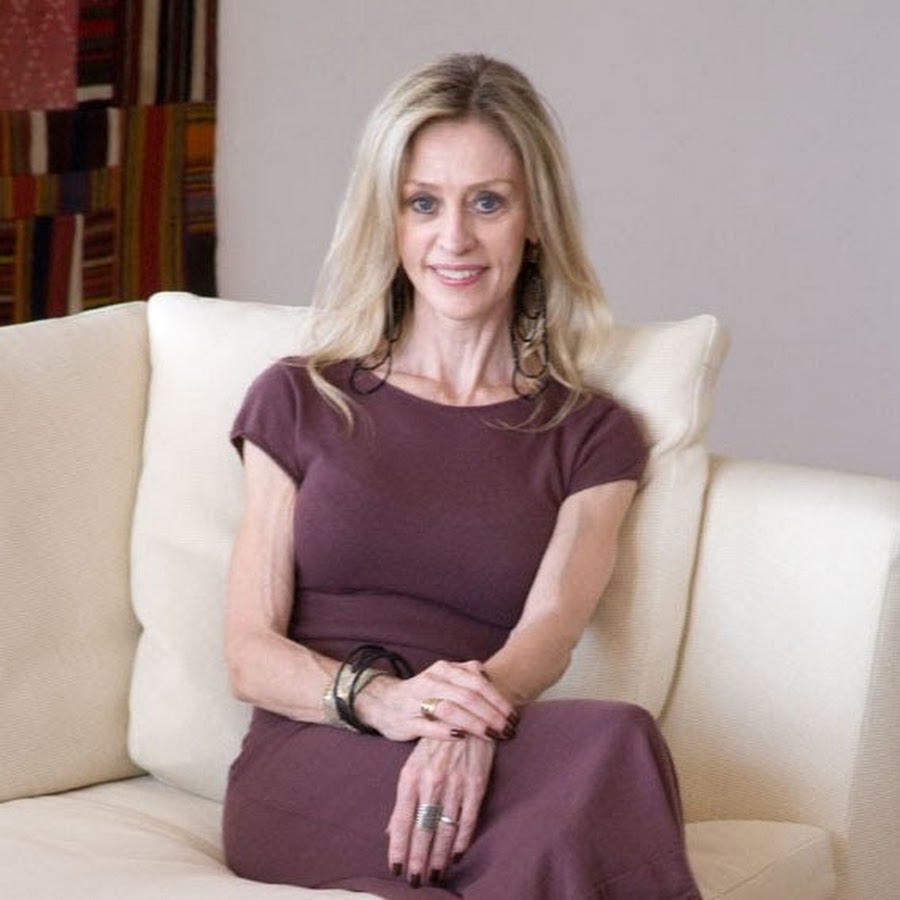
Caregiving is one of the most meaningful things you will ever do, but it is also one of the hardest. Many caregivers focus so intensely on their loved ones that they ignore the warning signs in their own bodies, leading to severe burnout. In this episode, host Diane Carbo sits down with Dr. Lynn Anderson, a naturopath and fitness professional with over 40 years of experience, to discuss restoring health naturally.
Dr. Lynn shares her personal journey from a "folk medicine" childhood to overcoming her own burnout as a single mother in college. She explains why caregivers—often Type A overachievers—frequently hit a breaking point where the body and mind simply crash.
🕒 Episode Outline: Reconnecting with Your Health
- The Early Warning Signs of Burnout
- Recognizing the "fogginess," numbness, and inability to make simple decisions.
- Why sleeping for days often doesn't cure true caregiver exhaustion.
- The Body as a Machine
- Using the car analogy: Driving in overdrive eventually burns out the engine.
- The physical toll of chronic stress and poor nutrition.
- Healing the Body, Mind, and Soul
- Understanding the "Soul" as your inner essence that waits for you to listen to your body's signals.
- How your mental state creates immediate physical reactions.
- Small Practices with Big Impact
- The power of 10 minutes of meditation to regenerate the brain.
- Overcoming the "guilt factor" when taking time for yourself.
- Natural Nutrition & Sleep
- Why the Mediterranean Diet is the gold standard for natural health.
- The "synergistic effect": Why nutrients like calcium and magnesium must work together.
- Deep belly breathing techniques to calm a thrashing mind before bed.
- Gentle Movement & Soul Walking
- How gentle yoga removes "knots" and restores fluid circulation.
- An introduction to Soul Walking: Moving beyond the facade to find your true mission and inner energy.

✨ Key Takeaways for Every Caregiver
"Your health is your wealth. When it's gone, it takes so much to bring it back... the more healthy you are, the more you have to give to others." — Dr. Lynn Anderson
- Saying "No" is a Boundary, Not a Sin: Learning to say no is an essential tool for survival and sustainability.
- The 6-Year Warning: Negative health consequences from caregiving can last up to six years after the journey ends.
- Laughter is Medicine: A sense of humor is a vital tool for relief and perspective.
- Connect with Nature: Even stepping onto a porch for five minutes can reset your mentality.
🎧 Why You Should Listen
If you feel like you don't even have time to take a shower, this episode is for you. Dr. Lynn provides a compassionate, natural roadmap to help you stop "stress eating" your problems and start walking with your soul again.
Connect with Dr. Lynn Anderson:
- Motto: Because Life Becomes What Life Does
- Website: doctorlynn.com
- Twitter: @drlynnanderson
- Instagram: @doctorlaa
- LinkedIn: Lynn Anderson
Podcast Episode Transcript
Diane: Welcome to the Caregiver Relief Podcast, where we focus on helping family caregivers navigate the challenges of caregiving while protecting their own health and wellbeing. Caregivers are often so focused on the person they are caring for, that they ignore the warning signs in their own bodies.
But the reality is that caregiver burnout is real and it's affecting millions of caregivers across the country. Today we're talking about how caregivers can begin to restore their health naturally by caring for their body, mind, and soul. My guest today is Dr. Lynn Anderson, a naturopath yoga, nutrition therapist, fitness professional author and international speaker with more than 40 years of experience in the field of natural health and wellness.
She has been featured in major publications, including Red Book, reader's Digest, Huffington Post Shape and Self, and she's the creator of the Soul Walking Series and the Naturopathic Wellness Series. Dr. Anderson has spent decades helping people reconnect with their bodies and restore balance in their lives.
And today she's going to share how caregivers can do the same.
Diane: Dr. Lynn, thank you so much for taking time outta your busy schedule, to share your information, which is desperately needed right now .
Lynn: Well, thank you so much for inviting me, and I'm excited because I have been on both sides of it. I've been the caregiver and I've been those who have helped with caregivers, so it's a really, it's a wonderful subject, so thank you for inviting me.
Diane: You know what I'm learning, the common thread through most of my podcast is a caregiver took. Was going through their caregiving journey. They've identified, an obstacle or a problem and they provided a solution for it. So I really love that because we have a silver tsunami. It's here and we have.
We're not prepared. Our caregivers are not prepared, so I'm excited for you to share. Now, you've spent more than four decades working in natural health and wellness. What first inspired you to pursue this path?
Lynn: Well, I can go all the way back to, we'll begin at my childhood. I grew up on a small island off the coast of Maine, and I grew up in a little fishing village.
And, in that fishing village. We were, we didn't have a doctor. And what we used to do is my mother and my grandmother would go out and they'd forage things and we would do what they called kitchen sink surgery, you know, whatever you could use to bring a fever down or to do whatever.
So it's a lot of folk medicine. So I grew up a lot of folk medicine. It was. Pretty much in tune with that. But then, I found myself as a young, single mother with two children, and I hadn't finished my college degree, so I decided to go back to college, and I went back. I had no money. I was flat broke, I nothing.
I had an old beat up car. That was it. And so I did everything I could to get myself through school. Long story short, I got myself through school and, when you graduate from college, whether you are where my circumstance or anybody's circumstances, there's a kind of an immediate let down as soon as you graduate because you don't have the pressure of meeting those deadlines.
I had. That let down, but I also had what was called severe burnout. I was exhausted. Oh, yeah. Yeah. I had been running and going and working and trying to keep all those balls going. So I had this complete burnout, and with the burnout, I began to. Examine things and say, the really, the best way to bring myself back is naturally is to feed myself good food, to get the rest that I need to exercise, to take care of myself physically, mentally, and soulfully in a natural way, rather than going out and getting, pills and from a doctor and prescriptions.
And that's what's really what got me on to the path of naturopathy.
Diane: I wished I'd knew you when I was young.
Lynn: Yeah.
Diane: Many caregivers don't even realize they're experiencing burnout. what are some of the early warning signs that the body and mind are under too much stress.
Lynn: I would say one, one of the really is there's this fogginess that comes over you and there's an inability, it's almost like an inability to make decisions or solve problems.
And I'm a Type A overachiever, and I think a lot of caregivers tend to be that. And we like to make our decisions and we like to solve our problems, and all of a sudden it's like. What's going on here? I don't even wanna get outta bed this morning. I'm exhausted and it's, and you could have slept all night and been in bed for three days and you're still exhausted.
So it's like a numbness that sets in.
Diane: Yes, yes. I've experienced caregiver burnout. I was both a family and a professional caregiver.
And, it's challenging, I'm really excited to share your information with my listeners because so many people think. The solution is a pill.
Lynn: Yeah.
Diane: You know, and, just gimme a pill and I'll be okay. And that's not it at all. it absolutely isn't. So, in your experience, what happens physically and emotionally when someone stays in chronic stress for long periods of time?
Lynn: Well, your body starts to break down. and nutrients, we don't eat a proper diet.
We don't exercise. And then what happens is the body, the body is a machine and it, and it's a wonderful machine and it's miraculous, but it, if you keep putting it in overdrive, just like a car, you drive your car in overdrive, eventually that engine's gonna burn out. Something's gonna break.
And that's really what happens with. The body and also the mind because the mind there is that breaking point of when people just crash and burn.
Diane: Yeah, I, I can attest to that and I've seen mar many caregivers. I have se I'm in several groups and I lose two to three caregivers a year to serious illness or death.
Because they push themselves so much and they don't realize it. Or they think that this, they have to carry this burden alone.
Lynn: When we're under stress, whatever the stress is, it doesn't have to be caregiving, but whatever stress, the first thing that usually goes is the diet.
Absolutely right, and we don't say, okay, I've got to take care of, I've got to get these nutrients in because nutrients are fuel. If you don't put the right fuel in the body, it's not gonna operate properly, but that gets discarded and then time to rest gets discarded because we gotta keep going.
The stress factor is in there. And so that's really, I think primarily the first thing that happens is people stop taking care of the essentials, eat a healthy diet. Take a walk.
Diane: It's too easy to grab fast food.
Lynn: Yeah.
Diane: It's too easy to grab junk food and shove it in your mouth and continue on. That's fuel for the body, but it's not healthy fuel.
Lynn: No.
Diane: And it's like putting in the wrong kind of gas in your car.
And breaking down. So yeah. I love the car analogy.
Lynn: Yeah.
Diane: Caregivers often say they simply don't have time to take care of themselves. What are some small daily practices that can make a big difference in restoring energy?
Lynn: 10 minutes of meditation.
It can do wonders. There's been numerous studies on just shutting down the mind, being quiet, being present, taking that time. And it also, there's a lot of breathing that's involved. There's been numerous studies that have shown that not only does it. Reset the body and the mind, but it also regenerates the brain.
It allows the brain, your computer up here to get recharged. And we can do it in simple little things like, 10 minutes. 15 minutes, but there's a factor that comes in there. There's a guilt factor that comes in. I shouldn't take that 10 minutes because there's so much to do. And you know what?
There's not so much to do that 10 or 15 minutes will give you more energy to do what you have to do. That's, we have to give ourselves that permission.
Diane: One. and that's the key. We have to give ourselves permission and we have to see ourselves as valuable. Yes. and we don't, you know, the typical caregiver is a people pleaser.
They wanna make sure everything's okay, like you said, we're the type of a personality. And, it, it just doesn't work that way. We really need to reach out and, ask for help from others, which is another whole issue that caregivers have a hard time doing. Yeah. But to realize that, and I know I say this and people will roll their eyes, but your body is a temple.
You need to treat it as such. And there are things, five or 10 minutes a day is nothing. If it can make your life's, your life better and sustainable.
Lynn: Exactly. And 10 minutes. We waste 10 minutes all the time. Yep. We have these things called cell phones that we scroll and waste.
And a better use of time is to take care of your health because as I tell all my students and my clients, the most important thing in your life is your health. When that's gone, you're no good to anybody. You cannot be an effective caregiver if you are health goes,
Diane: The research shows that after a caregiving journey, the negative health consequences that you've.
Experience during your journey can last as long as six years after the caregiving journey is over. And when people hear that, they're saying, oh my gosh. And I've seen it so much. Now you talk about, healing the mind, body, and soul. How are these three connected when it comes to he health and recovery from burnout?
Lynn: Okay. Well, first off, your body, what happens in your body does affect your mind, and what goes on in your mind affects your body. Th this is not hocus pocus. This we all know. We all know that. If you're really stressed in your mind that it's going, there's a reaction going on in your body.
But what. The other element of that is, and as a naturopath, we believe that perfect health and perfect balance is balancing out the energy of the body, the mind and the soul. And the soul is your essence. That's your inner essence of who you are, and it's like we think of it as that part of you that kind of sits back and is observing what's going on, but it doesn't jump in and say, okay, all right, forget.
I'm gonna come in and take care of the mind. I'm gonna take care of the body. It waits patiently and for you to get the signals, oh my goodness, I've got throbbing headaches. Why am I getting throbbing headaches? That's a signal. And that's a, and when we listen to those and we come back to the essence of who we are, because the essence of who we are is our soul.
And your soul is a very, it's a very calm and peaceful place. It's hard to get back there. Yes, there's too much energy going on out here. Too much clut.
Diane: Absolutely. And clutter is the perfect word for it.
Lynn: Yeah, it absolutely is.
Diane: Nutrition plays a major role in energy and resilience, as you mentioned earlier.
What are some simple nutritional changes? Caregivers can make that to support better health.
Lynn: Well, you know, people always ask me about diets and things like that, and I always circle back to the Mediterranean diet because it's really the most well balanced diet out there. There are all kinds of people selling you supplements and selling you this and selling you that, and this is gonna do it, and that's gonna do it.
Nothing will do it except a natural whole diet. There's a saying that everything we need is provided in nature. Nature provides everything. We just have to come back to it. But it's so easy today to say, I'm feeling really run down, so I will take this supplement that this person says is great.
Supplements do not have to, prove efficacy. And what that means is they're not controlled by the FDA. So anyone who's selling supplements, they don't have to prove they work.
Diane: Yes, yes.
Lynn: I just have to say, Hey, this is good.
Diane: Yes.
Lynn: But I don't have to prove it. And they did a lot of studies on supplements and they found that the majority of them have Absolutely.
If they have anything in them, it's so minute, you know?
Diane: Yeah,
Lynn: Yeah.
Diane: That it's effective.
Lynn: Yeah, yeah, yeah.
Diane: And there's some, and when they're doing it on tv, they're making lots of money on
Lynn: Right.
Diane: And it's just like the old snake oil salesman.
Lynn: Yep.
Diane: That we used to see in the decades ago, hundreds of years ago.
It's the same old thing, just in a modern way.
Lynn: What people don't realize too is that everything has a synergistic effect in life. And a good example of that would be calcium. Calcium needs, magnesium. To work effectively, the two of them work together. So if you're just taking calcium and you're not paying attention to your magnesium, they're not gonna work together.
So everything has a connection in life and works together. When you break that link, that's when you get a problem.
Diane: I'm glad you said that. the about the, calcium and, magnesium because people are on these, PPIs, positive proton inhibitors like Nexium, Prosac or Prilosec, and they don't realize that they're depleting the magnesium out of their body.
Just that simple thing. And they're, and. First of all, those long-term use of those is terrible for you. And people have been on them for decades.
And they're suffering from many different things and they don't know why. And even just a simple thing like magnesium could make them feel better, but they don't understand that, like you said, everything has a synergistic pattern and we need to listen to our bodies.
Lynn: Exactly. I mean, if you eat a natural diet, which is what nature has provided, you know that we're part of nature. And nature says if you eat this, and this, you get all the nutrients that you need. But we live in a world of processed food. We live in a world where most of our food is treated with chemicals.
And it is, and I do step back. It's very hard for most people to live a very organic and clean life. If you wanted to do that, you need to raise your own food. And we don't live that way, No, we don't live that way. and it's not that we shouldn't.
Have a treat every once in a while. It's okay to have a piece of cake, have a cupcake, have cookies. It's just don't go out and buy a box of Oreos and eat the whole box of Oreos. 'Cause there's not one thing in there. It would be better if you bake a batch of homemade cookies and ate all the cookies.
'Cause at least you're gonna get something. Do you know what I mean? You're not getting, oh, I do all the preservatives and stuff in there. And those things really wreck havoc on the body.
Diane: Yeah. As a woman who baked all her life, I, that was how I justified my bad eating is because I made it myself.
Lynn: Right, right. Yeah. it's me. It's don't show me a homemade cookie 'cause I'm going to eat it. Homemade cookie.
Diane: Exactly.
Lynn: Store bought cookies. Now I could care less about those, but I'm gonna eat, that's, I'm gonna eat that homemade cookie.
Diane: And I laugh because my sons used to give me grief if I cheated. Like I would make a pie and I didn't have my own pie crust. They would just, excuse me, you're getting lazy, mom. Yep. But they were used to homemade stuff, so we didn't do TV dinners or anything like that, and that made a big difference.
Lynn: I will just add that, when I was growing up, we didn't have access to that stuff.
Everything was homemade and everything was what we ate. We ate organic before it was a word because we had to eat what we could forage from the island and the fish that came in and everything. And I remember as a little child the first time I had a store-bought cookie and it tasted funny. It left a film in my mouth and it tasted funny and I didn't want to eat it.
Yeah and I think that's really good that my mother raised me that way because I really, I know the difference, my taste and again, if I wanna treat, I'm gonna go for something homemade.
Diane: Yes, yes, yes. Now many caregivers struggle with sleep. From a holistic perspective, what are some natural ways to improve sleep and recovery?
Lynn: One of the best things we can do is deep breathing and, there's been a number of studies done with breathing from the belly, and the reason I bring that up, we do this a lot in my yoga class, which when you breathe from the belly, you're really driving that oxygen throughout your entire body. And that oxygen, of course, is feeding all your vital organs.
So when your mind is thrashing away, which it does sometimes when you get into bed and you've had one of those days. It's really trying to focus on feeling the belly. I teach, feel the belly rise.
And then fall and just try to stay with that rise and fall up the belly. And that is one of the best things we can do to kind of relax.
As well as a dark room, And we all know, no screen time, just to go and have that time to yourself, but allow yourself to really, you know, we breathe. We all breathe. Everybody breathes. You're alive, but how many times do you stop and pay attention to your breath? We don't Exactly.
Diane: We don't, we don't,
Lynn: We don't.
No. we just take it for granted. And I always see in my classes, when I make my students do that as a deep breath, I always see this wonderful look on their face. Like, wow, this is nice. I've got time to breathe, Yeah. Yeah.
Diane: And that's the thing, caregivers don't even feel like they have a time to breathe.
Lynn: That's right.
Diane: and that's an important matter. A sleep hygiene is really important, and caregivers typically don't have that. When I say sleep hygiene, people say, what do you mean? it's having a routine that indicates to your body, that signals to your body that it is time for sleep.
Lynn: Right.
Diane: And caregivers don't allow themselves that.
I didn't know about the breathing so much. And I really like that in corporate 'cause I do meditation and In fact, we have, because caregivers minds are always going, blah, among the minute with all the things we even have a free guided meditation on the site for caregivers.
Wonderful. Because, wonderful. They can sit and listen to somebody, tell them. What they need to be doing, because otherwise, and they, if they can really focus on that, it's a good thing. But many of them just feel like they can't, they have all the, everything's running in their mind at the same time.
What they have to do, what they didn't do, what they should have done. And it's an ongoing cycle that interferes with them in a lot of ways.
Lynn: Well, there's again, that guilt comes in, I should be taken care of. I should be taken care of. what about, I, it's selfish to think about taking care of me, which is so untrue because I know from being a caregiver myself, the times that I would pull away and take care of myself, I would come back as a much.
More effective person. And I had more to give and I would see those signals would come and I would know when it was time for me to go away and regroup.
Diane: Yeah. I'm finally there where I know when it's time to and one of the hardest things that a caregiver has and many women have anyway, is the inability to say no.
Lynn: Yes.
Diane: They just can't say no. And, now I get a giggle and I'm 73, so it's taken a long time for me to get there. But, it's freeing to say no, and not give a response. Not, don't argue or anything, and just say no. And people look at you like you're shocked. But I also at an area in time where, I don't care if everybody likes me at the moment, And that's really hard. For a lot of people as well. But again, that was an I've evolved over time. And, you can't make everybody happy. And I think that's a big, it's hard for so many caregivers or, and a lot of females to say, they want people to like them.
They wanna feel loved, and they wanna feel that, they're important in everybody's life. And the thing is, you just have to make yourself happy. You have to take care of yourself because you're worthless to everybody else. If you don't,
Lynn: No is just another word. It's just another word it, but we put that connotation to it that if I say no, I must be selfish.
And that is not true. Yes, that is not true. It is just another word, and it is a way of taking care of yourself, and we have to learn to set boundaries throughout our whole life. When you have children, you're a mother, when you have children, you have to set boundaries. You have to set boundaries at work with people that you work with.
It's important to set those boundaries. And that's what happens. We tear, we let those walls get torn down, and then we're stampeded.
Diane: Yes.
Lynn: With all of this stuff coming at us and then we're exhausted.
Diane: Yeah, boundaries are really important. In fact, that's, one of the biggest issues that caregivers have.
And a lot of nurses have that too. Yes, because, we wanna be able to dowe wanna be everything to everybody, and you just can't be
Lynn: No, no. you can't.
Diane: Now movement and exercise. Let's talk about that. It can feel impossible when you're exhausted. What types of general movement or practices do you recommend for someone who feels completely depleted?
Lynn: I always suggest that they find a gentle yoga class because you're not going to be doing anything too stimulating in a physically stimulating like you would in an aerobics type of class. And if you're feeling that kind of exhaustion, what happens is when we feel that exhaustion or we know we should go exercise, we're not gonna do it.
But if you go and you have and I have many people who come to, I teach several yoga classes that are gentle yoga classes, and people will come to those and it's a time of reprieve. It's a time to come and to relax. And although we are stretching, we do stretching, we are doing breathing, we get up, we get down, we move the body, we get the circulation and stuff moving.
It's more of a flow. Allowing a person to just get the knots out of your body, because when you're a caregiver, you got knots in your body, right? All.
Diane: Yep.
Lynn: Yeah.
Yep. And just removing those, also, those tense muscles also releases the circulation of blood. And oxygen and fluid throughout your body.
And we know that when everything is moving perfectly in fluid motion, we have balance. And when we have balance, we have health. So it's important to get those knots out,
Diane: You know, caregivers are pulling and tugging and lifting and, as a nurse, my whole body from. I tease, I used to pick up men for a living, and it's silly, I did physical rehab and orthopedic nursing for years.
I've done a lot of different kinds, but you know that in those days, back in the old days, old stone age.
Lynn: Yeah.
Diane: We physically lifted people. And, it has a toll on our bodies over the decades. It really does. my son's a nurse anesthetist and he says his back bothers him just from helping to pull the patient onto the surgery table.
Lynn: Yep. Yeah.
Diane: And, he no longer is doing that. He's doing something, he's got a ketamine clinic now, so he is not doing all the heavy lifting and stuff. But,it's just that, it really plays on your body. It really does. And people don't realize that. That's why I worry about caregivers, because they need yoga, they need stretching, they need things and they don't see, They don't feel that it's something they should be doing to take care of themselves.
Lynn: Right? Yeah. I, yes. But you know, even if you're not lifting as a caregiver, your muscles are tightening. you're having, you know, and when your muscles tight, your back hurts. you're gonna throw something off balance.
And again, it's, it is it, that is probably, the hardest thing with caregivers is to really appreciate taking the time. 40 minutes, 30 minutes of relaxation can do so much more for your body and mind and give you so much more energy, and it is really important. I always tell everyone, if you lose your health, you're not any good to anybody.
Diane: Exactly. Exactly. And you make the caregiving journey sustainable. Yes. Otherwise, there, you know, the chronic stress, I have clients that were diagnosed with cancer while they were on their caregiving journey, and they didn't do anything about it because they felt it was more important To take care of their loved one than themselves.
Lynn: Right. Yeah.
Diane: And that hurts my heart. that people feel that, somebody else can't take care of their loved ones so that they can take care of themselves.
Lynn: Ultimately we're all responsible for ourselves.
Diane: Yes, we are.
Lynn: We are responsible for ourselves. And ultimately it all comes back to yourself.
Yeah. and yes, it is extremely hard to watch someone you love going through that whole process of dying. That is a very hard thing to do emotionally as well as physically.
Diane: Yes.
Lynn: But it is the process of life.
Diane: Yes.
Lynn: Life is birth and death. It is a process of life.
Diane: Absolutely.
Lynn: And what I always say to people is that we are nothing.
We are energy. And according to the laws of thermodynamics, energy is never lost. It simply changes form. So when we pass from this world to the next world, we just change to another form.
Diane: Yes.
Lynn: Right. So it's the process of letting that person go down that path that they have to go.
Diane: Yes.
Lynn: And I think in a caregiver, we wanna if I do a lot, I can hold them back more.
But it's not that there's a process and that process, we have to just kind of, if we can allow it to flow and move.
Diane: Exactly. Exactly.
Lynn: Not easy, not easy.
Diane: It's not. Now you've created programs like Soul Walking First. I love that name. Can you explain what that is and how it helps people reconnect with themselves?
Lynn: Well, it's really based upon, you know, getting in touch with the body and the mind, and then from the body and the mind, getting back to what's really important, which is your essence, which is your soul. Because our life here according to karma, and that is really what I'm, an expert in my master in karma.
According to karma, we are all here and it's really about the mission of our soul. And it's up to us to figure out what that mission is and why we're here. So we're not about this world that we think we live in. That's called, that's the world that we've been plunked into and we're plunked into this family and this life that we live, but there's a mission underneath.
And so soul walking is about trying to connect and find that mission underneath of why we are really here. And we are really here to discover what life is all about. And life is really about that process.
Diane: So tell me what the soul walking process is like. Just if a soul walking session, what would that entail?
Lynn: If I was working with a client, the first thing we would do is we would address any of the physical issues that, that was going on. So let's say somebody came to me and they had some kind of physical issue, so we would work on, I would look on, try to put a plan together for how they would kind of deal with that, and then I would explore what was going on in their life.
Because what's going on in their life, where they're at? Are they going through a divorce? Are they, are they going through the aging? The aging process is a whole another element of that.
Diane: Yeah.
Lynn: And get those things in balanced and then try to work into who that person really is beneath all of this stuff.
'Cause there's a facade we all put up and there's a person in there and sometimes that person is choked down so deep. It doesn't even know who it is, And it's kind of bringing that up and allowing a person to get in touch with who they really are inside. And in each and every one of us, there is a wonderful, there's a beautiful energy inside each and every one of us.
You just have to bring it to the surface. When it starts coming to the surface, you're soul walking, you're walking with your soul. You're not just walking with your body. You're not just walking with your mind, you're walking with your soul.
Diane: I take time as much as I can to walk on the beach every day.
Lynn: Yes.
Diane: To me, that is one of the most re-energizing things. Now you know, fortunately, I live close and I can go, but it's not the same when I'm walking in a neighborhood, I'm spoiled right now, and I do walk in the neighborhood. But being at the beach, there's, I feel like I'm at one with.
The universe in some way. I know that sounds silly, but
Lynn: No,
Diane: It's absolutely, and I have chronic pain, everything's broken, kind of sorta of, and I'm, my body's healing and when I walk, I don't think about anything but being mindful, enjoying the weather, enjoying the feel of the breeze, the, hearing the waves, listening to the birds.
I, I really make myself, immerse myself in my experience. And, I know people will look and roll their eyes and say, yeah, but you have no idea how that's rejuvenating and changing.
Lynn: Yes. That's the whole, it just, it lifts the energy and somehow the body seems to fade away, the aches and the pains and the troubles that the mind fade away.
And we begin to realize that those, everything that happens in your life is for your own evolution.
Diane: Yes.
Lynn: And we don't, none of us want to go through bad things in life. Nobody wants to go through that stuff. But it is for your own evolution. It's what you do with it. If you are handed a problem, what do you do with it?
You can, become an alcoholic, become a drug addict, I'm going way too deep. Extreme.
Diane: Oh, absolutely. Yeah.
Lynn: But you can, or you can hate everybody or you can do. Or you can use that as an opportunity to evolve as a human being and find compassion and understanding and forgiveness truly.
And that is part of soul walking is when you start to find that compassion, you find understanding, forgiveness comes, you are able to use those tools rather than, I'm really angry at you and I've, all of that stuff. You use those things. Yeah.
Diane: The amount of energy it takes to be rage, or I know personally, and I know many women do this, we stress eat.
And it's stuffing our problems and into our mouths and trying to push those feelings down. And eventually Pandora's Box opens up and once you, you let those feelings out, it's whoa. Get step back.
Lynn: Yeah, yeah.
Diane: And we, it's hard to get to that level and I know caregivers or listeners or even seniors out there are like, oh, come on.
But it's very real. it is a way of nature and, and in fact, I encourage every caregiver out there if, even if you can't, you feel like you can't do anything else in the day, stick your head out the window, step on the, in the yard, on the front porch or the backyard or wherever, even in the rain and snow or storm.
Just ha get in touch with nature because that simple act can change your mentality for the day.
Lynn: We come from nature. We are part of nature, and nature has a process, and again, nature just has a process. Everything in nature. Is born and everything dies and everything has its life expansion in between.
Yeah. That is the balance of life. And we as humans think we can overcome human mother nature. We can't, we ha we think that we can outwit it, but we never can. and I always use, I live here in Florida, a hurricane comes in.
Mother Nature's in charge.
There's not a absolutely thing you are gonna do. She is stronger than anything else,
Diane: Absolutely.
Lynn: Yeah.
Diane: Yeah. Well, I've lived through blizzards, I've lived through hurricanes, I've lived through tornadoes, depending on where I was living. And yeah, mother nature. And if people look at how strong and how forceful she can be, knowing that you can't fight everything
Lynn: Right.
Diane: Yeah. And I think one of the things that happens with caregivers is they, and they lose their sense of fight sometimes.
Because they've, they're worn out and tired and, they don't fight for the right things at the right time, like taking care of themselves.
Lynn: Right.
Diane: And say, this is my time. I need this.
And, and they do, the sense of guilt and the sense of, self-deprecation is sad.
Lynn: It really is.
Well, you know, exhaustion is the cry call of a caregiver.
Diane: Yes,
Lynn: It is the cry call of a caregiver and you know when that exhaustion sets in and it is very, when it sets in it's heavy. It's a very heavy, and it can feel like there is such a load on your back that you can't even get out of the chair.
You can't. Move forward. It's life is just it. It just keeps bearing you down and down. Yeah. And it's about being able to remove those things and remove them again. We'll come back to that without guilt.
Diane: Yes. Yes.
Lynn: There's, it, there's nothing to feel guilty about of getting a good night's sleep, taking a walk.
Diane: Have I have caregivers tell me they don't even have time to take a bath or a shower.
Lynn: Yeah.
Diane: I'm like, oh my gosh. No. That's not the way it has to be. It shouldn't be.
Lynn: No,
Diane: Nobody should be that time consumed or have that sense of overwhelm that you can't take. Five minutes for a, or 10 or 15 minutes in the shower.
Sometimes I would look at that, the bath or the shower as a place to just. Step away from everything for a while. That's all you gotta do with all the craziness and the, family dynamics and stuff. It's your private, peaceful place. Your safe space for a 10 or 15 or 20 minutes.
Take it. Enjoy it.
Lynn: Absolutely. Absolutely.
Diane: And meditate or whatever. I'm, I'm all about the positive thinking.
Lynn: And something else I'll throw in is a sense of humor. Because the sense of humor can do wonders. It's, there were times when I was a caregiver from my parents and I was the only one to do it.
I didn't have a sibling to help me. And I can remember times when maybe a friend would drop by and we would just get, or my children would drop by and we'd get. Laughing about something funny that happened in the family and everybody would, and it was just such a relief because it's okay.
Laughter and humor is a beautiful thing if used properly. Not to hurt someone, but a sense of humor and laughter is a, it's a wonderful sound.
Diane: A sense of humor and laughter is what gets me through life.
Lynn: Yeah. Yeah.
Diane: There are so many hard things and
Lynn: Yeah.
Diane: And sometimes as a nurse you can't have a dark sense of humor and laugh and say things and people are offended.
But if you're a nurse and you've been through, so of the things we've been through, you can see. Oh, okay. But, yeah. I have to use, if I don't laugh during the day, there's something wrong with me.
Lynn: Right, right.
Diane: Because, we have, I tell my caregivers, change your perspective. You change your life.
And it's really hard for some to change their perspective and they have to take baby steps. That's why I love your concept of soul walking. I love The message that you give, our listeners out there. Oh, Lynn, if there is one message you want, every caregiver listening or senior today to remember about their own health, what would it be?
Lynn: Well, that it is the most valuable thing in your life.
Diane: Yeah. Yeah.
Lynn: And when it's gone, it is your wealth. Your health is your wealth. Yeah. And when it's gone there it is. It takes so much to bring it back. If you can bring it back. Yeah. So it is the thing to value above all else. And it is not selfish again, remember, the more balanced, the more healthy, the more greater your sense of humor.
The more you have, the more you have to give. To others, you know? And that's, that to me is, has always been, it's been the theme in my entire life, is what I have taught and, to people is that, health is number one. Right behind that is happiness. If people could have complete health and complete happiness, that's nirvana.
That's it right there.
Diane: Exactly.
Lynn: Exactly.
Diane: Dr. Lynn, how do people find you?
Lynn: My website is dr lynn.com. So it's spelled out D-O-C-T-O-R-L-Y-N n.com. And you can go on there. There's a free newsletter. There's all about me and if anyone, would like to have a complimentary yoga class, I have an online class that I teach, they're more than welcome to send me an email and I'll just send them out a little link and they can come try a class with me.
Diane: Awesome. Awesome. Thank you so much for sharing your information. to my listeners out there, I just want you to know all of Dr. Lynn's information will be put on our website so that you can find her when you need to. And, to my family caregivers, you are the most important part of the caregiving equation.
Without you, it all falls apart. So please learn to be gentle with yourself. Practice self-care every day. Hey, try that soul walking because you are worth it.
Caring for a loved one can be overwhelming — but you're not alone. If you have questions, big or small, our expert team is here to help.
👉 Click here to Ask the Expert
Our Resource section can help you find the information and tools that you need. We have courses, videos, checklists, guidebooks, cheat sheets, how-to guides and more.
You can get started by clicking on the link below. We know that taking care of a loved one is hard work, but with our help you can get the support that you need.
Click here to go to Resource Section now!