When Words Change, Love Changes: The Hidden Impact of Aphasia on Caregivers with Genevieve Richardson - Episode 191
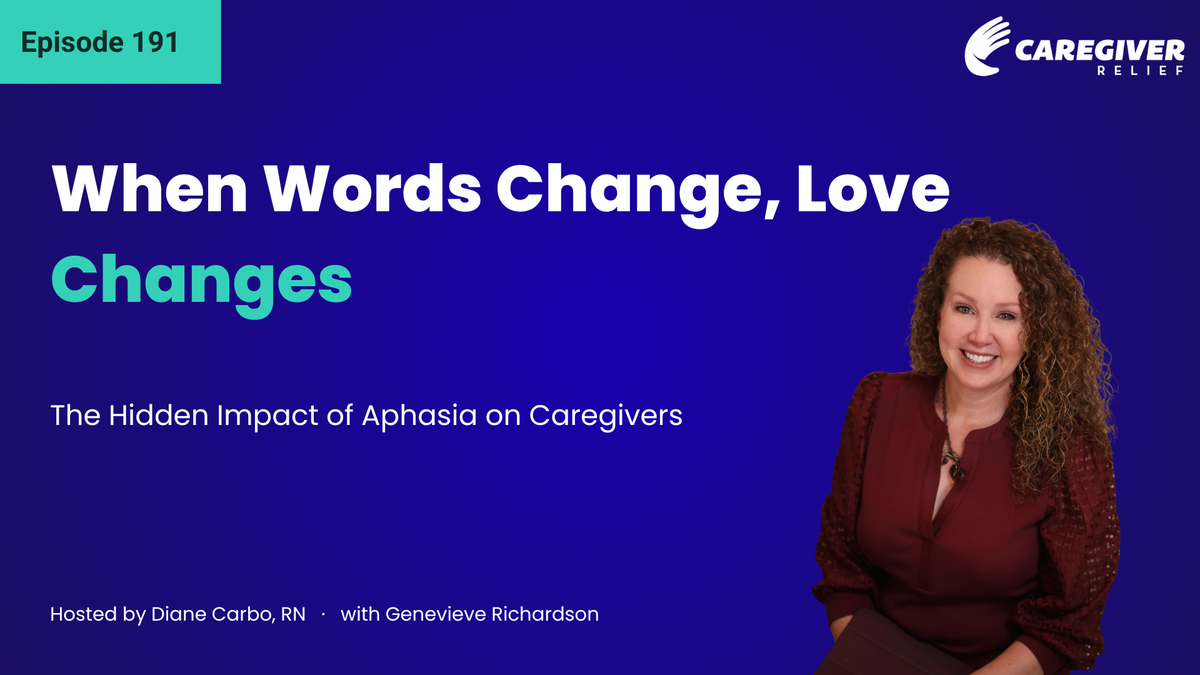
The medical system is great at treating the stroke, but who treats the marriage? In this moving episode of the Caregiver Relief Podcast, Diane Carbo sits down with Genevieve Richardson, a speech-language pathologist with over 30 years of experience, to discuss the "invisible" side of stroke recovery: the transformation of a partner into a caregiver and the silent struggle of aphasia.
🎙️ Episode Summary
When a loved one loses the ability to communicate, the relationship often shifts from a partnership to a "roommate" dynamic fueled by misunderstanding and burnout. Genevieve Richardson explains that recovery isn't just about finding words—it’s about rebuilding the connection. This episode dives deep into the signs of "Survival Mode," the distinct types of aphasia, and practical frameworks to help caregivers reclaim their lives while supporting their spouse's ongoing recovery.
📝 Key Insights
- The Shift to "Roommates": Spouses often become roommates because the caregiver picks up all roles and responsibilities while misinterpreting the survivor's intentions.
- Understanding Fluent Aphasia: The person sounds like they are making sense (normal cadence), but the words may be made up or nonsensical, and the speaker often doesn't realize there is a disconnect.
- Understanding Non-Fluent Aphasia: Characterized by a visible struggle to express thoughts; the person often understands what is said but cannot physically produce the correct sounds.
- Signs of Survival Mode: Caregivers may stop showering, experience middle-of-the-night adrenaline spikes, or feel they "barely have time to go to the bathroom."
- The "Step Away" Plan: A mindset framework to help caregivers overcome the guilt and "worst-case scenario" thinking that prevents them from taking necessary time for themselves.
- The Power of Purpose: Recovery is a lifelong journey; finding a reason to get out of bed—like gardening or music—is essential for the survivor's quality of life.
✨ Why You Should Listen
If you feel exhausted, unseen, or like you’re running on a hamster wheel of adrenaline, this episode is your permission slip to breathe. You’ll learn:
- 🚀 How to move from Survival Mode back into Partnership.
- 🧠 Why Neuroplasticity remains alive and well long after the initial stroke.
- 🤝 Small gestures, like the ASL "I Love You" sign or physical touch, that bridge the gap when words fail.
🛠️ Resources Mentioned
- The Care Partner Collective: A community providing a nine-step roadmap for aphasia care partners.
- Life Aphasia Academy: The educational hub featuring the "Care Partner Compass" digital tool.
- "How to Help": Genevieve’s book featuring scripts on how to ask for specific help from your support network.
 Life Beyond Aphasia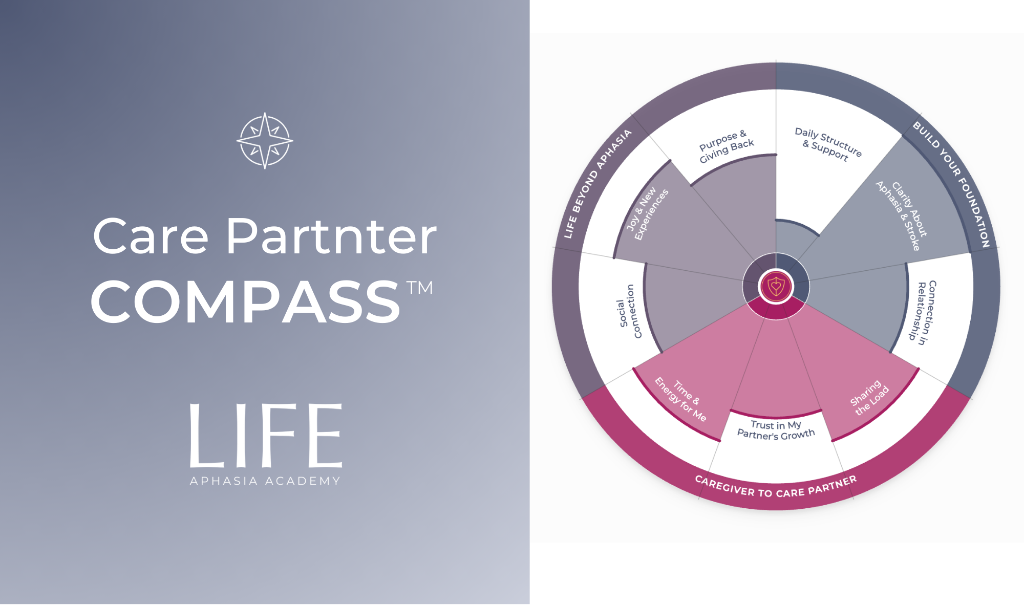
"I hate stroke and I hate aphasia, but I love you." — A powerful mantra for separating the diagnosis from the person you love.
Ready to shift out of survival mode? Press play to discover how to find your way back to connection. 🎧💬
Podcast Episode Transcript
Diane: Welcome to the Caregiver Relief Podcast. I'm Diane Carbo, rn, and today we're talking about something that does not get nearly enough attention When a stroke happens, the medical system rallies around the survivor. There's a rehab plan. Therapy goals and a discharge strategy, but the person standing next to them, the spouse who becomes a caregiver overnight, is often left to figure it out alone.
What happens when communication changes? What happens when roles shift from partner to caregiver? And what happens to the marriage? Today, I'm joined by Genevieve Richardson, a speech language pathologist, with only over 30 years of experience helping families navigate stroke and aphasia recovery. Through her work and the care partner collective, she helps couples move out of survival mode and back into partnership.
This conversation is honest, validating, and full of practical tools because recovery isn't just about regaining words, it's about rebuilding relationships.
Diane: Genevieve, I'm so excited to have you here because I work with a lot of stroke victims. I've been a nurse for 50 years and I've had family members with stroke.
I know how the impact of aphasia. But before we start, that you've been in. About 30 years in stroke and aphasia rehab. What first drew you to this work?
Genevieve: I love people's stories.
Diane: Yeah,
Genevieve: And because my mom was an RN and case manager and I basically grew up in the hospital or very much around it, she introduced me to the speech pathologist at her hospital.
I, it was, early in my university days and his specialty was laryngectomy. People who had their voice box removed, usually due to cancer. And many of these folks didn't leave the wholesomeness of lives. And that's what led to, bad habits that led to this cancer. But each one of them was turning over a new leaf and they were advocates.
They took their experience and made it into something different. So my summer. Between sophomore and junior year of university, I changed my major to speech pathology, and it was at my university, so it was seamless and perfect, and it's all about the story.
Diane: I've done rehab for many decades and I have to tell you, I think, speech and language pathologists are so unique in their personalities and they're different from the OT of pt.
And you have so much more opportunity to deal with everything from swallowing and feeding to communication. I'm. Really excited to talk to you about that. 'cause when communication changes, the marriage changes too, and the relationships with everybody changes. What does the shift typically look like?
Genevieve: The shift looks like? Wow, that's a great question. Burden, overwhelm, burnout, and an awful lot of misunderstandings if we're taking this from the perspective of a marriage, spouses that have been together, they could finish each other's sentences and now the wife is misinterpreting. What the intention is of what her husband is trying to say when he has aphasia, or maybe he has other issues going on as well, and because she doesn't understand the aphasia or how aphasia really impacts him, She misinterprets. And takes things personally and then that further damages the relationship. And then the longer this goes on, the more there is to repair.
Diane: Yes.
Genevieve: And they become roommates or not long after rehab ends, they do become roommates instead of spouses instead of partners, because she's also picked up all of his roles and responsibilities.
Because he can't do them because of aphasia. Not that he doesn't want to. It's just you need some language skills to do these things.
Diane: And it's very frustrating because, they did finish their sentence, each other's sentences. They, did things when they've been together for so long, 30, 40, 50, 60 years.
And all of a sudden, especially for the wives, it's really hard because the hu being a spousal caregiver is hard. I mean, every type of caregiver is yes. Nobody, the kids and No. And other involved extended family members expect the spouse to do it all by herself. More so than any other, and when it comes to challenge the, Patient or the loved one with the stroke, they get, they're tired, they're frustrated. Their frustration level is, will change at the drop of a hat. And they get the brunt of that anger too. The wife or husband, if his wife had it. Because there's constant frustration. You should know what I'm talking about and you don't what's wrong with you.
Genevieve: And it could be at the concept level, that's the thing about aphasia. Yes. It's not just finding the words.
Diane: Yes.
Genevieve: Sometimes it's at the formulation of a whole thought or a whole concept that is damaged and that's where. A clinician who works in this kind of chronic aphasia space, when the symptoms have somewhat, leveled out, we have to really dig deep and figure out at what level are things breaking down.
It's not just looking at listening comprehension, reading comprehension, saying your words. It could be at the thought level that it's not working, and that is deep information that spousal caregiver really needs to understand.
Diane: Yes.
Genevieve: So that she doesn't misinterpret, so she, it's just, it's so necessary to understand the fundamentals of it.
Plus, it's also necessary for her to learn how to be a caregiver, how to say no to things that pop up. Not feel guilty to manage her calendar that works for both her and her spouse that she's caring for, right? The doctor's appointment that gets rescheduled. The therapist visit that the therapist who's insisting on coming during his rest time and she knows he has to have that rest time or the rest of the day is shot, right?
Yes. Neuro fatigue is real.
Diane: Yeah it is. It's very real. What are signs that a caregiver, especially the spouse, is in survival mode, even if they don't recognize it in themselves?
Genevieve: Here's a couple of behaviors. Not showering, not washing your clothes. Thinking I barely have time to go to the bathroom, aches, pains.
Diane: Yeah,
Genevieve: That they now have, waking up in the middle of the night is a big one. Just that constant hamster wheel of their thoughts running over and over again. That is adrenaline running through the body. That just doesn't let you rest being forgetful when you don't have a memory issue, right?
You don't have those kinds of things, but if you are not sleeping, if you're not getting the rest you need, if you're not able to recharge. All of these other things go, are the obvious signs that you are indeed in burnout and in survival mode.
Diane: Before we go further, I'd like you to explain to my audience the different types of aphasia, because that even makes a difference in communication.
Genevieve: Absolutely. I think of aphasia fluent and non fluent aphasia and depends on which clinician you're gonna speak to, how they do it. But for me, in this chronic space, meaning chronic is usually six months or more after the onset when rehab is typically ended. Give or take, people may get rehab for a full year.
Who's to say, right? Every, every case is different. Fluent means they sound like they should be making sense, just like you and I are talking the normal up and down cadence, but their words may not be making any sense. Or there might be some words that do make sense and then some made up words in it.
And you are like looking at your person, I should be understanding you, but I'm not. And the person who has that fluent aphasia. Does not necessarily know they're not making sense. Often they think whatever's in their head is what is coming out. They have a disconnect between what their thoughts are and what comes out of their mouth.
So that's a fluent aphasia that typically happens, with an insult to the temporal region of the brain. If you think about where your ear is. That's the temporal region of your brain, and that's typically where affluent aphasia is. Non fluent. Aphasia is the exact opposite. These folks tend to understand.
What is wrong, what is not coming out? So they often have an apraxia, which comes with it, which is a disconnect between thinking about how to move your mouth to say a word, for example, and being able to move it. So they may know how to say cat in their head, like they could hear it, they could spell it.
They know what it is, but they can't get their mouth to put those sounds in the right order or to pronounce them. They may substitute other sounds and the word doesn't come out well. The point is they are struggling. So a non fluent aphasia is characterized often by struggle, struggle to express themselves, but their comprehension could be pretty okay.
Diane: So they understand what you're saying to them
Genevieve: For the most part. again, for the most part, yes. we're painting with a broad brush here. Yes. But
Diane: Yes.
Genevieve: But I, I think for your audience, it's important to understand fluent
Diane: Yes.
Genevieve: Sounds like you, sh they should be making sense, but they often don't know what they're saying.
The person with non fluent, they can't get it out. But they have, they tend to have a little bit better comprehension understanding of what is being said, of what's going on around them.
Diane: Good explanation. I think that was, thank you for that. I wanna ask, your thoughts on, the long term you, you're talking chronic and one of the things that seniors that have strokes and their caregivers don't realize that when you have a stroke, it's ongoing rehabilitation or working on yourself the rest of your life, in some way or fashion.
It may be continuing to make sure you walk, make sure you do your exercises to stay strong. How does that translate for people with aphasia?
Genevieve: You need to have a purpose.
Diane: Okay.
Genevieve: What is your reason for getting out of bed? Is it just to get to the couch to watch tv or is it to have your mobility so that you can travel with your spouse to go see your kids and grandkids in another state?
Just because the words don't come out or the comprehension's not perfect, doesn't mean you can't have meaning and purpose and intention and joy and a quality of life, but you do have to practice. Yes. And I find the best practice is in doing the things that you like. If you were a gardener before and if you need to learn how to garden one handed, there's probably a club for that.
And if you can't find one physically, they have 'em online. And it might sound silly doing a garden club online, but it is possible. I have a friend who was a classical guitarist. Before his stroke and his stroke was very young, he was 24.
He learned how to play his guitar one handed. That is his purpose.
That is, that was one thing that he did to get back to doing what he wanted. So the point is, you can do these things. You don't have to give up, you don't have to stop. It's about finding what is motivating and meaningful to you. And sometimes when I'm working with someone in therapy, we have to talk about these things.
Yeah. What did you enjoy before? Are you willing to try a different way? Here's some resources. Let's look up some YouTube videos. Let's find you some podcasts, or whatever it is. Inspiration. Let's find you a community. Isolation is a very real problem. With stroke and aphasia as it is with all the other diseases and conditions that are out there, but isolation when you can't communicate easily or well, many people stay away because they don't know how to cope with it.
They don't know how to help you. They don't wanna do something wrong where you're gonna feel bad or they're gonna feel bad or embarrassed because they don't know what to do. And so it's just easier to stay away.
Diane: I find that very true. I'd like you to talk about the care partner collective. What work do you do with that organization and what's its mission?
Genevieve: The mission of the Care Partner collective is to support, educate, train, provide community for aphasia care partners. This is the second arm of my business. I have my private practice where I work with the individuals and their families doing active therapy. Care Partner collective, your person does not have to work with me to be a member of the Care Partner collective.
We have a nine step roadmap. We have a weekly video training with PDF, and we have community every week, and it's very intentional. It's very purposeful. And it helps walk the care partners through these skills that they need to know things to put in place, to ease their burden, to give them structure, to give them life back, to give them a way forward so they can find their own joy, so that they can find connection, communication with their person If you're in survival mode.
It doesn't matter how much you wanna figure out how to communicate with your person, you're not gonna process those communication techniques that the speech pathologist might be. Sharing with you because you just can't do it. You just can't do one more thing and it doesn't make sense. So by helping care partners get control over their day to day, help them understand aphasia and cognition and how the environment impacts, and how do you start building that connection back, this is what we do inside of the collective.
Diane: Talk about your step away plan.
Genevieve: Ooh, this is one of my favorite things that I have created. The reason for it. Is so many care partners feel like they can't step out of the house for an hour. They can't leave their person, they can't trust somebody else. 'Cause you know the roof is gonna cave in or the house is gonna get on fire.
But when you're in survival mode, that's where your mind and your thinking go. Worst case.
Diane: Yeah.
Genevieve: So the step away plan. Again, it's about mindset and understanding. What are your underlying feelings, why you can't have some time away. Yeah. Sometimes it's the guilt that if I don't sacrifice myself, my person's not gonna get better.
Diane: Yes.
Genevieve: But the step away plan is my very specific framework for helping care partners be able to take the time. For themselves because we, if we keep talking about spouses, my spouse has things he likes to do, I have things I like to do, and then we have things we like to do together.
Diane: Yes.
Genevieve: Just because somebody's recovering from a stroke doesn't mean you're should be giving those things up.
So we help care partners learn how to do it so that they can have that time.
Diane: I was very excited to read, learn about your plan, what you offer, because the family caregiver is the invisible patient. And they're ignored all the time. And I really was excited to introduce your platform to my listeners because you actually focus on the caregiver.
And they are the ones that need the support and help as we move forward through their life. And you are providing a better quality of life to these individuals, that join your program because they. My, I always tell my listeners, change your perspective. You change your life. So if you get, and many caregivers, and I know you see this, Genevieve, they just feel like they have to do it all, that they're going to be criticized if they can't do it all.
And they also have shame about, asking because they feel like they're failing and we have to help them overcome that.
Genevieve: A hundred percent. I actually wrote a book about it, Diane.
Diane: Oh, it's called?
Genevieve: It's called How to Help, and it's a step by step how to understand who your support system is. How could first you have to understand who's in your orbit, who's immediately in your orbit.
Who's in a bigger circle of your orbit and somebody like if you think about community as being the bigger circle, if you understand who's in there and then you understand the kinds of things you could potentially use help with, then I go through scripts about how do you ask for help? Because people often don't ask 'cause they don't know who to ask, don't know what to ask for, and they don't know the words to use.
To do it.
Diane: Absolutely. I will put a link to your book on, this page that we create with your, the podcast as well. Now, could you tell me what happens in those first three days when a caregiver begins shifting out of survival mode? What kind of, observations are you seeing with, these caregivers?
Genevieve: Relief, smiling, right? Yep. This is when they can start actually answering the question, what was a win today? Or what was a win from yesterday? Because when you're in survival mode, everything's dark. That's how I think of it. And now they're like coming into the light. And they start building confidence because once they start getting control over different things or they just had the light bulb go off oh, I have misinterpreted what my husband was saying and he reacts this way because the TV is on and the dog is barking.
That so that the environment. Is what was causing this particular communication breakdown. And now she's seen it and she goes, oh my gosh, this explains so much. But yet I've been taking it personally,
Diane: Uhhuh.
Genevieve: So giving them these light bulbs, this relief, this coming into the light, so to speak, and they build their confidence and you can steadily see past those three days.
Diane is what is so powerful. Not that it's all solved in a week. It's an ongoing process when you're living with someone who has a communication impairment.
Diane: How can couples begin reconnecting emotionally when communications are limited or altered?
Genevieve: You have to start looking for little things to do for a lot of what I do with my care partners, and even when I'm in therapy, working with a survivor.
Did you hug your wife today? Did you say thank you? My number one thing I do, Diane, if they can't talk or can't talk consistently, I teach them the I love you
Diane: Uhhuh
Genevieve: Gesture. The, I love that the a SL sign and I, you would think they would know how to do this, but again, when you have a communication, you're thinking about things differently.
Diane: Yes.
Genevieve: And when you're in, when you are the survivor, you are very focused on what is happening to you and your recovery, and it's, this is just a fact of it. And you're, you might see that your wife is tired or hasn't showered in a couple of days, or her clothes are wrinkled, but it doesn't register the same way.
For that survivor, they don't perceive it. So if we can get them to just start a communication, just that I love you, sign or touch, handholding, shoulders, touching on the couch. we just need these little physical gestures and intention to start bridging that gap.
Diane: Absolutely. That's a beautiful, a way to approach, especially couples because, after so many years living together, if you're 50 or 60 or 70, sometimes you may l you know, not be as, do the public displays of affection like you used to. And, it's a chance to start over and on a different level. So I love, the touching, I encourage, I did rehab, so I always encourage people to make sure you touch your loved one. Tell 'em, share your day with them even if they, you don't think they're understanding.
Just do things that hopefully will connect with them.
Genevieve: That's right. Narration. By the non phasic person is really important. Include them. You can still speak simply. You can write down key words that you're saying.
Diane:Yeah.
Genevieve: And include them in the day. And this also translates to other conditions like dementia.
Diane: Yes.
Genevieve: We think they're not gonna remember. So why bother? It's about the connection. It's about that relationship.
Diane: Yes.
Genevieve: That we have to focus on. And try not to take things personally. That's why you have to understand your condition or the disease process that you're working with.
Diane: I think, activities are one of the most, overlooked types of, things that you would do with a loved one that people, the caregivers often think, oh, it takes too much time. I don't have time to play. But they don't understand that, doing an activity of some sort, even if it's just, sitting there and holding hands or listening to favorite music. You have to create those connections with each other and you have to start somewhere.
Genevieve: You do, one of the steps in the collective. It's step four. It's about starting these routines again. Ah, maybe your husband is in a wheelchair. And he could help you put away the dishes. he may not be able to stand up and put the plates in the upper cabinet. Why not move him to a lower cabinet where he could feasibly help unload the dishwasher, put the silverware away?
This, but all of this takes. Time to think of, a little bit of planning, a little execution, but if you're in survival mode, you are not thinking on this. You are just trying to get to the end of the day when your head can hit that pillow.
Diane: Yes. And when you encourage your loved one to take part in activities that will seem to help you, like loading the dishwasher, unloading the dishwasher, putting groceries away, you also improve the wellbeing of the your stroke victim, and that makes them feel like they're part of a team again.
Yes, it takes patience and yes, it takes time, but it's valuable. the results are valuable and worth taking that time out because it'll improve your quality of life over time.
Genevieve: One of the most important things. I knew it was powerful, but not until, nine months later these, my founding members in the collective they keep coming back to again and again is frameworks.
What's a framework? it's just another way to think about how do you structure your day. And the beauty of it. You don't have to just have one framework. You can have a morning framework, you can have a breakfast framework, you can have a meal planning framework, but the idea behind it is we're taking something that sometimes feels abstract.
Yes. Like meal planning, and we're making it concrete and structured and repeatable because we need to lower the cognitive load on that care partner.
Diane: Yes,
Genevieve: If she knows that Sunday night is sitting down at dinner time, looking at the calendar with her spouse, looking at the week ahead, seeing what nights they're out, what nights could they order in?
What nights could Betty the neighbor, two blocks over who wants to bring dinner, maybe Wednesday night would be a great night for Betty to bring that casserole. She's been promising.
Diane: Yeah.
Genevieve: Or
Diane: Absolutely.
Genevieve: let's, we don't have anything on the calendar tomorrow, so let's, you hang out with me in the kitchen and we're gonna do some meal prepping and freeze it away.
Diane: Yeah. Smart stuff.
Genevieve: So it's about breaking down. So I get all of this because I have the opportunity to talk to people all day. I talk to people all day long.
Diane: Yes.
Genevieve: And when I really started digging into. A care partner's day and all that they hold up and what keeps them up at night and what worries them and what needs to happen to fix.
If we have this kind of a problem, how do we break that down into pieces? This is how I think because this is what we have to do with communication, and so that's how the collective was born. That's how our nine step roadmap was born. Breaking it all down into pieces, getting at that mindset, getting at the underlying things that worry care partners and helping them get control.
Diane: That's beautiful. For the caregivers listening right now who feels exhausted and unseen, what is one small step they can take today?
Genevieve: They need to connect with their person.
Diane: Make the effort.
Genevieve: I think you start with touch. I think you start by saying, I appreciate you. You might also have to say, I hate stroke and I hate aphasia, but I love you.
Diane: Yep.
Genevieve: Where you can separate the diagnosis from the person.
Diane: Yes,
Genevieve: Mom, you have bad Alzheimer's, but I love you.
Diane: Yeah.
Genevieve: I may not like your behaviors, but you don't have to say that, but you get what I mean, Diane?
Diane: Yeah.
Genevieve: Oh, I do. I think it's that connection and really trying to make an effort for small touch. Maybe you're not a public display of affection person. Doesn't matter. A hand on the shoulder, a little squeeze, elbows touching on the couch at night.
Diane: Yeah.
Genevieve: Let's start there with connection.
Diane: Exactly. Now. Genevieve, tell me how my listeners can get ahold of you, find you and find your book and your program.
Genevieve: Okay, so Care Partners, you could start with Life aphasia academy.co. That's our website. That's our educational arm of the business. That's where we have the membership.
It's where we have what's called our care partner Compass. It is a digital tool that I created and it goes through nine questions. That helps a care partner start quantifying these different areas, how well they're communicating, how well do they believe their person can recover. We even talk about grief in there.
So the Care Partner Compass is an excellent first tool just to see where you're strong and where you could use some help. Care partner collective. Is in that same website. We will be opening doors to that at the end of April. We will be running a bootcamp right before that at the end of April that walks people through it's one hour a day for three hours, helping them start building that support network.
Start doing, start figuring out where you could use help. We start by doing a huge brain dump, and I systematically walk them through that over three nights and we do it late at night, later at night. So that they can. Start getting some control. That's where the step away plan was born. Because I need people to come into this training if they want to change how they are connecting and relating with their person.
They need to know how to step away so they can come to this training so they can build their support network and get to a life of rebuilding. Because you don't have to settle for where you are now. It can improve. I've seen it improve. Neuroplasticity in the survivor is alive and well. We have to use it, but we gotta get you all outta survival mode first.
Diane: Beautifully said. Thank you again for your time and sharing that knowledge. To my family caregivers out there, you are the most important part of the caregiving equation. Without you, it all falls apart, so please learn to be gentle with yourself, practice self-care every day because you are worth it.
Caring for a loved one can be overwhelming — but you're not alone. If you have questions, big or small, our expert team is here to help.
👉 Click here to Ask the Expert
Our Resource section can help you find the information and tools that you need. We have courses, videos, checklists, guidebooks, cheat sheets, how-to guides and more.
You can get started by clicking on the link below. We know that taking care of a loved one is hard work, but with our help you can get the support that you need.
Click here to go to Resource Section now!