Independence Restored: Meet Niko – Self-Transfer Robot with Aleksandr Malashchenko - Episode 192
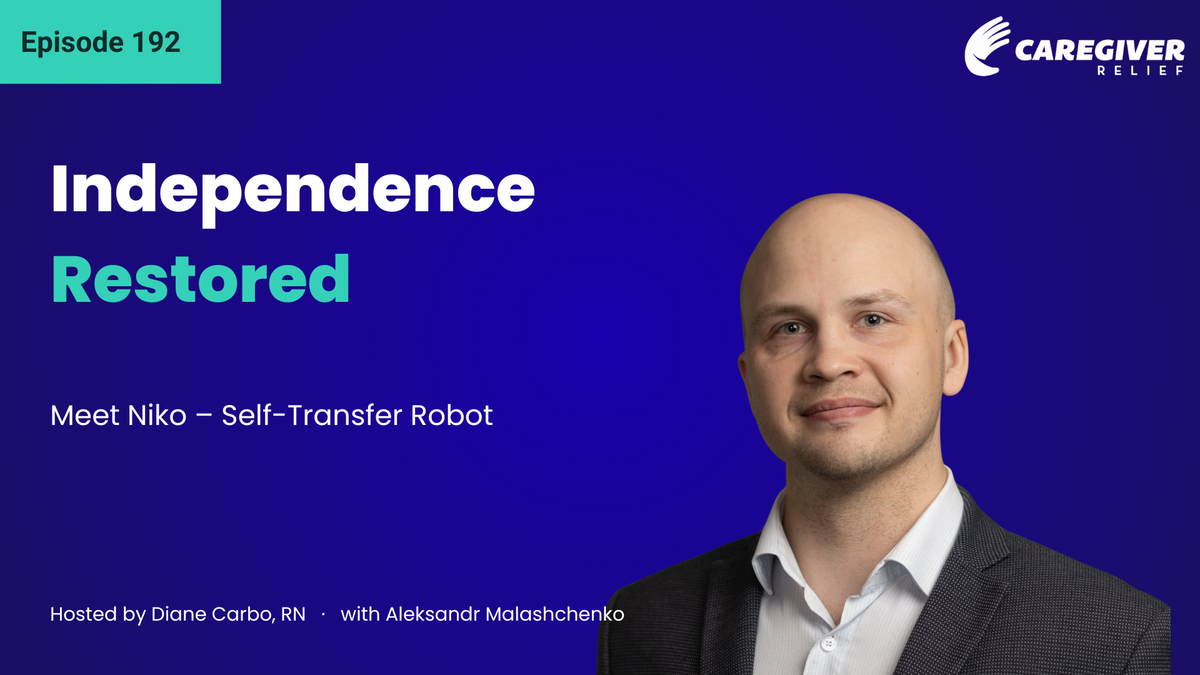
Imagine a world where you don’t have to wait for help to get out of bed, go to the bathroom, or reach for a favorite snack in the kitchen. In this episode of Caregiver Relief, Diane Carbo, RN, sits down with Aleksandr Malashchenko, the brilliant mind behind ReviMo, to discuss a groundbreaking innovation that is changing the lives of seniors and those with limited mobility: Niko.
Inspired by his own experience as a caregiver for his grandfather, Aleks created a device that prioritizes dignity, safety, and independence.
🎙️ In This Episode, You’ll Discover:
- What is Niko? Learn about this "new class of technology" that uses a unique scooping seat system and wireless remote control to move users without the need for belts or slings.
- Dignity in Toileting: How Niko's specialized "toileting mode" creates a gap in the seat to allow for private, independent bathroom use.
- Advanced Safety Features: From rear-view cameras to emergency buttons that can call 911, find out how Niko ensures the user is always protected.
- The Power of Standing: The mental and physical benefits of Niko’s ability to elevate users to standing height to talk face-to-face or reach high shelves.
- Support for Caregivers: How this technology eliminates the physical strain of manual transfers, preventing burnout and back injuries.
📋 Episode Highlights
- The Inspiration: Aleks shares the moving story of his grandfather’s stroke and the "embarrassment" of losing independence.
- How It Works: A deep dive into the ReviMote control and the mechanics of the scooping seat that slides right under the user.
- Portability: Niko is designed to be disassembled and can even be taken on planes or in a car trunk.
- Versatility: The device is compatible with 80-90% of existing wheelchairs, as well as recliners and shower benches.
- The Future of ReviMo: An update on FDA clearance and the hundreds of people currently on the waitlist for production.
💡 Why You Should Listen
If you are a caregiver feeling the physical toll of transfers, or a senior who is "fiercely independent," this conversation is for you. Diane and Aleks discuss how technology can bridge the gap between needing help and maintaining your autonomy.
"Some people were crying because they were able to get out of bed independently for the first time in their life... it really motivates us to keep moving." — Aleksandr Malashchenko
🔗 Connect with ReviMo
Ready to learn more or join the waitlist?
- Website: www.revimo.care
- Instagram: @revimo.mobility
- Facebook: ReviMo.Niko
- LinkedIn: ReviMo
Don't miss this episode! Click the player above to listen now and see how the future of mobility is being built today. 🎧✨
Podcast Episode Transcript
Diane: Welcome to Caregiver Relief, the podcast dedicated to easing the challenges of caregiving and helping our loved ones live with more dignity and freedom.
I'm your host, Diane Carbo, rn. I have lots of experience supporting families through tough caregiving issues, and today we're diving into a truly transformative innovation. My guest is Aleksandr Malashchenko. Known as Aleks They call him Aleks. He's a PhD in mechanical engineering. He's a former aerospace, r and d leader, and a passionate founder of ReviMo.
After witnessing the exhaustion and embarrassment his grandfather faced after a stroke, Aleks created Niko. A smart robotic mobility device that lets people transfer themselves safely. No waiting for help. No heavy lifting, no loss of privacy. In this episode, we'll explore how Niko Restores independence, supports safe toileting with.
Dignity, reduces caregiver strain and opens up new possibilities for rehabilitation in daily life. So if you're a caregiver, feeling overwhelmed or a senior just wanting your independence and autonomy, this conversation. Could change everything.
Diane: Let's get started. Aleks, thank you. As I've told you before, I'm really excited about your Niko.
Because people are always asking me is there anything out there that I can use to transfer myself out of bed? take me to the bathroom and do other activities without having a person around because. Seriously, we have a shortage of caregivers, professional and family caregivers are way over work.
So thank you so much for sharing this information with us today.
Aleksandr: Yeah. Thank you for having me, Diane. It's a great pleasure meeting with you and, telling about our story. Yeah, thank you for highlighting my personal experience with the problem. I was a caregiver for my grandfather who was paralyzed after a stroke, and it was always embarrassing for him to ask for help every time he needed to get out of bed and go to the bathroom, and he always wanted to get back his dignity, but there was no solution.
Basically, and I was his caregiver. I helped him with transferring toilet and showering, get everything manually, so felt this pain in my back. So yeah, I can definitely relate to the problem that many people are experiencing right now.
Diane: Well, you know, Aleks, what I love about my podcast is I am interviewing people that were caregivers that saw us, a problem or an obstacle, and they provided a solution to overcome it.
So I really appreciate that you took the, in innovation and, really cared enough about your grandfather, to create this. now exactly what is Niko exactly and how does. It's scooping seat and ReviMote control work to enable self transfers from bed, wheelchair, recliner, or even to the toilet.
Aleksandr: Yep. So Niko is, the new class of technology.
I bet many people haven't seen anything like that before. So it can slightly remind you a wheelchair, but it's not a wheelchair. It is something that has. Wireless ReviMote control. So a person who cannot get out of bed can easily retrieve Niko from a distance. And then, Niko has a special scooping seat system that can easily slide underneath and scoop a person up from a bed or a chair without any belts or slings.
It's very easy and it can be done just by pressing a couple of buttons. With minimal physical effort. And then Niko can lift the person up from a bed or a chair and they can use it as a powered wheelchair primarily. So they use a joystick to move around and they can transfer to the bathroom or kitchen or living room.
So Niko has. The free space under the seat, so a person can easily put themselves on the toilet or transfer to recliner chair a wheelchair, so it's compatible with almost any seated to seated transfers.
Diane: I just want my listeners to know that we will put videos on this page. We create a permanent page at the end with every podcast, that will have the videos of this 'cause.
I am loving Niko. I really am. Many seniors and caregivers, everybody dreads the loss of privacy and toileting is a big issue. and I, how does Niko make independent, dignified toileting possible and safe? I thought that was the number one reason why people would want it.
Aleksandr: So yeah, is this is definitely the most critical part when.
People lose a lot of dignity when they need to ask for assistance every time that they want to go to the bathroom, do their toilet genome routine. and here. So we have done a lot of work to simplify this process. First, we made the transfer possible without any belts or slings, which are hard to operate by people with limited mobility, people who have muscular weakness or low hand dexterity.
So we don't have anything like that in our device. We have our scooping mechanism that can lift the person just by pressing a button. And then we have a special toilet in mode. So when a person has been transferred to a toilet. They can press the button and the seat of the device can partially open, creating the gap in between providing access, to the toilet basically.
And it's, quite easy to take off pants with Niko. There are multiple ways of doing that. Some people can do it from a seated position, from some people can use our extendable handlebar to pull themselves up and take off. Depends,or some people will even use the device already without pants.
So if it's comfortable for them to do Yeah.
Diane: I have a question, about advanced safety features like the rear view camera sensors and alarm button. I think this can give users and families confidence, to try self transfer. Can you talk about those features?
Aleksandr: Yeah, sure. we worked a lot to ensure safety of, of the device users.
We added multiple sensors that prevent the device from, hitting a user by accident if they use it in their own way. So we also added, the backup camera so a person can see what's behind to easily transfer to the toilet or some chairs, and it's very convenient. People who use it really appreciate the camera and.
We also added an emergency button, basically, which is, autonomous. it has a separate battery source, and by pressing this button, a device user can notify a caregiver. So it'll call a caregiver or send a text message. And if a caregiver is not responding, it'll call 9 1 1. So just if things, go wrong, so a person can be confident that they will receive support if necessary.
Diane: I actually have a client, who has MS that is absolutely excited about Niko. I wanna ask you, how portable is Niko?
Aleksandr: Yeah, Niko is quite portable. I travel a lot with it. I take it on a plane. so transport it in a car. So the total weight of the device is approximately like 140 pounds or so, and it's, it can be partially disassembled.
There are. Quick release parts that can be taken off. And then the device, can be transported in two cases on a plane. So I generally transport it in two cases or it can be transported in just regular car. There are also some like compact retractable ramps that can be used to just drive Niko into the car trunk.
Which is also quite a convenient option to travel with it. And there are separate, like lifting platform similar to those, that are used for scooters and wheelchairs. So you can just drive Niko onto this platform, lift it above the road, drive, and then just put it back and use it as a transfer device.
So multiple ways,to improve the travel ability with Niko. but yeah, overall I think this is one of the benefits that Niko is a fully portable solution and can be taken anywhere where you go. So yeah,
Diane: That's amazing. Now, Niko elevates users to a standing level, and I found that really important.
Can you explain the benefits this offers for rehabilitation, being able to reach high shelves or just feeling more, like yourself to be able to do things without asking for help.
Aleksandr: Yeah, there are so many benefits of the standing mobility. So Niko can do it in two ways. A person can go up to a standing level in a seated position, basically, so it doesn't require the ability to bear weight on the legs.
and it gives people an opportunity. To talk to other people face to face on the same level, which is mentally important, or reach the objects on the standing level, like higher shelf of the kitchen cabinet or similar applications and people who still have some ability to stand, they can use, the retractable handle bar, that Niko has to pull themselves up and fully stand up again to do some.
Activities of daily living or just for rehabilitation? For practice standing. So there are a lot of benefits of standing improved blood circulation, bone density, and multiple others from the health standpoint.
Diane: I love this one of the biggest things, a lot of women, Miss when they end up in a wheelchair is their ability to cook or bake.
Those are things that they do for love, especially the older, like my generation, there were a lot of us that we grew up, making homemade everything and they seem to feel a loss of that. When I saw the, video with Niko helping somebody reach something in the cabinet, I thought, oh my gosh, you could still cook and bake if you wanted.
And, it would be so much easier and you'd be able to rest in between if you needed to do that. So I really,I thought that was a real plus. now compatibility is huge. Does Niko work seamlessly with. Wheelchairs, recliners, shower benches, or everyday furniture.
Aleksandr: Yeah, we have done a lot of work to make it compatible with most of the wheelchairs and recliners.
So we went through four generations of, working prototypes of Niko early on. So we started, from, we built our first prototype at Cornell University. I completed an accelerator program there. we tested it, understood overall the core idea with this scooping sitting system can work, but it was very far from what we have now.
Then we built the second version. Tested it again, improved it. Then the third one, the fourth one, until we got to our current pre-production version. and one of the, feedback portions we received from, our test users was, we don't want to only transfer from bed to bathroom, we also want to transfer to wheelchairs, recliner.
Transfer to vehicles. so a, we want to do like a lot of things with Niko, and we put a lot of thinking to make it compatible with multiple wheelchairs. There are so many different types of wheelchairs. Yeah. All of them have different geometry, different sizes. And now I can say that Niko is compatible with 80, 90% of wheelchairs and most of the recliners, shower benches, and, yeah.
Diane: Now from your engineering background, what makes Niko different from traditional lifts like hoer or ceiling systems in terms of ease, effort, and user control?
Aleksandr: So yeah, with the hoer lift, the main issue with that, in my opinion, that you need to use all this belts and slings to. Lift a person. It requires physical effort from a caregiver to move the person back and forth to set up all these belts and slings.
Then you need to lift them to safely operate the whole lift. You need two people. so overall the process takes a lot of time. Physical effort. With Niko, we, our first goal was, is to make it, Make it, possible for a person to transfer fully independently. And that's why moving forward with Belt Source links was not an option because no way a person with, limited mobility can do that.
So we designed this scooping sitting system and added the wireless ReviMote control, which made it possible for people to. Transfer basically independently and for caregivers. Basically. We also see a good application for Niko to be used by caregivers for, people who have like mental issues or like vision impairments or some other health conditions that can prevent them from using Niko independently in this case.
And can, it can be operated by a caregiver and it's much lower. Physical effort and time spending for a caregiver. transferring with Niko compared to the who lift A caregiver can do it just by pressing several buttons, so yeah.
Diane: I've used Hoyer lifts for decades. I worked with quadriplegics paras, stroke victims, and I can tell you that the Hoyer lift, in fact, it's very challenging to use.
It was the only solution we had, and it takes staff, but it also takes up a lot of space. you have to make sure that the legs are a certain space of. Part and then put and fit into the bed. And it's very challenging. And, and a lot of patients, I can tell you honestly, are afraid because they're afraid that it's gonna break or they're gonna drop and it's, it is, it's an issue for many.
Refuse the Hoyer because they don't want, that un, that feeling of hanging there and not knowing if it's going to drop or not. so I really appreciate your thoughtfulness when you're putting this product together. How has feedback from early users or beta tester surprised you? Any stories of regained independence?
Aleksandr: Yeah, so we, we have multiple great stories. Some people were crying because they were able to get out of bed independently for the first time in their life, or just for the first time in a very long, time. and it was like very exciting to see that we really made something that can help people can really change their lives.
Of some people. yeah, we received a ton of feedback on our first iterations. people were telling us what, how we should choose the ergonomics, the user interface,so the Manu ability, the size and some, so many, contradicting requirements, the, that we faced. However, I believe that we were able to find the pretty good, Combination of features, so I think we can meet like 90, 95% of requirements that our first test users asked us to implement.
Diane: I'm just amazed by Niko and I know that so many of my listeners are seniors that are fiercely independent and it's hard. I know. 'cause I'm one of them. It's hard for us to ask for help for anything.
It's, I've been that way my whole life. If I can do it myself, I wanna do it. And, this takes away so much. Power, over, how do I wanna put this? it is hard to ask for help and it's gives us an extra challenge in, overcoming an obstacle. Asking for help is personal growth. it is.
We all have to need help at some time in our life, but you can delay it for me.
Aleksandr: Yeah.
Diane: Yeah. And I like that. And be independent. I really like that. Now, what conditions or situations is Niko best suited for?
Aleksandr: Yeah, so we have so many, we have users starting at 12 years old to over 75, 80 years old.
Diane: Wow.
Aleksandr: So it's not only for senior adults, we have people with, Stroke, muscular dystrophy, Ms ILS, cerebral palsy, spinal cord injuries. I would say probably over 20 different medical conditions. Yeah. yeah, the common thing is people, so for people who use it independently, they still have some ability to maintain a seated position, on their own.
and they have like mental. Capabilities to use the device and some minimal hand dexterity to operate a joystick or assisted use. The requirements are even lower, so yeah.
Diane: Now caregivers often worry about injury from repeated transfers. I know as a nurse, my body is ruined 'cause we used to do fireman lifts and transfer people physically and my body is. My whole spine is broken and I always worry about the caregivers 'cause they don't realize that how much of a toll it takes, the pushing and pulling on their neck and their lower back, can cause them severe pain over time. with repeated transfers. What impact could Niko have on reducing physical and emotional burnout?
Aleksandr: Oh, we think it should be pretty significant. Whereas with Niko, a caregiver basically doesn't need to do like anything physical. only the only things that they have to do is just press several buttons and operate in the joy. To transfer an individual. so there is one part when a person needs to be brought from a line down to a seated position.
However, there, there are already existing beds that can bring a person to a seated position and turn them 90 degrees, basically creating a chair from a bed. And I personally tested Niko with this bed and it works perfectly. So basically the combination. Of this bad and Niko basically eliminates, the physical effort for a caregiver, even for quite frail individuals who don't have the capability to sit up independently.
Diane: Yeah. Looking ahead, what's next for ReviMo and Niko?
Aleksandr: yeah, we are very actively working on the launch, of the serial production of Niko and com, the completion of the FDA clearance. So these are major milestones for us that we need to accomplish before we can deliver Niko to our waiting customers.
So we already have hundreds of people on our wait list who are waiting. and every day basically I receive messages and emails from people. So how can I get it right now? So I really need it. So I don't have a caregiver. Tired of sitting in wet pants, like for multiple hours during the day. so people tell us very personal stories and Yes.
Yeah. And that it really motivates us to keep moving as fast as we can, just to bring it, to people, as fast as possible.
Diane: it's truly more cost effective too than the ceiling ones, 'cause I have had several clients ask about those. And when you look at the cost and the, what it does to the property, your, your home, it's not cost effective too.
Make that change, whereas, Niko seems to be just the right solution at the right time for this silver tsunami that's coming away. Aleks?
Aleksandr: Yeah.
Diane: Aleks, how do people find you and how do they find Niko?
Aleksandr: I think, the best ways are visiting our website, www rev mo.care. It's R-E-V-I-M o.care, or visiting our social media.
We have our Instagram page, rev mo dot Mobility, and our Facebook page. ReviMo.Niko.
Diane: For my listeners out there, I will have all this on the page so that you'll be able to find Niko and Aleks ReviMo, wherever you are, to my family caregivers out there, you are the most important part of the caregiving equation.
Without you, it all falls apart. So please learn to be gentle with yourself. Practice self-care every day, and that may mean getting a Niko for loved one, because you are worth it.
Caring for a loved one can be overwhelming — but you're not alone. If you have questions, big or small, our expert team is here to help.
👉 Click here to Ask the Expert
Our Resource section can help you find the information and tools that you need. We have courses, videos, checklists, guidebooks, cheat sheets, how-to guides and more.
You can get started by clicking on the link below. We know that taking care of a loved one is hard work, but with our help you can get the support that you need.
Click here to go to Resource Section now!