ER Care Without the ER: How High-Acuity Home Care Is Changing Caregiving with Lon Hecht - Episode 193
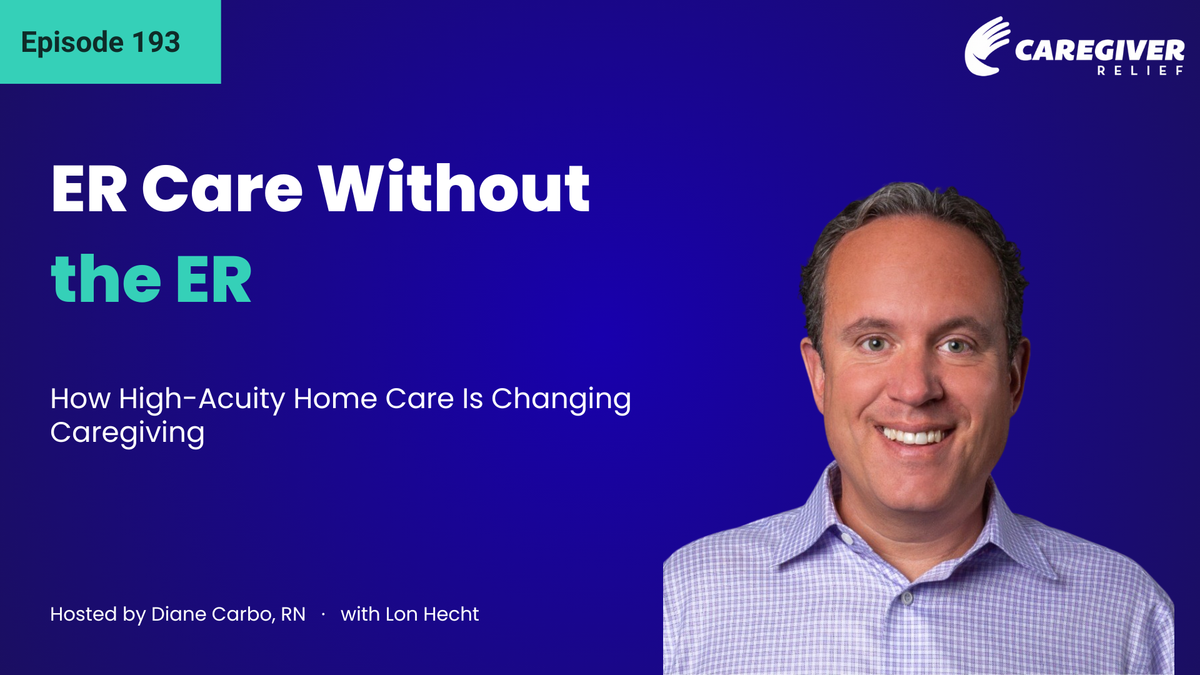
Is the ER always the best place for a medical crisis? For many seniors and their caregivers, a trip to the emergency room means long waits, fragmented communication, and a "black hole" experience that can lead to further decline. But there is a shift happening in healthcare—one that brings the hospital level of care directly to your living room.
In this episode of the Caregiver Relief Podcast, host Diane Carbo, RN, sits down with Lon Hecht, CEO of Care2U, to discuss how high-acuity home care is reimagining where healing happens.
🕒 What’s in This Episode?
- The Inspiration: Lon shares his personal journey as a caregiver for his mother and his 30-year career in healthcare that led him to tackle the high cost and low coordination of traditional ER visits.
- The "Black Hole" Effect: Why traditional ERs often fail seniors and how home-based care flips the model by spending 70+ minutes with patients instead of just minutes.
- The Cost Factor: Discover how high-acuity home care can be 1/3 to 1/6 of the cost of a hospital visit while being covered by many insurance plans.
- How It Works: A look at the "dispatch" model—getting a clinician to your door within 2 to 4 hours and using telehealth to bring a physician into the home simultaneously.
- Supporting, Not Replacing: How this model works alongside your primary care doctor to ensure better long-term outcomes.
📋 What Can Be Treated at Home?
You might be surprised at the level of care available without stepping foot in a hospital:
- Respiratory Issues: COPD and Pneumonia exacerbations.
- Cardiac Support: Congestive Heart Failure (CHF) management.
- Infections: Complicated UTIs and dehydration.
- Procedures: IV antibiotics, lab work, EKGs, and even minor surgical wound closures.
💡 Key Takeaways for Caregivers
- 🏠 Comfort is Medicine: Healing at home avoids "hospital delirium" and exposure to secondary infections like MRSA or C. diff.
- 📞 Ask the Right Questions: Even if Care2U isn't in your market yet, Lon advises searching for "mobile urgent care" or "high-acuity home care" in your area to find alternatives to the ER.
- 🧘 Slow Down to Speed Up: Lon’s #1 piece of advice for overwhelmed caregivers is to breathe and realize that not every decision has to be made in a state of high-stress emotion.
🎧 Listen Now
Ready to change how you handle the next medical crisis? Click the player above to hear the full conversation and learn how to bring the ER to you.
"Decisions made with emotions are always going to be poor decisions. Sometimes you have to slow down to speed up." — Lon Hecht


Podcast Episode Transcript
Diane: Welcome to the Caregiver Relief Podcast. I'm your host, Diane Carbo, rn. Today we're talking about something every caregiver knows all too well, the stress, confusion, and exhaustion that comes with an unexpected trip to the emergency room, long waits, fragmented communication, and often a decline in the very person you're trying to help.
But what if there was another way? What if high level emergency type care could come directly into the home, reducing hospital visits, improving outcomes, and giving caregivers real support when it matters most. Joining me today is Lon Hecht, CEO of Care2U, a company that is reimagining where healing happens by delivering ER level and hospital level care right into the home.
With decades of experience across health systems, managed care and home-based services, Lon is leading a shift towards more coordinated patient-centered care, especially for seniors and those with complex medical needs. Today we're going to explore what this means for you as a caregiver when this type of care is appropriate, and how it may completely change how we think about emergencies.
Diane: Lon
Thank you so much for, joining me today and sharing this information. I've been hearing about this for years now, and I am curious as to how it's going to, pan out for the listeners out there. Before we dive in though, what inspired you to, personally to focus on bringing high acuity care into the home, and what problems are you trying to solve?
Lon: First of all, thank you so much for having me on the show. I really appreciate it. Definitely love listening to your podcast. what inspired me, I would actually say a couple of things. Personal problem and need, I think was a big part of that. First thing I'll say is obviously there's a shift towards more care in the home, which I think is right.
But I can tell you one, I'm a caregiver, to my elderly mother, and I feel like care, like this is so sorely needed. But another thing is I've been in the industry. I keep saying for north of 25 years, but if I'm being honest, it's more like 30 years. It's getting there. And most recently I spent before being CEO of Care2U I spent about five years in the post-acute care and then I, my company got acquired by Optum, so I was in the home and community care space.
And we had a need. We were going to health plans and we were taking on their whole book of business and managing that care for them and the costs. And one thing that was just so apparent was that these health plans are really good. At risk adjustment on patients and focusing on star ratings and things that your listeners probably wouldn't even know about or care very much about.
But the thing that always got me was it wasn't great about managing and improving care in the home necessarily, and reducing cost and I think, one, you want to elevate care until you wanna reduce cost. So for me. When I found out about this company and what they were doing, it just hit such a need for me, one, in being able to drive more care home.
I've been focused on seniors for so long and this works for everyone, seniors is a big focus. But I think the other thing is actually being able to manage cost, I think is so important as well. And the second you bring care outside of the hospital, Costco, down drastically. so those were a couple of things that were near and dear to me.
Diane: I'm laughing because I've been a nurse for 54 years and I've worked on both sides of the fence, the insurance company side and the healthcare side, hands on. And I've provided care in the home to some really, Complex medical needs. but that was decades ago. They stopped doing that when, they had these long-term care hospitals that did acute care.
Not in a nursing home, but they were called subacute care. Yeah. And so that stopped coming into the home. So I'm really interested in How this works. Now, caregivers often feel like the ER is the only option in a crisis. what are the biggest challenges with traditional emergency care for seniors?
Lon: I think the first challenge is just what you said. People think the ER is the place you have to be for everything, right? So one is just getting past that. But I think the challenges for ER care for seniors, one is getting the senior to the er, not an easy task, right? So that's one thing. Two long waits, right?
You're there. we could argue all day about how long wait times are. Yeah. But I don't think most people would argue at least four hours. Typically. Yeah. Maybe six could be longer depending upon where you are. and then you're surrounded by a bunch of sick people, which is not where you want to be when you're probably somebody that's somewhat imi immunocompromised anyway.
So it's how do we avoid that? And one thing I'll say is yes, we bring the ER level care to the home. But believe it or not, if you need ongoing care in the home for that episode of care, we can actually, in essence, hospitalize you in the home. Now, it's not, we're not a hospital, right? So hospitalizing is probably the wrong way to put it, but we can admit you for an episode, whether it's a day, three days, five days, seven days in the home, to be able to manage that care.
So we can pretty much do what you would do for an ER visit or a hospitalization. It's not for everything though. I just wanna be super clear about that. If you're having a true life-threatening emergency, facial, droop heart attack, traumatic head injury, and blood thinners, things like that, there is a place for the hospital absolutely for things like that.
But there are so many things that could be managed in the home, and I can hit a couple of them if you'd like me to now, or we can talk about that later.
Diane: Yeah, I'd like to, I, you described the ER as a black hole experience. Can you elaborate on what that means for both patients and caregivers?
Lon: Yeah, so I think, you go to the er, you spend an awful lot of time there, and you probably spend a couple of minutes with a provider. A, a, a clin, a clinician that's actually going to treat you. and then getting that care coordinated back to your doctor is incredibly difficult.
The caregiver getting their questions answered, the patient getting their questions is, it's very difficult. Yeah. So I, we really flip this model on its head. So what happens is when a patient or a caregiver, or a doctor or a home health agency or whoever is referring to us. Calls us, we dispatch a clinician in the home within two to four hours, and then they work the patient up in the home and then they bring a physician on via concurrent telehealth.
So you actually have two providers in that visit to work on that care plan in tandem. you're probably spending upwards of 70 to 75 minutes with a clinician. That's a big difference than you get in the hospital. Right. Or in the er. Yeah. So you're getting a lot of time with that person. And then we wrap around all this care coordination around it, and you have access to our service for like 30 days after this episode to really be able to get your questions answered and for us to help you get into different types of programs and all kinds of things that you would typically need.
But I think what's even more important is. We're coordinating that care back to your primary care doctor or to the specialist or both for you. So when we get that referral in, we're asking who your providers are and then we work with the provider to understand how they want to be communicated with.
Some doctors want to hear from us after every visit, we pick up the phone and call them. Right, and some want us to just send notes back, but the reason I say the ER is a black hole. You go in there, you get this care, you wait, you know,you wait. It's very fast. And then you don't know what's happening.
And honestly, your doctor probably doesn't really know what's going on or hear much about that. So your provider may have no idea that you've been to the ER 3, 4, 5, 6, 7 times over the last several months and then can't really get on top of that care and be proactive in their treatment. So we really try to manage that for you and try and change that.
Diane: Communication is always an issue with anybody that goes into the emergency room or hospital. it's very frustrating because, you're right, the primary care physician has no clue. Or the specialist, even in, that the patient sees may not be associated with that hospital. They don't get, the information and, meds are changed and there's no discussion.
So I really like. what I'm hearing here with the approach, 'cause it can really make a big difference. Yeah. In the er you can just go in and they'll, they'll just see what meds you're on. They may change them or they may just add more on and nobody knows, what the. The right hand doesn't know what the left hand's doing when it comes to the long term, goal of the patient.
And, so I'm really liking this, hearing about what you're telling me. what kind of medic,
Lon: Oh, go ahead.
Diane: Go ahead. No, go ahead. Oh,
Lon: No. So I was gonna say, it's funny, my wife is, is a former hospice and current palliative care nurse. And it's funny, I just, I hear her all the time when I walk downstairs for a few minutes 'cause she works remotely and it's, they have patients that come outta the ER all the time with their meds changed and no one has any idea.
None the wiser what, and that just, it's so challenging to be able to manage a patient like that.
Diane: Oh.
Lon: One. One thing that I should mention, because your audience is probably thinking this, because this sounds so concierge in what we're doing, they probably think this costs a lot of money. It actually doesn't.
It's a whole lot less expensive than hospital-based care. And what I've done is, I have worked with a lot of the health insurance companies, so a lot of them are just reimbursing for the service at a specialist copay, which is great. and really if you look at a typical Medicare admission in a hospital or an ER visit, we're about a third of the cost of that.
Wow and if you're looking at commercial insurance, which is what I have, because I'm not Medicare age, we're actually like about a sixth of the cost of what it would cost for the er, for the hospital. So it's a big differentiator there. So we've really tried to make this affordable. So now you're getting care where you want it, you're getting it timely, and it actually is saving the system money, which I think is, a big win.
Diane: What a concept.
Lon: Yeah, yeah, exactly.
Diane: Saving money and providing quality care. now what kinds of medical situations can actually be treated safely at home instead of going to the er?
Lon: Right. We'll say, I'll say common things that we treat. CHF, congestive heart failure exacerbation, COPD exacerbations.
Pneumonia, obviously. Cold, flu, dehydration, complicated UTIs, DBTs, I mean, the list goes on and on of things that we do. We do minor surgical procedures in the home, so like closing lacerations, wound care, all of that and capabilities we send in. I think that's equally important. Of course, we can do infusion and IVs and we have a full, formulary of meds with us.
We're doing stat labs, which means we can turn really complicated labs very quickly. We even do. Point of care testing for a lot of things. Bring oxygen concentrators in EKGs. We can do imaging in the home. the list goes on and on. now I'm not gonna tell you that we have everything that an ER has because we don't, but we have some really high level and sophisticated capabilities.
And a cool thing is. When we get the call, we are more than happy to triage as well because sometimes we get a call and we actually think it's too high acuity and we're gonna make sure you get right to the er. That's kind of rare but on, but it happens. But on the other end, we do get a lot of calls that we feel are too low acuity, and I wanna be fair and one we can help refer you to like in-home primary care types of doctors.
Urgent care, even urgent care at home, different things like that so we can help get you into the right setting. At the end of the day, I want to be really good about going into the homes where we can add value and if there are other, and if it's something that I don't feel as high value for us, I wanna make sure that the patient's getting to the place that makes the most sense for them overall.
Diane: I worked on a pilot project in, Pennsylvania. They were doing it for Medicaid and nurses were actually. In the ER triaging the Medicaid clients to send them to other options because if it didn't meet a certain standard of care or necessary, and, that I thought was amazing because people just think, oh, go to the er, my nose is running, I'll go to the er, and they have no idea what the cost of that is.
Yeah. And so I, that was something that was like 20, 30 years ago they were doing. I don't know what ever happened with it, but I was part of that process for a while. So can you tell me what a typical visit looks like? who comes into the home and what kind of care can they provide?
Lon: Yeah, sure.
So typically, depending its market by market, but typically it would be some kind of, clinician is in the home within two to four hours. So that would typically be a physician assistant, a nurse practitioner, could be a paramedic, some states it could be an rn. They work the patient up, get all the information, bring on a physician.
Via concurrent telehealth, which just means at the same time, right? So they're on video. So it's once again two, clinicians working on that case, and they work on the care plan and start to implement that care plan. then the person that's on the ground is actually. Implementing. and then afterwards that visit, like I said, typically you're looking at about 70, 75 minutes or so.
And then if the patient needs ongoing care, we're screening them to make sure the home is appropriate. And if it is, we can just admit them to the home. Once again, it's not a hospitalization 'cause we're not a hospital. but we can admit them right into the home at that point onto our service. And then typically from that point forward.
We would do anywhere between one to two visits per day on that patient. If they were on our service for a hospitalization. at least one of those visits would be in person. The second could be in person, could be via telehealth, could be unnecessary. and what's really nice is our goal is always, once again, to be good about your finances.
As soon as you are in a position that we can get you to a lower cost provider, we're gonna do that. So it may be we're in there for a day or two to get you stabilized, and then we can bring an infusion provider in to finish IV antibiotics, or you need a, home health agency or someone like that to come in so we can manage and coordinate all of that care for you, which we do once we're done with that visit typically.
The provider is getting notified of what took place in that visit afterwards, and we're doing all that wraparound care coordination, following up on labs, following up on medications, sending those electronic orders out, everything like that to coordinate the care. And that's typically what it looks like.
Diane: Now, what happens if a patient's condition worsens while they're being treated at home?
Lon: If it worsens, a couple of different things. One, if they take a turn for the worse, we can typically deploy into the home pretty quickly, or two, if it escalates to the point where we feel that the patient would be better served in the hospital, we're gonna escalate them right to the er, to the hospital.
The good news is we work closely with a lot of hospitals, so there are situations where we can potentially get you an expedited pathway in.
Diane: You mentioned IVs and I have to tell IV therapy. And one of the issues I have is Medicare doesn't usually pay for IV therapy in the home. And we have these elderly patients who have had surgeries like prostatectomy, or wound care.
They need IV therapy. they actually are being forced to take a, somebody drive them and when they're uncomfortable and not feeling well to an outpatient setting for an iv, then to go home. And I just think that is, it made no sense. It was cruel. And so I really like that, if you have a need for IV antibiotics.
This would be a wonderful solution if, because Medicare just, I just find the government policy makers, don't understand humans. Yeah. And they're looking at numbers and I, it's just if you can make something easier, and this would be even because I used to work for a home infusion company.
I've been around and, one of the things I liked is being able to help the family set it up at home because it just makes this things so much easier. It's, there's lack, no need to get dressed, no need to get, everybody, out the door at a certain time. And, it just is more convenient and conducive to healing is
Lon: Right,
Diane: You say.
Yeah.
Lon: One thing I just wanna mention, because I think it's important,we're currently in the New York market right now. We're about to expand into other markets. We're actually doing some fundraising. We're well financed, but we're doing some additional fundraising with the plan to expand into three or four additional markets in, across the country.
But one thing I think is really important for your listeners to understand is. Care like this is available in a lot of the markets, right? So a couple of things that I just would point out is we're higher acuity than your typical in-home or mobile urgent care provider, but that's a good starting point.
If we're not in your market, ask around you. You may have a home-based care provider or a geriatrician or somebody that comes into the home ask if they know of any mobile. Urgent care providers or things like that could be leveraged. 'cause that's a good starting point. It's gonna be more on the ER avoidance side, less on the hospitalization type side.
But it's a really good start. And then once you understand what that is, you can say, okay, are there any even higher acuity providers out there that you could let us know about? So I just wanna make sure that I wanna be helpful to everyone. This is less about Care2U and my company. We're about educating the people across the country that there are other options.
You don't always have to run to the ER for, a lot of different things. So once again, true life threatening er, but ask around and go on Google or go on your AI tool and say, are there mobile urgent care vendors in my state, in my county? And start there.
Diane: Interesting.
Now, I wanna, from a caregiver perspective, how does this model reduce stress and burnout compared to traditional ER visits?
Lon: I almost goes without saying, right? Because one, I can tell you, I think I mentioned this, but, I'm a caregiver. I'm an only child. I have an elderly mother. Who has some cognitive decline and she's now in assisted living.
and it's challenging, she has good days and she has days that aren't as good. and first of all, if you're an assisted living community, we can come into assisted living communities, which is a great thing. but, the look of an ambulance outside, things like that, it's not exactly what the rest of the residents want to think and want to, because it's not a good feeling.
So how does this reduce stress? One, knowing that you don't have to get that person outta the house? Getting my mother outta that out of her room is not easy. And she's pretty mobile, right? Yeah. Just getting somebody together, are they remembering everything? Are they getting that? Yeah. You've gotta come in with a plan.
You've gotta travel, you gotta find the parking, you gotta get 'em there. Very stressful. you're sitting around sick people for four or five, six hours. You may be there for multiple days. 'cause the one thing that's really interesting is. The second you go to the ER and you're a Medicare patient, there's a pretty good chance they're gonna put you in something called observation care.
Right? Which often means you're sitting in, you're sitting in a bed in the middle of the hallway for 12 hours, which is getting billed an incredibly high rate. My father-in-law went in for, A-C-O-P-D exacerbation, I don't know, maybe six months or a year ago. And he has an amazing healthcare plan, like the top of the line kind of plan.
he still had a $1,675 observation deductible that he had to pay. Wow. it's outrageous how quick this stuff starts to stack. Now the caregiver has to stress about that and do they have kids at home? Do they, it just gets really complicated. So just imagine a world where something like this happens.
You don't have to wait long. Like the thing about the ER is people tend to be like, I don't know if I should go to the er. Am I gonna go to the er? What am I gonna do? And then they wait so long that they have to go to the er. Yeah. Like they've created an emergent situation that wasn't emergent before and this kind of lets you get that treatment sooner and it just takes pressure off.
And so I'll stop there. I can keep going on, but you get the point.
Diane: No. what I think about is caregivers, don't take care of themselves Well, true. So when they're taking somebody to the er, they have their own medications. They probably didn't take, they didn't bring, food.
They don't have. Drinks and it costs a lot of money. They don't always have the cash with them. I mean,I look at it from that perspective too, that it's really challenging and it sometimes the caregiver actually ends up being in the ER with their parent or their loved one because of their own health issues.
So yes, and I have actually seen that.
Lon: I believe it. It's hard to take care of everyone. Yeah. And then take care of yourself. Yeah. It's funny, as we're talking about this, I'm thinking that my next call is to my mom's accountant because I haven't done her taxes yet. Right. It just, it never stops when we hang up.
I'll be on the phone with the accountant.
Diane: Yep. It never, ever stops. It doesn't for the caregiver. can you share a real world example of how this type of care changed the outcome for a patient and their family?
Lon: Yeah, I certainly, we get these all day long. I think one that I think of is, just, I don't know the exact age, but somebody in their late nineties with an exacerbation, I don't wanna get too much into the individual case.
But it was one of those situations where, If we waited, if they waited any longer to go to the er, they would've needed the er, like it was progressing rapidly this case. And by being able to call us and have us in there, I think we were in there with two and a half, three, three hours, we were able to stop something that was escalating that would've turned into a full-blown hospitalization.
But because they were smart and they acted quickly and called us and we got in, rapidly. It stopped not only an ER visit, but a hospitalization. And we get these all day, every single day. I'm just thinking about that one because the, the caregiver actually reached out to me personally to talk about that one and just what a game changer it was for her.
and people that use us, just use us over and over again because,you and I are in, in, in this industry, but you have. an end of life cohort, Of folks. Yeah. That, which is just a, it's a sad way to think about it, but it's, it's end of life is where it gets incredibly costly and you're in and outta the er, in and outta the hospital all the time, and it's that's exactly where this person was.
And it gives you that quality time at home. And that's everything. and save that caregiver considerably. I'm not even talking about the money part. I'm talking about right. The stress and the heartache part?
Diane: one of the things you talk about is end of life and there are people that, are in and out of the hospital every other day and they're there for a week at a time.
A and so I love this option of just having it treatment at home. Yeah, because it just, it makes it life so much easier and less complicated. And as far as I'm concerned, I don't wanna be in a hospital, all those germs. And, I just think of, c diff and MRSA and VRE and all the bugs that are there and you just don't know what you're gonna pick up.
And, yeah, so I, especially as you get older, you really need to be careful.
Lon: And being woken up all night and the noises and like getting to the bathroom is sort different, difficult and everything. It's just so different at home.
Diane: It is, it really is. And it's calming, it's conducive to healing or just peace of mind really.
Is the way I look at it. so how does care, do you work with a pri. Patient's, primary care physician. And are you replacing them or supporting them at this time?
Lon: Yeah. So in no way, shape or form are we replacing them. We are not primary care providers. I wanna be really like straight about that.
Diane: Okay.
Lon: When you think of primary care providers, what we call them in the industry is they are longitudinal care providers. they're with you for a long time, right? yeah. We are episodic providers. We are with you for an episode of care. Now you may need us for multiple episodes over time, so we will build relationships over time.
We are no replacement for your primary care physician. and I think that's really important that primary care providers understand that we're not competition of in any way, shape or form. We are there to help them treat their patients in place the way they want to be treated. And here's something that most, caregivers and patients don't realize is a lot of these doctors are in what you call value-based care.
So they get judged. On how well they do at treating you in the most appropriate setting at a lower cost. They, this is helpful to them, right? Yeah. So for them to be able to have somebody like us go in there and do this at a fraction of the cost is beneficial overall. And the best part for them is now we're transitioning that care back to them and they know what's going on.
So it allows them to get ahead of things. Once again, that black hole we talked about in ER and I am not knocking the hospitals 'cause we work with a lot of hospitals and they're great. There is a time and a place for the hospital. Absolutely. And I think if you talk to most hospital folks, they want you to be in the hospital when you should be in the hospital.
It's clogging up the ER for all of these things that don't need to be there or what's putting such a strain on the system.
Diane: Yes. I think about the urinary tract infections, right? Those types of things that could actually be treated by you guys in the home. I think that's amazing. I really like that.
So if a caregiver is listening and thinking, or a senior even is listening, I need this. How do they access Care2U?
Lon: So I would say go to our website, it's Care2U.com and I'll, it's CARE, the number two letter u.com to learn about our services. If you are in that lower New York market or in one of the markets, we're expanding to wonderful.
Reach out to us if you have questions. We're more than happy to answer questions if you're not in one of the markets that we're in. Shoot me a note. Please go ahead and the put, put a form in. My name's LON. Lemme know where you're from and if it's something you'd love to have care when we get there, we'll put you in a database and make sure we reach back out to you when we expand in the services there.
But if we're not in your market, my suggestion is use our website to learn about what we do and then go on Google or go on your favorite AI tool. I know, AI's new to a lot of folks and everything, but try and understand. In your county who provides urgent care in the home. Once again, we provide higher acuity, like higher level care than that, but it's a really good starting point for you and gets your feet wet with that.
I really want to get this message out across the country because I just don't think people know a service like this is available. And I think it really can be a game changer for folks, especially for caregivers and obviously patients. Yeah, so try it. when you have an opportunity, try it. And the funny part is you could call your health insurer.
I don't even know that they would know that this is available, even though I have contracts with most of them. Yes. Right. Because it's still new and people are still learning, so if you're here , yeah. You're probably ahead of the curve. Share it with other people. 'cause more people need to know about it.
Diane: So they don't need a referral at all. They just would contact you through Yes. Your web, through your website.
Lon: Yeah. The insurers that we con, we contract with, Patients can come directly to us. Your doctor can refer you if you want, but we're typically, it's not one of those h HMO situations where, you know, all of that.
They can typically reach out to us. and we can typically bill insurance in the rare case where we don't maybe have, an advanced rate with an insurer. We can still bill for a house call and then we may have a small additional enhanced care coordination fee or something like that out of pocket.
We're always very upfront about that and share. We would never, the nice thing about Care2U is. When somebody's coming out to our house, you know what the cost is, period. End of story. When you go to the hospital, you don't know what the cost is for a month until you get the bill and you're never happy with what it is.
So you'll always know where you stand with us upfront
Diane: A month, sometimes my family, it could be
Lon: Months.
Diane: My clients have lost their. Family member has died and then a year later they're still getting bills. Yeah. it's awful. It makes no sense. yeah, 30 days would be a nice turnaround time to know what the bill was.
Lon: I just got my mom's, one of her explanation of benefits for things Uhhuh that were from like September of last year. Yeah. So you're absolutely right. Yeah. Yeah. I got, I would say it was Sunday. It was yesterday, but I, yeah, it was in the mailbox on Saturday. I just didn't get it till Sunday, but it was yesterday.
Diane: Now looking ahead, how do you see home-based high acuity care changing the future of healthcare for seniors and even youngsters? Kids, I can see, kids that are chronically, have chronic issues that this could be used.
Lon: I think it's, I really think that we are, I hate to use sports analogies 'cause people can't stand them sometimes, but I really feel like we're in the first inning of this here.
This is really, it's starting to gain a little traction. It's getting interesting. Maybe we're inning too because I have health plans that are paying for it and everything. but I think just more and more care is gonna be available in the home as we continue to move forward because we have a generation that is, aging.
Rapidly. and from a cost standpoint, it makes sense from a safety standpoint, it makes sense, from just, it's what people want. so for, from a customer service standpoint, it makes sense. So I just think it's gonna keep becoming greater and greater over time. And I feel like we're really on the front wave of this.
There have been a number of companies out there that have tried to do some of what we're doing and have not fared well. but we studied what they did and we've made the right moves upfront. And I think those right moves are working closely with insurers and risk-bearing entities and others to, to get these rates.
I think that's where a lot of them fell short. You in, healthcare they say follow the dollar and that means the person with the dollar has the power basically. Yeah. And we followed where the dollar is to help the patients.
Diane: Yeah. That's, I'm really, I can see this working because we have, the silver tsunami is here.
Lon: Yep.
Diane: And, it's just overwhelming. and we also have, the other thing that's happening is, community hospitals are closing.
And, because of the reimbursements not being able to keep them, open. So I can see this is a nice solution to help, those in the, even in the rural, more rural areas that, need help and can't get to a hospital and for hours.
Lon: I agree.
Diane: If you could give one piece of advice to caregivers who feel overwhelmed during a medical crisis, what would it be?
Lon: Oof. I'm trying to think.
I think the advice I would give is sometimes you have to slow down to speed up. Yeah. and I feel like I, I've, that's the beauty of I'm 53 now. The beauty is I've gotten to the point where I can slow down to speed up. When you're 25, 30, 35, 40, everything is just rapid decisions and stress and everything like that, and sometimes you just need to take a minute and step away from things and just try to get the right information in front of you and make a decision.
Not every decision has to be made in that moment in stress. Yeah. Breathe. I think that's the biggest thing and it's taken me a long time to learn that. I don't think I've even gotten good at that until I hit 50.
Diane: Decision, and I tell my caregivers this all the time. Decisions made.
With emotions are always going to be poor decisions, so it is important to take a step back, think about things logically, and then you'll come to a better conclusion. But a, in a time of crisis, people just fall apart. And,we're different 'cause we're in the healthcare field, when everybody else is running away from something, we're running to it so that our training makes us that way.
But, Juan, I really appreciate this. I fascinated by the concept. I've heard about it for years and, didn't know if it was gonna really work or not, but I really think that this is something that's going to change the future of healthcare.
Lon: Thank you. it's working. We've proved it in New York and what I think is one of the hardest healthcare markets.
Diane: Oh
Lon: My god. Yeah. it could take an hour to go a block. It's not inexpensive to deliver care there. Yeah. If we can deliver it there, I think we can deliver it in other areas. So absolutely. It's working and we're gonna take to other markets. So thank you so much for having me on. I really appreciate it.
Diane: To my family caregivers out there, you are the most important part of the caregiving equation. Without you, it all falls apart. So please learn to be gentle with yourself. Practice self-care every day because you are worth it.
Caring for a loved one can be overwhelming — but you're not alone. If you have questions, big or small, our expert team is here to help.
👉 Click here to Ask the Expert
Our Resource section can help you find the information and tools that you need. We have courses, videos, checklists, guidebooks, cheat sheets, how-to guides and more.
You can get started by clicking on the link below. We know that taking care of a loved one is hard work, but with our help you can get the support that you need.
Click here to go to Resource Section now!