No Regrets Caregiving: How to Create Sustainable Rhythms That Prevent Burnout with Rayna Neises - Episode 195
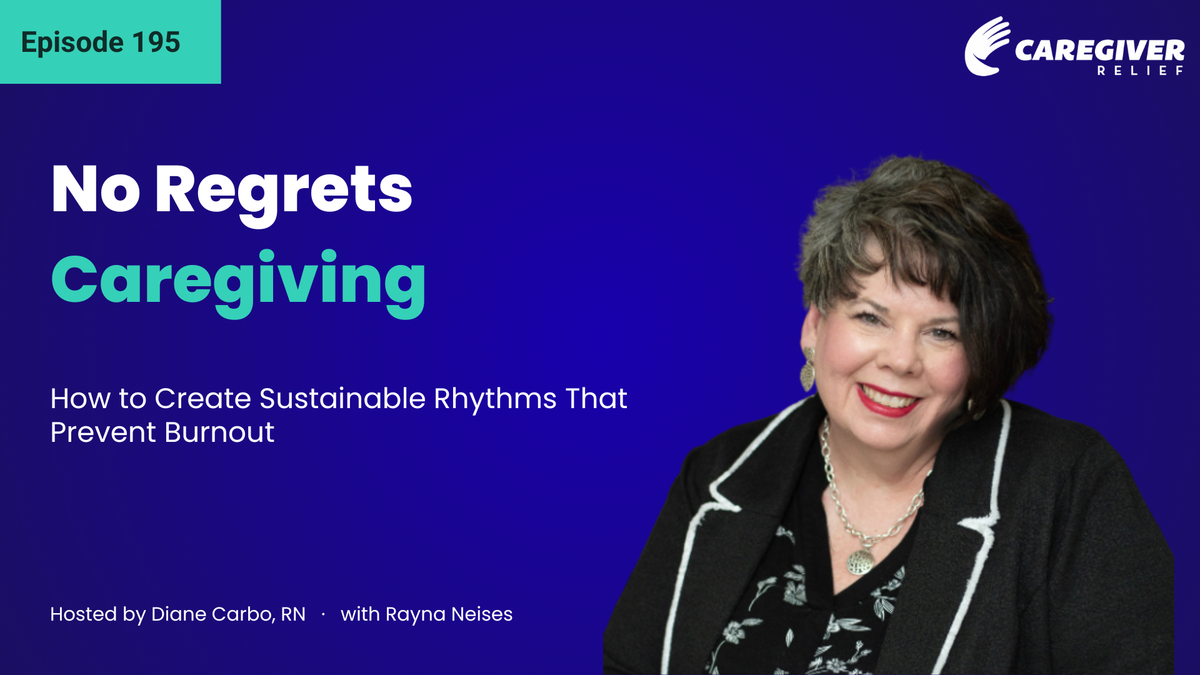
Caregiving is often described as one of the most meaningful roles we take on, but it is equally one of the most exhausting. In this powerful episode of the Caregiver Relief Podcast, host Diane Carbo, RN, sits down with caregiver coach and author Rayna Neises to discuss how to move from a state of "reacting" to a state of "intentionality".
Rayna shares her deeply personal journey—caring for a mother diagnosed with Alzheimer’s when Rayna was just 16, and later caring for her father for 14 years. If you’ve ever felt like you’re drowning in tasks or losing your own identity to the demands of care, this conversation is your lifeline ⚓.
📋 Episode Outline & Highlights
- The "No Regrets" Philosophy 🕊️
- Regret-free caregiving doesn't mean being perfect; it means making adjustments every time you hit a bump and staying true to your core values.
- Sustainable Rhythms vs. Burnout 📉
- Learn how small, consistent routines (like winding down for sleep or "scheduling coffee with yourself") can protect your energy.
- The Power of Asking Questions ❓
- Rayna reveals her secret weapon: asking herself, "What do I need right now?" and "Is my loved one happy?" to problem-solve before a crisis hits.
- Building a "Hope Team" 🤝
- Why you shouldn't want a team of people exactly like you. Rayna discusses her "Caring Personality Quiz" and how different personalities (like the fun-loving "Al") bring necessary balance to caregiving.
- Setting Boundaries Without Guilt 🛡️
- Distinguishing between "responsibility," "influence," and things that are simply not yours to carry (like a sibling's choice not to help).
✨ Key Takeaways for Your Week
"Caregiving is a season—it will not last forever. You can let go of some things now and pick them back up later."
- The 5-Minute Brain Dump: Feeling overwhelmed? Set a timer, write everything down, and sort tasks into three circles: My Responsibility, I Can Influence, and Not My Responsibility.
- Find the "Glimmer": Activities like playing table-top ping pong or raking leaves aren't just "tasks"—they are ways to connect with your loved one’s spirit despite dementia.
🔗 Listen & Connect
Don't navigate this season alone! Tap the link below to listen to the full episode and find the strength to create a sustainable rhythm for your life.
- Visit Rayna’s Website: www.ASeasonOfCaring.com
- Get the Book: No Regrets: Hope for Your Caregiving Season at www.noregrets-book.com

- More Resources: Check out contentmagazine.online for further encouragement.
Podcast Episode Transcript
Diane: Welcome to the Caregiver Relief Podcast, where we share real stories, practical strategies, and compassionate support to help you navigate the caregiving journey with more confidence and less overwhelm. I'm your host, Diane Carbo RN caregiving can be one of the most meaningful roles we ever take on, but it can also feel exhausting.
Isolating and at times overwhelming. Many caregivers quietly wonder if they're doing enough, if they're making the right decisions, or how they can keep going without burning out. Today's conversation is about finding a better way forward.
I am joined by Rayna Neises, caregiver coach, speaker, and author of No regrets. Hope for your caregiving season. Rayna Equips families with simple systems and compassionate tools to help caregivers create sustainable rhythms, communicate their needs clearly, and protect their energy while continuing to care with love.
Drawing from her own caregiving experience in years of coaching, Rena brings practical wisdom and real life empathy to help caregivers move toward a more supported, regret free journey.
Diane: Rena, thank you so much for joining the show. I'm glad you're here. Before we get started, can you tell us a little bit about your caregiving journey and what led you to become a caregiver coach?
Rayna: Sure. I would love to, and thank you so much for having me today. So I have a story no one wants to have. I was actually 16 years old when my mom was diagnosed with Alzheimer's disease.
Diane: Wow. Wow.
Rayna: So she was just 52, 50, almost 53, and she lived for 12 years at home with my dad for her primary. Caregiver.
But of course as a daughter, that impacted significantly that relationship and the ability to have a mother-daughter relationship. She was actually nonverbal within about three years of her diagnosis, and so a lot of gibberish and very easygoing and easy to take care of. But still those challenges of just.
Needing that constant care and to keep her safe. Seven years after she was diagnosed, my dad, or after she passed away, my dad was diagnosed with Alzheimer's disease and he lived for 14 years and we were able to, honor his request to stay at home. I have one sister, and so my sister and I team together by bringing.
Professionals in and all different kinds of people in on the team and keeping him at home for the last four and a half years of his life. He passed away in 2018. So at that point, that's when I made a shift with my coaching business to support caregivers and to enter this world of just trying to make it as, you can't even say the word easy, right?
Just make it as, as palatable as possible. Yeah. that caregiving season of our lives.
Diane: We have something in common. My mother was diagnosed with, lung cancer when I was 16, going on 17, and I became her primary caregiver and took care of my brothers and sisters and what. My listeners out there don't know or may not realize is there are lots of teenagers and young children that are caregivers for their grandparents or their parents.
And, they get very little support at all. and I really, admire you for trying to even try to keep your dad at home for as long as he could, that's, admirable. Now you talk about regret free caregiving. That's a topic I'd really like to delve in into because what does that really mean and why is it so important for caregivers to think about this early?
Rayna: I think regret free caregiving to me is being able to bury it them without regrets. And I think I have a probably a little different maybe definition of regret than a lot of people because it's not that I did it perfectly, it's absolutely not that everything went smoothly and that I did everything exactly right.
It's that each time I ran into a bump, I took that and said, what could I do differently? How can I make that better? And When I buried my dad, I looked back on what we did and I didn't have regrets. I felt like I had done everything I knew to do to make his life as happy and healthy, and to have him live as long as possible.
And so I think we can do that, especially if we really focus on that definition of not perfect, but just the best that we can do. And if we don't know. Find out and do it differently. And so make those adjustments throughout. And I think that's important. You said early, why do we need to do that early?
Because if we jump into caregiving. And we aren't intentional. We're going to find ourselves being pulled in so many different directions that we're actually gonna have regrets because we aren't living by our core values. As a coach, our core values are the key. We have to take time to know what is most important right now in this season.
So in that four and a half years where I drove 220 miles to stay at my dad's house. Half the week I had to let go of some things. I had to say, dad is the most important right now. Now, that doesn't mean that my marriage isn't important. That doesn't mean that my kids aren't important. That doesn't mean that I had grandkids born during that time.
They were still important. Church was still important, my faith, all those things, but what they looked like and how much of me there was to give had to change. I had to look at that and prioritize it. So I think the only way we can be regret free is to really be intentional and say, Hey, what is most important right now?
What can I let go of? What can I pick up again later? Or what can I just modify? What could I do differently? So bible study online or coffee chats on Zoom with friends instead of in person, thinking creatively and do things differently to be able to keep those most important things important.
Diane: You know, you make a good point because I was 16 going on 17, going to be going to nursing school, and I did start nursing school. I. Didn't know. I was a kid. Yes, I had no idea. And the emotions I was feeling was anger and rage and. Guilt and a, and shame. there were so many dynamics there.
decades later, I'm dealing with my dad, but I'd already been, out of nursing school, having a family. I had a family and kids and stuff, so I was intentional with my father. So you made a really good point there. of course, I'm the bossy big sister, so I, and the oldest of four. I took charge of what needed to be done and how to care for my dad. so I really appreciate that you make the point that, putting a plan in place or being intentional about your decisions is really important, so I really appreciate that. Now, many caregivers feel like they're reacting day to day.
You talk about sustainable rhythms, what are sustainable rhythms and how can caregivers begin creating them?
Rayna: So sustainable rhythms are those little pieces of the day that always look the same as much as we can. So they're going to be those things that we do to prepare ourselves for sleep. Now, it might not always be the same time because I taking care of my dad with Alzheimer's.
There were nights that he just wasn't ready to go to bed, and so even when I was, he wasn't. But what's the routine? How do you wind down? How do you get yourself ready for sleep? Those rhythms and routines can actually. Give us a boost in keeping ourselves from burning out and developing them. So sometimes they sound like a big deal, but they're really the things that we do naturally.
But they're also the things that we have a tendency to give up. Yes, without thinking about it, it's so frustrating how long it takes to create a habit, isn't it? Yes. And how short it is that it can go away. So think about those habits when you are in your best place, how, what are those habits? How are you taking care of yourself?
And make sure that you protect them as much as possible. There's gonna be days you can't, but being able to create those, and one of the rhythms that I think that we probably don't do enough that I feel like really sustained me in my caregiving was. Asking myself questions. So because I was driving almost four hours one way, between leaving my dad's house and getting home to the farm, I would ask myself the same questions each week.
How am I. Am I tired? Am I, physically? How am I feeling? Just how am I, do I need to cry? what, how am I doing? What do I need to do? What do I need? So do I need to do something differently? Do I need just a hug? Do I need, what do I need? And stopping to ask myself those questions about myself really made a difference.
Some weeks that was not a big deal. Some weeks it was like, okay, this is really not changing and I can't sustain this. So I'm a girl who needs a lot of sleep, for example. And my dad was getting up a lot, and I was afraid even when he was asleep that I wouldn't hear him. And so I needed to do something differently.
It was not a big deal. I did some research, I found a bed alarm, and that just helped me sleep. Soundly because I knew as soon as he was off of that bed alarm, it would go off and I would hear it and I'd be able to go help him. So just some practical things like that. Sometimes I found. I had a caregiver that I really didn't connect well with, and she was an energy vampire, you could say.
She just really always had the negative to share, and I'm coming into town and haven't seen Dad for a few days and I'm hearing all the bad things, and I just thought, this is really not working. After a period of time, I realized this isn't changing. This is not helping me start my time with Dad. I changed the schedule where I didn't see her.
I adjusted our hours so that I didn't have to interact with her in that way. So those are some of the things that I was able to do because I asked the questions. The other piece was then how is dad? Is he happy? Is he healthy? Is there what? What's going on with him and what does he need that he's not getting?
So that I'm able to then problem solve, think of things that we might need to try differently. For example, my dad was very physically fit and loved to play ball and be outside. He lived in Missouri, and so it was a hundred plus sometimes, and he would want to be outside and it's dad, he just didn't regulate his heat the same.
So I started problem solving, what can we do inside that's active and engaging? And I picked up at Walmart, one of those little nets that go across the kitchen table and we play ping pong for two and a half hours the first time I brought it out. Wow. And we just. Fell in love with it. Again. We hadn't played, I couldn't remember when I was a kid.
I remember playing with him. But it was one of the things we played all the way up until a couple months before he passed away. So we never know unless we ask ourselves the questions. And as caregivers, we are so busy that we forget. And so I say schedule. Coffee with yourself. Schedule something on your calendar where you ask yourself some really simple questions so that you can start to make those adjustments as you need to.
And to me, that's a routine that's, that can really help with caregiving.
Diane: To my listeners out there, I just want you to know that strategy is probably one of the most powerful strategies you will learn as a caregiver. And Rayna, thank you so much for pointing that out because that is one piece that is always missed by 99.9% of the family caregivers.
The other thing I want to, make my caregivers aware of and seniors activities are one of the most overlooked tools that we use in the toolbox to help us connect with our family. our family member. it's so powerful and it not only helps us have some respite sometimes, especially if somebody else is interacting with them in an activity, but it's also giving you the opportunity to connect with your dad on a level, because with dementia, there's moments when they're there and you wanna hold onto it because you see the glimmer in their eyes. You see you've got that connection and then it's gone. So if you got two and a half hours with your dad playing a game, that is such a blessing.
Rayna: We laughed. It was so much fun.
Diane: It's a gift. It's a gift to you, and it's a gift to him. And I just a little tidbit, Nancy Reagan. Ronald Reagan old, the ex-president, he had dementia and he loved raking leaves.
Always. Of course, they're in California. Do you know that she had fake leaves put out in the yard?
Every morning so that he had a task of raking leaves. And it make, people don't understand that avoids negative behaviors. It gives your loved one a sense of wellbeing and confidence. And it's sometimes. Gives the family caregiver respite. I, you've made some very powerful points here.
Thank you so much. Now let's go on. Burnout is so common and it's because many don't do what you're recommending, that's for sure. So what are the early warning signs of caregivers should watch for?
Rayna: Oh, it's hard because I think early is tricky because so many times we find ourselves there before we even realize.
But I would say that irritability was one of the things that comes out that when you just find yourself snapping, when you just find yourself feeling I just can't do this one more time, then you're in trouble. You're probably a little past trouble at that point. Yeah. because that's, it's impacted you in a really negative way.
Energy levels. not wanting to get out of bed can definitely be a warning sign you need to be aware of and then just not engaging. Yeah. Isolation can be such a big part of caregiving.
Diane: Yes.
Rayna: It doesn't have to be, but it typically can become that. But if you find yourself turning down opportunities to get out of the house.
You need to pay attention to that because whether it be just coffee with a friend or even just running to the grocery store, there are so many convenient things now that can prevent us from actually getting out of the house. They are convenient and they can be a tool, but they can also develop, Patterns that are actually are working against us in taking care of ourselves. Exactly.
Diane: One of the things I recommend to my caregivers and to the seniors is, it isolation is real. And, if you're in the home, you get used to comfort, and and not doing anything. I encourage everybody, stick your head out, stick your nose out the door.
If it's nice, just sit on the porch. You don't have to go anywhere, you don't have to do anything. But just sit there and enjoy the sunshine. I'm one, I lived in Minnesota. I mean, get your head out there in the blizzards, feel the air, the cold on your face. get, feel nature.
It just, one of the things I do. As part of my daily routine. Now, I'm not a primary caregiver right now, but even when I was, I made myself take a walk every day.
Rayna: Yeah.
Diane: And it was, it's not much. But if you do just that little thing, it can make such a huge difference in your life and in your attitude.
So that's a really good point. now here's a point I wanna talk about. Why do so many caregivers struggle to ask for help? And how can they begin to shift that, make that mind shift, set change
Rayna: Reality is to have someone else do it is probably harder than you doing it yourself.
Diane: That's what they think. Yep.
Rayna: Yes. that's how it start. It really does start that way. It starts that way because they don't do it the way you do it. And that's exactly
Diane: What I was gonna say.
Rayna: Yeah. It feels wrong. And I was just talking to somebody the other day and I said, you know what? Think about perfectionism. 'cause people will say, I'm just a perfectionist.
I just really like things done my way. Is there really a perfect 'cause your perfect is not the same as my perfect.
Diane: Exactly. Exactly.
Rayna: So we really have to be willing to accept help, whatever it looks like. And I think that can be tricky. And I think sometimes caregivers don't do that very well and they push away the help that could be there.
Diane: Exactly.
Rayna: So asking for help is a challenge, but receiving the help is probably where we need to start.
Diane: Yes.
Rayna: What can I look at that I could let go of? That would not be like fingernails on a chalkboard, right?
Diane: Yeah, exactly. Exactly.
Rayna: So can I go to the gym when someone else comes in to stay with my loved one?
One of the things I hear a lot, especially spouses that are caring for each other.
Diane: Yeah.
Rayna: It's just hard to have somebody else in your space.
Diane: All day long. 24 hours.
Rayna: yep.
Diane: 40,
Rayna: Yes. To have someone else in your space and have no privacy and No, none of your space. So what if it taking. What if the caregiver took your loved one somewhere so you could have your own space and you could enjoy your own home, something you haven't done in a long time?
A lot of times I think we just get stuck in definitions of things that caregiving means. They come to the house and they sit with the person, and that's all they do. we had caregivers for years that drove my dad to volleyball and he played volleyball because he was still capable of doing that, and he loved that.
Diane: Yeah.
Rayna: He also went to the gym and lifted weights, and they helped to facilitate that. We did that up until a year before he passed away. Sometimes we just put limitations on what our loved ones can do.
Diane: Yes,
Rayna: And then we keep them at home. The other thing is realizing that our help is going to. People will only help if we ask for something specific, so create that list.
I'm sure you talk about this all the time. Diane. I do create the list of asks with specific information.
Diane: Yeah,
Rayna: Dad has a re an A prescription at this pharmacy that needs to be picked up today or tomorrow. Can you do that? Really specific. We really love spaghetti. Would you be willing to bring dinner?
On Friday night. just be specific Exactly. For the asks.
Diane: Yes.
Rayna: Have them written down ahead of time. Hand the list to the person who wants to help you and let them choose. Because you always have things that need to be done, right?
Diane: Absolutely. I call it building a care team, partner team, group.
Rayna: Yes. Yes.
Diane: Absolutely.
Rayna: And you can only do that when you are intentional. Again, there's that my favorite word.
Diane: Yeah.
Rayna: You have to have that list available because on the spot,
Diane: Yeah.
Rayna: You won't think of it and they don't know what to do to help you. and remember that it's okay for them to help you too, not just the person that you're caring for.
Diane: Amen.
Rayna: You have many things that you need to get done and so it time is one of those things that can make a big difference, that if you can just get a little bit of space to go and get a haircut. To go and get your eyes checked to get that annual exam, schedule those things, but also schedule some fun things.
Be able to go to dinner with friends, be able to get out a little bit and take care of yourself in that way.
Diane: So yeah, that's one thing that I find that caregivers are so resistant. To continue to, they feel like they're a failure if they ask for help.
And they also, when you're talking about the negative caregiver, there are so many family caregivers out there that have negative family members.
Rayna: Yeah.
Diane: Uninvolved siblings and judgmental extended family members. And, they're being demeaned, demoralized, and sometimes just being destroyed, mentally and emotionally so that they will continue to provide care. So they're, it's really a challenge for them. And I say, if you have people like that in your life, if they cannot provide, give you a break and provide care, they should financially pay for support in the home.
And I'm telling people to ask that, and they're all like, oh no. Oh no. But yeah, you know what? You as a caregiver deserve a break and you're outside relationships die because. I look at relationships as a garden and you need to water it and sprinkle it and put sunshine on and let it expose it to sunshine.
And if you don't, it withers on the dies and you have to look at your outside relationships that way. And you've got, the thing is a lot of relationships also died outside the home, friends, because all you're talking about is your, how unhappy you are and miserable you are in caregiving.
Rayna: Yes.
Diane: And those are conversations that you should keep in the support groups you're in.
Rayna: Yes.
Diane: Or with your coach, but you don't share that stuff with your friends because they can't relate. Or if they can relate, they don't wanna hear it either. True and that's why it's go for fun, go to the gym, go to the movies.
I know you hear this too, Rayna. I have caregivers that say they don't even have time to take a shower or take a bath. and I'm like, whoa. No, don't do this to yourself. You do have time. There are ways to find that time.
Rayna: Yes.
And you're just not doing the right things and you know what a solution for you.
Maybe not the same solution as Rena or I may have. there are obstacles and challenges. We all have them, and you need to change your perspective to change your view of things. And, don't expect everybody to do it the way you do it, as long as they get the same result. Just be grateful.
Rayna: Yes, for sure.
Yeah. And you know, the other thing that I, that helped me was starting to notice that the different personalities that cared for my dad in different ways, actually, he enjoyed them.
Diane: Yes,
Rayna: So the caregiver that drove me crazy, we had a gentleman that my dad just adored, and he was, I don't, he was older probably in his maybe late sixties, early seventies, and he would come in and you could always tell when all had been there because the cabinet doors were left off.
Just the basic stuff, you're just like, the milk
Diane: Was amazing,
Rayna: Was always on the counter. It, he never followed through, finished anything. He got my dad dressed, he got in, he showered and dressed every day. He also made sure he had his meds. He fed him breakfast. But other than that, they just had fun.
Diane: Yeah.
Rayna: Now could we have had Al only all the time? Absolutely not. Al was once a week and that was, I could go along behind him and clean up after him. Yeah. But it was so funny because the behaviors of these two adult men. They were boyish. They were hilarious. Yeah. They would play hide and seek and just, the goofiness of it.
I was just like, oh my gosh. He just drove me crazy. But my dad laughed and they had so much fun, and so I learned by watching Al, I thought to myself, you know what? The truth is, dad gets tired of me.
Diane: Yes.
Rayna: And we don't need more of me. We need other people that bring other things to his life. This is his whole world is those of us that come in and interact with him.
So if they all look like me and act like me, then he's gonna go crazy. And so I need to be thankful for those other personalities and other people and look at their strengths and enjoy them for what they are. We've gotta let go. We've gotta let them be who they are and let them bring what they bring to the team.
Diane: I had a caregiver whose, father was recovering and alcoholic, and he would go to AA meetings and do, up until the week before he died, his teammates with, or his members in his group, would come and pick him up. And take him out to dinner and to an AA meeting.
Rayna: That's so amazing.
Diane: And, and, and he had a very slow form of dementia, It sounds like your parents did too. You know that they lasted so long, but it was, he, they did it twice a week and he looked forward to getting out.
Yeah. and the caregiver, the family caregiver, she was so grateful to be able to take a bath or, go out and enjoy something for a little bit and take care of herself.
So that really what you're, this is what you're saying, let them be them and enjoy other people.
Rayna: Yes. So important.
Diane: Yeah, it is. It is. Now. One of the things that caregivers have a hard time with is setting boundaries, and they can't do it without feeling guilt or fear of letting their loved one down.
How do you address setting boundaries with caregivers?
Rayna: It is a really tricky subject because,
Diane: Oh,
Rayna: It's our loved ones, They're not always making choices. in my situation, my mom and dad were not taking advantage. They could not do these things for themselves. Yeah. and I do think it's important to understand the difference between choosing.
Diane: Yes.
Rayna: And I talk about in my support group, I have a couple of people that are caring for people with traumatic brain injuries and they're just really struggling with, they're in some ways, they're very independent in other ways. They're very, they're not doing a good job. They're taking care of the things that need to be taken care of.
The everyday stuff, like the bills and things like that. And we often say we really have to evaluate and say. If they could, they would.
Diane: Yes. That's a good point.
Rayna: Now, there are some people who will intentionally not even though they could, but I really think there's more to that than we realize when we're talking about caregiving.
If someone could successfully, safely bathe themselves, take their medications, why wouldn't they? They don't want you upset with them. They don't want the tension.
Diane: Yeah.
Rayna: Now if they're not healthy emotionally, there could be some manipulation and things like that going on, but that's not a new thing.
This is a relation, you know that about your relationship, right? So if it's always been a healthy relationship and the caregiving has had to come into the physical needs, then we can understand that. But I think that's one of the tricky things about boundaries, especially mental illness boundaries can be really hard of when are you being manipulated and when are you not?
So I just say seek counseling when it comes to those things. Now we can easily give up our own health and all those other things because we become enmeshed with the person that we're caring for. And that's where a boundary needs to establish the end of their needs in the beginning of ours. And we are allowed to have needs.
We are allowed to identify their needs and meet their needs, but we are also still allowed to have needs. And I think start, some of it starts with just giving yourself permission to need something and to take care of yourself. And part of it is just starting to draw those lines and say, where is.
Where is my need and where is it being addressed and what is their need and where is it being addressed and do I have to do the addressing of their need again? I think that comes in so much with people feeling like they have to do it all. I talk especially to daughters that are caring for aging parents and they're out mowing the grass and weeding the garden and cleaning the house, cleaning their house, cleaning their parents' house.
There are other people who can do those things. You are not the one one who has to do those things.
Diane: Yes.
Rayna: So that's part of it is really looking at all of your needs and all of their needs and looking at what only you can do to meet their needs and your needs. Only you can do and then start handing off the rest.
Diane: That's a really good point that I think that caregivers struggle with. I just was, talking to a young man the other day at his mother. here's a man who's got a million dollar company, multimillion dollar company, and his mom's calling him to come over and pick weeds. And he's torn, literally torn.
And I said, are you kidding me? the family's wealthy.
I said, have her call the garden and this dad calls the snowblower broke. come over and fix it. really, no. You,
Rayna: It's hard because I think sometimes people, most of the time research shows that the people that are millionaires didn't start that way.
Diane: Exactly.
Rayna: And the reason why they got where they're is because they did fix everything themselves and do everything themselves. So sometimes it's a mental shift. Other times I think we have to explore the ask is the ask because mom hasn't seen you in a while.
Diane: Yes.
Rayna: Is the ask because mom wants to spend time with you pulling weeds because you will come do that and you won't come sit.
Especially those of us that are go getters, we don't enjoy just sitting, and so finding an activity that we can spend time together can be a real blessing, but I think you're so right. The other thing I always tell. Caregivers are just starting, especially caring for parents. The more you do and you don't put someone else in their path, the more they're going to expect you to do.
Diane: Exactly.
Rayna: It grows larger and larger, and they begin to feel like, oh no, only my child can take care of me.
Diane: Yes.
Rayna: Where if we can introduce early those other resources and let them start to get used to, okay, mom, we're gonna solve this problem together, but I'm not the answer to every problem.
Diane: And that is just what I was trying to teach this young man. Yeah. Is, it is time to say, mom, I'm not your problem solver. I'm your son.
Rayna: Yeah.
Diane: And that was hard for him to do. And, it is important. And that's, and caregivers have this issue all the time of having, asking, again, asking for help, but delegating jobs.
Yes. That's really hard. when you get to a point, you just absolutely want to do that. but you don't know how you're, that's when you get the point of burnout and you're, it just doesn't work. for caregivers who are feeling overwhelmed right now, what is one small step they can take this week to reduce stress?
Rayna: So one of the things I love to walk people through is a really simple, brain dump. I want. When overwhelm comes, get out a piece of paper, set your timer on your phone for five minutes, and write down everything that comes to mind. Everything
Diane: Good
Rayna: Because you're going to start with the really big things that are already stressing you out, but the little things are gonna end up on that paper and you could actually do it for way more than five minutes.
But I just, five minutes after you set your timer for five minutes, then I want you to make three circles on a piece, on another piece of paper. And in one circle I want you to write my responsibility in the next circle. I can influence in the last circle. I can't, not my responsibility. And go back to that list that's taking up all this space in your brain and start sorting them to where they belong.
Diane: Interesting. Good point. Good tool.
Rayna: There are things that are on your mind that you are not responsible for, and no matter how much you stress out about it, you cannot change.
Diane: Yes. Yes.
Rayna: The progression of disease, the fact that you are walking your loved one home, they're not gonna be here forever. There is not a happily ever after when you're taking care of someone with dementia.
Diane: Exactly.
Rayna: Many diseases are that way. People know that this is a goodbye.
Diane: Yeah.
Rayna: But we forget it because we're so focused on doing what we can. When we can. Which is important.
Diane: Yes.
Rayna: But we also need to understand that we can't change it. And just the research shows that our brains have open loops.
All these things that we're cycling through, we're thinking about all the time as an open loop. If we can just close that loop and we can close that loop by saying, I can't, I have no control over this, and I can let it go. Being a person of faith like myself, I pray about those things. Okay, Lord, just help me stop worrying about this.
Stop thinking about this. Help me focus where I can, where we can be together and not in these places of borrowing trouble. What can I influence? This comes to those things that we might be delegating. We might have delegated, we might have a sibling who's not doing what we want them to do, or they're not participating as much as we wish that they would.
I can influence that, but I can't change that.
Diane: Yes.
Rayna: Then there are things that are my responsibility. They're in my circle. I'm the one that they're, that I need to step up and take care of, and I need to figure out what to do with that. If I will take the things that are in my circle of responsibility and write down the next step, one step.
So if my mind is thinking about my brother-in-law's birthday, and I know I need to figure out a birthday present for him, and I know I need to. Figure out a card. If I will just write down the next step, what's the step I'm going to take tomorrow or I'm going to take by the end of the week to take care of that, it will help to close that loop a little bit as long as I follow through, and it'll put my mind at ease.
The overwhelm will disappear because our brain is overwhelmed because all of these loops are open. Now, that group of influence, we have to really also look at, can I really influence those if I have a sibling who's a jerk? I really can't influence that, can I?
Diane: No, you can't.
Rayna: I can move that over to not my responsibility.
Diane: Yep.
Rayna: And I encourage caregivers, especially if you're caring for your parents to say to them, ask, have the invite. Invite them to participate. Be specific. Mom needs this done. Would you be able to do that? If they say no, it's their loss. Yeah, we move on, but continue to invite so that they are not feeling pushed out.
Understand that sometimes the way we react to things can make them feel pushed out, but we can invite and we can just let it go.
Diane: Yeah,
Rayna: So we might need to move them from the influence to them, not my responsibility place. It's their responsibility to have a relationship with your parents, not yours. Their relationship is their problem.
So that is another thing that you can do is really look at that influence and make sure the other piece is. Do I have the right person helping me with those things? Because again, sometimes people really are not a good fit. Yes. And we're not really helping anybody by letting them continue to do it.
Diane: Correct.
Rayna: So if you need to, as Dave Ramsey says, let them go find the best position for them. It's just not in my company. It's okay To bless them and let 'em do it.
Diane: Exactly.
Rayna: So if somebody's not a good fit. Yeah, just say, I'm really, I don't think this is working out. Yeah. I, I think you might be really good at this or that, but not this, so we'll see it.
Yeah.
Diane: Yes.
Rayna: Be okay with that. Because if the lawn guy's not showing up every week like he's supposed to, that's just adding one more stress to you.
Diane: Yep.
Rayna: So look at those and make sure those things influence are actually things you can influence. And if you have the wrong person taking care of it, fix it.
Don't sit in it and worry about it, just fix it.
Diane: One of the things that happens with caregiving is, you could have been away from your family for 20, 30 years and just come home on holidays and stuff. And then you're in taking care of your loved one. And all those old family dynamics start to play again, just like you
Rayna: We're not adults anymore.
When we get along there.
Diane: I know. I know. and it's amazing. and when you talk about letting go, I know I have. caregivers that, have so much anger and rage at their siblings because they're not involved and they feel upset about it, and they just can't let it go. And I'm telling you that it's such wasted energy.
It is totally wasted energy. If you can get over that and forgive them for their, inability to help.
Diane: Yep.
Rayna: And their inability to have an interest in your parents, you'll be so much better off because, that's, you're expending energy and negative energy on stuff that you shouldn't even, like you said, it's not mine.
Move that over to not my responsibility. And I really, and this said, sorry.
Rayna: Yeah. The sad thing about that is too, is that we don't know what's happening in their life.
Diane: Yes.
Rayna: And we assume that we do.
Diane: Yes.
Rayna: But. I found if you do put people who are not in a healthy place in a caregiving role. Yeah.
The person they're caring for pays for it.
Diane: Exactly. That's true.
Rayna: So if you really want that angry, unkind, selfish sibling taking care of your parents. Yeah. When I put it that way, nobody's gonna say, yes, I do.
Diane: Exactly. Exactly.
Rayna: Yeah. We really have to realize that some just do not have the capacity to do what needs to be done.
Diane: And sometimes that's the parent's favorite child.
Rayna: It is.
Diane: And that has, that is a heartbreaker for the primary caregiver that's caring because, they don't understand, mom treats me badly, but my brother who is a worthless. Bag of poo that won't help me in a jerk. And he is abusive and whatever, gambling, drunkenness, whatever.
Mom thinks he's wonderful and she puts him on a pedestal.
Rayna: And I think sometimes we can have a perspective shift on that. We might also realize that maybe mom knows. That they're hurting.
Diane: Exactly.
Rayna: And that
Diane: Thank you.
Rayna: And that it hurts her heart.
Diane: Yes.
Rayna: Also, those people have a tendency to cut you out of their life.
Diane: Yes
Rayna: And no. Mom's heart wants to be cut out of their child's life.
Diane: No.
Rayna: Whereas the one who's tried and true and always there, that forgiveness is there. it's,
Diane: Yeah.
Rayna: it's like we talk about the people you live in your own family. You have a tendency not to be as kind to as the stranger.
And I think that. It plays out very much for mom's hearts.
Diane: It does. It does.
Rayna: Yeah.
Diane: And that's one thing that I encourage caregivers, don't take whatever your parent or your loved one, or whoever you're caring for. Says to you personally because they know that you'll always come back so they can say things and they know that you have a forgiving nature, so don't get brokenhearted about it.
Just let it go. And if you can't, talk to somebody like your coach.
Rayna: Exactly.
Diane: Or your minister or priest or rabbi, and
Rayna: Counseling is not a bad idea.
Diane: Oh, and it's not, but of course it, most caregivers don't have insurance and they, so the support groups are their counseling, unless they go to a faith-based, person that will help them.
Now you have something that I thought was unique. Can you tell us about your caregiving personality quiz?
Rayna: Yes.
Diane: And how understanding the personality can help caregivers get the right kind of support.
Rayna: Yes, so I developed this quiz because of Al. When I got to thinking about Al and his personality and how much he wasn't like me, I started thinking there is room on this team for everybody.
In fact, we need people from every personality on this. Team. So you can go to caring quiz.com and take a short quiz that will let you see what your caring personality is. It's called the Hope Team, and it goes based off of different kinds of personalities in their caregiving. And then after you receive, after you do that quiz, find out who you are.
You can have your teammates take that as well, or you can just read a little bit about every kind of person. I have one sister, my sister and I team together to care for my dad. We are nothing alike. We look alike in a lot of ways, but we just, I'm outspoken. I am a type A personality. My sister is that she was an accountant.
She's that steady, quiet, under the radar type personality. And we worked so well together. Because we knew we needed each other.
Diane: Yeah.
Rayna: And again, as caregivers looking at your team and saying, we need people on our team, and we do not need someone just like me. We need different kinds of people. Yeah.
And making sure that team is well-rounded and that we see and allow people to be who they are and do a good job at it. My sister did all the scheduling. She paid all the bills, she did the medical appointments. She was not with my dad when he was awake. Most of the time she slept over, she had young, elementary age kids, and so she would.
Show up after he's in bed. She'd leave before he was awake. But she was such a crucial part of our team, and we both just functioned in different ways. And so I created the Caring Quiz to really challenge us as caregivers to look at number one, what's our personality? What's our strength? What's going to help make us happiest or less likely to burn us out?
The details are okay, but I'm definitely not a spreadsheet girl. My sister loved doing the spreadsheet.
Diane: Me neither.
Rayna: So I'm like, you go girl. I don't wanna do that. So just learning those things and saying it's okay. It's okay to be me and to do what I enjoy. And yes, there's gonna be things I don't enjoy.
All of us have to do those things.
Diane: Yeah.
Rayna: But if we find ourselves having to do them all the time
We're probably not looking around to see who else could be on our team. And this is one thing that I think long distance caregivers need to be a part of the team and see where can fit.
Diane: Yeah.
Rayna: And so really looking at their personalities and letting them be apart and see what the needs are can be really helpful too.
Diane: I love that. I really love that. I was very blessed. I took off a year of work because when my dad was diagnosed with pancreatic cancer, but my siblings and we were very dysfunctional. My mom died early, so I'm the bossy big sister that took care of them while I was going to nursing school until my dad remarried.
But we all, stepped up to the plate. Every one of my siblings stepped up and did, what I asked, and many times they offered to do things that I didn't ask. So I, it was good. We were very blessed, but not everybody has that experience.
Rayna: Yeah.
Diane: And, I was very grateful for it. And to this day, I'm still grateful for it.
Rayna: My sister and I were actually not very close at all. We were, like you said before, go home for Christmas, saw each other love you, but not relational. We lived a distance apart. We just didn't have a lot, of involvement in each other's lives, but caring for my dad totally changed that. And we've become best friends and he's been gone almost eight years now, and we spend time together on purpose by scheduling it and continued that relationship because I didn't wanna lose it.
But I do think that it's very hard and many people that's one of the biggest heartaches for them as caregivers is that the family has not come around them.
Diane: Yes. Yeah. and it is a challenge. Now, Rena, looking back, what is one piece of advice you wish every caregiver could hear at the beginning of their journey?
Rayna: I'm gonna sound a little like a broken record, but be intentional. Take time to
Diane: 100%.
Rayna: Find your core values.
Diane: Yeah.
Rayna: Arrange your life according to them. We really, it's really a key to all success in life is being able to live without regrets in all areas. But if you really look at it and say, right now my job is to care for my family member and I need to let go of some things that are interfering with that, even if they're good things.
There's always time. Part of the reason why I use the word season all the time is because there's a season it will be over.
Diane: Yeah.
Rayna: This will not last forever.
Diane: Yeah.
Rayna: So you can come back to some of those things. You can be, one of the things I found that I was missing was I love, I'm very creative. I love to create things well with when I was caregiving for my dad.
That was falling by the wayside. And I started to realize, I haven't done anything creative in a long time, and I took an online art class while he was asleep at night. So there's ways to meet those needs, but we need to understand that we have them. So really pay attention to what's your core values and how you're gonna have those choreo values met and make the plans around the most important things.
Diane: I am, when I say to my caregivers when I'm working with them, look at this as a job.
Rayna: Yeah.
Diane: Many are offended. Yeah. And I'm like, Hey, you don't get it. It is going to be a job. In a job. You get days off, you get vacations. You have, you go out to coffee with friends. You have enjoy entertainment once in a while.
Look at it as a job and schedule those special times for you. So I really appreciate, your message to caregivers out there. Rain, and thank you so much. Now how do my caregivers and listeners, reach out and find you?
Rayna: The best way to find me is at my website at a season of caring.com. I do have a podcast that's available everywhere, and then my book is also no Regrets.
Hope for your Caregiving Season and that is available Amazon, all the major retailers, but you can reach out. Schedule time to visit at a season of caring.com.
Diane: I love the name of the book too. I, will put all of this on my website. I create a permanent page with the podcast, links to the podcast and your website and information.
Rayna: Thank you.
Diane: So thank you so much and to my family caregivers out there, you are the most important part of the caregiving equation. Without you, it all falls apart. So please learn to be gentle with yourself. Practice self-care every day because you are worth it.
Caring for a loved one can be overwhelming — but you're not alone. If you have questions, big or small, our expert team is here to help.
👉 Click here to Ask the Expert
Our Resource section can help you find the information and tools that you need. We have courses, videos, checklists, guidebooks, cheat sheets, how-to guides and more.
You can get started by clicking on the link below. We know that taking care of a loved one is hard work, but with our help you can get the support that you need.
Click here to go to Resource Section now!