Beyond the Hype: The Truth About AI and Aging in Place with Costin Tuculescu - Episode 155

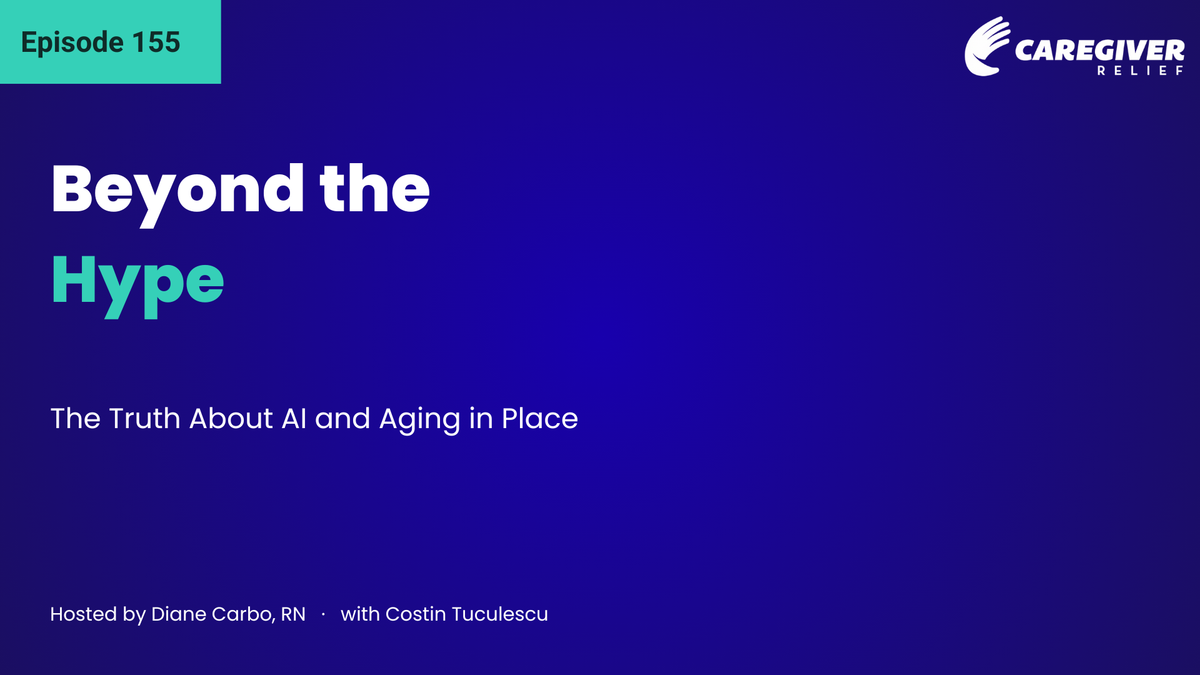
In this eye-opening episode of the Caregiver Relief Podcast, host Diane Carbo, RN, sits down with Costin Tuculescu, CEO of Onscreen Inc., to demystify the world of Artificial Intelligence (AI) in senior care.
If you've ever worried that technology might replace the "human touch," this conversation is for you. We explore how AI is actually becoming a powerful tool for connection, safety, and combating the loneliness epidemic.
📋 Episode Outline & Key Highlights
1. What Exactly is AI? (It's Not Science Fiction!) 🤖
Costin breaks down the "black box" of AI, explaining that it is essentially complex math trained on trillions of words to predict helpful responses.
- No Consciousness: AI doesn't have emotions, but it is excellent at emulating empathy to provide comfort.
- Safety First: Learn how "system prompts" and "guardrails" are used to keep interactions safe and professional.
2. Joy Calls: A Companion in the Living Room 📞
We dive deep into Joy Calls, an AI platform designed to support seniors and give caregivers peace of mind.
- Personalization: Caregivers can input mom’s interests (hobbies, news, weather) so the AI can have meaningful, tailored conversations.
- Memory & Recall: Joy builds a "memory" of past chats, helping with cognitive stimulation and recall.
- Transparency: Caregivers receive transcripts and summaries of every call, ensuring they stay "in the loop".
3. Fighting the Loneliness Epidemic 💔
Loneliness is a public health crisis. Costin shares staggering stats:
- Isolation is as damaging to health as smoking 15 cigarettes a day.
- It is associated with a 50% increased risk of dementia.
- AI serves as a bridge for the 25 million caregivers who do not live with their loved ones.
4. Protecting Your Privacy 🛡️
Don't get caught in the fine print! The episode provides practical tips for tech-wary families:
- The AI Hack: Copy and paste a company’s "Terms of Service" into ChatGPT and ask, "Are there any landmines here?" or "Can this company sell my data?".
- Green Flags: Look for US-based companies, clear "delete my data" options, and transparency about how AI is trained.
5. The Future: From Chatbots to Robots 🚀
From voice assistants that can refill prescriptions to humanoid robots that fold laundry (coming as soon as 2026!), the future of "Age Tech" is about augmentation, not replacement.


✨ Why You Should Listen
Whether you are a long-distance caregiver or a senior looking to stay independent, this episode offers a grounded, hopeful look at how technology can make caregiving "a little easier and a lot more human."
"AI is a tool... Why wouldn't you want to use a tool that engages with your loved one and gives you more insight into how their day is going?" — Costin Tuculescu


Podcast Episode Transcript
Diane: Welcome to the Caregiver Relief Podcast, where we empower caregivers and families with real world knowledge and compassionate support to make caregiving a little easier and a lot more human.
I'm your host Diane Carbo, a registered nurse, and today we're diving into one of the most talked about and often misunderstood topics in modern caregiving, artificial intelligence. There's a lot of fear out there about ai, especially when it comes to seniors. Some worry, the technology will replace human touch.
But the truth is, when used wisely, AI can enhance care, provide companionship, and bring peace of mind to families across generations.
Joining me today is Costin Tuculescu, CEO, and co-founder of Onscreen Inc. The company behind Joy Calls a platform using AI to bring connection and support directly into seniors living rooms. Together we'll impact what AI really is. How it's being used to help seniors age safely at home and what you need to know before investing in an AI powered caregiving solution.
So let's move beyond the hype and discover how AI can be a force for good in caregiving or aging in place. Costan, thank you so much for spending time today. after our last, conversation about Joy calls, I really gave it some thought and, you're right, senior and I checked it out. Seniors have so much hesitancy and they're caregivers.
Rightfully but I think, I'm grateful that you're able to, help us address the loneliness, epidemic so many of our older adults face. And you mentioned you were getting a lot of negativity and concern from people about using AI to interact with seniors. I want my listeners to know that has what sparked this conversation today.
Diane: so thank you for being here.
Costin: thank you for having me, Diane. It's great to be back. I really enjoyed our last conversation and it's wonderful to be able to continue and go deeper into this, really fascinating topic of how AI will support caregiving.
Diane: joy calls is such a positive approach to caregiving, and it just adds a level of comfort and care to the caregiver and to the senior and in all honesty, cost.
And we are in a public health crisis. We have two going on right now, and it's going to continue. For one is for the first time in history, we have more seniors than youth. And this imbalance is going to continue because we have people choosing to be childless couples, and that's the other silent epidemic that we are facing that nobody's talking about.
I've learned that each generation after the boomers has not replaced themselves in population, which means Whatever the boomers are going through, we're going to be going through it, every generation thereafter because we have created, we have not re replaced our youth in ev each popul level of population.
And we only have to look at Japan, even though in Japan, I will tell you. And I've been watching them for 20 years. They have been addressing their, aging population for 20 years with caregiver robots, and they're trying to get, they were getting prepared and so they're probably 10 years ahead of us.
But I think that this is not gonna go away. So I think our conversation today will help seniors and their caregivers learn how they can protect themselves. Absolutely. So thank you for so much for helping us alleviate these fears and concerns about, about ai because I really think we need to help consumers not just embrace AI outta necessity, but discover ways to protect themselves and their loved ones.
Costin: Sure. Absolutely. Yeah, it's definitely, A such a new concept. New topic to be able to interact with software. The way we interact with AI now, with chat bots and with voice bots and you know where it's gonna go in the next five, 10 years, it'll really be revolutionary. I think it'll reshape society across everything from self-driving cars, which will bring more independence to older adults.
Absolutely. AI assistance that'll help you navigate healthcare to, We're even starting to see relationships with ai. So who knows where it's really gonna go, but,why don't we, just start easy and maybe we break it down for everybody. What is ai? Yes. AI's really been around since the seventies.
I think we've heard some of these things. Seventies, eighties, nineties. It, they all had their own flavor of ai, but it's really in the last two, three years since this chat, GPT came out. That the whole world's been just,really impressed about what AI can do for us. So really, what is it?
I think to a lot of people, it's a black box. It's really hard to understand what's happening there. I just wanna put it out there in, in really simple terms. Hopefully it's simple. It's really just math. AI is very complex math. Okay. And all AI is doing is it's been trained, so it's been fed billions and trillions of text examples.
So imagine every book in the world, or maybe 90% of every book in the world. Imagine every webpage on the internet got fed into a computer. Now that computer, you ask it a question and it guesses what the right answer is. Based on everything that it's been fed, because it's seen these patterns before.
It's seen kinda these questions in the answers. there's just trillions of words of input. That then produces that one sentence answer for someone. So when you're chatting with Chad, GPT, all it's really doing to answer your question, it's just predicting the right answer for you and it's really good at it.
Yeah. Okay. I wanna say there's no consciousness there. Yeah. there's no emotion there. AI scientists work really hard to remove bias from the system. 'cause you can imagine the world's body of work, there might be some bias one way or another. They try to flag these biases and remove them from the system so that you, you get a version of truth that most people can agree with.
if these companies weren't doing that, then their products wouldn't be as good and people wouldn't use them. So at the end of the day, that's really all they're trying to accomplish is create a good product that meets the needs of as many people as possible and then, their companies are successful.
Yeah. To do that, you need to remove, eliminate bias. You need to eliminate untruths as much as possible and create a trustworthy product. And. we're probably 90% of the way there with the AI models that exist today. So hopefully that opens up the black box a little bit about what AI is. It's really just a piece of software.
It's a program that. They've gotten more sophisticated over years and decades, but it is at the end of the day just a piece of software, like how the Atari game pong was back in day. I remember
Diane: that.
Costin: Yeah. So hopefully that helps.
Diane: constant, you made a point that I want, our listeners to understand.
Companies like your yours have full control over how AI interacts with clients and what you feed into it. And I think that's a key that we have to be, we have to discuss and make our listeners understand. can you walk us through how you control your company on screen with Joy calls? what an older adult experiences when using your AI platform?
And how do you keep it safe?
Costin: Yeah, so all AI systems have a thing called a system prompt. And the prompt is what tells that AI experience that you're creating for that interaction. it tells it who you are, what persona are you, what are you going to interact with a user about, what topics are allowed, what topics are not allowed.
what do you do in case of an emergency? What do you do in case somebody asks you deep medical questions? So all of that we simply describe, in English, and that becomes a system prompt, and we provide that to the AI system. It's really crafting a character for a play or a movie. you're giving it its motivations, you're giving it its goals and.
Also, guardrails. This is a term that says ai, you cannot do this. These are your guardrails. So we do have full control. And the way we've designed joy is basically,we describe it as you are an AI companion for an older adult. you are empathetic. And a pleasant, friendly voice to converse with the older adult and so on.
it's several paragraphs long. And that creates a general personality of joy. And of course we have these guardrails, like if somebody says that they're feeling pain or that they're having any kind of an urgent issue, encourage them to hang up the phone and dial nine one one. So we handle for all of these.
potential, scenarios that we have to handle for.
Diane: so how does AI or like joy, learn to know the person is supporting and how do you ensure that experience feels safe? personal and human. Yeah, which is un it's hard to do because AI doesn't have personality or emotions.
Costin: it doesn't, but it emulates them.
Like I said, imagine if you read every Shakespearean play, every romance novel in the war, in the world, you'd be able to emulate some type of feeling. Good point. Yeah. Yeah. large language models and ai, they're very good at emulating these things. The way we create a personal experience is we really start with the caregiver.
Our customer is really typically the caregiver who signs up for joy calls and sets it up to call their loved one who may be lonely, who may be isolated. That person might go eight to 10 hours a day, not speaking with anyone. So that loving family member, the adult daughter, adult son. They go in there and they set up mom's profile.
So they, they enter mom's name,the zip code where mom lives so that joy can talk about the weather and joy can talk about maybe the latest news in the area. Then we also have just a little text box where people can fill in what mom's interests are. Yeah, so it's really as simple as that. You just tell joy about your loved one.
And then when Joy makes that first call and she introduces herself, then based on those interests that have been provided, which are now part of Joy's system prompt, which I was talking about earlier. Now, joy has personal information that was provided by the family and can chat about all of these different interesting topics.
In addition, as the conversations happen over time. Joy builds up memory. So all of those conversations are like transcripts in Joy's memory whenever she talks to that specific person. and so then she's able to recall things that were talked about yesterday, the day before and follow up. And over time really just get to know the individual and have very meaningful conversations with them.
We see this with our customers today that. they're there chatting 15, 20 minutes at a time, really covering topics from today, yesterday, et cetera. and the way we keep it safe is all of those transcripts are visible by the family member who set it up first. They get a summary text message or a summary email as soon as a call happens, so they see exactly what the chat was about.
then they're a, if they want to see more detail, they can log into our platform, see a transcript, and even listen to the call. Now, that might seem a little invasive, but like I said, the person setting it up is the adult child. They're worried about mom. So joy is really like an employee of the adult child.
It's as if you went and hired someone to call Mom every day.
Diane: 100%. Yes. Yes. Yeah.
Costin: except that it's, that person might cost $20 an hour or $30 an hour. joy costs $30 a month. Yeah. So really, it's much, much more affordable. and we give that full transparency to create safety and to always have a human in the loop that's reviewing the conversations and make sure mom isn't.
Plotting some sort of terrible thing for herself, or maybe mom's talking about this new person that came into her life and she's giving them her inheritance. Yeah.
Diane: you provide full transparency and I think that is what people don't understand, that whatever company, you, and we will talk about this later, but can you, I don't have the stats right here in front of me. can you talk about the impact senior loneliness has on people and how rampant it is in our country right now?
Costin: Oh, absolutely. Yeah. According to the CDC Loneliness and isolation is equivalent to smoking 15 cigarettes per day.
Diane: Unbelievable.
Costin: Yeah. Loneliness and isolation, has been associated with a 50% increased risk of dementia. and a 30% increased risk for stroke, and heart attacks and just general, increase in mortality. Now the numbers, so there's about 60 million, older adults, seniors in the us. The numbers are that about 40% of them are lonely or isolated.
Yes. Okay. So it's a massive issue That's something around 25 million people,fitting this, scary definition of lonely and isolated that leads to these terrible, detriments to, to our health.
Diane: Thank you for clarifying that. 'cause I know that it's massive. yeah, I know The stats for suicide for elderly is, Unbelievable. It's nothing like we've ever seen before, so I know that the hopelessness and loneliness and despair is out there at highest the highest levels we've ever experienced. Yeah. Now one of the things cost and that people are very concerned about is privacy and data sharing and their big concerns for families.
What should people understand about how AI companies handle their data and what steps can they take to prevent, to protect themselves or their loved ones?
Costin: Yeah, so it's really important to read the terms of service for whatever AI platform you're using. Really, companies can put in there that they are gonna use the data to, improve their service.
they're going to share the data with advertisers. They can do all kinds of things. It could be buried in there. So make sure you read the terms of service. which is not
Diane: easy to do because it's you, it's legalese, a lot of it, and it's in fine print. Yeah. I will tell you that I use AI every day.
I use grok, I use chat for research and to find things. And my way of dealing with it would be to cut and paste all the cut and paste that the, terms of service into AI and say, okay, what does this tell me that I need to know?
Costin: That's it. That's exactly what I was gonna say. Yes. I was gonna say exactly that. Copy and paste and Chad, GPT, and say, are there any landmines in these terms? there you go. Yeah. is there anything I should be worried about? put in Chad GPT and just ask, can this company sell my data Uhhuh? how can this company use my data to harm me? You can put the terms in chat GPT and get those answers.
so yeah, a lot of tech companies are always trying to improve their service. So there may be things in there about the data will be used to improve the service. I think that's fairly safe. I don't think that's nefarious in any way. Yeah. typically data is usually anonymized when it's being used to train models.
So it's really, if. If you're able to flag some situations where. The AI didn't perfectly handle that situation, then you can use that to, train it to do a better job in the future. So those are all good things. The other thing around protecting, the consumer, protecting family is look at the company.
How long have they been around? What's the history of this company? Who are its founders? Who, what are some of the partnerships that this company is associated with? Are they connected to any credible organizations that's willing to give them their logo and put it on the website? there's a lot of brand new startups just popping up out of nowhere.
Some are in the us, some are outside the us outside of the US you're gonna have even less protection. Yes. So really make sure you're doing business with a US company where you're gonna have, more rights in case they do misuse your information. But, Diane, I love your tip. copy paste the terms in the chat GPT and ask it.
So
Diane: yeah, I'm more than just a pretty face guy.
Costin: That's right. Got a great brain. Yeah.
Diane: Yeah. sometimes I'm now before purchasing a product that uses ai. What questions should caregivers or seniors be asking? what are their green flags or red flags to look for when using an AI platform? I know you mentioned the terms of service, but is there other things we should be looking for?
Costin: Yeah, I think a critical one is, can I delete my account? What happens to my data when I delete my account? Can I basically disappear? so these are some of the regulations that companies should allow you to fully be erased. Okay? So that's important. can I control some features, if there's some aspects of the AI that I don't want, what controls do I have in the system to turn things on and off?
like I said, is my data used to train the AI and if so, is it anonymized? How do I make sure that, my personal life story doesn't show up in some future version of the product? Yeah. what happens in an emergency? So if, for example, in the Joy Calls case, if,if joy calls mom and mom's not feeling well, and mom is telling Joy all of this, how is Joy going to handle that?
And I will just answer that question. I'll take the opportunity to say Joy. Okay, please, joy will tell Mom to hang up and call 9 1 1. And then also Joy will send a text message or an email, if text messages aren't enabled for that caregiver, it'll send an email and say, Hey, here's a summary. You may want to follow up.
Here's what happened.
Diane: I love that you also send, not just explain, and prompt to call 9 1 1. I know seniors that won't do that. They don't want the ambulance coming to their door. They're embarrassed and God forbid. Somebody come to help them and people know about it or think that they're sick.
And many times it's absolutely necessary. So I love that you follow up with the caregiver as well. because the primary caregiver, because that way I know things will get. Done because seniors are, we're, I'm 72. I'm old. I'm a senior but I, I wouldn't care if an ambulance showed up.
Heck, I might get some good looking guys coming to pick me up, I love that. I don't care. But,I do know that there, I know. Several seniors that would just be mortified to have someone, come to the ambulance, come and even they could be close to death and they don't want the, sirens on or the light red light flashing because it's drawing attention to themselves.
It's oh. nobody even cares who's in the ambulance. We just know we want you to be safe and hopefully get you help in a timely fashion.
Costin: yeah. you make a great point that even if the older adult themselves won't take action, with those notifications to the caregiver, the family member.
They'll hopefully take action if it's something that's really dire. the, these are kinds of the questions people should ask. Like, how does the product handle all of these different situations, especially if it's an AI assistant as AI chat bot, AI companion. red flags, it is if the terms are really weak, if the terms don't make any sense If the pricing isn't clear, if the comp, if you can't figure out what is this company, who are the people behind it, when did this company get started? typical consumer protection stuff. Yeah. So yeah, hopefully that helps a little bit.
Diane: Oh, absolutely. now we touched on this briefly earlier as well, but let's talk about the benefits that don't get enough attention, how AI can actually improve mental health.
Not only reduce isolation, but give seniors some meaningful engagement or even companionship.
Costin: Yeah, that's exactly what we built this product for. we onscreen started back during COVID by bringing video calls to the tv. we just thought that was a great way for people to communicate and see each other.
And what we learned was, even though we facilitated and did a great job with that, there were still so many hours in the day that were silent hours. people not talking to anyone. There's so many studies that show that just having conversation, just using your listening skills and using your speaking skills is good for your brain.
Diane: Yeah.
Costin: it's pretty elementary, but just having conversations is important. then there's recall, Hey, do you remember what we talked about yesterday? Remember we talked about this and we talked about that? That in itself is a cognitive benefit. Yeah. so in addition to just the general conversations about top, like the interests and the hobbies, which a caregiver fills and provides to joy, Joy can also call and do trivia. Okay, so she can ha she can play trivia about specific topics. joy can also tell jokes. So humor is also cognitively engaging.
Diane: 100%. Yeah. Humor. Yes. Yes. Yeah. You need to laugh a day. If not, that's right.
Costin: Like we, you can literally set up joy to call and tell a joke. As the opener.
And then if the client wants to keep talking, she can, otherwise she's okay, talk to you tomorrow. I'll have another joke for you then. yeah. And then another, really healthy routine that we have is our memory lane. So Joy can call and really ask about a wonderful memory.
that client would like to chat about, and hey, can you tell me about a time in your high school or, your youth or your adult days, and just walk through that and it's such a dual benefit. One, it stimulates the memory. Yep. Then also the family gets to have a transcript of that and gets to have that as a soundbite.
Diane: Yeah, I, you know what? I have to tell you, I, I really encourage many of my family caregivers and seniors to record conversations and, contribute them to StoryCorps, because it's so important to, for other future generations to know. What happened in the past, especially if it's related to your own family.
And I, I have a product on my vital vault.net and one of the, platforms on it is my, one of the modules is preserving recipes, traditions and Ancestry. And that's one of the things I encourage is. Get those stories. So you are actually, and you're probably asking the same questions I put in a list, or joy is, that's so important because you're saving such precious moments of time that, that it will, future generations will appreciate knowing about.
I love that.
Costin: Absolutely. Yeah. Absolutely. So yeah, we hear,we've seen the value of that. Customers love that. But again, it's also great for, mental health and emotional wellbeing to talk about these things. So absolutely,we've seen it. It really,[00:27:00] it, it really helps support the day-to-day mental wellness.
Diane: one of the things I want my listeners to understand, if you have somebody with dementia, they may not remember what they had for breakfast an hour ago, but their long-term memory is still in place. And this is a really good time if you have, have no opportunity in the past, have not had opportunity in the past.
To learn things because, we don't take time to sit and ask those questions, tell me about, this or tell me about that. So I really appreciate that because,it, it gives somebody with dementia, a way to connect at a level that they're not going to be able to connect with the future, and you're still getting probably more out of them through using joy calls and joy video calls than you would if you were even at home taking care of them every day.
Costin: Because that's absolutely right. Yeah. Because in, in your day to day, you don't have the time to just sit down and write it down and capture it and all of that. This is all built in. So even if you just get joy calls for that one use case where every day joy calls and get some memory recall going, there's a huge value there.
Diane: I, one of the things I wanna address is caregivers. Many of them are so overwhelmed they many work full time or they're long distance caregivers and they're just overwhelmed. it's hard. You're managing two households and you have to worry about grandma or your mom and the kid's grandma.
You have a lot going on. So can you tell me how AI serves as an extra layer of support, maybe an extra set of eyes even to help the caregivers feel more confident, their loved one is safe and connected.
Costin: Yeah, that's one of the core reasons we even built joy calls is to bring that peace of mind and to help the caregiver.
and I'm not sure if you knew this, we actually have a free forever version of Joy Calls. Oh, which allows for a daily short call to check in on Mom. So that lovely. And I'll tell you this much. There's 25 million caregivers that are supporting an older adult that don't live with them. Okay, this is from a, this is from a recent A RP, research that came out there.
There's about 63 total, 63 million total caregivers in the us, but 25 million of them don't live with a person that they're caregiving for. Wow. So those 25 million, they're constantly thinking, is mom okay? So even if you just sign up for joy calls and sign up for a free product. You will get a daily, like three minute call where joy checks in, Hey mom, how are you feeling today?
Is everything okay? Is there anything you need? And then the caregiver will get an email about it that everything's fine. so that's an example of how we do that layer of support even completely for free. We just wanna put the good out into the world. In addition, again, engaging that person. cognitively providing them with stimulation, providing them a, an outlet to talk about their hobbies, and maybe even if they're repeating the same thing every single day, give them an opportunity to get it out and have someone to chat with.
that provides respite for the caregiver, 100%.
Diane: Yes.
Costin: Yep. and it just helps support that, that loved one e even better than if they were just not talking to anybody else.
Diane: One of the things I know critics worry about is that AI or even or caregiver robots will replace human connection.
And I wanna clarify that 'cause, how do you balance technology with empathy and ae please dispel this myth that we're gonna replace human connection.
Costin: humans are social creatures. Yeah. We thrive on connection. I think that's when we're best. Yes. when we're around each other, COVID showed how incredible difficult it is to not be around each other.
I will say I'm a little bit worried when I see the younger generations glued to screens. even when you see a group of teenagers hanging out, three, four of them, they're. Near a movie theater or they're at a coffee shop, they're around each other, but they're staring at a screen and they're just showing each other what's on their screen.
Yeah. I'm not even worried about ai, I'm more worried about screens. You
Diane: know what I just learned that, Australia is, keeping kids off of social media until the age of, I think it's 16.
Costin: Yeah.
Diane: I wish they'd put it to 18 till they get outta high school. Yeah. 'cause of all the things that are happening.
But I agree there, I see teenagers. Texting each other and they're right next door, sitting right next to each other. Yeah. Instead of having a human conversation. And I'm learning that so many and when I'm out and about, I see, kids, mostly teenagers that don't even know how to make eye contact with a person when they're having a conversation.
That's right.
Costin: Yeah. That
Diane: just blows my mind.
Costin: Yeah. So it's less about AI and it's more about how technology is reshaping the human experience. we are not probably thinking about it enough at a societal level. Yeah. we, I've got young kids, we try to limit screen time. Yep. But the makers of toys, the makers of devices, they really want you addicted to their products.
Yeah. so it's a big fight. Now, AI is, I think we're trying to create another intelligence on this planet to help us. It's a tool that just helps us do our work better, helps us think through problems better. WW would you hire someone to replace you? Sometimes you would. Maybe sometimes you don't feel like cooking, so you'll hire someone to cook for you.
Yeah. You're tired. I see AI as augmentation. I see ai. I see it as a support system that humans can lean on when you know you've got too much going on and it's really going to be up to the person to determine how they leverage tools. And AI is a tool. Yeah. Okay. am I gonna text my mom or am I gonna call my mom?
That's a personal choice people make. Yes. and that's a choice of connection. Or am I gonna video call my mom so I can have a face-to-face call with her versus just audio only? Yeah. people will also choose what tools they can use to support mom. Will they hire an in-home caregiver?
why don't you go and take care of mom 24 7? Yeah. Why would you hire an in-home care? you just can't, right? Yeah. As more tools become available, I really encourage caregivers to use every possible tool available to them. And if there's a tool that engages with the older adult in a way that stimulates them, makes them feel like they're not forgotten about and that they're appreciated, plus that tool gives the caregiver more context, more insight into how their day is going.
Why wouldn't she want to use that tool? And I see that tool as enhancing the human connection.
Diane: Exactly.
Costin: Yeah.
Diane: when I was recently in a self-driving car, wow, awesome. Yeah. Awesome. and it's very fascinating because, there's no driver and they show you there's a big screen. It was a Tesla and it was amazing.
And, there are self-driving. taxi cabs right now.
Costin: Yeah.
Diane: And one of the things,people say, oh, I'll never get in a self-driving car, but I'll tell you right now, as a senior, we have, we get to a point where you have to take the keys away because it's unsafe. And,what is the most.
Challenging thing you have to deal with is keeping up those social interactions that your loved one may have. going to MJ on, on one day or going up to the senior center every day to do, get swim or whatever. And it's, and that is the, one of the biggest things that I see dropped in a care plan, so to speak with a family caregiver, is when they take those keys away, they don't find solutions.
That will replace,the activities and the interactions that the senior has. And that's why I think we have to embrace technology. I have no problems. I was fascinated in this car and I thought, if I'm gonna die, oh, it'll be a fancy place to be buried in.
Costin: You'll make the news. Yeah. You'll make the news.
That's for sure. Yeah.
Diane: That'll be my five minutes of fame. Yeah. So I've, I found it fascinating and we have to. If we want to be independent and if we want to have a better quality of life and a happier life, we have to figure out a way to. Embrace technology. Not just ai, but the technology that's coming forward because it's amazing.
And, I would like to be able to call up a robo Tasky and say, Hey, pick me up. I wanna go to the doctors. Or Hey, pick me up. I wanna go dancing, Yeah. or I got, I wanna get to Vegas so that I can gamble. There you go. and I can see that happening.
Costin: I think that, and by the way, that's exactly where we're building joy calls to be.
you will be able to call Joy and say, Hey, I need a ride, or I need to give it to my doctor. I need, and also can you help me with my doctor's appointments? So we're building joy calls to do all of these things and not just be a companion that chats with you, but will be an assistant that helps the older adult with their day-to-day activities.
So we're definitely
Diane: going there. A little activity director.
Costin: Yeah. yeah. Exactly. Exactly. I love
Diane: that. I love that. Yeah. and you know what, it's gonna be easier for the family caregiver to, to remain at work longer. 'cause so many of them leave their jobs and they end up in a bad situation. 63% of family caregivers become seriously ill or die.
Before the person they're caring for does cost in because of all the stress, there's no respite care, or if there is, it's not affordable. And that's why, I so many are in a, we have a staggering amount of, caregivers needing caregivers themself, over a, a point of time.
Costin: and that brings the conversation full circle. If there are these new tools available that can help support you, that can help engage with your loved one and help support them, why would you not explore these tools and see if they're the right thing to help you and your family? Yes, we're at the dawn of a new era, honestly. we've never seen technology like this before.
And we, I think we need to be open-minded about it. yeah, I agree. It could really help a lot of people.
Diane: I agree. And, we've put a lot of information into people's hands today. We've educated them how to protect themselves and I think that's really important. because the silver tsunami is here and it's coming even, and we're gonna have, we already have a public health crisis that's only going to get worse as we.
Are staying healthier longer or living longer, maybe not as healthy as we'd like. And those are issues that we have to embrace. yeah, finally, cost. And what does the future of AI and senior care look like to you?
Costin: Oh my goodness. It is, it is really hard to predict, I think where society's gonna be in 10 to 20 years since this new AI revolution, honestly.
but I do already see new technologies coming to the market very quickly, specifically to help support aging. First, let me just say, joy Calls and our parent company onscreen. We are part of the A RP age tech collaborative, and in the age tech collaborative, there's over 200 startup companies like ours building technology to support aging.
And a large part of those companies are leveraging ai, are leveraging all kinds of sensors and monitoring to help keep people healthy longer, to help them stay in their home and age in place and keep their home safe. be able to set up the home so that it's a smart home, anticipating your needs and reminding you about things.
And, onscreen has a part of that vision. I see homes getting smarter and more comfortable for aging. There are now already on the market. Diane Robots that you can pre-order. There's this, I believe it's called the Neo robot, and it's coming out in 2026. It's $500 a month and you can have this robot in your house.
Yeah. It'll cut, it'll fold your laundry. It'll put it away. it'll help with all kinds of stuff. So robots are coming. Okay.
Diane: Oh, they're here. They're here.
Costin: Yeah.
Diane: I just did a podcast on LQ.
Costin: yeah.
Diane: and and they are here and I've been reading about them and I do a whole, yeah.
Podcast series on technology. That's how I found you. Yeah. now I have to look for the other company. Yeah.
Costin: Because I do follow Tesla.
Diane: Yes.
Costin: Even Tesla's coming out with their optimist robot. I'm talking about humanoid robots though. Yes. we've had little things here and there, but the humanoid robots are coming who will do human-like tasks.
Yes. Probably replacing quite a bit of the home care giving industry.
Diane: Yes. Yes. That's
Costin: gonna be a big shift.
Diane: the caregiving robots will be actually providing practical assistance that caregivers need. take the dog for a walk or fold, do the laundry and fold it or,help me with dinner. Yeah, there's, so doing, I put away the dishes.
yeah, that's right. So I can see that we're living in, I know you. Probably don't know this cartoon, but the Jetsons when I was, of course I know The Jetsons. I love
Costin: the Jetsons. And by the way, on, on screens, our initial vision were those video calls on the tv, right? Yes. Like they would talk to each other through TVs.
That was part of our original vision.
Diane: Yeah. In fact, I laugh because when I see, I think about,Mrs. Jetson, I think her name was Jean Jetson, or June Jetson. I can't remember. Yeah, I
Costin: think it's Jean. Yeah. Jean.
Diane: Yes. Jean Jetson. I was right. Oh,no.
Costin: Jane. It was Jane Jackson. Jane Jackson. Oh.
Diane: but that's my term memory.
Jane, Judy.
Costin: hold on. Jane Judy was. Was it George Jetson? George
Diane: Jetson. George Jetson. Yes. Yes.
Costin: and their boy Elroy.
Diane: Yes. Yeah. and they had a robo dog too.
Costin: and they had a robo dog and then they had Rosie the Yes. The robot rescue park. Yes. Yes.
Diane: Yeah. and I always wanted a Rosie when I was growing up to help me with the household.
And we're going to see that, the only thing I wish we had now that, Jane Jetson had is she would put a mask. Up to make herself look like she was perfectly fine and beautiful every day.
Costin: Yeah.
Diane: So she didn't have to comb her hair and brush her teeth and look nice, so well,
Costin: George had a whole thing like, wasn't he on a belt?
He would just stand on a belt and it would put him through a box and he'd be in his pajamas. He'd go through this box and he'd come out in his suit for the office,
Diane: and he flew to work and now we're hearing about flying cars. yeah. Lord knows the flying
Costin: cars. I would say they're probably the most delayed, vision of the future.
Let,
Diane: I'd like for them to be delayed a little longer. yeah. Yeah. We don't do well with roads yet, let alone air traffic. And our air traffic controllers would totally be overwhelmed. That's so I can, that being, costing. but
Costin: I wanna say one more thing as far as the future Uhhuh, I think in the near future, voice ai.
Like joy calls will be extremely, helpful. With people that aren't as glued to their phones or in apps or using technology all day long. Voice is the most natural human interface. And when we can bring an intelligent voice to someone that needs assistance and we can help them with their doctor's appointments, we can help them with their prescription refills, we can help them, Hey, call my granddaughter, or send her a text message that says this.
Once voice is able to assist someone that way, we're going to really be helping them a lot and that's part of our mission and vision with Joy Calls.
Diane: Amazing. Coston tell people how they can reach you.
Costin: Yeah. I would love for everyone to go check out Joy calls.ai, so just put that in your browser.
Joy calls.ai. You can sign up for a free account. it's free forever. We, but we do give you a 14 day free trial of our premium plan, which has like longer conversations, all kinds of different conversations, but forever you can get this two, three minute check-in, call on your loved one every single day to just delight them and surprise them.
throughout, their week. me personally, I'm on LinkedIn. I've got a long, weird, crazy name, ESCU. If you put that in Google or in LinkedIn, you'll find me and you can get ahold of me. Yeah. So Diane, thank you so much for having me on your show again.
Diane: thank you so much and I want you to, my listeners to know, the ways to contact, Costan will be on the show notes and as well as I create a permanent page.
That we'll have links to Joy calls and to you and your calendar as well, and your one minute, video. I love that one minute video. So there you go. That you have. awesome. To my family caregivers out there, you are the most important part of the caregiving equation. Without you, it all falls apart.
So please learn to be gentle with yourself. Practice self-care every day because you are worth it.
Caring for a loved one can be overwhelming — but you're not alone. If you have questions, big or small, our expert team is here to help.
👉 Click here to Ask the Expert
Our Resource section can help you find the information and tools that you need. We have courses, videos, checklists, guidebooks, cheat sheets, how-to guides and more.
You can get started by clicking on the link below. We know that taking care of a loved one is hard work, but with our help you can get the support that you need.
Click here to go to Resource Section now!
You might also like this article:
 Diane Carbo
 Diane Carbo