Making the Hard Choice: Placing a Parent in Memory Care and Coping with Guilt with Sarah Vosburgh - Episode 210
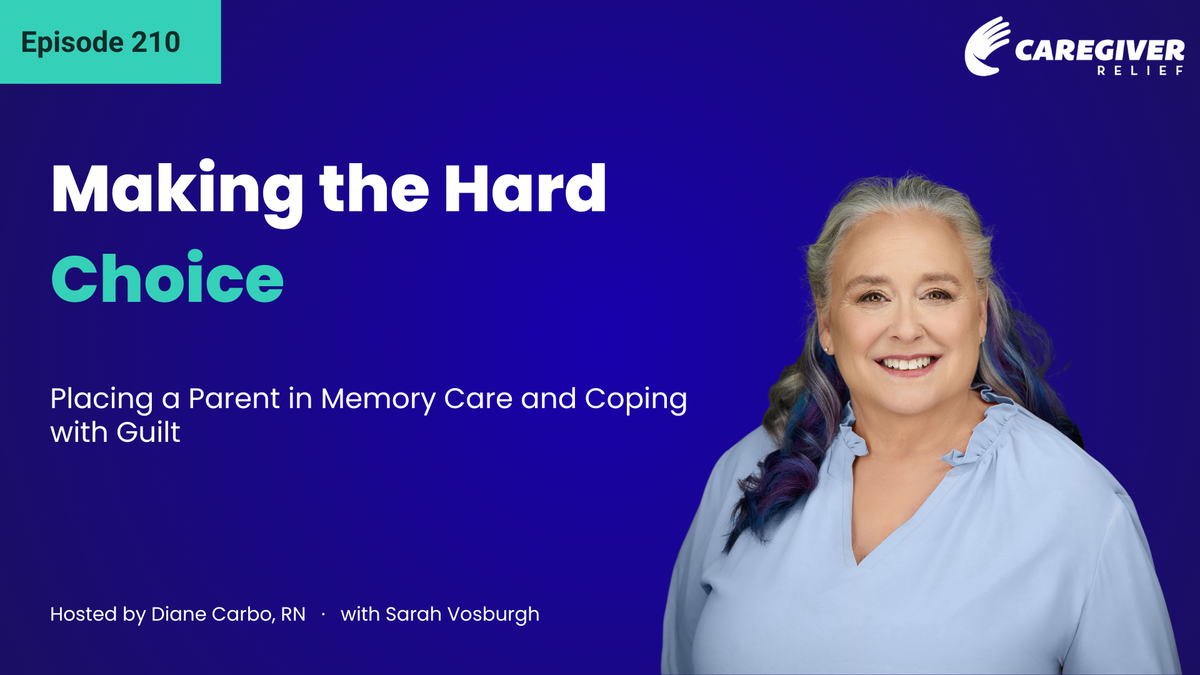
In this episode of Caregiver Relief, host Diane Carbo, RN, sits down with Sarah Vosburgh, author of the deeply moving memoir Who Will Name the Bees. Sarah opens up about her personal 15-year journey with her mother's cognitive decline, the systematic failures of the traditional memory care model, and the liberating power of self-forgiveness.
Whether you are currently whispering, "Am I doing the right thing?" or navigating the aftermath of letting go, this episode offers a warm, validating space to help you heal.
🎧 Why You Should Listen to This Episode
If you are a sandwich-generation caregiver balancing children and aging parents, or if you're struggling with the emotional weight of an upcoming facility placement, this conversation is an essential lifeline.
✨ Key Takeaways Include:
- The "Toddler" Reality: Understanding why severe cognitive decline requires 24/7 eyes-on supervision, and why safety must trump a parent's desire for total independence.
- Navigating the Red Tape: Crucial advice on dealing with uncooperative family members, dense medical systems, and why you must engage elder care attorneys early.
- Exposing the "Social Model" Flaws: A candid look at why many traditional assisted living facilities fail behaviorally challenged residents by prioritizing their own routines over person-centered care.
- The Gift of Self-Forgiveness: Moving past the impossible promises we make to our parents and realizing that stepping away from the daily caregiving role is often the ultimate act of love.
📋 Episode Outline & Highlights
📌 Introduction & The Story Behind the Bees
- The "Rally" Moment: Sarah shares the touching Mother's Day memory that inspired her book's title, capturing a beautiful, childlike window into her mother's fading world.
- A 15-Year Horizon: The gradual, often invisible progression of dementia, and how past traumas (like losing a spouse or undergoing chemotherapy) can accelerate a parent's decline.
📌 Independence, Driving, and Tricking the Neurologist
- The Car Key Illusion: A brilliant, practical strategy Sarah's husband used to handle the explosive battle over the car keys by disabling the battery while leaving the physical keys intact.
- Fierce Resistance: The extreme measures families often have to take to get an independent parent to see a specialist or transition into care.
📌 When Memory Care Fails & The Behavioral Health Unit
- The Routine Trap: How Sarah’s mother—a lifelong night-owl who loved to "soldier around" after dark—was rejected by a facility that demanded a quiet unit from 9:00 PM to 7:00 AM.
- The 72-Hour Hold: The whirlwind experience of having a parent declared incompetent by a psychiatric Alzheimer's unit, and the relief of finding staff who finally accommodated her mother's unique schedule.
- Overlooked Medical Issues: Diane highlights how often sudden "bad behaviors" in memory care are actually unaddressed physical ailments, like severe Urinary Tract Infections (UTIs).
📌 Family Dynamics, Scams, and Legal Planning
- The "Out-of-Town" Sibling: Navigating judgmental family members who don't help with daily care but show up with their hands out when it's all over.
- Protecting the Assets: Why a trust, will, and advance directives are critical by age 50 or 60 to prevent financial exploitation from bad actors.
📌 Processing Grief Through Writing and Poetry
- The Sharpie on the Nightstand: How Sarah coped with midnight insomnia by writing down memories on a glass-topped table to process the "cream cheese and olives" pressure of being a sandwich caregiver.
- A Multi-Generational Audiobook: Sarah reveals the beautiful structure of her memoir and how her two daughters joined her in the recording booth to read the poetry sections, cementing a true family legacy.
💡 Notable Quotes From the Episode
"Choosing memory care is not about walking away. Sometimes it is the most loving decision a family can make when care needs have grown beyond what one person or even one family can provide safely at home." — Diane Carbo, RN
"It's an amateur business raising children. It's an amateur business becoming a parent to your adult parent. Nobody does it right... You need to forgive yourself that you're not perfect." — Sarah Vosburgh

🔗 Connect & Resources Mentioned
- Sarah Vosburgh's Website & Memoir: Who Will Name the Bees (Available on Amazon, Barnes & Noble, and Audiobook platforms).

To our incredible family caregivers: you are the most important part of the caregiving equation. Please be gentle with yourself today, practice self-care, and remember that you are worth it. 💜
Have you faced the agonizing decision to place a loved one in care? What strategies helped you cope with the guilt? Let us know in the comments below!
Podcast Episode Transcript
Diane: Welcome to Caregiver Relief. I'm your host, Diane Carbo, RN. Today we are talking about one of the hardest decisions a family caregiver may ever face, placing a parent in memory care. Even when you know your loved one is no longer safe at home, even when the wandering, confusion, falls, sleepless nights, or constant supervision have become too much, the decision can still feel heartbreaking.
Many caregivers describe it as guilt, failure, grief, or even betrayal. But choosing memory care is not about walking away. Sometimes it is the most loving decision a family can make when care needs have grown beyond what one person or even one family can provide safely at home. My guest today is Sarah Vosburgh, author of Who Will Name the Bees.
Sarah is a writer, a poet, a memoirist, and a lifelong lover of literature. Her writing is shaped by memory, family, identity, and the emotional weight of life's most difficult transitions. In this episode, Sarah shares the deeply personal experience behind making the hard choice to place a parent in memory care, and the guilt that so often follows.
We will talk about the grief of letting go of the caregiving role you thought you could carry forever, the emotional conflict families face, and how caregivers can begin to forgive themselves when safety, dignity, and care require a new setting.
For every caregiver who has whispered, "Am I doing the right thing?" This conversation is for you.
Diane: Sarah, thank you so much for joining me today. I am excited. I love the, your memoir, Who Will Name the Bees. it's such a powerful title. What does it symbolize, and what inspired you to write that story?
Sarah: For starters, that particular story about naming the bees, or the whole thing?
Diane: Yes. Okay.
Sarah: The whole thing. for starters, thank you for having me. It's an honor to be here, and I appreciate your listeners' time and so on in, paying attention to this podcast. So there's that. Who Will Name the Bees is the title, which I find, is often when I read stuff that's out there, I find myself wondering why an author picked a particular title.
My readers won't be confused about that. It's very clear, but in short My mom found out, we were talking about our gardens on her last Mother's Day. We were talking about our gardens, and she was very with it, the last time she was with it, and the first time she had been with it in a long time. It was a rally experience.
And we were talking about gardens, and we got through talking about it. My husband was there, my kids were there, and, it was busy because it was Mother's Day, so it was busy at the memory care facility. And, we got through talking, and we were sitting in a companionable silence, and then she said, "So tell me about your gardens this year."
And I was prepared to go through the whole thing that we had just gone through, thinking that she was asking me about something that she didn't remember we had just talked about. and so I started over again, and she said, like really annoyed with me said "No, tell me about the bees." And we had decided the previous fall that my husband and I were gonna keep bees.
We were trying to help the bee population and so on. And so we were gonna keep bees, and I had talked to her about it over the year, but I didn't know how much of it she remembered. She hadn't asked me about it before or any of that, and she didn't tend to remember new pieces of information.
So I was a little surprised, more than a little surprised that she asked, and so I started telling her about them and telling her all the things that I had told her before that she didn't remember. And she asked how many there would be, and I said, "We're gonna have two hives, two nucs, and so there'll be somewhere between 40 and 50,000 bees."
And she said "Oh, Sarah, 50,000? How will you find names for them all?" And it was a precious moment in its innocence, right? And if a child had asked you that, you wouldn't think anything of it, and you would answer them. And you know that you probably wouldn't name them whatever. It was a window on her lack of understanding and how childlike she had become in so much of her thinking, even though she was having a very lucid day.
She knew 50,000 was a lot, and I just said, "I don't know, Mom, I guess you're gonna have to help me." And she said, "Yes, I guess I will." And so that was, that's the title and that much of that little story that's in there.
Diane: You memorialized that, that, that memory for forever. I love that. I did indeed.
Sarah: That was a precious gift.
Diane: Yes. Yes, a very precious gift. when your mom was diagnosed with Alzheimer's, how did that change your relationship with her?
Sarah: It didn't. I, she wasn't diagnosed with Alzheimer's until, maybe three, four weeks before she left for memory care. I could not get her to go to the doctor.
She resisted going to the doctor for much of anything because-
Diane: Yeah
Sarah: I think on some level she knew that she was going to be losing some autonomy, and she was fiercely independent and didn't want that to happen. And I think at some point she forgot why she was resisting it, but the desire to resist it was still there.
And so we tricked her into going to the neurologist. But at that point we already had her scheduled to go into memory care.
Diane: So you knew she was having cognitive issues, and you knew that you, I'll tell you what, so many families do have to lie to their loved one about going to the neurologist or, even when they're admitted to memory care because of just what you're saying.
They're so resistant. they fear loss of independence. They want to stay home where it's comfortable, and yet it's just not possible or safe anymore. four weeks before she went to memory care is amazing. So you must have seen a lot of changes over a long period of time.
Sarah: I did see a lot of changes over probably a 15-year period of time, but the last five years were the worst.
Diane: The worst.
Sarah: And, I forgot what I was going to say. Yeah, that menopausal moment.
Diane: I have them too. Now I want to ask, it sounds different for you, but most caregivers describe a gradual shift from the daughter to decision maker. What was that transition like for you? It sounds like it was very sudden.
Sarah: So she was remarried. my dad died when she was in her late 50s.
And she remarried a couple of years later. And, I refer to him as the creep in the book because none of us were comfortable with him. We all felt he was kinda creepy and all of that. And, She had already begun a decline at that point.
Looking back on it I can say, with relative surety that she had already begun at that point, and it may have been brought on by the trauma of losing my dad, which does happen with Alzheimer's when there are traumatic events or big events. They can make things downturn earlier on.
She did have chemotherapy, only a few years before that, and the contribution of chemo brain
Diane: Yes
Sarah: to, that also was an issue. But she was living with him, and he was, totally unworried, in denial, and went along with everything as she got befuddled. and until it became an issue of dignity or safety and he wasn't managing it, I did not step in.
You can't and she would've, she Exactly, you can't.
Diane: You can't.
Sarah: and I couldn't. She wouldn't have let me, and he wouldn't have let me.
Diane: Yes, yeah.
Sarah: But it got to a point where she was not manageable.
Diane: And that's hard for families to accept because they don't understand that unless your parent is deemed incompetent, they still have the right to refuse anything and everything, and it is an issue.
And I also want to, make another point to my listeners that, the signs and symptoms of dementia can actually occur up to 20 years before an official diagnosis is given. So depending on the type of, dementia, and some are very slow, moving, you can see. In fact, a lot of people get divorced because the changes that happen with dementia, only to find out years later it wasn't the person, it was the disease that was changing them, and that's really hard for many to accept and understand.
Sarah: You touch on a couple of points there that are, important to my, m- my mother's story. Number one, my grandmother had Alzheimer's, and, she didn't begin to really deteriorate until I was old enough to be very aware of what was going on, and watched my mother deal with that. So I had a blueprint from my mom about- what was acceptable because she was also, a fiercely defensive of my grandmother and wanted to help my grandmother maintain her independence for as long as possible, and it went longer than it should have gone. my grandmother was living by herself. She forgot to turn off the water in the faucet.
She forgot where the bathroom was. So Yeah, there's that. My grandmother's brain and my mother's brain were both donated to the local university hospital. so they're there, and mine will probably join them at some point 'cause I'm thinking that this is a legacy that I am not happy about, but it's likely, although I do have two generations of different genetics, mixed in there.
But then, when I did put my mom into memory care They wanted to go through a series of interviews and so on and so forth with her. And she wouldn't tolerate going there to be interviewed because, she didn't need to be with those old people, right?
Diane: Yep
Sarah: And she was just fine, as far as she was concerned.
So they met her at a restaurant with her husband. and while they were interviewing her, he gesticulated a lot, talked with his hands, a lot. And every time he brought up his hands to speak, she cowered in the corner of the booth that they were sitting in.
Diane: Oh.
Sarah: And they decided from this that there was a likelihood that she was being abused.
Diane: Yeah.
Sarah: And so they called me and said, "We're moving up her entrance date."
So it got moved up from, six weeks from where we were to two weeks from where we were to protect her safety. Yeah. So but the whole all the issues around putting her in there and so on, were all very, the legal issues were all very gray.
They were all very nebulous. Honestly, my mother probably could have walked out of there at any time except she was locked in.
Diane: Yeah
Sarah: but I'm not sure that they could have done anything about it. but, at one point she became too difficult for them to manage. and there's a story in that too, and I will happily share it with you.
But she was angry, and she wasn't particularly docile, and she was very independent, and she didn't wanna do what she needed to do when they told her to do it. And, she didn't wanna eat dinner when they ate dinner, and she didn't like what they had for dinner, and on. She wouldn't sit and watch TV.
She never did that, for as long as I can remember she never sat and watched a TV show from one, from the beginning to the end. And so she just became difficult for them. And one morning it came to a head, and they ended her up shipping her across town to the psychiatric Alzheimer's unit.
Which if you think the Alzheimer's unit is, challenging-
Diane: Bad. I've worked senior behavioral health. I know.
Sarah: Yeah. It's pretty awful. The older people with their noses pressed against the windows looking at the outside world where they will never be again.
Diane: Yeah.
Sarah: And so and they have to all be shooed away from the door before it can be opened to let visitors in and stuff like that. It's really disheartening. So there's that. Happily, I will discuss those stories with you if you like. My mother, one of the things in this whole process, you watch them go in bits and pieces.
Diane: Yes.
Sarah: And one of the things that my mother insisted on was driving, and I know a lot of people have this problem
Diane: Oh my lord,
Diane: yes with their parents in that they don't wanna give up the ability to drive, and they don't wanna give up the autonomy that goes with it.
bless my husband for paying attention, because I was so wrapped up in that situation, emotionally wrapped up in that situation. My mother was driving left on the road. I guess she thought she was in the UK or something, I don't know. But she was driving on the wrong side of the road, and if you told her she was driving on the wrong side of the road, oh my lord, she would just tear you up one side and down the other.
And she knew how to drive and so on. So we got to the point where we just said, "Oh, we're going the same place you are," "Can we take you?" kind of thing, even though we were going way out of our way to pick her up. And so we did that, but, there were a couple times that we mentioned maybe giving up her car, and she was like, "You're not taking away my keys.
You're not taking away my keys. You absolutely may not take away my keys. I'm not giving up my keys." it went on. and my husband finally realized that I'm sorry. My husband finally realized that, she was literally talking about her keys, by that point in time, because everybody'd been driving her and taking her places and everything, she didn't associate her keys with driving the car.
They just were, for whatever reason, associated with autonomy. And so she wasn't giving them up. And he said, "Leave her keys in the drawer where she keeps them. Let's dismantle the car." So he took out the battery, put a note in the battery cavity for whoever came upon it to please, take it to the
if, my mother had called them or something and said, "My car won't start," and they, not to say, "Oh, you have no battery in here," just to take it to the gas station down the street and let them. And they knew about it, and we talked to them. And then they told me, at the gas station down the street, they told me that they had done this for several other people.
Diane: Yes.
Sarah: And I'm like
Diane: yes
Sarah: I never knew this. I didn't know this kind of thing happened. I didn't know that, you know gas stations or, repair shops were in cahoots with everybody to take independence away from people who needed their independence
Diane: Now you'll know the secret.
Sarah: but it's too late. Like you go through it. so there's that isolation too. You don't know what you don't know, and you don't know who to ask these questions. so anyway, when she got moved to that second facility, the one that was a psych facility, Alzheimer's psych unit, they put her on a 72-hour hold because she had been so difficult at the other place.
And they put her on a 72-hour hold, and in less than 72 hours they had her declared incompetent. They took care of the legality of
Diane: Yep
Sarah: of every little piece. And
Diane: Yeah ...
Sarah: I was stunned. Like I had whiplash because I had been asking for help apparently in all the wrong places. But
Diane: Yeah
Sarah: I had been asking for help from the town social worker, from my church, from, not the, r- repair dude at the end of the street.
but her doctor, her PCP who said, "Oh, your mother's just lovely. just offer to drive her places and don't worry about it." And I tried to explain to her what was happening to her at home, and how she wasn't safe there, and how she'd go wandering out onto a secondary road where she didn't belong, where no one belonged walking, that kind of thing.
And she was just like, you'll just have to keep an eye on her. you can do that." And I don't think people realize unless they're going through it, that it's very much dealing like with dealing. It's very much like dealing with a toddler. You have to have eyes on them all the time.
Diane: Very big toddler, and a one that can change their mood in a matter of a second.
Sarah: On a dime.
Diane: On a dime, yes. You know what's sad is the first place she was, the first memory care, they let, and this happens all the time, they let you down. They kept, they try to have our, the patients or the residents in assisted living be according to their routine, and they don't, make it are not flexible in any way.
And if they could just let them have their own routine and consistent people caring for them, they wouldn't have those bad behaviors all the time. And that's one thing that, you have to address. the other thing is denial is such a huge, it's a coping skill that we as humans use even in the depths of dementia.
And, I know the challenges with driving is probably even harder to deal with than it is to get them in a facility. And I'm sad to hear that you were challenged. And I've heard this so many times, when you want to have somebody deemed incompetent. Nobody really wants to do it. But the No
that, in senior behavioral health, that was a common thing we did. We had to get them deemed incompetent so we could provide, safety and continue to provide them some care with dignity. and it's really challenging. So yeah, and once they are deemed incompetent, then you're, you have a say in their care as a power of attorney.
But before then, you're screwed. It's just if they're challenging. And one of the most challenging things that I see is that the, our, we don't have enough facilities to take care of the, those that are behaviorally challenged. We just don't. And, so I really get frustrated with that because I think that a lot of assisted livings, they say they're a locked unit is all they are.
Many of the staff don't know don't have behavioral skills or, are trained in any way, and it's very frustrating. I know I was a DON of a very posh, upscale assisted living, and our memory care, I made them have a activities in the unit, in the memory care unit 24 hours a day. If somebody's up moving around, then there are people that don't want to have to watch TV, and I think that's offensive that they want
You hit the nail butt.
And watch TV. Yes. Yes.
Sarah: You hit the nail on the head. My mother, hadn't slept well at night for a very long time. Probably since I was in my late teens. She was always up, what my family referred to as soldiering around, and she'd get up and she'd do things. She'd get up and she'd be productive, or if she was really tired, she would listen to music, or something along those lines. But she always did it quietly and so on. And when she was in the assisted living memory care situation, they weren't interested in that. They wanted her to sleep at night. They wanted the unit quiet at night where everyone was sleeping from, 9:00 to 7:00 the following morning, or whatever the hours were
Diane: Yes
Sarah: that they wanted that. And my mother wouldn't do that. And one of the things that happened in that psych unit was they accepted that she soldiered around, and they didn't care.
Diane: Yes
Sarah: And there was a sweet nurse at, that worked nights there who I met in the elevator one day. and she asked me where I was going, and I told her, and she asked me who I had there, and I told her.
And she said, "Oh, I love your mother. I talk to her all the time at night. She always comes out and visits me. She doesn't sleep much at There you go. And so it wasn't until she was there under those circumstances that she was able to follow her own schedule
Diane: Yeah. Yes. And what, I want you to know that assisted living is based on a social model, not a medical model.
So the people that are receiving care are supposed to be able to direct the people on what their care should be. And that doesn't occur in assisted living. I find it highly offensive, and it makes me crazy because, in the middle stages of dementia, many have sundowning, and they don't sleep.
It's a sleep disorder. So what do you do? you should offer, music, s- calming music, dimmed lighting. If they want to play cards or they want to play a game, help them. give them something to do. I used to make my staff take laundry baskets for the little old ladies and men that would sit up at night, get up at night, fold clothes.
They would fold towels, and I would tell my staff, "Once they fold them, you unfold them and put them back in the basket so they keep busy." And it kept people busy. And another one, a family was very offended when, their mama loved to clean. And, she was what? A little Italian lady, and she liked to clean, and she'd be doing the windows.
So we gave her a hand, a mitt that she could, to dust and stuff. And she was just happy going around cleaning the facility. And they were offended that she was so happy. And it met her needs and kept her from having bad behaviors. I had, a, about two years ago, I had a call from a man whose mother I had helped bring from New York to, South Carolina, during COVID.
She was having dementia, and he wanted to bring her closer to home. So I got her down here, and, we placed her in assisted living. And he says, "Oh, I'm good. Everything's placed." And I said, "You'll be calling me again." And he goes, no, I won't." He goes, "I don't need to now." I said, "Trust me." I said, "You'll be calling me."
And he contacts me, oh, months later, maybe six or eight months later, and he goes, "They're kicking my mom out of assisted living." I said, "Why?" He says, "Her behaviors are so bad they can't control her." And I said, my first response is, "Did they check her for a urinary tract infection?" And he says, "I don't know."
And I said, I said, I'm gonna give you two things to do. I want first you ask if she's not, if she's been checked for a urinary tract infection. If not, get her tested." I said, "The other thing to do is if she's having that kind of bad behaviors and it's not due to a urinary tract infection, then ask, take her to the ER and have her admitted to a senior behavioral health unit because that will help you, identify what's going on."
But turns out that she had been having bad behaviors and was close to being septic, that she was in the hospital with a urinary tract infection so bad that she needed IV antibiotics for a week. And
Sarah: Wow
Diane: This is why I have issues with assisted living, especially memory care, because you're paying these big bucks to people that really don't understand what's happening in the building.
and
Sarah: Nor do they understand, what's been taken away from people. I can tell you
Diane: Yeah
Sarah: two things right off the top of my head that my mother lost the minute she walked into memory care. One was the ability to take a bath because they did not have baths. My mother did not take showers.
Diane: Yeah.
Sarah: She took baths, all the time. She enjoyed them. It was her peace of quiet, on the regular, and it, she missed that. She wanted to take baths.
Diane: Absolutely.
Sarah: And the other thing was her kitty.
Diane: Oh.
Sarah: And the ability to sleep with or cuddle with or pet her kitty which was never gonna happen in memory care.
So one of the reasons for writing the book, there are many, but one of the reasons for writing and publishing it is an attempt to give families the support that they need to make
Diane: Yes
Sarah: good decisions for their loved ones.
Diane: Yes.
Sarah: And to not feel so alone because I felt very alone in this process, especially reaching out for help and not getting it.
And then, to feel validated in the decisions that they make, knowing
Diane: Yes
Sarah: that they've done the best they can with the information that they have and the services available to them.
Diane: I want to, tell my listeners, if you have a family member like your mom that loves kitties or loves dogs, they do have robo creatures now that look very real, and they don't have, you don't have to worry about potty training them or anything.
And, it's, a good replacement for somebody with dementia. 'Cause a lot of them go for people get offended when they when you say baby doll therapy. when they retreat back to their younger days, they want to nurture. They want to something to love. Whether it's a baby or a pet, it doesn't matter as long as they have something that comforts them, and that's really important, I think
at, now, what advice would you give to caregivers who are struggling with making this decision right now?
Sarah: To be relentless in their reaching out.
Diane: Yeah.
Sarah: To find a support group. and that support doesn't need to be a formal support group. My husband and my bestie supported me, every step of the way, through this, and I couldn't have done it without them.
A lot of it, while I can't say that I was in denial, because I was accepting of what was happening to her, I also couldn't think about it. The tears were very infrequent, and they were more often out of frustration for not being able to get her for her not being cared for the way I romantically thought she should be cared for, which I couldn't do.
So there's that. the, there's the other side of that. I can't do this anymore. I can't help you through this. Someone else is gonna do it, but I only want it done the way I think it should be done. So there's two sides to that coin.
Diane: And you're also grieving the loss of your relationship with your mother- and the loss of, as you said, you romanticize what life will be, and you think, you're gonna, she's going to go off into the wilderness and live happily ever after, and it doesn't happen that way.
Sarah: Or sit in a rocking chair in my kitchen and talk to me
Diane: Yes
Sarah: while I'm cooking, which my mother
Diane: Yes
Sarah: wouldn't do. but, just like she wouldn't watch TV. Yes. Yeah. It wasn't realistic.
Diane: Yeah.
Sarah: Helping people understand what it's all about, doing your research ahead of time, talking to your loved one before they may go downhill about what they may want and so on, like, when they're still really rational, To be able to say, I, and I know there are plenty of situations where parents have said to adult children, "Oh, don't ever put me in a place like that," or, "Don't ever do that."
And that's a whole nother ball of wax. my mother was in great denial about what was happening to her, so she never acknowledged that
Diane: Yeah ...
Sarah: anything was happening, so we never had those conversations, 'cause-
Diane: much of the caregiver it happened down guilt I, I see happening is, families make the promise.
"Don't worry, Mom, we'll never put you in a nursing home. We won't put you in memory care. We're gonna keep you home until, you pass." And I can tell you right now, I have an elder care communication course, and one of the lessons is making promises. Because when you make promises like that, you don't know what you're promising, what you're saying.
Because as dementia, continues on and, they start losing more and more of their skills, they could become aggressive. They could become abusive. They could become, sexually inappropriate. They could become, harmful to themselves or others. There's so many things that you don't consider, and families don't even consider that incontinence and cleaning them up, is something.
Like you said your mom couldn't find the bathroom. I can't tell you how many times I'm gonna be bad here. How many times I've found a man in dementia care watering a tree.
Sarah: Sure. Sure. It's because they And my, like I had said before, my mom was living at home with her second husband, and this was a long a long process for her, little bits and pieces at a time.
But one of the seminal events was that, that I knew she wasn't safe at home was that he didn't. He wanted to be independent in his day also. He didn't want to be watching her like a toddler, right?
Diane: Yeah.
Sarah: So she went to walk down the highway, and he didn't know she was missing. She had, breast cancer and had surgery, and he was feeding her leftover Big Macs from the refrigerator.
That might be high food. That's not sick food. so those kinds of things. And then, I can tell a graphic story, without being too graphic, I think. There was one morning that, just before she went into memory care, she was already slated to go in.
It was in that two week period after the meeting at the restaurant. and I had called the house just to talk to her, which I did every morning, and, he answered the phone and he was very hoarse. and I asked after him because I was absolutely not rude to him. under any circumstances, even though we weren't really fond of him.
But these kinds of, this story that I'm gonna tell you there are other stories like this, some of them worse.
Diane: Absolutely.
Sarah: I said, "Are you okay? do you have a cold or something? Do you need some help with my mom?" So on and so forth. And he said, "No, I'm hoarse because I was up all night yelling at her."
Diane: Ugh.
Sarah: What? You were up all night yelling at my mother who, can't have three exchanges in a conversation on the same topic, you were yelling at her? I'm like, "What are you talking about?" He said, I had to set her straight, but it was worth it because we had great makeup sex this morning."
Diane: Oh. Yes.
Sarah: And Diane, we're talking about consent here. yes. I was so grateful at that point that she was going into memory care. And as unhappy as I was with memory care, I at least knew that was unlikely to be happening, or-
Diane: Yeah
Sarah: at least we can all hope that. So this is one of and there are other stories like that in the book
Diane: Yeah
Sarah: that indicate, issues with her safety and her dignity and her, sense of self and so on that are, that were disturbing.
Diane: Yeah. I've heard stories like this so much. And, I've even had family members call. you have to maintain that, line of communications. And if you scream and yell at him and tell him what a jerk he is and, he's an abuse and all this and that, you close the door to him ever letting you back in to your see your mom, and he has the right to do that.
So you have to bite your tongue and be pleasant and,
Sarah: that is exactly what I did under-
Diane: Yes
Sarah: under duress.
Diane: Under duress, absolutely. My reaction would be to reach through the phone and pull him through and choke him. But you can't. And I also had a situation where, my dad was dying of cancer, but my stepmother was very controlling, and it was very hard for me because, I knew what my dad needed, and she didn't have any healthcare experience, and she just told me I didn't know what I was talking about.
And I just did what I had to do to be able to oversee my dad's care, and that wasn't even with dementia involved. But I understand, with dementia it's so much more strain. I've had families call, the, adult protective services, and adult protective services will go in, and they'll overlook things and say, "Oh, they're fine.
We can't do anything." So it's like a wasted visit. So I know families get so frustrated, and it
Sarah: I couldn't even get adult protective services to there wasn't
Diane: Yep
Sarah: there wasn't a whole lot of elder care adult stuff going on at the time, Yeah.
Diane: Yeah.
Your story touches on complicated family dynamics and past traumas.
Sarah: But honestly, everybody's got a story to tell like that with some sort of complication, right?
Diane: Absolutely.
Sarah: Whether it's the I'm an only child. There were friends of mine who said to me, "You're so lucky because you don't have to get everybody in the family to agree about what you're gonna do about your mom."
Although I had to put up with the creep. But, there are all kinds of complications when this sort of thing happens, and you get the whole, you get the out of town sibling who comes in and thinks that they know how to manage every little thing that's going on, and the other siblings get angry and so on.
So there's always dynamic and, the Alzheimer's just exacerbates the whole thing.
Diane: Yeah, it does. And I will tell you right now, they, it, there's always uninvolved siblings and extended family members that are judgmental and, even abusive to the primary caregiver. And they don't want to be involved in the care.
They don't, they just want to tell you what they think you're doing wrong or what you should be doing, and they won't support you or help you in any way. And, then but when the person dies, oh my lord, they're we'll tell you right now. They're involved
Sarah: They're right there with their hand out.
Diane: Yes. Oh, hand out?
They're in there picking the bones off the and leaving the poor caregiver. I can't tell you how many caregivers lose the place they were living and have no money because the family has disowned them and said, "You're out." I, there's so many ugly things that happen.
Sarah: And I, the book touches on those kinds of ugly things
Diane: yeah
Sarah: that happened in our situation too.
Diane: Yes.
Sarah: My mother was left with, nothing, which should not have been the case relative to her planning. And I will say there's also, if there's the legal aspect of this, and I touched a little bit on the incompetence thing to having her declared incompetent, which was not done by her own attorney.
I had sought out the help of her attorney to see if there were some things that we could do to protect her and so on. He would, he was exactly her age. he was born the same year that she was, and he was of sound mind and body. and he was not interested in taking away any of her autonomy.
And of course, he didn't see her all the time. So he'd come out to the house to visit or she'd go into the office to visit him, and he thought, maybe she was a little befuddled, but much like the doctor, she's fine. It'll be fine. It'll be okay. He did not want to do any of that. And There's a piece of advice for people who are going through this also.
Get involved with elder care attorneys early
Diane: Yes. Yeah
Sarah: while your loved one can be a part of that
Diane: Yeah
Sarah: and make decisions in advance for what's going to happen with them. Because were my mother told what was going to happen, she would have protected herself better.
Diane: Yes. people, I will tell you, getting them to an elder care law attorney is really hard.
But I hear stories of accountants who have, worked with these clients for forever. Families are stealing from them. The caregivers are stealing from them in, when they're getting care in the home, and they ignored it. I just did a podcast, about a few weeks ago with a man who's, was in banking, and his mother was in another state, and the caregiver stole a million dollars over four years.
And there was no oversight. People thought maybe things were not right, but nobody did anything or address it. it's really important that I encourage everybody to get, In fact, I tell people to start early. I feel that you need an advance directive from the age of 18 years and older, because you just never know what's gonna happen.
But I want people with advance and you review those advance directives every 10 years. You should do it yearly, people aren't gonna do it yearly. But what you want at 18, and 30, and 50, and 80 are two different things. So you really need to review that. And I really think that,what we're having right now, Sarah, is a, Medicare has moved to a cost sharing platform so that we are going to be more personally responsible for paying for the recommended care and services.
So I encourage people, the, if you're in your 50s or 60s, get that trust in place. Look and see how you could protect your assets. Put, get a will in place. Put things in place so that you can protect yourself as you get older because you don't know what evil lurks out there, and how you may not be in a situation to protect yourself.
Sarah: Indeed. Said.
Diane: Thank you. you beautifully explored both the fragility and power of memory. What did this journey teach you about memory and identity?
Sarah: A lot actually. it, first of all, it taught me about my role of storyteller in the family, which I really hadn't, wrapped my arms around.
And the relationship between that memory and family legacy is a pretty big deal. so Prior to my mother being sick, my kids grew up with family stories. and I think all kids grow up with that, but I was very mindful about what I said. And when I told stories, I told them over and over again in the same way, and so on.
So much of those stories are, many of those stories are in the book. There's plenty more where those came from. But, yeah, it really got me in touch with that role as the storyteller, the family storyteller, but also with how that storytelling is ever so much a legacy. Yes. And I think you don't think about that until.
I didn't think about it till all was said and done.
Diane: I wanna point out to you that we have a, at the Smithsonian there's an organization called StoryCorps. And
Sarah: Yes with StoryCorps
Diane: Are you? And I just wanted to say, you're writing your stories down, God bless you, and it's such beautifully written.
But people can actually, tell their stories on audio even. I encourage anybody who has a family member with dementia to start asking them questions early on about their life, or get photos out and say, "Tell me about this," and let the, and record them because, StoryCorps saves those for future
Sarah: Yes, they do
Diane: generations, and I love that. I just
Sarah: wish my They used to be on NPR. I don't know if they still are. They used to be on NPR every morning once a week.
Diane: Yeah. I see them
Sarah: So I wanna say it was Mondays, but I'm not sure
Diane: I see them. I watch, PBS on weekends for my favorite shows.
And, I'm getting to be such a nerd in my old age. Me too. I like quality TV. but they have them every once in a while on there, and I just think that's such a beautiful thing. they actually use the audio of the person that told the story, and they make an animation with it, and it's just, beautifully done.
Sarah: So I'll have to check it out.
Diane: Yes.
Sarah: That sounds lovely.
Diane: Yes. Now, did writing this memoir help you process grief in a different way?
Sarah: Yes, indeed. Remember I mentioned before a few minutes ago that the responsibilities were so thick when they were happening, right? That I was putting one foot in front of the other.
I wasn't really processing it. I was just doing what needed to be done one step at a time. And at the same time that I was doing all these things for my mom, I was raising kids in their tweens. so I, but this happens to lots of people who are
Diane: Oh, trust me
Sarah: dealing with someone with
Diane: I know
Sarah: with dementia.
I was sandwiched right in between. I was the cream cheese and olives between the two slices of toast. and, so I didn't really process a lot until after she had died. And then what happened was I wasn't sleeping well, and I thought I wasn't sleeping well because I was a woman of a certain age.
Diane: Yes.
Sarah: I'm sure you can relate.
Diane: Yes.
Sarah: And, but what was happening was I, it wasn't just not sleeping well, I was awakened in the night with stories about my mom, and I would ruminate on them. I couldn't go back to sleep, and I would just ruminate on the stories until it was time to get up. Or I'd fall asleep, three and a half minutes before the dang alarm went off
Diane: Yep
Sarah: and not get enough sleep, and so on. My husband finally said to me, "Would it be better if you wrote it down?"
Diane: Yes
Sarah: and then, then I was futzing and fuddling around with, paper and a pencil on my night table in the middle of the night, and you gotta turn on the light and blah, blah, blah, blah, blah.
And so he just quietly, bless his sweetheart, quietly measured my, night table for a piece of glass to put on the top, and got the glass to go on the top, put it on there, handed me a Sharpie and said, "Use the Sharpie. Write it on the " My, it happens to be white. So off-white. the Sharpie stood out against the white of the top of the table.
And I'd get up in the, I, first of all, I would do that, and I didn't need a lot of light to write with a big Sharpie, right?
Diane: Yeah
Sarah: so there was enough ambient light for me to be able to get down words, phrases, whatever, to remind me in the morning, or whenever I wanted to be reminded of it, to do something with the story.
So that's how a lot of the stories came about. And I would take a picture in the morning of what I had written overnight, and then clean it off with alcohol, and it was available for the next time I did that. So that was how I processed, everything that had gone on, and that it's a largely how I process.
But it was after she died. I could not, I wasn't in denial about it. I was in hyper-focus about let's do the right thing. Yes. Let's take care of her. And like you said about the memory care thing, I was, I got so annoyed. Like, when she was home before memory care, I would get calls all the time from her husband about, "She's doing this, she's doing that.
Please make her do this or that." I wasn't gonna make my mother do anything when she was in her right mind and when she wasn't. so there was that. But then she was in memory care, and I was still getting those phone calls. You have to tell your mother that she needs to sleep at night." No, I'm, no.
No. No. You have to tell your mother that she the memory care
Diane: failed you.
Sarah: You have... Yeah. They failed you
Diane: miserably.
Sarah: Yeah. "You have to tell your mother that she has to watch TV. You have to tell your mother that she can't talk to the w- nurses." Why can't she talk to the nurses? Isn't she their job?
Diane: That's right. Y- you know what makes me crazy about that, makes my head explode, is that it's a dementia unit. People with dementia have sleeping disorders. they have different behaviors. They, the fact that they want them to sleep, that they should have been reported. they, were not a memory care unit at all.
They were just a locked unit saying that they did memory care, which I see everywhere, and there's a big difference. So yeah, they a good memory care will have the same staff, allow the patient to sleep in and have breakfast later, accommodate their needs. So what if you have to put it in the refrigerator on the unit and heat it up in the, microwave later?
It's okay. Have activities during the day. Every patient, if they love music, should have a music playlist that you can put in their headphones or on headphones or earbuds so that they have music they enjoy, because it can be calming and enjoyable to them, but it has to be from their time, the time when they were younger and whatever they liked to listen to.
There's so many things that a memory care, a good memory care should do but is not doing. So they really did fail you and I'm sorry for that. But,
Sarah: I didn't know enough to do the kind of research that would have been necessary to find all that out. I didn't that's also in part my ignorance, and hopefully people will learn from the book to
Diane: Yes
Sarah: ask some of those questions.
Diane: 99.9-
Sarah: Or your podcast to, you know to understand that there are these things that should happen and can happen. And, having a playlist is not, that's just not a difficult thing.
Diane: No, it's not. And there's so and it's affordable. But the memory care units, they really don't give the families, a chance to, explain.
I want a person-centered care profile. I want people to know, what they like to eat, what they like to do, who their favorite people in their lives were, talk about things so that you have a whole a person-centered profile is you're talking to them as an individual and not as a patient.
They wanted her to be a little soldier.
Sarah: They did.
Diane: Be a soldier and get in line. And it, in memory care, that's unrealistic and just cruel. It's just cruel. And it just shows me that the aides that were working that unit were very lazy, and the administration, I guess in an order to keep them, allowed them to get away with it.
I don't know. But, what role did forgiveness or reconciliation play in your journey?
Sarah: The person I needed to forgive was myself yes for making the decisions that I made, and taking the autonomy away from her, and not knowing all the things that I needed to know when I needed to know them.
So there's that. And it's an amateur business. It's an amateur business raising children. It's an amateur business becoming a parent to your adult parent.
Diane: Yes.
Sarah: And nobody does it right. Like I said before, you make the best decisions that you can at the time with the information that you have, and you need to forgive yourself that you're not perfect.
Diane: And you have to forgive the medical delivery system, because I can tell you right now very few primary care physicians, very few doctors out there actually know about dementia. And they have no clue, and they tell you things that don't make sense and are not helpful to you. That's why you really have to reach out to support groups where you can all share your stories and help one another.
I think that's really important. Or reach out. Sometimes a care coach or care manager can help, or elder care specialist. There is people that you can reach out to. But don't hesitate to, call I always tell people, when you're having a situation in any building, you have an ombudsman. Call them in and ex- and complain because you will get better care and get your issues addressed because it goes the state comes in.
That they call it the state coming in to oversee. And if they have a, an unexpected visit by the, from the state to review everything, it screws them up, and they don't want to, they don't want to be written up.
Sarah: Sure.
Diane: And so many of them should be.
Sarah: And I wonder how much I don't wonder. I know that much of how my mom got dealt with in memory care was, or how I dealt with it, was reactive on my part.
I didn't realize that there was the opportunity to be proactive.
Diane: Yes.
Sarah: And I didn't know the questions to ask, and I didn't know to say, "Please do this or this with or for her." Or that there were an, were ombudsman there that could help out and so on. If your peeps, if your listeners learn, some of those things, I think it will go a long way.
I do wonder a lot about what would have happened had I been better informed.
Diane: I always encourage people to make the administrator of the facility your best friend. Let them know you're there, you're checking on them all the time. If there's a director of nursing, let her or him know that you're there all the time.
And definitely, and get in their face because I hate to say this, I really hate to say this, but the squeaky wheel gets the grease.
And if and when you don't know what you don't know, reach out. I'm thinking about your mom and I'm thinking she was just a busy little bee.
Sarah: She was. Speaking of naming bees.
Diane: Yeah, naming bees. Yes. Yeah, for sure . Yeah. Sarah, who do you hope this book and your story will reach, and, what do you want caregivers listening today to take away from it?
Sarah: I hope it reaches people who are entering into caregiving or know they will be entering into caregiving.
And I'm hoping that they get some validation for what they're doing and some new little pieces of information about what they can be doing, ahead of time. And, knowing that they're not alone and people have been there before them. And, they can always reach out, right? They can reach out to you.
Diane: Absolutely.
Sarah: They can reach out to me at my website.
Diane: yeah.
Sarah: So tell people how they can find you. And also people who've been there already who
Diane: Yeah.
Sarah: Yeah.
Diane: Yeah. So how do people find you?
Sarah: You can find me at www.whowillnamethebees.com.
Diane: I love that.
Sarah: And, that will connect you to my website and my social media accounts.
I'm looking for book clubs to work with if any of your listeners are interested in that, please reach out to us. The book 'll be available at all bookstores and Barnes & Noble as well as at Amazon. And the audiobook is coming out next week on Amazon, Audible, and Apple Books. And the book is split up.
We didn't talk about this. The book is split up. the period of time that I cover is the time from the day that my mother, entered memory care until her death and it's done by month. So I begin in October when she went to memory care. And each paragraph has in the very beginning talks about what is happening with her in memory care in October.
And then the second half is reflections on what has happened in Octobers past in my mother's relationship with me or in my mother's relationship with my girls. and in between that is a poem. they're all written by me. The two prose sections, the beginning and end of each chapter, the prose sections I tend to think of as black and white photos, and the poems in the middle being a Polaroid color snapshot.
Oh, that's beautiful. 'Cause you can say so much more in poetry with a few words, and the poems connect, the two sections. So there's that. I can also be followed on Facebook and Instagram, so yeah.
Diane: Thank you so much. I'm excited about, sharing your book with, my listeners. I think that, it's going to be a bestseller.
Sarah: Oh, thank you. God willing. God willing. the reason I brought, the reason I brought up the structure of the book, relative to the audiobook is that when I did the audiobook, and this is something else that I learned, this was really an important lesson in this process, my daughters read it with me.
So I read that first section, my younger daughter read all the poetry that was in the middle, and my older daughter read the sections about the younger me. So all three of our voices are there. My mother's, daughter, and her two granddaughters are there in that, audible, that,
Diane: That gave me goosebumps
audiobook.
Sarah: Oh. And you know what? It was a lot of fun to do, but here's the thing. When they read it, their emphasis on words was not where the emphasis was in my head, and I realized that was something that I needed to let go of, so I let them do it the way they interpreted it.
Diane: Yeah.
Sarah: Because when people read it, they're not going to hear it in their head the way I wrote it. So that was a learning curve for me. Well and it was fun. And I love, love, loved the way they did it. So if you are, if you are an audiobook person, I think you might find some fun in listening to it, with the three of us.
Diane: I think the majority of caregivers don't have time to read. They to read a book, they actually do listen to audio more than. That's why I do so many podcasts, because they don't want to read, they don't have time to read. And, and I just want to say, you gave your daughters a beautiful gift of you and your mother in doing that.
What a beautiful story that they can pass on to their children and their children's children.
Legacy, it's a beautiful story. Yeah, it's a legacy. Thank you so much. To my family caregivers, you are the most important part of the caregiving equation. Without you, it all falls apart. So please learn to be gentle with yourself.
Practice self-care every day because you are worth it.
Caring for a loved one can be overwhelming — but you're not alone. If you have questions, big or small, our expert team is here to help.
👉 Click here to Ask the Expert
Our Resource section can help you find the information and tools that you need. We have courses, videos, checklists, guidebooks, cheat sheets, how-to guides and more.
You can get started by clicking on the link below. We know that taking care of a loved one is hard work, but with our help you can get the support that you need.
Click here to go to Resource Section now!