What Does an Elder Care Specialist Do? How They Help Families Navigate Aging and Caregiving with Laurette Foggini - Episode 209
An elder care specialist guides families through caregiving, medical decisions, and aging challenges—helping reduce stress, prevent burnout, and improve care outcomes.
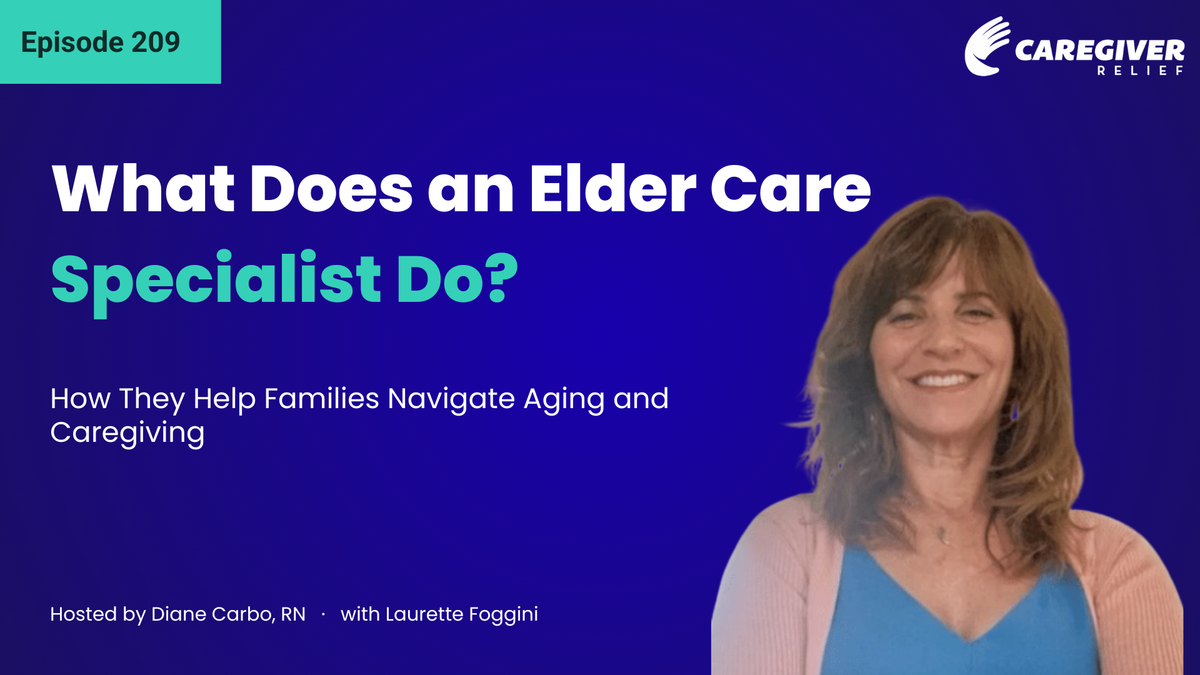
In this episode of the Caregiver Relief Podcast, host Diane Carbo, RN, sits down with Laurette Foggini, an elder care specialist with over 20 years of experience. Laurette pulls back the curtain on how an elder care specialist (also known as an aging life care professional or geriatric care manager) acts as a "professional family member" to bring peace of mind to chaotic situations.
They dive deep into the brutal reality of today’s healthcare system, the soaring costs of care, and how Laurette uses her unique background as a death doula and children's author to support families through the entire lifecycle of aging.
📋 Episode Outline & Key Takeaways
1. What is an Elder Care Specialist?
- The "Professional Family Member": Laurette explains how she steps in when families are long-distance, overwhelmed, or simply don't know where to start.
- Proactive vs. Reactive Care: The differences between managing a sudden health crisis and planning ahead with an older adult who wants to retain control of their future.
2. The Hidden Healthcare Crisis: Unsafe Discharges & Sticker Shock ⚠️
- The Insurance Trap: Diane and Laurette discuss the frightening trend of hospitals discharging patients too early due to lower Medicare and Medicare Advantage reimbursement rates.
- The Real Cost of Care: With agency caregivers costing up to $50 an hour in major hubs (and shifting toward strict 8-hour minimums), preparing financially is more critical than ever.
3. Navigating Sticky Family Dynamics 💥
- Sibling Resentment: How old childhood roles reignite during a parent's decline, and how a care manager acts as a neutral party to unite families around a single, realistic plan.
- The Power of Denial: Overcoming the resistance to dementia diagnoses, giving up the car keys, and managing the rising threat of elder financial fraud.
4. Battling Burnout & Building a "Circle of Care" 🛑
- Caregiving is a Marathon: Why asking for help isn’t a sign of failure.
- The Companion Hack: How Laurette’s brother utilized a friend network to give himself a break while keeping his mother safely engaged.
5. Explaining Aging & Grief to Children Through Storytelling 📚
- Laurette shares the inspiration behind her beautiful children’s books available on Amazon:
- The Song in Lola's Heart (Explaining dementia through a "tired brain")
- The sequel on navigating childhood grief
- The Tale of a Hero I Know (A tribute to the everyday caregiver heroes)
💡 Top Quotes From the Episode
"I think of myself simply as a professional family member. I step in when family members can't, or when they just don't know where to start." — Laurette Foggini
"Caregiving isn't sexy. It's not like having a baby where everyone says, 'Oh, look how cute!' It is demanding, and you cannot do it entirely on your own." — Laurette Foggini
"To my family caregivers: you are the most important part of the caregiving equation. Without you, it all falls apart. So please learn to be gentle with yourself." — Diane Carbo, RN
🔗 Mentioned in this Episode
- Connect with Laurette Foggini: LauretteFoggini.com
- Find Laurette's Children's Books: Available on Amazon (Search: Laurette Foggini)
- Women's Support Group: Adventure Gals SF
👉 Ready to Listen?
Click the play button above to discover how an elder care specialist can help restore sanity to your caregiving journey!
Podcast Episode Transcript
Diane: Welcome to the Caregiver Relief Podcast. I'm your host, Diane Carbo, registered nurse. This podcast is dedicated to supporting family caregivers with practical tools, expert insight, and real conversations with the realities of caring for aging loved ones. But before we begin today's episode, I want to ask you a question.
When a loved one begins to decline physically or cognitively, who helps the family figure out what to do next? Many caregivers suddenly find themselves managing medications, doctor's appointments, home safety concerns, and difficult decisions about long-term care, all while trying to balance their own families, careers, and responsibilities.
Most caregivers step into this role with very little guidance, but there are professionals whose entire role is helping families navigate these challenges and develop a clear plan for aging and caregiving. Today, we're talking about elder care specialists, who they are, what they do, and how they help families navigate the complex world of caregiving.
Joining us today is Laurette Foggini, a highly respected leader in the caregiving field with more than 20 years of professional and personal caregiving experience. Laurette has guided hundreds of families through the challenges of aging, dementia care, and end-of-life support. Today, she's going to help us understand what an elder care specialist does, when families should seek their help, and how these professionals can make the caregiving journey more manageable.
Later in the conversation, we'll touch on Laurette's work as a children's author, and how storytelling can help families explain caregiving and aging to younger generations.
Diane: Laurette, thank you so much for joining me today. I'm really excited about sharing your information with my listeners.
Laurette: Thank you, Diane.
Thank you for contacting me, and it's a pleasure to speak to you.
Diane: Laurette, can you share a little bit about your journey into caregiving, and what led you to become an elder care specialist?
Laurette: Sure. So I think you just identified before we started this conversation that I've been in it for 20 years, which, ah, I can't believe it.
but- It goes fast ... oh my gosh, does it. But I was looking for, at that time in my career, I was looking for something that had a lot more meaning to me, and at that time, my parents, were starting to we're all aging, right? But I started to see the future of what I might be dealing with, and I joined a home care agency.
And that where we were hiring caregivers and meeting with families and managing care plans, and so I was exposed to what I was going to be dealing with down the road. and it became my first job where it really, I was living it. I was talking the talk and I was walking the walk. as I spent more time in it, I was really walking the walk.
So I was doing that until, then I started seeing the decline of my parents and needed to, help them out more, than I was, I cross- I'm bi-coastal. I'm not really bi-coastal, but I became bi-coastal as a result of my parents in,declining health in New York. So I was doing the long distance caregiving, which gave me a whole different perspective.
As in home care I was dealing with families and talking to them about local services and support, and then becoming a long distance caregiver, of course, I was navigating the whole, what happens when you're not there?
And that's where an elder care specialist or you, sometimes they're called aging life care professional or geriatric care manager, steps in when a family is not, is long distance, or maybe just needs extra support even if they're close by because they're dealing with all these other aspects of their life.
So that's how I got into it. and as I was dealing with my own personal experience, I started expanding what I did, and went, to a death doula class, so started learning more about the, that end, real end of life, and then also, as a care manager. So yeah, it's been a journey.
Diane: Many families have never heard the term elder care specialist.
So you want to tell us more about your role and what's involved, when you, take a client on?
Laurette: Sure. I think, and there are a lot of terms for what I do. Many people find me through the Aging Life Care, Association. So the way I think of myself, it's simply a professional family member.
I step in when family members can't, or it's they just don't know where to start. Oftentimes I'm consulting with them and I may be helping them fill that role. So people are usually, I get all different types of calls. Sometimes it's because of a situation, a change in health condition and the family member just doesn't know what to do and where to turn, and so they'll call me and tell me, "This is," and they're frantic, right?
Diane: Yeah.
Laurette: Sometimes I get people that are seeing what's down the road, so a family member that's seeing, hey, my mom's or my dad or, whoever it is, we're starting to see and I don't know how to prepare.
And so I would work with them in preparing and understanding what options are out there, for them, whether it's placement in an assisted living community, whether it's bringing caregivers in, what kind of, daycare services might be available, ways, enrichment services also. It's sometimes it's just I'm seeing Mom's more depressed.
She's not getting out. She used to be so social. I don't know what to do. How do I get her motivated? And sometimes it's I'm taking them and exposing them to a lot of those, a lot of those different activities that are available. so it's, and sometimes I'm getting calls directly. Every once in a while I get a call directly from an older adult themselves, which is always to me the most exciting.
Diane: Yes
Laurette: When someone's actually taking the reins and saying- Yeah ... "You know what? I'm in great health now. I'm 85 years old. I'm in great health, but I met someone just on this, at a coffee shop the other day," and that's, she is that person. I want to know what's, how to prepare. I want to know, I want to be in control.
I don't want my family just to make those decisions. So get all different types of people calling. And all, provide all different types of services. Sometimes it's guidance on how they can be a more active, family caregiver. Sometimes it's actually doing the work on their behalf for whatever reason.
And sometimes it's looking at down the road what it's going to look like. and I also have, an expertise in long distance caregiving, and also, caring for not only an older adult, but someone that has, physical or disability as a younger, person based on my own experience with my sister.
So I do, do talk to a lot of different people in a lot of different situations.
Diane: You also mentioned too you're a death doula, which, that makes you very unique in what you do. can you tell me why you explored that as an avenue as well as the elder care especially?
Laurette: Yeah.
Diane: 'Cause it all ties in perfectly.
Laurette: It does.
Diane: Yes.
Laurette: So I'm not a ... there's different types of, certifications in the death doula world. I took the first step towards becoming a death doula, and like for me, it's just I see it so often. I've, I've met with, I don't know, at this point it's probably 700 families, in different stages of the aging process.
And for me, the death doula, was after my mother passed. I was, spent a lot of time with the hospice nurse, and she had said to- And I saw, my brother is local and with my mother, was there all the time. And it was so difficult for him to face that last chapter in my mother's life. He was very close to her, he was there, and he expected her to live to 100.
And when we said the word hospice, he just freaked out. So I think it was definitely from my own personal experience trying to, relate to people at the end of their life, and also their loved ones dealing with it. and I think the most interesting part of going through that coursework was the importance of dealing with our own immortality, right? Mortality.
Diane: Yeah. Yeah, exactly.
Laurette: It's, we're not going to be around forever, so taking looking at our own death, 'cause every day we're getting closer to that, and understanding how, what we wanted that to look like, was really helpful. So I do bring some of it in to my practice.
And sometimes I think people just need to we don't talk about, we don't talk about death, we don't talk about end of our life, we don't talk about earlier on, and so what I try to do is normalize the conversation and have more conversations, using myself as the main topic. "This is what I've thought about, guys." it was a very interesting-
Diane: Kudos to you for doing that, because, there are so many out there that have n- avoid the subject of death and dying. And, when you have that experience, personal experience, and then you've looked into more fro- in the death doula arena,I like that.
It's more meaningful, 'cause you'll understand things totally different than some that haven't been, had that experience.
Laurette: Yeah. We don't even use the word death, right? We say people pass away.
Diane: Yeah.
Laurette: And when we talk about children, which we'll get into a little later
Diane: Yeah
Laurette: What does that even mean?
Diane: Yeah.
Laurette: Where'd they pass to?
Diane: Yeah.
Laurette: So it's, it is interesting, because even just using the word is unique.
Diane: Yes. it is. It is. Absolutely. What are some warning signs that a caregiving situation is becoming unsafe or unsustainable?
Laurette: A caregiving situation you mean for the act the family caregiver?
Diane: Yeah.
Laurette: It's an interesting question 'cause I think it's always unstable. I do too. I do too. yep. it starts unstable and it just gets more unstable. I think that, you know warnings, there's a lot of warning signs, right? there's the classic warning signs of, for elder abuse, for, hygiene, for, nutrition.
I mean, so many people, I've heard the diagnosis failure to thrive, which you're probably familiar with as a nurse.
Diane: Yeah.
Laurette: But that comes from all of those warning signs are happening, right? All that. And I think people don't they're not looking for it.
Diane: Yeah.
Laurette: So it almost has to smack them in the face.
They get a call from the neighbor that says "Hey, your mom's, walked out without her shoes on the other day." and that's late stage. I think we have to be aware, although we don't want to watch it, but anyone that's approaching, 80 and above, we need to be looking for things, ourselves and others.
And I think so many things as we age cause challenges that we don't address. No one wants to get the hearing aids. No
Diane: Yeah
Laurette: We didn't want to get glasses. At 50 I remember going, "I don't need any glasses," and I couldn't read the menu, right? So I think we just have to be more proactive in understanding that we have to, we may have to use a cane.
Things are going to start to happen. and if we're not looking for it, then someone else needs to be looking for it. And
Diane: Exactly
Laurette: I find that people have such a hard time how many adult daughters and sons I've spoken to that said, "Mom doesn't want to talk about it. Dad doesn't want to talk about it."
Diane: Yeah.
Laurette: And that's really hard, and my advice is always talk about it early, when it's not imminent. Talk about it before and just say, "You're doing me, by talking about it, you're doing me a favor, 'cause I stress out." put it on yourself as the family caregiver.
Diane: Yeah.
Laurette: Don't put it on the other person.
Don't say, "Hey, you're 80, Mom. you're gonna have to move." That's not gonna work. But if you approach it from, "This is something that's causing me stress and keeping me up at night. Can we talk about it early so that I understand what you're, what you want to do and how to approach it?" I don't know if answered your question, but Oh, no,
Diane: That was perfect. Laurette, what I'm seeing, and you probably are as well, we're I'm seeing more unsafe discharges to home than ever before, and it's frightening. And the family caregivers, it could be the first time the senior, or I'm 73. I have people around me in their 60s that are going in the hospital, and, they, because of- lower reimbursement for therapies in rehab.
We used to have 100 days in rehab for skilled care. We still have 100 days, but because the reimbursement is so low, facilities are given a higher level of reimbursement not to provide therapy, and those on Medicare Advantage are being discharged between 11 and 14 days, whether they're ready or not, and those on traditional Medicare are being discharged within the first 20 days, 'cause that's the highest level of reimbursement a facility can get.
And I am seeing some really unsafe situations, and that's why I think it's so important for people to know. 'Cause I think you and I and people that help the aging population are going to get very busy because they're are desperate for help, and they're not prepared at all for what is happening.
Laurette: It, it's Yeah. I agree. I think the challenge is also people don't understand the cost. And that needs, you need to prepare for it, because and you need to get creative sometimes because-
Diane: Yes
Laurette: In-home care, which is what the field that I was in be- Yep ... adjacent to this, I should say is very expensive.
Diane: Yeah.
Laurette: And you need to, that's why you do need to plan. I hired someone like myself in New York when my father was getting discharged, 'cause exactly as you say and they were discharged early, and I was all the way over here, and I said, I have no idea if this is a safe discharge or an unsafe discharge
Diane: Yep
Laurette: or what he's going back to." So I hired someone like myself to go into my home and into the facility and tell me what I needed to do. Now was it cheap? No, it wasn't cheap. But it was cheaper than me putting in 24-hour care
Diane: Yes
Laurette: or having him come home and have this horrible really bad situation.
Diane: Yes
Laurette: So but it does you need, you can't, people can't just go home without anything, and I, and no one wants to ask for help, right? I mean
Diane: Yes
Laurette: The parent doesn't want to ask for help. "Oh, I'm fine." They're afraid of losing their independence, and then they get home and they fall, and they go back in.
Diane: And It's happening a lot. Yeah.
Yes. Laurette, what's happening, what I'm seeing happening is, when you're talking about the cost, people are going to get sticker shock when they see that Medicare has moved to a cost-sharing plan, which means the, if you want the recommended treatment, services, or therapies, you're going to have to pay out of pocket for them.
And right now we have Medicare Advantage programs that are charging $200 to $400 a day co-pay just for skilled care. Ouch. and that's why people are coming home early. It's not sustainable, and we are really in a serious healthcare crisis, because not every senior has that kind of money.
The wealthy will be able to take care of it with no problem, but it's the middle class and poor that are going to really struggle. And the therapy copays, for a lot of, seniors is, 25 to $45 a copay for a session. And what it used to be three days a week for six weeks was pretty much average of what you would get for therapy.
Now, the managed care organizations are, giving six visits for, of six months. And there's really and we are seeing rationing of care. I know personally, I am seeing rationing of traditional Medicare, treatments. Like I, I go for interventional pain management, and I used to get one treatment four times a year.
Because of all the years of nursing, my lower back is really bad. And now I'm only able to, unless I want to pay out of pocket for it, to get it twice a year. So government policymakers are actually limiting they are deterring the use of benefits with high copays and high deductibles. So the sticker shock of that plus having someone like us come in is really, it's going to be, it's shocking to them
Laurette: Yeah.
Well
Diane: It's the, and but it's the wave of the future. We don't have any
Laurette: Yeah
Diane: solutions, so
Laurette: No
Diane: it has to be done. And I also think, your role as an elder care specialist is going to be utilized by, we have so many seniors that never had kids, childless couples, and the solo agers, and they have, they may not even have extended family around them to provide care.
And, so there's all kinds of situations where they need to reach out for help early and get things organized and in place so that when, a challenge comes, a fall, which is, often what breaks the
Laurette: Yeah ... the senior, it, that first fall.
Diane: It also may be the last fall because they may never be able to return home again because of things that, that have occurred. So
Laurette: Yeah That's a really good point. and you didn't even talk about the cost of, having a caregiver. in San Francisco- Exactly,
Diane: yes ...
Laurette: a caregiver is now at, if for shorter shifts, is $50 an hour, which is crazy.
So you're getting it's not crazy 'cause you have to pay them. but it's really not affordable, for many people.
Diane: Yeah. Are, now when they're, you're saying $50 a shift, are you also-
Laurette: No, an hour. An hour.
Diane: Oh, an hour. yes. Yeah. Yeah. I thought you meant, yes, no. $50 an hour.
Is that with the agencies also funds in there? Because agencies
Laurette: Yes
Diane: are charging 50 to 75% higher.
Laurette: Yes. That, yeah. that's what, yeah. Yeah. They're all, that's what they're operating on, most of them.
Diane: Yeah and that's out here in, in Myrtle Beach, South Carolina. We're also seeing those fees.
Laurette: Yeah.
Diane: Yeah, it's just that the in-home care, the unskilled caregiver.
Laurette: Right
Diane: And there's also a shortage of them, so when you get one, you better treat them like gold.
Laurette: And that's what here, for instance, 'cause I ran this, for a region- people would ask for four-hour shifts, and I had to prepare them and say, "You probably are gonna lose this caregiver because they're all looking for longer shifts."
So
Diane: Yes
Laurette: four-hour shifts. So then you're looking at, the price goes down a little bit, but if you want to keep them you're looking at eight-hour shifts, which sometimes. So it's incredibly expensive. but without that we call it unskilled, but it's actually, I tried to do it myself, and I gotta tell you, it felt pretty skilled, that a skill that I didn't have.
I mean toileting and ambulation and, changing adult briefs, it's really hard.
Diane: Yeah. Yes, it is
Laurette: and it's interesting you brought up the point that there's so many people that don't have the adult children, and I just wrote a post on LinkedIn specifically about that, 'cause I have a son, and my point was he's not in my circle of care, because when I'm gonna need it, he's gonna be dealing with probably a young family or,
Diane: Yeah.
Laurette: So I think we have to, that's one of the things we did in our death doula class is talk about who's in our circle of care. Thinking about that before we age.
Diane: Yeah.
Laurette: Or even I was talking to a friend who has an only child, and she said, "I don't want to put that burden entirely on her."
Diane: Yeah.
Laurette: "So how do I create a circle of care that supports her? Maybe she will be involved."
Diane: Yeah.
Laurette: "But how do I support her in that?" So I think those are the conversations, thinking about it earlier from our own perspective. Don't just assume you have children and they're gonna take care of you for the rest of their life, 'cause they have a life too.
Diane: I And it's not fun ... just, I just did a podcast on family estrangement. And there are so many families, aging parents that are, they're, are estranged from their children. And, it's really an issue. So
Laurette: Yeah
Diane: Yeah, there's a lot of, things that people are gonna have to, deal with as they get older.
Laurette: So and they are getting older now. People are getting a lot older, right?
Diane: Yeah. Oh.
aurette: Which is good.
Diane: I'm there, girl. I'm there. Now, what should caregivers look for when choosing an elder care specialist?
Laurette: I think the most important thing is that, one, yes, they have the experience and know the local, market.
An elder care specialist will give you some guidance in general if you're living someplace else, but I think understanding the local market. The other thing that I do is make sure that I meet the older adult, because I can tell you right now
Diane: Yeah
Laurette: An adult child can love you all they want, but if you're dealing with their parent or their loved one and they
Diane: Yep
Laurette: for some reason don't mesh with you-
Diane: Yep
Laurette: it's gonna be ... It's not ... It's brutal. So I always like before we- Exactly set up a schedule of what I'm gonna do, I'm like, "Let me meet your person
Diane: Yeah
Laurette: and see if they jive." Now, usually I'm lucky because
Diane: Yeah
Laurette: I play the, "I'm not pushing you into anything."
Diane: Yeah.
Laurette: I think that's the most important thing, because that person is going to be your local person, your local family member, your expert.
Diane: Yeah. Yeah.
Laurette: So you need to figure out if they're gonna mesh with your loved one, or who is gonna mesh. So for me, it's all about that relationship, that primary relationship.
And then of course, there's the adult child or whoever's hired you. And then the, elder care specialist's ability to get along with all, 'cause they ain't... it's not always smooth sailing when it comes to the family. you have siblings that don't agree, so can they navigate those waters?
They need to be very much of a neutral party and come in as, let's, we're gonna all work, whether you get along or not
Diane: Yeah
Laurette: we're all gonna work together, so can that person address... We're not gonna fix the problems. I don't go out and fix sibling issues. You can't.
You can't, right? It's a whole, that's a whole other field.
Diane: Yeah, it is.
Laurette: But I do understand the nuances of there's dynamics here, so let's come up with a common plan. I think you're looking for someone that can come up with a plan that makes sense for you, and also give you some reality checks.
Diane: Yeah.
Laurette: I was just listening to someone. They were talking about, they wanted their mother to go on outings.
They hired someone, "I want... She has to go on outings." And the mother was like, "I'm not going." And their expectations were that somebody was going to magically come in and just whisk them away and get them back to where they were a couple years ago when they weren't depressed. And that does so you want someone that's going to be realistic.
That'll be realistic. Okay. Yeah, and tell you the truth. the, I can do so much... but the, your mother or father or uncle or aunt needs to accept my role. And we do a lot of, we call it therapy, therapeutic lying, right?
Diane: Yeah.
Laurette: Sometimes we have to tell stories of I'm not a care manager, I'm actually a friend of your daughter's, and I
just happen to be in the neighborhood. However you can create that relationship. So I think that's where you're, it's, you have to be flexible with that.
Diane: One of the things that I know you deal with, and I have as well, where you get in, the, outside, extended family members, the other siblings, whoever are not involved in the care, when they all get together, they could have been apart for 20, 30, 40 years. All of a sudden, those old family dynamics that they had when they were a child all kick in, The middle they all make judgments on each other. Yep. And it's oh, Yve, it's just hard.
Laurette: Yep, yep. And there's a lot of resentment for the one that's- Oh, yeah ... the lo- one that's local, I'm doing more work. You don't do anything. I mean I had a great situation with my brother. He was local and doing a lot of the physical work. We divided and conquered, and he hated the administration, so I did all the administration early on and then supported him by flying back and letting him take off. So you know, it's, that's, I do talk about my own personal experience and the importance of making that local person feel good.
Diane: Yeah.
Laurette: If even if you can't fly in, just thank them. Send them a massage therapist.
Diane: Yeah.
Laurette: a massage certificate or something.
Diane: Yeah.
Laurette: but yeah, there are a lot of dynamics, and I don't work with everyone. if it's too messy and sticky then, I'm very happy to tell people, "Hey, this is what I think you should, this, I might not be right for you. This is what I think you might want to do."
And I give a lot of ad- advice without take them on as a client sometimes.
Diane: Yeah. no
Laurette: or I don't think they're ready for someone, or they can't afford it, whatever,
Diane: and there's always, like someone with dementia, some family members may not understand, accept, or even accept that the family member has dementia, and then the primary caregiver who's there all the time sees the little things
Laurette: Yeah
Diane: the nuances that when you first are diagnosed, or even before you're diagnosed with dementia. And then I know you've dealt with this too, where the interaction is like, "No, you're lying. You don't know what you're talking about." They don't. It's just, they're tired, they're stressed or whatever.
And it's hard to overcome the family dynamic sometimes, and
Laurette: Very hard. Very hard.
Diane: Yeah.
Laurette: And no one wants a diagnosis of dementia. No. Not the individual
Diane: No
Laurette: or not the family member. ... it automatically goes down the road. It's, as we know, it's progressive, right? It's not
Diane: Yes
Laurette: going to stop.
Diane: Yeah.
Laurette: so no one wants that diagnosis.
Diane: Yeah.
Laurette: And they see glimmers of hope, "Oh, no, actually today was a better day. She was just tired then." and it's scary, like what happens when you do have that diagnosis. Driving, right?
Diane: Yep.
Laurette: And people don't want to give up licenses.
It's giving up my independence. Yeah. everything, The finances, taking care of finances, the fraud, like how many people get stuck in
Diane: Yep
Laurette: the conversation on the phone where they just said that my grandson was in an accident, and I'm going to send $10,000, It's all that stuff happens and you can't...
I think people try to use that sometimes, you know
Diane: Yes ...
Laurette: adult family member to show, "See? Things are bad." So then they try to prove it, and then it's worse because mom or dad or aunt and uncle is like, "Now you're trying to accuse me of having dementia." And they do, but
Diane: yes, yes
Laurette: you don't want to prove it,
Diane: Yeah ...
Laurette: It that's just a painful experience. Like you don't want to
Yes ...
Laurette: prove someone's-
Diane: Yes ...
Laurette: it's, yeah, and then the family And, and gets blown up
Diane: denial is one of the strongest coping mechanism that we use, and it's just easier to deny and keep yourself in a little box so that you don't i- you know, it's harder when you open up the box and you look at what might be reality for you.
But it's a challenge, that's for sure. Oh, boy, is it.
Laurette: It I've never met anyone that's I think once in my entire career did I meet a gentleman who had a diagnosis and was talking about it. I have this diagnosis, I know where it's leading to, I know what's happening
Diane: Yeah
Laurette: I'm watching this. But it's very rare.
Diane: Oh, it's becoming more and more the baby boomers that are familiar with social media and stuff. I've followed over the years several, that have been diagnosed, and they put it out there and they check in every day. And, Love it
it's amazing to me. it's also, it's interesting to see that, that they know when they're, not right and they go into this state where they're confused or whatever, and then they come out of it and, they didn't realize they were doing that. But, but they're accepting 'cause the family member will videotape them or whatever.
But there is I'm learning a lot more, and I think the world is learning a lot more about dementia because these brave souls take their diagnosis accept it, and share with the world what their experience is. And, it's very interesting to me. It really is.
Laurette: I love that.
Diane: Yeah. So what are some ways caregivers can protect their own health and avoid burnout while caring for a loved one?
Laurette: Oh boy. I think it's important not to take it all on yourself.
Diane: Yeah.
Laurette: If there are financial issues, that you can't bring in a caregiver for the number of hours, so you do need to provide some of that hands on care, I think it's really important to create a network that allows you to still get out and take care of yourself.
So get out, and obviously we know the best medicine is to exercise.
Diane: Yes.
Laurette: But I think there's a couple of things that you can do. If you can't, if you don't have family members that can help you out, I think you can use Friends always ask, "What can I do," right? they want to do something, but they're not gonna know.
They're not gonna say, "Can I sit with your mother for an hour and play Scrabble?" And I give that example 'cause that's exactly what happened in my family. My brother, who was the local caregiver and was starting to didn't want to leave my mother. He asked a friend. And yeah, ended up paying a friend.
But she would go there and play Scrabble for hours, which my mother was obsessed with. And it allowed him to get out and feel okay. Now, you can do that when there isn't a lot of physical care that's needed. At that point, my mother didn't need a lot of physical cares. But just that but she still needed someone there.
We still didn't want to leave her alone. So I think you, you really need to, you need to carve out time in your day, in your week, where you are out of that role. So there's, I'm assuming if there are financial constraints, you tap into your friend network. caregiving isn't sexy.
It's not like having a baby. Yeah. Everyone thinks it's sexy. "Oh, it's so cute, the baby." But it's so demanding. So I think you need to tap into your friend network if you can't afford to hire a caregiver. If you can't afford to hire a caregiver for many hours, you need to bring them in for at least a couple of hours if you can.
There are also organizations that provide grants sometimes for caregiving, for family caregivers.
So I think, yeah, so one of the things that, this is what my brother did, is ask friends to step in.
Just for companionship, for one or two hours so that you can go out and do something that gets you away from that stress really. because it is quite stressful. and I think joining a support group is really important, and I was asking if you have a support group because I know that a lot of people just need to talk to other caregivers and
Diane: Absolutely and kind of well, you know the, what, we have a public health crisis right now where we don't have enough, people, youth, to take care of our elderly. And we have- so I encourage families to create, the family caregiver to create what I call the caregiver relief team or group. A support group.
And they need to absolutely involve because every, everyone, we're going to have a situation where, we have nursing homes closing right now because the reimbursement rates are so low that they're not sustainable. And, we're not going to have places to put our seniors, as they get into the later stages of life.
So I think having a care I call it, the caregiver relief group, support group, what you do is you have to ask for practical assistance.
And if you can't do the dishes and stuff, or you're so overwhelmed, ask someone to come in and do it.
Laurette: Yeah.
Diane: Ask someone to walk the dog if you need for people are really willing to help if you ask. And you can't expect people just to offer because
Laurette: They don't
Diane: Yeah. And so many caregivers, I can tell you right now, are, think of themselves as a failure if they ask for help. And I'm saying this is a marathon, not a sprint, and you've got to give yourself time to relax and rejuvenate because this journey could last as long as 20 years.
Laurette: Yeah
Diane: I recently had, a year or two ago, I had a woman who's in California. She's in her 80s, and her mother is 104.
Laurette: Oh my gosh.
Diane: And her, she says to me, "I need to put my mom in assisted living because I need to live my life a little bit before I get old."
And I'm like- ... "Oh my God, you're already 80." God bless her- That's crazy ... but she's been living with her mom and taking care of her for a very long time.
Laurette: Wow.
Diane: And her mama will probably outlive her, but I just-
Laurette: Wow
Diane: thought that was just adorable.
Laurette: Oh, I love it. I love it. Yeah.
Diane: Yeah.
Laurette: But we do. the caregiver burnout is real, right?
Diane: Oh, it's very real. And, I'm on, sites where the caregivers are angry and full of rage. And I think, it's time for you to walk away and
Laurette: Yeah
Diane: you really need to think about doing it. But then, and then there's the ones that are, enjoy having that victim mentality.
and you just can't help them if they don't wanna help, if they don't
Laurette: Sure ...
Diane: want help. So now, Laurette, I wanna talk about your children's books.
In addition to your caregiving work, you've also written children's books about caregiving. I love, love, love this. What inspired you to help families explain aging and illness to children?
Laurette: This was during COVID. I think COVID was interesting because it did allow us all to tap into some of our passions. And I liked writing children's stories for a while. and because I was working in the field and watching caregivers, save people literally at the sometimes expense of their own family because they were, coming in with COVID because they were exposed to people in the hospital, et cetera.
Diane: Yeah.
Laurette: So I decided to write a story dedicated to them. Aw. But also, from a children's perspective, what as someone starts to show signs of dementia, just because I saw so many families struggling with it, and sometimes the multiple generations, the young kids were coming in.
So the first book, The Song in Lola's Heart, is about a young girl. She's actually six and three quarters. And, according to my illustrator, Michelle, she drew her to look like me. So she has pigtails and little overalls, and I guess I wore that when I was a kid. and it talks of her grandmother, so I pulled from my background and some of the things I saw, and her grandmother is her best friend.
And then her grandmother forgets something, and so Lola is confused and hurt. Her feelings are hurt, and she, gets angry as a six-year-old, and her grandmother explains that she has a tired brain. So this is a more evolved grandmother that actually understands what her diagnosis is. And so it allows Lola to accept what is coming.
But one of the things she says to her, "No matter what I forget, I will never forget how much I love you." And Lola keeps that message in her heart and she learns, this ID is when people have dementia, oftentimes they revert to their parent, their mother tongue.
Diane: Yeah. Yeah.
Laurette: So I've seen that a lot. So in the story, her grandmother, Babu, is from, Russia. She speaks Yiddish, she's Jewish. And so Lola learns the words to their favorite song, and she sings it to Babu in Yiddish.
Diane: Oh, I love that.
Laurette: And she keeps the song in her heart. so that was the first book that came out.
Then there's a sequel to that where Lola's grandmother does die, and Lola is trying to find that song in her heart. And so that's the story of how she deals with grief. This is several years after she finds out. And then the last book I wrote was a, for my brother who was a caregiver hero. So when I told him, because he, in going with the theme of appreciating those that are closest and doing the heavy lifting, I wanted to give him something.
So I jokingly said, I'll get you a cape." And he said, "Write me a story." And so I took it literally, and that one is called The Tale of a Hero I Know, and it is about my brother's journey of being a caregiver hero. But the message there is people aren't born caregiver heroes. They don't decide, I'm gonna be, a caregiver.
But because they love someone, sometimes they have to become the caregiver hero. So it's the story of my brother becoming the caregiver hero, and at the end it's give a hug to the hero, the caregiver because sometimes it may be you or it may be me,
Diane: Oh, I love that. Yeah. I love that. Yeah. Laurette, thank you so much for spending time with us and sharing such amazing information.
How do my listeners find you?
Laurette: So I have a website, it's my name, Laurette Foggini, www.laurettefoggini.com. And then I'm also active on social media. I do, on LinkedIn, I do a lot of, posts just about Caregiving, family caregiving, long distance caregiving, caring for a sibling. so I'm pretty active on those sites, and then I'm also on, Facebook and Instagram.
I have a, started a group called Adventure Gals SF with a good friend of mine, and we're women supporting women through adventure. And oftentimes that supporting of each other is through the caregiving journey. And there is a website for that, Adventure Gals SF. So I'm pretty active on all of those sites.
Diane: Awesome. Thank you so much for your time. And, we create a permanent page on the site, so my listeners will future listeners will be able to find you, in the future. and I don't know if I have book, your book covers. Where are, where can we find your books, your children's books?
Laurette: So those are on, they're on Amazon.
Diane: Okay.
Laurette: You can put my name in there. Okay. I could probably send you a couple for yourself so you have them.
Diane: if I just get a link to them, I'll put it on the site. And the and if you have the pics, that would be good. sure.
Laurette: And the pictures are on my website. You see the titles of the three books.
But yes, it is on Amazon, and it's under Laurette Foggini if you all want.
Diane: Yeah. I think those are great Christmas gifts to give kids.
Laurette: Yeah, they're fun.
Diane: I really do. So now, to my family caregivers, you are the most important part of the caregiving equation. Without you, it all falls apart. So please learn to be gentle with yourself.
Practice self-care every day, because you are worth it.
Caring for a loved one can be overwhelming — but you're not alone. If you have questions, big or small, our expert team is here to help.
👉 Click here to Ask the Expert
Our Resource section can help you find the information and tools that you need. We have courses, videos, checklists, guidebooks, cheat sheets, how-to guides and more.
You can get started by clicking on the link below. We know that taking care of a loved one is hard work, but with our help you can get the support that you need.
Click here to go to Resource Section now!
You might also like this article:
 Diane Carbo
 Diane Carbo
 Diane Carbo