Medical Equipment After Hospital Discharge: What Caregivers Must Know to Avoid Dangerous Mistakes with Tara Slaughter - Episode 207
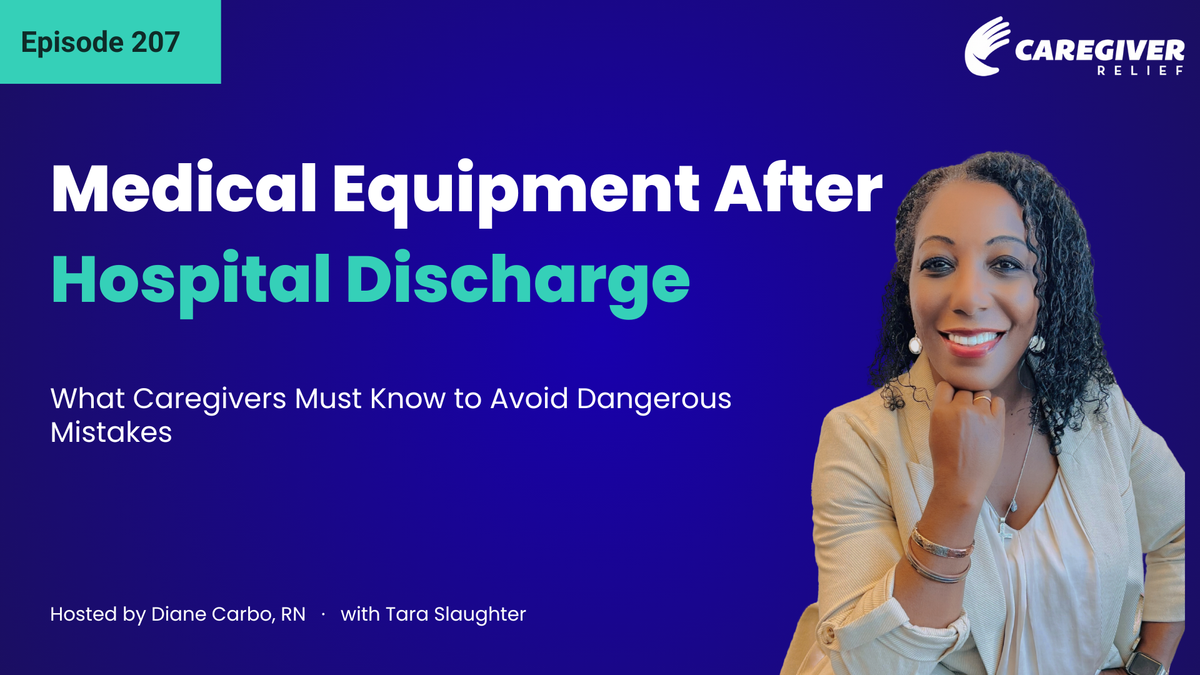
In this episode of the Caregiver Relief Podcast, host Diane Carbo, RN, sits down with Tara Slaughter, a certified durable medical equipment specialist with over 30 years of experience and founder of CFS Medical Supplies and Equipment. Together, they pull back the curtain on a dangerous, growing crisis: unsafe hospital discharges and the lack of proper medical equipment and guidance once patients return home.
Whether you are currently navigating a hospital discharge or preparing for the future, this episode is packed with lifesaving advice, data-driven insights, and practical steps to keep your loved one safe and protect your own physical well-being.
🎧 Why You Need to Listen to This Episode
In today's healthcare climate, patients are being sent home faster and sicker than ever before. Caregivers are frequently left to act as untrained nurses, trying to figure out complex equipment on their own. This episode is a must-listen because it teaches you how to avoid the hidden traps of the medical equipment world, navigate insurance limitations, and stop preventable injuries before they happen.
📋 Episode Outline & Key Takeaways
1. The Critical Gaps in Hospital Discharges
- The Reality of "Unsafe Discharges": Busy hospital discharge planners and social workers are often overloaded, meaning crucial home safety assessments and equipment orders can easily fall through the cracks.
- The Illusion of Independence: Hospitals may label a patient "independent" even when sending them home with a wheelchair, creating a massive mismatch between reality and expectations.
2. Common Medical Equipment Mistakes Families Make
- The "Prescription Myth": Assuming an item is covered by insurance just because a doctor wrote a prescription for it.
- The Danger of Basic Insurance Gear: Insurance companies generally cover minimal "medical necessity" items, which are often uniform, bare-bones products (like a standard hospital bed with a basic foam mattress) that fail to fit the unique clinical needs of every individual patient.
- The Risks of Blind Online Shopping: Turning to online retailers without professional guidance can lead to buying the wrong products, poor quality gear, or items that literally won't fit through the front door.
3. The Real Risks to Patients and Caregivers ⚠️
- For the Patient: Falls, pressure injuries, poor positioning, and high rates of preventable hospital readmissions.
- For the Caregiver: Severe physical strain, chronic back injuries, and rapid burnout from lack of training in proper body mechanics.
4. Innovation vs. "The Dark Ages" of Nursing 🛏️
- Tara and Diane discuss how far medical equipment innovation has come—highlighting advanced low air loss mattresses that laterally turn patients and customized Broda chairs that provide specific tilt-and-recline configurations.
- Learn how a proper clinical product assessment saved one family $6,000 while successfully eliminating a patient's severe wound pain.
5. Navigating Financial Realities and Healthcare Fraud
- Out-of-Pocket Truths: Medicare reimbursements are shrinking, forcing families to take on heavier financial burdens for comfort and advanced care items.
- Protecting Yourself: Tips on staying vigilant against healthcare fraud, fake medical supply companies, and how to thoroughly audit the care your loved one is receiving.
📊 By The Numbers: Why Structure Matters
Tara, a self-proclaimed "data girl," shares powerful statistics illustrating how the right support changes lives:
- Pressure Injury Reduction: Proper support surfaces reduce pressure injuries by 40% to 50%.
- Fall Prevention: Combining structured care with the right equipment results in a 30% reduction in patient falls.
- Caregiver Stress: 40% of caregivers report experiencing high stress levels when operating without adequate equipment support.
🛠️ 3 Steps to Protect Your Loved One During Discharge
If you are feeling overwhelmed, start with these immediate actions before leaving the hospital facility:
- Ask Targeted Questions: Don't let the staff rush you. Ask specifically: What equipment is being sent home? Who is delivering it? What bandages or underpads are being used, and what are their exact reorder or model numbers?
- Request Medical Records: Secure a copy of the clinical records and find out if any specialized supplies (like medicated bandages) require a separate doctor's prescription for home use.
- Write Everything Down: Carry a dedicated notebook. Document every provider name, phone number, discharge instruction, and expected home health nurse visit schedule.
📲 Introducing the CFS Medical Supplies App
To bridge the dangerous education gap, Tara developed the CFS Medical Supplies App. This free-to-download mobile tool acts as a real-time guide in your pocket, featuring:
- 🎥 How-To Videos: Short tutorials on how to properly adjust walkers, execute safe transfers, and operate complex home care beds.
- ✍️ The Subscription Portal ($12.99/mo): Deep-dive guidance detailing exactly what phrasing to use with insurance companies and how to navigate strict medical qualification guidelines.
- 📰 Blogs & Community Links: Instant connection to podcast episodes, expert networks, and trusted caregiving resources.
✨ A Message for Our Caregivers
"Without you, the entire caregiving equation falls apart. Please learn to be gentle with yourself and practice self-care every day—because you are absolutely worth it." — Diane Carbo, RN
🔗 Connect with Tara Slaughter

- Medical Equipment Supply: CFS Medical Equipment
- Consulting & Advocacy Support: CFS Solutions DBS
- Download the App: Search for CFS Medical Supplies on the Apple App Store or Google Play Store.
Podcast Episode Transcript
Diane: Welcome to the Caregiver Relief Podcast. I'm Diane Carbo, registered nurse and your life care advocate. If you've ever brought a loved one home from the hospital and felt that pit in your stomach that you weren't ready, that something was missing, that you were expected to just figure it out, you are not alone.
Today, we're talking about one of the most dangerous and overlooked issues facing family caregivers right now, unsafe hospital discharges and the lack of proper medical equipment and guidance once your loved one gets home. Joining me today is Tara Slaughter, a certified durable medical equipment specialist with over 30 years of experience.
Tara is the founder of CFS Medical Supplies and Equipment and CFS Solutions DBS, and she has dedicated her career to helping families and caregivers navigate the complex and often confusing world of medical equipment and care planning. We are lucky to have her as a regular contributor to our platform on Caregiver Relief.
Tara brings not only professional expertise, but also personal caregiving experience, giving her a unique understanding of what families are really facing.
Diane: Tara, thanks and welcome to Caregiver Relief. I'm excited to share, your information with my clients today.
Tara: Oh, Diane, you know what?
Thank you for having me. I love coming to the Caregiver Relief Podcast, and so I'm always, of course, excited about this particular, discussion when it talks about how we can help families and, what resources as well as equipment and whatever we can do to help them. So thank you for having me back.
Diane: You're welcome.
I'm glad you're here because this is desperately needed. Tara, before we get started, can you share what inspired you to create your app and how it's designed to support caregivers during such a critical time?
Tara: You know what, Diane, I went, we started the app, actually, it's so funny because I created an app about a few years ago, and it didn't turn out how I was visualizing it to do.
And, so I had another one created, and this particular one here was more geared to, giving families resources as far as videos- blogs, there's a subscription on there, and it's pretty much to help guide people on what questions to ask the insurance, what questions to ask the doctor, what to look for if you're gonna be discharged and you get equipment that you think that's gonna maybe work for you or your loved one, but it's not ideal for the situation that you're in at that moment in time.
And so I just felt like having that on there, would be good for someone to have on their phone, and they would be able to access that or just already know, before anything happens. And so that's why we created the app. and I'll go back to this too. many years ago I worked for a several companies, but while I was working for those companies and I talked to families, I would find that there was only so much I could say to them.
I couldn't really explain how I wanted to explain to them. Because, when you work for someone, it's only so far you can go when you're trying to help someone. Yeah. So there's a limit, and I had to stay in that place. And then so I just felt like even with this app, just remembering back on some of the conversations I would have with families, that now I can actually add this to an app that people can have real time, get access to it.
We have videos on there, how-to videos. When I say how-to videos, when it comes to equipment, how to use the equipment, what equipment to look for, blogs, even our podcast too for the Medical Equipment World and Healthcare Get the Scoop, you can listen to that. And so you can get, access to all those things on the app.
Diane: Families are dealing with so much when they're bringing someone home from the hospital, and the last thing on their mind is medical equipment.
Tara: Yeah.
Diane: They don't even and they don't even know what all that entails. And I personally have seen such terrible situations in my own neighborhood that I live in, that frightens me, and that's why I was so excited when you told me about your app.
I thought, "I have to have you talk about it," because people need help on so many different ways, when they're a family caregiver, and this is, this app is going to be able to help them in ways they didn't even know that it would. Now you
Tara: Yeah
Diane: have been in this field for over 30 years.
What are the most common mistakes families make when trying to get medical equipment after a hospital discharge?
Tara: I would just name a few. So one of them is assuming covered, the items are covered.
Diane: Oh, yes.
Tara: And the so sometimes people have the assumption that because my doctor wrote for it- it's covered, and that's unfortunately not the case.
It depends on what's going on. It depends on medical necessity. and and then buying based on price and convenience. That's some of the other mistakes that we see the families make. insurance, and just understanding that, insurance covers minimal medical necessity products, if that makes sense.
Diane: Yes.
Tara: So not all the time would you get something from through the insurance for the medical equipment it's really conducive to, for the patient, if that makes sense at all.
Diane: Yeah. Yeah.
Tara: And so but people don't know that, so they, they automatically, "Oh, the doctor wrote this for they wrote a prescription for the bed.
They wrote it for this particular item, this walker, what have you. It is the best thing for my loved one." But unfortunately not all the time. Now, that's not to say it, now that's not the case, but we find that being boots on the ground, that a lot of times that's not always the case. Because everybody, if you think about it, if you write everyone a prescription for the same item, an example a hospital bed, right?
Diane: Yeah.
Tara: So you get the same bed across the board, where everybody's situation is different.
Diane: Yeah.
Tara: So do you honestly think that particular bed is going to accommodate every single patient's situation?
Diane: Nope, not at all.
Tara: So if you really think about it, if you just sit back and think about it, 'cause even though if you even think about when you go to purchase a bed or any product of, item if you think about it, if you go into, what is the first thing you're gonna look for if you go to purchase a lifestyle bed?
You're gonna look for something that's gonna be conducive to what you want, right?
Diane: Yes.
Tara: You're not gonna just go in there and say, "Hey, you know what? Give me that bed over there that they have that the head goes up, the feet goes up, and I've seen it on TV." You could say that, but ideally you wanna know about what the functions are, what are the, all these things.
Oh, you may have someone, take a husband and wife. You may be sleeping on one side, he may look, want firm and you may want soft.
Diane: Yes.
Tara: So those are the things, right? So it's the same thing when you're talking about a patient who may be in need of a particular item. Does it fit what's going on?
Diane: Now, we are seeing more unsafe discharges, patients being sent home way too soon. What are you see happening on the ground right now?
Tara: Well, unfortunately, when patients get home with a partic- they get home and they have a order request for we'll go back to a bed or a, a particular wheelchair- or a, and when normally when you get a bed it comes with a regular basic foam mattress.
And then you have the patient, they get there, and unfortunately depending on what's going on with that particular patient, the particular item that they bring out is not really conducive to what's going on. So I'll give you an example. If there's a lot of if you're having to do a lot of lifting with the patient, you're having to do a lot of bending over and making changes, with when it comes to incontinence and all those type of things. If you're doing that and it's taking two and three caregivers or you, to you and two caregivers to maybe move that patient
Diane: Yep
Tara and you're bending over because the bed is not high enough.
Diane: Yep.
Tara: it's a lot of different things that go into it. So at that point you're like, "Okay, but I have this item, and why isn't it working for us and not against us?"
Because at this point now, the back, your lower back is hurting, right? Your arm is hurting because you're trying to push and pull and all these things. So those are some of the things that we see, on the ground. And of course, patients sitting in chairs for longer periods past two hours, vertical, and they're just not conducive for that, and then they end up back into the hospital because they don't have the right sleep surface, a lot of times as well.
Diane: Hey, Tara, I had one of my neighbors be discharged from the hospital. They told the husband she was independent, but they sent her home with a wheelchair, which was incongruent with that thought process. She was home just less than an hour and fell. Now, listen to this. She had no walker and no potty chair.
She was on the first floor. There were 17 steps to go to her handicap-accessible bathroom and bedroom, and they sent her home. There was no bed in the house. There was no potty chair. There was no grab bars. They didn't do a home safety assessment to see what was needed, and, we couldn't get her into the bathroom.
I wasn't there. my, roommate's daughter was a student nurse at the time. She runs over and she tells the husband, "You gotta go buy a potty chair."
Tara: Oh, my gosh.
Diane: Literally running in because what were we gonna do?
Tara: Yeah.
Diane: No bed. She had no comfortable chair to sit in. There were so many things wrong, and, they didn't even order her some of this stuff.
Tara: Yeah. Well
Diane: and I can't believe it.
Tara: Yeah. the thing of it is that I think that one of the... Okay, so basically at the time the patient was gonna be discharged, if the family had known, and a lot of times families don't know to ask those questions. What am I gonna be needing?
Do we need any kind of equipment? We need any..." Because they're assuming- That the family is assuming that discharge planner or the social worker, whomever, is going to be giving them the information they need, and sometimes it happens and sometime it doesn't, because you gotta know that sometimes people are...
There's a lot, they working on a lot, they have a lot of cases, right? Yeah. So they're working and something may fall through the cracks. But see, once, like these conversations that we're having, if a family can ask those questions. What do I need? Am I gonna need some what kind of equipment should I be looking for?
All these things so that person they're gonna be talking to can advise them on those things and what they're gonna be needing. But then I have to say, too, now if you're being discharged from a hospital, a lot of times you can get the, depending on your insurance, a lot of times they can coordinate for you to get that equipment the same day or a few days later.
Diane: Yeah.
Tara: Now of course with the provider, you have to make sure you have the right medical necessity documentation. So a lot of times that's a delay, too, and when people get discharged, they're like, "Okay, we were supposed to have a bed out here days ago, weeks ago, and we still don't have it." We see a lot of that.
Diane: Yeah.
Tara: And that's because they don't have the the provider may not have the right documentation to support why you're gonna be billing for that particular product.
Diane: Yes. And my issue was with this particular case, my neighbor. She had no short-term memory due to, a history of seizures and, low oxygen during a heart attack, 15 years prior.
They, the organization in a rehab facility didn't have a family meeting. They trusted her to get all the right information, and it's like she has no short-term memory. Oh my goodness. I don't know how they did that.
Yeah, no. But it was just... and let's talk about what happens when a patient is discharged without the proper equipment or instructions.
Well- What are the real risks for both the patient and the caregiver?
Tara: Falls. Oh, yes. Pressure injuries. Yeah. Poor positioning. And the caregiver, physical strain and burnout.
Diane: Yep.
Tara: And, immobility increases risk of complications without proper support. So those are the type of things that happens when someone gets discharged and they don't have the proper equipment or proper services, right?
Yep. again, we go back to if you have the right particular product, if you had a walker there, it may save you from falling. But then also, too, how do you use the equipment?
Diane: Yes. Yeah.
Tara: That's another thing, too, because you know, people aren't trained to know to use these things, especially if this is your first time.
Tara: Yep.
Diane: You wouldn't know how to use a walker, how it folds. Is it adjusted properly when it gets delivered to your home? is it adjusted properly to, for your loved one to use, right? Because if it's not used properly or they haven't been shown how to use it properly, they could fall.
Diane: Yeah.
Tara: So those are the different things that we see and why people get either readmitted to the hospital, or the burnout from the caregivers because they don't have the right equipment.
Yes. And that's normally what we see.
Diane: Yes. I did ortho rehab nursing. So I took care of quadriplegics, paraplegics stroke victims. And I, we were taught proper body mechanics. And we didn't have all the equipment available to us. We literally did in the Dark Ages, we picked the patients up.
Yeah. big... I transferred many a patient, and one of the things, I've done is it's challenged my body to the point where I have chronic pain all the time. And I, people that caregivers don't know what they don't know about how much it can hurt them.
Tara: Yes.
Diane: And they don't know. They don't even have, they haven't even been trained in proper body mechanics.
Tara: Exactly.
Diane: So it's really... and you know what? If they hurt themselves, they may never be able to transfer another patient or pull on them again, or it may be for months at a time because they'll re-injure themselves.
Tara: We... You know what, Diane? We see it constantly.
Diane: Yep, I'm sure.
Tara: The sad part about it is that even down to you have caregivers who are hired to be in the family's homes-
Diane: Yes
Tara: to assist them
Diane: Yes with transferring. they're caregivers, right? Oh. They're in-home caregivers. And unfortunately, I have to tell you that they, a lot of them don't know how to operate the equipment either, and that's the sad part.
Diane: 100%. Yeah. I agree. Yeah. Yeah. And they don't even know the proper body mechanics, a lot of them.
I know I have stopped caregivers that were transferring. I was in a home one time trying to help a family. I was managing the care, and the caregiver's taking this little, cute little old lady and putting her into bed, and she's doing it, like, all, everything wrong, and the patient was gonna fall and stuff.
And I showed her and she says, "I prefer my way better." And she di- And my, the person that was paying her had to fire her because she was not willing to learn the proper body mechanics so that she wouldn't harm the patient, let alone herself.
Tara: You know what?
Unfortunately, you see that too. Actually, it's funny you say that 'cause I had a k- lady tell me that the other day, that her mom has she has several caregivers in and out, but she was telling me that this one caregiver they have, 'cause the old one just left, a new one came in, and they've been trying to train now she's a, she's a experienced caregiver but it doesn't mean that she's doing the techniques right and properly, right?
Diane: Exactly, yes.
Tara: Yeah. And so they were she was sharing with me that she says, "Tara, I don't know what I'm gonna do. we may end up having to let her go. I don't know if she's gonna be able to stay here because she's not doing...
She's not following the right processes that we've learned as, as a daughter
Diane: Yeah
Tara: that I know of she should be using to transfer my mom, and I just am afraid that we're not gonna have her for long." And I was like, you have to do what you have to do, unfortunately," because, what you don't wanna do is you don't wanna get your mom hurt, and you don't want her getting hurt either.
And sometimes I think that because, sometimes people, the way they move, maybe they feel like, oh, this is the right way. it's unfortunately, it's not.
Diane: Yeah. My very first back injury was I was working at Sister Kenny Institute in Minneapolis on the- ... rehab unit. I was transferring now I'm, like, 5'2".
I've never I'm, like, I was 135, 140 at the time. And I'm strong. I've always been strong. I've lifted weights and stuff. But here I am transferring properly with the gait belt and everything- ... this little, tiny little lady, and she spasmed on me. And while I was transferring her, and I always have somebody stand by.
We had to and it just, the way she wrenched her body it put me out of commission for months because it hurt me. And, so those things do happen.
Tara: Yes. they do. Yes.
Diane: Even if you're trained properly, but some of it just, I like having a gait belt. I feel it- I feel for me, I feel safer when I'm with a patient that has a gait belt when I'm transferring them or even walking them. but there's just situations where, you know, you hurt. You can hurt yourself even if you do have good body mechanics. But using body mechanics and using the proper techniques makes it so that you are more successful and less less likely to harm yourself in the future.
Tara: Exactly. And the thing of it is too, Diane, I'll just go back a little bit, and I wanted to just share some data, 'cause I love I'm a data girl. I love
Diane: Yes, you are.
Tara: I love data. I love to see what the trends are and what the-
Diane: Yes
Tara: statistics show, because what it does is it opens up your eyes to understand, okay, where we need to really work at, right?
So I'm going to share just a little bit here. It says, "Proper support surfaces reduce pressure injuries up to 40 to 50%." Okay? So that's that. "Structured care and equipment, fewer falls, up to 30% reduction." Did you hear that?
Diane: Wow.
Tara: So structured care, structured care, plus equipment, 30% less falls.
Diane: Yeah.
Tara: Okay? And and then when you talk about the burden of care, proper equipment reduces physical strain, injury risk, and burnout that we were just talking about.
Diane: Yeah.
Tara: 40% of caregivers report high stress without adequate support.
Diane: Yeah.
Tara: So when we talk about support, we talk about, the burnout, we talk about movement, all these things,
They all play a part together.
Diane: Yes. Yes.
Tara: Everything is intertwined there. So I just wanted to share that, because I love to put those numbers out there so that people can honestly not even hear what we're talking about based on our experiences
Diane: Yeah. Yeah ...
Tara: but also know and understand this is a problem.
Diane: Yeah. it absolutely is. Yeah. And I do want to mention here that, a family caregiver, when somebody is in the hospital you should be, looking at their skin and checking their heels, their bottoms, their elbows. looking for skin breakdown. Tara, I don't know...
I know you know this, but I am seeing these, They call it patient rights. And a patient now has the right to refuse to be turned, has a ref- a right to not be, get up and cough and deep breathe. the thing is, what is, discouraging or concerning to me is that patients do not know what the complications of immobility are.
And so basically what, it's costing people more because the patient's harming themselves unknowingly. And I feel very discouraged and ashamed of my own profession if these nurses can't say, "This is not good for you. We have to do it," and tell them, and say, "Look, gently move them," or whatever. But, it's very frustrating to me.
I'm seeing a lot of pressure sores and, complications that cost the medical the insurance companies 10 times more money than they would spent if they had done preventative measures. That's why it's so important that we get the right bed, the right cushion on the chair, and all those things because
Tara: Yes
Diane: these things can cause harm, and my caregivers, my listeners out there need to understand that. Now, oh, Tara, now I wanna talk about the caregivers that turn to online shopping to get what they think they need.
Tara: Oh. Oh, dear God in Heaven.
Diane: Yeah, the what are the dangers of buying medical equipment without- Oh my gosh proper guidance? that's a doozy one.
Tara: That is a doozy, and we get it. Oh my goodness. Yeah. Do we get it. wrong product, unsafe quality, no training.
Diane: Yes.
Tara: It's not having the right equipment. it's about having the right equipment.
Diane: Yeah.
Tara: So it goes back to getting, going online, and what's really sad too, which we see doctors actually giving families orders to just go online, "Oh, just go online and get it."
Diane: Yeah.
Tara: I don't know where that started from and I'm, I, and I don't know, I don't know if it's because it's just an easy way to say just, "Here you go."
Diane: Yeah.
Tara: Or is it a way, or it was, they really just don't know about a medical equipment company, or they've dealt with the companies that have not been satisfactory or have not taken care of their patients like they probably thought they should have. I don't know. But we do see that where the, our patients are get orders and they say, "Oh, just go online and get it." and and of course sometimes I will say in the industry, if people calling you, you're not answering your phone
and people can't get ahold to you, some families will say, "You know what? I'm just gonna try to get it on my own." I get it, because they're already trying to figure out what their n- are already trying to figure things out and what to do with their loved one, and the last thing they need is trying to figure out what kind of equipment.
They get so they just try to go and get it on their own, but unfortunately what we have seen is, injuries.
Diane: Absolutely.
Tara: Injuries, wrong equipment, it didn't fit through the doorway, it didn't fit my loved one, it wasn't the right one. I'll just give you a few examples.
Diane: Yeah.
Tara: So we have a client who purchased a bed.
They went online. They didn't know. They just went and they're like, "Oh, I think this bed is the right one." And they went online and they purchased it, and they spent thousands of dollars for it, too. It wasn't a cheap bed.
Diane: Yep.
Tara: Thousands of dollars. But unfortunately, depe- though because of the type of, condition that their husband was in, that particular bed was not conducive for him.
Diane: Yep.
Tara: So of course, they end up having to spend more money, more thousands, because now you're gonna get the right bed, but now it's gonna cost you two.
Diane: Yeah.
Tara: So having a clinical assessment is so critical when you're trying to make these decisions because how do you know?
Diane: Yeah.
Tara: How do you know you're getting the right sleep surface, right?
I had a client not too long ago, he had came in, his sister was in a different state, and she didn't want to be moved. She was in a rehab facility, and it was a very expensive facility she was in. But at the same token, like you said earlier, she could refuse to be turned or moved.
Diane: Yes.
Tara: She's, she was in so much pain, though.
Diane: Yeah.
Tara: She was in a lot of pain, so he was like, Tara, what can we do? What kind of mattress do you think I could try to get my sister so that she won't be in so much pain?" And I'm like, let me... I got, I need to first look at her situation. Let's look at her case, right? Let me find out what she's, what she has going on with her clinically, and what has she used in the past and what is she currently using."
Diane: Yes.
Tara: Okay? And so we went through the analysis. I spoke to the DON at that particular facility. They sent me the records, we reviewed the records, went through, matched up, found out what she had been using. when he had presented, when I presented it to. What, the way he was telling me, she didn't want to be turned, and they wanted something to turn her, of course there's equipment out there that can turn you.
Diane: Yes. So there's in truth, I've been a nurse for 54 years. We didn't have that equipment. Yeah. We didn't have that equipment. yes, they didn't have it. Now they do. we had to make the patient turn. We had to make them. Yes. Yes. And in, But we also massaged their backs and their bottoms and their heels. We took time to do that.
Tara: And that... And, but you know what, though? That's how it was back then. Yes, it was. So you had to do things on your own. Yeah. But the equipment and innovation now, they have low air loss mattresses that turn, laterally turn you. They have beds that turn you. They, all these things. However, that still does not mean that it's gonna be conducive for the patient. And in this particular situation he was, that particular item was gonna cost him about $6,000. And I said, before you purchase this thing, I know that this is something you're thinking that this will help your sister turn and all these things." But she had a spine condition.
Diane: Wow.
Tara: And when I looked at her case, when I looked at her case, and we analyzed, and I'm like, no, this isn't I don't think this turning, this lateral turn, is gonna work for her."
Diane: Yeah.
Tara: come to find out when I redid the, finalized the case, she had been using Or she was on a regular foam mattress but they had not tried a, I would say, because people don't realize this, but there's different levels of low air loss mattresses.
Diane: Yes.
Tara: And based on what's going on with your loved one, they should be on that particular low air loss mattress. Now, of course, things do change in the interim sometime with depending on the, your loved one's condition.
But ideally, at that moment in time, in this particular situation currently right now, when we analyze that situation, when I did the finalization of it, I did not recommend her getting that particular rolling, turning low air loss because it was gonna harm her. And had they did that, it was gonna have to be on the doctor to make that recommendation.
And so I said "Had you guys tried a basic, not a basic low air loss, but more of an advanced low air loss?" But just something on the, a little bit under... it wasn't even a probably like maybe $1,000, $1,500. But guess what, Diane? That clinical assessment saved him $6,000.
Diane: Yep.
Tara: Got his sister the right low air loss mattress. And now she's comfortable.
Diane: Oh. and that's a, that's priceless.
Tara: Yeah. It's priceless. there are- Because he's I'm sorry. Go ahead, Diane. No,
Diane: I was just gonna say there are so many, and I hate to say it, in this industry, not, so honest people out there that would say, sell you the $6,000 mattress no matter what because of the money they were gonna make from it.
Tara: Yeah.
Diane: I've seen it, and it makes me crazy. But, that's why it's so important to work with somebody that is conscientious, provides good customer service, and, actually does a total assessment so that you get the right product at the right time.
Tara: Exactly. Exactly. The thing of it is that of what see, for real, I'm a patient advocate first, though.
Diane: Yes.
Tara: I've been that for years.
Diane: Yep.
Tara: So it's not a thing like, so the equipment part of it is a, is an add-on, but it has never been my prime. It was a number, I've always loved helping people and families. That's just my background. That's why I started in skilled nursing. I, that's what I like doing, right? Social services. That type of stuff. Helping people, right? And so I'm always looking out for them on a patient advocacy- standpoint, right?
Diane: Me too. Yep.
Tara: And then we help them on the back end when it comes to what they need. Yes. But not all product is gonna work for your loved one, and so we constantly have that conversation. And and so basically, when you talk about buying online, that's the scary part, and that's the things that we see when people go online. Not that online is a problem. It's, that's not, I'm not saying it's a problem. I'm saying that understand that you may get something that is not conducive to your loved one. You may receive a walker. You may have a family member who may have some cognitive issues going on and don't remember to put the brakes on.
Diane: Yeah.
Tara: And you go and you get them a rollator and then they fall, because a rollator wasn't good for them in the first place because they didn't remember even to put the brakes on.
Diane: Yeah.
Tara: So those are the type of things that you're gonna get if you have a clinical assessment done. And when I say a clinical assessment, some people think I'm talking about, from a physician. I'm speaking on a product clinical assessment.
Diane: Yes. Yes.
Tara: So yeah.
Diane: and you also look at the patient from a disease perspective and progression.
Tara: Yes.
Diane: So it's not only looking at what's right for them right now but what will work for them as they either improve or decline in their disease process. And not everybody does that either.
Tara: Yeah. again, you going back to on the clinical part of it, right?
Diane: Yeah.
Tara: So you know, I can't just look at what the specs does. I have to look at everything. We have to look, go to the root cause. We need to look at everything. how is this gonna... if you get a chair, I'll give you an example. If you get a wheelchair, and it doesn't have remove, removable arms, and it's a Parkinson's patient then we know that there's progression with Parkinson's. We hope that it's not. But if you're gonna sell someone something, it might be, it would be good for you to recommend that they get one that remove, so that way you as a caregiver, you don't have to lift them out. You can flip that arm back and transfer them out properly.
Diane: Yes.
Tara: Yes. So those are different things that you recommend when you see a person based on their diagnoses, based on what's going on with them. Can they, are they mobile right now? They're immobile. There's a whole bunch of things that we look at, and not just say, "Hey, this item right here is good for you because of what the specs does." Because it's not conducive.
Diane: Exactly.
Tara: Yeah.
Diane: I wanna talk about, how does the lack of education around medical equipment contribute to hospital readmissions?
Tara: It goes back to what we just talked about. Not have that training.
Diane: Yeah.
Tara: So if you don't, if you don't have the proper training to show someone how to use a walker, then the chances are them falling on it is a probability. They could fall, right? So not knowing how to use the equipment. even down to, I'll give you an example too. we could talk about a chair, with just an example, a reclining chair. We have a client that, had purchased a reclining chair for one of their residents, and they called and was like, "Oh my God, this patient, the mom is, wondering why is he in so much pain in this chair." And we're like, what is the problem?" They bring the chair in, and the chair was folded. So the caregivers... Now mind you, when you got it, you were shown how to use it.
Diane: Yeah.
Tara: But of course you have different caregivers. You have different. situations, and so now, you're in a facility, in a home, and maybe that they didn't realize what was going on.
Diane: Yeah.
Tara: But the mom couldn't understand why he was in so much pain, so when they brought the chair in we're like, what, why is this bar down in the back?" So come to find out the bar was down. The bar is supposed to be up and locked in the back.
Diane: Oh, boy.
Tara: So now he's good. So those type of things with the when you talk about training so you want to make sure that you as a family caregiver is trained on the equipment, and you also want to make sure that your caregiver is trained on the qu- And you will know. If you are a family caregiver and you starts doing this stuff and watching these videos and understanding how these products work yourself- Yeah when you have a caregiver come into your home, you will understand and know if they understand the product or not, because they're gonna, they're gonna either know it or they're not gonna know it.
Diane: Exactly. Exactly.
Tara: And it's so important. And so when you talk about injuries, if you don't know how to use the product properly, you are going to end up hurting yourself as well as the patient.
Diane: Yes, exactly.
Now, Tara, we're gonna talk about, a difficult subject. Why... We don't talk enough about the financial side.
Tara: No.
Diane: What kind of money are families losing by purchasing the wrong equipment or being overcharged?
Tara: It's in the thousands.
Diane: Yes, it is.
Tara: It goes back to I just mentioned earlier a family purchases a bed, and they're paying thousands of dollars for it to find out it's not conducive.
Diane: Yeah.
Tara: They've now spent thousands. Now they gotta spend more money, 'cause now you're gonna get the proper bed. the proper bed isn't a, it's not... It's gonna cost too.
Diane: Yes.
Tara: So had you got a clinical assessment to make sure that you're getting a proper bed, then you would've saved yourself money and time
Diane: Yes. Yes.
And I do wanna touch base and reiterate what we said in the beginning. Medicare reimbursement for equipment has been cut year after year so that it's, they pay for just the bare bones basic if you're lucky. And I think that'll eventually go away as well, because Medicare's moving towards a cost-sharing plan, which means that the consumer, if they want the recommended treatment, services, or equipment, they're gonna have to pay out of pocket for it. And e- that's hard for people to swallow, but that is where we are in our medical delivery system right now.
Tara: We are, and I think if I remember, my memory serves me, 5, over $500 million was spent of out-of-pocket spending for medical equipment in 2024, I think it was.
Diane: Yeah, I believe that's- '23
Tara: or 2024, but the number is, it's up there, and it's increasing.
Diane: Yes.
Tara: But because the thing of it is, Diane, is because when Medicare created they're giving you what's, I just mentioned. If everybody across the p- everybody across the spectrum is on the same bed, how is that possible? It, How can that regular same bed work for everybody?
Diane: It can't.
Tara: Yeah. There's just no way. Yeah. There's no way. I'll give you an experience I had about a, it's been about two months now, where the lady called me crying and she had been recommended from a nonprofit organization, and she called me in tears. I was like, "Oh my God," "What is going on?" She says, "My mom has dementia and, the insurance sent me out this brown bed and, it's just not working. She can't get out of it. I'm... She's falling back-" all the, it was just going on and on. And I told her, I says,let's n- let me do a clinical assessment. Let's see what's going on," and things of that nature. She end up going with a innovative, more advanced care bed, right? Oh. Insurance doesn't pay for those.
Diane: No.
Tara: But she had to. She says, "Ta- I just can't... There, there's no way I'm gonna be able to do this. I kinda g- my mom has gotta have something. It's just hard on the caregivers, it's hard on me." And she went with that, and, she had them to pick up the, the brown bed. Now, not to say that the brown bed isn't a good bed It's just depending on what's going on with the patient
Diane: It wasn't the right bed for that patient at that time
Tara: Exactly.
Exa- Yeah There you go. There you go. and that's the thing too, I don't want people to take away like, "Oh, the equipment the insurance is providing is no good." No, that's not the case. That's not the case, no.
Diane: That's not
Tara: what we're saying. No. We're saying is that what they provide is the basics. Yes. yes. they're providing the basic of products. So I'll give you an example. We do a lot of what's called Broda chairs. Broda chairs are customized chairs that's go- You know, we, they, we go in, we do an assessment on the patient, get their weight, measurements, all these things, have a clinical do the full-on diagnosis, what's going on with them. Are they slouching? Are they sliding? All these things, right? And we have the chair made for them. If they're sitting in the chair longer than two hours and their loved one is "This is not good. They're sliding. They're leaning to the side," depending on their condition then that's when you go in and you get these position chairs that has tilt and recline. And let me tell you, Diane to see the face of a patient who has been sitting vertical
Diane: Oh, I know.
Tara: I've seen that ... even in a standard reclining chair, go into a
Diane: Yeah
Tara: customized chair where the straps contour to the body-
Diane: Yes
Tara: and they can position themselves in a way that, that, when they're, that those wounds are no longer, with your hip bones as well because you're
Diane: Yes
Tara: sitting so long.
Diane: Yes.
Tara: It's positioning you and it's contouring to your body, the straps are, is priceless.
Diane: Oh. It's priceless. I've seen it. Now, they also didn't make the kind of chairs in the early days, in the dark ages of nursing and rehab. It's true. It's
Tara: You know what it's so crazy? I had a client the other day. actually I did a clip on it too. I did a little video on it. I had a client the other day that they, someone had brought out a Jerry chair.
Diane: Oh, yes. Now you know Jerry chairs have been around forever. Yes. I'm very familiar with Jerry chairs.
Tara: Yes, Jerry chairs. That was our go-to chair. Yeah, that was the go-to chair, but guess what? Yep. Depending on what's going on with you, you can't sit in it. You know what he told me? Yeah. He said- I know ... yeah, it was crazy. So he had tried that one, the Jerry chair, for a few day, the few days prior to us taking ours out, and we took out the Broda and he sat in it. He told me, I said, how did you do today?" And, 'cause we had went to pick it up, and he says, "Tara, I sat in that Broda chair for three hours."
Diane: Oh, wow.
Tara: He... And he was able to go outside, Diane. No, that's something. He had not been able to do that. Yeah. He had not been d- 'cause he's been in the rehab for a long time. He has not- Oh ... been able to do that, and he was so happy. and he said, "I tried that other chair, and they thought I was-" complaining.
Diane: Yeah. Yeah.
Tara: He said, "I could not go past 45 minutes," he said, "and I wasn't complaining. It was a very uncomfortable chair." He said, "But when I was sitting in that," he said, "I sat for three hours." I was like, oh my God. Like I said, "Yes!" And so he was so excited. And then I says, "Okay, what we doing now?" So he's now he's picking out his color frame and then all these things. he's so excited. I said, "You are just so special." he, 'cause he wants, "I want this color here, I want that color." So but my point to that is, but unfortunately the insurance doesn't pay for that.
Diane: Yes.
Tara: It doesn't pay for that. not to say, now some organizations you can find that, some non-profits, sometimes depending on what's going on with you, they can, they have some organizations out there that may step up and pay certain things or what have you.
Diane: Yeah.
Tara: It just depends, but most of them are out of pocket, and unfortunately insurance doesn't cover that part of just... Because basically that particularly would be considered comfort, right?
Diane: Yeah. Yeah.
Tara: And it doesn't pay for comfort. And so but he's made, now he's, even his wounds, he even felt better because he had a wound on his lower area and he was saying just sitting even in that just made it feel better because of the type of straps and all that. But, it's a huge, it makes a huge difference. We see it constantly.
Diane: Yeah.
Tara: And, just look, it's just every day. we have, the stories are endless. I couldn't even share all the stories. They're just so powerful of how the equipment has changed fa- families and made things easy-
Diane: Yes
Tara: for them. Now,
Diane: there is so much information out there about fraud and overbilling in healthcare. it's really rampant.
Tara: Yeah.
Diane: So what should caregivers be watching out for to protect themselves or their, and their loved ones?
Tara: I would say ask questions. I would say ask questions. Don't be rushed, to get into something. if you feel like, an example, your loved one can be okay with, oh, I'm not gonna s- because that's tough to say, if they're okay with a walker and the doctor recommended a walker, but again, it goes back to what's going on with your loved one, and then you have a provider that's pushing you to get a wheelchair.
Diane: Yeah.
Tara: Now, and that's iffy though, because we have seen, patients who did need a chair.
Diane: Yeah.
Tara: Depending on what type of chair. So if, an example, a basic standard chair versus a complex rehab chair. or a positioning chair that would be more beneficial to the patient, because now you get, you know a regular wheelchair is just a vertical. You're just gonna sit there in that chair vertical all day.
Diane: Yes.
Tara: So if you have a, so you may have some providers, like myself, may say, "You know what? Based on your condition and what we're looking at on your medical records. You may need something more advanced than a regular standard wheelchair. You may need a complex rehab chair. You may need a more, what, a, something a little bit more where it's not allowing you to. It may have some maybe tilt to it that's gonna take that pressure off of you, especially if you have wounds already. So it's that's tough. So but when you talk about the fraud, there is a lot of fraud. I have to tell you, it is.
Diane: Yes.
Tara: and I've seen situations where I'm like, I have questions some things myself. So there is, and but I would say, don't be rushed. Ask questions. why am I getting the prescription for this? Do my, does my loved one really need this? do your own homework. Look and see, do some research to see hey, let me see what would be conducive for them if, for this particular item that they're requesting, and things like that. So but I can tell you this, the reimbursements are
Diane: Yeah
Tara: are low. So the, when I talk about the fraud, there's different aspects of fraud in this industry, right?
Diane: Yes.
Tara: When we talk about fraud in this industry, a lot, I'm not gonna say it's not over, it's over-billing, but people are billing for things that's not even real.
Diane: Yeah.
Tara: They're billing for there's patients that don't exist.
Diane: Yes.
Tara: That's the kind of fraud we're, that I'm, talking about. But when you're talking about fraud as far as like a provider who's actually billing, I don't, I can't really speak to that.
Diane: Yeah.
Tara: Because the reimbursement rates are not, sometime are not there, so it would not behoove them to really even be billing that way. We do see a lot of people, popping up with fake companies and billing fraudulently.
Diane: Yeah. Yes. And, and you're in California and all the hospice companies that-
Tara: Oh, my God
Diane: were using the patient's information, the healthy patients, and pretending they're on hospice and bilking the system out of millions and billions of dollars. It is. And there, and the irony is 95% of them didn't die because they weren't meant for hospice, so they had to-
Tara: Exactly hospice at a fast rate. Exactly. So it's like, how do you, and that's another thing. Unbelievable.
Diane: Yeah.
Tara: It's crazy. It's like how in the world can you be... And they're billing people that it wasn't even supposed to be billed on. And then on to, yeah, it's definitely, yeah, it's a lot of fraud. And you're like, "Why is this person still on hospice two years later?"
Diane: Yes. Yes. Yes.
Tara: So I don't know. So I say be as a advocate of your loved one to ask questions.
Diane: Yes.
Tara: And just be vigilant, and just ask questions. And be and then contact people like yourself, like myself of people who can answer some questions for you, give you some answers, or go on a, go onto the app and maybe you can hear some conversation about how, what to ask for, what to look for, and all those things if you can't get a hold to myself or yourself to ask those type of questions
Diane: So how does your app help caregivers understand what they actually need versus what they're being told they need?
Tara: I tell you what. What I have done is I have a video on there in, it's under the subscription section. There are some videos on there that's free. But under the subscription section, it's 12.99 a month, and what it does is it tells you what questions to ask the doctor, what questions to ask the insurance, what to look for when you call them, the, some of the tips and wording to use, how, what items would be covered, what medical, qualifications that's needed in order to get a particular item covered. So those are the different things that's on there to help the caregiver or whomever, so now you don't have to go looking all over the place. You can actually find it in there. And also, too, on how to use the equipment, so that's another thing. Those are some videos on there. And there are being more added, too, so there's, we're constantly adding videos as we go.
Diane: Family caregivers don't realize that even a walker I saw a little old lady the other day. and I'm 73, so I'm a little old lady, okay? But she's this tiny little thing, and her walker was so high she had her arms resting on the Oh and I'm like, "Oh, my lord." I was like, it's not the right walker." even something simple as that can be ordered wrong. And that's why you need people like you to help people find the right equipment, or at least find information on your app that can help people.
Tara: Yeah, exactly. Yeah, just, just even knowing how to transfer, To, yeah. Yep. Yeah, how to transfer from a bed to a walker.
Diane: Yeah. Yeah.
Tara: the right way, the proper way. just different things like that. How to position it, all those things. Yeah. And so that's why we created the app, just to help people give, resources and information.
Diane: Yes. Now, for a caregiver who is overwhelmed and doesn't know where to start after a discharge. What are the first two or three steps they should take to protect their loved one?
Tara: Ooh, I would say, again, ask questions. Before you get a discharge, you're gonna ask the doctor or the nurse, "Hey, what do I need?" you have bandages that they're using or anything like that, ask for reorder numbers. ask for the medical records. If it's possible, I can get the medical records. what bandages are you guys using right there? What kind of item is that? What kind of underpad is that under her? I see she's dry right now, right? What is that? Is that a reusable, is it disposable? What model number is that?
What reorder number? Can I get that particular item in, for my home use? all these things you want to ask. Oh, what kind of equipment? Are you guys gonna be sending any equipment to the home? If so, what kind of equipment am, am I gonna be getting? What kind of equipment do they need? being, having all that information. What, who's gonna be coming out? Is there gonna be a nurse coming out to visit my loved one?
Diane: Yes.
Tara: If, so how long, how many days are they gonna be? How long does it take them to come out? Who should I call? Can I get the phone number? can I get their name? I'm a... Look, when I tell you, you have to ask, and write it down. That's another thing too you guys out there. Make sure that you have a notepad. I like to write stuff in tab- 100.
Diane: I got too many tablets.
Tara: Yeah.
Diane: yep.
Tara: But write things down. I don't how, wherever you want to store it, but I would say this, you want to write those things down because we get so many calls where a family have got, been discharged or they was, had a procedure done at the doctor's office or what have you, and they're like, "Oh, I'm supposed to be getting this. I'm looking for this particular bandage." And we're like, "Okay, what is the, or you have the order number or the model of it or what have you?" "No, I don't. I just know it's, shaped." Okay, there's so many different shapes- yes ... and, bandages, and then some bandages too have medication in them- Yes which you need a prescription.
Diane: Yes.
Tara: And sometimes the doctors don't realize that, and then you calling- Yes ... around and you're being told, "I'm sorry, we can't provide that because it's, has medication in it. You need a prescription." my doctor didn't tell me I needed a prescription." Unfortunately you do. So ask those kind of questions. This, what I'm using here, does it require a prescription? And the doctor may say no, but if it has medication in it, sometimes it may.
Diane: Yes. yeah.
Tara: So just have all, just get all of that information before you get discharged.
Diane: Tara, I'm an old seasoned rehab nurse, and- with the equipment stuff, I wouldn't know, I know to ask questions, but I don't always know what. I'd be calling you, girl. Yes. help me, please.
Tara: I tell you. Oh, we get it. We get it. We do get the calls. Yeah. and but- Yeah ... the thing of it is that, we don't mind getting the calls, Diane.
Diane: Yeah.
Tara: Because when I can take something, when I can see a, go visit a family member or family and I see their struggle
Diane: Yes
Tara: and then we bring something in and they're like, "Wow."
Diane: Yes.
Tara: And now they're like, "I can't belie- This is amazing." They've went from, that stress level of not understanding. we have a lot of, we get a lot of calls too for fall-risk patients who have dementia.
Diane: Yeah.
Tara: Some of them we bring care, some of them are at home but they still need that certain type of bed to be low enough to the ground.
Diane: Yeah.
Tara: And then if you have a loved one that's trying to climb out the bed, all of these different things that go into it, then you want to make sure you have the proper equipment. But unfortunately, the medic- the insurance does not cover those type of beds.
Diane: As healthcare consumers under our government run healthcare right now, Medicare, Medicaid, just realize that nothing is for free, and you're going to be paying out of pocket from now till the end of time because they have not prep- they are.
The high deductibles, high co-pays under Medicare Advantage are meant to deter use of benefits. Now, that's, we might as well have the ill we only have the illusion of healthcare then. And this has been going on for a long time, but we're at a, we're at a, what I call critical mass right now where we're in trouble with, all the unsafe. And people are shocked that they have to pay out of pocket. And that's and it's sad, but, they think Medicare's going to pay for everything when it pays for very little to nothing. So I think that it's important. That's why I was so excited to have you on today, because I want my listeners to know we're trying to prepare you for the future. And right now, Tara, there are 63 million family caregivers out there. In the next five years, it's going to double.
That means the double, the amount of seniors that are going to require care is going to be overwhelming, and we are not prepared. So we're get we're doing, I'm doing baby steps to help my listeners know what they need, when they need it, and they just need to call Tara when it comes to equipment.
Tara: The thing of it is, Diane, is that if I tell, I always say one of my favorite sayings is when you know better, you do better. Knowledge is power.
Diane: Yeah. Exactly.
Tara: I love saying that. And I've seen it. I've seen it. I've seen families where we give them information, and they take it and they're like, "Ooh, this is good." I- Yeah. Yeah ... it worked for them. And so and that's all what we're trying to do. And so I just feel and that's one of the reasons why this app was created, because we can't answer every call, right?
Diane: Yes.
Tara: You can't. So we can't. but when we have the resources, that's why I love, I always share your website and your podcast with my interviewees I interview too, and with families. I'm always sharing your information with families because you interview out some of everybody. And I love that because you can get something from every situation literally off of listening to these interviews. Like I've learned, I have learned so much from listening to your interviews. I love them. I'm like, oh my God, I didn't even know that. I, that was good. So I, yeah, I did an interview yesterday with these two wonderful ladies. They're caregivers.
Oh, yeah. And I was telling them, I shared your information with them on the interview because I feel like when people know, information is just so huge.
Diane: Yeah.
Tara: So it makes such a difference. down to, I get clients who I've gotten something for them, or I did an assessment with them, now they, they need, a caregiver. Yeah. They need, to know, they know they loved one is about to get ready, they're getting discharged and they're about to go to rehab, and they wanna know, "Tara, what is a good rehab that I should look for?"
Diane: Yes.
Tara: And I may not have all the answers for all of them, but guess what I do have? I have some contacts that I can reach out and say, "Hey Diane." Yeah. "Hey Leslie." Yeah. "I need some... I can't... what ideas you have? What kind of-" Yeah. that's the community that we wanna build, right?
Diane: Yes.
Tara: And that's what we're doing. And network.
Diane: Yes. Yeah. We are. And network. So that we have the right people at the right time for our listeners.
Tara: Exactly. Exactly.
Diane: Tara, tell people how, my listeners out there, how they can find you.
Tara: they can go to www.cfs, that's Charlie, Frank, Sam, medicalequipment.com. that's the medical equipment side of the business. And they can go to www.cfssolutionsdbs.com, that's the consulting side of the business. So if you needed, a consultan- consultation for just understanding what you have going on, trying to figure it out, that's where you go for those consultations. And then of course, the main reason for this call today is the app.
Diane: Yes.
Tara: So you can go to any, the Apple or Google, depending on what type of phone you have, and download CFS Medical Supplies, that's how it's tagged. And you can download the app, and it's a free app, and you can get all the information you need. And, it has, connects you with our podcast, with our, blogs and all that. And I love the blogs because when we interview someone, Diane, it goes into a blog, and then that li- the links to the connecting to those people are there, so you still can reach out to them.
Diane: Awesome.
Tara: So that's where that resource part come in at, too. So if you-
Diane: Tara, one of the things I know about you is you provide the utmost best customer service, and that is something so many companies lack. And so I appreciate you, and I appreciate what you do for us, in sharing your information here on this, on our podcast. Now, to my family caregivers, you are the most important part of the caregiving equation. Without you, it all falls apart. So please learn to be gentle with yourself. Practice self-care every day, because you are worth it.
You might also like this article:
 Diane Carbo
 Diane Carbo
 Diane Carbo
 Diane Carbo
 Diane Carbo
Caring for a loved one can be overwhelming — but you're not alone. If you have questions, big or small, our expert team is here to help.
👉 Click here to Ask the Expert
Our Resource section can help you find the information and tools that you need. We have courses, videos, checklists, guidebooks, cheat sheets, how-to guides and more.
You can get started by clicking on the link below. We know that taking care of a loved one is hard work, but with our help you can get the support that you need.
Click here to go to Resource Section now!