Caregiver Burnout, Weight Gain, and Hormones: Why Your Body Is Breaking Down—and How to Fix It with Marianne Pinkston - Episode 228
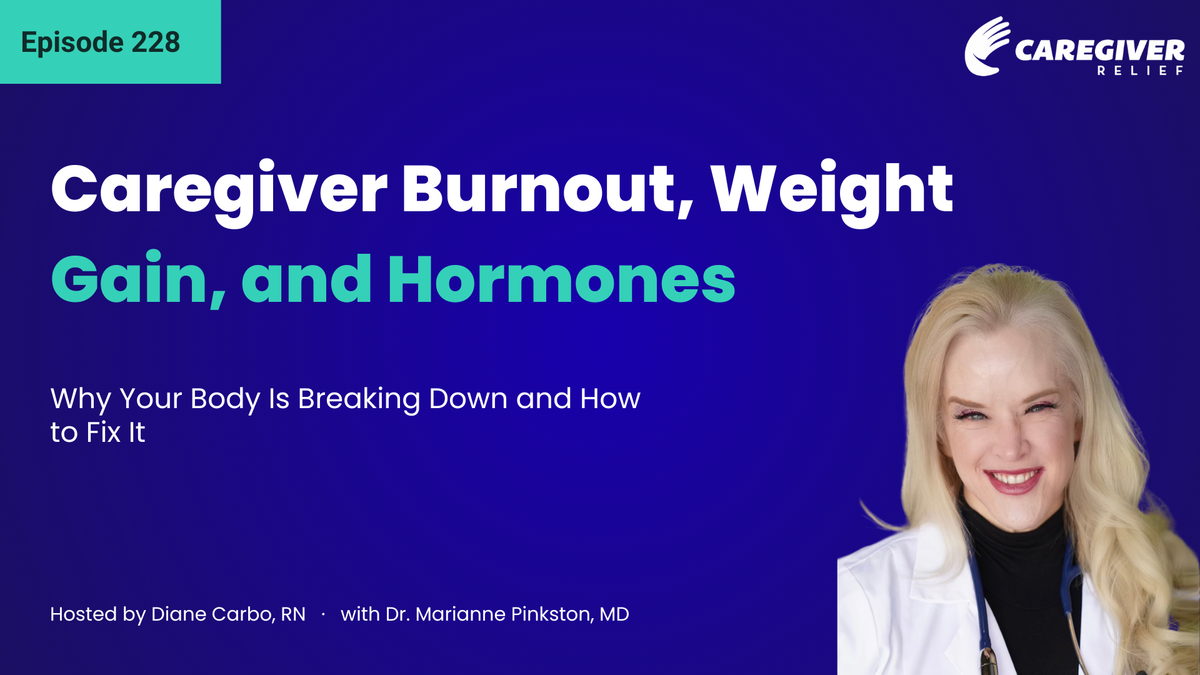
In this episode, host Diane Carbo, RN, sits down with Dr. Marianne Pinkston, an integrative medicine physician with over 25 years of experience. Dr. Pinkston shares her powerful personal story of losing 180 pounds and overcoming autoimmune disease, diabetes, and cancer. Together, they break down exactly how caregiver stress wrecks your hormones and metabolism—and how you can take back your health.
🔥 Episode Highlights
- The "Wired but Tired" Cycle: Learn how 24/7 caregiving keeps your sympathetic nervous system ("fight or flight") switched on, spiking cortisol and preventing your body from recovering at night.
- The Hidden Thyroid Trap: High cortisol levels can block your body from converting thyroid hormone ($T_4$ into the active $T_3$), leaving you with sluggish thyroid symptoms even if your standard lab tests look "normal".
- The Power of the Mitochondria: Discover how chronic stress and lack of sleep damage your cells' powerhouses, causing widespread inflammation that can lead to chronic illness.
- Shift from "Asking for Help" to "Delegating": Changing how you think about support can help you set firm boundaries and protect your peace without feeling guilty.
- The Shocking Reality: Studies show that 63% of family caregivers become seriously ill or pass away before the person they are caring for. The physical toll of caregiver stress can even linger for up to six years after your caregiving journey ends.
📋 Episode Outline
- Welcome & introduction of Dr. Marianne Pinkston.
- Dr. Pinkston’s personal battle: Reclaiming her health after reaching 300 pounds and facing chronic illnesses.
- The biology of stress: How your sympathetic and parasympathetic nervous systems get thrown out of balance.
- Why your "normal" thyroid labs might be lying to you, and how cortisol messes with your metabolism.
- Why caregivers are highly prone to autoimmune issues, leaky gut, and chronic inflammation.
- Functional medicine vs. traditional medicine: Getting to the root cause of your symptoms.
- Real, daily steps caregivers can take to build healthy boundaries and start healing.
- Why you need a "Caregiver Contract" and how to delegate tasks to family members or look into program reimbursements.
- Dr. Pinkston’s ultimate message of self-care and how to find her work.
💡 Keys to Reclaiming Your Health Today
- Put your oxygen mask on first 🎭: You cannot provide good care for your loved ones if you run yourself into the ground.
- Say "No" and set boundaries 🛑: Learn to view asking for help as delegation—acting like the leader of your family's care team rather than a victim of circumstances.
- Be consistent, not perfect 🔄: True health is a lifelong journey. If you fall off the wagon, forgive yourself, take responsibility, and get right back on.
🔗 Mentioned in This Episode
- Guest Website: Learn more about Dr. Pinkston, read her health tips, and listen to her podcast at drpbetterlife.com.
Remember: You are the most important part of the caregiving equation. Without you, it all falls apart. Be gentle with yourself, drop the guilt, and start taking care of you!
Podcast Episode Transcript
Diane: Welcome to Caregiver Relief, where we support family caregivers with the knowledge, tools, and encouragement you need to navigate caregiving without losing yourself in the process.
I'm your host, Diane Carbo, RN and founder of Caregiver Relief, and today we're talking about something that so many caregivers experience but few truly understand. If you've been feeling exhausted, gaining weight, struggling with sleep, brain fog, or just not feeling like yourself, this is not just part of getting older or just stress.
There is a deeper physiological reason behind what's happening in your body. And today we are joined by Dr. Marianne Pinkston Mueller, an integrative medicine physician with over 25 years of experience helping patients heal from the inside out. Her experience is not only clinical, it's personal. After facing serious health challenges including autoimmune disease, diabetes, and significant weight gain, she transformed her own health, losing 180 pounds and reclaiming her life.
Lord have mercy. We're gonna really talk about that, Marianne.
Marianne: Thank you.
Diane: Today we're going to explore how caregiver stress impacts your hormones, your metabolism, and your overall health, and more importantly, what you can do to begin reversing that process. This is a conversation every caregiver needs to hear.
Dr. Pinkston, Marianne, I'm so excited to have you here today because as we were talking before, I started recording, our healthcare system is so broken in so many ways. And, we get 15-minute visit to the doctor, and now Dr., Oz and Dr., or Mr. Kennedy, Robert Kennedy Jr. are encouraging medical, schools and universities to include at least 40 hours of nutrition. And I'm like, oh my God. that, that's all?
Marianne: Yes. And my response was, "Only 40?" Right?
Diane: I know, yes. So I want to welcome you. And, thank you for sharing your knowledge with us today.
Now, your personal health journey is incredibly powerful.
Marianne: Yeah.
Diane: Can you share what led you to transform your own health and how that shaped your work today?
Marianne: Oh, sure. Oh my gosh. Thank you, first of all. What an honor. I really appreciate you so much having me on, and, I love sharing this story because it is, I think what it ends up being is just a recommendation for people to say that you can take control of your life.
It is possible. It really is. If I can do it, anybody can. And so yes, I think with all of the stressors, with life, but also reaching, certain ages where, you know, your hormones are disappearing, the stress takes over, your sleep is terrible, you're taking care of every- especially as a woman, you're taking care of everybody else except for yourself, and, and patients and all.
I gained up to 300 pounds. And I think what got me, not only just wanting to look better, feel better, regain my confidence back and my, get my health back, because yes, I developed rheumatoid arthritis, diabetes, hypertension. I also had melanoma, and developed cancer out of it. So many things were going on, so of course I wanted my health back.
But I think looking in my children's eyes, and then also, at the time I, owned a med spa, opened up one of the first med spas in San Antonio, Texas. and I was sitting in front of people trying to explain to them how to get their health back and lose weight and all, and I'm 300 pounds. It just doesn't, that
Diane: Correlate
Marianne: Yeah.
Diane: It doesn't connect.
Marianne: Yeah, I just lost that connection. So I know people are looking at me like, "Really?" And so I just knew it was something that I had to make myself an example for my children and for my patients, and then just do something for myself. That was really important to me. So I did, and it took several years, and definitely a lot of, consistency and persistence.
A lot of change. But
Diane: that's how you keep it off is
Marianne: That's it
Diane: developing a lifestyle. It is. I've struggled with my weight my whole entire life.
I was a caregiver very young. and, my way of handling stress was to grab anything to eat on the run.
Marianne: Thank you.
Diane: And it could be anything, and it was always sweet, or salty, I know that. And it was high calorie and low nutritional value. And, I had... That was very hard for me to break that cycle as well. And that's real.
Marianne: That is so real. Eating out of stress, and developing, what you do is you get into an insane amount of hormonal imbalances, but neurotransmitter imbalances and, gut health, and all of those things fall into place, and it sets you up for this.
And you just lay the stress on like icing on the cake, and it really develops those cravings and that and I consider it an eating disorder. And I don't care what kind of a caregiver you are. anywhere, as long as you are taking care of others instead of yourself, that tends to be our basic personality anyway.
Most of us did that, took care of our parents when we were younger or, took care of, other children while the parents were at work or whatnot, all the way to taking care of your parents when they're elderly, plus taking care of your children. Then on top of that, being a healthcare provider, right?
And, And so all of those things set you up, I think, for, giving more than what you've got to actually give. And that does. It sets you up. It's horrible.
Diane: When you were explaining that here you were 300 pounds and you're telling people, at your med spa what they need to do to be healthy and well.
I laugh because I can't tell you how many doctors. They don't address. They just tell you to lose weight, do this, do that, or exercise, don't smoke. But, they're telling you that as they're shoving food down their throat or they reek of cigarette smoke
Marianne: Right, right ...
Diane: from, on their lab jacket.
Marianne: Yes. Yeah,
Diane: so it's and that's the typical, experience I've had in my 54 years of nursing.
Marianne: Right,
Diane: You know, do as I do. do as I say, not as I do.
Marianne: Absolutely. You are correct.
Diane: And we really have to address that. And, can you talk specifically, about caregiver burnout and how it affects hormones like cortisol, insulin, and thyroid function?
Marianne: Absolutely. This is the heart of what I of my own journey, and now I have turned that journey over to look at, look at my patients, and everybody, at, as the basis of what I think is wrong. And you know, you have two, two parts of your neurological system, right? You've got the sympathetic neurological side.
You've got the parasympathetic neurological side. The sympathetic is running from the bear. It's, you know, the part that gets you up and gets you going and running and, always on edge. And that's where a lot of the anxiety drive comes from. It drives up your cortisol and all of your adrenaline, and, it's necessary.
It's what we need to keep us going. we're supposed to have that downtime, though, of our parasympathetic, nervous system side where that's the rest, digest, and restore, right? It, helps you to, heal all of those cells that are kinda dying and rewired to not function correctly. It's where things like cancers come from and what not.
But that is also the side that helps us make our hormones at night. That's when we make most of our hormones is at night. And, and we're supposed to have that rest and relaxation to compensate. it's a recovery period, and so we're supposed to have that. What happens, I think, is, we've got the imbalance, and it comes from very young, especially people who are in the care- healthcare field.
We're type A driven, right? we're headed we're working all the time, and we're always trying to be perfect and do the right thing, and we're very, very driven people. And so that sympathetic dominant side is on all the time, and cortisol spikes all the time. We never get a chance to recover and allow that system to heal itself.
And so it deranges everything. Like I said, our hormones are made at night, and if we're a cortisol adrenaline surge 24/7, especially night shift workers, so people a lot of nursing, a lot of the medical field is healthcare, working at night, healthcare workers at night.
And so we really derange that cortisol system, that adrenaline system. So it causes that imbalance. We don't make our hormones at night. The cortisol, yeah, high cortisol is very, intrusive to our thyroid production. we've got the typical thing that doctors check is TSH and T4. But what we don't understand and realize and what we are not taught in medical school is that T4 really doesn't have a whole lot of function.
It has to be converted Into free T3, right? And that is where the action of thyroid occurs. But when we ha when we're overwrought with our cortisol system, it interferes with that conversion. So we can have a normal TSH and T4, but our cortisol is high and we don't convert to T3. So you can have plenty of hypothyroid symptoms and have a normal thyroid panel that doctors check, and it's all because your cortisol is overwrought.
So it is just a domino effect from there, a cascade, so it's
Diane: You know what's sad is that I know that what you're saying, I have I learned that. But doctors that are actually taking care of us
Marianne: Yes
Diane: don't have that knowledge.
Marianne: Correct.
Diane: And that makes my head explode. It does. That's why, you know, functional medicine docs and integrative, medicine docs are absolutely necessary because you look at the holistic approach and you deep dive into what's causing this, whereas all Western medicine does is treat the symptoms
Marianne: Correct
Diane: but it doesn't go to the root cause of anything.
Marianne: Correct. Yeah.
Diane: And I thank you, but that's 54 years of nursing that has seen how we have absolutely, let our patients down.
Marianne: Yeah.
Diane: Yes, of course. And thank goodness they make it 40 hours of nutritional training.
Marianne: At least. Oh, my gosh. Well- Oh, my
Diane: God bless us
Marianne: Yeah
Diane: I guess that's a-
Marianne: Yeah and I would love to speak to that because this is kind of how I have I've done this now for almost 30 years and I can look backwards now and understand it.
The pharmaceutical and the insurance industry have definitely lent their hand to this. But I think doctors ultimately, it's like being the President of the United States where, you can blame all the people that are down below you and the people that, come into the office and have something to say
Diane: Yes
Marianne: and do, but ultimately you're the boss, right? And
Diane: Yeah
Marianne: and I see that in medicine as being a doctor that, in medical school we learn the basic science
Diane: Yeah
Marianne: It's not there to necessarily make us fantastic physicians that can cure everything. We can't learn everything there is to know.
Yeah. But it gives us the basics, and I think what we forget as physicians is that it is our responsibility to not just graduate medical school, put our shingle on the door, and then just say, "Okay, I'm ready to treat patients." No, you, we are responsible for learning more and going farther and getting that, education and developing it further.
And that integrative doctors are people who are forward-thinking like that. Most of the time, the light bulb comes on when we get sick or somebody in our family gets sick, and we have a story. There's always a story behind somebody who practices functional medicine. But beyond that, I think we all should search it out.
We are not done when we leave medical school. We have a responsibility to patients and to the system to continue learning and to open it further and go deeper. That is our responsibility, and a lot of physicians just don't take that responsibility.
Diane: Dr. Marianne, what I have seen and experienced with doctors is our government policy makers are now are in charge of our healthcare, not our doctors.
I just had a conversation with a surgeon, and he wanted to do back surgery, and it took a year to get that back surgery approved for this patient because his approach, which is a much safer approach, is, was to go in through the stomach and work, it's called an anterior, I think, approach, versus going in through the back.
And, the, insurance company said, "No way. No, no, no." But here is a This doctor knew this was a better. He's gonna get a better result.
Marianne: Yes.
Diane: And he, one of the things I've learned about people with back surgery, they have repeated surgeries over and over and over again because
Marianne: Absolutely
Diane: they expect to have, relief from pain, and it's, it may relieve it a little bit, but it doesn't totally go away, so they keep going back for more and more surgery. Yeah, but I think that right now what we're dealing with is physicians that, Well, first of all, doctors are making less than they were 20 years ago.
Marianne: Much less.
Diane: Much less, yes. And they have more government hoops. I think that our doctors, the young doctors just don't have it in them to go on. Maybe I'm making a blanket statement there, but I see the lack of moving forward and learning more because the government's in the way, the insurance companies are in the way saying what you can and cannot prescribe and what you can treat.
Marianne: Absolutely.
Diane: That's why I think functional medicine, is the, last frontier of good holistic approach to medicine, and I encourage everybody, if you're sick that, or have a chronic illness, you really need to see a functional med doc. it's to your benefit because they're gonna look at the root cause.
Now so many caregivers develop conditions like autoimmune disease, diabetes, or chronic inflammation. Can you explain why that happens?
Marianne: Again, I really think we are a whole different breed of people. We Yeah and I can really only explain myself, but I think I am, an example of many others.
And, you know, I had a difficult, very traumatic childhood, and that I'm already empathic, to begin with. I have a sense about people and I absorb other people's energies. And I, I think when, this best explains it. So when I'm in a room with a patient, and let's say I'm seeing 20 patients today.
Diane: Yeah.
Marianne: with a patient I essentially put myself into their world, their body, their brain, their mind, whatever, however you wanna look at it. And I absorb what they're, try to feel what they're feeling and, as a direction to, to give me a sense and a place where I can actually get to where they are and help them.
And after doing that 20 times a day, I go home and I take my work with me, because I can wake up in the middle of the night and sit straight up in bed and go, "Oh my God, I forgot to call in that prescription." Or, "I shouldn't" Oh, yes. ... " I shouldn't have done this." And so I'm on 24/7.
And so I really think that I take a lot of that, inside and take it with me, and I really do care about people. And I don't think people go into the healthcare field, to just work. I think we all take that in with us and we do it for those reasons. But what happens is that we get so beat up by the system and other people, and we just extend ourselves a very long distance into other people and into a system that doesn't really accept that, and give back.
And so there's not a lot of places that I can go and say, I'm a doctor and I'm tired, and I'm doing too much. I need help," right?
Diane: Yep.
Marianne: There's no there's nobody there for me. Nope. Nope, I'm at the top of the food chain. I'm the doctor. So
Diane: Yep
Marianne: Yeah. So it really is, I think, a built on a lot of things.
I think it's built on just an inner personality, at the core. It's wonderful to be, you know, an empath and have experienced things I experienced in my past. It's made me a better doctor or whatnot, but at the same time, it set me up, to work a little harder probably and, you know, send myself farther into my work than I should and overextend myself a- and all.
But I think that, I think we're all set up in the same fashion. I don't know if you agree, but that's how I see it.
Diane: I do. I absolutely agree. And I too am an empath, and it, my heart goes out to anybody that, because it's draining. It is. It's really draining, because we do, put ourselves in the place of that person and feel their pain a lot, and it's really hard.
I will tell you that when I, nursing, when managed care hit, nursing changed dramatically. You know I went to school in the Dark Ages, and, so in the '70s were, nursing was really good.
But there was abuse by the hospitals and stuff. I get that. putting patients in two and three days before surgeries and stuff.
But the '80s when managed care hit, things changed in the hospitals dramatically. And I used to get physically ill the day before I had to go in for a shift.
Marianne: Wow.
Diane: And I could feel it, and it was like, "What is wrong?" And then it would take me two or three days to decompress and go through that cycle all over again.
And that's when I started looking at alternative nursing, Because I had to get out of the hospital. I just, it was just not, a good place for me. And nurses nowadays are getting beaten up by the, patients.
And they're getting beaten up by the management because everything the nurse does must be, if a patient responds badly, it has to be the nurse's fault.
So nurses are struggling. But, because family caregivers are under a tremendous amount of stress, you talk about the body begins to break down. So what are early warning signs caregivers should not ignore?
Marianne: Oh, great question. So I notice things. this is a bit of a, it should be viewed as a bit of a process.
Like you say, the early warning signs. and so early in your career, if you begin to notice that you're having, first of all, this is arbitrary and all over the place, I apologize. Yeah. But this is what I think of first. I think that the first thing that began to happen was I began to my sleeping pattern.
So I began to notice that, when I would go to bed, I was exhausted, dead tired, fall on my face. I could fall asleep in two seconds, but the second my head hit the pillow, my brain started going,
Diane: Yep.
Marianne: So I was wired but tired, right?
Diane: Yeah.
Marianne: So I would think and think, and I couldn't fall asleep.
Either that or I would go to sleep, but then I'd wake up at about 3:00 A.M. or so, and wake up a lot, and I couldn't get back down to sleep, and my brain would start going early. And then I started needing caffeine during the day, so then I was fatigued, during the day. And it was starting to catch up.
Things like brain fog, I mean, you know, things that people might not really think of as being part of a deterioration like that. But the fatigue, lack of sleep, and the brain fog and all of those things. It's a progression. But I think I, those were the things that I noticed. The other thing I noticed too was I just felt more irritable.
I was snapping.
Diane: Oh, yeah.
Marianne: Yeah. I was snapping at people a lot more. Yeah. Snapping at the kids more, and I just wasn't able to sustain joy. Let's just say it,
Diane: 100%.
Marianne: Right?
Diane: Yeah, yeah.
Marianne: I, the joy was diminishing as the irritation, and then flexibility was increasing. And so I just, those were the things that I began.
Then came the weight gain and, all of that on top of it, right? So yeah. I think
Diane: I've been through that cycle myself several times before I decided I had to address it and get it right.
Now let's talk about the lack of sleep and the constant responsibility impact on the metabolism and how it, and the weight gain
Marianne: I guess great.
And so like I say, it as that neurological system begins to get unbalanced, our body has I'll say it this way, the body has everything that it needs outside of the right type of nutrition, right? And so as long as we're getting the right nutrition, our body has everything it needs to perform well and do its job, but we start to ignore.
We start to ignore those signals and patterns. we start to ignore the fact that we do need sleep. It's I don't have time to exercise. I don't have time to eat right. I don't have time to get seven hours of sleep, whatever. We start to ignore those patterns and we get those needs, and we get into a pattern where our body then just isn't fed correctly or receiving what it needs underneath.
So, you know, from a cellular level, that cortisol and neurological derangement or whatnot, it begin. Every cell in our body has, of course, the nucleus with all the DNA in it, but I think the most important little organelle that belongs in the cell is the mitochondria. So the mitochondria, we all learned it in biology, this
Diane: Yep
Marianne: the powerhouse of the cell. I mean, everybody's heard that since they were little bitty and in high school biology, but it is. And whenever the mitochondria doesn't have, the vitamin supplement, minerals and whatnot that it needs to function, the cortisol's too high and the demand is off, and, from there we begin to our cells begin to just work on trying to catch up. It's all a catch-up game. And if we're not giving it what it needs over a long period of time, then it produces a lot of inflammation. And so that inflammatory response is at the basis of every single disease or problem you can think of. And, that's the reason why our immune systems don't function well.
We become autoimmune. It's the reason why, we aren't able to, again, make our hormones and what not at night. It's the reason why we develop cardiovascular disease or dementia or even osteoporosis and all those things. Inflammation's at the heart of that, and you just have to just, take these big problems that nobody seems to know what to do with and just go backwards to the very, very basic biology and biochemistry and just understand that your body's not getting what it needs in any shape, form, or fashion and work from the, small level there up.
And I think that's, the main issue.
Diane: From an integrative medicine perspective, how is your approach different from traditional medicine when treating these issues? I know this answer very well. You know the answer. I know wehave shared this.
Marianne: You know the answer. It, and like you say, again, in contemporary medicine we're given basic biology.
So in functional medicine, we take this knowledge and apply it differently, and learn how to go into a deeper, place. Again, more than just placating symptoms and, giving a pill to kinda adjust something. Again, it's a root cause. Functional medicine is very root cause in its basis. And again, you just have to understand how important things like magnesium is to the body. How important, sleep regulation and controlling inflammation and, I think one of the things that is not focused on hard enough is gut health. So leaking gut and the microbiome, and its dysbiosis, and all those things.
The other thing that we focus on more in functional medicine is where did the cell go wrong? And there's always some sort of toxic effect underneath, and stress is one of those toxins, but so are heavy metals. the mold and Lyme disease, all the viruses we're exposed to. Now with all the environmental exposures, the microplastics and all of those things.
We have to focus on the dangers that are out there affecting our bodies from that basic biological system, and that's something contemporary medicine leaves out. They don't look for heavy metals. They don't look for mold and Lyme. Don't even believe in it, honestly.
Diane: Exactly.
Marianne: I know that for a fact.
Yeah. Yeah. So I think there is the differentiation. And the way I, explain integrative medicine to everyone is that, there's contemporary traditional medicine, and we've got to treat symptoms. We've gotta, focus. Sometimes prescription medications are absolutely appropriate, and they have a place.
Then there's the natural, medicine world and it definitely has its place. But both sides can go off in tangents and ignore, the importance of the other side, right? So you take
Diane: Yeah .
Marianne: the best of both of those worlds and integrate it, and you've got integrative medicine.
You just use the best. There you go of both worlds. Yeah. So that's kinda how I view it.
Diane: Now, many caregivers don't have time for complex routines. What are some simple, realistic first steps they can take to begin improving their health?
Marianne: That's a good You've got some great questions. So
Diane: Thank you.
Marianne: I think that, you know, there's so many different ways you can come at it. And I think first, the first thing that I learned is actually I do have time. I have to make time.
Diane: Yeah.
Marianne: Because if I don't like in the airplane, and this is such a, great metaphor, but it's when you are the mask drop, right?
There's no oxygen. You've gotta put your mask on first before you put somebody else's on. And it's said on, on and on and often, but it's so true. I cannot be a good, doctor to my patients if I don't take care of myself. I cannot be a good mother to my children if I don't take care of myself first, la. And so it is important to just focus on the fact that you do have to make time to take care of yourself, and it's worth it. I think the main thing that I learned to do was to say no and develop boundaries. That's not easy for me. I was not raised to have boundaries.
And I think I just began, that was part of my journey of taking care of myself, and I was just able to very nicely and easily say no more often that I can't because I'm going to go work out, and that's just the way it's gonna be. And so
Diane: Exactly
Marianne: Once I finally did that, I think that is ultimately the thing that people need to get through their head.
The other thing, too, that I think was really important was just being consistent about it then.
Diane: Yes.
Marianne: We always adopt a change in our life. It's like, "I'm gonna start that new diet tomorrow. I'm gonna start this supplement. I'm, you know"
Diane: Yeah
Marianne: "gonna do this and this and this, and I'm joining the gym, and I'm gonna s- start getting e- getting exercise and what not."
And what? About two or three months later, we drop it and move on and go back to our old patterns. And I think after I finally understood that this is going to be the rest of my life, these changes that I make now, I have to be able to live with it, but I have to live this the rest of my life.
I'm gonna make mistakes. I'm gonna fall backwards. I'm gonna, fall off the wagon, however you wanna say it. But ultimately, it's my responsibility to recognize it, take accountability for it, and jump right back on and just keep going. When I finally got that through my head, then that is where a lot of things changed.
So it really isn't about, what diet is popular right now, what supplement is popular, what medication. we got GLPs. We got all these things. we got so many answers coming at us all the time, and none of them are really answers. It's really more about what you can do to look at yourself in the mirror and just say, "It's time for me to take care of me, and therefore, when I'm in better shape, everybody else will be much better for it."
And go from there. So I, that's my best advice
Diane: You know, one of the things, Marianne, that, most of my caregivers ha- have an issue with is setting boundaries, setting limits. And, one of the and asking for help. So everything you're
Marianne: Oh, wow. Yeah
Diane: telling them is things that they need to hear.
And what I encourage is every family caregiver should create a family caregiver contract, and they should take this, and look at this
Marianne: Wow
Diane: position of providing care to their loved one as a job. I know that insults people, but
Marianne: No, you're right
Diane: you have got to say what you will and will not do.
You have to have days off. So the uninvolved and judgemental fam extended family members and siblings need to be involved. And if they will not give you time off on, a regular time off twice a week or, and, or give you cover for vacation time then they should be financially responsible for contributing to give you that time off.
And I think that's really important. And one of the other things is family caregivers, because they can't set boundaries, they think they have to, they're in it for the long haul, and they don't understand that 63% of family caregivers right now are becoming seriously ill or dying before the person they're caring for, and they're unable to care for their loved one.
So it, that's really important. And I recommend one other thing to the family caregiver, is to create a caregiver relief support, group around you. Have people provide practical assistance. People want to help you if you allow them to. And one of the things caregivers feel like They are failing if they ask for help.
Well this, nobody was made to provide care alone. It's just not possible. Even babies, we do, we have babysitters come in. We, we have things for when they're little. that needs to pertain to us now. So practical
Marianne: Yeah
Diane: assistance is, hey, let somebody put the groceries away.
Let somebody come, bring a meal or two. Let somebody sit with your loved one
Marianne: Yes
Diane: so that you can go out. Maybe they're gonna play a game or whatever. But there's gotta be things that they can do to allowyou to have the liberty in your mind that, okay, I can go out and go to the gym. I can take time to go see the doctor. Whatever it is.
Marianne: Yes, yes. And I see it as I agree with you a thousand percent. And so the way that I was able to, I think, manage my mindset over that, because what you said is perfect, is that if I will see it as a delegation rather than asking for help, if I'm asking for help, I'm seeing my, visualizing myself as failing at what I'm doing, not able
Diane: Yep
Marianne: to keep up and all. But instead, I see it differently. So this means it's all perspective in our heads.
Diane: Yeah.
Marianne: It's all us and And so what I see it as now, more of delegation. So I'm taking control.
Diane: Yep.
Marianne: Instead of failing and being a victim, I'm standing up and I'm taking control. So I'm delegating. I'm not asking for help.
Diane: Yeah.
Marianne: I'm delegating. And that way, somebody else can do this job. I can pay somebody else, and if I can't afford it, then I can just. I've got that's what kids are for, right? You just, you have them so that you can delegate.
Diane: Yeah.
Marianne: And, those are, those I'm just kidding, but
Diane: I know.
Marianne: just the way. Or, my office staff or whatever, I can tell people very nicely and make them feel better about themselves that they're accomplishing something and they are helping and being a part of a team. And you know, we as caregivers need to see ourself as leaders. we are in Yeah
this position to perform great services that, are above and beyond so many of the service industries, 'cause what we do helps people at its base. And so we have to see ourselves as leaders. Even if we're a CNA, even if we're just a child taking care of a mom or what not, we are a leader in the family.
We're a leader in our in our office. We're a leader wherever we are, and we are delegating and making others, not. And I think when we don't ask people to do things, we enable. So sometimes family members don't respond to you and don't want to help because guess what?
This is set up by you in a way because you've allowed them and enabled them
Diane: Yes
Marianne: to have that pattern. So whenever you take on this new, and this is what happened to me in my weight loss cycle, because not only was I losing weight, but I was changing my entire life. I wound up getting divorced. I had to my entire world changed, but the resistance came from me no longer being somebody you could walk over and I'm just gonna give you everything I am, to somebody with boundaries and a lead more of leading characteristics and whatnot, and I was taking control.
And I tell you, when you start doing that, people are not going to like it. They're gonna make you feel
Diane: Exactly
Marianne: they're gonna make you feel terrible about it. But what you learn is that you don't need this type of person in your life. You need more structure of people who support you and see the value in you.
And it's hard to think that you're letting somebody down, but you're not. They're letting you down. And taking that role is responsible, and it's the right thing to do, and sometimes you just have to say goodbye to that mentality and, goodbye to the people who aren't going to support that, and allow this new person to wake up and walk into that role, 'cause it's wonderful.
Diane: You know what it really is with so many caregivers have been, they're beaten down by extended family members or judgmental siblings that, they're, not doing the right thing doing enough to take care of their loved one, and only they can do it because everybody else in the family is much more important and much more busy than the primary caregiver. And the messages they're giving are demeaning, demoralizing and just downright awful. And it's meant to be beaten the caregiver down, and so many of them, when they're done with their journey, are financially broke. Absolutely their bodies one of the things that I've learned is the negative consequences of long-term chronic stress can be felt as long as six years after the caregiving journey ends.
Marianne: Okay. Wow. That is fantastic what you just said. Now, if I look back, you just opened my eyes to something. I hope this is appropriate, but as I look back, this has been a 10-year journey, okay? I didn't just drop weight in two years.
Diane: Yeah.
Marianne: This has been a 10-year journey of taking control of my life and turning people.
I started this when I was 47, this journey. And I'm going to be 57 next month.
Diane: Yeah.
Marianne: And it has taken all this time for all this to change, what has been so beautiful? I'm closer to my children than I've ever been.
I married, I found a wonderful, beautiful, you know, soulmate and married my best friend, and, have.
My whole entire life has changed and ultimately I can tell you so many great things like that, but ultimately I love what I do so much more than I did. And I'm contributing more to my family. I'm contributing more to society. And my patients and everybody else, having given to myself more.
I'm watching a very good friend of mine, go through the, this family struggle, and I wonder what the stat is because I do see that when it comes to families, having a sick, parent or spouse or what not, it always falls on one person. They could have That's very true.
Diane: Yeah
Marianne: they could have a family, the largest family you've ever seen or known, it always falls on one person.
Diane: Yeah.
Marianne: And this has happened to her, and so she's learning this- in her late 40s now kind of what I went through and I'm watching her walk that path trying to guide her but, you just have to walk through the fire.
Diane: Yeah.
Marianne: And, and I'm watching that but it all fell on her and I'm just like, where can we begin to affect people where they can understand what needs to change and how to do it and how to progress through that and ultimately come out on the other side, winning like I have?
And I don't know what it is, ultimately to share with everybody to do it. But what I can say is that you're worth it And it's important for you to understand that you're worth it.
Diane: Yeah.
Marianne: And, and walk the fire. Because when you come out on the other side, it's such a beautiful thing. You're a better person.
Diane: Yeah. Well, you know, so many family caregivers, I will tell you right now, Dr. Marianne, they actually feel shame or guilt
Marianne: Yes
Diane: about putting their own health and their own emotional well-being, even their financial well-being first.
Marianne: Yeah.
Diane: And that is, is an ongoing problem that, we have got.
That's why I say get a family caregiver contract in place because you can set boundaries. Absolutely. And actually, I have it set up so you should be able to pay for your caregiving.
Marianne: Yes.
Diane: for your work. and everybody's going, "Oh, no." But there are avenues you can take and look into.
Marianne: Absolutely.
Diane: And it is absolutely. Because right now, with the reimbursement rates changing so much in Medicare and they move to a cost-sharing plan, we are more financially responsible for paying for any recommended treatment or a procedure. And, the family caregiver now is the single largest pillar of the long-term care industry.
Marianne: Yeah.
Diane: They are unpaid and untrained and providing services once provided by healthcare professionals.
Marianne: Absolutely. And I found I have referred people in and It's been a little while since I've done this directly, but I have been able to get, the family members covered by either Medicare or Medicaid or both for being a provider in the home. There is, there are reimbursements out there, in the VA system too, and it's do they advertise that?
Diane: Yeah.
Marianne: Absolutely not. Do most physicians offices even know anything about it?
Diane: No. No. No.
But it is out there. That's where people like me come in. We can help them.
But it's Medicare Advantage may pay for care in the home. Traditional Medicare does not. They're even cutting you're not going to believe this. They have cut the home care benefits so bad that they don't pay for a nurse in the home.
Marianne: Oh, no. Gee.
Diane: And, that is the last frontier because here, 'cause I'm seeing more unsafe discharges to home than ever before.
Marianne: Yes.
Diane: And one of the things is a nurse can, should be opening those cases that come home, because they can identify what is needed, what education was missed, what they. And train and help the family caregiver. They have totally taken that away and a PT usually opens the cases now. And, if a nurse comes, they're supposed to come within the first 72 hours, and, they're not sending them out because they're not reimbursed.
Marianne: Isn't it insane?
Diane: And it's just, it's really sad. So we really have a broken system. Okay. That's why, I think it's really important that if people want to be healthy and well, that the functional medicine docs are the best way to go because you're going to have better health for a longer period of time
Marianne: Absolutely
Diane: because you're actually addressing the, root causes of what's going on with your body. Marianne, if there's one message you want every caregiver listening today to remember about their health, what would it be?
Marianne: My goodness. Gosh, I have a list as long as my leg. I think in that regard. But Yeah I guess I would just fall back to, I would fall back to accountability.
Diane: Yeah.
Marianne: And that is just understand your own personal role in what your life has, built, what you've built in your life around you. And it is those boundaries, and that is that, that self-respect and that self-esteem that's underneath and all.
And just realize the importance of what you do and what you provide. Even with the horrible system around us, we still have a lot of power to improve things around us. We have the ability to
Diane: Yes
Marianne: we have the ability to post something that isn't right on Facebook and state, make a statement about it. But you know, ultimately, you are in a place when there's a patient in front of you or someone you love in front of you to be able to have a voice and take some control and keep your eyes open and ears open and look for the solutions and be a part of that solution.
And so ultimately just, you just know when you go to bed at night and you close your eyes that you've done the right thing for yourself, not just for someone else but for yourself, and just stay accountable to that. I, really I think that is at the basis of it all and, and that would be my message.
You're important and your job is important no matter what it is that you're doing in any shape, caregiving situations, not physician all the way down to the guy who sweeps the floor, answers the phone, whatever.
Diane: 100%,
Marianne: Yes. It doesn't matter. You are providing a service and somebody on the other end of that service depends on you.
So just stay accountable to that and, and keep putting your best foot forward, but take care of yourself in the meantime. So little big thing.
Diane: Dr. Marianne, it's been such a pleasure having you on provide so much important information. How do my listeners find you?
Marianne: Thank you. I appreciate this opportunity and all and you're just a beautiful light in all of this. Thank you for doing what you do.
Diane: Thank you.
Marianne: And, so I have a podcast and I would love for people to look into it. If you reach out, on the contact form at web my website, drpbetterlife.com, drpbetterlife.com, I answer all of those emails and everything, so it's all me.
I just learned that I have 1.2 million download, for the lifetime of the podcast.
Diane: Oh, wonderful.
Marianne: Is that not just
Diane: That's a huge, that's huge
Marianne: that's huge. And I have 40, 40,000 now, just hit 40,000 followers, subscribers on YouTube, so please listen in. Just go to drpbetterlife.com and, and you'll have your choice of iTunes, Spotify, YouTube.
I'm on Pandora. I'm on all sorts of places. So just whatever you listen to, but there's links there and more information, so please reach out.
Diane: And all this information will be placed on a permanent page on Caregiver Relief as well.
Marianne: Thank you.
Diane: So people in the future will be able to press a link and find you as well.
Marianne: Thank you. That's wonderful. I appreciate that very much.
Diane: Thank you. To my family caregivers out there, you are the most important part of the caregiving equation. Without you, it all falls apart. So please learn to be gentle with yourself. Practice self-care every day. Lose the guilt and shame, because you are worth it.
Caring for a loved one can be overwhelming — but you're not alone. If you have questions, big or small, our expert team is here to help.
👉 Click here to Ask the Expert
Our Resource section can help you find the information and tools that you need. We have courses, videos, checklists, guidebooks, cheat sheets, how-to guides and more.
You can get started by clicking on the link below. We know that taking care of a loved one is hard work, but with our help you can get the support that you need.
Click here to go to Resource Section now!