Helping Children Grieve After Losing a Parent: The Widow Chose Red with Rachel Kerr Schneider - Episode 252
Rachel Schneider, author of The Widow Chose Red, shares her family’s journey through ALS, widowhood, faith, and helping her boys navigate grief after losing their father.
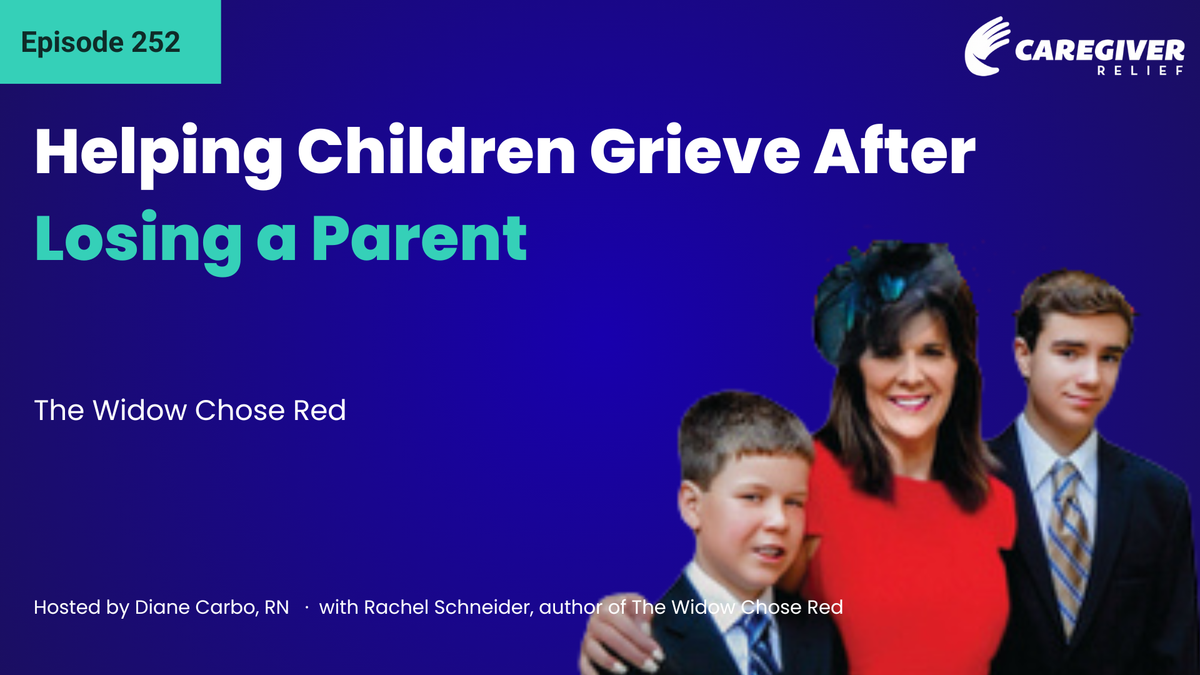
In Episode 252 of the Caregiver Relief Podcast, host Diane Carbo, RN, sits down with author Rachel Schneider for a deeply moving conversation about the heavy weight of family grief. Rachel shares her family's painful journey following her husband John’s terminal ALS diagnosis and how his subsequent passing impacted her two young sons, J3 and Jake.
The discussion dives headfirst into the hidden, chaotic ways children carry loss—focusing on behavioral shifts, adolescent addiction, suppressed emotions, and the resilience it takes for a surviving parent to steer a family through the dark. Together, Diane and Rachel candidly explore how faith, firm guardrails, and honest conversation can slowly pave the way for healing after tragedy.
📝 Key Takeaways & Episode Outline
- The ALS Diagnosis & Caregiver Strain 💔
- Rachel reflects on John’s sudden diagnosis after an executive physical at the Mayo Clinic.
- The hidden physical and emotional reality of navigating a rapid motor neuron disease while trying to maintain normalcy for young boys.
- How Children Process Loss Differently 👦
- The Oldest (J3): Grieving through adolescence, turning to substance abuse, and struggling under the unspoken weight of feeling forced to be "the man of the house".
- The Youngest (Jake): Processing grief in silence—becoming the quiet "solid citizen" while watching the family dynamic shift around him.
- Navigating Teen Addiction Amidst Tragedy ⚠️
- Facing the heavy stigma of adolescent addiction and the trial-and-error process of finding effective help (from Outward Bound to treatment centers).
- Overcoming maternal guilt, releasing the false burden of self-blame, and making tough choices like setting up firm boundaries.
- Faith, Guardrails & Rebuilding Life ✝️
- The vital role of faith in moving through deep grief and letting go of control.
- Why children need strong guardrails and consistent consequences—even in the middle of a family crisis.
- Finding hope on the other side: How both sons co-authored Rachel's latest book to share their own perspectives on healing and recovery.


🌟 Episode Highlights & Quotes
"Children, they process and handle things... and the worst thing that anybody could have said to J3 was, 'Okay, you're the man of the house now.' You can't put that kind of responsibility on these young kids."
— Rachel Schneider
"Resilience is a skill. We don't all have it—it's a muscle that we develop... It has to be grown, it has to be recognized, it has to be nurtured."
— Rachel Schneider

Podcast Episode Transcript
Diane: Welcome to the Caregiver Relief Podcast.
I'm Diane Carbo, RN, your host. Today we are talking about one of the most tender and difficult parts of grief. What happens to children when they lose a parent? My guest today is Rachel Schneider, author of The Widow Chose Red.
Rachel's story includes love, marriage, ALS, widowhood, faith, and the painful reality of raising boys who had to face the death of their father too soon. This conversation is more than one woman's grief. It is about the grief children carry, especially boys who may not always have the words to explain their pain.
It is about faith, anger, silence, behavior changes, and the battles that happen inside a family after the death changes everything. Rachel's new book, The Boys, the Bible, and The Battles, speaks directly to the struggles her boys faced as, they navigated grief. Today, we'll talk about how a surviving parent can support children through loss, while others are trying to survive their own heartbreak.
Diane: Rachel, thank you so much for being here. This is a topic that touches me 'cause I lost my mom at 18.
Rachel: Oh, Diane, I'm sorry.
Diane: And I am the oldest of four, so I think that this is a topic that absolutely needs to be addressed. So thank you for joining us, and thank you for writing this.
Rachel: Oh, absolutely.
And I am proofing it right now, as... And so it will be out probably within the next month. And I think, Diane, as I'm listening to you and knowing what you've just shared, trauma like that when you are young trauma at any age, but especially when you're younger, I don't think...
And looking generationally where we were when these things happened
Diane: Yeah
Rachel: I can only imagine for you, it was probably more like just buck up, buttercup. This is the way it is. You're gonna... you've gotta step into this role now. Your brothers and sisters are counting on you.
And that generation just didn't do a whole lot with, "Oh, how are you feeling?" Or, "How can we help you through this?" Or
Diane: You know what? That's it. I felt abandoned, alone, and terrified. And it's impacted how my future relationships. I can tell you that it's really had a traumatic, impact on me, as well as the relationships with my siblings.
But we'll go into that a little bit. Sure. I wanna start first by, for those meeting you for the first time can you share a little bit about John and your family and the journey that led you to write The Widow Chose Red?
Rachel: Of course. I was, John and I met and got married. His mom was the one that introduced us, here in Dallas a long, long time ago.
And we were married and traveled all over the country as he continued to get promoted. I was the trailing spouse. So we went from Philadelphia to Seattle to San Francisco, back to Dallas to Chicago, back to Dallas, and then finally in Minneapolis. We made all those moves in about 14, 14 years. So it was like once every two years I was recreating our life.
And after about 21 years of doing that, we settled in Minnesota, and he had, he got the job of a lifetime. He loved it, everything about it. We had our two boys. They were young. We had settled into the community. I had adjusted to a way of life in the Great White North that I never thought that I would.
Diane: Yes.
Rachel: Because I'm a Southern, I'm a Southern girl. And so, you know, life was good, Diane, and, like all of us, we get thrown some curve balls. And, John had been an athlete. He had participated in sports in both high school and college. He was used to having those aches and pains and sometimes those things as we get older that don't quite resolve as quickly as we think they should.
And unbeknownst to me, he had been seeing a neurologist for over a year because his foot just wasn't, picking up properly, and he was curious as to what might be going on.
Diane: Yeah.
Rachel: And so after about a year, he was due for his executive physical at the Mayo Clinic, which is of course the mothership of medicine.
Yeah. People know it throughout the world. And they confirmed what his neurologist thought was going on, and, gave him the diagnosis two days later that he indeed had ALS. And it is, for those people who may not be that familiar with it, ALS is still considered somewhat of a rare disease.
There are about 30,000 people who are currently living, with ALS in the US. Across the, the world it's known as motor neuron disease because that's what happens. The motor neurons which carry the messages from the brain to the muscles, they stop working. They, they die. And so what happens is the body starts to self-paralyze while the brain stays completely intact.
So imagine that you've got an itch at the end of your nose, and you know it's there, and you wanna scratch it, but you can't lift your arm to get your hand to get your finger to the edge of your nose. So it is a brutal disease. Between 5,000 and 6,000 people will be diagnosed every year. the community is still very small because, you know, to give you an idea, there are about nine million people that are affected by Alzheimer's.
So when you look at that versus 30,000 from ALS
If you don't, if you haven't heard about it, that's okay. It's quite all right. and even though all the campaigns for ALS awareness, and just recently We've had a young, football player, Chris Johnson, just revealed his diagnosis several weeks ago, and they've tried to revive or are reviving the ALS Ice Bucket Challenge, which, 10 years ago raised over $250 million.
Diane: I remember that.
Rachel: Yeah. I do, yeah. Yeah, everybody dumping buckets of ice over their head, and a lot of money was raised, and so they are bringing that back because, of course, Diane, there's a whole generation that doesn't know about that. You and I
Diane: Yeah
Rachel: remember it, but there are a lot of people-
Diane: yeah
Rachel: that don't. And and that's all well and good, but the thing is that when you are in the middle of experiencing a disease like this, research is great, but you need to figure out how to get your loved one into the bathroom.
Diane: Yeah.
Rachel: You need to figure out how to get them, up, from the car to the house.
You need a ramp built. You need to redesign... So there are some organizations that are so good. the proceeds from my first book benefit the Live Like Lou Foundation, which didn't exist when John had ALS, but they are boots on the ground. they provide scholarship. They provide grants for, making improvements to your home, and they also donate to research too.
And the second book, I'll tell you where the proceeds from that book will go as well. But that in short is our story. John lived with ALS for three years. He had a straight line decline. What happens, ultimately is that your diaphragm, which is a muscle that controls the breathing of your lungs, moves them, it quits working, and, and most, you know, most suffocate.
They can't breathe anymore. John has been gone for 15 years now, and my boys were 10 and 14 when he passed. And so that's what we're gonna spend today talking about is what
Diane: Yes
Rachel: what that next piece looks like because, as you well know, the trauma of losing a parent, and especially too, Diane, a parent of the same sex.
Diane: Yes. Yeah.
Rachel: That is a huge, that's a huge piece of, Yeah ... what happens or how they process or don't. Exactly.
Diane: So your upcoming work, The Boys, the Bible and the Battles, it does speak directly to how your sons navigated the grief. Now, children, I know from personal experience, grieve differently than adults.
What did it look like for your boys after losing their dad?
Rachel: Well, I will tell you, it looked very different for each one of them
Diane: Yeah
Rachel: because one was 14 and one was 10. the interesting thing which I love is that both of the boys contributed to this book, Diane. They were able That's beautiful they were able to go back. It gives me chills to tell you that. But they are now, 29 and 25, and they were able and willing to go back. And, I gave them questions to help prompt them. but what it looked like, of course, at 14 you're entering adolescence and that's when boys are supposed to pull away from their mothers and bond with their dads.
Yeah, yes. That's normal. That's what they're designed to do.
Diane: Yes.
Rachel: And although, we had waited a year before telling the boys about John's illness because the thing about ALS is that when you're usually when John was diagnosed, you couldn't look at him and tell. He still looked healthy. He still looked normal.
A year later, there was definitely something going on. And we just needed some time to, to prepare for this, 'cause we knew once we told the boys our whole world was going to change again. And so they were even younger when we told them, right? Yeah. And they were living with their father, watching this decline.
And I don't know, Diane, that I realized exactly because when you are in that caregiving mode
Diane: Yeah
Rachel: you become so focused on getting the job done that I think for me, I thought, well, if my boys see me handling this okay, they'll be okay. We're just supposed to think that this is normal, that we're building ramps, we're reconfiguring bathrooms.
Dad's one day on a walker or a cane, and then he's a, walker, and then he's in a, a regular wheelchair. Now he's in a fully motorized wheel There's nothing normal.
Diane: Yeah.
Rachel: And I think that's you try to normalize this because this is a part of your, this is a part of your life now.
But them helping Dad get out of bed and these are just things that, kids just do, And then that person's not there anymore. And you're supposed to make that normal too. Yeah. that, there's nothing. You know? I, so there's so much wrapped up in it, and John, my oldest, had already started experimenting with marijuana, and I didn't...
I just wasn't aware 'cause I was so tied up with taking care of his dad and everything else. and the thing too, Diane, is when you're at that age, how much of this was grief? How much of this was adolescence? How much of this was just normal guy, you know, boy behavior? You're gonna try stuff.
You're gonna do stuff. So I was really at a crossroads with I didn't think that we were gonna go down a really serious route, which we, we actually did.
Diane: Yeah.
Rachel: Yeah. and then Jake was 10, and at 10 you're still so tender. You're just a little
Diane: Yeah
Rachel: you know? He still
Diane: Yeah
Rachel: lets Mama hug him.
Diane: He still wants to, curl up next to me and read a book or watch a show. and his heart is still so open. And, and as I reflect and look at what he's written, he was just watching. He was just watching and determined not to create any drama.
Diane: God bless him, because the baby of the family is always the one that's going to cause chaos because they need to get attention.
Rachel: A point noted.
Diane: Yes.
Rachel: Noted.
Diane: Yeah.
Rachel: And yet he was watching. And why is it, Diane, that the child that is usually the worst behaving is the one that, sucks all the energy out of the room and is what everybody leads with in a conversation?
Diane: Yeah.
Rachel: Nobody was asking about Jake.
Diane: Yeah.
Rachel: Because Jake was a solid citizen.
Jake was an Jake wasn't But John, that was the first question out. What's John? How's John? What's going on? Especially as his behavior became more erratic, he was starting to spiral. You know, I was finding the drugs. He was breaking car. He all of the things. and I, and John writes too that he was just lost.
I mean, he just whatever it took, he just did not want to be where he was. He just didn't, he just didn't wanna be there, and he didn't know. The only way he knew how to get anywhere else or to dull the pain was just let's get high, and check out and stay checked out.
Diane: Yeah. When my mom died, we had, she was given a lung cancer diagnosis, and I ended up helping to take care of her.
In fact, I was her primary caregiver 'cause my dad worked all the time, and became the mother to my siblings. My mom is actually in the oncologist office and he tells her, "Louise, you beat cancer." And she's so excited because in those days, that was a rarity. And he says, your lungs are clear.
You're doing well." On the elevator on the way down to tell me, I was at nursing school across the street, had only been there for a few months, she threw a pulmonary embolism and died that night. And I went over, the school told me, I went over to intensive care, and all my mom does is say, Diane, you have to go Christmas shopping.
There's a few things you need to pick up before the boys, before the kids." The And I said, "Okay, Mom." So I'm out grocery shopping thinking my mom's going to make it, and she died that night in intensive care.
Rachel: Oh.
Diane: So
Rachel: Yeah
Diane: Yeah. And so, you know, when you say how everybody reacts differently I immediately, everybody wanted me to quit nursing school and stay home
Rachel: Oh
Diane: and help with the kids. And I said, "I'll move home," which I did. I moved home, which was grueling as it was. But-
What happened was I put my focus on nursing school. But you know what? Nobody ever reached out to me, 'cause I was the oldest, "Hey, how are you doing? What can we do?" Nobody helped me with our, my siblings, and I come from a big Irish family.
Rachel: Wow.
Diane: My mom was the glue to that family where, and you're right, everything looks different. children, like I saw anger, withdrawal, behavioral changes, and even fear. and you talk about your son's addiction, or, maybe not addiction, but interaction with drugs. That's painful. My siblings did that. I was dealing with that while I'm going to nursing school, and, it's just, it's impacted my relationship with my siblings for the rest of my life. you know, because I'm the bossy, know-it-all, big sister.
Rachel: Girl, I can relate.
Diane: Yeah
Rachel: I'm the eldest of four, so I get it.
Diane: Me too.
Rachel: Yeah. I get it. and you kinda go, and you know, I think the, the people ask me sometimes if I have a regret about what, how things were with the boys, and I think it's that, as I said earlier, I just thought, Diane, if I set a good example
Diane: Yeah
Rachel: that it would be okay for them. And like you said, children, they process and handle things and of course they're boys too.
Diane: Yeah.
Rachel: So they are going to, they don't know what to do with these emotions and with these feelings. And then the worst thing that anybody could have said to, to J3 was, "Okay, you're the man of the house now." Okay. He's 14 years old.
Diane: Yeah.
Rachel: Don't you are you joking?
Diane: Yeah.
Rachel: I'm still his mother.
Diane: Yeah.
Rachel: I'm still, you know,
Diane: Yeah
Rachel: he's not. He's not gonna take care of your mom. No. He doesn't need to take care of me. And I, and even now when I hear people, I know they mean that in a good way, but it's, you can't put that kind of responsibility, on these young kids.
Yeah. You just can't. They're carrying a weight, and to your point, Diane, they, their outlook on life has been completely shift it has completely changed.
Diane: Absolutely. Absolutely.
Rachel: They will, the carefree unaware
Diane: Yes
Rachel: That's all gone.
Diane: That's it was. It was
Rachel: It's been hijacked, yeah.
Diane: Yep, it was totally hijacked.
So, I wanna ask you, why was it important for you to tell that part of the story?
Rachel: Well, because here's the thing. I, there were not, when I was going through all this, I couldn't, there weren't, I didn't know any other widows, okay? So I didn't know anybody who was widowed at, at, in their late 40s. I didn't know anybody.
And then I didn't know anybody who had kids that were having drug problems. Yeah. I just couldn't find them. and even this was, 15, 16
Diane: Yep
Rachel: years ago. There was still such a stigma around it. You couldn't get online like you can now and find a support group or find a recovery group.
There, and John was a teenager.
Diane: Yeah.
Rachel: And getting, they didn't have AA for teens. They didn't have, it was hard enough to find... And look, once again, I'm in Minnesota. Hazelden the hallmark of
Diane: The hallmark. Yes, yes, yes.
Rachel: I lived in Minnesota the hallmark of addiction and recovery right there in my backyard.
We did outpatient with them. here's the thing, Diane. I gave it, I threw everything but the kitchen sink at addiction because I couldn't do anything about ALS.
Diane: Yeah.
Rachel: There was zero I could do about ALS. Yes. So I thought, all right, I'm gonna go from one extreme to the other.
Diane: Yeah.
Rachel: And I even had, trying to find counselors, therapists. I had several who said, I don't have..." They thought they could help, and then after a couple of sessions, they're like, "Yeah, I can't, I can't"
Diane: Yeah
Rachel: "do any more for you." And then I remember specifically after one session, the counselor's like, "Well, Rachel, you need to let John know that you're sorry for the bad choices that he's made."
And I looked
Diane: What in the world? That's the stupidest thing I ever heard.
Rachel: I know. And I'm like, "Are you kidding me?" No. Or, "Are you he's the one doing it, and I'm gonna apologize for his bad choices?
Diane: He's making bad choices, and I'm supposed to say, "I'm sorry that you're making bad choices.
It's on me"?
Rachel: Yeah.
Diane: Yeah.
Rachel: Diane, I gotta tell you. So I think the other piece of this, that was so important for me to share is that, you know, getting the right kind of help
Diane: Yeah
Rachel: it doesn't just happen. No, it doesn't. It doesn't just happen. It can be, and this is for caregivers too, getting that additional help, whatever you need to take care of that person you
Diane: it is a process.
Rachel: You can't, you're not gonna make one phone call or have one appointment and it's all gonna work out.
Diane: Yeah.
Rachel: And I
Diane: Oh, it doesn't work that way
Rachel: No. But I think too many of us, because of where we live and the abundance now of everything that we have we think it should be, easy peasy.
But that was the thing that really, that really I knew that I needed to tell this part of the story and I knew that the boys, I needed their agreement to do this because it was hard and confusing and chaotic, and it went on for years.
Diane: Yes. Yeah.
Rachel: And, and what I realized too, we did Outward Bound.
I sent John to the boundary waters of Canada and the United States for five weeks with two guides and four other teens to, you know, I thought, "Okay, he needs to get out in the great outdoors, carry his own canoe. this'll shore him up."
He looked at me, Diane, and he goes, "Okay, mom, that sounds really smart, sending me out in the wilderness with five other guys who are making bad decisions.
Yeah, that's, and you're gonna pay for that?"
And that is the flawed logic of an addict speaking
Diane: Yes
Rachel: as well, right? Because they
Diane: Yeah
Rachel: will weave in one little bit of truth, just one little bit.
Diane: Yes. Yeah,
Rachel: I know. And then you're the one thinking, "Okay, am I crazy? Am, am I crazy?"
Diane: Yeah.
Rachel: 'Cause when you put it that way, it does sound really ridiculous.
Diane: Yeah.
Rachel: Yeah.
Diane: But I've, worked with, some Outward Bound, groups in the past.
Diane: Yeah.
Diane: Not, just helping patients overcome fears and stuff.
Rachel: Yeah.
Diane: And, I have to tell you, it would have been, I don't know if he went or not, but it would've been good for him.
Rachel: He did. Yeah. He did. He did. And
Diane: I will tell you I was like, or they were bringing their own drugs and they were gonna smoke pot and stuff while they were out there.
Rachel: Now, that did not, that I know did not happen.
Diane: Yeah.
Rachel: But I do know, but I do know when my son was in a sober living house, there was one of the kids OD'd.
Diane: Yeah.
Rachel: OD'd at the sober living house.
Diane: Yeah.
Rachel: It happens. So we have run, I feel like we, we ran the gamut with it all.
Diane: Yes. Yeah.
Rachel: And ended up actually, after all of this, and John was at a point where he was stealing phones at school to sell them to, to buy drugs.
Diane: Oh.
Rachel: And, and I was actually like, okay, I, the, and the police were hesitant to arrest him because of course he's 17. They don't wanna put something on his record. And I'm thinking, "Well, maybe if he spends a night in jail
Diane: Yeah
Rachel: that might scare him straight."
Diane: Yeah.
Rachel: But the police were like, "Look, we really, if he just gives the phone back or you da da da da da."
And I'm like, all right. but the final straw was he started writing checks. Now Diane, this was when this was when you could just write the check and take the picture.
Diane: Okay?
Rachel: I don't even know that you even have to do that. I don't know, even know if anybody's writing checks anymore.
Diane: Yeah.
Rachel: But he got in my checkbook, and here's the thing, he wasn't writing it for hundreds or thousands of dollars. This was like 50 bucks, 60 bucks. Oh. But Wells Fargo was cashing them.
Diane: Well, because, that's not
Rachel: Yeah
Diane: it's not enough. So anyway, it was at that point I was like, okay, we, this is full scale.
Rachel: I had a girlfriend who had a friend who did interventions.
Diane: Yeah.
Rachel: You've probably had experience with that as well.
Diane: Yes. Yes.
Rachel: Yeah. And I will tell you, Bill came over, we sat at the kitchen table and he basically said, "Okay, John, you get to make the choice. We're gonna call the cops 'cause now we've got forged checks here, or you can decide to go..."
This was a treatment center, Caron. It still exists. It's in Wernersville, Pennsylvania. They were one of the few places that treated teens.
Diane: Yes.
Rachel: Okay? Now, not so hard to find. Back then really difficult. And, and so he said, "You can go for 10 days. Let's see what happens. Let's get you there 'cause you are in some serious, you're in some serious trouble."
So we were on a plane the next morning.
And I will tell you, that was one of the... I was, I couldn't let him go by himself 'cause I didn't know that he would actually get there, even though they'd had so much money now.
Diane: I understand.
Rachel: Yeah.
Diane: Yeah. Yeah.
Rachel: And and plus, I needed to see this place.
I needed to see where, 'cause I was like, "I'm really gonna do this? I am real am I really gonna do this? Is has it gotten so bad that I'm really gonna do this?" And let me tell you, that's an expensive thing to do too. There is nothing about recovery treatment that's inexpensive. AA may be the only, AA may be the only one because it's free.
Diane: Yeah
Rachel: It's free, right? But you still have to do, you still have to do the work. But I took John, I did all the paperwork, laid down the credit card, and the next thing I know they're like, "Okay. Say goodbye, Rachel. This is it." And I was just like seriously, Diane, it hit me at that point. And I thought, you know, is this...
I still was like, there was a desperate part of me that was like, "Okay, I gotta do this." And then there's the mom part of me that's like
Diane: Yeah
Rachel: "I'm really gonna leave my son with these people?" And what I didn't realize, Diane, is this, John contributed to the book. He just felt like a ping pong ball. 'Cause I was Oh
I was sending him and doing and this and that, and he's like... And he learned how to read the room and say, "Okay." And how to play the game to get what he, to get what he needed. Because, and, and now, okay, that skill is serving him well out there in corporate America.
He can adapt. Yeah. He can adapt to a lot of situations that get thrown at him, but at that time, he's 17, and I mean, you just think about... I sent him to Australia to be with my family because I have a brother and I have a dad, and he needed a strong male influence. I did it all, but Karen was the last, Karen was the last straw, and the 10 days turned into 30 which turned into 90 And in the meantime, I had... You know, one of the things they tell you is that you need to change the environment of the addict, if you can, because if he comes back to the same place, he'll
Diane: Yeah
Rachel: it's easier for them to fall into the same patterns of behavior
Diane: Yes
Rachel: right? And to hook up with all those bad influences and whatever.
So Jake wanted to play Friday Night Lights football, and where do you play Friday Night Lights football? You play it in Texas. You play Friday Night Lights in Texas, and I told Jake that we could go wherever he wanted. wherever he wanted to go, whether it was California or Vegas or Texas I would take him wherever he wanted to go because that was his dream, and I had worn myself out. And his brother, it was now time for me to focus on Jake, and Jake chose Texas. So we moved to Dallas, while John was in rehab.
Diane: Whoa, whoa.
Rachel: And so I thought, "I'm doing all the right things," right, Diane? I'm doing...
I mean, I changed his whole... He wouldn't know, he didn't even know what neighborhood we were in. He didn't know
Diane: Oh
Rachel: about anything. He got out for Christmas. I moved into the house a week before Christmas. And here you are trying to put together this, "Oh, let's put together a, a picture perfect Christmas."
Diane: Yeah.
Rachel: And here comes John. He was out for good behavior, and because he was long distance, they gave him a longer period of time to be with us. And then you spend that whole holiday just on pins and needles going
Diane: Yes. Yeah
Rachel: am I gonna trigger him? Is something gonna happen? Is he gonna go
Diane: Yeah
Rachel: do whatever?
we got through that, and then I put him back on the plane And he was done. He was discharged in February right before his 18th birthday.
Diane: Wow.
Rachel: And you and I both know too, at 18 legally
Diane: Yeah ...
Rachel: as parents, we have no say.
Diane: No say anymore, yep.
Rachel: And it doesn't matter, you at 18, very different than my son at 18.
Diane: Yeah.
Rachel: Yeah. I just, sense of responsibility, sense of, personal autonomy. So John gets released and tells me the day after. Well, he gets home and he goes, "Okay, you guys, now I can tell you." And we're like, "What?" I can tell you who was in, who was in, at the, at Caron with me, who was in one of my, group sessions."
I'm like, "Okay." He goes, "Johnny Manziel." of Johnny Football fame, right? yeah. And Jake's first thing out of Jake's mouth was like, "Did you get me an autograph?" And John's like, "Man, that would not be cool. No, you don't do that kind of stuff when you're in the middle of group."
But John had an NDA, he couldn't tell us until he
Diane: Yeah
Rachel: and I'm like, okay. And you think of Johnny Manziel, and I don't know if a lot, I hope that your listeners may know, but if you don't Do Johnny Manziel was the youngest player to ever win the Heisman. He won the Heisman Trophy
Diane: Yes, yeah
Rachel: as a freshman at Texas A&M.
Diane: Yeah.
Rachel: The boy had promise and talent and blew it
Blew it up.
Diane: Yeah. I have a question for you, Rachel.
Rachel: Sure.
Diane: One of the things that I'm wondering if, your sons worried or concerned or the behaviors they were exhibiting were because they thought they were going to die young and maybe even get the condition that their dad had.
Rachel: It's a great question. I will tell you what I didn't realize, I don't think that was their thought, but I do think for the first couple years, they thought something might happen to me.
Diane: Oh, wow, yes, yes,
Rachel: Yeah. And that's not unusual. That's not unusual either. and I don't know if in your case maybe you guys were want, if that hap- if something might happen to your father too.
But apparently that is something that's a real fear that children carry because death
Diane: Yeah
Rachel: yeah, it happened to one, could it happen to the other?
Diane: Yeah. For me, it impacted me in such a way that I thought I was going to die in my 40s. I gave... I was married, had kids. I gave everything away all the time.
I have no attachment to, sentimental attachment to anything.
Rachel: Okay.
Diane: I can live without things. it was just, I didn't know. There's a book called Motherless Daughters. Okay. And I read it in my 40s, and then I realized, "Oh my God, this is what I've been doing my whole life." subconsciously thought I wasn't going to live beyond the age my mom did.
Rachel: Wow.
Diane: Yeah. So I was just curious if that was a concern for your sons. And it's not that I thought I was gonna die of lung cancer
Rachel: Yeah
Diane: because I didn't smoke. I didn't... My mom didn't smoke either, but she grew up above a, their, her parents owned a dry cleaners.
Oh. So all the siblings, of my mom, all had some sort of cancer.
Rachel: Oh, my goodness.
Diane: But
Rachel: Wow
Diane: now, you're a woman of faith.
Rachel: Yeah.
Diane: So how did your faith help you get through those dark seasons?
Rachel: Well, I gotta tell you, I'm always asking the Lord, what am I supposed to be learning? What are you trying to teach me here? Because, the journey with my husband, John, was pretty traumatic.
And, and that developed, I developed a different relationship with God, and then I went deeper. And then to have this happen with J3, I call him J3 'cause he's John III.
Diane: Yeah.
Rachel: I'm like, seriously? I didn't know anything about ALS, and I didn't know anything about drugs other than just stay away from 'em. And now what is it... And here's the thing You know, Diane, when it's an adult and it's your spouse and somebody who is, you know got their facilities, their faculties around them, that's one thing. But then you've got your child.
And you're just wired to take care of this person
Diane: Yeah
Rachel: at all costs.
Diane: Yeah.
Rachel: and yet what I realized, too, is me sacrificing myself, whether it was for my husband or my son, ultimately I wasn't going to be able to save either one of them. That wasn't my job.
Diane: Yeah.
Rachel: That's the job of Jesus. That's His job. And yet we all want to take that back from Him, don't we?
Diane: Yes
Rachel: we'll give it to Him, then we go and take it back, and then we give, because things aren't going the way that we think they should. And I think for me, realizing that we all know children are a gift from God, we know that, they are His. He's lent them to us. He's given them to us to be this great blessing.
I also had to, so I had to let go of the fact that I carried a lot of shame around his whole addiction, around the things he did, the way he acted, the way he was. I thought there was something I did wrong as a parent. I could attribute
Diane: It's always the mother's fault.
Rachel: It is, even though the dad It's always.
Even though the dad, even though the dad died it still must've been something that you did that Rachel didn't do.
Diane: Absolutely.
Rachel: And I will tell you that, I think that was probably the hard and it's probably hard for anybody who has someone in their life who is an addict, is that, maybe because of the way we're raised or brought up, I tended to, I carried so much of that with me.
And the thing is, too, is that I guess and I didn't know truly the depth of John's... when he told me he'd used heroin
Diane: Oh
Rachel: Diane, I was like, 'cause they have to do this timeline when they were in rehab about when things started and where they progressed.
And I sat there just shocked, like, how did you even know where to get it or what to do with it?
And this was the interesting thing that I learned. He said to me, "It was scary But he would do it again, scared.
Diane: Yeah.
Rachel: The other thing that I learned is that people, a lot of people who die of an overdose don't intend to die from the overdose.
Diane: Sure. Yep.
Rachel: It's just they wanted that little, they just wanted that little extra, just that little bit more.
Diane: Yeah. Yep.
Rachel: And that's what
Diane: They pushed the envelope too far.
Rachel: Exactly. Absolutely. Yeah. Exactly. Yeah. In search of that, of more of that, that feeling.
Diane: Yeah.
Rachel: Which had never occurred to me, right? I didn't,
Diane: Well, we're not drug addicts. I am an adult child of an alcoholic. Okay. And I can drink.
I choose not to.
Rachel: Yeah.
Diane: I don't get the, I don't wanna be... I'm a person who doesn't wanna be out of control because I don't, my environment, I wanna be aware of my environment, and I just don't enjoy drinking. But I'm the one in four. one in four of, alcoholics or drug addicts in the family, are not, prone to addiction.
Now, I have a lot of isms. Like I work too much, I focus too much on working or, other things, but you know, like stress eating and stuff, but I don't, I'm not into drugs. I'm not into, I don't get any of that. I really don't. But, now Rachel, you have, looking back, what did you learn about God, motherhood, and resilience from this journey?
Rachel: You know, Resilience is a skill. We don't all have it.
Diane: Yes.
Rachel: And Yeah, it's a muscle that we develop. And I think that's the thing that I do think that we can... It's learned. and I've watched, My mom, I might have shared this with you, my mom was an immigrant to this country.
She grew up, she was born in Ukraine, in Kiev, and she was put in a displaced persons camp in Germany at the age of three.
Diane: Oh.
Rachel: And she lived there until her mom remarried, because her father was taken and put in the gulag. They never saw him again. And her mom remarried, and they were sponsored and brought to the United States by a family.
They got to Tupelo, Mississippi, which is where Elvis was born. And they picked cotton. They lived like sharecroppers in a
Diane: Wow
Rachel: shack, and picked cotton to pay off their passage to this country. She went to high school. She learned English at the age of 15, 16. Her first book report was on The Three Little Pigs.
That's all she could get out.
Diane: Oh.
Rachel: and then she took herself to secretarial school in Jackson. And, so maybe part of it is in our DNA
Diane: Yeah
Rachel: a small part. But it has to be, it has to be grown, it has to be recognized, it has to be nurtured. Yeah. So I do think resilience. and what I do know, too, Diane, and I know I'll circle back, is that I see this in my boys.
Diane: Yeah.
Rachel: I've seen this in my boys through, through everything that they have, gone through. and I'm not saying I'm responsible, but I think, God worked through me Yeah to show them, and for them to recognize themselves. They've got great faith. They've got a great relationship with Jesus.
They both, and I think that I had something, hopefully something to do with that, too. But motherhood is, I think, parenting. I won't just say mothers, but 'cause this was a thing that I knew that my husband leaving this world when he did this is what made him so sad, was knowing that he was not going to get to raise those boys.
Diane: Yeah.
Rachel: And we know as, I think parents It is the most difficult, it is the most difficult job out there. Definitely bar none.
Diane: Yes.
Rachel: Bar none. and we don't always get it right.
Diane: Yeah.
Rachel: There's a, and but we don't always get it wrong either.
Diane: Exactly. Yeah.
Rachel: And yet we can't know, we can't know.
Sometimes it takes years to see
Diane: Yes
Rachel: the seeds that we've planted or the actions or the consequences, how they all come together. John now is working. He's got, he's a dad. He's got two little ones. They're six and four, and he's engaged, and he is remarkable. He's sober. That life, that, that life doesn't even.
And it was a big ask, Diane, to get him Yeah to come back to that, and for Jake as well, because they would rather They'll never forget it.
Diane: Yeah.
Rachel: But to have to go in and sit with it is a whole nother, and write about it, is a whole nother thing. But I do think, the resilience thing is something that, that I still work on today.
I mean
Diane: Yeah
Rachel: because things, challenges still come into our life and will continue to. But what is the how you do one thing is how you do everything.
Diane: Yeah.
Rachel: I think that it, that's part of, that can be attributed to our resilience and our ability to adapt and come back
Diane: Yes
Rachel: to situations as well.
So I hope that answered your question.
Diane: Yeah. Well, you know, I want to thank you for sharing such intimate details with my listeners. I know that's powerful, and, it will help others realize they're not alone in their journey. How do people reach out to you and find you and get your book?
Rachel: So you can find me, at my website is probably the easiest, which is spiritedprosperity.com. And the book is available on Amazon and Barnes & Noble, where you get your books. It's also on Spotify, the, and Audible. And I'm on YouTube and Facebook and Insta and LinkedIn and all of those great places on social.
So yeah, and like I said, the new book, The Boys, the Bible, and the Battles, will be out probably in about a month.
Diane: Awesome.
Rachel: And it really, I just really wanted to encourage people who were dealing with children who are going through something. And whether it's drugs or death or, they're just having a bad day.
Diane: Yeah.
Rachel: I think it's important that we understand, you know, I talk about the fact too, Diane, that it's hard for parents to enforce the consequences, but children need guardrails. They're looking for
Diane: Yes, they do
Rachel: they're looking for them.
Diane: Yes, they do. Yeah.
Rachel: That's why they test them
Diane: Yeah
Rachel: is to make, are they gonna hold?
Diane: Yeah.
Rachel: Are they going to hold? And too often we put them in crabgrass and not concrete, Well, and you know what? They need to learn there's consequences to their behaviors, whether it's good with rewards or, consequences that they suffer some sort of pain without, without a phone or whatever.
Diane: Yeah. Or not being able to go out. So Oh, yeah.
Rachel: Oh, yeah I talk about how one day I... So privacy, right? Yeah. I took the door off of his room.
Diane: Oh, yes, yes, yes. Seen it, done it, been there. Oh, I get that so much. yes. I'll show you, so
Rachel: And let me tell you, not having a door to slam or close or whatever, it's, yeah,
Diane: It takes away the drama.
Yes, yes, yes. I love it. Oh, Rachel, it's been so wonderful to hear, and I know you're gonna come back and share your third book with us.
Rachel: Absolutely, and that one's due, I'm looking at a Valentine's Day, because that's God, the guy, and the girls.
Diane: Awesome, awesome. To my family caregivers out there, you are the most important part of the caregiving equation.
Without you, it all falls apart. So please learn to be gentle with yourself, practice self-care every day, because you are worth it.
Caring for a loved one can be overwhelming — but you're not alone. If you have questions, big or small, our expert team is here to help.
👉 Click here to Ask the Expert
Our Resource section can help you find the information and tools that you need. We have courses, videos, checklists, guidebooks, cheat sheets, how-to guides and more.
You can get started by clicking on the link below. We know that taking care of a loved one is hard work, but with our help you can get the support that you need.
Click here to go to Resource Section now!