Why Does My Mom With Dementia Keep Calling Me? Understanding Repetitive Calls and Separation Anxiety with Kirstin Thomas - Episode 251
When dementia separation anxiety resets with every memory gap, repetitive calls can exhaust even the most devoted caregiver. Diane talks with KindredMind co-founder Kirstin Thomas about using a familiar voice to calm fear and protect connection.
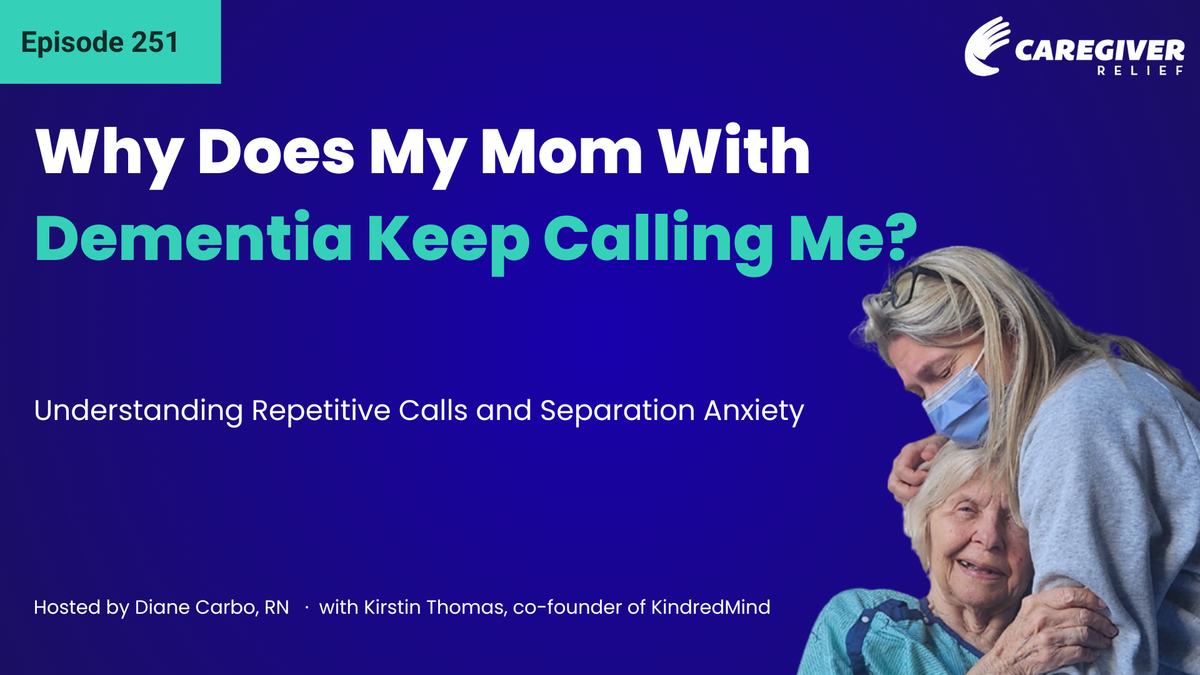
In this episode, host Diane Carbo, RN, speaks with Kirstin Thomas, co-founder of Kindred Mind. After managing repetitive calls from both her grandmother and her mother, Sharon (who lives with frontotemporal dementia and the effects of a stroke), Kirstin created an innovative tool to support overwhelmed families.
🎧 Episode Highlights
- 🧠 The Neuroscience of Repetitive Calling: Why damaged short-term memory (hippocampus) and continuous threat detection (amygdala) keep anxiety resetting after every hung-up call.
- 🤝 Compassionate Deception & Validation: Why validating feelings and gently redirecting conversations is more humane than re-traumatizing loved ones with strict reality orientation.
- 🤖 How Kindred Mind Works: How familiar voice technology interacts with loved ones using a personalized knowledge base while enforcing strict dementia-friendly guardrails.
- 🛡️ Safety & Safety Bypasses: Universal and custom distress keywords automatically alert caregivers in real-time when immediate action is required.
- 💚 Addressing Caregiver Guilt: Reframing boundary management and technological tools as supportive, life-saving care rather than abandonment.
📋 Episode Outline
- Introduction
- Host Diane Carbo introduces the cycle of repetitive phone calls and separation anxiety in dementia care.
- Meet Kirstin Thomas
- Background on Kirstin's mother, Sharon, and the inspiration behind founding Kindred Mind.
- Sharon’s Story & Early Signs of Frontotemporal Dementia
- How subtle changes in executive function and social behavior appeared before traditional memory loss.
- Generational Patterns & Clinical Insights
- Lessons learned from Kirstin's grandmother and the neurological drivers behind separation anxiety.
- Deep Dive: Kindred Mind Voice Companion
- How real-time voice technology uses validation therapy, simulated presence, and custom knowledge bases to calm loved ones.
- Ethics, Consent, & Compassionate Redirection
- Addressing the "elephant in the room": why meeting emotional needs takes priority over harsh reality checks.
- Safety Guardrails & Emergency Alerts
- Real-time distress keyword detection and post-call mood summary reports for caregivers.
- Caregiver Guilt & Who Kindred Mind Is For
- Targeted for moderate-stage dementia where repetitive calling is prominent; aiding caregivers without replacing them.
- Closing Thoughts & Resources
- Where to find Kindred Mind and Diane's final encouragement to prioritize self-care.
🌐 Mentioned in This Episode
- Kindred Mind Website: kindredmind.care
Podcast Episode Transcript
Diane: Welcome to the Caregiver Relief Podcast. I'm Diane Carbo, RN, your host today. And today we are talking about something many dementia caregivers experience but do not always know how to explain: The repeated phone calls. Oh, they're awful.
They call, they may call once, then again, then again. You answer lovingly. You wish reassure your parent or loved one, and a few minutes later, the phone rings as if it was the first conversation they never had. For the person living with dementia, it may feel like the first call every single time.
The anxiety resets with the memory gap. They are not trying to frustrate you. They are not trying to interrupt your life. They are scared. They are disoriented and reaching for the voice that makes them feel safe Today's guest is Kirstin Thomas. She understands from the inside. Kirstin is a dementia caregiver whose mother, Sharon, lives with frontotemporal dementia and the effects of a basal ganglia stroke.
Kirstin visits her mother almost every day, but so many fear, family caregivers, she cannot answer every call while also working, raising a family, managing a household, and protecting her own health. That lived experience led Kirstin and Patrick Armstrong to co-found Kindred Mind, a voice companion designed to answer those calls in the familiar voice of the caregiver, using personalized knowledge about the person's life, routines, family, and calming needs.
This is not a conversation about replacing family connection. It is a conversation about preserving it, especially when the caregiver is overwhelmed and the person with dementia needs reassurance again and again. We will talk about dementia, separation anxiety, repetitive calling, caregiver burnout, ethics trust, and how technology may help families respond with warmth, when human capacity has limits.
Diane: Kirstin, welcome. I'm so glad to have you. There's a common thread throughout my podcasts. a caregiver finds has a challenge, an obstacle, or a problem, and then they provide a solution, to it so that others that follow them will not have the same, experience.
So I'm real excited about learning about Kindred Mind. So welcome.
Kirstin: Thanks, Diane. Thanks for having me.
Diane: Now before we talk about Kindred Mind, tell us about your mom, Sharon, and Who she was before dementia and stroke changed daily life for both of you.
Kirstin: Yeah. Where do I even begin?
And how do I do this justice? I guess to give you an idea of, who my mom was, early years, my mom went behind her own mother's back as a preteen to get a job. This was actually against her mother's wishes back in the day. But I feel like that tells you everything about her force of will.
She had moxie, her drive, and her, definitely her work ethic from the very beginning. She raised me as a single mom. My dad never paid child support, so every opportunity I had, you know, university, every privilege, every vacation, came directly from her hard earned, persever- her grit and her belief in herself.
I like to say she was a powerhouse in a suit with shoulder pads. Remember the 1980s?
Diane: I lived in those shoulder pads.
Kirstin: And she routinely exceeded her sales quota, she did really well career-wise. Very successful. And she also, she, I like to say, too, she gardened in heels. That was my mom.
Diane: Oh, I
Kirstin: The self, that she showed that, the entire world, like that outward self, the charismatic, strong, classy.
Always entertaining, always traveling, total social butterfly. I like to say, too, she always lit up a room. She also had, a deep well of empathy. I remember vividly, bagging meals and taking, hand-me-down clothing and combing the streets of Toronto on Christmas Eve to hand to homeless people in bus shelters.
She would take in every stray animal if she could. That's just who she was. like I meant you do.
Diane: I understand that. I relate to that. Yes, yes.
Kirstin: And, I mean, even in her retirement years, she did a lot of volunteering. she volunteered at SickKids Hospital in Toronto, and what she would do is she'd bring posters and crafts and toys to the kids to, and, you know, to make their room feel cozier and less scary.
So in summary, I guess, she was always uber busy, always moving, always giving. that's just who she was.
Diane: Now she had been diagnosed with frontotemporal dementia, and that's devastating for any family. When did you first realize, that her symptoms were more than just normal forgetfulness?
Kirstin: This is it's tricky because it didn't show up the way I think, universally we're taught to kind of see the signs of forgetfulness. With my mom, it was a bit different. it didn't just arrive in one moment. It was like 1,000 small clues that kind of
Diane: Yes
Kirstin: that I kept explaining away. Call it denial. My mom started sleeping a lot, so more than she ever had. Like napping during the day still sleeping all through the night. and she would always talk about how fatigued she was and but we just chalked it up to her getting older. I noticed too that she couldn't really hold on to the arc of a story anymore.
I'd be telling her something, and then partway through I could tell she kind of either wasn't paying attention or she just lost the thread of it.
Diane: Yeah.
Kirstin: Like she was still totally herself in the room, warm, acknowledging, nodding, all the social cues, but I could tell it wasn't resonating. Like either my words or the story wasn't.
Another sign that kind of pulls at my heart is that she used to be in a group, and would play euchre often
Diane: Yeah
Kirstin: weekly with some friends over the years, and she became ostracized because she was no longer following the rules, and they were taking the game quite seriously. And so she
Diane: Oh, yes. You don't mess with somebody when they're playing mahjong or euchre or any of those. They're very, they're tough.
Kirstin: Yeah. And so she lost that social
Diane: Aw
Kirstin: circle because of it. yeah, so I would say there's no, there was no pattern or, I wouldn't be able to predict or forecast
Diane: Yeah
Kirstin: the way I could with my mom's mom, who was diagnosed with Alzheimer's, who you know, displayed the regular kind of short term forgetfulness. Yeah. But with my mom, a lot of the decision-making changed for her before the memory. So I would chalk that up to, the executive functioning, which is
Diane: Yeah
Kirstin: in line with FTD, the frontotemporal, diagnoses that she had. because even, she would know what she'd want, like book an appointment, log onto Facebook, but all of these things she couldn't do the steps to execute.
Diane: Yeah.
Kirstin: Even picking up her voicemail
Diane: Yeah
Kirstin: or even updating her Excel sheet, like the things that she would be doing for years and years.
She started asking me for help, so those were clues too. yeah. So I was making a lot of accommodations that way, where like I said, I was excusing a lot of it, chalking it up to aging. But if I really took pause and inventory, I think that, the writing was on the wall.
Diane: Yeah.
Kirstin, everybody responds to the, a different type of dementia. There's, first of all, there's 100 types of dementia.
Kirstin: Yeah.
Diane: And everyone experience is totally different from anybody else. What we see, may not always be, like you said, you were in denial.
But you know what? It's normal because, your mom said she was tired and stuff. I get that. So she wasn't the typical classic case of what you would think of, but this, you were, you also had been dealing with a grandmother who had memory loss.
Kirstin: Yeah, so my mom's mom. Yes,
Diane: Okay
Kirstin: Yeah, and if we wanna look back, I was in high school at the time.
My mom was working full time, and so we were away from the house, but when we'd arrive home, we would play the answering machine messages that would play aloud for the whole household back in the day.
Diane: Yes.
Kirstin: That's how, on a landline. and literally from the moment she woke to us retrieving these calls, my grandmother was leaving messages.
Sometimes the messages would suggest that she actually thought the outgoing recorded message was conversing with her because it
Diane: Ah.
Kirstin: Yeah, it wasn't any more that she was leaving a message per se, but rather thinking she was having a conversation.
Diane: Conversation.
Kirstin: And so I actually, I fielded most of those calls myself in the evenings because I could see that, what it was doing to my mom.
She'd hustle all day
Diane: Yeah
Kirstin: at work, and then come home to this.
Diane: Yeah.
Kirstin: So when my mom stopped texting me, this happened pre-stroke, and started calling more regularly, I started kind of picking up on that pattern. I recognized, I thought
Diane: Yeah
Kirstin: this is something we might be dealing with, so it wasn't really a surprise. If anything, that experience with my gram had already built, this foundation of patience . Yes. And, yeah, and empathy certainly. And it really positioned me to start problem solving right away. The question wasn't anymore like, why is she calling all the time? 'Cause I already understood that.
It was more about. How do I answer every call? How can I be in two places at once?
Diane: Oh, absolutely. I have had clients call me up crying because they can't take another call from their family member.
Kirstin: Oh, yeah.
Diane: And, I understand what people go through. So for caregivers listening who are getting repeated calls from a parent with dementia, what do you want them to understand about what is really happening emotionally for the person calling?
Kirstin: Yeah. That's actually a really good question, and if there's anything to distill, I think, from this conversation, it's really to understand what's actually happening at a clinical level, because that completely changed my perspective. anxiety is one of the most common symptoms people with dementia experience.
They say roughly 90% can develop it at some point. Now, mind you, not all of them have the behavior of the repetitive reassurance phone calling but there is an element of anxiety that lives with them.
So people with dementia, like in the case of my grandmother and my mom, they experience real separation anxiety, so the feeling of being insecure or afraid when they're not with their person.
Diane: Yeah.
Kirstin: The person that they have, this really strong connection with, in this case me. I'm an only child, and it's always just been my mom, so I'm her go to. and there's a neurological piece here, too. through all my readings I've come to, understand this in a more, scientific way, I suppose.
Like cursory level, very, but it makes sense. there's a connection between separation anxiety and the amygdala reactivity, so the amygdala being the brain's kind of fear and threat detection center.
Diane: Yeah.
Kirstin: And so what's actually happening is the hippocampus, that's the one that's holding on to those new memories or that reassurance, having just received reassurance after a call, is damaged.
So it can't retain that reassurance or that new memory. And so instead, the amygdalas just keep firing, threat," "Threat." And so once they hang up, they don't remember that call. And the fear that made them pick up the call, the phone in the first place just resets.
It doesn't go anywhere. And so a few minutes later- they called again. And oftentimes too, the question they're posing, that repetitive question isn't so much about, needing the answer.
It's disguised. It's, like, camouflaged.
Diane: Yeah.
Kirstin: It's, if they're saying, "What time is it?"
It's not really a quest for the time. It's an expression of anxiety or disorientation. "Where am I?" this, overwhelming need for reassurance from their person.
Diane: Yeah. Kirstin, I worked for quite a few years with head injury survivors and stroke survivors. And many of them have no short-term, have lost their short term memory.
Kirstin: Yeah. Yeah.
Diane: And it's really hard, 'cause they'll eat and not remember they ate, and want to eat again even though they're not feeling hungry. I've had wives, say, you know, they're so frustrated when their husband, wants to do something and he wants to do it over and over again because he doesn't know that he doesn't remember it.
So it's very frustrating, and there's different with dementia you're right. it's a reaching out for comfort. It's when they say they want to go home all the time, even though they may be home.
Kirstin: Yeah. Yeah. Yeah.
Diane: It's not, it's the feeling of comfort that they're looking for.
And one of the things you pointed out to me is Grandma would leave long messages, in, on the old answering machines I can imagine.
Kirstin: Yeah.
Diane: And she would have a conversation as if she was having a conversation with
Kirstin: Yeah
Diane: the machine.
Kirstin: I remember that.
Diane: Yeah. That was, the, you were destined to create this, this
Kirstin: Oh, yeah
Diane: Kindred Mind. You absolutely were, because, it's a basic problem so many have. I mean, it, they really do. And it, you're offering a wonderful solution. Now, you say your mom doesn't need you to answer every call. She just needs to hear your voice. and I understand that, very well.
How did the realization become the foundation for Kindred Mind?
Kirstin: Yeah. Well when my mom would call over and over again, I couldn't treat it like most tech does. they, like, as a problem to manage. They would the alternatives that I looked at were call blocking, send it to voicemail, limit how often all of these things.
Diane: Yeah.
Kirstin: That fixes the symptom, right? The symptom of, like, the too many calls.
Diane: Yeah.
Kirstin: But it doesn't really address where my mom's coming from, which is a place of concern
Diane: Yeah
Kirstin: anxiety, maybe disorientation. So she wasn't calling me 'cause she wanted to talk to me per se, and get
Diane: Yeah
Kirstin: those answers to those questions.
She was calling me 'cause she was scared, needed the comfort. And the only thing that actually calmed her was hearing my voice. I noticed that if I wasn't able to get to those calls, those calls would come with more urgency, more frequency.
Diane: Yes, yes.
Kirstin: More frequent with more urgency.
Diane: Yes.
Kirstin: And then when I finally answered, it sounded like she was, she had just run a marathon.
She was, like, exasperated.
Diane: Yeah.
Kirstin: So instead of asking, "How do I stop all of these calls coming in?" I, really wanted to say, how can I, like I said before, how can I be in two places at once? How do I make sure every call, is answered even when even when I can't get to it? And although I do try very hard, it's just not humanly possible.
Diane: It's not possible. and it's unrealistic, especially if,like, you're a sandwich generation mom.
Kirstin: Yeah, yeah.
Diane: You know, you've got kids. Three kids. You've got, yeah, three kids. You've got a job. You've got your mom. I mean,you've got a husband to take care of. You have a whole, a whole life, and your mom is, putting extra pressure, extra stress.
I know you love her. I mean, we all love our loved ones.
Kirstin: Yeah, but I found I was having to choose sometimes. Like, Yeah ... I cite this example 'cause it's a real life example. I was in my daughter's, she's in competitive dance, and I was in her recital, and she's on stage, and my mom calls. And I had to make the choice, do I take my mom's call to ensure that she's not sitting in this, like, in spiraling concerned about my safety, her all of these things, or do I slip out and, you know, and miss, do I miss my daughter on or do I take... And I ended up choosing my mom in that instance, and that's kind of one of the moments where it's like, I need to solve this.
Diane: Yeah. You know what? It, we have our priorities, and one of the things is when we put our loved ones we prioritize them over our other family, our real family,
Kirstin: Yeah
Diane: It's very frustrating. The kids get upset. The spouse
Kirstin: Oh, yeah
Diane: get upset.
Kirstin: And then you have the caregiver guilt that comes.
Diane: Oh, yes. Yes, yes. Yes. and you know, it's really hard. People, I know family caregivers are always being challenged, and it is even more challenging when, you have, as they go through their, stages of dementia, where they have these periods, like, where she's calling all the time, her anxiety level is high.
So I love your concept. So tell me, how does Kindred Mind work when your mom calls and you can't answer?
Kirstin: Yeah. So okay. So Kindred Mind, picks up in my voice. So it's not a recording, it's an actual real time conversation.
And it's built on a knowledge base that I set up myself. So I give, family member names, her, I reference her daily routines, you know, her meal times.
I know what can soothe her. I know her reoccurring questions and the things to to say. So when I, you know, and in essence it's familiar voice technology. It's a voice companion that, is all based on the pillars of validation therapy, simulated presence therapy, and it follows the Alzheimer's Society of Canada's guidelines to dementia friendly, calls.
So it's got strict guardrails, it's closed loop, and so and knows not to correct her. So if my mom says, something like when are you gonna get me out of here?
Diane: Oh, oh, yes, yes, yes.
Kirstin: And that's been posed. it'll say, something like, "Soon, Mom. As soon as, you're fully healed from your stroke.
The doctors are really happy with your progress." And so it's validating her. Yeah. it's not correcting her. And then it gently redirects to something that... You know, she loves gardening, and she now has, some potted plants outside her sliding doors and in her room. So it will And it knows that because I've the knowledge base.
I've added those, key details to draw upon. so it'll say, "How are the flowers outside your window? Do they need watering today?" So it's redirecting to something real and specific from her actual world. And so for instance, I think they call this, compassionate deception, so if you're
Diane: You know what? It is.
Kirstin: Yeah.
Diane: It is compassionate deception, and I love it, and I'll tell you why. Because they have no the short-term memory is gone for, here's one way I can explain it. Let's say your dad had recently died, and she can't remember that. As soon, every time you tell her, "Mom, Dad's died,"
She feels Oh, it's re-traumatizing it's traumatizing, and she feels that grief as if it's the first time. First time over and over again. And, compassionate deception is a way to redirect them and say, "Well, Mom, he's out for, he's out shopping. We'll see," and just redirect her. Yeah. It's more gracious and humane to do that than to cause them to be in a total, state of disarray and angst.
Oh, yeah it really is. yeah. So that's why I'm really interested. How does, what does she hear and how does the system know how to calm her? Tell me
Kirstin: Yeah
Diane: how you set that system up.
Kirstin: Yeah. So I guess the onboarding process is such that, the virtual assistant through KindredMIND will prompt the caregiver with questions.
And it's twofold. So it'll capture the airtime of their voice, but at the same time, help to complete the knowledge base. And of course, you can then go in after the fact in the dashboard and tweak it, adjust it, and update it on a daily. But, so because you're adding in those reoccurring fears, those reoccurring concerns, it will be able to address it in the way you would naturally.
So it's drawing upon that knowledge. But I will also say, and with everything there are curve balls. And so for example, if my mom has just or misplaced her hairbrush, for example, I wouldn't have necessarily been able to forecast that and deliver that into the knowledge base. But because KindredMIND is founded and built on these pillars, of validation, as I said, the simulated therapy and the Alzheimer's Society of Canada's, guidelines, it knows ultimately the goal of the conversation is to steer into a calm and peaceful reassuring direction.
Diane: Yeah.
Kirstin: So it will validate. It will say, "Oh, you lost your hairbrush," and likely she thinks someone has taken it.
I'm sorry to hear this sort of it'll validate to say, "And you probably wanted to, brush your hair this morning before you set out to your day. That, you know, when I get there later today after work, I'll help you find it. I'm sure it's just misplaced. It might have just fallen, under the bed."
And then once that's been validated and reassured that we will locate the brush today then we can steer into, "Oh, it looks like it's 10:30. In an hour you're about to go have your lunch. I wonder what they're serving today." So it knows to redirect to a positive, something to look forward to direction.
Diane: I love that because, most, like, if she was in a memory care unit, the facilities do not train their staff on behaviors and how to respond. It doesn't happen. It's very rare that it
Kirstin: Yes ...
Diane: that it's done.
Kirstin: Yeah.
Diane: So your, Kindred Mind app is just an amazing way to not only respond appropriately, but redirect to a happier, place.
Because, you know
Kirstin: And what's great, you get a summary too at the end of all the calls.
Diane: Awesome.
Kirstin: So you're in the... Yeah, so you're in the know. You're never left wondering what the content of the conversation was like all day. So you get a report, like a Coles Notes version on their mood the topics of conversa and if there's anything, if there, we also have what's built in are, universal distress keywords.
Like, if, for example, my mom has called and I have it toggled to cover for me, like Kindred Mind is covering for me right now, 'cause for example, Diane you and I are having a conversation.
Diane: Yes.
Kirstin: And let's just say, she says, "Fire," any of these, or, "Fallen," any of these- kind of universal distress keywords are detected during that conversation, it will bypass my cover for me, mode and alert me in real time so that I can take action.
And of course I like to say too, some people have unique distress words that may not necessarily be universal, but just unique
Diane: Yeah
Kirstin: and personalized to your loved one living with dementia, and you can add those in as well. So we tried to think about everything, so as to ensure safety of course.
Ultimately that companionship and that reduced agitation and physiological response from anxiety.
Diane: Well, what I like is when you are face-to-face with somebody with dementia, they pick up on your emotions
Kirstin: Yeah
Diane: what you're feeling, and they look at your body, they listen to your voice, and I agree.
Kirstin: Yeah you could be, you could have a happy face and they are going to be, feel pretty happy. But if you're scowling and angry, they're gonna pick up on that no matter what you say to them. So, you know, people have to ... So I love the fact that, you're constantly working to redirect to a, a better, frame of mind because that's so important with a person with dementia.
Kirstin: and to your point, Diane, if, without this tool, and let's just say you are trying to field all of those calls, ultimately we're all human
Diane: Yes
Kirstin: and we do reach a limit with our patience.
I hate to admit that, but then you're, you can detect that in your voice
Diane: Yes ...
Kirstin: to your point.
You know, you're more frustrated. You're more quick. Your pace is, it's not gentle and soothing and calm. And of course as you say, that person can pick up on that. And then that just enhances their level of agitation, anxiety, fear, and all those negative feelings.
Diane: Yes. Yes. It really does. And, the people on the other side that are, of the phone where she is, when she puts that phone down, are absolutely going to bear the brunt of what her, if she's angry or whatever.
Kirstin: Yep.
Diane: And I was in a nursing home in, or in an, a memory care unit.
And, the little old lady, when her family would get frustrated with her, God bless her, she would call the operator and say, "Help, help."
Kirstin: Oh, no. I've, yeah, I've actually heard-
Diane: And police were coming to the door.
Kirstin: Yes, I was just gonna say, I've heard that this one instance where, someone left a Facebook comment about their loved one where they said, their family member living with dementia was calling 911 all the time because they weren't-
Diane: Yes
Kirstin: they weren't reaching their
Diane: Yes
Kirstin: their family caregiver. But that, what happened was they actually got, removed from that care facility because they were because 911 wasn't going to that facility anymore because of the, these, I guess, prank calls.
Diane: Yeah. And you know what's really sad about that is that facility should've found another solution, because it's so hard for a, a person at that stage of dementia to be put into a different setting.
So
Kirstin: Oh, gosh, yes
Diane: that facility failed that family.
Kirstin: Do you know if some facilities
Diane: And they should've found another solution for that
Kirstin: and some have done some kind of, like, very creative analog version where they'll take, they'll capture the family member's voice recording. So it's just a recording.
And they'll play it for that, that loved one living in that care facility, and they have observed that it reduces the anxiety, and it also, doesn't create this kind of like mob agitation, because it can be contagious. once one person gets agitated, kind of like it gets every Trust me,
Diane: I've worked in, on units, and that's exactly what happens.
One gets, agitated and
Kirstin: Yeah
Diane: angry and upset. then they start yelling at each other. It's very it's a very challenging situation. It can become dangerous to be in. Oh, hey, I've had patients attack me,
Kirstin: Oh, gosh
Diane: you know, and it's,
Kirstin: Oh, wow
Diane: not their fault. It's just that, you know, when one gets riled up, it's like a gang.
They get all riled up and it can be very frustrating. So I could hear some saying, "Oh, shut the hell up."
Kirstin: Oh.
Diane: "Be quiet." there's always somebody, there's always gonna be somebody telling somebody else off, and then they start arguing about that. God bless them, but.
Now, one of the hardest parts of dementia caregiving is the guilt.
Kirstin: Oh, yeah.
Diane: Tell, let's talk about how the repeated calling affected your work, your family, your life, your sleep, and your emotional capacity.
Kirstin: I mean, yeah, and, it's just one thing having to contend with this diagnosis for your mother, but then to layer on top, I would say But with the repetitive calling, it wasn't so much that.
It was those calls that I truly couldn't answer that would weigh on me. So, like, being in a meeting, or as I cited, at my daughter's dance recital. and I'm only 20 minutes away from her, which, on most days it's, no problem, but it felt like a million miles away when she was repeatedly
Diane: Yes
Kirstin: calling that I couldn't answer, and then when I did, like I said, she sounded either exasperated, or in some cases she was crying.
Diane: Yes.
Kirstin: So I want to say that caregiver guilt in dementia, 'cause I can only speak to that isn't a personality trait, even though I feel like I, my baseline is that.
I feel like I'm wired for it. But because I was running two households, raising three crazy kids, two crazy dogs, and, trying to, build businesses
Diane: Yeah
Kirstin: and somehow also supposed to be able to take all of her calls in real time, like, all the time. It just wasn't sustainable. There's this saying that I lean on because it really resonates for me. It goes like, "Caregiver guilt doesn't come from doing too little. It comes from loving someone in a situation where enough is actually, impossible to give." No, it is. it's never enough.
So all of my visits, and I do try to see her every day because of our proximity, all of my visits, all of me reaching for the phone, tripping over things to get to the all of that it was never enough.
Because again it just resets. There's no memory bank of, like I just fielded, 20 calls today. There's no memory of that, or that I was even there five minutes ago. she'll call
Diane: Yeah
Kirstin: and I had just visited her, and she'll ask me "When are you coming to see me? Oh, my goodness."
It's enough to make you, you know
Diane: Yes
Kirstin: pull your hair out.
Diane: And it's very frustrating, because we don't know what it's like to be in their shoes. And we really have to realize it's, they're not doing it intentionally.
Kirstin: No.
Diane: That's not attention seeking at all.
Kirstin: No, no, no.
Diane: It's not bad behavior. It's just they're trying to make sense of their world, and when you have no memory of things, you just do it over and over again, and it's really hard.
So I wanna talk now about the ethical questions families will ask. they're gonna wanna say, "Isn't this deceptive?" And I'm all for, compassionate deception. Or is it comfort? How do you think about consent, legal decision-making, and your mother's wellbeing? Let's talk about that because I think that's a big question that, that's the elephant in the room.
Kirstin: Yeah, no, and it's brilliant that you brought it up. because yes, it's deceptive I suppose in a technical sense. I mean, I don't, I'm not hiding from that. My mom is hearing a voice companion that sounds like me. it's my voice. And but she doesn't know the difference, and that is true.
But here here's what like I contend with and always go back to. The alternative isn't that she understands she's talking to AI.
Diane: Yes.
Kirstin: Her brain can't hold onto that detail.
Diane: Correct.
Kirstin: The alternative is that the call either goes unanswered, or, you know, in some cases people medicate them to stop that obsessive behavior.
Diane: I hate that. You know what?
Kirstin: I can't even I hate that I mean, these alternatives like call blocking some people remove the phone and but that's their lifeline to their loved ones.
Diane: Yes. Yeah.
Kirstin: So you're also removing autonomy. All of these things, like I just, they didn't work for me, and they they certainly didn't work for my mom. Like, it's not solving her anxiety. So what she needs every single time she calls is to hear my voice and know that she's loved, know that things are okay, that she's safe, that the place she's in right now is important for her to heal.
That's kind of the messaging that I give her.
Diane: Yeah.
Kirstin: And that need is real, and it's legitimate, and that's what Kindred Mind does. It meets that need instead of correcting behavior or as they say, managing the behavior. And because and to your point about, power of attorney, yeah, I hold legal decision making authority, and I like to say, for my mom's care, but I like to say, it's the same like, she doesn't understand what all of her medication, she doesn't fully understand what her medications do or Right
And certainly she wouldn't have chosen the care facility that she currently lives in. But these are decisions that I had to make on her behalf.
Diane: Her behalf,
Kirstin: Absolutely. because I love her, I want her to be safe, I want her to be happy and because I'm responsible for her wellbeing.
And so this kind, for me, sits in the same framework. So it's ultimately the goal is comfort and peace and safety.
Diane: 100%. And she has an unmet need. She calls you to reach out to, to feel, resolve that need or satisfy that need. She hears your voice. She feels comforted. And she feels it's calming to her.
You've met her need.
Kirstin: Yeah. Yeah.
Diane: She's happy. She hangs up. Now, she may come five, 10 minutes later and call all over again.
Kirstin: Yep. Yep.
Diane: But, and that truly does happen.
Kirstin: Yes.
Diane: And I can tell you, I've been on the units. I've worked on the units. I've even worked in senior behavioral health, and I can tell you when unmet needs, are not resolved, it just escalates to
Kirstin: Escalates
Diane: bad behavior, negative behavior.
Kirstin: Yes.
Diane: And, my op I know you can do call blocking, and I know you can take away, the phone. Or, it doesn't even solve the, when they do call, if you say, "I already answered you," none of that matters.
Kirstin: No.
Diane: Yeah, it just doesn't, it doesn't make a difference to them 'cause they don't have the ability to retain that information anymore.
And I can tell you what's happening with the call blocking or the taking away the phone, because I have had families do that, and the behaviors that we experience in the building with that client, with that resident or patient at that time are really challenging. and
Kirstin: Oh, yeah
Diane: you know, they can't find their phone, so they're looking for it.
They get, they accuse people of stealing it.
Kirstin: Yeah.
Diane: It's very untowards. And I will tell you that if the behavior becomes unmanageable, and it sometimes it really, really does, they're asked to leave the building.
Kirstin: I know. I know.
Diane: Or they are sedated.
Kirstin: Yeah.
Diane: So, I really loved the Kindred Mind concept because it's calming.
Kirstin: Well, technology isn't good or bad. It's what you do with it, right?
Diane: Exactly. And, everybody's got this thing, AI's bad. Well, you know, it's exactly what you're saying. It's how you utilize it. And, how do you protect, so how do you protect your clients that, choose to purchase, Kindred Mind for their families? I wanna know who is Kindred Mind right for, and just as importantly, who is it not right for?
Kirstin: Okay. Yeah. Well, this is built... It's not built for every family, and, I would say, and it's also quite nichey, because not everyone living with dementia is going to have this repetitive reassurance behavior.
Diane: Yeah.
Kirstin: So I would say likely, you know, the early onset mild phase, it wouldn't be appropriate.
And it certainly wouldn't be appropriate near the advanced stage either, where they may not even recognize a phone, let alone dial your number.
Diane: Yeah.
Kirstin: So we're sitting right in the middle, like, in the moderate, phased dementia, where they can still pick up the phone and initiate a call on their own, which, you know, as I said, typically is where the repetitive calling pattern tends to show up.
So it's built for, and I wanna make this so clear, for caregivers who are very present, engaged, and truly, want to answer all of those calls, but need a bridge for those calls they can't get to. In the instance they're on a flight, or they're in a meeting, or they're in surgery, or at their daughter's dance recital.
So it's to amplify your voice. It's absolutely not to replace you, and, I wanna highlight that point. So it's truly a tool for caregivers, and you can have a whole care circle, so if you have siblings
Diane: Yeah
Kirstin: or, to lean on in those moments where you simply can't get to. So of course, it was built with, my mum in mind. so my priority was to ensure that she was comfortable and felt safe. But, a nice kind of win-win is that it does give the caregiver that reprieve. It gives them that moment to be able to carry on and be productive in their work without interruption.
Diane: You know what else? It also makes it easier for the staff at the facility if, or that they're with, or if they have a caregiver at home, a professional caregiver that's covering
Kirstin: Yeah, yeah
Diane: while you're at work.
Kirstin: Yeah.
Diane: it makes it easier for them because they're not having to deal with untoward behaviors.
I can see this, for, people that have head injuries or those that have had strokes that have no short-term memory and feel a need to call all the time. That, I can see that type of, patient also needing this or benefiting from a Kindred Mind. Now, Kirstin, for, a daughter or son that is listening right now that has exha that is totally exhausted by the 10th or 20th call of the morning but still deeply loves their parents what would, what do you want to say to them?
Kirstin: Oh, well that they're not failing. Like, you know you're just human, and the fact that the 10th call still, hurts to hear, you still feel the pull, you know to pick up the call, it's a sign that, you're, that you love them dearly.
And not to feel, not to beat yourself up, if you just you just need a, either a break or you literally just can't get to the phone.
Diane: Yeah. and I just think it's just a nice reprieve. it's actually a kind, service that you're doing for yourself. Caregivers, I don't know if you know this, but 63% of family caregivers become seriously ill or die
Kirstin: Oh gosh. I didn't know the stat was that high
Diane: yeah, before the person they're caring for passes.
Kirstin: Oh my goodness.
Diane: And that is because the chronic stress we put on one, ourselves, and the, medical delivery system puts on the family caregiver is too much. The, and we all need a reprieve. And this is not only affordable, reprieve, it is, It's a necessary reprieve because you can't keep doing this.
You're going to get high blood pressure and become sick yourself. So I really appreciate. So how do my listeners find you, Kirstin?
Kirstin: Oh, thanks for asking. It's at kindredmind.care. That's our website. We're also found on all socials.
Diane: Great, and I create a permanent page on every podcast, and I'll have your, a link to you, your website, and to all your social media, platforms as well so that my listeners future and future visitors will be able to find you.
Kirstin: Thank you.
Diane: Thank you so much. Now, to my family caregivers out there, you are the most important part of the caregiving equation.
Without you, it all falls apart. So please learn to be gentle with yourself. Practice self-care every day because you are worth it.
Caring for a loved one can be overwhelming — but you're not alone. If you have questions, big or small, our expert team is here to help.
👉 Click here to Ask the Expert
Our Resource section can help you find the information and tools that you need. We have courses, videos, checklists, guidebooks, cheat sheets, how-to guides and more.
You can get started by clicking on the link below. We know that taking care of a loved one is hard work, but with our help you can get the support that you need.
Click here to go to Resource Section now!