Why Rest Doesn’t Fix Caregiver Burnout: What’s Really Draining You with Jenn Fredericks - Episode 227
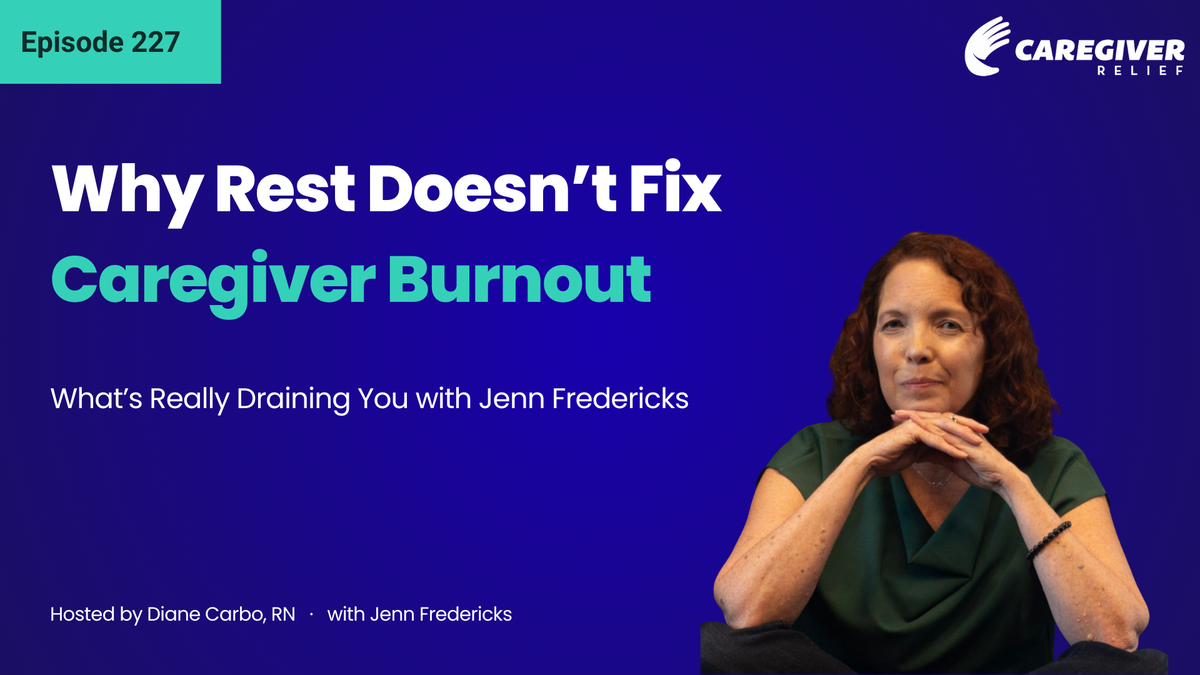
In this episode, host Diane Carbo, RN sits down with Jenn Fredericks, a resilience practitioner, prosilience coach, and the creator of In the Thick of Care. Jenn shares her raw, lived experience of navigating chronic illness, surviving two kidney transplants, and caregiving for her daughter for over a decade. Together, they dive deep into why traditional rest fails to cure caregiver burnout and how you can start reclaiming your energy today without waiting for life to get easier.
💡 Key Takeaways From the Episode
- The "Vigilance Load": Caregivers carry a constant, underlying "on-alert" state. Even when you sleep, your central nervous system remains in fight-or-flight mode, waiting for the next fall, medication change, or emergency. This constant alert state slowly drains your battery.
- Prosilience vs. Resilience: Traditional resilience is about bouncing back after you fall. Prosilience is proactive. It’s about managing your personal energy (physical, mental, emotional, and spiritual) so you don't fall so hard in the first place.
- Micro-Pauses are Lifesavers: You don't need a week-long vacation to reset. Jenn explains how taking intentional, one-to-two-minute "micro-pauses" throughout your day can calm your nervous system right where you stand.
- Boundaries are Acts of Compassion: Setting limits and asking for help isn't selfish. Clear boundaries provide safety and clarity for both you and your loved one.
📋 Episode Outline
- Introduction: Diane introduces Jenn Fredericks and the myth of "just get some sleep."
- The Breaking Point: Jenn shares the raw moment she realized caregiving stress had changed her behavior and how she hit her limit.
- Why Sleep Doesn't Fix Burnout: Understanding the "vigilance load" and the chronic stress that keeps your nervous system dysregulated.
- The Hidden Emotional Drains: Coping with guilt, shame, and the capacity erosion that keeps caregivers from asking for help.
- What is Prosilience? Jenn breaks down how proactive resilience protects your baseline energy.
- The Toll of Chronic Stress: How caregiving responsibilities have shifted from medical professionals to families, leading to physical illness.
- Interactive Box Breathing Practice: Jenn guides us through a quick, powerful breathing exercise to instantly calm the mind.
- The Family Caregiver Contract: Why treating caregiving like a professional job with scheduled breaks can save your life.
- Choosing Joy: Final words on reclaiming your identity and finding pockets of peace.
💨 Try This Right Now: Jenn's Box Breathing Method
Jenn recommends using your breath as a remote control for your brain. If you are feeling overwhelmed, take one minute to try this simple exercise:
- Inhale through your nose and deep into your belly for a count of 4.
- Hold that breath for a count of 4.
- Exhale slowly through pursed lips for a count of 4.
- Hold empty for a count of 4.
- Repeat this cycle 3 to 4 times to instantly ground yourself.
🔗 Resources Mentioned in This Episode
- What's Draining You Quiz: Find out exactly where your energy is leaking by taking Jenn's short quiz at In the Thick of Care.
- LinkedIn: Jenn Fredericks
- Instagram: inthethickofcare
- Facebook: Jenn Fredericks | Prosilience Coach
- TikTok: @jenntlecoaching
Podcast Episode Transcript
Diane: Welcome to Caregiver Relief. I'm Diane Carbo, RN, and today we're talking about something many family caregivers experience but often struggle to explain: the deep exhaustion that goes, does not go away even after rest. Caregivers are constantly told to take care of yourself, get some sleep, or practice self-care. But what happens when you finally rest and still feel emotionally drained, overwhelmed, or disconnected from yourself?
My guest today is Jenn Fredericks, a resilience practitioner, a prosilience coach, and the creator of In the Thick of Care. Jenn combines her lived experience with a chronic illness, two kidney transplants, and more than a decade of caregiving with professional resilience training to help caregivers understand what is truly draining them and how to begin to restore themselves without waiting for life to get easier first.
This is a deeply honest conversation about caregiver burnout, emotional survival, identity loss, and learning how to care for yourself while still caring deeply for someone else.
Diane: Jenn, thanks so much for joining us today. I have no idea what a prosilience coach is, and I'm really excited to learn about it because I'm telling your lived experience of the two kidney transplants and a decade of caregiving, I'm really interested in your perspective.
Jenn: All right. Thank you so much for inviting me. I'm honored to be here, and I can't wait for this conversation.
Diane: Yeah. Can you share the moment when you realized you no longer felt like yourself as a caregiver?
Jenn: Probably when I was punching walls in front of my eight year old daughter
Diane: That would be a sign.
Jenn: That's a bit of a sign, yeah. Or, the boot scuff, by the back door from kicking a wall.
Diane: Yeah.
Jenn: That is not me. My great aunt would always say, "We're a gentle people." And so when I found myself just so out of sorts and out of me, and hurting my fist, I don't. What is this irritability? What is this
Diane: Yes
Jenn: extenuating sense of overwhelm? It just didn't compute for me. I had no idea what was going on, where to start, what happened to my 30 years of experience having a personal connection to illness and healthcare.
Diane: Yes.
Jenn: Where did all of that wisdom and knowledge and practice go when it came to caregiving for my daughter?
Diane: It's funny that you say that because I've been a nurse for 54 years, and when I went into nursing, I loved it. But when managed care came into the, arena of insurance for us, nursing care changed, and it changed dramatically. And I became... Days before I would go to work, the day before I would go to work to be scheduled to work a shift, I'd get physically ill.
My stomach would hurt, my head would hurt. And, then, you go to work and you work through all that, and then you come home, and it took me three days to calm down to start it, that cycle all over again. So as a professional caregiver, I experienced that. And then what you're talking about as a personal caregiver, I've experienced that too. you know, I took care of my dad, with my stepmother, which, who hated me, so that was a very challenge, very challenging.
And then I took care of my brother, and I seriously Or my son. And my oldest son was in the military and went through the military medical delivery system. And I have to tell you, I still have PTSD from dealing with them because they, the, their abusive and substandard care is rampant and there's no common sense in that arena. And, 'cause I dealt with it for years. what you're expressing to me is wanting to I wanted to pound walls.
Jenn: Yes. I get it,
Diane: And there's just, you know, and, so I truly understand. And, we hear caregivers say they're exhausted even after having a good night's sleep, and many of them don't even get that. Why does rest alone often fail to fix caregiver burnout?
Jenn: So what I've come to learn and understand through my, general personal and professional development training as a coach, and then also as a personal resilience practitioner, is that and from my personal experience, I learned the framework, and then I realized, oh, I'm living this, and then there's something else underneath it for caregivers. So the Prozilience or building proactive resilience framework was made for organizational and development teams in corporate America or the business world.
Diane: Okay.
Jenn: But when I read the book Prozilience, it laid out what I'd been doing since I was 15. So it put language to my experience of, oh, how are you so resilient? This is how I'm doing it. But what I found is as I work with caregivers on one of the building blocks of Prozilience, I still was feeling that exhaustion.
And I was like, "What is going on here?" And it made me realize that we always have an on alert level as a caregiver. And I explain it that way, or as like this vigilance load that we're always carrying underneath everything else that we're doing.
Diane: Yeah.
Jenn: So we might know that as our sympathetic nervous system, our central nervous system being dysregulated, or always in fight or flight, or always
Diane: Yes running.
Jenn: So there's this like hum underneath. Even though you're getting your eight hours of sleep, which is
Diane: Yeah
Jenn: caregivers we know that we don't really, because our ears are always perked up when we hear something different. We see a light go on under our door and wonder why the hallway, hallway light's going on. We hear something fall and wonder if it's our loved one or the cat jumping off of the table. So that underlying vigilance level actually depletes the self care that we're giving ourselves. And I'm not saying this to like scare us or to say "Oh, great." No, "There's one more thing we need to do."
But just as like an awareness. Hey, you're doing these things you're being asked to do, and it's not working.
Diane: Yeah.
Jenn: Here's why. And there's a way to manage that vigilance load, that on alert level so that your energies, your physical, mental, emotional, and spiritual or identity energies actually do get to be replenished, and you don't have to get to burnout.
Diane: Yeah. My first experiencing realize that I had my fight and flight syndrome, system was always on was, my, my sons were young. We go to the, park, an amusement park. And I used to love roller coasters. I loved all those crazy rides.
Jenn: Yep.
Diane: And I can remember this. I mean, I get off the roller coaster ride with my boys, and I realized oh my God, this is the way I feel all day long. And
Jenn: Yes
Diane: and I thought, oh, and I never got on another rollercoaster. I'll go to an amusement park with the kids or grandkids or whatever, but it's, I realized that what was once fun to have that adrenaline rush was something that I experienced.
And I, I know that's what I felt when I was providing especially when you're dealing with active hands on care of a loved one, and you're navigating the medical delivery system, and you're trying to set up appointments and deal with insurance and, understand the medications. It's enough to make your head explode.
And I was a nurse who knew a lot and worked for insurance companies, and I knew the med- how to maneuver the medical delivery system. And so many caregivers are not even, aware of, what goes on in healthcare. They just, and all of a sudden they're in a situation where they're caring for a loved one.
And Jenn, I know that's why it's so important we get your word out because we're gonna, we have 63 million family caregivers right now, and they're providing $1.1 trillion of unpaid care. That's gonna double in the next four or five years. Because we have the, baby boomers, the last of them will be, retiring at 65 years old in the next four or five years, and then the oldest of them are also turning 80.
So we are in big trouble because we don't have, we don't have e- enough youth to take care of our elderly also. So can you talk about what are the hidden emotional drains caregivers carry that most people don't recognize?
Jenn: Yeah. It's so interesting. I just, I volunteer at a local guest hospital house, so it's like a, so like a Ronald McDonald House that serves families of kids in pediatric hospitals. This is like the adult equivalent. And we were talking last night about that permission to feel what you're feeling without piling guilt on top of it.
Diane: That's a tough one for caregivers.
Jenn: Yeah. Well, here's your permission slip.
Diane: I love that
Jenn: feel what you're feeling and you need to feel it
Diane: Yeah
Jenn: without piling guilt on top of yourself. Because one, you're a human being doing a job that is so difficult
Diane: Yes
Jenn: made difficult by the systemic issues that underlie all of it, and you're doing it pretty much on your own.
Diane: Yes.
Jenn: And there's not a handbook to walk you through it, although there are some really great resources out there that you can access. When you're a caregiver, sometimes it's too hard to access the support that's available because you don't have the capacity to deal with it. I cannot put one more thing on my plate.
Diane: Yes.
Jenn: Also, I can't feel bad. I can't shame myself for this being hard and knowing that there are resources out there that I don't feel like I have the capacity to actually use
Diane: That's well put. Yeah
Jenn: It's that piece of self compassion that it's difficult for us to show ourselves. We can give our compassion to the ones that we're taking care of, even in the most difficult moments, and then we start berating ourselves for feeling the way we do inside.
Diane: Many caregivers, I find, have a hard time asking for help. They don't know how to say the word no, and they look at themselves as failures, not only if they say no, but if they have to ask for help. And they think that people should know what they need, and that is so wrong on so many levels, and it's really tough for the caregivers, out there. Then they get in this mode of victimhood, I'm gonna call it, where, "Nobody can do this but me.
And that puts them in, more of a flight and fight syndrome than, before because they're always on guard about everything, to the point where so many of them, if somebody does offer to help, if they don't do it the exact way the caregiver wants it done, they tell them, "I can't use you," or, I don't want it."
And without being, instead of being flexible and saying, as, "I'm grateful you're here. I'm glad for your help. you do it different than me, but as long as we get the same result, I'm okay with that." And caregivers don't do that.
Jenn: Yeah. It's difficult for us too because, this is, for the most part, someone that's, very beloved.
Diane: Yeah.
Jenn: And sometimes it's even more difficult, with whatever interpersonal relationships are going in, on within the caregiving dynamic in families. But one thing that I also have learned from caregivers that I support is that a lot of times they step back from asking for help because those times when they are drowning and they reach out no one's there for them. So they're protecting themselves
Diane: Yes, I, yes
Jenn: from being let down
Diane: Yes
Jenn: by not asking for help. And all of these things circle back to that question you had about where is that emotional energy going, where do caregivers find the drains in their emotional energy. And then I would then propose that there are ways to plug those drains in your emotional energy and start to refill them slowly so that you can have more access to emotional vocabulary and relational, experiences with others without feeling those levels of shame and guilt and disappointment. And one of the first ways is to simply recognize the emotion that you're feeling.
You don't have to do anything about it, but at least recognize it's there. And also remember that emotions are a little bit like clouds. They could be the beautiful white fluffy clouds or they could be the storm clouds, but emotions pass through us. They don't need to set up shop. And sometimes we feel like if they do, we're a failure.
Diane: Yes.
Jenn: But a lot of times if we simply acknowledge and recognize it, it allows them to move a little bit more so we can allow some other emotional experiences in so that we don't feel that emotional drain and hopelessness that a lot of caregivers can feel.
Diane: And hopelessness is, and helplessness, is rampant through the caregiving, family caregiver. Caregivers, they really struggle, because they're that they don't, they don't have a lot of support around them or they, and they don't feel like, even the doctors or healthcare professionals are helping them in any way, and they're 100% right about that. So I want to talk about prosilience. What in the world is that, and how is it different from traditional resilience?
Jenn: I liken it to that scene in one of the Batman movies where I think it's, it's Batman when he falls, and either his dad, I, but I believe it's, his butler says, "And why do we fall, sir?" Says, "So we can pick ourselves back up." So that's the traditional definition of resilience
Diane: Okay
Jenn: where we fall down and bounce back.
Diane: Yeah.
Jenn: Why fall down if we don't need to?
Diane: Oh, that's a different perspective. I want to hear more about this because
Jenn: Yeah
Diane: I've fallen many times, and I keep getting back up, and it does get to a point with many caregivers that, they just can't get, give up anymore.
Jenn: And it's not the fact that we won't fall down. Maybe we will.
Diane: Yes.
Jenn: But what if we don't have to fall so far and then claw our way back up to our baseline
Diane: Good point
Jenn: and then build from there. So that's what prosilience is about.
Diane: Okay.
Jenn: It is proactive resilience. So it sounds to caregivers sometimes "Oh, great. Something else I have to do."
I can't. I don't have the capacity. I don't have the mental bandwidth. My emotions are frayed. I don't feel like there's anything outside of myself to keep going for." "I am so bone tired, I can't do one more thing." Well, with prosilience, there's one specific building block that I focus on with caregivers, which is about managing personal energy. That physical, emotional, mental, and spiritual or identity-based energy. And human energy fuels resilience. So if we can get a handle on how to plug some of those energy drains and refill them, we will have more access to our resilience.
Diane: Interesting
Jenn: So prozilience would be the idea that we can do small things and build it into our muscle memory or our daily routine to help build and restore that energy, which then helps fuel our resilience. So as uncertainty keeps coming at us and challenges keep coming at us, which they will because we're human. We don't have to fall to our knees each time.
Diane: So what you're talking about is it, I perceive it as we are under chronic stress.
Jenn: Yes.
Diane: and we get, it weakens our ability to, be resilient and it allows us to fall further. And could you talk about how that affects, the, nervous system or emotional health over time? 'Cause what I'm seeing is 63% of the family caregivers out there are becoming seriously ill due to chronic stress. Or they're dying before the person that is Caring that cares for them. Or that they're caring for passes. And it's really disconcerting to me because when I started my website 20 years ago, I can't believe it's that long now.
Jenn: Congratulations.
Almost 25, almost 25. I have to tell you, it was at 50%, and I thought that was really a bad, but now with all the changes in Medicare and Medicaid and managed, managed care, we are seeing more and more responsibility put on the family caregiver, and this responsibility was once provided by healthcare professionals. And now they're, you're expected to be a nurse, a PT, a aide. You're supposed to know occupational therapy. I mean, there's And you have to be a pharm tech. You are doing more things than ever expected of somebody, and it's just not possible.
And even a psychologist, right? Because Yeah.
Diane: Yes. Thank you
Jenn: I support.
Diane: Yeah I missed one. Oh my goodness.
Jenn: Yeah. Like, I support myself and my daughter with our mental wellness as well.
Diane: Yes.
Jenn: She's been under this for a decade. She's, was seven when she was diagnosed with a low grade glioma, a brain tumor in her third ventricle.
Diane: Oh, my lord. Jenn:
Jenn: And she's 17.
Diane: Yeah.
Jenn: So your question was, I may need to have you redirect me.
Diane: Oh, that's fine.
Jenn: But it was the talk about this chronic stress.
Diane: And how it affects our emotional and nervous system and health over time.
Jenn: Yes. Well, like I was talking about, it slowly erodes our capacity to be able to deal even with general life, let alone caregiving life. I talk about capacity erosion, which is that idea of meeting ongoing uncertainty and challenge while under chronic vigilance or the on alert stress level with compressed recovery times.
So what I mean by that is long before a caregiver finds that they're becoming ill more often, long before they identify that they may be burned out, there is this erosion of capacity happening, and most specifically in those energetic components I talked about, that there actually can be something done about it before.
So the idea of my work is to help people take micro pauses throughout their day that help reset and calm and regulate their central nervous system, which then in turn helps the four energies that fuel resilience. And as you're doing those little things during the day that give you a bit of relief without you having to leave your post you're actually building your prosalience.
Diane: Explain what this micro
Jenn: Pause? Yeah
Diane: What did you call it?
Jenn: like a micro pause.
Diane: A micro pause, yes. explain that to me. I find that an interesting term.
Jenn: Sure. So it's basically just, like, setting a boundary for yourself during a time of the day where you feel yourself maybe feeling like this, and if no one's watching, I'm, like, making my hands go back and forth really
Diane: Yeah
Jenn: really fast above my torso. that's how I used to feel inside all the time.
Diane: Yeah.
Jenn: And when I'm able to take these mini pauses, these micro pauses, set boundaries for myself and do a practice, I can feel more calm and at ease and at a baseline. So I am stepping into some sandwich caregiving as well right now.
My father about, a year and a half ago had a heart attack, and he's well, but lives in Texas, and I am in Wisconsin. and so I, I remember flying down, to help with his recovery after his heart attack. My sister took the first phase, right? And then I came a couple days later, and within two days of me being there, had to take him back to the hospital for a GI surgery.
Very emergent. Oh. it was very difficult, emotionally and mentally not knowing what was going to happen. But I remember Oh, and at the same time, my daughter with the brain tumor, which is stable right now, but she has other comorbidities that we manage along because of the treatments and
Diane: Yes
Jenn: the effect that the medical trauma has had on her central nervous system. She has, functional neurologic disorder, which at times when it flares can cause her to just faint.
Diane: Oh
Jenn: And sometimes have, non-epileptic seizures. And so at the time that I was flying down to help my mom with my dad, my daughter was here at home in a wheelchair with my husband because we didn't know how to protect her shunt that she has in her head with her brain tumor. So she was in. Okay, so anyway I remember sitting next to my dad's hospital bed and, he was just coming out of anesthesia, and I'm pretty used to having that baseline of calm regardless of what's going on in a hospital because I'm just used to being in that, like Yeah, you're used to being in the hospital environment.
Diane: Yeah ... yeah.
Jenn: Can you, who else here can, go to sleep to the beeping of machines and a professionally warmed blanket?
Diane: Me. Yeah.
Jenn: give me that in a hospital setting and then I am a happy girl.
Diane: Yeah. Yeah.
Jenn: I remember sitting there and again, my body inside just started to
Diane: Yeah. Yeah, feel
Jenn: Feel out of sorts Agitated and agitated.
Diane: Yes. Yeah.
Jenn: And I couldn't walk away, right? He was very agitated. I was trying to help. the nursing staff was overtaxed and wasn't able. So I remembered, oh, what I can do for myself right now is continue to hold his hand as he's in the hospital bed. And that helped calm him. But what's gonna help calm me?
Diane: Yeah.
Jenn: So I put my feet on the floor. These are simple things, but we forget to do it. I put my feet on the floor, I allowed myself to feel safe because I was supported in that way, and then I did box breathing Breath is a remote control for our brain.
Diane: Yeah
Jenn: which is also, you know, it's our central nervous system.
Diane: Yeah.
Jenn: So when I could take a minute, that's all it took, a minute, to ground myself, feel supported by the chair and the floor, and then do box breathing, I calmed my insides, I calmed my thoughts, I calmed my emotions, and I restored some of my physical energy as well.
Jenn: Do you mind if we, if no one, if people aren't familiar with box breathing, if I talk through that for a minute?
Jenn: I would love for you to. I was just gonna ask you to explain it and maybe do a,
Yeah
Diane: a simulation of it for us.
Jenn: So basically, this box breathing is where you imagine a square in front of you, an imaginary square, and you use the sides to help you know where in the breath cycle you are. It's best just to walk through it, so let's go ahead and do that.
Diane: Okay.
Jenn: I'm gonna invite everyone to put their feet on the floor. if you're driving, please don't participate in this right now. Do it later.
Diane: That's a good point.
Jenn: Yeah. But go ahead and put your feet on the floor, and rest your hands on your lap. And if you feel comfortable doing so, just soften your gaze or close your eyes. And you can imagine a square in front of you, and we're gonna start on, it would be my left side is how I'm gonna do it. We're gonna start on the left side and go from the bottom corner to the top corner of that box, and we're gonna breathe in for four.
Breathe in, two, three, four. Hold along the top, two, three, four. Exhale from the bottom to the top. Sorry, top to the bottom, two three four. Hold again as you go across the bottom, two, three, four. So if anyone's watching, I'm gonna I was tracing too low, but I actually trace as I breathe in, two, three, four. Hold, two, three, four.
Exhale, two, three, four. Hold, two, three, four. Inhale again, up, two, three, four. Hold, two, three, four. Exhale, two, three, four. Hold, two, three, four. And then as you do that and become more accustomed to it, as you inhale, make sure that you're breathing in through your nose, but inhaling all the way from your belly Holding, and then as you exhale, purse your lips and let it out.
And then hold again. Inhale through your belly. Hold. Exhale. I like to exhale all the way through my toes. And then hold. Inhale through your belly. Hold. Exhale. I like to exhale all the way through my toes. And then hold. And so that's something that you can do sitting next to someone's hospital bed. That's someone you, something you can do when you're sitting across even from a doctor and you're becoming, agitated or not following or not, loving the conversation that's being had. You can take your breath anywhere, and we know that.
Diane: Yeah.
Jenn: It's an in voluntary bodily function. However, when you use it intentionally, it serves more purpose than just keeping you alive.
Diane: Yes. When you're focusing on your breathing, you can't focus on other things, and it gives you a moment to just compose yourself and relax.
I tell my, family caregivers and listeners that decisions and choices made by emotions are poor decisions and they lack all logic. So I've never heard of box breathing. I like that, approach, because it's, something that you're explaining how they can do it in a concrete way and help them stay focused, and it's something they can practice any time, anywhere, any place.
Jenn: Definitely. We always have our breath with us.
Diane: Yes.
Jenn: Always.
Diane: Yes.
Jenn: Another, micro pause I can offer is a moment maybe where you do need to step away and your loved one is safe, and you just need a few minutes to go and not feel and not think and just collapse into something, let's say. I did this as well with my dad's, illness.
Got up, went out into a hall, found a little secluded spot, set my phone timer for two minutes, and sat down, and just did nothing We feel like we don't have enough time to take time for ourselves.
Diane: Yes.
Jenn: We can all take two minutes. This is your permission slip again. Take two minutes just for that quick reset where you don't have any responsibility but sitting there for yourself. If you feel emotion, that's fine, but if you don't want to, you can say, "Okay, I see you, I hear you, you want to be witnessed. Can we put you on a shelf for just a minute?"
Diane: That's a good point. I like that
Jenn: I just need to be here
Diane: Yes
Jenn: in space and time and not do anything else.
Diane: I have caregivers tell me that they don't have time to take a shower.
Jenn: I've been there.
Diane: And it's like, I understand that, but, if you don't take a shower and give yourself five minutes in the shower just to have a respite from the world and allow yourself to not just cleanse your body, but maybe your spirit a little bit, you know, by being there and just going, "Oh, it feels so good. Just let me have a moment of peace."
Jenn: And it's a great place to cry in private if you'd like to.
Diane: Yeah.
Jenn: that happened quite a bit at the children's hospital when my daughter was first diagnosed.
Diane: Ah.
Jenn: That's like the one private place you have.
Diane: Yes. Yeah.
Jenn: So allow the water to wash over you and soothe you, and let the emotions come as you need them to, or maybe you don't need them to. I think one of the biggest points I'd just to share is that we all feel like we're doing this wrong. We aren't
Diane: Right
Jenn: Even professional caregivers, you've been trained to provide care But there are parts of the job that you aren't prepped for, and then you can't do that wrong either. I like to tell people that as long as you're coming from a place of care and intent for yourself and others the response that others have to whatever you're sharing isn't your responsibility.
Diane: Yes. Yeah.
Jenn: So if you can take the time to ground yourself with some breathing, and then come from a place of authenticity and truth, and it might be charged with emotion. But if you're doing it from a place of like not trying to hurt someone, but really get across what you're going through
Diane: yeah.
Jenn: you're not responsible for the other person's
Diane: Absolutely. And you know what? That is one thing that I know as both a professional and family caregiver. I, I tried for, for decades to make people happy, and ignoring my own happiness, and it's not good for us to do that.
And until you start to think about putting, uh, yourself first, uh, and how you're feeling. You know, ask, "Is this within, is this within my values and morals?" "What they're asking me to do. Is this something I really want to do or can I do? Is this something that I need help with, and I'm being expected to do this alone?"
And when you start asking these kinds of questions, you start to realize that, oh, this is more than I can do alone. This is way more than a- any. And the expectations. I will tell you, and I know with your, your interactions with family caregivers, you come across this too. The primary caregiver is always may have extended family members or even siblings that are not only in, uninvolved in the care, but they're judgmental about the way the care is being done.
But they're not willing to step in and help. And, you know, when I, I tell my caregivers is, you know, if they're not willing to step in and help, I actually encourage caregivers to put a family caregiver contract in place.
Because caregivers are so challenged to have set boundaries and limits.
So if you sit down early before you start your caregiving journey, or even now if you've been in it for a while, sit down and write down what you will and will not do, what you can and cannot do. There are caregivers out there that would be, would be mortified to clean up after their family member that's been incontinent of urine or, or stool.
And, yet they're doing it now, and they're, and it's uncomfortable for them, and they don't have to do that. They can actually look for help outside the home, for people to come into the home. Or ask those uninvolved, judgmental
Jenn: Yeah
Diane: siblings or extended family members to, to financially support a person in the home to give that caregiver a break.
And I really recommend that every family caregiver out there look at a contract, a family caregiver contract, also known as a personal care contract, because you need to treat this as a job. I know that's insulting to many of you, but in a job you get a break. You get regular breaks. You get vacation days.
You get days off. And if you treat it as a job, then you realize that this is something I can't do alone. Because, I think the average caregiving journey is, like, five or six years, but some can go as long as 20.
Jenn: Yeah.
Diane: And, and nobody has the ability. I, I tell the story of this, 75-year-old lady, out in California, calls me and says, " my mom's 104."
And I've been caring her, for her for 25 years. She says, "Is it wrong for me to want to put her in assisted living because I need to start living my life?"
Jenn: Oh, sweetheart.
Diane: Oh, Lord have mercy.
Jenn: Oh. What I love about what you just said, Diane, is it touches on a couple of things, right? It touches on that spiritual identity energy
Diane: Yeah
Jenn: that I mentioned that helps-
Diane: Yeah
Jenn: fuel our resilience. So being able to really take a moment or a week or however long to reflect on what is your guiding compass, what is your true north, what are the, the things in morality and, and ethics that are important to you? Fuel that spiritual identity, which really is sort of the buoy for all of the others. Because if we don't have that connection to something larger and outside of ourselves
Diane: Yes
Jenn: we become very bogged down in that. And then when you're talking about setting boundaries, a lot of people shy away from even the word because they think, "Oh, that's me being selfish. That's me always saying no."
But what I like to share is that boundaries actually equal compassion and clarity for yourself, for the person that you're caring for. So when you're able to practice some of these pauses we talked about
Diane: Yeah
Jenn: it creates space for you to actually or when you set boundaries, it allows you to create space to take these pauses. And, and boundaries are just you having clarity on what's needed for you and, and the loved one, and compassion and self compassion for the both of you by asking for help.
Diane: I love that. You know, if you change your perspective, you change your life. And you offered a different perspective there that caregivers need to hear. And I really love that. Jenn, you've given us some really good tips that we could use with no money, no time, and use them in, in a way that will help us ground us. What would you say to caregivers listening right now who wonders what they would, will f- ever feel like themselves again?
Jenn: Well, I mean, that's your choice.
Diane: Yes
Jenn: People don't wanna hear that.
Diane: Yes, yeah
Jenn: Because we're like, "Well, there's nothing else I can do. This is my life circumstance."
Diane: Yes
Jenn: Things that I've shared today, and some other tips and tricks and tools and guidance that I have, allow you to find relief without your life circumstances changing.
Diane: Yeah
Jenn: I was punching walls.
Diane: Yeah
Jenn: I realized I didn't wanna live that way. I realized if I kept living that way, I was jeopardizing my second kidney transplant. I've had the gift of life three times, you know? My initial birth and then two kidney transplants.
I don't want to live in a way that doesn't allow me to find pockets of joy
Diane: Exactly
Jenn: in life while I'm caregiving.
Diane: Exactly.
Jenn: And so we do take a lot of time to try to find those glimmers or those, those moments of joy, even in the dark times.
Diane: Yeah
Jenn: Because why are we working so hard to care for and or heal ourselves or our loved ones if we're not going to truly live?
Diane: Exactly. Exactly. And live a quality of life. You can live a long quantity of life and be miserable, or you can choose a quality of life with joy. And it starts at the, at, as soon as you're done here. You know, you need to choose joy and find it in pockets of that in your life. Jenn, how do people find you?
Jenn: It's pretty easy. You just go to inthethickofcare.com, and that's my website.
And there are some options there to connect with me. There's options there to sign up for my monthly newsletter that provide more pause tips and sort of perspective on, on caregiving and how to relieve some of what we feel so that we can continue to live life and caregive without things coming into hitting each other.
Diane: Yes
Jenn: How
Diane: And coming blows.
Jenn: Yes, And then I would really love if people are interested in this idea of energy and draining energy, I believe in the show note there will be a link to a quiz that I have that you can take called What's Draining
Diane: Yes, it will be included on the page that I create.
Jenn: Yeah. What's Draining You. and just take a moment. It's very short. Fill that out and just get an idea of what's draining you right now, and then it gives you an idea of what you can do to start plugging that leak and refilling.
Diane: Oh, thank you so much. I really appreciate your knowledge and your perspective on caregiving. It's desperately needed out here with our caregivers. to my family caregivers, you are the most important part of the caregiving equation. Without you, it all falls apart. So please learn to be gentle with yourself. Practice self care every day. Take Jenn's test that we're gonna have on the website because you are worth it.
Caring for a loved one can be overwhelming — but you're not alone. If you have questions, big or small, our expert team is here to help.
👉 Click here to Ask the Expert
Our Resource section can help you find the information and tools that you need. We have courses, videos, checklists, guidebooks, cheat sheets, how-to guides and more.
You can get started by clicking on the link below. We know that taking care of a loved one is hard work, but with our help you can get the support that you need.
Click here to go to Resource Section now!