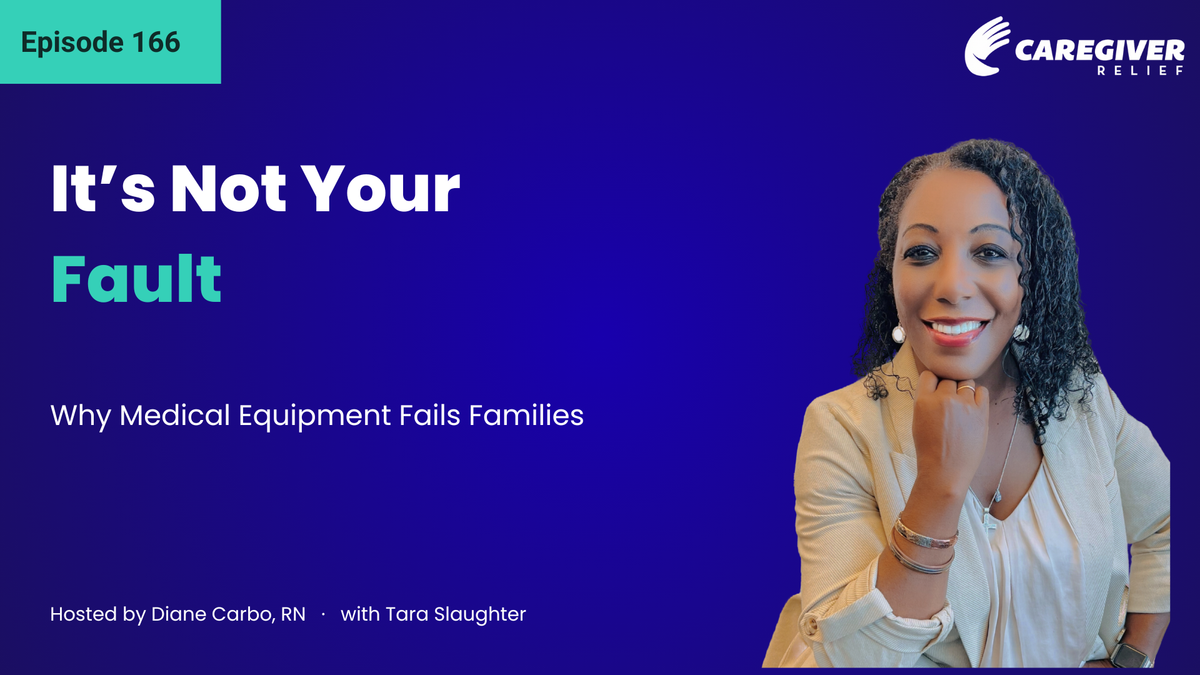
It’s Not Your Fault: Why Medical Equipment Fails Families with Tara Slaughter - Episode 166
Navigating the world of Durable Medical Equipment (DME) often feels like running a marathon with hurdles you can’t see. From insurance denials and "same and similar" product flags to the dangers of unregulated online purchases, many families are left feeling frustrated and overwhelmed.
But here is the truth: It is not your fault.
In this episode of the Caregiver Relief Podcast, I am joined by Tara Slaughter, a certified DME specialist with over 30 years of experience. We pull back the curtain on the "boots on the ground" reality of getting the equipment your loved ones actually need—and why the right gear is the ultimate form of self-care for caregivers.
Key Takeaways from Our Conversation 💡
- The Documentation Trap: Did you know Medicare might deny a wheelchair if you’ve received a walker within the last five years? We explain the "same and similar" flag and how detailed medical necessity documentation is the only key to breaking through the red tape.
- The Critical Gap in Care: Too many families are missing out on professional clinical assessments from Physical or Occupational Therapists due to the rationing of care. Without this assessment, you might be buying the wrong equipment for your loved one’s specific stage of progression.
- Preventing Caregiver Injury: It is a silent epidemic. Using the wrong equipment—like a bed that doesn't adjust to the correct height—leads to debilitating back, shoulder, and hip injuries for the caregiver. We discuss how the right "long-term care" bed or transfer device can eliminate over 50% of injury risks.
- The "Online Buy" Danger: While it’s tempting to hit "buy now" online when insurance denies you, these purchases often lack the clinical oversight needed to ensure safety and effectiveness.
- Compliance & Fraud: We touch on the rising tide of Medicare fraud and why providers are under intense pressure to document every single detail—even down to an emergency contact number—to stay audit-ready.
Resources Mentioned 📚
- CFS Medical Supplies & Equipment: For expert guidance and specialized assessments.
- CFS Solutions: Providing clinical consulting for families and facilities.
- CFS Medical Supplies App: Download the app on Apple or Google to access educational modules, blogs, and direct chat support for your equipment questions.
You Are Not Alone 🫂
Remember, you are the most important part of the caregiving equation. Please be gentle with yourself, practice daily self-care, and never feel like you have to navigate this journey in isolation.
Podcast Episode Transcript
Diane: Welcome to the Caregiver Relief Podcast, where we shine a light on the hidden struggles of navigating durable medical equipment, insurance battles, and long-term care. I'm your host, Diane Carbo, rn, with years of hands on experience helping families just like yours avoid the pitfalls that can turn caregiving into a nightmare.
Today we're tackling a crisis that's hitting families harder than ever before. The rising tide of durable medical equipment denials skyrocketing out-of-pocket costs, and the Dianegers of unregulated online purchases. Recent data shows Medicare Advantage plans denied over 3 million prior authorization request in 2023 alone with appeals on the rise and fraud schemes.
Billing seniors for thousands in phantom supplies like catheters, we are seeing complaints, flood insurance, hotlines and social media from Medicare, Medicaid, bare bones gear causing harm to Medicare advantage programs, rationing therapies with high copays,
and don't get me started on online buy scams, repair headaches, and no assessments leading to ill-fitting equipment that's more harm than help. Joining me today is Tara Slaughter, a certified durable medical equipment specialist with over 30 years in healthcare. She's a regular contributor and the founder of CFS medical supplies and equipment and CFS solutions.
DBS Tara seen it all. From insurance, red tape baring doctors in bureaucracy to family scavenging thrift stores for subpar gear. She's also the host of the medical equipment world and healthcare. Get the Scoop podcast, advocating for patient dignity and smarter care planning.
Diane: Tara, thanks so much for being with me here today.
let's empower our listeners to fight back and get the right DMA.
Tara: Yes. Oh my gosh, Diane, hi. And hello, listeners out there. I am happy to be back again. Diane. this is one of my, I love having this discussion because I just feel like we always just need to share resources and information to try to help people Absolutely.
In, this caregiving journey, to take care of their loved ones in, every step of the way. And so that's why we do what we do.
Diane: Yes. Now I want our listeners to know why this topic matters. At this time,
Tara: right now we're in a place where we're, competitive bidding is, lurking again.
and what that means is that you'll have some providers who may provide you products and services right now that may not be able to once the competitive bid, kicks in. And so I don't know exactly when that will happen, but it is a conversation right now and it's something that you as a consumer or a patient may want to try to look into to see how it's gonna affect your services and your products.
And so that's one of the things. And then of course, with our daily experience, what I call boots on the ground, the experience we witness every day with families just trying to take care of their loved ones and the delays in authorization or deferred, and all these things that we see when you're trying to get something authorized for a patient.
and so a lot of times I often say that a lot of times it's not even so much, sometimes it's of denials too, but sometimes it's just basically documentation also.
Diane: Yeah.
Tara: And that's one of the things that we struggle with, often when it comes to trying to help families and patients get what they need through insurance.
Diane: Tara, I've worked on both sides of the fence. I was a person, a nurse who did catastrophic care management and geriatric care management. And I was one of the nurses that approved length of state every few days get an update. But I was also the one that had to approve the durable medical equipment.
Yeah. And, I was limited to what I could do because the companies didn't wanna provide more. And that's really tough. So I wanna talk about the realities families are facing right now with this dilemma.
Tara: the thing of it is, Diane, a lot of this documentation, and of course this product too, because when you, I'll give you an example.
So if a patient is in need of a, a wheelchair I'll just throw this example there. If you are in need of a wheelchair and you've had a walker less than five years, the provider may not provide the wheelchair to you now because it'll flag as a same and similar product. Wow. And yeah, so it'll flag is the same and similar product.
And now it doesn't mean that the insurance won't pay for it, but it is documentation, it has to be very detailed. The doctor has to be very detailed into why the patient now needs the wheelchair, as they had received a walker prior, maybe five years less than, what they need to. And so when that happens, there's a lot of documentation that has to be provided.
the us being a provider, we have to have that documentation listed and detailed properly for compliance. So when we get audited, from CMS, then they don't, it doesn't look like we just provided a wheelchair. Now when the patient had that and we're billing for it, so in the event that Medicare does pay for the wheelchair and they go back and they audit and the documentation wasn't detailed, they have up to seven years to recoup what they call recoup the money from the provider.
And a lot of times families don't, they don't know that. They wouldn't know that. But as a provider, sometimes I'll, the, sometimes I hear families say, they just didn't tell. They just said, no, it's not approved. a lot in the back end, there's a all of that red tape and those things that go into it.
So I feel like when families know what we deal with and what's consistent of everything, then they'll have a better understanding. And then also too. I try to share with families that when you get an order for a, an example for a walker
Depending on what's going on with your loved one, you wanna have a conversation with the provider you're gonna be working with to say Hey, I have this order for the walker.
I understand, but what if my loved one or myself need a wheelchair within five years from now? Do you think Medicare will cover it? Do you think the insurance will cover it and allow them to be able to share with you what that, what the answer may be, and then you yourself reach out to your insurance company and say, I know my loved one need this walker, I'm afraid that maybe in a couple of months or maybe a year we may need a wheelchair and will you guys cover it?
And if that's the, and if they can't give you that answer, I was advised sometimes that you might wanna just pay for that walker as it maybe what? Maybe a hundred dollars?
Because a wheelchair is more expensive. And so what would you rather do? Would you rather, get the walker out of pocket right now and save you, try to save the benefits you do have for that wheelchair in case you need it down the line.
And unfortunately those conversations are, families don't know that.
Diane: Yeah.
Tara: And because people don't go into detail to tell 'em and explain them to that. And I think knowledge is power and so that's one of the things I see the bottleneck of why people a lot of times don't get authorization.
So when you were working on that end there, Diane
That is a lot of reason why you can't get the pro certain products that you probably were wanting for your clients, your residents.
Diane: Yeah. And I will tell you. the Strangulating government regulations, all the hoops you have to go through to get them.
the hospitals, the doctors, they have had to hire extra staff just to focus on this. And it's going through. People don't understand that it's going through charts and get, finding specific information and getting, yeah. If a doctor misses one diagnosis or the coder, the medical coder codes something wrong.
Yeah. It screws up the whole system. And, now I have a question for you that some Listeners might be asking right now. What if you get a wheelchair first and you can advance to a walker?
Tara: How does
Diane: that work?
Tara: yeah, that's a good question, Diane. So that's it. It goes hand in hand because now you had a walker, you had a wheelchair.
And now you need a walker, right? And so it's like things have changed. So the doctor has to now be very detailed to the change, right? Why is the patient going from a wheelchair now to a walker? So it's not that they won't pay for it sometimes, but the documentation has to be clearly specified.
It has to meet medical necessity, and it has to be outlined as such. So basically you can't, so in other words, a lot of times, and this is what we see all the time, we'll get a prescription and to say a wheelchair or a walker and the medical reports, when we receive the medical reports from the doctor, it'll say, sometimes it don't say anything about the wheelchair or the walker.
Diane: Yep. Yeah.
Tara: So we have to send the documentation back and say, I'm sorry, but can you please, explain, make sure the medical necessity is there for why you're a prescribing this. A prescription by itself does not. It's not medical necessity, it doesn't make it medical. Correct. Necessary to give, right?
Yeah. Not saying you don't qualify for it, but you have to have that documentation there. So in that aspect, that's what happens. That's the delay, right? So now what happens if we bill for you now to get a walker, it could possibly be denied and then that means if it's denied, you're gonna get the bill.
So you wanna be aware of those things. You wanna be able to ask your insurance company, be, be transparent with your insurance. Hey, I got this now I'm needing a walker. My loved one needs a walker. Now you know, I know you guys pay for this wheelchair. I am. I gonna be able to get it. And then those things.
And so that's where, I can't say, I'm not gonna say they won't cover it, but it could be very challenging and some providers just won't do it. They're like, oh once we run that and it comes up and the system is same and similar, some providers just won't touch it because unfortunately the reimbursement isn't, they're either,
Diane: yeah.
Tara: To really, for people to really try to go the extra mile. To try to get it covered.
Diane: Yeah. what's frustrating that I'm seeing out here from my point of view is
the doctors don't always have the information in front of them of why they need this wheelchair or whatever they rely on the physical therapist, the occupational therapist To say the, this is what we need and why we need it. And now they're cutting, they're actually rationing, pt, so people aren't getting the therapies that they need to actually have an assessment. and that's why I wanna talk about this critical gap that families are facing, the clinical assessment.
we're not getting that information from the therapist because, of rationing of care or, the, with the change in Medicare right now, we're seeing a lot of unsafe discharges to home because people, the facilities get a higher level of reimbursement for not providing care. So the 30 day, 20 day mark for Medicare, that's the highest level of reimbursement.
They're sending people home, and saying they're ready and independent and safe. And it's not always that way. And with Medicare Advantage, they're sending them home between 11 and 14 days. And with Medicare Advantage, they also, they might give you, oh, the pt, oh, we'll give you six visits over six months.
that's, we need more than that. So I wanna talk about the critical gap families are facing and that's the, a lack of a clinical assessment and how that's so important.
Tara: Wow. Yeah, Diane, that's a great conversation right there because I see so much of that. And one of the things when you talk about clinical assessments and you talk about PTs and the OTs, yeah, sometimes they're the patients, because even I'll ask them, I'm like, have you seen a PT or ot?
And they're like, no. things like that. And so a lot of 'em have not. and but what we do is we try to do our own clinical assessments and side of why they need a product, what's gonna make a difference in the product that they're gonna be getting. And A clinical assessment is so critical because what it does is it breaks down the diagnoses.
It tells us what stage, we have a conversation on what stage you're at. if you have Parkinson's or something like that, then we wanna know what level you're at because that's how we better determine Yes. What you're gonna be getting and what you're gonna be needing. So we take all that information that, and all that information that we gather, and then we work with our team to try and figure out what would be the best product for you.
Based on, not even, not in the moment that you're at right now, but the progression. Yeah. So when you've been in this industry for quite some time, you kinda know, we all wanna heal. We will know we want everyone to heal. But we also understand that there is a chance that in six months maybe what I recommended and what we see right now may not work for you down the line.
And so when we see those type of things and we understand that we'll make a different recommendation. So you're not gonna get that online, you're not gonna get that if you deal companies that don't specialize in doing clinical assessments and they're just selling you a product. So that's the difference.
And when we talk about the clinical assessment, and I'll just give you a story. I had a client actually, this week, and they were in need of a particular positioning chair. And what, based on the con the diagnosis, what they had, I recommended a particular position chair. And the family was like, oh my gosh.
you're recommending a ch it's the same brand, but it was two different types. So when I went out and I did the clinical assessment at the facility, which they were in an assisted living, but I saw that the training for some of the caregivers were not there. That the training not their fault.
Diane: Yeah.
Tara: Because a lot of facilities, the caregivers, they do the best that they can, but a lot of them do not have medical equipment, training, medical, they're very limited.
Diane: Tara, I just want my, listeners to know assisted living is based on a social model, not a medical model. And the people there are not medically trained in any way fashion, or any way at all.
So they need somebody from home care or somebody like you to come in to do those assessments and, if necessary, which I find really upsetting is to have to train their staff on a piece of equipment.
Tara: Yeah. And that's one of the things that we see so much of Diane when we go Into facilities and even going into facilities and even people who come into our office when they come in with a patient and their family, sometimes the caregivers are with them.
Yeah. And they don't know anything about the product. They don't know how to transfer the patient properly from one product to the other. For an example, from a wheelchair to a bed and the proper way. And when I say the proper way, I'm talking about in a way that keeps them from being injured too, the caregiver.
So I'm like, oh yeah. so we find ourselves, we train staff, Caregivers on how to transfer properly, what products would be, ideal for them to keep them from having these shoulder injuries, which is, the top thing at the top of the list of injuries. If it's not your lower back,
And so because of the lifting,And so that's one of the things with the clinical assessment piece is so critical. And and talking about the decision and how it makes a difference is because anyone can sell your product. Anyone can tell you what the specs does. Like you can go online and see what the specs of the product does.
But ideally, you wanna know if it's gonna work for your loved one. And the only way you would know that is if it was a PT or ot, a clinical, certified DME specialist or A TP that evaluated the situation to understand what that need would be. And so I, and I made a, make a recommendation that was a little bit less cost effect.
it was less than what, a different type of chair. And the family was like, why are you recommending, is it something going on with the other chair? Why you recommend the cheaper one and not the most expensive one? I said, they said it was a quality. No. 'cause it comes from the same brand.
They're the same brand. But the difference, and the chairs pretty much do the same thing. The difference was, is that when I did the assessment, it was based on really the caregiver, the chair, the chairs are gonna do the same. The chairs are advanced, the chair's gonna do what they're gonna do. But if you have a caregiver who is not, and I know that caregiver turnover is high,
Diane: yes,
Tara: I could be doing you a disservice to recommend something.
I knew that needs a clinical training for this particular product, even though I could train you. But if you get another caregiver in a month or two, they might not know how to operate the particular chair. And if they don't know how to operate it properly, then that's gonna be a disservice to your loved one.
They're not gonna get the fullness of the money you're spending, which is thousands of dollars for this particular product. And so they were like, oh my god. Yeah. So I, told them why I was concerned based on the different features of the two different chairs. And even though, and so basically.
It goes back to I'm not just trying to sell you anything. So I recommended the cheaper one that even though, but it was based on the fact that it wasn't gonna be an easier product to maneuver for any caregiver versus one, because let's just be honest, some of these chairs, if you don't have the training,it's not gonna be effective for the patient or you as a caregiver because you don't know how to use it.
So if they, the patient talking
Diane: about the, oh, go. I'm sorry, go ahead.
Tara: Oh, no. I was gonna say now, if they were at like a particular skill type of facility where it comes to we call like more clinical where patients, like you got nurses there, like some of those are trained nurses, trained PTs and clinics that kind of, they already use some of these products so they know how to use them.
Then it would've been different. But because it wasn't that type of a setup, I recommended something different because of that, along with assessment of the patient too. But a lot of it was the whole surrounding everything.
Diane: Now you're talking I, I wanted my listeners to, to pay attention to this next topic because there is a silent epidemic out there.
And it's caregiver injury that nobody's talking about. And it's because they have the wrong type of durable medical equipment. Can you address that?
Tara: Yes. it'll, I'll go to a particular product, so we'll just, let's use a hospital bed.
Diane: Okay,
Tara: so we have, the regular hospital beds.
And I know a lot of times families say, oh yeah, the high low. The high low. Okay, they're all pretty much high, low.
Diane: Yeah.
Tara: but you have some where the head goes up, the feet goes up, some of them by crank, right? Yeah. Those are disappearing and not out there any longer. But then you have the ones that they, of course the head goes up, the feet goes up, and then the frame goes up and down.[00:20:00]
Now those are the ones, what we call semi electric hospital beds, and those are the ones the insurance normally pays for. Now, if you,if you have the particular type of diagnoses or some extensive things going on, they may pay a pay for a full electric, but either one, whether it's a semi electric or full electric, it only goes so high up
Diane: Yes.
Off
Tara: the ground.
Diane: Yes.
Tara: And it only goes so low to the ground. That's what they pay for. Okay. Now, when a patient. Having to be repositioned or a patient needs to be moved and you have to get them up and move them a certain way. You, as a caregiver, a lot of the injuries come because you're bending over because the bed only goes so high.
Diane: Yes.
Tara: And so depending on your height, depending on what you're doing with the patient, that's where a lot of the injuries come from. And then all of a sudden you're picking and you're lifting. So now you're lifting, so now you're hurting your arm and you're hurting your back because the beds are just not high enough for you to do what you need to do with the patient.
Diane: Yep.
Tara: We call, we like to say long-term care beds, because long-term care beds is very good because they go very high. And they go very low.
Diane: Yeah.
Tara: And with the remote control, not cranking it. Okay. So that's one of the things I see that harm harms a lot of, caregivers, is because of not having the right product and that being a bed for starts now mind you, the insurance is paying for a semi electric.
The frame does go up. But when we're talking about just, just how high is the bed? It is not high enough. it goes high, but it's not high enough. Sometimes when patients are bent over, and I know this because we see families and caregivers all the time, oh my god, my back. I'm just like, I can't do this.
Like just bending over is just so much and you're lifting 'em and the bed is not high enough, so you're trying to bend over and pull up and all these things. So when you have what's called long-term care beds, that goes a very high off the ground, those beds are very conducive to what you're gonna be doing.
Now, if you have, if you don't have all those things going on, then you won't need anything like that. But if you, if it's a long-term care, a long, you're taking care of a loved one and this is what you're doing, you might wanna look into what's called a long-term care bed. Because the staff, unfortunately, those are not covered by insurance.
Diane: Yeah.
Tara: They're not covered by insurance. So they are out of pocket. And that's the thing, when we talk about products and what's out there, they have, all these different lift transfer lifts. Outside of Hoyer lives. 'cause a lot of times Hoyer lips can be Dianegerous. A lot of patients don't like to get in them.
Yeah. And sometimes it takes two people, especially if you don't have a real trained caregiver. Yeah. To use a Hoyer lip, it can be very detrimental to the caregiver as well as the patient. Yeah. But they do have transfers out there that, of course, the insurance don't cover those.
But it's very helpful.
So if you take a combination of a good, a proper bed, a proper transfer, you have literally eliminated over 50% of your injury because now you're not bending over so much, it's gonna help your back even with your lifting. And now with that transfer. Now you don't have to worry about transferring them, the machine is gonna transfer them.
'cause all you do is push it up to the bed, put them on course. It depends on what's going on with the patient too. You gotta, that's why a clinical assessment is needed, because that transfer may be conducive for some patients, maybe not. So you have a clinical assessment. You're gonna make sure you get the proper bed.
You're gonna make sure you get the proper transfer device, right? Now you got two devices that's doing your job. Literally. So now you're not having to do all that. And I have families that's been a game changer for them. They're like, oh my gosh, Tara. they can't believe it. And it's so crazy too, Diane, because a lot of caregivers, like some of the, therapists that I've, some of the families I have uhhuh, when the therapists come out to the home and they see that what the patients have now, they're like, what in the world?
Where did you get this from?
Diane: Yeah, exactly.
Tara: Yeah. And they're like, they're loving it because they're like, oh my God, I, even, and it's so funny too, 'cause we in, in the facilities too, I'll tell you this. some of the facilities too, they'll, the families will, they'll purchase these, high level beds, right?
And the caregivers that's in those facilities are like, oh my God, I want to take care of Mrs. Jones.
Diane: You know what, I understand
Tara: my patient get that bed. it, somebody, stuff like that. But that, I understand that.
Diane: nurses have bad backs, bad hip, shoulders. you really, I go to a chronic pain doctor because like I said, I picked up, I tease, I picked up men for a living, but I literally did.
And, we need, we had, At least I did orthopedics. We had, trapeze so that they, a person could help themselves. But many of elderly aren't able to use those.
Tara: Exactly.
Diane: so they can't help themselves. And then you have the caregiver having to use a draw sheet to try to pull them up in bed when they work their way down, or to turn them over to give them skincare and reposition them. So a good proper bed makes a, an incredible difference.
Tara: It does. Diane. Oh my gosh. it has been life changing for families. Let me tell you, you would think like the whole world has changed. A simple, I don't wanna say a simple bed, 'cause they're not cheap, but a bed. Has made so much difference.
All that sliding down, no more of that sliding down. Yeah. it is just, it's a game changer. It really, it's a re I tell you what, there is a reason why in IQ, ICUs and, some of the acute facilities, what do they use most all the time they use. Long-term care beds. There's a reason for that.
Diane: Yep.
Tara: They do that because they know what they're dealing with.
So if you have a loved one at home and they're, they may be at home, but they may be receiving the same type of treatment and services as if someone was in an acute or a hospital or a long-term care rehab type of place, right? And if that's the case, then you need to prepare you know, it's good to have that type of equipment.
I know you can't have specifically what they have, but there's things out there that's similar to it that can do the same job that would make life so much easy on you, and you just don't know. The smiles on people's faces, they're like, oh my god, Tara. What in the world, what have this been on my life?
Yeah.
Diane: I get that because that would be my response. I've gone into, I've been a concierge nurse, I've done home care. I've done a lot of different things, and I have to tell you, when I go in and I see the long-term care bed, I am in heaven. Yeah. I know that life is going to be easier Yeah.
In education, in that bed. Versus having to, because a lot of times, you have to have somebody else come and help you lift and tug and Yeah. and that's what the problem with many family caregivers. They may be the only, and especially spouses, they don't have someone to help them. And it's so sad because they're ruining their bodies and they don't want to try to, address their own health issues because they don't wanna leave their loved one.
And, so that bed to me is it's worth, it's priceless to me when, if it'll save my body for the future.
Yeah. And it's too late for me. 'cause we didn't have those kinds of heavy duty beds 50 years ago. We had the old crank ones and it was over time that we got the. The heavy duty, I started out with a brand new hospital in a brand, in Memphis, Tennessee, Uhhuh.
And, it was orthopedic. So they had premium beds. And I, and then when I left there and went to other places, 'cause we were transferred a lot, I was like, oh my God, I didn't realize how lucky we had it.
Tara: Yeah.
Diane: My,
Tara: yeah. So
Diane: I really get it.
Tara: It makes a difference. And it's so interesting too.
'cause if you get a care, an experienced, real diverse caregiver too, they will tell you, I've had a client where we went and we did an assessment and the first thing she says, which one are you bringing here? I hope it's not that brown one. I hope you're bringing that white bed.
And I was like, you know what? I said, all I can do is give the options to the family.
Diane: Yeah.
Tara: I can't GI can't guarantee. she says, I don't work at any, and she was like a private caregiver. So she's used to working in these P You call Posh?
Diane: Yeah, p, yeah. In the posh facility.
Tara: Ly. Yes. She was used to that. And so I was like, oh my God. I was like, okay, you know what I said, then you would have to talk to the family to make sure, because they're the ones who be paying for this. So I can't, all I can do is make recommendations, but ultimately they're the ones who make the decision and she says, I need to let them know, because in other words, I won't be here.
If they're bringing in that bed, that with the crank and the, that doesn't go high enough because she, when she said the white bed, she's talking about that long-term care, high, low. The real high low, right? Yeah. Yeah. And so I said, oh my gosh. yeah. but yeah, she was on it. She, I thought that was so funny.
Diane: Now we talk about that, but yeah, I want people to know, my listeners, to know that the low bed goes down low and if you have a family member that's a fall risk.
Tara: Yes.
Diane: is so nice to have it low so that they, if they fall out or they get out or they escape from their bed That they're not going to get a broken bone or have a head injury because they're so close to the ground.
Tara: Yes.
Diane: We, and that's a plus as well.
Tara: it is. Let me tell you, that is another game changer because we've had facilities that have, had Pat, they'll call us and say, Hey, Tara, we need a, we need that, we need a low bed. and we'll of course do the clinical assessment, make sure everything's on the, we're good to go.
And then we recommend the one that goes very low to the ground. And now mind you, in some assisted livings, they don't allow rails.
Diane: Yep.
Tara: For safety reasons. And so they are confinement as they say, and, but we do recommend a floor mat. So even though the bed goes very low to the ground, they still add a floor mat, but it still makes a difference.
I had one, customer, she told me, she said she had her mom in one place and they kept calling her like every day just about, oh, your mom's falling. Your mom's falling, your mom's falling. And she was like, this is crazy. So she put her mom in a different facility, and that facility, of course is more, I would say, more in tune to resolving and solving a problem for their resident, right?
And so they called us in to do the evaluation and we got a low bid for the family. This lady has not got a phone call. because now her mom, it makes a
Diane: difference.
Tara: Yeah, the bed is low enough now she's not getting phone calls and it's eliminated that everyday calling. And so that's another thing of facilities.
If you're out there assisted livings or whomever, if you have families out there and you're calling them constantly, you need to be reaching out to companies to find out what's out there that can help you solve the problem. The reason why we started was called CFS Solutions. we started that because it is ideal to be helping people to find out what the solution is.
Diane: Yes.
Tara: And yeah, that is, definitely.
Diane: And you provide a level of customer service bar. None. you really, I'm very impressed and I know that, that is something that we lack all over the country. There's no longer customer service. Tara, let's talk about the emotional toll on families that this ta this takes, you've been talking about, so many of your clients.
it's a rollercoaster ride, isn't it, for them?
Tara: It is. I'll, I'll share with you, and I got so many stories, like I have another client and, I felt so bad for her because she called and she wasn't a customer at the time, but when she called me, she's I gotta find something for my husband.
I bought this particular bed. For him that she thought that was gonna work for him? She didn't know. it was one of those, it was a rotation bed, but it wasn't the type of rotation beds that we provide. It was more like a, it was more of a lifestyle type of rotation bed. And unfortunately, can
Diane: can you explain what that is to me when I hear rotation bed I'm thinking of a circle, a bed on a circle where we put the patient and, we put them between two, they're like a sandwich and we turn them over. So like you push a button and there the circle bed. So I'd love to learn more about this rotation bed.
Tara: Yes. the rotation bed, what it does, it is, it's a awesome thing.
It's almost like a regular high low, long-term care bed and a lift chair combined. Oh, yes. It's amazing. It's on our, it's on our website, but what happens is that you have a patient and it turns the patient. So just an example, if the patient is trying to get out or exiting or entering the bed
the bed rotates them and put it, them, puts in a, what's called a chair position. So now the patient is able to sit there, or if you have a transfer, or you can transfer them from their wheelchair into the bed. it's like a chair they're sitting in. So you're gonna transfer them that, and then the, with the remote control, it turns them and put them in a, in a bed position.
Like they're gonna go to bed, it go to sleep, it elevates like a reclining chair. it does a little bit of everything. It's amazing.
Diane: Now I feel old 'cause I've never seen one.
Tara: Are you serious? Oh my gosh, Diane, I'm gonna have to, oh my God. I'm gonna show. I have to show you, but oh
Diane: my god. Yeah. I've never seen one, but that sounds fascinating to me.
Tara: it is. It is a game changer for a caregiver, let me tell you. It's a game changer and it's very comfortable for the patient. But the thing of it is that it's like anything else, there's a lot of, there's options out there. I wouldn't say a lot of options, but there is some products out there. They are rotation beds, but they're not conducive to the clinical need of the patient.
I'm not gonna say that they're not good, but if you don't have anything going on with you, then it could be ideal for you. it's probably a little bit cheaper and it's probably just more of a lifestyle turning bed that you may just need some assistance getting up in the morning or something like that, whatever that is.
But it's not clinical. It doesn't serve for a clinical, so there's different kinds. So you have other ones that serves as a clinical type of rotation bed. So basically she ordered the one that wasn't considered clinical. And she thought she was doing the right thing and she was so down on herself and I told her like, you did not, you don't know what you don't know.
You did a great job. You did what you thought you was doing for your husband. You didn't know. no one told no one. When she called that company and she got it online. They were, they just sold your product. They didn't ask you anything about, oh, what is your husband going? What's going on with your husband?
They don't know that because they are just salespeople giving you specs of a product. They don't do clinical, they don't do that. It's not what they do. And so I said, you didn't do anything wrong. And so she was down on herself and she said her kids was on her. 'cause like now that bed wasn't cheap either.
So now she needed something that was gonna help her caregiver and all that. And it's a lot with family dynamics that go into something like that. you're spending a lot of money here. So now in order to her to get what she truly needs now she's doing the clinical assessment.
Now we, but she was so devastated and her husband was so devastated behind the other bed that the proper rotation bed, that would've been wonderful for them. they didn't even wanna look at it. You know what I'm saying? Like they, they already had a, in their mind, these things are horrible.
Yeah. But it wasn't the, it wasn't the right one, And but that's fine though, because we have options. And so we end up going with the, something totally different, which is gonna be such a blessing for them as well, for the caregiver. So they came in and we did the full clinical assessment and they tried the different ones.
And so the one that, that she's gonna get, but the sad part about that is, is that now they have to spend more money.
Diane: Yeah. Yeah.
Tara: They have to spend more money because the clinical, had the clinical assessment been done, we, we would've made sure she got the proper bed. Yep. The proper rotation bed. Or, and again, if you have a, even though the rotation beds are amazing, they're not for everybody.
But you only know that if you have a clinical assessment done.
Diane: Exactly. Exactly. Yeah. Tara, families caregivers are expected to, do treatments and make decisions that were once done by healthcare professionals.
Tara: Yeah.
Diane: And it's really sad and, it's frustrating for them and they don't know what they don't know.
Yeah. And even when I was a care manager, I would call different durable medical equipment companies, and I always wanted to work with anybody who was willing to work with me and teach me.
Tara: Yeah.
Diane: While I'm helping trying to, support a client. So I knew what kind of product to, refer for the family to pay or for the insurance to pay for.
It just depends on what side of the fence I was on. And that's really important. and you brought up another point. Families are increasingly turning to online platforms out of desperation or after repeated denials or delays. Let's address that.
Tara: for one, I can understand sometimes when you, if you've been denied so many times and you've called the provider, the supplier, and no one's really trying to help you, and you are like, what am I gonna do?
Let me just go online and get something. And then you have some doctors out there too that I don't know what their relationships are with some suppliers, but they will give, they'll tell the family, oh, just go online and get something. or Here's a prescription. Just go online and get that walker or that product, what have you.
So we see that and unfortunately. what do you say to that? because if a person is just, if they're getting the runaround or no one's trying to help 'em, the thing probably are gonna go online.
Diane: Yeah.
Tara: And so the unfortunate part is that how can, that, you can't tell 'em they're wrong for doing that.
I've tried to get help, no one's trying to help me. And if you call a provider and they're not nice, or they're not trying to give you extra help, then what all are you gonna do is gonna go online and try to figure it out for yourself. But unfortunately, the online thing is costly. Now, when I say online, I'm speaking about reputable companies, because we sell online too, but we do clinical assessments.
We, we push doing a clinical assessment with the family before you purchase, even though you can go online and purchase products. We push clinical assessment first. 'cause even if you order it, you're gonna get a phone call. You know what I'm saying? Depending on what
Diane: it's not like the Amazon effect where you just push a button, say buy now, or put in the cart to buy with after many other things.
So yeah. Yeah. That makes a huge,
Tara: yeah, it makes a huge difference. It really does. And so what we try to do is we try to push education, we try to push like more like this call we're on now with you and putting information on, we can actually have an app now and on our app, the app is just a, it's a free app.
You download it, you can get it on Apple or Google. It's CFs medical supplies is which type in you download it in your phone And we do interviews like this here, you can actually listen to, read the blogs, listen to the podcast from the app. But one of the great part of that, also too, you can chat, you can send a message too if you have a question about something, right?
And but some of the information we talk about on these podcasts and on these blogs, you, it's just right at, you're almost at your fingertips, right? And then we also have, the CFs solution side, and that's the consulting side. for families who wanna get it right the first time.
So we have tier. So we have it, if you want a virtual tier a virtual consultation, there is a small fee for it. But what happens is that the every dime is applied to the purchase if you decide to purchase.
Diane: Oh, I like that.
Tara: If you don't purchase, then you have all the information you need to try to make a sound decision, right?
And but we have things out there. We also have a membership on the app. It's a small membership fee per month. But what it does is it has videos, modules on there to talk about the different products, different categories, what's covered by the insurance, what's not covered by the insurance, what to ask the insurance, what you know, all these questions with ask your doctor.
So those are things on there because I believe that when you educate people. When you start out with educating people and giving them knowledge on what they're dealing with, they can make a better sound decision because we can all sell product. let's just be honest. Exactly. And so we push,
Diane: educate your video subscription side is my favorite side because
things have changed over the last 50 years and I am in and out, but I never, ever in my entire life saw a rotating bed, yeah. What I'm thinking of is the striker frame.
Tara: Oh yeah. you know the striker, yeah, the striker herero beds. So actually it's so interesting because like with the Stryker and the Hillrom beds, in the hospital
Diane: Uhhuh,
Tara: you have some of those the beds.
Now the long-term care beds, that's out there, they do have they all those features, but they have exactly what you need. They have the trend bird, they have the high low, they go very high, they go very low. They can go into chair positions. They can go, these beds are doing some things that you're like, whoa.
Yeah, they're good. they're good, but again, a clinical assessment is needed because there's different kind that does different things.
Diane: Yeah.
Tara: they have clinical contours in them. And what that clinical tour do, you have ones that re track back and the retraction makes the bed go back with the body and it's doing different things to the body.
The comfort level is just unbelievable. I'll share a story with you. I had a client who brought her father in from another state, and she said he was, he had a regular bed and, he was just having so many different health issues going on. So she brought him here local, and put him in an assisted living.
And she did a demo on one of our retractor beds.
And she says, Tara, I can't believe like. The difference of his, like his everyday, his attitude, his movement. He started get feeling back in his leg and all these things because he had the proper mattress on the bed. Yep. He had the bed, has a clinical and tour inside of it, so he's more comfortable.
He was resting, he was sleeping well. He couldn't the, him and the therapist, they couldn't believe it. they were like, wow, like just a bed.
Diane: Yes.
Tara: It's something that simple. And so she was like, wow. So she's yeah, I gotta have this for my dad. And so those type of things really make a difference.
I am, but again, you need to clinical assessment because every bed is not for everybody.
Diane: I'm thinking of just people buying everyday mattresses or beds for their homes. there's sleep number beds, there's the purple mattress. There's so many different things. Yes.
And you actually go in and test it out and figure out what's best for you. People don't. Take the time to do that for their own family member when they're buying a very expensive piece of equipment and, nothing. this gentleman that you were talking about, who the bed transformed him. I can understand that because, if you're sitting on him, he was probably like, a lot of us are like the princess in the pee. we get up and we have a, or we feel hurt. we hurt and get uncomfortable in bed. And it's not that we have a pee under us. it's our back is sore or our muscles are fatigued and we don't get a good night's sleep. So when you get the right bed Or the right mattress for you, it makes a huge difference. So I can see that.
Tara: It does. A sleep surface is another thing. I tell people that as well because sometimes, you say, oh yeah, I can get the bed, but what about if I can just get a cheaper, a mattress?
that's a problem.
Diane: Yep.
Tara: I'll tell you this. So you have some companies out there that sells the good beds, but for pricing, so then they can get the deal. They'll give the family a cheaper brand mattress. Now. That's the unfortunate part, because you're getting this bed. And the bed, the frame is gonna do what it's gonna do.
But if the comfort that sleep surface is not appropriate for the patient, then that's where you start . That's another problem. So now you're not gonna fix the problem. Now you gotta now go buy another mattress or call them and say, Hey, my loved one is not comfortable. I'm a true believer in the sleep surface.
And I tell you, it's so funny, I was telling someone this the other day. I, when I was younger, I used to ask my grandma, why do you spend so much money on your mattresses? I was like, what in the world? this was back then, I was like, in what? Junior high school?
And my grandma, I'm like, why do you spend so much money on your mattress?
and back then she was spending thousands of dollars on a mattress and I didn't understand, I thought it was a waste of money. Oh. And she would say, just wait till you get older and you understand.
Diane: Yep.
Tara: Now I understand what she meant because a sleep surface is so critical. When you are young, you are like, ah, whatever.
I can sleep on the floor, I'm good. But when you get older, even in my age now, like if I'm not sitting, I'm always sitting on the seat cushion. I'm always on a back cushion and my sleep surface has to be up on a game because let me tell you that rest and that sleeping in your neck and how you feel in a comfort, I get it now.
Diane: Yeah,
Tara: I get it. I get it. I
Diane: do too. I
Tara: do. Yeah, I get it. And so again, but a clinical assessment is good for that because every mattress does something different.
I had a client the other day and they were trying to get their loved one a, a particular, the, their sister was having a lot of issues.
Been having a lot of issues, and they were in, Florida. And he was like, oh my god, Tara, like she's having so many problems, like I don't know what's going on. And I said, what is she sleeping on? he said, I don't know what she's sleeping on. So we did a clinical assessment and so I got in touch with the DON and talked to her and she sent me over the clinical information and we did a, because if originally we were thinking, oh, let's get her the turning low air loss.
I don't know if you've seen that, but they have a turning low air loss. Yes. It turns the patient, but the patient has a spine issue going on.
and she's in a lot of pain when she moved, so basically she doesn't want anyone touching her.
Diane: Yeah.
Tara: while the time I did the clinical assessment and did all the studies and kinda look into it and all these things with the rotation, even though it's more expensive.
I said she can't have that. She can't get it. And the only way she would be able to get that is the doctor would have to sign off on it. I wouldn't approve, I wouldn't recommend it. Yeah. But it would be something the doctor would have to do. So again, the clinical assessment was very critical because basically on our assessment it was narrowed down to her having, a low air loss.
But it needed to be this, a certain type of low air loss mattress, not just any kind. But the turning one wouldn't have benefited her. It would've hurt her even more because of the type of diagnoses that she has going on. So my point to that is, is that just getting any type of sleep surface, any type of sleep, seating surface is not always ideal.
we, there's so many cases there. the cases are endless of just how critical a clinical assessment has made such a huge difference for patients as well as students. 'cause we do school districts too for students. But, it is like. I can't even tell you how huge doing an assessment is with this equipment.
Like all of this equipment, you should have an assessment done, before you start purchasing it or, understanding what you're getting.
Diane: Yes, I agree. And I know that I insist on when my clients are looking at equipment, to call you.
Tara: yeah. No,
Diane: I, I don't have the knowledge that she does.
I can, I, it is just that you're so much more up to date with the type of equipment and it's changed over the years.
Tara: yeah.
Diane: Now I wanna talk about fraud's, ripple effect. we have so much fraud out there, that is impacting our, the industry with equipment.
Tara: Yes, it's so true, Diane.
Unfortunately, the fraud is endless and they are cracking down. And so it goes back to even for us, like in a survey, we usually get accredited, surveyed every three years. as a supplier, DME supplier, but now they're talking about us surveying us every year now, which is very, it is tough because when you're in survey, there's so many different things that go into it.
they're there for eight hours sometimes doing a survey and you like,
Diane: definitely don't want them to have to come back the next day.
Tara: Exactly. So I'm gonna have come back the next day. Not for us. Oh, thank God. But I've heard the stories and now there's a lot of,and honestly, it needs to be because it costs taxpayers money when fraud happens.
and that's the thing too. And that's why we really hone on, I know for us, we really hone on medical documentation. it has to be done, and unfortunately the scams and the fraud is out there. they've had, DME companies pop up. There really wasn't even real DME companies.
Diane: Yep. Yep.
Tara: And billing, Medicare, and so the crack down is real. and it needs to be real because we're the ones as taxpayers who get stuck with the bill when fraud is lurking. And so it's unfortunate though, because what happens is now the patient are not getting what they need because you have providers now Hey, no, I gotta have this documentation.
It needs to be this way. It's gotta be that way, Or we're not gonna get paid. Or if we do get paid, they can come and recoup the money up to seven years, and take it. I had an associate of mine who did, he was doing repairs on chairs. He wasn't providing the chairs, but he was repairing, he thought he was doing a good deed.
He was billing the Medicare for the chair repairs. They came back years later and recouped every dime from him.
Diane: Oh, wow. They did. They did
Tara: because
Diane: Wow.
Tara: Because he didn't provide the chairs.
Diane: Ah, oh, wow.
Tara: Yeah. He didn't provide the chairs, he felt he could bill for, and of course, Medicare for us, I can't speak for any,other sides, whatever.
but when it comes to us and what we do, it's a trust factor.
Diane: Yeah.
Tara: So basically Medicare is saying, CMS is saying, we are trusting that you have the proper documentation. We're trusting that you've done your homework on this patient. We are trusting that you have everything properly documented in that file.
So when we come in to see you, if you don't have all those, I've even had, I had a survey, like we was missing a, an emergency contact
In the folder in the file for a patient.
Diane: Oh.
Tara: And I got Dean for that.
Diane: Yeah,
Tara: for not having the emergency contact in there. And I, I told my team, look, you better check that list.
That list has better be, every check mark. So now they have to check everybody. They can't submit anything. They can't do anything unless they go through every single checklist to make sure all the documentation that's required is in there, even down to a backup, even down to an emergency contact number.
You wouldn't think that would be, But when you come in and they survey you and they go through that, because what they're doing is they're making sure that if Medicare does come out to audit you, that you're audit ready. And so I even though I was like, oh my god, really a back emergency contact, really?
But I got it. it's Hey, no, you need to have this, because when you get audited by the real people. You don't wanna be faced with just missing documentation. So that's why it's so critical to have that documentation, Diane,
Diane: nursing homes and lfs, I've been through,their surveys and it is awful.
And we prepare in those settings weeks before and we have, we, we just check everything and it's hard. It's really hard. And, it's sad because the turnover in the is of staff in these buildings. if you had good staff that was trained on everything, you wouldn't have to worry.
But with the turnover and the use of agency nursing, 'cause I was an agency nurse, if, if they don't have every single block, if you don't give a medicine or don't document that you gave a medicine. they get dinged. So I'd be called like you were in this building this day, we need you to come in to put your signature just a d, just DC Diane Carbo, on that block.
So we know that med was given.
Tara: Yes. And you know what, Diane, you say that, it's so funny you say that because when I first started out in Scouts 18, Diane, I'm gonna go back some now here, but I started out in skilled nursing as an activities assistant and and that's how I just felt, fell in love with, 'cause I've always been around seniors, especially, I just was always around my grandma and stuff.
And so I started out in that as an activities assistant. But I end up, being in it, going into administration. They're at the same facility. And one of the things I would do, I would be responsible for the Medicare cards back then and they had the little cards back then. I would be responsible for that and I would be responsible for taking the state around.
Diane: Oh my lord. That's a heavy response.
Tara: Yes. And for somebody who knows. But you know what though? I loved it because I learned so much. And let me tell you, we would literally, so I would take her around. I never forget this like it was yesterday. I would take her around and mind you, leading up. To the survey, what you talked about is going, come someone calling you.
I was that person. I would be the one calling you saying, Diane. I went 'cause I would go and check all the reports, all the charts. Yeah. And I would look through the charts and I would find that, you documented but you didn't put your initial or you didn't put the date, you didn't, or there was something missing.
It was always something going on. So I would call you and say, Hey Diane, I need you to come in, put this initial here. 'cause we got survey, the state's coming in. And but it was so funny because I would, and then when they would come, I would be the one to take 'em around, show 'em the different sites and then we would sit down and they would go through the charts and look through things and I was telling 'em, oh yeah, this is this is that.
So it's so funny you said that because Yeah, it is. They are no joke. And one of the major problems is the equipment.
Diane: huh.
Tara: Equipment in the facilities is one of the major writeups that across the board. It's crazy because a lot of people they're like, they're doing their, what they're supposed to do, but a lot of 'em aren't specialized in medical equipment or knowing what equipment.
And then you're getting equipment from suppliers who are not gonna help you with compliance. And so we do that. I help with compliance and so I have a facilities and then we'll go in and we'll consult with them, letting them know, with the binders and all this stuff, like what they're gonna, what surveys gonna look for.
What you need to have, your staff needs to be trained because an auditor, when they come in, they can walk up to you and say, Diane, okay, do you know how to operate this, product right here? And you don't even know how to operate it? That's the citation.
Diane: Wow. Wow.
Tara: Oh yeah. Oh yeah, because you, how can you be helping a patient if you don't know how to operate the product?
Diane: yes.
Yeah.
Tara: so those things are, very critical. So we do compliance for facilities and, and train their staff and offer videos for their staff so they staff can open. Of course, you talk about turnover, right? So when they come on site, when they come on with your facility, they can watch those videos about the medical equipment and how it operated and how it works.
But again, in every quarter you can have 'em do a refresher that way you, they're privy to it. So if they come and you get audited, you're ready. You got that. You got all those things and, locked in. And yeah, becausewe see it all the time. Don't, no one knows when you don't know what that elevating leg rest is, and you are helping a patient inside of a facility that's a problem.
Diane: That is a massive problem. That's a problem. That's just a basic thing. You know what I like about the videos that you provide is there are a lot of people that work 11 to seven and they're expected to come in during the day on their days off for staff meetings or training, and your facilities or your training is available to anybody and they can do it while they're on a shift.
And not have to, have to come in on their day off. And that makes. Staff that, that re helps retain staff because you're working with them and not against them.
Tara: Yeah. Yeah. and it's a huge, it makes such a difference too. 'cause when I get caregivers and I'm like, Hey, let me show you this right here.
'cause what you were just doing, you're gonna hurt yourself. And oh, thank you so much. I didn't even know that. And I'm like, yeah,you trying to keep your job, girl. You need to make your money.
Diane: You need to be working. I was at my chronic paindoc, the other day and her. The staff there comes and is putting this lady in a wheelchair and they're doing it all wrong.
and I said,wait. Here I am, bold as can be. I'm saying, excuse me, but I am a nurse. I've done rehab. Let me show you how to do a proper transfer so nobody gets hurt. Yeah. And even the family said, we didn't know that nobody's ever trained us. And I'm like, oh, they, that's awful. Yeah, that's awful.
Because, our backs are, we need our backs, we need our shoulders. We on our next be gentle with yourself. Try to learn things the proper way so you're not harming yourself or the patient.
Tara: Yeah. Yeah. It's so sad. And you need to work. People need to, people have to have their jobs, they, even though you get, you may get some disability or something, but ideally you want your body to be intact.
And so any information and resources that we can give to help people. It's so funny as people come in and oh my God, can we take you guys home? We need you guys at office.
Diane: I know.
Tara: Sorry.
Diane: Trust me. I absolutely know that. Yes. Yeah. It
Tara: is sorry, can call, but I got some videos. Yeah. But, but yeah, know, and
Diane: that's the important thing that you really, Really encourage is education of your clients, of their caregivers, of the caregiving staff. that prevents downstream harm that we talk about. and I have to tell you, your app offers so many solutions. I like the articles that you've been providing. In fact, I share them with my followers.
there's some really good information there. And every once in a while I come across something. I go, I didn't know that. I didn't know that. today, the rotating bed, I never saw one. And now I'm gonna look it up when we get off here and find out what it's about.
Tara: Oh my gosh, I have to send it to you.
It's, it's amazing. And of course it's not for everybody, but, it is great. It's an awesome thing. I tell you when you get families who, get it and then they get that transfer also with it. They are like, oh my God, like this is a game changer. I'm like, yeah, it is a game changer. But,it's a lot of things out there to help people.
And I think the unfortunate part is that I, that kind of hurts me a little bit, is that because families really need it, but everybody can't afford it. Diane,
Diane: and that's, I know it bothers me and, I've seen it my whole life. Yeah. I've seen it. and it's always been people on Medicaid, but now it's everybody.
Medicare MA plans, Obamacare, it's all our government has screwed up our healthcare system to the point where, it's everybody. If you want good healthcare, you have to privately pay for the equipment, the treatments and,the support of support staff.
Tara: Yeah. the thing of it is too, and a lot of people are, of course we know, we talk about this all the time with people aging at home.
Diane: Yeah.
Tara: And and if you do have family, I tell people sometimes you just, everybody just may have to chip in, a lot of families that, and that's
Diane: happening more and more. And I encourage it. I tell my caregivers, if they're not, if your family members need to help chip into, maybe they're not able to put in hundreds of dollars, but every little bit helps.
And,it, you have to work it out somehow, some way. If you want the right equipment at the right time.
Tara: yeah. Everybody has to put in a little, put in a little bit maybe, and, a chip in and,it's, there's ways and there's financing too. that's out there as well, so that we offer financing as well too.
to try to help people best we, they can. And then we have other tips too that I give my clients to even help 'em save a couple of dollars, more dollars
Diane: ever
Tara: but ever Uhhuh. those, I do that as well with, my clients. And it has really helped them,with saving some dollars and Anything that we can put out there or try to share with families. Diane, this is a conversation that I could talk about all day long.
Diane: me too, because, and we do. We
Tara: do. We do.
Diane: We talk about it a lot because what I see and what makes me crazy sometimes and it hurts my heart other times.
Yeah. Tara, thank you so much for spending your, time with us and sharing your knowledge. it makes us better caregivers, it makes us safer caregivers. so I appreciate you. How do my clients find you?
Tara: we have two sites. We have www dot cfs, that's Charlie Frank sam medical equipment.com.
That's the equipment side. And then for the consultations, it's www dot cfs. That's Charlie Frank Sam Solutions, dbs, that's d. As in David, B as in boy, S as in Sam. And so you can find us there and you can also go and download the app on Apple or Google on, by typing in CFS medical supplies. So if you type that in under Apple or Google, you can download the app and, just follow, you can listen to the podcast and of course we, you're a contributor to us as well, so we're always having these conversations and I'm always sharing your, I love what you do too, Diane, so I just wanna thank you for this space as well.
I wanna thank you for what you do. I'm always sharing you with people and I'll be like, ah. Lemme ask Diane. when it comes to that nurse side, right? Yeah. And so it's, I really love what we have, we've all been doing. 'cause we have a, like a, I would say we have this ecosystem of different people, John Carlo and, Linda and Richard, just a group of different people, a Diane, everybody's just trying to, help people with resources.
And so when I get calls or I'm helping a family, I'll say, Hey, 'cause in our block what we do is, what we try to do is when we do our episodes, we add it to the block. There's a blog created and in the link to your information. So when patients and families go on there, they can actually just click the link to get to you or to whomever so that they have access right away to call or reach out to you guys.
But I love what you've created here. I love it. And congratulations on your podcast being number six and caregivers. Hey ladies.
moving on up. I
Diane: love it.
Tara: Yes, I love it because I love your podcast. You, your interviews are amazing. I get so much information from your guests and your, the questions you ask.
It has really helped. I've listened to your podcast and recommended so many different, episodes to customers and clients, and it has been awesome. It's amazing because resources are, you can't look. When you're taking care of your loved one and you're just trying to take care of yourself and figure it out.
Diane: Yeah,
Tara: you need to know what to ask. You need to know what to look for. And thank you for providing such an amazing podcast. And, caregiver.com and your vital vault too. Oh my God, I love you guys. Get that. I don't know. She's talked about that, but yes, my, my vital vault is amazing as well. Diane, I just wanted to say that to you
Diane: and I want my listeners to know out there that, you are the most important part of the caregiving equation.
Without you, it all falls apart. So please learn to be gentle with yourself, practice self-care every day because you are worth it.
Caring for a loved one can be overwhelming — but you're not alone. If you have questions, big or small, our expert team is here to help.
👉 Click here to Ask the Expert
Our Resource section can help you find the information and tools that you need. We have courses, videos, checklists, guidebooks, cheat sheets, how-to guides and more.
You can get started by clicking on the link below. We know that taking care of a loved one is hard work, but with our help you can get the support that you need.
Click here to go to Resource Section now!