Lotus by Design: Technology That Restores Independence with Dhaval Patel - Episode 188
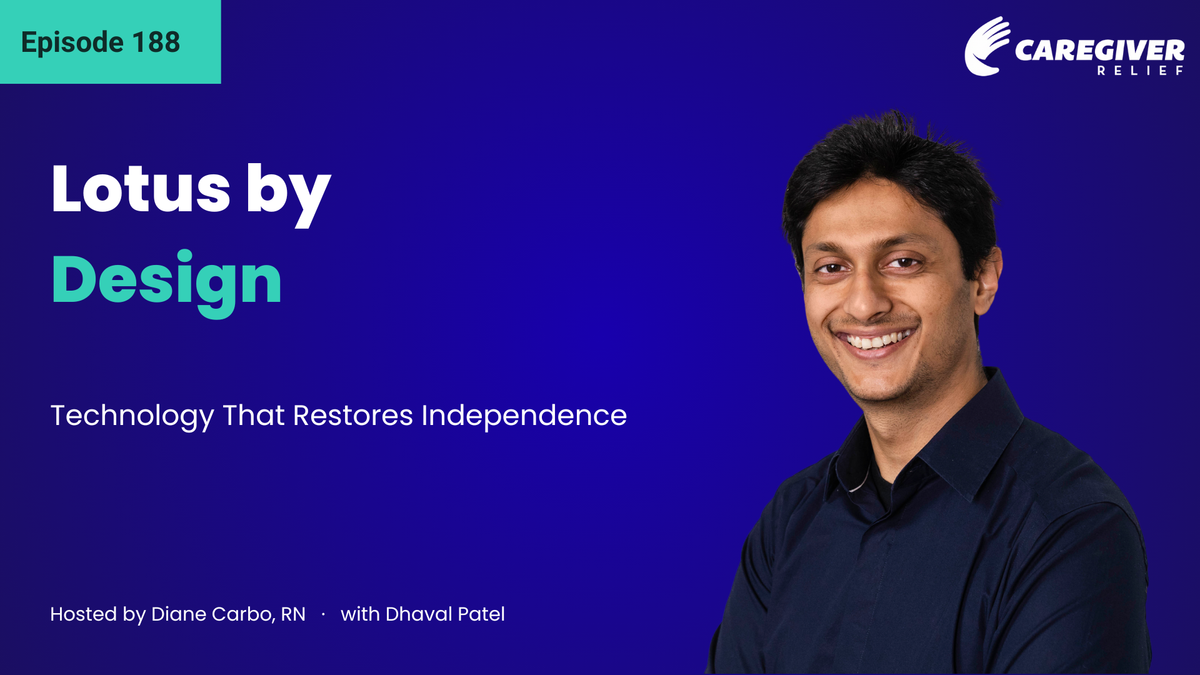
Imagine a world where you never have to choose between your safety and a dark room. In this episode of the Caregiver Relief Podcast, host Diane Carbo, RN, sits down with Dhaval Patel, a former Apple engineer who is revolutionizing home accessibility.
Dhaval’s journey began with a personal struggle: as someone born with twisted knees who often uses crutches, he once spent an entire night with the lights on because he was simply too exhausted to get out of bed and hop across the room. This sparked the creation of Lotus, a "smart" home solution that requires no apps, no Wi-Fi, and no rewiring.
🎧 Why You Should Listen
If you are a senior who wants to maintain autonomy, or a caregiver looking to reduce the "on-call" fatigue, this episode is a must-watch/must-listen. You’ll discover:
- The "Invisible" Fall Risk: How simple tasks like turning off a light can lead to dangerous "sit-to-stand" transfers.
- The Privacy Solution: Why Lotus is the perfect alternative for those uncomfortable with "always-listening" smart speakers.
- Dignity Through Design: How a simple wearable ring can give someone back 90 minutes of their day.
📋 Episode Outline
1. The Problem with "Smart" Homes
- 91% of US homes were built before 2008, making them difficult and expensive ($2,000+) to upgrade with traditional smart technology.
- The barriers for seniors: complex apps, privacy concerns, and voice assistants that often fail to understand commands.
2. How Lotus Works (Point & Click)
- The Ring: A wearable device with a single button that stays with the user, even in bed.
- The Switch Cover: A magnetic cover that snaps onto existing wall switches in seconds—no tools required.
- The Technology: Uses infrared (like a TV remote) to control lights, fans, and appliances from up to 30 feet away.
3. Impact on Safety and Caregiving
- Fall Prevention: 90% of users in a New York State pilot reported a significant reduction in fall risk.
- Pain Management: 96% of users reported reduced pain because they no longer had to make unnecessary trips across the room.
- Caregiver Relief: Caregivers reported a 9.7/10 rating for peace of mind, saving an average of one hour per day.
4. Real-World Stories
- Hear about Martha, a 110-year-old user who uses Lotus to continue knitting into the evening without having to "trek" across the room to turn on a lamp.

✨ Key Takeaways for Caregivers
"The number one thing people want most, more than anything as they age, is dignity. They don't want to feel like they're a burden... it's the little things that make a big difference." — Dhaval Patel
- 🛡️ Safety First: Use technology to eliminate unnecessary transfers before a fall happens.
- 🤫 Silent Support: Control the environment without waking a sleeping baby or spouse.
- 🧳 Portability: Take your "smart home" with you to hotels or family members' houses.
🔗 Resources Mentioned
- Lotus Official Website: getlotus.com
Don't miss this inspiring conversation! Click play to learn how you can restore independence with the touch of a finger. 💍✨
Podcast Episode Transcript
Diane: Welcome back to the Caregiver Relief Podcast. I'm your host, Diane Carbo, rn. Today's episode is about something caregivers and seniors tell me they want more than anything, independence without complication.
My guest is Dhaval Patel, former Apple engineer and founder of Lotus. Dhaval helped design technology. Many of us used every day, but Lotus was created from something deeply personal. Living with a physical disability and navigating the small, exhausting challenges that can take away energy and dignity.
Lotus is a simple system, a wearable ring and magnetic switch covers that allow people to control lights and switches from anywhere in the room. No apps, no wifi, no rewiring. So if you're a senior, a caregiver, or someone supporting someone at home, this conversation is for you.
Diane: Dhaval, thank you so much for joining me today.
I'm really excited to share your product, Lotus with my listeners. it's very innovative and timely.
Dhaval: Thank you. Happy to be here. Thanks for having me. I'm honored.
Diane: Yeah. before we talk about the technology, can you share the personal moment that made you realize something had to change for you?
Dhaval: Yeah, happy to. so what listeners probably can't see is, I was born with Twisted Knees. Actually, me and my brother both and over the years I've been on and off crutches a lot. And one night, a couple years ago, actually, in the house I'm in right now, I had just gotten into bed at the end of a long day, but forgot to turn off my ceiling lights as you do.
But I was too tired to climb out of my bed, hop onto my crutches, hop all 10 feet, turn off the light and vice versa. So I slept with the lights on the entire night and woke up in the morning thinking if someone like me. So I'm an electrical engineer by training. like you mentioned at the time I was managing a division at Apple for iPhone watch and AirPods.
And funnily enough, before Apple, I've even worked at the company that makes the WA switches at Lutron. And it got me thinking, if someone like me doesn't even have a smart home, who does? And what about everyone else? More vulnerable? And so that's what got me thinking that was the genesis.
Diane: The homes in our, in America, the majority of them are built for a young body, not an older body.
And it's hard to make them smart. And I can tell you right now, so many seniors and even some caregivers hear smart home and they feel overwhelmed. And, what does that mean? What do I have to do? what problems were you specifically trying to solve with Lotus?
Dhaval: Yeah, it's a great point. So I would even go as far as to say it's not just seniors.
Yeah. I started digging into this problem and to cut a very long story short, I did this for about nine months. I learned that 91% of US homes and structures were built before 2008.
Diane: Yes.
Dhaval: Meaning before smart homes even existed, right?
Diane: Yes.
Dhaval: But there's no easy way to upgrade them. To your point. So for instance, if I wanted to solve my problem that night, the first step would be I would have to rewire the wall switch that controlled that ceiling light.
Diane: Yep.
Dhaval: I'd have to take it out and put in a new one that was smart, that connected to the internet, so then it could talk to, Alexa or Google or Siri, what have you. So my point being step one, you'd have to rewire the wall switches to connect to the internet, which itself is about 11 hours or $2,000.
Diane: Yes.
Dhaval: So that's step one. Let's say you do that, step two, you now have to put a smart speaker everywhere you did the rewiring. So now I gotta put an Alexa in the kitchen. In the living room. In the bedroom and bathroom. And this is assuming you're okay with the privacy trade-offs.
Diane: Yes.
Dhaval: Because it has to listen in all the time.
So that's step two. And then assuming you do those two, then you have to still set it all up. Yeah. This is with downloading in through another app. This is kitchen light. This is living room light. This is light number 23. And by the way, everything I'm describing is best case if you own your house.
Diane: Yes.
Dhaval: If you're renting an apartment, what do you do? And then even if you somehow did all this and now you're traveling for work or for pleasure, what do you do? You can't bring your smart home with you to a hotel, so it affects everyone, but disproportionately affects seniors and their caregivers, and of course people with disabilities.
Diane: Absolutely. And I, what I think of is people with limited mobility, how hard they have to work sometimes to get something done and the energy that they, burn and the, it's just not physical energy. It's mental because many of them are feeling fatigued and worn out. And, So I see this as a wonderful challenge, for people with limited mobility to have a solution to.
I just, for someone who can't see the product, can you walk us through what the, how the lotus ring and the switch covers work together?
Dhaval: Yeah, absolutely. So it's meant to be very simple. The ring is basically a ring that you can wear. That controls certain objects at home by pointing, but like you mentioned, there's no app, no wifi, no rewiring.
So the way it works, step one, you put on the ring, so at the moment I'm putting it on my pointing finger or index finger, and there's only one button on the ring. Which is by your thumb. So step one you put on the ring.
That eliminates the need to have a smart speaker in every room of the house.
Diane: Yeah,
Dhaval: Because the ring stays on you and goes with you wherever you go. So that's step one. You just put on the ring, step2 for any existing wall switch in the house.
You can attach what we call a switch cover. It's the second half of the loaded system.
And it just snaps on using magnets.
Diane: Fascinating.
Dhaval: There's two magnets in the back and they snap onto the screws on your wall switch. There's no rewiring. In fact, there's not even an up and down. You can flip it either, which way?
So that's it. Step two is you snap on a switch cover and it snaps on using magnets so there's no rewiring.
And then step three, you can just point and click. So you can just point the ring in the general direction of the wall. Switch uhhuh, push the button on the ring and it will turn on or off your wall Switch. You can probably hear it going on and off right now.
Diane: Yeah. Yeah.
Dhaval: Now you can also continue using the wall switch manually, like you would anyway, uhhuh.
So you can push the button anywhere on that switch cover. And you can still manually use the switch. So step one, put on the ring.
Step two, snap on the switch cover, step three, point and click. And using infrared like a TV remote, Uhhuh eliminates the need for any app or smartphone or wifi.
So it takes about two seconds.
Diane: That's fascinating. I was thinking about your story about going to bed and not want not. Being so tired, you didn't wanna get up to turn the lights off. And for many people, once they get in bed after a day in a wheelchair or using their walker, they're exhausted.
And like I said, and you've made us aware as well, the majority of homes in the country are made for a younger body. They're way older. And the cost, it's cost prohibitive for many to make it a smart home. and that's really challenging. That's why I loved your idea and couldn't wait to share the information with my listeners because there are people that want some solutions to, a problem.
I love this because getting light is a hard. as we age, our eyes, our need more light to see. And so many people get up in the middle of the night and, you can't reach over as you get older to turn the light on. And so I love that. actually it can actually be a mem a form of fall prevention.
'cause you just,
Dhaval: That's right
Diane: Click and point. And the light turns on, and then you can get on your merry way into the bathroom. I, in
Dhaval: Fact, we have data on this now.
Diane: Oh, do you? Okay. Sure. Please share.
Dhaval: The funny thing is, when we started this product and journey, we didn't even have falls in mind.
We weren't thinking of rings, we weren't even thinking of fall prevention. It turned out, so the latest pilot, one of the biggest pilots we've done to date is with the state of New York.
Diane: Okay.
Dhaval: And it was specifically the department that sponsored the study was Office of Aging. It's called NY Sofa.
And particularly they were interested in preventing faults, which was interesting to us because we never saw the product as a fall prevention device. Funny enough that you mentioned that.
Diane: Yeah.
Dhaval: And as it turns out, we actually have data now showing that over. So we had about 85 interviews that we did.
The users used it for three months. And the statistics were 90% of users reported a reduction in fall risk, and the degree of reduction was nine out of 10.
Diane: I, you know what? I just had, I did a podcast, earlier that, they have safety products and fall prevention and, I, he just made me aware, the speaker, Jonathan, made me aware that when you have, they did a study on falls from in the bedroom.
and one of the things they learned is going from laying to sitting to standing. As we get older, your body doesn't have a time to adjust your blood pressure, and he calls it the one Mississippi, two Mississippi, three Mississippi. If you can get up and take those first steps, without falling, that's a blessing because as you get older, it gets challenging.
So here, and people. Just automatically do it. But I can see how this could be a fall prevention tool just in itself. Or you have to, 'cause you wanna tell people, don't get up in the middle of the night. Make sure, or make sure your slippers are there. Make sure the light's on so you can see, this way they could actually sit up and allow the body while they're pointing and clicking, to get the light on.
They're giving themselves time actually. To have their body adjust so that they don't fall before they even get to the bathroom.
Dhaval: Yeah. You actually covered the, so we were curious. we were not expecting this outcome. 'cause again, that was not, the product was made mostly to improve quality of life and independence and dignity.
Yeah. And so we started digging into it and you were correctly pointed at one of two mechanisms. So it turns out what you're describing, there's a clinical term for it. It's called a sit to stand. Transfer.
Diane: Yes it is.
Dhaval: And the majority of falls happened during that process. So yeah. What the lotus ring unbeknownst to us was doing was that it was preventing falls by fixing two situations.
So the first situation was, it's been a long date, you just got into bed.
Diane: You
Dhaval: forgot to turn on the, on the fan or turn off the light. And we can talk more about that. It's not just lights, it's controls, whatever your wallet switch, controls, lights, So it can be lights, fans, appliances, tv, what have you.
So the first situation was you got into bed, you forgot to turn something off. Now when you're tired, it's been a long day. Now you don't wanna get back up on your walker or your crutches or your cane because that's when a fall happens. You're fatigued. Yeah. And so that's the first sit to stand transfer.
So that's category one, which is it completely eliminates unnecessary transfers.
Diane: Yep.
Dhaval: So that's why it's not even reacting to a fall, it's just preventing it to begin with.
Diane: Correct.
Dhaval: Bucket number one. Bucket number two, it makes the remaining transfers safer. So that's the point you were talking about. It's 3:00 AM It's the middle of the night. You gotta get up to pee.
Diane: Yeah.
Dhaval: Now, most people what they do is they try to, once you're asleep, you wanna stay asleep for as long as you can. Yeah. Until you really have to go to the bathroom.
Diane: Yes. Yes.
Dhaval: But then you really have to go to the bathroom, right?
Yes. So that's when people rush and try to do it in the dark. a, they don't have the, three Mississippi time.
Diane: Yes.
Dhaval: And worse, they're doing it in the dark. Yes. So they, they'll miss where the crutches were, or they'll forget that little rug that's on the side of the bed.
Diane: Yes.
Dhaval: Or twist it up, basically trip hazards.
Diane: Yes.
Dhaval: And so now they can turn on the light before they transfer, before they get up, before they transfer into a wheelchair or crutches or cane or walker. And then watch. So for a common example is you forgot that the wheelchair was not locked. Yeah. Now you can see it. Yeah. Or things like that. So A, it removes unnecessary transfers and B, it makes the remaining necessary transfers safer.
And actually that's the reason why we even built a ring to begin with. Because it's the only thing people wear to bed at night and keep on.
Diane: Yes.
Dhaval: When we were studying it. Everything else came off, necklaces came off, earrings came off for women, apple watches are charging, your phones are charging.
People just don't have anything on them in bed at night. Yes. Except their wedding rings.
Diane: Yes.
Dhaval: So that's actually why we made a ring.
Diane: Wait. Old Lotus starts being the wedding rings for the seniors.
Dhaval: No, it's funny. people have asked me that a lot. I got married two years ago, and so that was a common question, which is are you gonna propose to your.
Now wife, using the lotus ring. So it does come up.
Diane: Hey, this is, we're in it together, baby.
Dhaval: Absolutely. Absolutely.
Diane: I can see that happening. who is the ideal person for Lotus? What mobility or caregiving situations does it help most with? Yeah,
Dhaval: So I would say we started off the obvious one is what you pointed out, which is anyone with limited mobility.
Diane: Yeah.
Dhaval: So on the acute side of things, it could be something like a stroke, a traumatic brain injury, you've had an accident or a fall or some, in our case we are even working with the va. So it could be like an injured veteran.
Diane: Yes.
Dhaval: Or a sports injury, or even like a spinal cord injury, right?
Anything sudden. Usually accident, external or internal, like a stroke on the chronic side of things, something as simple as arthritis. Your knees hurt or you've just had hip surgery or something like that. But the other common ones are, any chronic conditions like MS or a LS or cerebral palsy. So those are some examples.
I, I, we've now learned that it's not just limited to them. For instance, pregnancy is now a very common use case. So because prenatal to postnatal, that's a whole year. Literally doing that sit to stand transfer. Getting up when you're second or third trimester or pregnant is a pain, literally a pain in the back.
And once you've delivered, you're healing either from C-section or delivery. And then post, your IES now in your arms. So for grandparents, and I'm seeing this firsthand, we just had a child two months ago and my parents are visiting, as new grandparents. And, for them getting up to do anything for the baby or when the baby, when they're feeding the baby, like a bottle
Diane: uhhuh
Dhaval: And the baby falls asleep.
Now you're stuck.
Diane: yeah.
Dhaval: You can't make a sound. You can't say, Hey, can you turn off that light
Diane: Uhhuh,
Dhaval: Because the baby will wake up. Yeah. Can't move your arms. You can't even get up. But you can push the buttons. Turn off the light.
Diane: I'm laughing because you so are a new dad with the first kid because the second and third kid, you just put the kid down and let it live with the noise.
Dhaval: Oh, absolutely. At this point, we'll do anything to keep him asleep and when he is asleep. Oh,
Diane: trust me, I had the first one too.
Yeah.
Diane: So I get it. now can you tell me how far away can someone be and still use the ring effectively?
Dhaval: Yeah, you can be as far away as. 30 feet so you can actually be diagonally across a large hall.
Yeah. And this is particularly important to caregivers. So of course what I mentioned was limited mobility. Yeah. Now we've seen even low vision, folks that are hard of hearing. we've even now covered intellectual and developmental disabilities. Yeah. So folks with Down Syndrome autism, they're actually able to use it as well.
So really the whole spectrum. Anyone, that is unable to use smart home technology today and needs independence and autonomy? This becomes particularly important for caregivers because they can also use it at a distance and there is no preset up. So let's pretend you have a ring.
And you're visiting your son or grandson's home.
Your ring will automatically work even as far away as 30 feet in their home. There is no setup when you visit them.
Diane: Oh, wow.
Dhaval: If they come to visit you. Their rings will automatically work in your house. So even if you didn't have Lotus devices, their rings would at minimum work with your TV automatically.
And that's why it's also important for caregivers. So in the state of New York, 100% of caregivers, and this is a statistical anomaly, a hundred percent of caregivers that we interviewed reported peace of mind and relief. And the degree to which they got this was 9.7 out of 10. Essentially they say, we feel like we don't have to be.
On call every second of every hour of every day. Yes, I can step out for a breath of fresh air. I can go get groceries, I can go grab some water. I don't feel like the, the person I'm caring for won't be okay.
Diane: One of the things you mentioned is about appliances, on the switches, and one of the, my biggest concerns that I see often is the caregiver who gets busy, they're making dinner, or the senior who's making dinner and they, left the stove on.
And I love the ability because in, like again, it's the older homes, where you can have a switch for peace of mind. And if you're not sure, you can turn it off from the right. I really think that is amazing and
Dhaval: yeah, in fact we're, that's just where we started now, and I can share this. We're working on the next set of things.
So the ring can control anything. A wall switch controls, so lights, fans, appliances, fireplaces, as a common example. Yeah. And by the way, for the tv, you don't even need the wall switch. Oh wow. You don't need that switch cover because the TVs, all TVs already have infrared built in. So think of the ring like a little TV remote.
Whatever a TV remote can control, which is TVs The ring can automatically control. You don't need that second half. Now, in addition to all that, we're also now controlling anything that directly plugs into the wall. So now even things that are not controlled by waltz switches, you can control.
So like a floor lamp,
Diane: uhhuh
Dhaval: Or a floor fan, like your bedside lamp.
Diane: Yeah.
Dhaval: Things like that. You can also control those now and we're piloting that right now as we speak.
Diane: Oh, I love that. 'cause, that is a lifesaver. I think of myself when I get into bed and I'm like. Laying there and it's hot and I just need to have the ceiling fan on.
Yep. And getting up to do that, sometimes it's oh, I have chronic pain, so when I get comfortable, I really don't wanna move for a while because it's just nice to Ah, yeah. anybody that suffers, in with pain. So I love the, I feel, I think I'd feel powerful. It's the lightsaber, Darth Vader's lightsaber.
Dhaval: The funny, the funny anecdote I'll share here is a weird side effect of having created this product is I can now tell what fantasy world you like. because people will often refer to it as. Star Wars, it feels like the force. Or if you're really into Harry Potter, then people will refer to it as the Wind Guardian, LEOSA, or, Lord of the Rings, one ring to rule them all.
And it's funny, the phrase that they use tells me what they like to read or what they like to watch. And so it's a bit of funny.
Diane: I'm gonna really date myself. We're living in the Jetsons.
Dhaval: Hey.
Diane: And you probably don't even know who that is.
Dhaval: No. I used to watch Jetsons growing up, so I love that
Diane: idea.
Oh, So I'm living in the Jetsons world and I just think that is amazing. especially because the homes, we have a silver tsunami coming. Yeah. it's here. In fact, it's not coming anymore. It's here in the next 10 years. we are, functioning in crisis mode in our country, probably all over the world.
We have more seniors than youth, and we don't have, many people to take care of our elderly. it's, a statistic. it's a fact, it's a truth. And one of the things that I'm also learning is that, they we're moving from a Medicare is moving to a cost sharing platform. So they're sending patients home, when they're not ready to be.
the family caregivers are not able to provide the kind of care that they, they require. And, this is happening, Medicare has cut reimbursement, for therapy so that people don't. they get paid, the facilities get a higher level of reimbursement for not providing therapy, right?
So it's following, falling on the family. And I really see Lotus as a very cost effective, simple tool that can help the frail list of elderly. do things without having to have someone around them all the time. And I like that because one of the biggest things I get asked all the time is, what tools can I use so I don't have to depend on another person to take care of me?
Dhaval: Yeah, absolutely. In fact, we get statistics on this. So the pain thing that you were talking about.
Diane: Yes.
Dhaval: And we measure that in New York's pilot, 96% of users mention it reduced pain.
Diane: Yes.
Dhaval: And the degree was 9.2 out of 10. So I, I believe that's a lot. Yeah. The caregiving time that you're talking about.
Diane: Yeah,
Dhaval: We measured that it saves an average of 90 minutes a day and if you remove outliers it saves an hour a day. So somewhere between one to one and a half, which was a huge surprise to us. 'cause we thought it would save you like 10 minutes a day, Uhhuh. And it turns out, to your point, you don't have to wait for somebody anymore.
You don't have to. Someone's in the basement or someone's outside the house. You don't have to yell to them. Yeah, you don't have to wait for all the time. I can't tell you the number of stories we've heard of. Oh, I just sat in the dark for a while before someone, knew that I needed them, but they were out of earshot.
Diane: Yes.
Dhaval: Or the number of times I've slept with the lights on because, my caregiver was out of earshot or wasn't around, and so I just decided to sleep with the lights on, or worse, I tried and fell. And so actually that was the big reason that the state of New York wanted to do it because we did the math for them.
Uhhuh. Even if Lotus only helped you stay in your own home for only one week longer. Uhhuh, it's a 1000% ROI per user per year
Diane: That ROI is return on investments listed.
Dhaval: Return on investment. And so from, because from New York's perspective, if they have to move you and you're not able to age in place,
Diane: Yes,
Dhaval: It costs them $10,000 a month.
Diane: Yes.
Dhaval: A month.
Diane: Yep.
Dhaval: And or if this device just saves you one fall, that's $30,000 saved.
Diane: Yes. Yes.
Dhaval: And to your point, the whole idea was to make something that was super simple and it's portable because you can take it with you to a hotel or an Airbnb or to your children's place. So the idea was to keep you safe wherever you go.
Diane: And you know what, I have to say the obvious here. It's cost effective compared to all the other tools. And I can tell you everybody, is very concerned about their privacy and when they learn that, Google, Alexa or whoever you have in your home is always listening to you. People don't like that.
They don't feel comfortable with that. So I think that you have a wonderful solution, especially here in the States because so many of the homes are so old, and to bring them up to the modern day standards of a smart home is not cost effective.
Dhaval: So for the listeners, we usually, these Lotus devices come as a starter kit because you can have as many as you want.
So the most popular one is where you get a kit that has one ring and three switch covers, and that kit is 3 99. Okay. And that's about the same price. If you had to pay for an Alexa and put one in every room and put a switch cover, and that doesn't even include the cost of rewiring or getting a contractor
Diane: Correct.
Dhaval: So it's 3 99, but again, you can get whatever combination you want. You can get one ring and two switch covers, or you can get one ring in five or you can get one in three and add more as you go. 'cause again, there's no setup. And so that's the, hence the discussion on ROI because it's a one time, there's no subscription fee.
And to your point, it's completely offline, so there is no big brother. In fact, the funny thing is in the state of New York pilot privacy was the number one concern. Yeah. Because we ask people why they aren't using Alexa already.
Diane: Yeah.
Dhaval: And privacy was the number one concern amongst older adults.
Yeah. Number two, overall, but number one, amongst older adults for why they weren't. It turns out the number one reason was Alexa doesn't understand them.
Diane: Yep. The
Dhaval: Number one reason, the number one reason you weren't giving the command correctly or it didn't hear you, or it goes off at random times. that was the number one concern overall.
But for older adults, the number one concern was privacy.
Diane: I believe that. now, what kind of feedback have you heard from your users out there? Could you share a few stories?
Dhaval: Yeah. let's see. So we had a father and a son. again, this is in the pilot. There are many stories actually. We got text messages.
That's how I know.
Diane: Yes.
Dhaval: Okay. They texted me on my personal number. I have a lot of imposter syndrome, so I assume everyone's just being polite.
Diane: Yes.
Dhaval: 99% of the time. So anytime anyone says anything nice, I assume they're just being polite. So the real test was at the end of three months, we took the devices back.
And then just so we could ask the state of New York, who do you want us to send these to? And we started getting all these text messages to us, to my own personal phone. And so one was this father and son duo. The dad was in the pilot. He's, 77 years old. the son actually runs independent living for the state of New York.
He was not in the pilot. Okay. And his dad, he was so worried about his dad not having the lotus ring. He drove two hours to go back and stay with his dad. His, their mom has passed, so the dad stays by himself, just because he was that worried about his dad not having the lotus ring and worried about a fall.
Oh
Diane: God bless that son.
Dhaval: Oh yeah. And so a amazing son and between him and his sister, they tried to take care of their dad. But because we had taken the lotus ring back, he was really worried about his dad's fault. Yeah. And he had not been worried because he'd had peace of mind the whole time that his dad had the lotus ring.
'cause his dad was independent. we had another lady, who actually has no visible disability. To your point, her name is, Anne. she specifically has chronic pain. That's her condition.
Diane: Yep.
Dhaval: And it's mostly sort of joint pain. And she actually started crying during our interview. She was saying, people think there, there's no visible disability, so there's no disability.
Diane: Yes.
Dhaval: And I'm in so much pain all the time.
Diane: Yes.
Dhaval: That even just five steps actually means a lot to me. And so having the lotus ring. Saved me so much pain. I can't put it into words.
Diane: Yes.
Dhaval: And she was super excited to have it. And so she actually, the most common feedback is people didn't wanna give back the devices.
Diane: Isn't that's a testament to a good product.
Dhaval: I am blessed.
Diane: oh. I think, you're sharing this with the world is also a blessing because it's a product that's desperately needed in an a country where we are have this tsunami and senior Isolation is a very real thing and for.
And we don't have enough professional caregivers to take care of our elderly as it is. So for them to be at home alone at. For as long as possible is really important. And this, it's affordable. it's absolutely affordable and can improve somebody's quality of life. my son, had RSD reflex sympathetic Dystrophy and, or they call it chronic regional pain syndrome.
And that is a severe pain condition that if you have A breeze go by your affected part like his was in his foot. It could put on cause you to have excruciating, agonizing pain. it was awful. And I know many out there suffer with that condition. You can't see it, and, but it's real. And just being able to turn the fan off and stay under the covers or turn the light on or even just, stay in the bed while you want to do something so that you don't have pain is amazing to me.
Dhaval: Actually, your story reminded me of one,this particular one I wanna share. We just, so we are, part of our process is anytime we give devices, we always want to get feedback. So we just gave our devices, and this is super cool for me to a lady that just turned 110.
Diane: Oh my lord,
Dhaval: She, her birthday was last weekend, not this past weekend, but the weekend before that.
And her daughter is 80.
Diane: Yep.
Dhaval: And so both of them were on the Zoom call. I was interviewing both of them simultaneously.
And she loves it. they both loved it and for different reasons. So the mom, actually gave an example of she loves to knit or loves to read, often knitting. And she will sit in a spot and knit for hours.
And at some point the sun has set and the room is dark.
Diane: Yep.
Dhaval: And it takes a long time and a lot of pain for her to get up and go, put down all her knitting equipment.
Diane: Yeah.
Dhaval: Put it to the side, get on her walker, in her words. Take the trek across the room.
Diane: Yep.
Dhaval: Turn on the light and then come back.
Yeah. And she mostly relies on her daughter to help her out, but her daughter not, may not always be around, might be, have gone to the grocery store and She will often just, once the sun is set, she will just sit in the dark For a couple hours and wait. And so she hasn't had to do that anymore, so she can just continue knitting or continue reading.
She's often in a, like a soft, comfortable sofa chair thing.
Diane: Yeah.
Dhaval: And it's like it takes a lot of effort to come out of that and get from a sitting position to a standing position. And so her daughter and her mom, both on the same call, were talking about. They love that scenario where now the daughter can not worry that, oh my God has the sunset.
Do I need, do I need to be home for my mom? Otherwise, she's probably sitting in the dark.
Diane: Yeah.
Dhaval: And the mom doesn't feel like she has to be calling her daughter for help constantly.
Diane: Yeah.
Dhaval: And so that was one example. The other one was when she's in bed, she doesn't have to. When she has to go to the bathroom, the, it just so happens the way their home is set up, the lamp is on the other side of the daughter, and so she doesn't have to wake the daughter up to turn on the light or do it in the dark without waking the daughter up.
She can just turn on the lamp and go about her business when she has to go to the bathroom in the middle of the night. So I just remembered this 110 year old lady, and I particularly remember this because. they immigrated from Germany at some point, and, she was telling me how she has even told her extended family in Germany
Diane: Uhhuh
Dhaval: about these devices that she's using and it just came to mind.
Her name is Martha.
Diane: I love it. I think that, Lotus is a product that many should look into, it's cost effective and can actually improve the quality of life for many. Dhaval. Thank you so much for sharing all this information. thanks for having me. If caregivers take one message away from this episode, what do you want 'em to understand about independence and dignity at home?
Dhaval: I would say the number one thing people want most, more than anything as they age is dignity. They don't want to feel like they're a burden on somebody else, and they want to not be asking for help constantly, especially for the little things. Yes. And so it's the little things that make a big difference, Lotus or not.
Diane: Yes.
Dhaval: And so the more we can help empower the end user, it's good for everybody. They feel more independence and autonomy and dignity, and their family members feel peace of mind and relief. And so it's actually a win-win. And so I would say my main message is look for the little changes. Look for the little changes.
It doesn't have to be a big change, but you'd be surprised how far. Little simple changes can go.
Diane: Yes. So how do my listeners find you and find Lotus?
Dhaval: the website is get lotus.com. That's G-E-T-L-O-T-U S .com. Lotus like the flower. and my email is Dhaval@getlotus.com or there's an informational email on the website as well.
But you're welcome to go to the website, email me, or reach out directly through the website. and we'd be happy to talk to anybody.
Diane: Well, thank you so much. I appreciate this information To my family caregivers out there, you are the most important part of the caregiving equation. Without you, it all falls apart.
So please learn to be gentle with yourself. Practice self-care every day. Get yourself a lotus. An extra hour a day would be awesome 'cause you are worth it.
Caring for a loved one can be overwhelming — but you're not alone. If you have questions, big or small, our expert team is here to help.
👉 Click here to Ask the Expert
Our Resource section can help you find the information and tools that you need. We have courses, videos, checklists, guidebooks, cheat sheets, how-to guides and more.
You can get started by clicking on the link below. We know that taking care of a loved one is hard work, but with our help you can get the support that you need.
Click here to go to Resource Section now!