Scams Targeting Seniors: How Caregivers Can Protect Loved Ones from Fraud with Al Pascual - Episode 206
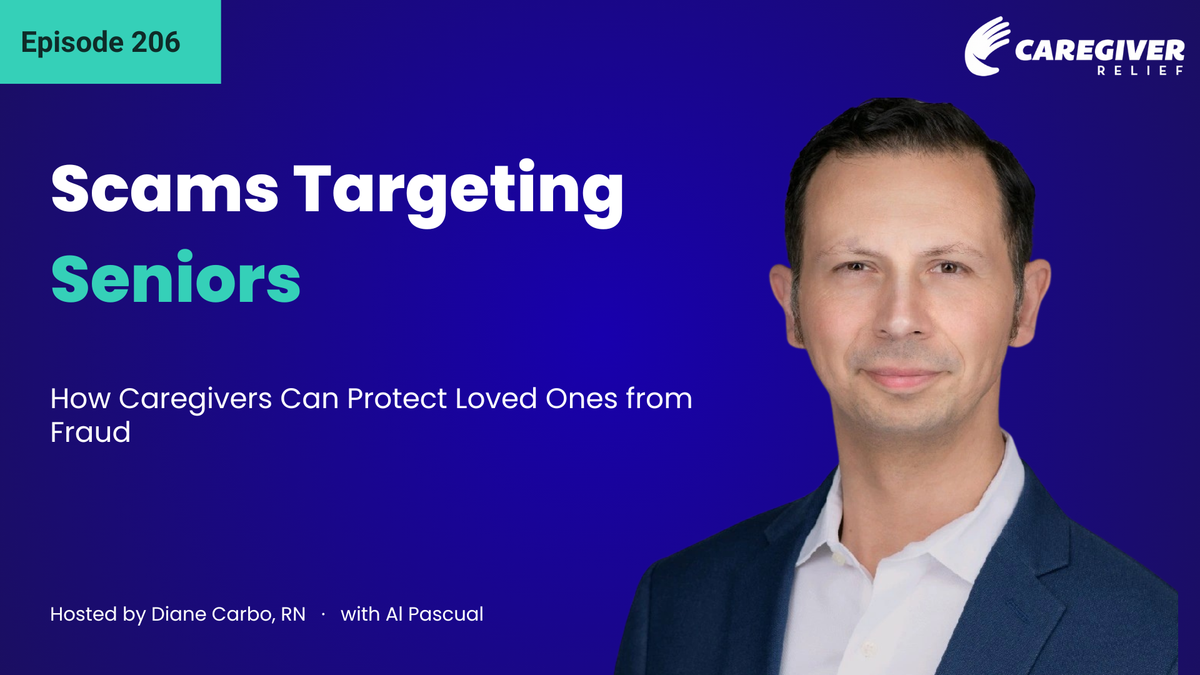
In this must-listen episode, host Diane Carbo, RN, sits down with Al Pascual, CEO of Scamnetic, a recognized cybercrime expert and former investigator whose work has led to the arrest of over 400 fraudsters. Together, they break down the psychology behind these modern scams, why seniors are high-value targets, and the exact steps caregivers can take to protect their loved ones' life savings before it's too late.
📋 Episode Outline & Highlights
- Welcome & The Silent Epidemic: Diane introduces the evolving and highly sophisticated world of modern fraud targeting older adults.
- Meet Al Pascual: From growing up with detective parents to investigating banking cybercrime, Al shares his background and the personal family experience that drove him to launch Scamnetic.
- Why Seniors are High-Value Targets: Al corrects a major misconception—anyone can be scammed. However, seniors are aggressively targeted because they possess the retirement savings and assets that younger demographics don't.
- The Isolation Factor & Deep Fakes: How social isolation makes seniors vulnerable, and how scammers use AI-generated deep fake videos and audio to mimic peers, celebrities, or trusted figures.
- The Rise of Impersonation Scams: Real-life stories of fraudsters pretending to be local pastors, utility companies, or banking institutions using leaked data from corporate breaches.
- "Pig Butchering" & The Long Con Romance Scam: A look into the incredibly insidious tactic of building romantic or friendly bonds over months to gradually siphon away hundreds of thousands of dollars.
- Re-Victimization: The dark reality of fake "scam recovery services" that target seniors who have already lost money, tricking them into losing even more.
- How Scamnetic Fights Back: Al explains how his proprietary technology analyzes communications to "break the spell" of the scammer and force them to prove their true identity.
- Proactive Steps for Caregivers: Actionable, immediate strategies caregivers can implement today with banks and financial institutions to act as a shield.
- Navigating Difficult Conversations: How to talk to your aging parents about scams using educational anecdotes without inducing shame, fear, or resistance.
- Fraud vs. Scams: Understanding the technical difference between identity theft (fraud) and emotional manipulation (scams), and why traditional banks struggle to stop the latter.
- The Number One Action to Take Today: Al's primary piece of advice for immediate financial protection.
- Credit Cards vs. Debit Cards: A quick safety tip on why credit cards offer superior legal fraud protection over standard debit cards.
🛡️ Key Takeaways for Caregivers
👥 1. Anyone Can Be Scammed
Fraud is no longer just about clicking a suspicious link. Scammers use highly targeted data from corporate breaches to know exactly where your loved one banks, who their friends are, and what their interests are.
🎭 2. The Power of AI & Peer Impersonation
Scammers aren't just pretending to be famous celebrities anymore; they are creating deep fakes of other seniors or community leaders (like pastors) to build immediate, peer-to-peer trust and relatability.
🛑 3. "Trusted Contacts" Are Your Best Friend
Many financial and retirement institutions allow users to add a Trusted Contact to their accounts. This does not give the caregiver access to see or move money, but it automatically alerts them if a high-value or suspicious transaction (like a large wire transfer) is attempted.
💡 What You Can Do Right Now
- Call the Bank: Contact your loved one's bank and 401k providers to ask about setting up a "Trusted Contact" notification system or establishing joint account alerts.
- Ditch the Debit Card: Encourage your loved ones to use credit cards for transactions rather than debit cards. Credit cards offer broad, legally protected liability timeframes, whereas debit cards leave you vulnerable to a tighter 90-day reporting window.
- Watch the Attachments: You can safely open most text emails, but never click on unexpected attachments or unverified links.

🔗 Connect & Learn More
- Protect Your Communication: To learn more about how to intercept scammers and verify identities using advanced technology, visit Scamnetic.com.
- Scamnetic LinkedIn: Here
- Scamnetic X (Twitter): Here
- LinkedIn: Here
Remember to practice self-care today. You are the most important part of the caregiving equation. If you found value in this episode, please Like, Share, and Comment below to help us reach more caregivers who need these vital resources!
Podcast Episode Transcript
Diane: Welcome to the Caregiver Relief Podcast. I'm your host, Diane Carbo, RN. If you are caring for an aging parent or loved one, you already know how overwhelming it can feel to keep them safe, not just physically, but financially and emotionally as well. Today, we're talking about something that is quietly affecting millions of families, scams targeting older adults.
They are not the obvious scams we used to recognize. Today's fraud is sophisticated, emotional, and often deeply personal, designed to create fear, urgency, and confusion in moments when people are most vulnerable. And the truth is, even the most independent, cognitively intact older adults can fall victim.
To help us understand what's really happening and what we can do about it, I'm joined by Al Pascual, CEO of Scamnetic. Al is a recognized expert in cybercrime and a former investigator whose work has led to the arrest of more than 400 fraudsters. In this conversation, we're going to break down how these scams work, why older adults are being targeted, and what you, as a caregiver or even a senior, can do to protect yourselves before it's too late.
Diane: Al, thank you so much for sharing this, your information about this topic. It's very timely. I recently had a neighbor who lost a half a million dollars. but before we dive into what Scamnetic is, can you start by telling us a little bit about your background and what led you to the world of cybercrime and fraud investigation?
Al: I appreciate the question, and Diane, thanks for having me. so to be clear, I wish my job didn't have to exist.
Diane: Yeah.
Al: But nonetheless, I, I got started doing this, because my parents were actually in law enforcement. they were both detectives, which was a fun house to grow up in. but, they really wanted me to go to college.
I did. I found my way, actually to banking, but I realized I was very good at telling when people, were lying. And that ultimately led me into, fraud investigations. worked at, many banks. I actually used to work for a research firm pro- focused on consumer fraud, so it was a company called Javelin.
Started my own technology company, focused on consumer cybercrime. and started, Scamnetic, a few years ago, the reason for starting the company was, twofold. One, after my last company, I started to hear a lot about scams. and it's not that they didn't exist, it's that, they weren't nearly as prevalent 10 years ago as they are today.
And so something had changed. and, I also had a bit of a personal experience, talking about people, losing money where, my father, you know, who I mentioned had been in law enforcement for, better than 25 years, just as a police officer, a detective, ended up losing, hundreds of thousands of dollars to someone over many years. and by the time we found out, it was already too late.
Diane: Yeah.
Al: And it felt something needed to be done. That, it's something that I could do something about, and here we are.
Diane: Now, why are seniors such a prime target for scammers?
Al: I do want to set the record straight.
And this actually I think maybe speaks to the situation with your neighbor too. Everybody can be scammed.
Diane: Yes, absolutely. Absolutely.
Al: Everyone can be scammed. So just like my father and just, I have a, professional, friend who was in the space for decades. He's been scammed. I've known PhDs who've gotten scammed.
Diane: Yep.
Al: Now I think the catch with seniors, is that they're higher value targets, and that's what makes them so attractive. Because, as opposed to, ripping off, someone who's in college and can barely make the rent- seniors have retirement, they have savings.
So that makes them very attractive targets, and that's why they're often targeted, and that's why we also, often hear stories of significant loss because, they have the money to lose, much more so than, an 18-year-old kid.
Diane: And we also are seeing social isolation and loneliness.
That is really huge. I recently had a friend a woman, she, and her husband, they're not getting along. they sleep in separate bedrooms, and he gave away his life savings to a tennis star that wanted him to come and live with her and build a home together.
I'm like, oh, these poor people. of course he realized that, she wasn't real and it was probably somebody in another part of the world that was taking his money. So are you seeing an increase in scams that specifically target, families or caregivers?
Al: I think the caregivers are in a unique opportunity, to be the, that watchful eye.
That can get ahead of the scammer, maybe stop it before it gets too far. so the scams themselves don't necessarily target those people, but they play a really important role.
Diane: Yeah.
Al: But, in as far as, the scams affecting seniors and, why they're so successful, you did mention, again, the social isolation component for sure. I think there's also something to be said for technology. The fact of the matter is, everything going digital over the last 20 years has made all of us much more accessible.
Diane: Yeah.
Al: But on top of that, it's also made scams incredibly convincing. And, even in the last, three or four years, advancements in things like deep fake video technology are just been absolutely tremendous.
Not just the quality, but the accessibility. So for criminals, it's very easy to get access to technology that makes them look like and sound like whoever they want a- and with very little work on their end. And, they take advantage of things like that social isolation, and leverage deep fakes to, create these convincing personas.
And they're not, just, famous people, the tennis star. I've heard the, the story of the country singer before, right? We've seen the ones with, Brad Pitt and Keanu Reeves.
Diane: Yeah
Al: But a lot of the ones I see and hear about are, scammers impersonating, other seniors.
Diane: Yes. Yeah.
Al: Because, they there's relatability there, right? They can build bonds around, shared interests, and it's a lot easier for them to have that conversation when it, it feels peer-to-peer-
Diane: Yeah
Al: to their victim. so they are taking advantage of the tools at their disposal, and they understand their target.
And unfortunately, they're getting very good at what they're doing.
Diane: What are the most common scams that you're seeing in adul- older adults now?
Al: Some of the more common scams, let's see. there's ... I have a good story. I don't know if it, if I'd necessarily put it in a category.
But it does speak to, how scams have changed, so I think it's something that people need to be aware of, criminals have, much more information at their fingertips
Diane: Yes
Al: than they did before, too. So you think about things like a data breach, where these big companies lose all this information.
It used to be that criminals would use that information to commit fraud. So they'd try to be the victim because they have all this sensitive information. Now, that information combined with what they can use AI to find allows them to be super targeted when they go after victims, even just everyday victims.
Not just, not like company CEOs, but you and I. And the impersonation scam, is one that has gotten incredibly prevalent. Now, impersonation can mean a lot of things. It could be the criminal impersonating your bank. it could be them impersonating someone near and dear to you.
I had another story with some seniors where, the scammer was impersonating their pastor.
Diane: Oh.
Al: And, they had reached out, and these two people were very active in the church. they... Again, they were, themselves were, both professionals. And, the pastor, quote-unquote, "managed to convince them" to go buy gift cards, right?
To be handed out to the congregation. And, they ended up in a situation where they almost lost, ended up spending, $50,000, on gift cards. And ultimately, amazingly, the store stepped in, which we're seeing increasingly, too. The stores are becoming aware of this sort of activity, and they're trying to intervene.
But impersonation ones are big, right? So the same thing with the banks. When criminals have data, they steal your credit card information.
Diane: Yeah.
Al: Now when they have that credit card information, they know where you bank.
Diane: Yep.
Al: And so they'll reach out to you and pretend to be Bank XYZ.
Diane: Yeah.
Al: They'll have all the information on your banking relationship.
So they can tell you this story that's just so convincing, knowing things that no one could possibly know. and then they get you to move money.
Diane: That is what happened to me recently. But because I'm really trying to be aware of these things when doing research and reading about what, schematic, I, actually said, it's unusual that the bank calls me.
I don't feel comfortable giving you..." They wanted more information on my account to protect me. So I said, "I'll call you back." And of course, I called the bank, and it was not who they said they were. But I felt that it wasn't, but I was cognizant enough to say, "Why is the bank calling me? They text me.
They, they do, they send me emails or whatever." But even emails you can't trust anymore. You have to check. that's one that recently happened to me, and it was from a data breach I'm s- I'm sure that, happened, a few, sometime last year.
Al: A 100%, I have no doubt.
Diane: Yeah.
Al: So the impersonation ones for sure.
And then, the long con romance scams. They call them pig butchering.
Diane: Yes. Yes. Yes.
Al: Yes. and for those who are not familiar, un- unfortunately, pig butchering is a very unflattering term.
Diane: Yeah.
Al: But it comes from, the Chinese, and it means to fatten the pig before slaughter. And so the idea is, these are, scams that start very innocently.
Diane: Yes.
Al: It's typically an unsolicited outreach, but they're not necessarily asking for anything in the beginning.
Diane: In the beginning. Yeah.
Al: It's a mistaken identity. it's just someone looking for a friend, and the idea is to gradually build a relationship.
Diane: Yeah.
Al: To gradually, create these bonds of trust, and this can happen over months.
Many months.
Diane: Yep.
Al: and even when they go in for the kill, quote, unquote, the amount of money they may ask for in the beginning is very small. They may ask for $100.
$200. $20. Just something to get it started, and it builds over time. and then it can turn into things like investment opportunities, crypto, foreign exchange.
And then, before you know it, you're out tens of thousands, hundreds of thousands of dollars. but you're so deep at that point and you've done so much over all that time that, it just becomes progressively harder and harder to stop.
Diane: Yeah.
Al: And so it's incredibly insidious and dangerous, and that's one that people need to be very aware of.
Diane: I watched a Dr. Phil episode, and this little old lady gave all of her savings away to a man she was in love with, she's never met, never seen. And she literally, her ego would not allow her to accept that it was a scam. I mean
Al: Yep
Diane: She still wanted to send him money. And I'm like, oh my. And they actually got the man on the phone.
And, a- and I thought, here he is saying, "Yeah, I'm not real." and she still and it's really sad that there's some people that feel a need to protect their ego. They can't accept that they've been taken advantage of in any way.
Al: Yeah. And the, that happens very often. but, then unfortunately, when they finally do realize that something's happened, we're also hearing, about cases where people try to get help with a scam after they've been victimized.
And then they are re-victimized.
Diane: Yes.
Al: Where there are services that supposedly will help you get your money back.
Diane: Yeah.
Al: a- and yeah, I heard, I actually heard of a case, two days ago where someone, actually got taken advantage of twice. They were scammed, and they went to two different services, quote, unquote, to get their money back.
And they were scammed again two more times. So it just speaks to the fact that there are no depths to which scammers will not go
Diane: Yes
Al: to make money
Diane: So that brings me to how is technology helping detect or prevent scams, and where are the gaps? I want to talk about what you have done to help us protect ourselves from the evil out there.
Yeah,
Al: No, it's, and I appreciate the opportunity and I want to be clear, there's a lot of opportunity, a lot of things that people can do. So I'm going to talk about maybe more than just what I do too. but, what we do is two things. And what we'll work with, we'll work with banks and telecoms and insurers and other companies that give technology to consumers, and the technology will, tell you when you're being communicated with by a scammer, whether or not it is a scam.
So an email, a text message, something on WhatsApp, Telegram, we will intercede and tell you exactly what we see and why we think it's a scam. Because what we want to do is we want to get ahead of the scammer. Before they build the trust.
We want to break that spell, make it so that you immediately question their motives, and then you are much less likely to engage with them.
And we're able to use our own artificial intelligence and proprietary technology to analyze almost any kind of communication so that we stop you from engaging. But the other thing we can do is, we can also tell you who they really are. And so we took technology from, from a past life of mine where, it's the same kind of technology that a bank will use when you want to open a new credit card or an online loan.
We built our own process around that kind of technology. but the idea is it makes the person on the other side prove who they are. So before you ever send someone money
Diane: Ooh, wow. That's powerful
Al: you think you're talking to Sarah in Tampa. we're going to tell you, look, it's not Sarah in Tampa, it's Tran in Cambodia.
And guess what? We also looked at their face, and they were using a deep fake.
And so now you're definitely thinking twice before you send them that money. And we're trying to catch things early if we can. If we can't we can at least give you something, right? to, again, break that spell before you make a mistake.
Even if, you don't have access to that kind of technology today, increasingly people do, there's still lots of opportunities, for folks to protect themselves or especially for caregivers to keep an eye on what's happening with their loved ones. One of the things I like to suggest that people do, caregivers do, is take advantage of the ability to add trusted contacts to financial and retirement accounts.
So there are some institutions that support this option where, you know, as a caregiver, you can get notified when something happens with their account. for example, there's a high-value transaction. So you're a caregiver for your mother, she tries to wire $100,000, you're gonna get a notification before the wire's released.
And so now it gives you the opportunity to engage, with that family member, the person you're caring for, and understand if there's something happening before the incident as opposed to being reactive, and then learning about it after the fact. And so-
Diane: I have to tell you, I love that, and I'll tell you why.
I just did a podcast with a man who was in banking, literally working in banking, and his mom was, He was in the East, on the East Coast, his mom was on the West Coast. She had a full-time caregiver in the home who was ... he paid ha- handsomely for her. And she bilked them out of a million dollars, and they didn't know.
And, that ... So I love the idea of that, you have somebody that's going to notify people of these large, of notifications of money. She actually falsified checks and everything to get money from this, and the family didn't know. They only found out after the mom died, and they're looking at her accounts that have been depleted.
Al: Yep. Yeah. That's ... And I have, again, going back to my earlier experience
Diane: Yes
Al: for a lot of people, and especially a lot of people who care for others, they are gonna find out too late.
Diane: Yes. yes
Al: And then the more, and unfortunately the more that criticize, the new love interest, the new friend
Diane: Yeah
Al: the more inquisitive you are, the more you push the more that person will pull back.
Diane: Absolutely.
Al: And so to be able to come, to be able to come to them with evidence, to be able to come to them, in, a moment before they make, that mistake, that's, that's gonna be your best opportunity.
Diane: Yeah.
Al: The, to stop- You know- ... it from happening.
Diane: Yeah. I have a neighbor that is 98 years old, and his wife is 94, and they have very they've been socially isolated, and they wanted a caregiver. They had an outside caregiver come in four hours three times a week, and they paid her $30 an hour.
That's a really handsome salary. You can't complain about that. She, we only know, we only learned that the caregiver was taking money, she wanted him to pay her car repairs. She wanted him to pay, and he always took her when they went out to eat, she, to nice restaurants, he bought them meals.
He would pay for her husband's meal. she's building a home in Guatemala. he gave her $5,000 to put windows in, then gave her husband $3,000 to get extras for the house. And, he's 90-some years old. And the only reason why anybody found out that this was going on is one of my clients calls me up and his, says his daughter works at the bank, and this man goes to his daughter's bank.
And the daughter says, "There's this woman, and he, she's, he's taking out $5,000 at a time." And, we had to stop it. The hard thing is he would not, and this makes me crazy, he would not press charges because he was embarrassed and ashamed that it happened. And I was livid because this person needs to be stopped.
But that's how they keep going over and over again because of people like that. So I really like some of the, strategies you're giving people to protect themselves from financial exploitation. Yeah.
Al: And, in, in a situation like that, there are other things you can do, where you can add yourself to your loved one's bank account.
So that way in the event a situation like that had occurred. Then, the family member could have pressed charges.
Diane: Ah, okay.
Al: And there's other alerts and notifications that are available, inside most traditional bank accounts too. So even if they don't enable or they don't offer what we call trusted contacts- if you're on the account, you can still get those alerts and notifications. So that's an alternative path to take. it's a little bit harder, I think, the navigating conversation depending on your loved one.
Diane: Yeah.
Al: But it could give you some more options to stay informed and also take action, if things start to get really bad.
Diane: It's really sad, but so many seniors are very private about their finances. Yeah. They don't want their family members to know. And, they need to know because of situations just like this where they're exploited and, can lose everything in a matter of days, weeks, or months, it doesn't matter. But, can you give us some ideas of how to have conversations about scams without causing fear, shame, or resistance?
Al: So you definitely want to get ahead of it. And I think the best way to at least start to have those conversations is, to make it more about education, anecdotes- to be able to relate stories of, similar cases, things you've heard, things you've seen, shows you've watched, where these things happened.
And that way, at a minimum, hopefully they're on the lookout, but it doesn't become an out of the nowhere, out of nowhere conversation when you start to get concerned. it gives you a bridge to have the conversation. Something to point back to, as opposed to, simply, a, an unwelcomed intrusion, right?
Diane: Yeah.
Al: Which is how it's gonna be viewed otherwise.
Diane: I have a dear elderly friend. She's no longer with us, but she got a phone call one day saying, "Grandma." And she goes, "Yes, what do you want?" So whatever her grandson's name was. So all of a sudden that person was her grandson, and he was in jail, and he needed her to bail him out.
Al: Yes. Yes.
Diane: And do you know, she took the information, sent a money order to, for him, and while she was doing it, she said, "I think I'm going to..." She sent it first, which was, she should have waited. But she then called her grandson to see where he was, and he was at work. And, so she called. She knew that the money was going to somewhere in California, at least that's where they, she thought it was going.
But she, and she notified the pol- the local police, but they said it was already too late and they couldn't get it. And then she was saying, "Can't you get a picture of them? Can't you?" when they pick the money up. Oh, she was so mad at herself. But, she, they do things so easily that you just fall into it and it's credible in your mind at the time.
Al: Yeah, they, that's, the scammer knows how to set things up so that, you're much more inclined to act quickly without thinking.
Diane: Yeah.
Al: It speaks more to that, the reflexive part of our brain, right?
Diane: Yeah. Rather than the thinking part
Diane: Yeah
Al: of our brain. Which is, it's also unfortunate because then you're thinking about what kind of advice can I give somebody.
there's not a lot of advice that pierces that sort of emotion, You're trying to, it's like putting your hand on a hot stove, right?
Diane: Oh, yeah.
Al: your instinct, or even if it's not hot, right? Your instinct is to pull it away.
Diane: Yeah.
Al: Scammers use that, right? 'Cause we react to a lot of situations that way.
Asia. so they know exactly what they're doing.
Diane: I tell my listeners and my caregivers all the time, decisions made on emotions are poor decisions. They lack any kind of logic, and many caregivers function on an emotional decision basis versus a logical one. And, it's hard for people to understand that.
But, our media has us pulling at our heartstrings every day, and it just makes me crazy. I see the ads with the animals that are abused. I can't even watch those channels anymore. I have to turn it off because it's pulling at my heartstrings. That's something that's a concern of mine, but I can't fix the world.
And I'm a caregiver professionally and personally and I always want to take care of people, and things, and animals are a love of mine, but I just can't fix the world and I have to I can't let them push, pull at my heartstrings for that.
Al: Yeah. and it's not even just about, caring for, everybody and everything.
It's the fact that, they, scammers are going to ingratiate themselves. So another thing I think maybe you can, if you're a caregiver, have a conversation about, is, being mindful of the places where, we build relationships online.
Speaking about, another scam that we see, these like affinity scams where, maybe you are, part of an online group that is interested in, travel or crafts and, they will, then use, they'll use that to build that relationship with you, right?
They'll be part of the same group. and, they'll have, they'll talk about the places they've been and, ask you about where you've been. And so it's not, they find what you care about, right? It's not, all things. It's the things that you care about specifically and the places where you are, and then they use that to build the human connection.
They never have to be in the room. they could be a million miles away, but, if I'm a caregiver, I'm worried about the new Facebook friend, for sure.
Diane: Yeah. Yeah. and caregivers get scammed too because, yeah, they're desperately needing help and they're trying to reach out and find help, find support.
Most of them don't have the financial means to- Support, this fraud or this exploitation, because many of them don't have . They quit their jobs to provide care. So it has to be the seniors that they have to go after. So tell me about why you developed, Scamnetic and, what you do to help protect us out there from the evil forces.
Al: Yeah, the ... I was in the fraud space for a long time, and fraud and scams are different.
Diane: Okay.
Al: So when we talk about fraud, generally what we're talking about is where the criminal tries to be you. They're impersonating you. They wanna open an account with your name on it.
They wanna take over your credit card. with scams they're trying to manipulate you, acting as somebody else, and that's a big difference. Because all of the controls that exist at banks and other organizations are designed to stop fraud. So they're designed to make sure that Diane is Diane.
But what they're not designed to do is to figure out, once we know it's Diane, is she doing what she's supposed to be doing, right? Is she making a transaction that makes sense? And so when we started doing this, that was a paradigm we had to really consider and focus on. and one of the places that we thought we can make the most change was working with, institutions and telecoms and others, because they're the backbone of where all this stuff is happening. If we can embed ourselves there, right? Offer them a new approach, because the approaches that they built for the last 25 years were not designed for this. Then, we could be that dam, right? That wall- that, stops these things from, either reaching the customer or leaving their account.
But that's a big part of the reason we did it. I've been working in the space for a long time, and there was nothing. Billions invested. regulations, left, and center, but nothing for scams. And but meanwhile, people call their bank when they lose money.
Seven out of 10 people who are scammed call their bank, right? Wow. The bank can do nothing for them. In the United States there is no liability shift here. So if you lose your money in the United States to a scam, you are out the money. So the banks had nothing. and so while we're working with them, we're working with the mobile carriers who are getting the messages and the emails to your phones, to try to get ahead of it too.
Because, again, they're looking for spam. They weren't looking for scams.
Diane: Yeah.
Al: And so we just saw that gap because, no one was prepared for this, no one had invested in it. so it, it was a clear opening, Diane, for us and, we're making good headway.
Diane: I think we, we said this when we first started, talking before we started the show.
Can you imagine those people that are scamming us, if they used their lo- their knowledge and their information and their abilities for good, how much better the world would be?
Al: My, one of the things my parents told me when I was, younger was that, if you want a job for life, work in, crime prevention.
Because crime will never go away.
Diane: Yeah.
Al: There are just gonna be people in this world, who are gonna make money that way.
Diane: Yeah.
Al: And it'll never stop. I'm under no illusion that we can stop it all, but, there are things I know we can.
Diane: Yes. Now, if there's one thing every caregiver or senior listening today should do immediately after this episode, what would it be?
Al: So I would contact, your bank. I would contact whoever holds your 401K if you have one. and, see, what controls they can offer you, what ability to, include loved ones, caregivers, just on a notification basis. They don't have to have access to your account. They don't have to be able to move money at all, right?
But just have, just to have that active, as a last line of defense, right? And you're, you may never, ever need it. most people will never need it, too, right? So this is not an admission of any kind. It's just a, think of it as like a parachute.
Diane: Yeah.
Al: You definitely want to have it when you need it.
Diane: Yes. Yes.
Al: Yes. so don't jump out of the plane without it. So that would be one of the first things I would do for sure. and then, increasingly, solutions like what we do are available, too. look around, ask, see what they have for you, because, they are increasingly concerned about the issue.
Regulations are gonna change soon, so- they're gonna have more reason to do something about it. but, that's where your money is, and they are increasingly inclined to help now. So that would be my first call.
Diane: Good point. Thank you so much. Al, I want to tell you how much I appreciate this information, because I worry about everybody out there, 'cause we're all getting scammed.
I know I get lots of emails every day because of what I do, and, I send ones that I'm not sure of to my IT guy, and he's always saying to me, "Why do you open any of these?" He yells at me, And I don't know who's, because I have a lot of people that I don't know contact me to be on, a guest on the podcast.
And he just yells at me, "Don't open anything. Do you know what you're doing?" I'm like,
Al: It's, he, listen, he's got a good point. Never open an attachment. That, that I can say
Diane: That, that I don't do. That I don't do ...
Al: never open attachment.
Diane: I will ne-
Al: You can op- you can open an email.
Generally they're gonna be relatively safe to the email itself.
Diane: Yeah.
Al: But never click the attachment. He's got a point.
Diane: Yeah, thank you so much. Yes, and, I have literally had my credit card hacked, five times last year, and I've had five different credit cards. And, somebody, it's on Amazon somehow it was working and they would buy little things. And I guess as they go higher and higher, to keep trying to see what they can get away with, so I try not to use Amazon anymore. And, oh, I love it, but ... I'm afraid to because I don't know if my I'm tired of getting new credit cards. do you know how many people I have to change the numbers with every time?
That's a pain.
Al: At least you're using credit cards, Yeah. Because credit cards give you actual, and another good point, they give you- Yes ... very broad protections that debit cards do not.
Diane: Yes, yes.
Al: so the, you have an unlimited period to make a claim on a credit card because of fraud.
With a debit card you have 90 days.
Diane: Ah, true.
Al: So if you do not detect it within 90 days, you have liability up to $500. So if you're good at managing your money
Diane: Yeah
Al: and you're concerned about safety, credit cards are gonna keep you safe. so
Diane: Yeah
Al: another good one.
It's, more of a fraud protection, but it even works for scams too, 'cause scammers, they like your card too.
Diane: Yeah. Oh, yes.
Al: Just like fraudsters do.
Diane: Yeah. Al, how do people find you?
Al: they can go to scamnetic.com. I know it's not the easiest thing in the world, but, it's S-C-A-M-N-E-T-I-C .com.
Diane: Okay.
Al: And they can learn about, what we do. We've got some great content on there, as well. so a lot to learn, but, just appreciate people checking it out.
Diane: Thank you. And to my listeners out there, we create a permanent page on the site, and we will have Al's information on the site so you'll be able to find him in the future.
To my family caregivers out there, you are the most important part of the caregiving equation. Without you, it all falls apart. So please learn to be gentle with yourself. Practice self-care every day, because you are worth it.
Caring for a loved one can be overwhelming — but you're not alone. If you have questions, big or small, our expert team is here to help.
👉 Click here to Ask the Expert
Our Resource section can help you find the information and tools that you need. We have courses, videos, checklists, guidebooks, cheat sheets, how-to guides and more.
You can get started by clicking on the link below. We know that taking care of a loved one is hard work, but with our help you can get the support that you need.
Click here to go to Resource Section now!