Can Learning Music Prevent Dementia? Why Midlife (50+) Is the Perfect Time to Start Again with Caroline McCaskey - Episode 223
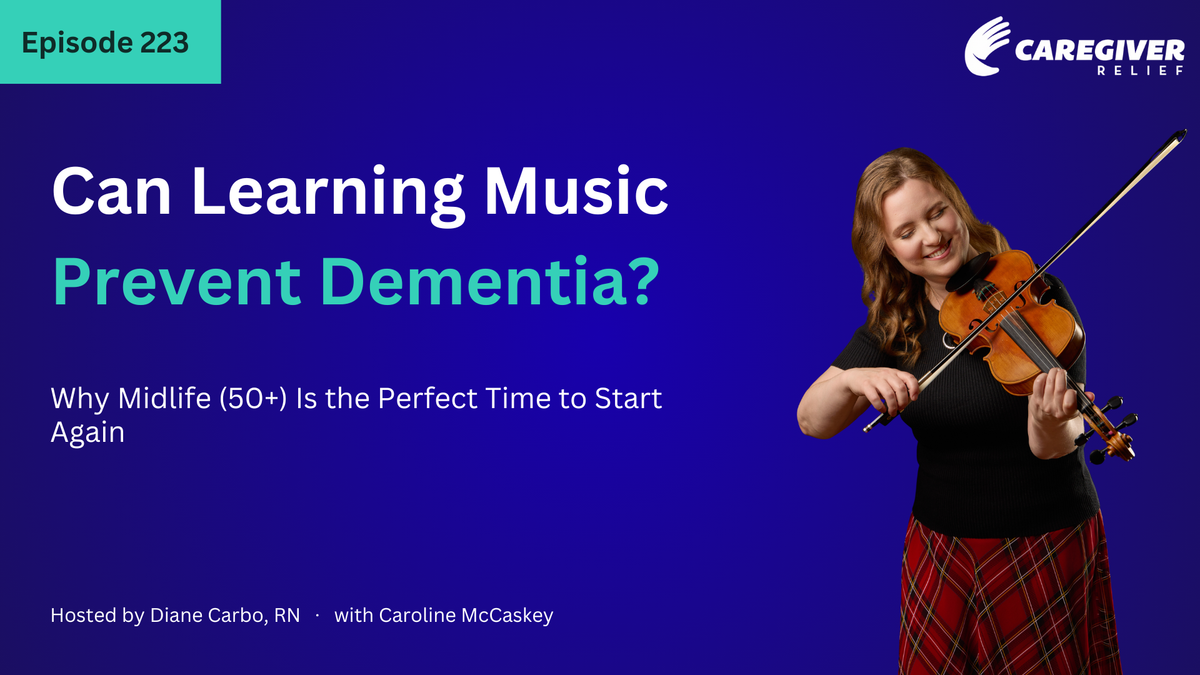
In this episode of the Caregiver Relief Podcast, host Diane Carbo, RN, sits down with award-winning violinist, educator, and director of the San Francisco Scottish Fiddlers, Caroline McCaskey. Together, they bust the myths surrounding adult music education, explore how music alters the brain, and explain why midlife might actually be the perfect time to pick up an instrument.
🧠 What Happens to the Brain When We Learn Music After 50?
For a long time, conventional wisdom suggested that the brain's ability to adapt declined rapidly with age. Science has officially busted that myth. * Boosts Neuroplasticity: Learning to read and physically play music creates new neural pathways and rewires the brain, keeping it elastic.
- Massive Dementia Risk Reduction: Caroline highlights a profound study tracking over 10,000 older adults. It revealed that participants who played an instrument or actively listened to music had a 35% to 39% lower risk of developing dementia compared to those who didn't.
- The Power of "Brain Play": The brain retains information best when it is having fun. Choosing to learn an instrument out of pure desire—rather than childhood obligation—creates the perfect environment for cognitive growth.
🌟 The "Adult Advantage" (Why Kids Don't Have It Better)
Think children learn instruments faster? Not necessarily! Caroline notes that adults possess distinct advantages when picking up a fiddle, cello, or viola later in life:
- Prior Life Experience: Adults easily grasp complex concepts by using relatable analogies (like keeping a violin bow straight by "staying in your lane on the freeway").
- Intrinsic Motivation: You aren't being forced to practice by a parent. You are there because you want to be there, which breeds consistency.
- Physical Adaptations: Unlike rigid, traditional teaching methods, Caroline specializes in modifying ergonomics—adapting bow holds for arthritis, or altering instrument angles for past rotator cuff injuries—proving that your body can do this.
👥 Battling Isolation Through "Terrible" Communities
Beyond brain health, music is a powerful antidote to senior isolation. Whether it's joining a local group like TACO (the Terrible Adult Chamber Orchestra) or participating live online, music brings people together.
Caroline’s program, Alt Strings Academy, operates like a virtual community gym. Students from California to Australia drop into live Zoom office hours, practice together, and even "pass notes" in the chat room. It’s a space where a 60-something student and a 90-year-old retired cardiologist can share a laugh, hold each other accountable, and build deep, cross-generational friendships.
📝 Episode Outline & Key Takeaways
- Introduction: Diane Carbo on the quiet anxieties of aging and the power of protecting your memory.
- Meet Caroline McCaskey: From teaching a middle school teacher's chiropractor at age 12 to pioneering "midlife music" education.
- Busting the Myth: Why 50, 60, and 70 are structurally ideal ages to learn something new.
- Neurological Miracles: The science of neuroplasticity and moving stories of music unlocking memories in catatonic patients and brain tumor survivors.
- Why Learning Alone is Hard: The benefits of community accountability vs. relying solely on YouTube.
- Playing Without Pain: How to adapt musical instruments for arthritis, stiffness, and old physical injuries.
- A Message to the Hesitant: Why you don't need anyone's permission to be creative.
🎸 Ready to Begin Your Music Journey?
You are never too old to surprise your family, find a new passion, or give your brain a defensive shield against cognitive decline.
- Connect with Caroline McCaskey: To explore live online classes for violin, fiddle, viola, or cello, visit altstringsacademy.com.
💡 A Final Reminder from Diane: "To my family caregivers out there, you are the most important part of the caregiving equation. Please learn to be gentle with yourself, practice self-care every day, and consider taking a music lesson... because you are worth it."
Did this episode inspire you to dust off an old instrument or try something new? Let us know in the comments below, and please share this post with a caregiver who needs a reminder that it is never too late!
Podcast Episode Transcript
Diane: Welcome to the Caregiver Relief Podcast. I'm Diane Carbo, a registered nurse, and your host today.
Today we're going to talk about something many people begin to feel in midlife, that quiet thought that shows up somewhere in your 50s or 60s or even your 70s. I know I have friends that are asking about these things now. Did I miss my chance? missed the chance to learn something new, or to try something you've always wanted to do, or to invest in yourself in a meaningful way.
And at the same time, there's another question that starts to surface: What can I do now to protect my brain, my memory, and my future? We hear about staying active, eating well, doing puzzles, but there's something much more powerful that often gets overlooked: learning music. Not just listening, but learning, engaging your brain, your hand, your focus, and your creativity all at once.
But the truth is, your brain is still capable of learning, adapting, and growing well beyond 50, 60, and even 70 years of age. So today, I'm honored to introduce Caroline McCaskey, an award-winning violinist and educator who specializes in helping adults rediscover music through what she calls mid-life music. I love this.
This conversation is about possibility. It's about protecting your brain, and it's about realizing it's not too late. In fact, it may be the perfect time to begin again.
Diane: Caroline, thank you so much for sharing, this information and joining us today. I'm, really excited about this topic.
Caroline: Thank you so much for having me, Diane.
I'm so excited to be here.
Diane: Music is so powerful, and it's definitely one of the things I encourage for dementia prevention, is doing something new and different every day. Going home a different way, than your usual route, using your non-dominant hand instead of your, dominant hand.
There's so many things you can do. And music, I love this. I love being able to learn about music. So can you share your story that what led you to focus on helping, adults, especially those in mid-life, learn music?
Caroline: Absolutely. So, I began playing when I was a kid, as a lot of professional musicians do.
It's, start when they're younger. But I also began teaching when I was very young, when I was, 12, actually. My first, student was, was my orchestra teacher's, my middle school orchestra teacher's chiropractor. He wanted to learn to play the fiddle. And he said, I got the student that plays," and so my very first...
And of course, who's gonna send their, nine-year-old for lessons with a 12-year-old?
Diane: Yeah
Caroline: No one would want that anyway. And I discovered that over the course of adding, more adults and learning more about teaching, of course, as I go, I have degrees in music and just pedagogy training and all of that, and adding more adults to my studio, what I discovered is that, one, adults tend to be very underserved in the music learning space.
There's a lot of like negative associations like, "Oh, you know, you yeah, like you said, you missed your chance.
It's too late," and yeah.
Caroline: Yeah.
Diane: Which is just like absolutely, I wanna totally bust that my sorry.
Diane: I love that. I love that.
Caroline: I wanna totally bust that myth today because it's absolutely not too late. music is for everyone, and, at whatever level you can get to.
And the other thing is that I really developed a heart for the particular challenges that adults face when they're learning music, especially for the first time. Sometimes, I have, adults who played as a kid and then took a big break, you know
Diane: Yeah
Caroline: decades sometimes, and then came back to it, in retirement or in, when their kids were older and didn't need as much, one-on-one help all the time as they do when they're younger. but yeah, the particular concerns of not just bodies who have had a wider variety of experience than children have had, but also, mindset. Sometimes people were told when they were a kid, "Oh, you can't sing," and that really gets into their head, but they always still really wanted to do it.
And so I've just really enjoyed, helping people do things that they didn't think they could do.
Diane: I love that. The qu- I love, let's start with the big question. Is 50, 60, or 70 too late to learn music? Obviously you say no. Explain why not.
Caroline: Oh, yeah, it's absolutely not too late. A few advantages that adults have, one of the major advantages in learning music that adults have is that you have prior life experience.
You know
Diane: Yeah
Caroline: I can use analogies like, oh, you're, to make your bow go straight, it's staying in the lane on the freeway. you're not gonna stop your car on the freeway, pick up your car, and move it over to the next lane. You're gonna adjust gradually, or put your signal on, and you're getting, so you can make those kinds of smoother adjustments with your bow, just as a little technical example.
But even just in, in general, in terms of they have experience learning other things. A lot of times they had to learn things for their career, or they were in school or they, learned how to raise children, or, everybody has just this wide variety of life experience, and that, that all comes to bear when you're learning something new, for better or for worse.
So sometimes we do
Diane: Yeah
Caroline: work through that. yeah, it's, so that's one advantage I think that adults have. And interestingly, I know everybody says, "Oh, children learn so much faster." I just really haven't found that to be the case. Maybe it could be the string players select for, people who are like ready for a challenge,
Diane: Yeah.
Caroline: Because, it's also, it's known that violin is like a pretty difficult thing to do, but it's very worthwhile. But I've found that adults definitely, pick up concepts, in, in general, the pick up concepts quicker. They already understand, things about their bodies and space and, how physics works and stuff.
Like they have that and and they're not as likely to just, throw their violin across the room necessarily. It just depends on the person,
Diane: But it absolutely, it depends on the person.
Caroline: Yeah. Yeah. It's... yeah, I definitely, yeah, I definitely have a student who's a, an adult who does throw things, but it's okay. We love him.
Diane: He's a child adult Or an adult child.
Caroline: I know. I don't... it's a, yeah, there's a, it's a late-in-life autism diagnosis. And yeah.
Diane: Yeah. I get that. I get that. Yeah. Yeah. it's okay. I so get that. 'Cause I get frustrated when I can't do something.
And I think one of the things that, when you decide as an adult that you're going to do something, it's because you wanna do it.
Caroline: Yes.
Diane: You are interested in it. And I think, a lot of kids were forced to take piano lessons.
Caroline: 100%.
Diane: And, they, they stopped as soon as they could because it just wasn't of interest.
And many were very good. And, as they come back, as they get older, they're like, "Wow, I wished I had..." and it's really interesting because it's at those ages when you think, "Oh, I can, do something that will surprise my family. I can do something that is that I wanna do, and I'm gonna work at it."
Because, it's a, it's consistency. And, if you love it, you'll do it.
Caroline: Absolutely. Yeah. And in terms of, not just surprise my family, but sometimes serve as a role model even to go "Look at me, I'm still learning. I'm still" Yes ... "Don't count me out," right?
Diane: Yeah. Yep. Absolutely. I'd be a shameless opportunist, and I would be saying, "I'm gonna learn so I can be the, I can play at parties."
Caroline: Yeah, totally. Yeah, we all have different reasons. Yeah, absolutely. Yes. yeah. And they're all totally valid. I think that's great.
Diane: Absolutely.
Caroline: I think that's so great.
Diane: Absolutely. Yes. Yeah. now, Caroline, you use the term midlife music. Why, what does that mean, and why is that stage of life so important?
Caroline: So to me, this midlife, you know, this section of life, and I'm entering this myself. I'm turning, 39 in a couple days. So I'm
Diane: Oh, you old lady.
Caroline: I know. I know. I think, yeah, all my, all of my Boomer students are like... They're wonderful. they're like my wonderful my village, right? They're the-
Diane: Yeah. Yeah ...
Caroline: The wise women around me, and they're like, "Oh, I remember that. I remember that time," That sort of thing.
But I became interested in this because at this point, I have both the experience of the friends that I grew up with, that maybe we were together in band in high school, but then they quit when they went off to school and stuff like that. and, at this point, we all sort of delayed having kids, so it's...
They're not quite ready to pick that up again. But I do, I do talk to some of my friends going "Oh, you know, all I play these days is 'Baby Shark' for my toddler, but at least I'm playing," "And I wanna"
Diane: Yeah.
Caroline: "put my kid in lessons, and then we can like, do it together," and that sort of thing.
But then the idea of also, this sort of time period where it's, I would call maybe the, the second half of a typical career span.
Diane: Yeah.
Caroline: You might have you're, again, your kids might be older. You might have, you might have a little bit more, earning power maybe to afford like to rent an instrument, which maybe that didn't make as much sense when, when you were earlier in your career.
Or, I mean, you may have even inherited a violin, and you're like, "I don't know what, maybe I'll learn this. I don't know," "Why not give it a try?" and so a lot of times what I've seen is that this is a stage of life where people go, "Okay, maybe what I want matters too.
Diane: Yes.
Caroline: Maybe it does. That's, yeah. And of course it does it's easy to say that from the outside, right? But, you know
Diane: Yeah
Caroline: if you spent all this time going, "Okay, I'm, raising kids," or, "I'm, like, really putting everything into my job," or, you have other, concerns, or, "I'm traveling," or, you know, "I'm..."
Whatever it is that I'm doing, to sort of set my life up. And then maybe in the second half, maybe you're, caring for aging parents, or you are an aging parent yourself. and you not only. You have this balance sometimes of not having being very busy and, not having a lot of time, but also feeling, bored and unfulfilled in a way sometimes.
Diane: Yep. Yep.
Caroline: Not universally, I would say, but, certainly my mom got busier when she retired than she was when she worked. I was like, "Mom, would you ever answer?" And she like, I'm the one going "How come you're not answering your phone?" I love that.
Diane: I have
Caroline: Yeah
Diane: I have friends that say, "I don't know when I had time to fill in my day with work."
I mean how did I work with all the activities I'm doing now?
Caroline: Yeah. Yeah.
Diane: And you know what? In all honesty, I'm 73 and I should be retired, and I'm doing this, to keep me busy.
Caroline: Wonderful. Yeah.
Diane: But I wanna talk about what happens in the brain when we learn music after 50.
Caroline: Yeah. You'll hear people talk about learning music as a, it's a language, right? Music is a
Diane: Yes
Caroline: is a language. it's a, like a function of the brain. and you have this, you have this chance to actually, build and, like, rewire your brain. You have this opportunity.
Diane: 100%.
Caroline: Yeah.
Diane: Yes.
Caroline: And it's really a beautiful thing because I think for a long time we thought that, oh, after a certain point it's just all, all downhill from here, and it's just not. The brain stays much more elastic if you
Diane: Yeah
Caroline: it's just like anything, it grows by use, right?
And it, and it
Diane: Yep
Caroline: and it's, and it is, the, and the more you learn, the better you are at learning, and the more fun learning can be for your brain as you make different connections with things. I
Diane: Yeah. It actually does increase neural pathways, and it does improves neuroplasticity.
And one of the things that I learned about music, in children is it helps them be better math students too.
Caroline: That's true. Yes. Yeah.
Diane: Yeah. And I thought that. And you know what? As I am I used to be really good at math. I really was, and now I'm crap at it because I don't, I don't use it every day.
Caroline: Yeah, you gotta practice.
Diane: So I think yeah, I gotta practice. yes. And I'll sit there and talk, do the timetables in my head and stuff like I did
Caroline: Oh, nice
Diane: as a kid. Just trying to do math. I had a grandmother, she was in her 80s, that could do, you could have a row of five, numbers, five across, and she would have the answer in a matter of minutes.
Like just ready to go. And I'm like, "Oh my gosh, I need to do that." So I try to work on those things. That's why I was real excited about interviewing you, because this is such an important way to, not only, improve yourself, with a, something that you like and a, and create, have a hobby, but it's good for, your mental health, but also your...
It's a way to, it's a dementia prevention, tactic you can use.
Caroline: Absolutely.
Diane: Or if you can't prevent dementia, you can slow the progression of it with these types of activities.
Caroline: Absolutely. In fact, preparing for this interview, I had to brush up. This is something that we all those of us in the music education sphere, we all know this intuitively, but
Diane: Yes
Caroline: I was, looking at the, this is on the, Harvard Health, publishing, site in case anybody wants to dig it up. but there's a study published in the October 2025 issue of the, International Journal of Geriatric Psychiatry. And, they followed, it's a, I think a large health study, like over 10,000 adults ages 70 and older.
And they, they, and it says, participants who did not, it says who did not have dementia at the start of the study underwent annual cognitive tests, so they're tracking this over time. And you know, it's self-reported whether they, listen to music or play an instrument.
And it's in the 39% and 35%, lower risk of developing dementia than those who did who neither listened to music nor played an instrument,
Diane: Yes. Yeah. Yeah.
Caroline: Really, really significant. Those are, I mean, especially in a sample size that big, that's a large number of people.
Diane: Yes.
Caroline: Yeah. It's a and correlation of course, but it's
Diane: Oh, absolutely
Caroline: it's, yeah.
Diane: And, we still don't know so much about the brain. I recently watched a movie about a young man who, had, an argument with his parents, left, it was during the Vietnam War, in my era, and he was upset because his, he was flag burning and stuff.
Anyway, long story short, he leaves his family, only child, and, comes back, 40, 30 years later, 20 years later. And he's in the hospital, he's unkempt, and he looks terrible, and he has a massive brain tumor.
Caroline: Oh.
Diane: And this young man grew up with music, and, they removed a large part of his tumor and, but he had no, interaction with people.
He didn't know, he didn't have any memory, had no short-term memory at all, and very little long-term memory. And just by pure coincidence a nurse, he wasn't sleeping one night, and, put a headset on him, and he got up and he was listening. It was music that her son liked, because they were the same age.
And, he actually started talking and singing, and got up. He had a, he played a trumpet, and he was actually playing music. Now, this is a man who had brain surgery, hasn't had any interaction for, a very long time, and now they're finding this. So the family contacted a music therapist
Caroline: Yeah
Diane: And started introducing different types of music. And oh, my Lord, what they learned about how he could regrow his memory through music was impressive.
Caroline: It's, I mean, So my, in my undergrad, program, I was a composition major, at University of the Pacific. They have an incredible music therapy program.
It's one of the best. And, yeah, some of the stories that I heard, it was just, the way that music will reach someone or can
Diane: Yeah
Caroline: reach someone when nothing else will. Yes. whether that's, dementia, whether it's, you know
Diane: Yeah
Caroline: autism, whether it's, all sorts of things.
Diane: Brain injuries. Brain injuries,
Caroline: Absolutely. Yes, absolutely.
Diane: I tell this story. I had I was working on a senior behavioral health unit, and I had, somebody come in, to play, music, as a therapy session for people. It was on the weekend, and we don't have those types of didn't have those things.
And I asked a friend to come in and lighten things up with music. Anyway, long story short, there was a woman in there, a, an older Black woman who was catatonic. She had been there for, oh, probably a few weeks. Didn't say a word, didn't respond to anything. And I learned from the family, of course, I didn't know about music and memory at that time, and I asked the family what kind of music she liked, and she was a Southern Baptist who loved gospel music.
She was in the choir.
Caroline: Oh, nice.
Diane: Well, they started playing some old gospel music. And I will tell you, she started singing.
Caroline: Oh, yeah.
Diane: It just, oh my God, the family was shocked, and it just, it was just amazing. and that's what, neuroplasticity does, is, when you're learning new things, you're growing new neural pathways, and you're expanding your brain so that, you have better memory and you have, you just have a better experience with so many different things.
And then that leaves you open. One of the things that I see that we're having with seniors is social isolation is very real.
Caroline: Yes.
Diane: And loneliness is very real. And, if people have the ability just to get out to learn music, learn to play an instrument
Caroline: Yeah
Diane: oh, my Lord, what an incredible thing. It opens up their world to new and different experiences and to other people.
Caroline: It absolutely does because you develop a relationship with the teacher you're working with. You develop relationships with the people that you go out and play music with, whether it's, at a jam session, or if that's at church or it's, in a chamber music.
Then they have all sorts of things for adults people don't realize. They have, there's one at, one of our, one of our sort of local things here is, a group called TACO. It's called the, the Terrible Adult Chamber Orchestra.
Diane: I love it. I love it.
Caroline: They just embrace it. They go, "You know what?
Again, music is for everyone, even us."
Diane: Yep. Yep. And chamber music for me is challenging sometimes, so acknowledging they're terrible it makes me wanna go to them.
Caroline: It's a very, it's, yeah, it's a wonderful, it's a, like, the vibe is really good.
Diane: Yes. Yes. Yeah. Yes. Yeah. Now, can you tell me why so many adults struggle when trying to learn on their own, versus taking a class with, taking a class with others or, with, a Just the, instructor?
Caroline: Oh, yeah. I think a lot of factors go into that. I would think the, one of the, one of the more, I would say that applies to more different types of musical situations. because different instruments take different sorts of, things and some feedback to
Diane: Yeah
Caroline: to really learn properly.
But, one I think I would say more, one of the more obvious ones is, sort of like having a gym buddy, you know? You wanna... If other people are expecting you to be in class, you're more likely to go.
Diane: Yes.
Caroline: I think for a lot of us, that's a factor. And then of course you get, you develop friendships with other people.
Say you're taking a, a group ukulele class at the senior center or something like that, you start to you guys like do this for weeks and weeks and weeks. You start to meet each other, and you start to go
"Oh, yeah. Oh, hey, you were telling me about your grandkid.
My grandkid started that same sport," or, whatever. And then
Diane: Yeah
Caroline: suddenly you have friends, that you're, you, that you now have maybe more than one thing in common with, which is really cool.
Diane: Yes.
Caroline: and so being in a community. Now, in my, I have an online, academy, Alt Strings Academy, and people, yeah, people definitely. And so it's all online, and it's all in Zoom, these live classes. And people come to office hours, and they come to our group classes for different levels of string player, and they start to see the same people. They start to see
Diane: Yeah
Caroline: even though they're not, some of them are in Oregon, some of them are in Australia, some of them are in California, some are in like, Canada. And they start to see the same people week after week and month after month, and then they start to have. It's so funny, like sometimes they're just not paying attention, and they're just having like side conversations in the chat.
Which I love.
Diane: like kids in school,
Caroline: Like passing notes.
Yeah. I'm I honestly, I'm thrilled. I was like, "You know what? You just, don't play that scale. Just get back to your friend." that's like
Diane: Yeah.'
Caroline: cause we're all just hanging out and playing music, and so that's a huge motivating factor.
Diane: Yeah.
Caroline: Another thing that makes, people of any age, it makes it difficult to learn an instrument on your own, right?
Diane: Yeah.
Caroline: Is that, you don't have anybody sitting there going, "Okay, you're so close. Just try it this way." Or "Let's break it down into smaller pieces," or these sort of things that, you know, especially if you don't have a background in teaching, that you might not know how to, break things into their smaller sort of component skills. whereas as someone, someone you know, with a teaching background can help you do that. That's one of my favorite things in, to do in office hours, is to take somebody who maybe started learning the violin or the cello, from YouTube or something like that.
They, you know they found an instrument, and they started teaching themselves. And to go "Oh, I've been trying to do, vibrato," this technique where, it wavers the pitch, right? And it's a very characteristic sound of strings and, And then they're like. It turns out that they're like doing something with their left hand that's creating tension or something.
They would never know that. Yeah. But vibrato's never going to work if they're like squeezing it too hard in a certain way. So of course there's they have this goal of wanting to sound this way, but they for me, I can look at that immediately and go, "Let's change the position of your thumb, and also make sure that it's not squeezing against the side of your hand," and things like, I can offer them very specific technical advice very, in very, tiny pieces so that they can both be successful, they can feel like, "Okay, I'm successful at each of these steps," and achieve their goal much more quickly.
Diane: Yeah.
Caroline: So that's one thing that, again, the one thing that I love, like you were spot on when you said, adults, are the, they want, if nobody's dropping them off and going to the grocery store and picking them up afterwards, they're there, they made time in their schedule, they're paying, themselves, not, li Yeah
I only have one adult student whose mom still pays for her lessons. Yeah, her mom's, in her 90s, and she's "Mom, Mom was a, a church organist," and the daughter's, 60-something, and she's "Yeah, my mom, that's what my mom got me for my birthday." I'm like, "I love you guys. Can I be you when I grow up?"
Diane: I love it.
Caroline: I love it. It's so good.
Diane: Yeah.
Caroline: It's so sweet. And then they still have, and the mom is still, I don't know how much organ she plays anymore, but they sing together still.
Diane: Yeah.
Caroline: They, they have this musical connection across generations, which I think is really beautiful.
Diane: I think that's beautiful. And you know what else that's great for, if you have, and, you start having grandchildren or, at around 50 or 60 or 70, depending on how old you were when you got married and had children, and your children had children if they did in today's world.
It's fun to be able to show off to the kids what Grandma or Grandpap is doing. And I think that's fun. The other thing, and you were talking about, I can see me doing a group class, being the one to get in trouble 'cause I'm talking to somebody else. And, but I would. I just admit it, okay?
Caroline: Yeah, absolutely.
Diane: But I'd also be the one to say, "Hey, could we, the person I'm talking with, maybe we should practice together." Yeah. let's get online and practice together. And, and there is a competitive side to me. It's not real strong like some people, but if I would have fun saying, "Let's get together to do this," and then it forces me to be better.
Caroline: Yeah.
Diane: And, and it also gives me a reason to show up, because if I don't show up, I'm disappointing those around me that expect to see me. 'Cause, hey, I'm special.
Caroline: No, for sure.
Diane: and we need to support one another. I'm part of a team.
Caroline: That's right. I know, and I love that too, like when people, stuff comes up, right?
That's one of the reasons I structured my academy the way I did. It's like a gym membership, and people can come to whatever they're, interested in and, you know at their level and stuff like that. but people will still, even though it's like, I'm not taking attendance, right?
They're not getting a grade or anything like that. Yeah. But they'll put in the comments like, "Oh, I'm so sorry," "I had to take, to the dentist or whatever, but I'll see you. I'll watch the replay and I'll see you next week," which I think is so great 'cause, and I always respond to those going, "That's great."
Like, you know, we miss you." I'm not, gonna follow up with everybody 'cause I don't wanna- make somebody feel bad if something came up in their lives, they can't
Diane: Yeah
Caroline: come to class for a couple weeks. that's part of the reason I priced it really affordably too, 'cause if you end up, Retirees sometimes will go on trips for, two or three weeks. They don't have to worry about their job anymore. They can go and then, maybe they're only in class for one week. So I mean, I wanted to still make it worth it, as that way.
Diane: Oh, absolutely
Caroline: Yeah. 'Cause it's just, it's, important that the sort of instruction that adults receive fits their lifestyle. A lot of teachers
Diane: Yeah
Caroline: and for good reason, will require students to come to their weekly private lesson, and and if you if you're not there, you still have to pay for it 'cause you're buying that half hour of that
Diane: Yes Yeah.
Caroline: teacher's time.
Completely appropriate. I yes, that's totally.
Diane: Absolutely.
Caroline: But then, that works great for kids who like really, need that consistent, like adult presence in their lives.
Diane: Yeah.
Caroline: and you do. And I've developed wonderful relationships with my, like child students that I've, started in elementary school, and then they've, gone off and graduated and stayed in my studio the whole time, and that's beautiful.
But that doesn't really work for adults in, in general. if the ones that are retired and they're like, "I'm making this my thing," and "I'm definitely..." Then that's great. That's a really great choice, and I love working with those folks one on one and
Diane: Oh, absolutely
Caroline: face to face. And we develop a really deep relationship.
I get to really know their learning styles and the things that are holding them up, and their goals, and as their goals change and like how do we, change our
Diane: Yeah
Caroline: approach as they do. I love that sort of work. But for a lot of adults, especially if they're, caring for other people, in their family
Diane: Yeah
Caroline: or things like that, that's just, that's not always, you know, it's maybe they, something happened and they can't practice at all or they, whatever, so
Diane: Yeah
Caroline: that doesn't work as quite as well. But having this community aspect around it.
Diane: Yes.
Caroline: And especially for my site seems to be pretty beneficial, particularly for those people who live in the little bit more isolated areas.
They love their
Yeah ...
Caroline: rural home, but
Diane: Yes
Caroline: but they can't, they're not gonna drive, two and a half hours, every week to get to the nearest, violin teacher or something like that. so that's, I find it to be, a really good solution for that. the other reason
Diane: I like the solution, of an online class from my own perspective is I'm in an area where, it's a tourist area, and to drive, in South Carolina
Caroline: Oh, yeah, traffic.
Whoo ... in the middle of the week.
Diane: and traffic can be so horrendous, and getting to some places, can be, challenging. and I've also lived in New York not in New York City
Caroline: Yeah
Diane: but in Hoboken, New Jersey, and it took the tram over or the, I took a boat over. I will tell you, it's just, it takes a long time. So-
Caroline: Yes
Diane: I like being able to be at home, even in my pajamas, do
Caroline: whatever
Yeah, absolutely
Diane: I'm supposed to be doing. Absolutely. and getting it done and still having fun doing it.
Caroline: Yeah. Look, I live in the San Francisco Bay Area. I get the traffic. I completely understand it. Yes. Yes.
Diane: Yes.
Caroline: Yeah. Yes. and about pajamas, I love this one. I'm not gonna, I'm not gonna call out his name, but anybody who's listening who, if any of my students are listening, they're gonna know who I'm talking about.
My oldest student, my older and he's somebody that I see week after week, and we can do that because that's what we meet on, online. but he's 90. He's my oldest student,
Diane: and God bless him.
Caroline: I know. And it, boy, the roasting I get if I'm even one minute late to his lesson.
'Cause he's... we have our lesson at 9:00 AM on Friday mornings, and I'm I'm kinda dragging still at that point.
Diane: Yeah.
Caroline: I'm, like, just pulling up. Maybe I'm still putting my hair in a ponytail and- maybe I answer it at, like, 9:01, and he's, "Oh, I didn't wake you up, did I?"
I'm like, "Oh, man, come on. Give me a break. You've been up for three hours already." Like...
Diane: Caroline, you'll appreciate this. I grew up in the Dark Ages, and when I went to nursing school, we were told if you have an, if you're 15 minutes early for an appoint, an appointment, you're already late.
Caroline: Yeah. Sure. Sure. Well, yes. this particular. This is gonna, totally say who it is if anybody's listening, but yeah, this guy's, like, a, was a
Diane: Yeah
Caroline: he's a retired cardiologist, and he goes, you know
Diane: Oh, there you go. Yeah. That explains it. And, you know, at 90, he has no time to waste.
He wants to get the most out of his life as fast as he can.
Caroline: That's right. And he and I have been working together off and on. I've known him since I was 12 years old. I've been
Diane: Oh, wow.
Caroline: Yeah. the fiddle club that I grew up in, in the San Francisco Scottish Fiddlers, that I'm now recently made the music director of, which is wild.
My 12-year-old self would absolutely not believe you.
Diane: Congratulations. Oh, awesome.
Caroline: But he's my fiddle club grandpa, so Yeah. So I've definitely, I worked with him, in between college and grad school, and then after grad school, and then now, online. And yeah, it's just wonderful watching him.
When he played as a teenager, this guy, and
Diane: Wow ...
Caroline: he took a long break. 'Cause, you're not gonna get a lot of practicing done in med school,
Diane: Not at all.
Caroline: Yeah. It's just not a lot of violin is happening. and he had, has three kids that are adults,
And he I think it was in his 50s, like I think it was maybe late 50s, was like, "Yeah, you know, I wanna do this again," And it's, of course it's been decades at that point, but he goes, "Yeah." Yes. I mean, this type of guy is totally undeterred. He's just "It's good.
We're just gonna do it." And his wife played piano. She was, is a very lovely pianist. and so they got to play music together, and they became this, just this fixture in our musical community, and everybody just looks up to them in just the most beautiful way. And I, Yeah, I have said, I will teach him as long as he wants me to, I've. that's if he wants to keep going, we will keep going. And he's you know that-and he is improving. I got to roast him a back a little bit at his birthday. Did you really? Yeah, his son thanks me for doing that. So he's this kind of joker guy, and he, at his 90th birthday, I said, I introduced myself, I said, "Hi, I'm, so and so's teacher.
Don't worry, he's getting better." And the room was "Aw," and then, he cracked up laughing, and his son cracked up laughing, and everybody relaxed. I was like, "You guys know, yeah." So that was really fun.
Diane: I love the fact that at 90 years old, he's up on a Monday morning ready for a lesson, and he's-
Caroline: Yeah
Diane: and he is excited and, has a love of life
Caroline: Yes
Diane: that, that is impressive. that's just wonderful. It just really is.
Caroline: Yeah. Yeah. This guy's just absolutely incredible. Yeah, and it's beautiful because, as someone, and his wife is also 90, and he's her primary caretaker, as well, and, but he also has this that's wonderful
free clinic that he started nearby, and he's an active Rotarian, and he's always had these goals.
Diane: Oh, my lord
Caroline: Yeah, so he's just, so busy all the time.
Diane: Yeah. Yeah.
Caroline: Yeah, but he's, he always has goals for his, violin is part of his life. He, you know he still plays at events for the, the Rotary Club honored him, recently, sort of lifetime achievement kind of thing, and he's like, "Yeah, I'm gonna play my fiddle for you guys."
"You're a captive audience, so let's go." But he's he's good, He's played for decades. That's the thing people don't realize, if you. I mean, you know, they say life is short, but life is also long, It's
Diane: I was just gonna say in some ways, when you're talking about midlife, 50 and 60, it truly is because people are living to 100 or beyond now, it's just happening, and, it's incredible, and, you can still live a productive life if you choose to. And it's the choices that we make that, gives us the opportunity to grow, and people that who are like your 90-year-old, who are very social and have activities and things to look forward to, can live very long, fulfilled lives.
Caroline: Absolutely.
Diane: I love that.
Caroline: Yeah. it's true. And I think a lot of people when they think about learning something as an adult, there's this stigma that, oh, it's harder when you're an adult. It's harder to learn. Children learn faster. And like I said, I just, I haven't found that to be the case.
The thing that I have noticed though, the people that decide to do something like learn to play a string instrument as adults, they go, okay, they go into it usually with their eyes open. They're like, "This isn't gonna sound beautiful on day one." It might sound okay if you have somebody guiding all of your steps,
Diane: Yeah.
Caroline: But it's not, they're not expecting to sound like, whatever the, sound model they,
Diane: Yeah
Caroline: for whatever reason they wanted to play. so I think I appreciate that. but one thing that I've noticed about adults is just in terms of so intellectually
Diane: Yeah
Caroline: you know, they, like I said, they often learn faster than children because of their life experience. But physically of course, you know, there's a lot of hold ups, sometimes from, stiffness or from
Diane: Yeah
Caroline: past injuries or, disease or something like that could be any, variety of things. And so something that might take a child, 30 times, 30 repetitions to kinda get the hang of it and then they can go home and practice, with an adult it might take them, 50 times.
Diane: Yeah. Yeah.
Caroline: Which is more. That is more, but here's the thing is that they'll go to 40 times. They'll do something 40 times and go, "Ugh, I saw that kid, they didn't, this just isn't for me." And what they don't realize that I realize as a teacher, having seen this over and over again, like You're so close. don't quit
Diane: Yeah
Caroline: when you're that, like you, you just have never been there so you can't see the finish line, but I can, and let me tell you
Diane: Yes
Caroline: you are almost there.
Diane: Yeah. Yes. Well, you know, if you haven't used your fingers for, and hands for a long time, or, and you really have to, build up your muscle strength in your fingers. And there's muscle memory and all of that,
Caroline: Yeah, I have
Diane: Just give yourself a chance.
Caroline: Yes. My philosophy of. So that's another reason that I really enjoy working with adults, because kids, they're, everybody's bodies are different of course, but tastes to
Diane: Yeah
Caroline: kids tend to be flexible and, they bounce, that kind of thing, but
Diane: Yeah
Caroline: you know, so they can, do a lot of what is sort of like traditionally asked of, violin technique, for example.
but for an adult, a lot of times, and arthritis is another one that's a, I forgot to mention, but that's, it's
Diane: Yep
Caroline: very common, inflammation type things. And for me, I really have a heart for making physical adaptations for people
Diane: Yeah
Caroline: to make playing possible.
That's one of my, I can't believe it took the entire interview or this interview so far to, to get to that point, but that's one thing that I just absolutely love. Like I said, it's something about, about for me, like helping people do what they thought they couldn't do.
Diane: Yeah.
Caroline: Because, maybe they saw a picture of, they Googled what's a violin bow hold supposed to look like, how are you supposed to hold it?
And then they, they can't because maybe they were, a physical therapist for their career and their thumb is worn out, to use
Diane: Yeah
Caroline: an example of one of my students. And we can adapt how they hold the bow, or we can adapt, I mean, in some cases, like even switch sides.
Like, I think like a sort of a traditional, teacher might really struggle sometimes with what to do if they're not used to making all these types of adjustments. Oh, you have a rotator cuff injury. Okay, let's point your scroll back farther, or let's do, you know
Diane: Yeah
Caroline: make this adjustment with where it sits, or let's move your thumb, 'cause, maybe you had a, an accident that I wish I didn't know as much about, about
Diane: Yeah, I know.
Caroline: maybe. and then your thumb is like in a different place than it was when you were younger. So let's work with that, not against it. See,
Diane: I love that.
Caroline: Yeah, I love it.
Diane: You're willing to adapt the
Diane: Yeah
Caroline: the equipment to have success, and
Caroline: Yeah
Diane: I know that people don't always get that when they're dealing with somebody older. There's so many people that are teaching music that don't have those skills or that knowledge. So I just love that you're able to do that, and you're willing
Caroline: Thank you
Diane: to do it.
Caroline: Yeah, it's one of, like I said, it's one of my favorite parts of my job is this individual, creative problem-solving. I have actually outlined on my site my philosophy of making adaptations. So there's an open invitation, to anybody that's part of my program to go, like, you know, if I you're in class or something like that, or we're in office hours and we're working together and, I say, "Here, do this." What I'm really saying is try this, and you listen to your body and you go "Okay, I'm not feeling that today." Or maybe "That's just not possible for my body.
I know that for the following reasons." Yeah. Or, "I just discovered that because it hurt." so at that point, then we go, "Okay, now we're gonna think about, like, how to approach this." Yeah. So step one for that is my job where I go, "Okay, here's the end goal of what I want them to do," and know.
And my, this is where, my experience comes into play. Like, I know what goal, what the end goal is. I know how it's like. I don't wanna say normally, like typically, like most often done in the, majority of cases. and knowing why, because that why part, and that's something that is really difficult to find on your own online, especially if you don't really know what you're looking for and you're trying to teach yourself.
Diane: Yeah.
Caroline: Then, 'cause you might end up adapting something yourself, and it will really hold you back later, or it might hurt in, a different part of your body. So for me, having a knowledge of ergonomics, of playing the instruments, is really important. So the step one is me knowing okay, here's like a, an entire, outline of the problem.
And then step two is going, okay, if what's missing? is it, lack of flexibility? Is it lack of strength? if it's, if we've tried the positioning that I've, recommendedexcuse me, will a different position, work? That sort of thing. So like I said, that's honestly, that's one of my favorite parts of my job.
Which, like I said, you really, if you're learning an instrument, you really kinda almost can't, unless you have a physical therapy background or something like that, which you actually might Occupational therapy background.
Diane: Occupational therapist, yeah.
Caroline: Yeah. Yeah. You, yes, in the case of a hand for, yeah, for sure.
you know, you might- that's what I
Diane: was thinking about with you.
Yeah. I'm thinking, oh, she could've been an occupational therapist too.
Caroline: One of my first interviews on my, I have interviews with, my teachers and other, professionals. I have a whole course that's prerecorded called Playing Without Pain.
And that's one of the very first interviews I did with that is a friend of ours from Fiddle Club, was an occupational therapist for her career.
Diane: Wow.
Caroline And she gave a whole presentation on treating and preventing musician injuries. I'm like, that's great. We need that, It's goes beyond you know That's beautiful technique and advice. Yeah. So then the after... Step, so step two is, like, how close can I get with, like, you know, if there's stretching, how, you know is that something we can develop a little bit more over time? How close can we get in terms of, like, strengthening? Whatever it is that we need to do for that particular thing.
Then at that point we go, "Okay, cool. We did as much as we can here. Now we change-" we're not necessarily moving the goalposts of that goal
Diane: Yeah.
Caroline: but we go, "Okay, cool. Like, how is it... What is this? What could this look like for you and your body?"
Diane: Yes. Yes.
Caroline: And I just love that. That's something that I get to do with adults that, kids don't have the patience for that, and they also mostly don't need it, unless they have you know, underlying other issues.
Diane: And you know what, I will say that adults that really wanna do this, they'll figure out a way. And, if they have that love and that desire to learn. And it's so important because not only are they creating neural, new neural pathways and improving, their neuroplasticity, they are improving their physical strength and muscles that needed to play, which, can actually, with arthritis, can decrease pain with on- ongoing exercise and use.
Caroline: Yes, absolutely.
Diane: All my life I've had to tell seniors, and now I am one, "Oh, it's arthritis. You gotta get up and move," And I've had men go and I've been sworn at and saying, "Oh, you don't know what it's like." Now I do. Yeah. And I still make myself. I'm thinking, "I've gotta pay penance." The Catholic girl in me says "Oh, got a time to do penance for all the people I pushed to do things."
Caroline: Yes.
Diane: But I do learn that once I start moving, I feel better.
Caroline: Yeah. Yeah, absolutely.
Diane: And just. And I know so many people struggle with their hands or their shoulders or whatever,
Caroline: Yeah. It's definitely a use it or lose it. Yeah, for sure.
Diane: Absolutely.
Caroline: Yeah.
Diane: Absolutely.
Caroline: Range of motion or but yeah.
Diane: Yes.
Caroline: it's really
Diane: Yes ...
Caroline: it's really great for that.
Diane: Absolutely
Caroline: and it's a two-sided, a full, full body or at least from the core up type of activity to
Diane: Yeah. Yeah Absolutely
Caroline: most of us don't raise our arms above our heads
Diane: Yep
Caroline: enough. that kind of thing. Yeah. And playing a violin, it's not above your head. if you're playing, if you're teaching yourself and you're playing it above your head, okay, yeah, maybe let's...
Come talk to me. But yeah, but it definitely. I mean, you might not in regular life hold your arms up for minutes or, you know-
Diane: Yes
Caroline: 10, 10 minutes or 20 minutes at a time.
Diane: Yeah.
Caroline: It's really good for you, and it causes you to, take in oxygen 'cause your brain and body are working together, and it's just really good for you in, like, all the ways that things should be good for you.
Diane: And you're making beautiful music eventually too.
Caroline: And yeah. And we haven't talked about that exactly right on the head, but the idea of, learning takes place best when you, when the brain is playing. And it doesn't need to be like playing music, but, think about a child who's forced to you were talking about the times tables earlier.
If you're sit down
Diane: Yeah
Caroline: for, you will not get up from this table until you know your entire, 12 times tables. they're gonna be You must
Diane: have lived in my house.
Caroline: They could, they may be frustrated or bored, or maybe they, if the, a more
Diane: Yeah
Caroline: like, you know, ingenious child might figure out a way to make it fun, even if they, But then, but if they're stressed or "I'm gonna, I'm gonna, do something bad to you every time you don't do this," it's, we don't learn under those conditions.
Diane: No. If it's Absolutely do not. Yeah. No.
Caroline: But if it's something that you're, the flip side of that coin, is, when the brain is at play, when it's having fun, it's making connections, it's like that's when we really learn. That's when we are really able to retain what we've learned, and that's where it makes the biggest difference in the, truly in the structure of your brain. so that's, yeah, that's one thing that I love about music is because, especially teaching adults, everybody who's there wants to be.
And so they all have that advantage. It's beautiful. I love it
Diane: Yes. After watching that movie, when I saw they put, turn music on, and this young man would become alive. And he was back in the '70s with the Grateful Dead, and, and all of that, and it was very interesting because when they turned it off, he went blank again, and didn't have communications.
And it's just over a matter of time where they worked with him that he started interacting on a regular basis, because they used music. And this is the interesting part. Old music that he loved, he could recall long-term memory.
Caroline: Yes.
Diane: But they learned to teach him new memory, to create new memories by learning new music and applying it.
So I thought that was such a powerful thing.
Caroline: Yeah, the brain is elastic. It absolutely
Diane: Yes
Caroline: even after an injury,
Diane: Absolutely Yes. Even after years of, this was a massive brain tumor this young man had, and he had absolutely. He was living on the streets, homeless. He wasn't a druggie. for over 20 years, and it probably is because of this brain tumor, and his parents had lost track of him.
So you know, it's just music is powerful. And, what would you say to someone listening who always wanted to learn, but keeps putting it off?
Caroline: Oh, I would say you are my favorite kind of adult musician. Because you're, you want. That sustained
Diane: Yeah
Caroline: like, wanting of
Diane: Yeah
Caroline: of doing it is, it means that you're, when you do start, you're not gonna give up on the first try.
Diane: Yeah.
Caroline: And maybe you're putting, it off for, you know, time reasons or money reasons, or maybe it's even just self-confidence reasons.
Diane: You know what? The self-confidence, I can see. I know so many people that won't even go to an art, one of those where you paint a, paint something
Caroline: Yeah
Diane: because they were told they don't have any talent. Well- first of all, that doesn't take talent, No. But, go and have fun. Be creative. And so I love what you're doing and encouraging people. Caroline, how do people find you?
Caroline: If they wanna work with me in Alt Strings Academy, they can go to altstringsacademy.com.
That's A-L-T strings academy.com.
Diane: Great. And I want my listeners to know that there will be, a permanent page made with links to Caroline. I even put a video up of her playing her fiddle
Caroline: Oh
Diane: because I came across your video on your site, and I thought, "That is just adorable."
Caroline: Oh, thank you.
Diane: And it's, and, it was so upbeat, and I thought, this is great."
So I wanted to share that with my listeners as well. So thank you so much for sharing your knowledge, and I enjoyed this so much because, topics are difficult at times, but dementia prevention and learning something new and different is so important, and, I love the way you approach music with, your students.
Caroline: Thank you so much. I just had one more thing that I wanted to add, to what I would say to somebody
Diane: Absolutely
Caroline: who's always wanted to play, or maybe they're just hearing us talk now and decided, "Oh Yes ... this is, maybe this is a cool thing I could do." whether it's music or, or visual art or dance or theater or whatever, your poetry, whatever it is, scrapbooking, that you the creative thing that you find and it brings
Diane: Yes .
Caroline: you joy, I just want you to know that you don't need anybody's permission to do that.
Diane: Amen. That's true.
Caroline: Yes. Yeah.
Diane: I think one of the things that's good about as we get older, I don't care if I make a fool of myself.
Caroline: Yeah
Diane: people tell me I'm invisible, So they're really not seeing me when I'm doing it.
Caroline: That's great.
Diane: And, first of all, you know, if I wanna be seen, I'll become a glitter goddess, and you'll know I'm there. But I think also that you get to an age where if you want it, you just say, "Well, I'm damn well gonna do it."
Caroline: Yes, you do.
Diane: And I don't care,
Caroline: Yeah.
Diane: And that's a good place to be, because if we live our lives for, what other people think of us, we're in trouble.
Caroline: That's right. Amen. That,
Diane: yeah. And at 73 years old, it took me a long time to get there.
Caroline: Yeah. I
Diane: As a people pleaser and it's not a good place.
So I love being able to be strong enough to make decisions and choices and say, "Well, I can do it if I fail." I always look at failure as, I have another step. I've got another step, that I can do something better or different, and I'll be successful.
Caroline: Absolutely. Yeah. That's one of my favorite.
Then you're on my list now of wonderful role models. But that's one of my favorite things about working with people, in their 60s, 70s, 80s, or even 90- is that I have so many, I'm just so fortunate that I have, like I said, I'm turning 39 soon. I have so many incredible role models, so many wonderful examples of what aging can be like. This
Diane: Yeah
Caroline: this group of, this community that we've built, that we're building is, it's just, it's so good for me personally. I know it's good for the members too 'cause they keep coming back. And they're making friends. But you know, as a millennial, I have- this beautiful view ahead of oh my, you know, my senior years could look like this, or they could look like that, or it could look like this other thing. And there are so many ways to live life and I just, I'm so blessed to get to see so many cool people that are doing their thing.
Diane: Well, the boomers are making it happen and they're
Caroline: Absolutely
Diane: gonna make it easier for you
Caroline: and I wish I could say for, speak for my whole generation that we all appreciate it, but I certainly appreciate it. I certainly appreciate it. Boomers are some of my favorite people, and yeah. You guys are great.
Diane: Yeah.
Caroline: Keep, keep on, keep on keeping on.
Diane: Yeah, exactly. Oh, I've enjoyed this, Caroline. Me too. One more time, tell my listeners how to find you.
Caroline: Thank you so much. My program, if you wanted to start or continue playing, violin, fiddle, viola, or cello, it's Alt Strings Academy. A-L-T Strings, like a stringed instrument, academy.com.
Diane: Great. And to my family caregivers out there, you are the most important part of the caregiving equation.
Without you, it all falls apart. So please learn to be gentle with yourself, practice self-care every day, and consider taking a music lesson with Caroline.
Caroline: Yeah.
Diane: Because you are worth it.
Caring for a loved one can be overwhelming — but you're not alone. If you have questions, big or small, our expert team is here to help.
👉 Click here to Ask the Expert
Our Resource section can help you find the information and tools that you need. We have courses, videos, checklists, guidebooks, cheat sheets, how-to guides and more.
You can get started by clicking on the link below. We know that taking care of a loved one is hard work, but with our help you can get the support that you need.
Click here to go to Resource Section now!