Reverse Heart Disease Naturally: Stress, Blood Sugar & Aging for Seniors with Dr. Melanie Icard - Episode 225
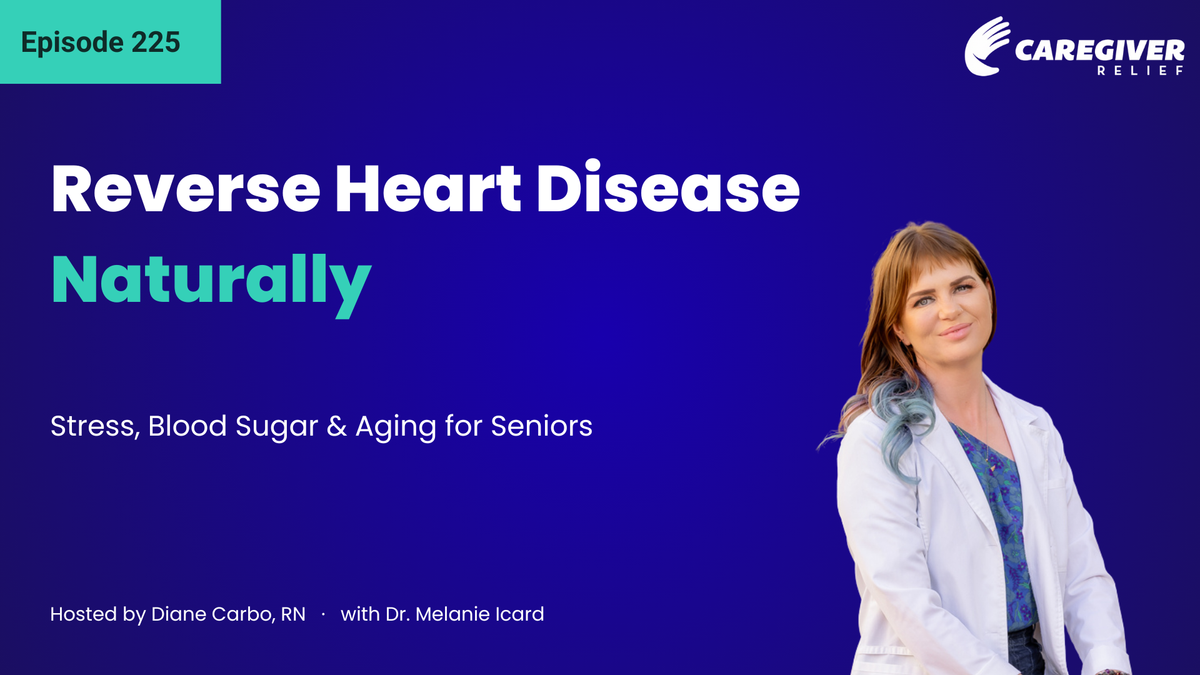
In this eye-opening episode of the Caregiver Relief Podcast, host Diane Carbo, RN, sits down with Dr. Melanie Icard (Dr. Mel), a naturopathic doctor with over a decade of experience in integrative cardiovascular health and metabolic optimization.
If you’ve been told that heart health is solely about managing your cholesterol, this episode will completely change how you look at your body. Dr. Mel breaks down how survival mode, internalized stress, gut inflammation, and blood sugar spikes secretly age our hearts—and more importantly, how we can naturally reverse the damage.
🚀 Key Takeaways from the Episode
- The Cholesterol Misconception: Over 50% of fatal heart attacks occur in people with normal cholesterol levels. Lowering cholesterol alone often provides a false sense of security while underlying arterial damage continues.
- The "Stoic" Stress Effect: You don’t have to be yelling or in an active crisis to experience chronic stress. Internalizing an endless to-do list or rushing through life pumps out cortisol and adrenaline, clamping down blood vessels and raising blood pressure.
- The Gut-Heart Connection: Systemic inflammation often starts in a "leaky" gut. Clearing out this inflammation through regular detoxification can radically stabilize blood pressure, blood sugar, and even your mood.
- Reversing Plaque is Possible: Dr. Mel shares inspiring real-world success stories of seniors in their 70s completely clearing arterial plaque, restoring weak heart pumping strength (ejection fraction), and safely weaning off multiple medications.
📋 Episode Outline & Breakdown
Introduction & The Caregiver Stress Crisis
Diane highlights the heartbreaking statistic regarding caregiver mortality rates and introduces Dr. Mel, creator of the Biohacked Heart Blueprint.
Debunking the Cholesterol Myth
Why traditional focus on statins and cholesterol-lowering drugs might be missing the root causes of cardiovascular events.
How Chronic Stress Physical Damages Your Arteries
A deep dive into the physiology of fight-or-flight: how constant adrenaline restricts oxygen-rich blood flow, and how cortisol triggers spikes in glucose without you even eating a bite.
The Changing Healthcare System & Caregiver Burden
Diane and Dr. Mel discuss the heavy operational demands being placed on unpaid family caregivers due to shifts in medical insurance and the lack of traditional home nursing support.
The Gut Health and Inflammation Connection
Why gut health is a "system of systems" that drives systemic inflammation, anxiety, and heart disease—and the value of an annual herbal and nutritional detox.
Dr. Mel’s Perfect Heart-Healthy Morning Routine
A step-by-step breakdown of how to gamify your morning to lower stress hormones before reaching for your phone or your coffee.
Mindset, Identity, and the Science of Sleep
Why claiming your diagnosis as an identity can halt healing, and how poor sleep (or relying on alcohol/marijuana to sleep) creates oxidative damage in blood vessels.
Metabolic Deep Dives & The "Fat-Fear" History Lesson
Dr. Mel shares her personal journey of being pre-diabetic despite a "healthy" lifestyle. Diane and Dr. Mel track how the 1950s government food pyramid replaced dietary fats with sugar, sparking an epidemic of insulin resistance.
Hope After 50: Miraculous Transformations
Real stories of 70-year-old patients who reversed 70% arterial plaque to 0%, upgraded their heart's pumping capacity, and reclaimed an active retirement.
🌅 Dr. Mel's Heart-Healthy Morning Routine
Want to escape survival mode? Try starting your day with Dr. Mel's recommended morning ritual:
Hydrate First: Wake up and immediately drink a large glass of water.Get Outside & Ground: Go outside—barefoot if you can—to catch the morning sun.Practice Gratitude: Spend 10 minutes listening to nature, doing a light stretch, and naming three things you are truly grateful for.Earn Your Fuel: Only after this grounding period should you check your phone or pour your morning coffee or tea.
🎧 Listen to the Full Episode Now!
Don't let chronic stress quietly dictate your health or the health of those you love. Empower yourself with actionable, natural strategies to reverse aging and protect your heart.

🔗 Connect and Learn More:
- Find Dr. Mel: Learn about live webinars, retreats, and the Biohacked Heart Blueprint at drmelanieicard.com or subscribe to her YouTube channel @ItsDrMel.
- Facebook: Dr. Mel Holistic
- Instagram: drmelholistic
- Titok: Dr. Mel Holistic

Be gentle with yourself, practice self-care daily, and remember: you are the most important part of the caregiving equation!
Podcast Episode Transcript
Diane: Welcome to the Caregiver Relief Podcast. I'm your host, Diane Carbo, RN. And if you're a caregiver, you already know what it feels like to live under constant pressure, making decisions, managing care, and often putting your own health last. But what if that stress is doing more than just making you tired?
What if it's quietly impacting your heart? Today, we're diving into a topic that every caregiver and senior out there needs to hear. I'm joined today by Dr. Melanie Icard, known as Dr. Mel, a naturopathic doctor with over 10 years experience in integrative cardiovascular health, meta- metabolic optimization, and mind-body medicine.
She is the creator of the Biohacked Heart Blueprint, a program designed to help people reverse cardiovascular and metabolic aging naturally. Dr. Mel brings a fresh and powerful perspective on heart health, one that looks beyond cholesterol and focuses on stress, blood sugar, and inflammation, and how we live our daily lives.
Diane: Dr. Mel, welcome to my show.
Melanie: Thanks for having me.
Diane: I'm very excited about this topic because, chronic stress, I don't know if you're aware of this or not, but 63% of our family caregivers become seriously ill or die before the person they're caring for. And it's due to the terrible chronic stress. So for those, my listeners out there, what is the biggest misconception about heart disease that you see today?
Melanie: We'll just start with the obvious one. It's very cholesterol-lowering focused. And, what I've found in, is that it doesn't, lowering the cholesterol doesn't give the r- the desired results, which is less plaque, right? Which is less risk
Diane: Yes
Melanie: of major event. And my big problem with it is that it gives us false peace of mind, 'cause we think that we're doing something that is going to be protecting our heart or ha from having a stroke, protecting our brain. Meanwhile, all the damage is still happening and we could've been repairing that. That's, that, that's the worst part I think, 'cause, you think you're doing the right thing, and then,over 50% of fatal heart attacks have normal cholesterol.
Diane: Yeah. One of the things, that I see as a nurse is the side effects of statins
Melanie: True
Diane: can be horrific. And, some of the ones that you develop if you're taking a statin is, they don't go away, and, that's really hard. So I really look for natural ways or alternative ways to keep the cholesterol and have a healthier heart.
Melanie: Yes.
Diane: Now, you talk about stress as a root cause. How exactly does chronic stress impact the heart and cardiovascular system?
Melanie: Yeah. So basically what's become apparent to me is that all of us are, have been living in survival mode
Diane: Yeah
Melanie: unconsciously for decades.
Diane: Yeah.
Melanie: Like you're say, Like, when I bring it up, everyone goes, "Yeah, that hits," right?
Diane: Oh, it hits home really. Yeah, absolutely.
Melanie: And you don't have to be yelling at people or having a life crisis to be in chronic stress. That's the thing, that people go, "Oh, I'm not stressed," and it's th- that's cute. You're so committed to, like, being okay. I love that. But it still happens. So with the cardiac people, you know you have that cartoon cardiac guy with, the hot head and there are those
Diane: Yes
Melanie: really reactive kind of like the anger's right at the surface kind of
They're usually squishy on the inside. But there's also the s- what I call the stoics. The everything's fine, I'm fine, but it's still
Diane: Oh, yes
Melanie: that stress is getting internalized in the, on the blood pressure.
Diane: That's usually the males.
Melanie: Yeah. Yeah. And I love that you're not yelling at people, but that's not enough,
Diane: Yeah. Yes.
Melanie: Yes. So it's like a never-ending to-do list.
Diane: Yeah.
Melanie: That's chronic stress. always being in a rush to hit the next thing, that's chronic stress, like not liking your work environment, that's chronic stress. like simple little things, And it's... I'm not trying to give you, despair, I'm just saying, it's not something that we can ignore because it's a... It's almost at, at the top of the flow, right? Stress
Melanie: Yeah
Diane: and emotions, and there's grief, which is just bigger stress and emotions, right?
Diane: Yes.
Melanie: So a lot of times, you know, people's numbers and everything will get worse, after, a real-life crisis like losing their mother or something like that, and we need to reset.
And then of course in modern times there's toxins. And we can't really avoid them. we can do some things. We can stop using the microwave and plastic containers and stuff like that. But in general, you just have to know that you're gonna have to be ongoing detoxing. Like detoxing isn't, just once a every couple years thing anymore.
It's got to, you've got to find an efficient detox and just kinda like you wouldn't clean your house once a year, it would be a mess.
Diane: That's right.
Melanie: That's right. And this is like your best house.
Diane: You know what? That's a good analogy because, we take for granted our good health.
We take for granted the abuse that our body, we create in our bodies, and we shouldn't because over time it dramatically impacts us, as I'm seeing from decades of working with caregivers and seniors. And it's hard. And one of the things we, I'm seeing in our culture is everybody's stressed to the max all the time.
They're... they're so unhappy. They're, nurses in particular are getting beaten up by patients, literally, physically sometimes, if not being demanding and overbearing and not being the nurses need kindness, too. But the management, is always beating up. So everybody's got numbers they have to make in other, jobs like marketing and sales.
And, I was recently, sitting outside of a car dealership waiting for some work to be done, and inside was this team of people. They were for cellular phones or something. And the manager was doing this, a team meeting. and Dr. Mel, I almost died. I thought, I wanted to go in there and go, "Young man, behave yourself."
This young man is the manager of all these poor salespeople, and he was screaming at them Oh, no ... that was going to motivate them to do their job. I would've just... I'm the kind of person, I would've said, "Oh, I can't deal with this. I have to go." But that's what they do. They put people under a tremendous amount of stress.
And, so I can see what's happening in our world. That's why I was so excited to talk with you, about things because, we, we just discussed, many people are told cholesterol is the main issue. But how should we look at that differently?
Melanie: Yeah, so if you go through the flow after the stress and emotions your body's gonna pump out cortisol and adrenaline, right?
Diane: Yeah.
Melanie: Which like if we go back to say we're prehistoric or whatever if there is a situation, we need that extra power to get out of there or fight, right? That's where that fight or flight comes in. So your body's sensing the stress, and it's trying to give you the fuel you need, but we're always...
We get stuck there. We don't, we don't shake it off like the gazelle once they get away from the lion, we're still chugging along. It's stress. And so the adrenaline's gonna clamp down the vessels.
Adrenaline, maybe that's fine if you're bungee jumping for 30 seconds, right?
But like 30 years, different story, right? Yeah. And so that's gonna raise your blood pressure, right? 'Cause if these tubes are clamped down, it's gonna raise the blood pressure, and then those organs aren't getting that good oxygenated blood that they want, and then they're getting a little sad, right?
Meanwhile, the cortisol is telling the body like, "Let's pump out some glucose," 'cause that's some great fuel for these muscles. So if we gotta run or if we gotta like book it or fight, let's have some power in these muscles, right? So now our glucose has gone up, but we haven't put any food in our mouth yet.
And then I don't know about you, but when I'm stressed, I make the worst food decisions.
Diane: I'm guilty of that. Always have been, And one of the things I, I know about caregivers is, they're eating on the run all the time. They're putting bad choice foods in their house, high sugary things, eating.
They're even taking energy drinks, which I just feel bad 'cause that is not a solution.
Melanie: And it will raise your cortisol.
Diane: Yes. Thank you. You know what? I attribute this... I, here's an something that I experienced as a young woman. I used to love, roller coasters, and I loved the feel, the adrenaline rush.
And after I had kids, we were at the park, and I was like Oh my gosh, I don't enjoy roller coasters anymore because that feeling that I had, I was th- that you get with that rush, was something I was experiencing every day.
Melanie: Yes.
Diane: And I made that connection.
Melanie: I think I've noticed that. like anything that's intense- I'm just not into it. I'm like, "Life's been intense for over 40 years."
Diane: Yes.
Melanie: I'm looking for things that make me chillax, okay? Yes. I don't need this ice bath. I can take a cool shower at the end. I don't need like I've had enough intensity. yeah. Yeah.
Diane: Oh, yeah. and one of the things I noticed personally for me in nursing, as managed care grew and, our healthcare system changed, nursing became some it was no longer about caring for people and educating them, my patients.
I wasn't able to do that. I had there was, there were everything was given to the aides so that we would do medications and charting and all this unnecessary stuff. and it took us away, the best part of nursing away from us. And nursing became so stressful, I would get up in the m- I'd be off for a few days, and the day before I'd have to go back to the unit, I'd get physically ill.
My stomach, my body was telling me, "Hey, you need to look at an alternative setting," which I absolutely did. And that was in my late 20s, early 30s. And now I'm 73. And I did, I got, I did a lot of outside hospital nursing, because I wanted to Relax be healthier and not live in that chronic sense of stress.
Melanie: Yeah. You know what I noticed? 'Cause I worked in the... I was a respiratory therapist in the ICU for 11 years, so I worked with a lot of nurses. God bless you.
Diane: Yep.
Melanie: Yeah. and that was intense too, right? but what I noticed is most of the Nurses they would, it was like a 10-year window, and then it was like they had to, then they had to
Diane: Yeah
Melanie: find some kind of exit strategy.
Diane: Yeah.
Melanie: They went to NP school. They went to a family practice.
Diane: Yeah.
Melanie: They went
Diane: Yep
Melanie: everyone liked going to PACU. PACU was like the first step out,
Diane: You know what? I have to tell you, nurses are leaving the profession in two years.
Melanie: Oh, now it's two years.
Diane: Two, it's real... And it is because the 12-hour shifts and the amount, as In fact, what's happening is that the nurses are being expected to do more with less support. And they're getting unsafe,numbers of patients they're providing care for.
Melanie: Yeah.
Diane: And, one of the things I'm learning about the younger nurses is they don't want to do that, so they're leaving.
Melanie: Yeah.
Diane: You know, we really don't have a shortage of nurses. We just have a shortage of nurses who will work under those stressful god-awful conditions. But this is, we're... It's not just nursing. Our, my family caregivers are being expected to take more and more responsibility on that was once done by healthcare providers.
Melanie: Okay.
Diane: And the amount of stress they are experiencing is off the charts.
Melanie: You know what, Diane? I just remember. So my ex-boyfriend, he's Israeli. He's been in Israel 'cause his father's dying, and I'm just blown away because it's like it's. They must have a totally different system there, 'cause I'm like, do they not have a nurse that comes?
Do they not have, an assisted place?" 'Cause it's like he has to give him IVs, four times a day. And they had to train him how to do this, and it's every other day they're going back to the hospital. And it's. I gotta. I might wanna connect him with you too, but it's like they, they put it all on, the family, I guess.
Well
Diane: And I was like, "Wow" ... welcome to reality, Dr. Mel. This is happening in our culture right now.
Melanie: Is it? I'm just like
Diane: Our medical delivery system is now at a point where everything is placed on the uneducated, untrained, and already stressed out family caregiver. I don't know if you know this, but
Melanie: didn't know that
Diane: they actually provide... There's 63 million family caregivers in the country right now. It's gonna double in the next two years. And they already provide $1.1 trillion in unpaid care. They are actually the largest, pillar of the long-term care industry. Wow. And they are not res- represented, they are not provide.
They are invisible. They are, our biggest home workforce in the, in our country. And the things you're saying that's going on in Israel right now is also here.
Melanie: Yeah, 'cause he's not sleeping. I don't know how he's gonna and it's been months.
Diane: Yes. In fact, we are moving to hospital in the home.
Melanie: That's what it sounds like over there.
Diane: It's absolutely what he's dealing with. we already I've done home IV infusions, and it's already being done here. But, it is going and you, but you have the company I worked for, we went out, we trained the parent, family, we followed up with them.
We did that stuff, but there's a piece missing. In fact, here's another thing. Medicare reimbursement has taken away the nursing visits for home care.
Melanie: Really?
Diane: They, yeah, they don't reimburse, so you're not getting... That's such an important piece.
Melanie: That stuff never makes sense.
Diane: It doesn't make sense.
And they'll have OT or PT open the case. Usually it's PT that opens the case now, and the nursing, the education, piece, or the support for the family and the, the, and the care recipient is just not there. So that's why I'm was really excited to talk with you because there is such stress going to, to...
It is here, and it's only going to get worse because we have no one to take care of our elderly. Every generation before since the boomers has not replaced themselves in numbers. So all the low birthrates are... We're at dangerous low birthrates for, of the youngest of our generation. And the youth are our tax base.
The youth are our workforce. And we have no one not only to provide care for our elderly, it's gonna go on for every single generation. And my concern is not just for the family caregiver, but who's gonna take care of the solo ager or the childless couple?
Melanie: Right
Diane: So this is stress. I'd like to talk because I'm very interested in this.
I wanna I've read you mentioned the gut health connection.
Melanie: Oh, yeah.
Diane: How does the gut health influence cardiovascular disease?
Melanie: Oh, yeah, 'cause it sounds weird, right? if the gut and my health. So this is a whole system, right?
Diane: Yes.
Melanie: It's a system of systems, so that's part of the issues that we've tried to, do these octopus legs.
But, everything's influencing everything else.
Diane: Yeah.
Melanie: It's like a spiderweb almost of spirals, right? So all of our guts more or less are just inflamed. it's, the different chemicals they put in the food. We could go around and round, but there's multiple reasons.
Everyone's gut is inflamed. And that gets leaky, and so instead of the cells being butted up like, a nice,
Diane: Yeah
Melanie: then, they're fried, and so things are leaking out, too, into the system causing systemic inflammation, right? So this can affect your blood pressure, your vessels.
It, innumerous ways this can affect you, right? So everybody that's alive should work on their gut at least once a year, right? And that's gonna, that's gonna heal your everything basically, but I always have people do an herbal detox first.
It's amazing. I got this formula where it's all wins, right?
So we always start with that, 'cause you're like, "Wow, my energy's better. Wow, my bowel movements"
Diane: Yeah
Melanie: "are better. Wow, my blood pressure's better," right?
Diane: Yep.
Melanie: Because then I'm gonna ask you to do more, right? So I need you to feel good and get the wins, right? So because then you have to do the nutritional detox.
You have to get the list of all the things I'm gonna need you to take out for at least two weeks, and there's at least one you're gonna kinda cry about, right? But you're gonna be bought in 'cause you're getting these wins. Like you probably lost five pounds.
Diane: Exactly. Yeah. We are seeing an over-prescribing culture for stomach medications.
I know. Omeprazole, Nexium. I see. And what we're finding is that there are some severe long-term consequences of being on these medications.
Melanie: Oh, yeah.
Diane: And, I can tell you right now that I was on, Omeprazole, it was Nexium or Prilosec, for 30 years.
Melanie: Oh, yeah.
Diane: And my son worked at Mass General Eye and Ear and he was a nurse anesthetist there, and he worked with a world-renowned, ENT doc who, created some products to help with this, 'cause he was seeing an increase in esophageal cancers.
And, you know, I have polyps. Now you can have a million polyps, but you've gotta stop taking those medications. The thing is they have rebound effect and if you've taken it so long, it's like you're gonna have terrible acid. So there are ways, and I'm in this process now of I'm, I've done the detox, I'm trying, there is a really strong connection to the gut, heart, and I've learned about it just recently.
I'm also learning about, the role inflammation plays in aging and heart disease. can you talk about that a little bit?
Melanie: Yeah, and I just wanna say if you're not doing it, the best thing for acid reflux is taking digestive enzymes
Diane: Yes ...
Melanie: with your meals. Yeah.
Diane: Yeah,
Melanie: and then there's also a product, that's like a chewable, natural one, that kinda helps symptomatically while you're going through that period.
so I'll let you know, I mean
Diane: Oh, yeah, please yeah I'd like to learn about that.
Melanie: Yeah, 'cause those are some simple things. So what was your question again? I'm sorry, I was
Diane: oh, no, that's fine. I just wanna learn to explain to my listeners what the role inflammation plays in aging and heart disease, and, how maybe, and then start talking about your, platform that helps you
Melanie: Yes.
Approach this. So think about it, right? 'Cause what do you think about when something's inflamed? Let's talk about like maybe, or something we can see like on our skin.
Diane: Yeah.
Melanie: It's red.
Diane: Yeah.
Melanie: It's swollen. It's more puffy. maybe it's a little goopy. So that's us on the inside, right? Inflammation, right? So that, it can manifest in infinite ways. It could be autoimmune disease. It could be cancer. It could be cardiovascular. You can see all the vessels get swollen. You're gonna maybe get more damage, then you get more calcium and plaque and it all kinda does compounding interest on itself until you figure out how to stop it, right?
Also, we've got a lot more depression and anxiety these days, or at least we acknowledge it more,
Diane: Yes.
Melanie: Maybe both. so inflammation, 'cause I used to do a lot of work with depression and PTSD, and I would always have them also do the same detox. Because taking off that layer of inflammation is going to like radically improve the mood and the anxiety and the depression, right?
Diane: Yes
Melanie: Basically everything, it's like just clean, everything's flowing, everything's functioning well with less inflammation, right? And that's why when people start the herbal detox, which makes it easy to disinflame, they go, "Oh, wow, I have such great energy," And, "Oh, wow, my blood sugar's better.
Oh, wow, my blood pressure's better," right? And so if you do, if you are interested in this kinda stuff and you reach out to me, I make all my clients check their blood pressure twice a day, 'cause it's not uncommon for it to improve quickly in just a couple, few weeks, and they need to start weaning off their meds, right?
Diane: Yes.
Melanie: That's the benefit
Diane: Yeah, and that's a really good point of
Melanie: decreasing inflammation.
Diane: Yeah. Yeah, you don't wanna stop the meds, until, but you may have to wean yourself off the meds, because I've seen this with clients. They go through the detox, and all of a sudden their blood sugars are normalized.
Their, blood pressure is being stabilized. It's improving every day, and then they wanna, take their meds, take away their meds right away and, or they don't think about them, and they're taking meds that they don't need to, and then they're having problems with low pressure.
Melanie: And then that's dangerous and doesn't feel good. So that's why we have to be mindful. Yeah. It's really important. And then it's nice to wean off those meds, but you gotta be, you gotta know what's goin' on so you don't overmedicate yourself.
Diane: Yes. See? Yes. Yes.
Melanie: Yeah, so it's gotta, just gotta be present, and that helps us heal too is, just being present too.
Diane: Can you walk us through what a typical day of heart healthy living might look like using your approach?
Melanie: Yeah. So I have all my clients, when they wake up, it's one of two things. it always starts with a big glass of water. And if they're doing the calcium balancing therapy, 'cause we gotta take calcium adhesions out of the arteries, joints, wherever, and put it back into the bones and teeth.
Diane: Yeah.
Melanie: Then they'll put a scoop of that Meragen in there. Drink the glass of water and wait 30 minutes. I say this is a great time to go outside.
Diane: Yes.
Melanie: outside.
Melanie: If you can, go barefoot. Get some morning sun on you.
Diane: Yeah. And just think of three things that you're grateful for.
Diane: Yeah.
Melanie: And listen to the birds. Notice if there's a butterfly. Just give yourself 10 minutes. Do a little stretch, 'cause we forget to stretch, Even if it's just, one minute,
Diane: Yeah. Yeah.
Melanie: That is the best way to start your morning. Then you can have a cup of coffee or mushroom coffee or whatever,
And that's... And make it, gamify it so that you earn, you earn the things, right?
Diane: yes
Melanie: don't jump out of bed and get on your phone and get on the coffee 'Cause that's gonna pump us more into the stress and adrenaline.
Diane: Exactly. Exactly.
And it's like if you do it, then just notice it and then back the truck up, My goal every morning is to roll out of bed and, get dressed and take a walk. I don't even take a shower. I just brush my teeth, comb my hair, get dressed, and I get out and I try to get in nature every day. I live near the beach and I like
Melanie: Great
Diane: to go to the beach a lot. I actually help, dogs sit so that I'm forced to, on the days when I'm down, forces me They love walking to get out with the pups. Yeah. So I like that. I'm very happy doing that. And it's interaction. 'Cause it's also social interaction for me because when you have dogs, people are always talking to you. And I we have, a beach, a few beaches here where you can take your dogs on the beach without a leash for, a few hours every day that it's open.
Melanie: Oh, they love that.
Diane: Oh, yeah, I love it because the dogs are getting energy, using their energy. They're having interactions with other dogs, and I get to have interactions with humans that love animals, and at least we have that one thing in common when we first meet. So
Melanie: Yeah
Diane: it's been very important because as seniors, we also are socially isolated.
Melanie: Yeah.
Diane: And I think that getting out and feeling nature, I encourage that every single day to just, I don't care if you're living in. I lived in Minnesota. If you're in a blizzard, put your nose out there in that blizzard for just a minute even. Feel the snow.
Feel the cold. Take a fresh, a breath of, a deep breath of fresh air, that coldness, Whatever. It's just important to get out at, as I, believe to get out and get grounded with nature.
Melanie: Nature heals. Sunshine
Diane: Yes
Melanie: air, the ground. you always notice when you go to a beach town that the people are a little bit more friendly and a little bit more happy 'cause they're getting more.
Diane: Yes.
Melanie: That's why. That's why. it's as simple, physics,
Diane: Oh, yes, I agree. I agree. And it's really important. And you also do practices like, gratitude, nature, and the mindset actually creates measurable changes in the heart health. Can we talk about that a little bit?
Melanie: Yeah.
One thing that I tell people to, to work on is careful what you say Careful what you say.
Diane: Yeah.
Melanie: And I encourage them, obviously people do whatever they want, I encourage them, don't claim any diagnoses or problems. And if you have been in a habit of saying that, I do this. I make it a, like a whole movement.
I used to, Yes. you know, I'm healing from, And that way you, 'cause you catch yourself and then you do something to, reset it. 'Cause it's just like an old, it's like a groove you made in your brain.
Diane: I'm learning to do that Dr. Mel. Because I did, rehab nursing for decades, and orthopedics as well. So my lifting and tugging, I'm presently working on healing my broken back.
Melanie: Yes. Yes.
Diane: You know, my knees are bad.
Melanie: Even if you feel like you're full of it and you're like, "My back is strong,"
Diane: Yeah. Yeah. And,
Melanie: and Even if you feel silly saying it, it's so good
Diane: Yeah, but you know what? I don't, I wanna put the right things out to the universe. And, but you know what? I, as a nurse, you're so used to saying, "Hey, let's talk about your diabetes. Let's talk about your heart health," and, "Hey, your blood pressure's up. What could we do?" we look at it from a different perspective.
So when I say, "Oh, I've got chronic pain," I'm healing from chronic pain. I'm learning to readjust my thinking. And that's not, it has not, it's not that it's not easy, but I have to make a conscious effort to change my thinking.
Melanie: It takes practice. It's like going to the gym. Like you're, you just suck at everything at first, right?
And then you get better.
Diane: Yes.
Melanie: And then you get better.
Diane: Yes. Yes.
Melanie: And then you get better. The other thing is a lot of people don't sleep good.
Diane: Yes.
Melanie: I would say at least half the people. And
Diane: Yeah
Melanie: and it, they don't realize that it's become part of their identity. "Oh, I've always been a night owl," So I just say, "Okay, let's just start by not saying that anymore," Yeah. And even if you feel like you're full of it, just be like, "Oh, I just sleep like a champ," you know? "Oh, I just love, my great sleeps," because the mind is so funny 'cause it's some kind of survival
Diane: Yeah
Melanie: thing that just clings to any identity. Yeah. It's "Oh, we don't... Oh, we're a night owl. Oh, yeah, we don't sleep. Oh,yeah." Wow. And then you're, and that's the opposite of what you want because the thing is we've packaged up sleep and just been okay with, poor sleep.
But poor sleep causes oxidative damage, causes damage to the blood vessels causes inflammation. And we haven't evolved past all these layers of sleep. There's a reason. We don't even really know all the reasons, right? But we haven't evolved past it, so we wanna be getting those. And, The other thing is, 'cause this happens in modern society, if you are drinking alcohol, or taking some kind of marijuana to kinda help you go to bed you might fall asleep, but it's been proven that you're not getting all the layers.
Diane: Yeah.
Melanie: So you're not
Diane: Yeah
Melanie: getting that whole benefit
Diane: Yeah
Melanie: of the sleep, right? So just something to kinda lean into, 'cause that's. We get, we as humans, we get really attached to our habits,
Diane: Yeah.
Melanie: And that's another, that's like a self-talk thing.
I have to eat ice cream and have a cocktail before I can go to bed. No, you don't. No, you don't.
Diane: I'll have the ice cream. I can skip the cocktail.
Melanie: Yeah.
Diane: But you know what? I used to, I had a 95-year-old grandmother that she would hide drinking a bottle of beer at night, or she actually would buy boxed wine, God bless her, Galileo, boxed wine, and she would sneak a drink of wine every night, which she only started that in her 80s.
Melanie: Oh, how funny.
Diane: And it shocked me, 'cause then she would complain about terrible sleep. And, you know, I had to say to her, "Gram, I know I'm not supposed to know that you're drinking at night," And it wasn't abuse drinking. It was just overnight she thought it would help her sleep.
I said, "That's the worst thing you could do for your sleep."
And I had to compl- you know, explain it to her. we did look at other ways, but, she, it's a lot of people, that's their go-to thing. a drink will relax me and put me to sleep. But it wakes you up. It has a effect on you, and you're not gonna have good sleep.
Melanie: Blood sugar issues. You'll see that when you get on your continuous glucose monitor too. And I just find that's the best thing for, patient compliance and getting them
Diane: Yes
Melanie: on board to make the changes. Like
Diane: Yeah
Melanie: so I actually ended up being pre-diabetic. I was so pissed off. And, and of course I thought I was doing everything right.
Diane: Yeah.
Melanie: So 'cause I was like a naturopath, no, no junk food, gym, ice bath and even meditation, right? But I had two things that weren't working for me. And, this may resonate with people or it may trigger people, but one was I was burning the candle at both ends. I was a single mom with an autistic kid running a medium-sized business,
Diane: Yep.
Melanie: And that's a lot of work. And then especially when you're in healthcare, you're like everybody's mom,
Diane: Yeah.
Melanie: You got thousands of kids.
Diane: Yeah.
Melanie: And then , right? And then I was living a vegetarian lifestyle, and what I found is like with my high stress level, I needed a lower carbohydrate and a higher fat and protein diet so that I could be stable. So when I started, so I had to go deep dive, how, okay, what can I let go of? What can I hand off to someone else, and what do we just throw the baby out with the bathwater?
Diane: Yes.
Melanie: Yeah. Because like I did this. I wasn't trying to blame anybody. I'm like, "This is my fault," like period, So what am I gonna do about this? But then you get empowered, right? If you're looking for someone else to blame, then someone else has to fix you, and that, and it just doesn't work that way.
Diane: Yeah. Exactly.
Melanie: Get empowered. Don't be afraid of the responsibility. It's power. It's you getting control of your life, right?
And it's not that difficult. So then I had to let things go. I had to change. I immediately said, "Okay, fine. I'm gonna put the, put some meat and fat back in here," you know? And then I started monitoring and learning. I did that metabolic deep dive. And girl, there were things that I would have, I'd have been going, "Oh, good job, Mel.
Oh, that's such a healthy snack. Oh, you're such a good girl." Blood sugar said a different story,
Diane: Yeah.
Melanie: It said pew, and I was like And it's not uncommon, right? Like, when everybody starts, they always get surprises. They always
Diane: Yes
Melanie: everyone gets surprises, right? So this is why you have to do it, 'cause it lifts the blindfold.
'Cause we're right now, most of us, we're just flying blind. ignorance is not bliss.
Diane: Absolutely.
Melanie: It's dangerous.
Diane: Yes.
Melanie: So that was the best thing, and then you find what's giving you that reactive hypoglycemia. You gotta. You look back and you Nancy Drew you.
Diane: Yes. Yes.
Melanie: And that walk you were talking about, take the walk after you eat.
Get that glucose into the muscles where they love glucose, and out of the bloodstream. And if you made a bad call on, some pasta dinner and you see your glucose like
Yeah I always say keep it to a 30 increase. So if you're going 50, 60, get up and do 30 squats, 'cause you'll see it go down in, two minutes, like 20 points.
It's amazing.
Diane: Wow. Fascinating.
Melanie: It's amazing. And for people to say, "Oh, like I'm a little old. I have bad hip, a bad knee," I say, "Just grab the kitchen counter and, do an assisted squat," 'cause it's just moving
Diane: Yes
Melanie: those big muscles.
Diane: Yes.
Melanie: And it just sucks up that glucose. So that's why I say I love that people go to the gym.
You kinda have to, right? You gotta do weights. We gotta keep that muscle. But the habit you need to get is moving after you eat, right? So if you have a dog great. They're always up for a walk. They're... So you take them on the walk. You get your glucose into where it's better for you.
And that's, that has to be a lifestyle thing, but it's nice. I remember when my son was little, we used to always go on a walk after dinner and take the dog for a walk, and I don't even know why I started doing that, I think maybe he was, like, hyperactive. I have no idea.
But, but I just thought, that's a nice thing to bring back in now in, fast-forward 20 years and I'm, like, pre-diabetic, right? and it makes me get outside, right? And it makes me get that nature healing, so it has all these other benefits. The other thing that you can do with your meals is just squish them closer together and have a bigger fasting window, 'cause that's where the magic happens.
Diane: Okay.
Melanie: And so we were all told eat three meals a day plus snacks.
Sad face. That's a setup for insulin resistance, and now we're, like, 88% insulin resistant. I don't know. The numbers are terrible.
Diane: Yes.
Melanie: So I was a hypoglycemic kid, and they always said, "Feed her, feed her, feed her." Well, you know, that and chronic stress and my vegetarian diet, I ended up pre-diabetic.
I could have caught it at the hypoglycemia, but we didn't know. We were following
Diane: Yeah, we didn't know
Melanie: What we were told, right? Exactly,
Diane: yes.
Melanie: Just like the low-fat diet. I remember, I don't know about you, I was afraid to eat butter for, like, most of my life. I was like, "Sugar and butter. I'll have a heart attack."
Diane: Oh, Lord have mercy, girl. My grandfather had a heart attack, and I will tell you how bad. The government made the decision that fat was bad for us.
Melanie: Yeah.
Diane: And so what they did was, in the '50s and '60s, is create, the food pyramid where fat was bad for you. so the, they wanted fat out of everything.
My grandmother used to buy what they call ice milk. Not ice cream, ice milk. What the heck? And that was a fad that, you know, and we, everything had to be fat-free. The problem is
Melanie: Oh, yeah.
Diane: Yeah, everything was, had to have, be low-fat. So what happened in the interim is the food, industry made the food more palatable by putting sugar in it.
Melanie: Yeah.
Diane: And I actually, you'll appreciate this, Dr. Mel. I'm 73. When my mom passed, I was in nursing school. I was 18.
Melanie: Oh.
Diane: And, I was trying to go through all her things and see what I wanted to save and what I didn't, needed to discard, and, one of the things I found was my prescription for formula, baby formula.
'Cause
Melanie: Oh, yeah
Diane: they were just starting with the new baby formulas, and pushing away from breastfeeding.
Melanie: It was, like, posh to do baby formula.
Diane: Yes, yes. Well, the baby formula was whole milk with two tablespoons of Karo syrup that high fructose corn syrup and
Melanie: That's what it was
Diane: yes. And it was a dropper of baby vitamins, liquid vitamins.
And I'm thinking it's no wonder, we have obesity in our culture because they use sugar instead. The government made a bad choice, as they often do, and now we're paying the consequences by, we're addicted to sugar. When you know, how we use ketchup is a perfect example.
Each teaspoon of ketchup has, a lot of sugar in it, and I was, like, shocked. So now it's like we need to change our palates and and it's really hard. I too
Melanie: Butter's delicious. That's a great, that's a great one.
Diane: Yeah. you know what? Yeah. I can remember when, oh, butter was bad and margarine was better.
Now it's like, well, margarine's plastic. You need to go back to butter. I'm like, oh, my lord. and
Melanie: of course- There were so many cases of the opposites.
Diane: Yeah.
Melanie: Yeah so there was fat fear, and, what happened when... 'Cause I remember get- you wanna get low fat.
Diane: Yep.
Melanie: Dairy. And I was getting my Lean Cuisines.
It was microwaved ravioli. Was that o- was that really okay to eat?
Diane: I know. I know. Really unbelievable. Unbelievable.
Melanie: When you look back, you're like, oh. And so we all got fat. When we were afraid of fat
Diane: Yes. Yeah
Melanie: we all got fat and
Diane: Yes ...
Melanie: we all got insulin resistance. Little kids didn't used to get diabetes, like this
Diane: Yes.
Now they do. Now it's rampant. It's so sad.
Melanie: Yeah. and it's still happening. I think there's still a lot of like, this 'Cause it was for decades, just you know?
Diane: Yeah.
Melanie: So there's still a lot of fat fear out there.
Diane: Yeah.
Melanie: There's still a lot of salt fear.
Diane: Yeah
Melanie: and also, they, if you really dig into it, the people with less salt, they, they have more problems because then the body's gonna compensate, right?
And pump out hormones and raise your blood
Diane: Yep
Melanie: pressure and stuff like that. But I would say, get a mineral salt. Get a sea salt, so it has, the sodium and all the
Diane: Yes
Melanie: studies. But, like
Diane: Yeah
Melanie: we run on that stuff. We run on electrolytes, right? we are like a
Diane: Yep
Melanie: human electric chemical battery, you need hydration and you need minerals. You know, sometimes if you just drink water. You're going pee all the time. Like, water wants some friends. It needs some minerals in there so it can
Diane: Yes
Melanie: stay in and out.
Diane: and if you're peeing all the time and you're not replacing your salt and other electrolytes, you're ruining your body.
Melanie: Yes.
Diane: Yeah.
Melanie: And you're spending all your time in the bathroom.
Diane: Yeah, exactly. Exactly. Now, Dr. Mel, for someone over 50 years of age, is it really possible to reverse or improve cardiovascular aging?
Melanie: Yeah.
Diane: And where should they start?
Melanie: Yeah. you should start with the detox. You can always book a complimentary strategy call with me or my team. We're a very small team, but we will accommodate you. We do live webinars at least once a month, so you can learn there, and then we have, a Q&A at the end, and there, there's little entry offers that we do, especially on the live webinars. Oh. But just, 50 is a, you're a baby, okay? If you're 50, you're still a baby, okay?
Diane: Yeah.
Melanie: You're gonna heal great. 'Cause I have plenty of patients that are over 70 that have totally healed their heart. I have a guy
Diane: Yeah
Melanie: that went from, 70% to zero plaque, and has
Diane: Wow
Melanie: stayed there for years. He's out golfing every day. He's living his best retirement life.
Diane: Yeah.
Melanie: Why not you? He's not, a superhuman, right?
Yeah. I have another guy, super skeptical, I love this, flew out from Ohio 'cause they were like, just take meds," and
Diane: he was like, "Eh."
Melanie: Yeah. And he felt skeptical and overwhelmed by me, and he, went home and built a new house. That's how much energy he got. He feels 20 pounds He said, "I would never have done this."
He lost 40 pounds. Doesn't have a blood pressure problem anymore, everything, and he was so happy to go back to his doctor and be like, "Look." I'm better, and these guys are 70, and I've had guys that have had major events and then everything's stacking. diabetic, had a heart attack, on five meds.
We get them pre-diabetic in a month. We're, weaning off of the meds. usually in the first like one to two months because the baseline improves so much. And even one guy, he just came back to me, he had a heart attack that. You know but he wouldn't even realize it, right?
Then he went in and they're like, "Oh, you had a heart attack." So his, the heart gets weak
Diane: Yes
Melanie: when it has a heart attack, right? So they call it the ejection fraction, but guys, it's just how strong the heart can pump, right?
Diane: Yes.
Melanie: Which you know you want it pumping, right? It's gotta be pumping.
Diane: Yeah. Yeah. So he was down at 20% and, and on the beta blockers, which slows everything down too, and this was a guy that was like hunting, he had like a show dog, he had a construction business even though he, maybe he was 70, and he was dragging. So he came in, and even like just after the first treatment in clinic he's "Wow, Mel, I feel so good. I have so much energy,"
Diane: Yes.
Melanie: and the whole protocol only takes about, it depends on you, but maybe two months.
And when he went back to Mayo Clinic, his ejection fraction was up at 50%, and they couldn't believe it.
Diane: Wow.
Melanie: But he could felt it right away, right? 'Cause imagine like we said, things get swollen and inflamed.
Diane: Yeah.
Melanie: That oxygen-rich blood that your cells want isn't getting there.
Diane: Yeah.
Melanie: So once we dis-inflame and vasodilate and put anti-inflammatory things in the system that can heal and repair the vessels, I was surprised, but like people have hope because this thing is like repeatable.
Diane: Yeah.
Melanie: None of these people were like biohackers. These are just
Diane: Yes
Melanie: regular fellas and ladies just like you. I had one lady that come in, and she was cute because she is supernatural. So she didn't want any meds. She didn't wanna do a CT scan to see what her imaging was, and I was like, "Okay."
but her blood pressure was so high. Oh. It was like 190 over 100. She's like
Diane: Oh, god bless her
Melanie: I have to like just get it. And I'm like, "Girlfriend, okay, I get you don't wanna do meds, so we're gonna give you these supplements
as a med." like it's gonna be
Diane: Yeah
Melanie: your Band-Aid 'cause this is crazy lady.
Diane: Yeah
Melanie: right? we gotta just get that down. But then in a month and a half she just had normal blood pressure. She didn't need herbs, right? She was like 120 over 80. But one of the things
Diane: Oh, wow
Melanie: we talked about with her in addition to the protocol so the nice side effect is everyone gets rid of their high blood pressure issues, right?
But she, is a woman, maybe it's us more, she was noticing that even though she was retired, she was like always on and reacting to stuff, right? She has eight kids. Yes. She has eight kids
Diane: Yeah
Melanie: and I don't know how many grandkids. And so she, I, we just talked about the idea of getting out of survival mode and just You know, just like not Enjoying in the nicest way possible, it's not gonna sound right, but, just not caring as much,
Diane: Yes.
Diane: just things, what can we control? Nothing except our reaction.
Diane: Yes. Yes, exactly.
Melanie: Yes. And I think that was, like, a little bit of the pixie dust in, her radical, improvement, was just the idea of, getting out of,
Diane: Yeah
Melanie: having our foot on the gas and being reactive.
Diane: So I think that idea one of the things about modern medicine is it's reactive and it's not proactive. Whereas you're taking a proactive approach to your health or fixin you have a proactive approach that can delay or, totally change your body if you follow your plan, and that's what we need to look at, I don't want medicines being shoved down my throat. I don't wanna do things. I'm trying to do and this is one thing, baby boomers are demanding this type of products and services.
Melanie: Yeah, they wanna age differently.
Diane: Yes, they do.
Melanie: They wanna age differently
Diane: Yes
Melanie: and I love that.
Diane: Yes. Yes, so that's really important.
And they can. Yes, and they can. Yes. the science and the information is out there. Dr. Mel, how do my clients and listeners find you?
Melanie: Okay, so there's a few ways. we have a website. So on the website, there will be a free masterclass. You can just, if you're like, "What is this Biohacked Heart Blueprint?"
It's just 20 minutes. You can click on that and it'll send you, an email so you can watch that video and learn more. And, there's a link to book a strategy session on there. and there's also a link to book to come to our next live webinar, right? so that's one. So that's D-R Melanie, M-E-L-A-N-I-E, Icard, I-C-A-R-D, drmelanieicard.com.
And then you can kinda check it out, it talks about me, and we do the retreats and stuff like that. and I'm also on social media. So I'm on most of the social medias at drmelholistic, H-O-L-I-S-T-I-C. And if you don't have social media, I do have YouTube, so that's easier for some people.
Diane: Yes.
Melanie: Yes. And it's I-T-S-D-R Mel. It's Dr. Mel. Yeah. So I try
Diane: Oh, I love that. Yes. Yeah. I think I think I have all that information that will be put on a permanent page on my site so that at the end of the podcast we'll have all your links. And if I don't, I'm gonna contact you to make sure I have 'em all, 'cause that's really important.
I want future visitors to my site be able to find you.
Melanie: Oh, thank you so much.
Diane: As well. Yeah, we love it. 'Cause it's just, it's I never thought I was gonna be doing this, Diane.
Diane: Yeah.
Melanie: People I thought I was gonna treat cancer, 'cause that's what my mother died of, right? And then
Diane: Yeah
Melanie: and then life just has a way, but it's it's just seeing the people, radically improve in, such a short period of time and then
Diane: Yeah
Melanie: be able to enjoy their retirement.
Diane: Yeah.
Melanie: That's what it's all about. Because we work hard all of our life, and then we don't want to be in an armchair with a bucket of pills and doctor dates. Like
Diane: Exactly
Melanie: and even if you're already there, there's a good chance you can unwind that.
Diane: Yes. Yes, and that's the important part. Dr. Mel, thank you so much for sharing your information and, with us today. I know many of my listeners will benefit from it. To my family caregivers out there, you are the most important part of the caregiving equation. Without you, it all falls apart. So please learn to be gentle with yourself.
Practice self-care every day. Check out Doc what Dr. Mel has to offer, because you are worth it.
Caring for a loved one can be overwhelming — but you're not alone. If you have questions, big or small, our expert team is here to help.
👉 Click here to Ask the Expert
Our Resource section can help you find the information and tools that you need. We have courses, videos, checklists, guidebooks, cheat sheets, how-to guides and more.
You can get started by clicking on the link below. We know that taking care of a loved one is hard work, but with our help you can get the support that you need.
Click here to go to Resource Section now!