The Hidden Dangers of Home Care Agencies: What Every Family Caregiver Must Know with Jacklyn Ryan - Episode 224
Jacklyn Ryan shares how families can protect aging parents from unsafe caregivers, financial theft, poor agency oversight, and elder abuse before a crisis happens.
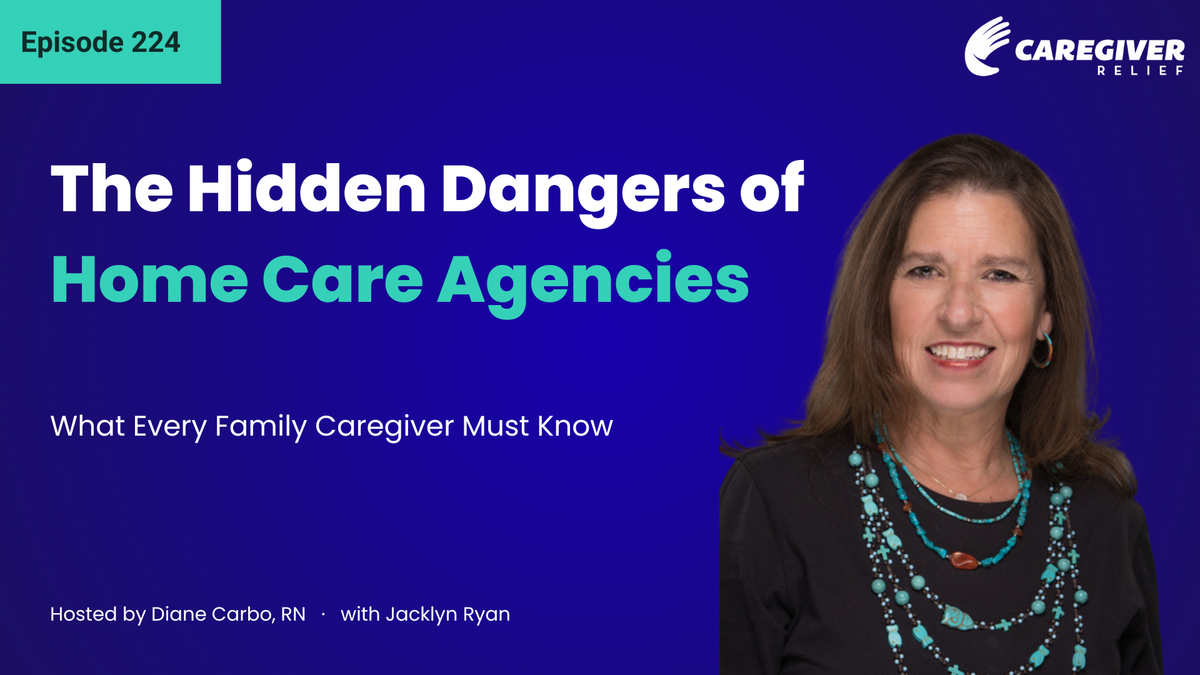
In this eye-opening episode of the Caregiver Relief Podcast, host Diane Carbo, RN sits down with Jacklyn "Jackie" Ryan, a senior care advocate, speaker, and bestselling author of Caregivers Scare Takers. Jackie shares the raw, deeply personal story of how her father was financially exploited for over $100,000 and how a trusted caregiver manipulated her family and turned her father against her.
This is a must-listen episode for any family caregiver navigating the complex, often lawless "wormhole" of private-pay home care. 🎧
📋 What You’ll Learn in This Episode
- The Reality of Background Checks: The shocking truth about the gaps in state laws regarding caregiver screening, including states where fingerprinting and federal checks aren't required. 🚫🫵
- The "Best Friend" Trap: How manipulative con artists use emotional grooming to make seniors feel needed, valued, and entirely dependent on them.
- Sibling & Family Dynamics: The uphill battle of trying to intervene when your siblings aren't on the same page or when a parent threatens to write you out of the will. 📑
- What is an FBI Rap Back? How an ongoing, real-time federal background check system could revolutionize senior safety nationwide. 🚓
- Practical Steps to Protect Your Loved Ones: Immediate actions you can take today to safeguard a senior's identity, mail, and financial assets from inside the home.
🧠 Notable Quotes from the Episode
"Raise the bar on caregivers, and we'll raise the bar on the quality of care." — Jacklyn Ryan
"The older people don't feel needed anymore... When a caregiver is around your loved one for an extended amount of time, they may convince them: 'If your kids care about you so much, where are they?'" — Jacklyn Ryan
"People of low morals and poor values justify it in their minds as a good thing... they see it as helping their own family member as they are stealing from yours." — Diane Carbo, RN
🔗 Important Links & Resources Mentioned
- Jackie’s Bestselling Book: Caregivers Scare Takers
- Website: https://caregiverscaretakers.com/
- Get Involved with Reform: ROAR for Long-Term Care (Respect, Oversight, Advocacy, and Reform)🦁

🎙️ Ready to listen?
Don't let your family be caught unprepared. Click the play button above to listen to the full episode and learn how to ask the right questions before trusting a stranger with the person you love most.
Podcast Episode Transcript
Diane: Welcome to the Caregiver Relief Podcast, where we discuss tough subjects on topics many family caregivers face. I'm Diane Carbo, RN, your host, and today we are talking about something every family hopes will never happen, but too many families face after a crisis: unsafe care, caregiver neglect, financial theft, and the shocking gaps in oversight that can leave vulnerable loved ones at risk.
My guest today is Jacklyn " Jackie" Ryan, a senior care advocate, consultant, speaker, and bestselling author of Caregivers Scare Takers. So many adult children, Jackie was working, living her life, and visiting her father regularly when one fall changed everything. Her father broke his hip, went through surgery and rehab, and the family turned to home care for help.
What followed was years of painful lessons about caregiver screening, agency accountability, and how unprepared families can be when they are suddenly pulled into the healthcare system. Jackie's mission now is to help families be proactive before a crisis happens. She is advocating for stronger laws to protect vulnerable loved ones, including fingerprinting and FBI rap back checks for caregivers across care industry.
She is also involved with ROAR, a movement using storytelling to expose failures in long-term care, elevate family voices, and demand accountability and reform. This conversation is about protection, preparation, and giving families the tool to ask better questions before trusting someone with the care of someone they love.
Diane: Jackie, thanks so much for joining me today. I'm excited to have, this topic. It's one that many nobody really wants to talk about, but it's rampant in our, in our culture right now.
Jacklyn: Yes. Diane, thank you for having me on your show here. It's none of this caregiving is happy, but it's a necessary conversation we all must have.
Diane: Yeah.
Jacklyn: Cause caregiving is gonna happen to, each and every one of us in one form, shape, or another before we, exit out of here.
Diane: So, you know, you're so right about that. now before we get into the hard parts of this conversation, can you share a little bit about your dad and what life looked like before his fall?
Jacklyn: Well, let me back up a second, is I was living in Dallas, Texas, and, everyone knows where we were in 9/11, and my uncle had passed away, planes were shut down, and so I had to make a U-turn. Instead of flying from Dallas to Tulsa, that I drove to, northwest Arkansas. And so my stepmother's, cancer had reoccurred, and, they had been in a car accident on the way over to the funeral home that day.
And, my cousin missed seeing her dad by about two hours. She was in Weatherford, Texas. And, I thought, "I'd be dang to be in Dallas making a dollar and my family's in Arkansas." They weren't going to move to Texas. So I decided to return to Arkansas, and I built my home above on my dad's property where I could see his house from where I lived.
I did a life change of returning to Arkansas from Dallas, Texas. So that kind of really puts it in perspective that I was close by. So my stepmother had passed away a year later in 2004. Dad was widowed, and then, he was involved with scams, and this goes into some of some, whether it's the telephone calls, the paving the highway
Diane: Yeah
Jacklyn: "Let's fix your roof," blah, blah, blah. So he was very naive, gullible, rainbow chaser, dream seeker, and he'd been successful in his career, in his life with his wife, my stepmother, and then she passed. So I was really concern. And that's really the main reason I returned to Northwest Arkansas.
So however, yeah, one fall does it all. He fell and broke his hip later, and it was about 2000, probably '13, '14, around there. It's after I was married. I got married in 2010. And he fell and broke his hip. He got home from rehab, and all of a sudden, I, the daughter, is thrust into the home care wormhole.
So, hey, we're in a crisis. I just called a home care agency that I knew about, I'd heard about. Didn't know about, but I'd heard about them. And I called them. And so they'd send people out, whether they would show up or not show up or somebody would bring their dog and my dad's got a dog, or my dad smokes, they don't like smoke.
And you know, it's hard because we're out in the country and my dad's got a dog and he smokes constantly. Until later one day, Diane, about three or four months into it, that lo and behold, I'll say, Claire, one, one, she showed up. Two, she showed up on time. Three, she had a great smile and was very engaging, and honestly, it's like I found my new best friend.
She was very, active with my dad. My dad liked her. She liked my dad. The family liked her. Yes, I've got two other sibling brothers. And so rock and roll on. Until, Diane, probably about three or four months after Claire was hired, I found a tire receipt on the counter for $900. Yeah. And so that was the beginning of it.
And, So I brought it to the family and we had a end meeting conference with Dad and Claire, and Dad was apologetic and, "Claire, I'm sorry. I was gonna pay him back." And Dad's not supposed to be driving, but, she had a good new so, you know, of course, Dad had to follow her in his truck to, for her to get her tire.
It was $900. "Oh, I'm gonna pay it back." And, we're just at our wit's end because we like this person, and our biggest mistake, Diane, is that we did not notify the agency. We did not.
Diane: Oh, you didn't?
Jacklyn: We did not, Diane. Ah.
Diane: I will tell you, Jackie
Jacklyn: Yeah
Diane: this happens a lot. The, I've had many situations where the caregiver, the hired caregiver, took advantage financially oh, in so many ways. And they, the senior is left, the family's left to clean up the mess. But because of shame
Jacklyn: Yeah
Diane: they do not, or I can't get, I can't tell you how many times I have asked seniors to let me call the police, let's press charges, and they don't do it.
Jacklyn: No, because, I, later, fast-forward a lot, but I, as a whiny little daughter, I'm not the victim.
Diane: Yeah.
Jacklyn: See? Yeah. Yeah. And my dad certainly wasn't gonna call, and later he had dementia and he had fallen and broke the other hip, and so Claire was on full time then, and other stuff happened. This is over, with my dad, Diane, it was about a six-year period that long. And we couldn't fire her because, yes, Dad paid her.
In essence, Dad hired her. And to the point about two and a half years or so into the employment, she let me and a neighbor know that she had been in jail for meth before.
Diane: Oh my God.
Jacklyn: Oh my God. She told me this. I found her face on mugshot. And her teeth, Diane, no wonder they looked nice, because they weren't real because of meth.
Diane: Oh.
Jacklyn: In her mugshot, no, she doesn't look good without her teeth in, huh? No. So I went and I took this to the home care agency and I said, "Did you know that Claire had a charge? She'd been in jail." And he turned his screen to me and he says, yeah, but, we've inherited her." Meaning because I had moved her from one agency to this agency because the previous agency she was at, the accounting person was embezzling money, and overcharging us and embezzling money from the care owner of the first agency.
And so the second agency just brought on Claire, knew that she'd been in jail, but did not want to lose my dad's $200,000 account annually.
Diane: Jackie, I will tell you that doesn't surprise me either, because I have seen where bad nurses or bad aides, or, professional caregivers go from one agency to the next.
And it shocks me that, they're supposed to have background checks and stuff. But the agencies, they have problems keeping and, help and finding help. So they're, they put themselves in these situations where they, it's all about finances. And if they have a caregiver who's got a, you know, that works with a family that, that gets it to get a job, keep the income coming in, they don't want to lose it. And we have a lot of unsavory or unethical, home care companies. Now, these are the unskilled care companies. These aren't the ones that are skilled, which you bill to Medicare.
But there's plenty of fraud through there too. But what we have right now is a situation where it's private pay, for you and they're, they charge 50, the home care company charges 50 to 75% above what they're paying that person to be in there. So that's a big chunk of change.
And it's really, allowed for, terrible things to happen. And the other situation is that the senior that is receiving that care is so happy to have someone to take care of them that they will tolerate a lot of unwelcome things, like the finances, or they'll pay them extra just to keep them because they don't want to be alone.
Jacklyn: Yes. So on some of those aspects, Diane, it's like I've got a saying, "Raise the bar on caregivers we'll raise the bar on the quality of care."
Diane: Yeah
Jacklyn: And so in the state of Arkansas, caregivers are not required to be fingerprinted. They're not.
Diane: Wow.
Jacklyn: Yeah, seriously, they're not required. And okay, you've been here five years in Arkansas, you don't have to have a background check.
Yeah, seriously.
Diane: Who makes these rules? Oh, our government policy makers must be idiots.
Jacklyn: Oh, yeah. and then this is why I, was close to getting a Senate bill passed last year in the state legislation of Arkansas, Senate Bill 120, from a senator. And this is a, a quick process, I'll tell you. So there's a family health committee, so it goes to the Senate committee.
Okay, it passed that And then it goes to the Senate floor. It passed on the Senate floor. then my bill, which would require fingerprinting background checks, and yes, the Department of Human Services was there. He heard my story. And then the bill went to the House committee, which I was not there. I was not invited there.
I was out of town anyway. And the chairman said, I know a little something about this Alzheimer's, and I wouldn't vote for this." Yeah. And he he, called for a, he just says, "Yays and nays," and bill fails. and he called on DHS, that's why I'm mentioning that. He called on DHS, and the DHS guy said he didn't know of any stories.
He flat out lied. And I emailed him. I found his email. I emailed him, "I'm sorry for what happened to you, Jacklyn, blah, blah, blah." man, it's like undue red tape regulation on small businesses. That was the bottom line. Well, I'm in real estate, and this is the deal, Diane. I'm in real estate in the state of Texas, state of Arkansas.
I have been fingerprinted and background-checked. But these people who make 10 to 14, maybe $15 an hour, maybe even as an independent contractor, not as an employee
Diane: Yeah
Jacklyn: then you're one of the 32 blues, come into your home, and when these people are making 10 to 14, 15 an hour as an independent contractor, they might feel entitled, they might feel entitled to, shop around in the house.
You think?
Diane: Yeah. Yeah.
Jacklyn: And that's what happened to my dad. My dad was financially voided for over $100,000. You say, "Oh, Jackie, how?" Well, he paid off her seller finance mortgage of about $33,000. He's buying her cartons of cigarettes. If you want to smoke, Jack, you can smoke, because she wanted him to buy cigarettes so she would have a carton of cigarettes.
Yeah. She smoked right up through with him. Oh. And, she threw me under the bus 'cause I started dogging her.
Diane: Yeah.
Jacklyn: Started finding out what's going on, and I couldn't get her fired. She turned, this is, six years crammed into a few minutes here. She turned my father against me, like I mentioned.
I moved to be close to my father. I could see my father's house from where I lived.
Diane: Yep.
Jacklyn: The last year of his life, the year before he died I found three receipts totaling around $300 of groceries that another caregiver said walked out the door. He's a skinny man of 88 years old now, skinny man, and he doesn't need $300 of groceries in three weeks here.
And I text Claire, "Do you have enough groceries now?" No response. Bad answer. No response. And within a month's time, Diane, that I know what happened. She called the attorney, had my dad on the phone, convinced him I was going to be after his money and put him in a nursing home, and the attorney removed me as his health POA.
I was not even financial POA, health POA. Removed me as his health POA when I can see his house from where I lived.
Diane: Yep.
Jacklyn: A month later, he fell under the caregiver's watch, not that one, but another one, and he, he called me. I was down there immediately. I sat there for about an hour and a half or two waiting on my I called my mother's son to show up.
He finally did. And, the nurse, I asked my dad, I said, "Why did you remove me as your health POA? I would've had you to the doctor's two hours ago." He says, "You were after my money." And I said, "I don't need your money." He said, I know that." What... Yeah, okay, forget about it. So that he didn't pass away till about a year after that, short of a year after that.
And, but I did call the agency and no, this is after he fell and broke his elbow, a different time. And these people, like I said, they're getting paid around 14 an hour when the agency's getting paid 25, $30 an hour.
Diane: Yes.
Jacklyn: Yes, like you're going back to your point there. If these people would be fingerprinted and background check, maybe they deserve to be paid 16, $18 an hour then.
Diane: Yes.
Jacklyn: You know? And the Medicaid, does not reimburse very much. And so then they're just totally out that way. You got to you're in a crisis situation, you're desperate, you're just going to go with the first caregiving agency. Yeah, that's it. You're not going to interview who they're interviewing.
You trust this agency to do the right thing, to have these people in your home, your vulnerable loved one's home to care for them. And you know, taking the cuckoo clock, taking clothes, taking whatever, or having my dad pay for your grandkids' summer camp. All this stuff.
But on the flip side, Diane, and this is something very important about people who are listening that have loved ones and of yourself. the older people don't feel needed anymore. I'm not gonna, I did not cater to my dad. I didn't need to cater to him. I made my money. And yes, I'd go down, I see him, I love him, I'm not gonna put up with his sometimes.
And, So when the caregiver is around your loved one for an extended amount of time, eight hours, overnight, whatever, no telling what they're saying and doing and going on about your loved one, and may convince your loved one that, hey, they're the best things, and, if your kids care about you so much, where are they?
Well
Diane: Yeah
Jacklyn: we're out here. we've left the nest. We're out here, we're working. We're out here working. We're having our life and we'll come see you. But my dad, it's not "Jack, can I have $100?" "Oh, Jack, my grandkids, I'd love to have them go to the camp, summer camp, but I just can't afford it."
"Okay, honey, how much is it?" "Oh, that'd be wonderful. It's a couple thou" "Okay, hon." because then they feel needed.
Diane: Yes.
Jacklyn: They feel wanted, needed. It's gratifying to slip her $100 here in her purse, or, "Here, let me pay for your carton of cigarettes. Let me pay off your mortgage," because then they are so appreciative, of course.
She, "Hey, Dad, why don't you pay off my mortgage?" "No, man, I'm out here working."
Diane: Yeah, I get it. I've heard this type of manipulation for decades. it's been going on, and it's more rampant now than ever before because, we have an aging population. We don't have enough people to take care of our seniors.
Jacklyn: Yeah.
Diane: And, some unsavory characters are, being, able to take jobs that, they go in, everybody sees them, oh, they're wonderful, they're great. This person, they're going to help with my dad, and then in the background, that person's a con artist that is going to take your parent for everything they're worth and manipulate you, manipulate them to go, to be wary of you.
I've seen it before, and it just breaks my heart.
Jacklyn: Yes. And, that is a long story short of my dad. My mom, she had cancer, get perforated bowel, got home, home hospice. I hired a, you know, of course, yes, Mom paid, but yes, I found a different care agency. They send somebody out And I had to clean out the toilet the first, the second night, and then I had to call a plumber the third night.
Diane: God Oh, no
Jacklyn: I was like, "What is this?" So I fired that one. I am not putting up with this kind of stuff anymore. So I fired that one, and I opened up the medicine cabinet, Diane, and Mom's Oxycontin and hydrocodone were missing.
Diane: Oh my God.
Jacklyn: And so I told the other agency this, and of course they were charging Mom, $30 an hour because she's bedridden, blah, blah, and all this.
And I said, "No, I want some compensation. This is ridiculous." And so they wouldn't do anything until, yes, I did file a police report. Yes, the woman was, picked up. No, she's not going to go to jail. Yes, I do have her written confession where she stole my mom's narcotics 'cause her stepfather was sick or blah, whatever.
Bull.
Diane: it is.
Jacklyn: Oh my gosh.
Diane: Con- people of low morals and poor values have no, they don't see the harm that they're doing. They don't see that it's hurtful and harmful, and it's illegal. They justify it in their minds as it's an, a good thing to do because they're helping their family member
Jacklyn: Yeah
Diane: as they're stealing from yours.
Jacklyn: oh, the Clara I told you about, she had God bless this house place mats. She just did everything. She just played it all. And, you know but on the flip side, she was putting the other caregivers down. we went through, it's good to have three caregivers.
Diane: Yep.
Jacklyn: Scrambling around on two, and why? Because then if you got two, one backs out, then you're down to one. You got one or two, and they gotta have overtime, time and a half.
Diane: Yep.
Jacklyn: Yeah. It's all money, money, money, money, money. I mean, this one particular home care agency, they went from leasing a place to, yes, buying a nice brick individual building and have a fleet of transportation, cars now, vans, and all this stuff and everything, and growing and doing and having a...
And, you know, but Diane, the book, Caregivers Scare Takers, it's not only my story. And then like you, there's so many stories out here. My book has many other different people's stories and in different circumstances, and how it came about or what happened. And, I tell you, one of my friend's nephew was cutting.
"Shane, what are you doing?" "Well, I'm cutting up jewelry." "Where'd you get that?" I stole it from the caregivers." "Well, where'd they get it?" "Well, they stole it from the old people."
Diane: Oh.
Jacklyn: It's just a three breeze circle going around here. This dude stole from the caregiver. It's everywhere.
Diane: Yeah. I have a good friend whose, daughter-in-law had a dad in Florida in a nursing home, and he passed.
And they were living in Vegas, so they came to the... They flew in, overnight to get to their dad's assisted living and clean it out, and they found that everything had already been gone. His scooter was taken. His expensive wheelchair that he had was taken. His nice clothes were taken. And it turned out, as she reported it to the police, and it turns out that the assisted living administrator and the people that worked in there let this lady in who took all these things and resold them it just, incomprehensible to me.
People are like vultures and
Jacklyn: and so why was the administrator not held accountable for that?
Diane: I'll tell you what, there's a lawsuit involved right now that hopefully that place will be shut down. Those kinds of people will pop up somewhere else cre- doing the s- providing the same services and care.
Jacklyn: And that's the thing. You've got to qualify. So you mentioned, yes, in my book it's called FBI Rap Back.
Diane: Yeah.
Jacklyn: And what does that mean? So of all things, I came across it in 2019 when I was renewing my real estate brokerage license in the state of Texas. Like, what is this? And why is this?
It's just some extra paperwork. And what it is, Diane, is an ongoing real time background check on the realtors in Texas. And why is that? I guess because there have been a lot of fraudulent people dealing in real estate in Texas. Okay, so what? Okay, past that. So but ongoing real time. So what happens is like the state police, collaborates with the FBI nationally, okay?
So when I... And I checked, I found out, I had the, I had passed the Arkansas State, criminal background check here in Arkansas, but they didn't do anything federally, and so in real estate. So why cannot the FBI Rap Back be implemented nationwide? It is on about maybe eight to 10 states right now.
Oklahoma and Missouri's getting it, but they're getting it for different reasons. It's not for caregivers, just like Texas, oh, it does have it for realtors, but not caregivers yet. And so for instance, and what this means is, Okay, so you're in Florida, right?
Diane: No, I'm in Myrtle Beach.
Jacklyn: I'm sorry, yeah, Myrtle Beach.
Okay, okay, let me just use my Northwest Arkansas area. Northwest Arkansas, we're an hour away from Tahlequah, Oklahoma. And so say if, Missy leaves the Meadows, home agency and, goes for a weekend over in Oklahoma, goes party or whatever and gets busted for meth, right? Me- meth, drugs she's probably gotten from the, home agencies or from, assisted living places.
She gets busted in Oklahoma. She gets bailed out. She goes back to work. The employer doesn't know anything about it, right?
Diane: Yep.
Jacklyn: Okay. So what would happen with FBI Rap Back is that the Oklahoma State Police notifies the Arkansas State Police, and then the Arkansas State Police would notify the employer, not that they've been convicted, not been in, trials.
Nothing's happened. But just to let the employer know, "Oh, Missy was over here, a month ago on a weekend. She got busted for drugs." Just let the employer know. Of course, the employer may let them go. But, otherwise, the employer has this meth head drug abuser, employed at wherever, until when?
Diane: You know, I learned decades ago that in Pennsylvania, they, the agencies would hire people. Now we did have background checks in Pennsylvania, but they would hire them before and put them to work before the background check came through. And, we really have a serious situation here.
My concern is, here's, your father had a, somebody to oversee him right there in his neighborhood, right in his backyard.
Jacklyn: Yep.
Diane: And this occurred. I worry about the solo agers and the childless couples who are going to be at, the mercy of these kinds of individuals. and I know you're advocating for stronger, laws to protect our vulnerable loved ones.
What changes do you believe are the most urgently needed, and do you see any hope for it in the next decade to happen?
Jacklyn: Oh, it better happen. I am frantic. I am just, I am frantic, Diane, because I am a childless person. And, yes, and not, oh, I don't want my kids to take care of me.
No, you don't, but then what? And I've come up with this, what's your exit plan? we've got to have fingerprinting and background checks. it's really simple as that.
Diane: Yeah.
Jacklyn: And so that's part of the question, people, when, you're interviewing a caregiver or a home care agency.
Have your people been background checked, fingerprinted? When was the last time they were background checked? Three years ago? Not good enough. Not good enough. And these people come out to your vulnerable loved one's home, and you just trust everything's okay, and it's not, man. They're back there snooping around in the drawers and looking to see what they might want to take home with them.
Diane: I always recommend you never have them bring in the mail. Have the mail forwarded to your house. I encourage you to put all valuables in one room with a locked door.
Jacklyn: Yeah.
Diane: There are things that I encourage because I've seen this happen so much before, and it's really you have to literally pack things up and put them, and just have the bare minimum out.
You don't want important papers that they can steal your identity. You don't want them to see the credit cards. And, that, those are steps that you can take that I encourage my listeners to do when they're, going to have someone in the home. Because, and the other thing is, you need to have someone who's overseeing the, banking or the finances, or you just take all that information out of the house where they're going to be, and don't have, don't allow anybody to have access to it.
There are steps that people can take, but they don't. Jacky, for families listening right now who are already has a caregiver in the home and suddenly feels worried what is the first practical step they should take?
Jacklyn: If you've already got a caregiver. Okay, so let's clarify that. If you've got a individual caregiver, maybe that's somebody that you've known, maybe somebody you've vetted yourself, or, don't put them on alert.
But you can find a casual way to say, "How have you gotten into this business?" And, I heard this episode. Have you ever been fingerprinted, background checked?" You know, put it off on something else, not to raise any red flags. Once the red flags was raised with Claire, that's when she really started throwing me under the bus and turning my back.
Diane: Yep. Yep.
Jacklyn: I had no idea until it was too late. So you don't want to raise red flags, because your daddy might like Lisa that comes in and checks on him and stays with him. But what if, how do you know Lisa's not ripping your daddy off?
Diane: So I have seen
Jacklyn: Yeah
Diane: I've gone in unannounced to homes when I did care management for clients and to check on the agency aides, and I can't tell you, I've caught them doing laundry.
Jacklyn: Laundry.
Diane: Bringing their laundry to the house and doing it there. I've caught them, t- taking food out of the freezer.
Jacklyn: That's right.
Diane: Or stealing booze. there, there
Jacklyn: All of the above, everything. All of the above happens. You have allowed this thief to come into your vulnerable loved one's home.
Diane: Yes.
Jacklyn: And this is the big quandary, Diane, is, okay, Lisa's been ripping your dad off, you want to get rid of Lisa, but then your dad's like, "You get rid of Lisa, I'm cutting you out of the will."
Diane: Yep, yep, yep.
Jacklyn: Because your dad has fallen in love with Lisa even though he's not going to marry her.
Yeah, you Yep.
Jacklyn: There you go.
Diane: Yep.
Jacklyn: So Heard it
Diane: before ...
Jacklyn: you can't, so with that, this is a good conversation. you can't do it by yourself, and this was my problem. Hey, Dad was happy, Claire's happy, everybody's happy, and it's no, this is not right. And my brother would say, do you want to do it?"
It's no, but there's other agencies out here. And, another common question, "Well, Jacky, how come you didn't have Claire fired?" Well, If I'd fired her, yes, Dad was threatening to cut me out of the will, okay? Yeah. Or that she could have been fired. The agency didn't want to fire her.
If they fired her, Dad would rehire her direct.
Diane: Yeah.
Jacklyn: So I was stuck, and I had no support from my siblings. That's the key. So whether you've got siblings that will support this effort to have this discussion with your vulnerable loved one, whether it's your cousin, mom, dad, whoever it is, or, one of their trusted friends.
This Claire even turned my dad against his trusted friend, one of the guys, and it's just ridiculous. you've got to have a sit-down conversation, and what does that mean? It not mean like, okay, you know, you got to build up to this and start establishing, reestablishing a rapport with your parent on a different level, And, I'm trying to use my book, Caregiver Scare takers. "Oh, you know, Dad, I found this book. What do you think about this? Take a look at it," or something. And it's got a lot of resources, questions, and tips in there, how to better qualify an agency and caregiver. But, to find a resource, even your website, Diane, Caregiver Relief or something.
Find something to clue them of, we need to have a discussion. Start throwing some stuff out that way to start having a discussion. You can't just sit down and have a discussion. They're going to be defensive, and red flags, and throw you out, and cut you, threaten to cut you out of the will
Diane: One of the things I really strongly believe is the family caregiver is the single largest pillar of the long-term care industry.
They provide $1.1 trillion of unpaid care. They are expected to do tasks that were once cre- done by, healthcare professionals. So they are this decentralized, group of people that are providing the massive amount of care to our seniors. And for those that don't have a family caregiver, they are dependent on these agencies.
And we have got to as a group, I can tell you, I've heard politicians that are saying, "Yes, we're gonna to support the family caregiver. We're gonna put things in place." And I can tell you, my site's 20 years old, and I have I actually just recently took down a page about Hillary Clinton her and Bill and what they were gonna do for the family caregiver, and they talk a good game, but they do nothing.
And your experience that you had, you got so close, and then they just, this, they dropped the ball. we as a group have got to find a voice and to step up and demand that we have these things addressed because it's not safe out there otherwise.
Jacklyn: It's not safe. And that leads me, and I know we're running short on time, Diane
Diane: Yeah
Jacklyn: to ROAR for Long-Term Care. so
Diane: Yes
Jacklyn: Susie Snear Carter, I am the Arkansas walk leader. if anybody wants to be a walk leader in the state of Arkansas, contact me info@caregiverscaretakers.com. let me spell that out because I know people get confused with it. Caregivers, C-A-R-E-G-I-V-E-R-S, scare takers, S-C-A-R-E-T-A-K-E-R-S.
It is one S in the between for caregiverscaretakers.com, info@caregiverscaretakers.com. But Susie is working on a national movement and, I am one of 22 states, involved with ROAR. ROAR stands for Respect, Oversight, Advocacy and Reform for LTC, the number four, LTC.org, for long-term care. And, her experience was with nursing home, mine was with home care.
We couldn't get on the same page until she named it for long-term care because all of us are gonna have a long-term care in one shape, form, or another. It, I know you
Diane: And that has got to include assisted living.
Jacklyn: All of it.
Diane: All of it. Jackie, I appreciate your time today. To my listeners out there, I just want you to know we will have a link to Jackie's book and, a link to the ROAR organization so you could learn more about that.
And to the family caregivers out there, you are the most important part of the caregiving equation. Without you, it all falls apart. So please learn to be gentle with yourself. Practice self-care every day because you are worth it.
Caring for a loved one can be overwhelming — but you're not alone. If you have questions, big or small, our expert team is here to help.
👉 Click here to Ask the Expert
Our Resource section can help you find the information and tools that you need. We have courses, videos, checklists, guidebooks, cheat sheets, how-to guides and more.
You can get started by clicking on the link below. We know that taking care of a loved one is hard work, but with our help you can get the support that you need.
Click here to go to Resource Section now!