What to Expect When a Loved One Is Dying: A Compassionate Guide for Caregivers with Jamila Gubbels - Episode 222
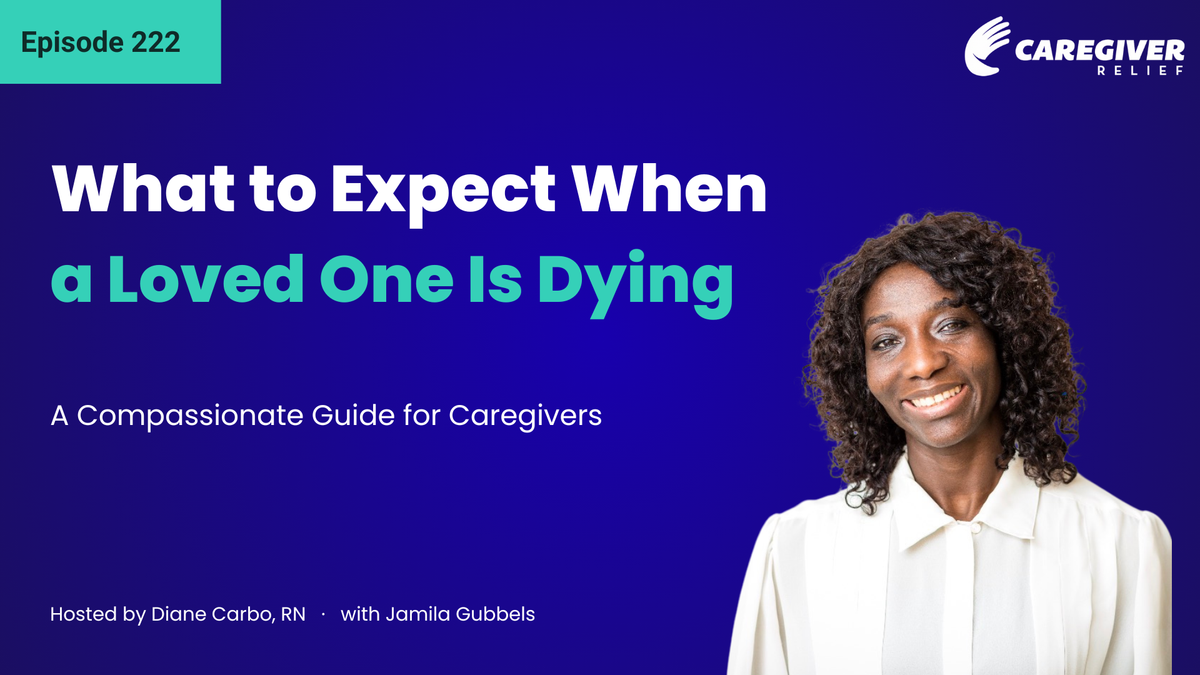
In this profoundly moving episode of the Caregiver Relief podcast, host Diane Carbo, RN, sits down with Jamila Gubbels, RN and Death Doula, founder of Tender Presence. Together, they strip away the clinical coldness often associated with the end-of-life journey and explore how caregivers can navigate this sacred transition with peace, clarity, and deep compassion.
If you are a caregiver feeling overwhelmed, fearful, or uncertain about what comes next, this episode provides the grounded, gentle guidance you need to move from a state of medical crisis into a space of meaningful connection. 🌟
📋 What You’ll Learn in This Episode
- The Sacred Parallel: Why the dying process mirrors the birthing process as a natural, labor-intensive, and unique bodily transition.
- Demystifying the Decline: Understanding the natural withdrawal and reduction in appetite that occurs weeks or months before active dying.
- The Truth About Feeding Tubes: Why forcing food or inserting feeding tubes can often cause more harm, discomfort, and complications than good.
- Signs of the Transition: What to expect during the final stages, including shifts in lucidity, changes in breathing patterns (apnea), and the "death rattle."
- The Role of a Death Doula: How a death doula steps in to hold the emotional, spiritual, and holistic space that busy medical systems often overlook.
- Navigating Your Emotions: Learning to sit with anticipatory grief, numbness, and anxiety, and understanding why taking care of yourself is the greatest gift you can give your loved one.
⏱️ Episode Outline & Key Moments
Introduction to a Sacred Conversation
Diane introduces Jamila Gubbels and discusses the beautiful, calming philosophy behind her company, Tender Presence. They tackle why society treats death as a taboo topic and how talking about it reduces caregiver anxiety.
The Parallel Between Birth and Death
Jamila explains how dying, like birthing, has its own rhythm, beauty, and physical steps. They discuss the early signs of decline, such as natural social withdrawal and a diminishing appetite.
Food, Culture, and the Body’s Wisdom
A deep dive into why the body naturally rejects food and fluids as it conserves energy for vital organs. Diane and Jamila break down the cultural pressure to feed loved ones and explain why artificial nutrition can cause pain and complications like aspiration pneumonia.
When to Call a Death Doula
What is a death doula, and when should you reach out to one? Jamila shares how doulas help clarify values, map out advanced care planning, and even facilitate "life celebrations" while a person is still healthy and vibrant.
Recognizing Normal Physical Changes
Jamila explains the physical changes that can frighten caregivers if they don't know what to expect. They discuss fluctuating consciousness, irregular breathing patterns (periods of apnea), and the mechanics behind the "death rattle"—and how simple adjustments like turning the person on their side can provide comfort.
The Relational Gift of Time
Shifting from "doing" medical tasks to simply "being" a son, daughter, or spouse. Jamila and Diane share personal stories of how to create a comforting environment through music, prayer, and presence during a loved one's last moments.
A Final Message of Encouragement for Caregivers
Jamila offers a powerful piece of advice: sit with your emotions and practice deep self-care. Diane reminds caregivers that they are the most important part of the caregiving equation.
💡 Key Takeaways for Caregivers
"Dying is not just a medical event; it's a relational and sacred transition. It is a gift of time that allows us to prioritize listening and just being present."
- The body knows what to do: A drop in blood pressure, fluctuating oxygen levels, and an irregular breathing pattern are all a natural progression, not a crisis to be solved with endless vitals monitoring.
- It is painless: The physical signs of slowing down (like not eating or gurgling sounds) are often much more distressing to the person watching than to the person experiencing them.
- Get ahead of the crisis: Don't wait until the final days to have tough conversations. Engaging with end-of-life planning early allows a person’s values and wishes to be fully respected.

🔗 Connect with Jamila Gubbels Ready to learn more about end-of-life planning or seek compassionate support?
- Website: www.tenderpresence.ca
- LinkedIn: Jamila Gubbels
💖 A Reminder from Caregiver Relief
Caregiving is one of the hardest and most meaningful things you will ever do, but you don't have to do it alone. Be gentle with yourself, practice self-care, and remember that you are worth it.
Podcast Episode Transcript
Diane: Welcome to the Caregiver Relief podcast. I'm Diane Carbo, RN, your host, and I'm someone who understands firsthand the emotional weight of caring for a loved one. Today, we are talking about something many caregivers face, but few feel prepared for. What happens when someone is dying? Not just medically, but emotionally, relationally, and spiritually.
Because for many caregivers, this is one of the most overwhelming and uncertain times. You may be asking yourself, "Am I doing the right things? What should I expect next? How do I stray, stay strong for them when I feel like I'm falling apart inside?" My guest today, Jamila Gubbels, brings both clinical experience as an RN, registered nurse, and the deeply human presence of a death doula.
Her company's name is Tender Presence, and I have to tell you, that is such a beautiful explanation of what she offers. To me, it explains what we all want at the end of our life, a tender presence as we go through our death and dying process. But it also defines the type of support so many families need as they may be experiencing the death of their loved one, or this may be the first time they've ever experienced death of any type.
Jamila helps families understand the dying process, not just as a medical event, but as a sacred transition. This is a conversation that will bring clarity, comfort, and a sense of peace to caregivers who need it most.
Diane: Jamila, thank you so much, for sharing your information here with me today. this is such a difficult topic, and it's one that nobody really wants to discuss, but when I saw the name of your company, Tender Presence, I thought, "I need to talk to this girl."
Oh.
Jamila: Thank you so much, Diane, for having me. I love what I do. Tender Presence is really about really, being present at the end of, during the most, special moment of someone's end of life.
Diane: Yes. Yes.
Jamila: And what I do is to demystify the process of dying, to lower the anxiety.
We live in a society where we do not, support
Diane: Yes
Jamila: or we don't really Appreciate the topic
Diane: Yes
Jamila: of death and dying. We think it's too morbid.
Diane: Yep.
Jamila: We think that we are hastening death by talking about it.
Diane: Yes.
Jamila: But it's further from the truth. When I started this business, Tender Presence, I had to open a business account, and the first thing they asked me was, "What will you do if you can't pay your bills?
And that's a natural question.
Diane: Yeah.
Jamila: So even us as a society, what would happen if something happens? God forbid something happens, are you prepared? And the answer for most people, they are not prepared because they think that talking about death and dying is forbidden.
Diane: Will bring doom and gloom upon them.
Jamila: Yeah. I have to tell you,
Diane: Exactly, I'm 73 years old, and I can remember my great-grandfather, Bachman, he's my grandmother's father, having last rites seven times. and I remember, the priest coming to the house and his bedroom was his bed was in the dining room. And every single time he would go through his death and dying process, my little aunts would bring out their, my grandmother's sisters, there were all four of them, would bring out the tea service, and they would have their, sit there, and they would be talking and praying.
And I learned that, very early age that, death was a process of life. And, we have gotten away from that. People don't die at home anymore. we're moving more towards that again, but and people see death on TV is, you just talk, and all of a sudden you're not there, and you're asleep.
Jamila: Yes.
Diane: And it doesn't happen like that. And I feel that
Jamila: It's not
Diane: I'm a real advocate for hospice, but as I tell all my clients, there is a, there are some really good hospices out there, but there are some very bad hospices. And I'll be the first one to admit that and tell you. that's why we desperately need death doulas. We really do.
Jamila: Yeah
Diane: Because there's so much, misinformation, and fear about death and dying that we need to address. I'm very open about it. You know, I have, I will talk about death and dying. And, one of the things that I've seen with hospice companies here, is that, the nurses are, there's no support for the family as the person's actively dying.
They say, "Give us a call if you need anything." And that's not what, death and dying should be like.
Jamila: No
Diane: Caregivers often feel so unprepared. So what are some of the common signs that, as a loved one is nearing the end of life?
Jamila: So just before I answer the question. Death and dying is like birth, birthing.
Diane: Yes. yes.
Jamila: There's a parallel between the birthing process and the dying process, and that's where death doula comes from birth doula.
Diane: Yes. I love that. I love that.
Jamila: Yes and both are natural, labor intensive bodily transitions that possess their own rhythm, beauty, and unique sanctity.
Diane: I love that. And that's beautiful
Jamila: and one of the things is that there's a shift in how people naturally begin to withdraw
Diane: Yeah
Jamila: the first couple of months before death. They're not interested in the things they used to be interested in.
Diane: Yeah.
Jamila: You know, If they used to watch TV, you notice that they don't wanna watch TV anymore. if they used to play sports, you notice, that desire would diminish. And also one thing is that you will notice that their appetite reduces in the first couple of months. They don't wanna eat food anymore.
Diane: Yes.
Jamila: It takes a lot of energy. It takes even just getting up, going to the table, sitting down, and eating. All these steps take a lot of energy from them.
Diane: Yes.
Jamila: As the body starts preparing to let go, to shut down
Diane: Yeah
Jamila: all these activities that we normally take for granted are taxing the body
Diane: Yeah
Jamila: and making it very difficult, and they can't do it anymore.
Diane: and in some cultures, like I had an Italian husband.
Lord have mercy. Oh, my God munge eat and many cultures are like that. As soon as somebody starts, their decline and shows a lack of interest in eating, it's like the earth is quaking.
Jamila: Yes.
Diane: And it's so hard. It is. But people don't understand that there is a natural process to death and dying, and a decline can happen as long as far as a year to six months before a person actually starts their active dying process.
Jamila: That's right. That's right. And the thing is, it's not a sign of depression.
Diane: No, it's not.
Jamila: Because often
Diane: Yeah
Jamila: we think that, oh, it is a sign of depression that needs to be medicated.
Diane: Yep. Yeah.
Jamila: And that is not the case. It's just the body's natural way of, taking care of business. Slowly taking care of business so that when the time comes, the body can physically leave the body, this physical body that is you and me.
Diane: Yes.
Jamila: the soul will leave, but that takes work.
Diane: Yeah. Yes.
Jamila: So it's gonna prepare in a natural way, just like birthing.
Diane: Yeah.
Jamila: Birthing, there's all kinds of signs leading to the baby being popped out.
Diane: Yes.
Jamila: But there's a whole bunch of steps that takes place.
Diane: Yes.
Jamila: and death and dying can happen any time.
Diane: Yep.
Jamila: It can be a morning death, in the middle of the night. That is why caregivers, sometimes they need help in the middle of the night, or it can be any time. It can be sudden. It can be drawn out.
Diane: Yes.
Jamila: It can be, very, sudden and very, slow, a little bit too slow for sometimes families. They've made their peace. They're ready, but
Diane: Yep
Jamila: the person is not ready
Diane: Yes. Jamila, I want to talk about the death and dying, the process where people stop eating and how the body is getting ready for the active dying process.
Because one of the things that we as a culture feel is the need to have a feeding tube in place.
Jamila: That's right. That's right.
Diane: And people think, oh my God, if they don't put that feeding tube into their loved one, they're going to dehydrate, they're going to starve to death. And you know, that's not it at all.
In fact, I'm going to come right out and say it, that a feeding tube can be harmful to somebody who's going through their active death and dying process. But more, you. I'm gonna, I'm gonna say you know more than me about that because this is your business. Could you address a little bit about that so that people, we demystify that, part of the death and dying and declining process?
Jamila: So one of the things is that when, there's a shift in appetite as the body naturally dies- as the body naturally leaves this earth, and one of the things is that, the desire to eat is no longer there. It's not a sign of, depression. It's not a sign of anything. It's just the body being more conservative
Diane: Yeah
Jamila: and focuses on the main organs, the heart and the breathing. So the body has X amount of energy per day.
Diane: Yeah.
Jamila: As the body starts leaving this world, and the thing is, with that X amount of energy, the body is very smart about what to do with that amount. I only have 50% of energy, so what I'm gonna focus on are the vital organs, the heart, the breathing.
The, that is one of the reasons why those are the last things we look for, because the body focuses on that. Now, taking care of digesting food is no longer a priority.
Diane: Yes.
Jamila: It takes too much energy
Diane: Yeah
Jamila: for the body to digest food, to even deal with fluids.
Diane: Yeah.
Jamila: Our bodies are made of 30, 70% of fluid.
Diane: Yeah.
Jamila: And towards the end, the body just decides, "No, I can't. I want to, but I need to focus on leaving."
Diane: Yeah.
Jamila: "So I have 50% of energy, and this is the only amount of energy I have, so I am not gonna deal with water." That's one of the reasons there's congestion at the end of, at end of life.
I'm not gonna deal with food. So you forcing and that's one thing that causes panic. my husband is Cuban. And food is everything. So I've already started training him that
Diane: Yeah
Jamila: when I'm on my deathbed, please do not force food on me, please.
Diane: Yes.
Jamila: I am training him to be ready.
Because food
Diane: Exactly
Jamila: means love. It means so much.
Diane: And in the Italian culture too, and in so many cultures it's like that. That's right. Food is a love. And people have to understand, the public needs to understand that, people you're not starving your family member.
Jamila: They're not starving
Diane: No, and it's, and there's no. It doesn't cause pain. It's a natural dying process that you need to accept. And I can tell you that I feel bad when, people put these feeding tubes in someone, like with dementia or, Parkinson's, because they have this concept that they need to eat, when in fact their body's not even able to digest that food anymore or that volume of,
Jamila: That's right
Diane: of liquid. And then they have the potential for aspirating. You have to keep them sitting up.
Jamila: That's right.
Diane: You can't make them
Jamila: That's right
Diane: and you're not improving their quality of life.
Jamila: No, you're not. And that's the key, is that it causes more harm-
Diane: Yes
Jamila: to the person at the end. When you force the, food-
Diane: Yeah
Jamila: whether it be artificial, feeding
Diane: Yeah
Jamila: it just causes more, discomfort.
Diane: Yeah.
Jamila: It creates, a situation where, your loved one may even suddenly die
Diane: Yeah
Jamila: because of aspiration pneumonia.
Diane: Yes, yeah.
Jamila: And it just complicates things in a way that
Normally what you wanna do is be that the presence
Diane: Yes
Jamila: with your loved one towards the end as you prepare together
Diane: Yes
Jamila: for the person to leave this world. And the thing is, that is part of the problem, is that families are in a kind of a medical crisis mode
Diane: Yes
Jamila: where they're just wanting to do to the very end instead of be.
Diane: Yes.
Jamila: What is, what do I need to be right now?
Diane: Yeah.
Jamila: Do I need to be a daughter? Do I need to be a son? Do I need to be a spouse?
Diane: Yeah.
Jamila: What. And that is. That require us training our society, because our society, even within the medical field
Diane: Yeah
Jamila: we are not ready to tell families or caregivers, "No, this is actually not what the person need.
They are not starving. This is a natural dying process. This is what dying looks like, and it's natural, it's painless, and the person is just using the reserves that they have." And it's amazing how our body is so efficient.
Diane: Yes.
Jamila: It is so efficient in doing what it needs to do so that everything goes smoothly.
Diane: Yeah.
Jamila: But when we interject that process, and we intervene, and we, impose feeding, it actually causes harm, discomfort, and pain
Diane: Yeah
Jamila: to our loved one, which is definitely not what we want to do.
Diane: Right. You know, there's such a lot of information about hospice out there and what it entails.
And there are actually Facebook groups, hospice is killing my family member . And I'm like, first of all, that makes no sense because if they're killing them, they're not making any money. that's a whole not her ballgame. And I find, and I'm going to become, I'm very open about this.
I'm 73. I've seen it all. There are people that keep their family members alive for financial reasons. They want the Social Security check. They want the benefits. They want whatever they have. So they're going to do everything in their power to keep their loved one, alive and that makes no sense, but there are reasons, and they're not always good reasons, that a family keeps a person alive. I've seen it my entire life in nursing. it's sad but,
Jamila: Yes
Diane: that's real. Now, a death doula is a new role basically in the, medical delivery system. And I am I'd like to know, from your perspective, when is, it time to, to talk to a death doula?
The reason why I'm asking is we have an aging population. The next few years, we are going to have, we're going to double the amount of caregivers and seniors as the baby boomers hit their 65 and they decide they're going to start retiring. The oldest of the boomers are soon to be hitting 80.
So we're going to have a lot of death and dying going on. And the other thing we have is no, we have the lack of youth to provide care. And what I'm concerned about is not just the family caregiver, but the solo ager or the childless couples who have no one to really, family members to reach out and help them.
And I see the death doula as a role that can help so many people in so many ways because I don't think anybody should die alone. And that's just my opinion. But, I would like to hope that, many others feel that way and, will help sit vigil. But there are people that may only have a person like yourself.
So when's a good time to start, considering having a death doula come into your life?
Jamila: That's an excellent question. The thing is, when a, when a person really is at the, let's say the medical team says it's within three to, a couple of months
Diane: Yes
Jamila: let's say the doctor, technically the question is, will I be surprised if the person was to die?
Diane: That's a good question. Oh, yeah.
Jamila: Will I be surprised? In that case, that person needs to already start dealing with that, with, just listening to a death doula and preparing the way
The thing is, a doula steps in to hold the emotional and spiritual and holistic space that usually a nurse cannot. The nurse is just busy, going from tasks
Let's say, a patient is in the hospital. They've been in and out of the hospital so many times. just having, reaching out to a death doula at that point even, it's okay. The sooner the better, right? It doesn't mean that it's just like advanced care planning.
Diane: Yeah. Yeah.
Jamila: It doesn't mean that, it's gonna happen, quickly, but at least you can start having that conversation.
Diane: Yes. Yes.
Jamila: So you can even feel, you know, does death doula, is she a good fit or is he a good fit for me?
You know? just have a conversation with them and see. It does not mean. And then when you need them to be there and to, to provide respite care, to provide vigil care, you can call that you already have that relationship, that connection The problem is we leave things to the very end, and then it's just we're in a crisis mode.
Diane: Yes. I find that because, and this is all down to finances, I find that doctors refer a patient to hospice or even delay talking about death and dying, because if a person goes on hospice, they no longer get paid for providing any kind of services. I think, the average person should be on hospice six months, maybe a little longer.
But, you know most people don't get a chance to adjust to the fact that they're, actively dying or even, slowly dying. And, they're referred at the very last minute, and then they only have one or two weeks at the most, where everything's in crisis mode. And
Jamila: That's right.
Diane: I can tell you one of the things that I like about the death doula role is hospice nurses aren't there at, during the end of life. People think they're going to be there, but they're not. You're on your own when you have somebody on hospice in your own home. And they don't understand that.
What am I doing? And whereas a death doula. And I can tell you the nurse'll answer your your calls and talk to you, but they're not running over there unless they're going to, to certify the death. at least that's my experience with hospice. I've been around a long time. So
Jamila: That's right
Diane: one of the things that I like about the death doula is, and I really think this is important, and you can tell me if I'm wrong, Jamila. People just don't wanna talk about advanced directives. They don't wanna talk about end of life planning. And I think that one of the things that a death doula can do is actually have those discussions and get those conversations started early.
I have a old friend, as in he's in his 80s in the UK, and he has started doing, exploring, end of life. And the death doula set him up to have a, life celebration
Jamila: Oh, wow
Diane: before he died.
Jamila: Oh.
Diane: And, I'm seeing that more and more here in the States where, you have your kind of life celebration funeral before you die.
Jamila: Yes.
Diane: and it's all about celebrating life. his name was John, and, John was such a dear heart. he had such a good time, and he had enough booze to last him, given to him. they, everybody brings him whiskey or whatever he drinks, a good scotch. And he goes, "I'm gonna do this every year till I die."
A celebration of life. and I love that because as we get older, we have fewer friends. We have
Jamila: That's fine
Diane: fewer people in our life. And-
Jamila: That's fine
Diane: I love that death doulas are helping people actually, go through the process of celebrating their life. it makes a person feel relevant. It makes
Jamila: That's fine
Diane: them feel loved.
Jamila: That's fine.
Diane: And it also makes them feel, that their life is being acknowledged.
Jamila: Yeah and that's exactly it. Death most people would reach out to death doulas when they're perfectly healthy, right? So that the doula can help clarify the values.
Diane: Yeah.
Jamila: Map out, what, they want at the end of life.
How do they want to celebrate
Diane: Yes
Jamila: their life, the legacy that they have left behind?
Diane: Yes.
Jamila: What does a good death look like for them? Those conversations can be had even prior to
Diane: Absolutely
Jamila: when the person is still very healthy
Diane: Yes
Jamila: and vibrant.
Diane: Yes.
Jamila: Those conversations are so important, to have with a death doula, just to really map out, what is important, to you.
What is important to me is very different to, what is important to you. And John, he wants to have, a drink with his friends. he wants to celebrate this in this manner, and that's, that is what he wants.
Diane: Yeah.
Jamila: And we want to, really, celebrate that and help him, help his values be respected. The things
Diane: Yeah
Jamila: that he wants be respected.
Diane: There is no role in the medical delivery system that does what a death doula does. There's nobody that will sit with you and talk about
Jamila: That's right
Diane: What your values are. What do you want?
Jamila: That's right.
Diane: What does a good death look like for you?
Jamila: That's right.
Diane: I love that because people don't know what they don't know about the death and dying process. And- you know, some people want to you know, want to go out with the press, chest compressions and everybody poking and prodding them, and strangers beating on them, trying to bring them back to life.
And, other people want to. They just want to be home and go through their process. and you have to respect everybody's point of view. But people
Jamila: That's right
Diane: don't know that they have choices, and they don't know.
Jamila: Yeah.
Diane: And I think that, some of the things that you bring to the table, because you have worked with the death and dying, is you can also talk about the changes that the body goes through.
And, I know, like we were talking about not eating and how the families, oh Lord, I know that's a challenge for many families. But what are some of the other normal changes that a caregiver might mistake as something going wrong when it's just a natural process of decline?
Jamila: That's right.
So the other changes are the breathing and the consciousness. the one day your loved one is very alert and, having conversations, and the next, minute they're not. They're feeling very sleepy. They can't hold a conversation, or they'll fall asleep during the conversation that they're having.
They, and they're not aware. It's not that they're even aware that it's happening. or, so there's, The change in, lucidity.
Diane: Yes.
Jamila: And, so one day they're very lucid, very with it, and the next day they're not, and they're. And also, there's confusion that can be seen, where their short term memory is you have to remind them just very basic, simple things.
So that is something that is natural. it's good to, to just remind your loved one, who you are. They may even forget who you are. Who you are, why you're there, and that they're safe.
Diane: Yes. Yes.
Jamila: The other thing that is also seen is the breathing, the changes in the breathing. sometimes the breathing can be heavy.
sometimes it can be shallow. It can be rapid. Sometimes it will, there will be pauses which is called the period of apnea, where there's long pauses that can be, seen in between, breathing. And that can be an alarming for a family that's watching. "What's going on? Why is it
Diane: Yeah
Jamila: Why is he not breathing?" Why is he "Is he..."
Diane: Yeah. Yeah.
Jamila: Is he dead? Is she dead? but and then they'll see that, oh, it came back. And they're just in a state of panic. But just knowing that, no, that is a normal part of, the dying process. it's very, It releases anxiety, and it allows the family member to just be, present, to be a tender presence for their loved one, instead of just focusing on the breathing and the pattern and, how it's, it changes, which can be very, disconcerting if you're just focusing. That is one of the reasons why at the end, you know, especially in hospice care, usually we try not to do vitals because
Diane: Yes
Jamila: then you focus on the vitals.
Diane: Yes.
Jamila: And really, the vitals at the end don't, they don't provide any information that's gonna help the situation. there's the BP lowers, your blood pressure lowers, your, the O2 sat is gonna decrease.
So it's just provides more distress to the family.
If you, they see you coming in with a monitor, it's oh, okay. What is it?" And you're not gonna allow them that gift of, it's okay. This is natural, and the numbers don't mean anything right now. It's a natural progression where all the numbers are just gonna go down to zero
Diane: Yes
Jamila: by the time the person leaves.
So let's not focus on that. There's also, one of the things I mentioned earlier is that our bodies are made of 70, 80% of water, and towards the end, the body, is conservative and starts focusing its energy on the heart, the breathing. So the circulation, is no longer, something that the body focuses on.
Like circulating the fluid, because even us, as we're, like we're talking, there's no gurgling at all because our body is doing all that work without us even knowing about it. And but when the, towards the end, the fluids just pools, especially with the muscles of the throat would relax, and will weaken, so they, you hear this gurgling, which is called the death rattle.
Diane: Yes.
Jamila: And it's more disconcerting to us than to the person. It's like when you're sleeping and you hear all the peculiarities in your my, like I can listen to my husband sleeping, and his, the breathing pattern, I knows every single thing.
Diane: Yeah.
Jamila: But it's normal, and he's not even aware.
Diane: Yes.
Jamila: In the same way, like when we are sitting there and hearing all this gurgling and the, you think, "Oh, my gosh, are they drowning?" "Are they in pain? What is going on?" This is not a beautiful sound to listen to. All you have to know is that is normal part of the dying process, and the patient is not suffering.
They're not drowning in their, fluids. They're sleeping. And just like when you wake up, you don't know what happened.
Diane: Yeah.
Jamila: In this case, they're dying, so they're not, they may not even wake up. But what we do is we manage the secretions by turning the body, and sometimes just turning them to the side helps a relieve, not only relieve the liquid that may come out of the mouth, and, it can also help with, the sound, reducing the sound and the discomfort of listening to that death rattle.
Diane: I like to think of it as when you're when somebody's snoring. we don't know
Jamila: Yes
Diane: that we snore,
Jamila: That's right.
Diane: And, you know
Jamila: That's right
Diane: and you elbow your spouse.
Jamila: Yeah. "
Diane: Roll over."
Jamila: That's right. That's perfect example. Yeah
Diane: Yes, and, you don't know you're doing it. You're not uncomfortable. it's the reality of life. And,
Jamila: That's right
Diane: and as you go through the death and dying process, it's the same thing that we think, "Oh my Lord." And, it's. If you think of it as somebody that, just turn them over and he and make them more comfortable, it will relieve some of those secretions. It does help.
Jamila: Yes. It does help.
Diane: But they're not in pain.
Jamila: Yeah
Diane: They're not suffering.
Jamila: They're not in pain.
Diane: No.
Jamila: They're not suffering, No. And sometimes, depending on the team, they may, have some medications
Diane: Yes
Jamila: to help manage the. But really, the medication is really, at that stage, it's not reducing it's not reducing the liquid. It's more just to give more added comfort.
Diane: Yeah.
Jamila: But, there's no need for it really.
Diane: It's also, it's a way of having the families think- that they're providing help and support
Jamila: That's right
Diane: because
Jamila: Yeah
Diane: because you're right, it's not doing anything. But,
Jamila: That's right
Diane: I have to tell you a funny story about my great-grandfather.
He was in a coma, and he, we, my little aunts and grandmother are around. Now, I'm just a preteen. I'm very young. Anyway, he had bought a suit before he, went into and had taken it to the tailors,
Jamila: Wow
Diane: 'cause he was getting ready for a time when he would be laid out and, you know that kind of thing. for his, death and dying process and what his celebration afterwards. Anyway, long story short, everybody's around, they're all sad. The kids are running around the house playing and making noise while, you know, it was just another day in the neighborhood.
And as you say, sometimes they just wake up, and that's what my grandfather did. He woke up, and the very first question he asked after all this, you know,like a day or, so of being in a, like a coma where he didn't respond to anybody, didn't talk, was, "Did you get my suit from the tailors?"
So those things do happen, and, you know.
Jamila: They do
Diane: and, and then he got up, and he got, he, he got through that process. But some people take a little longer to die than others, And one of the things we do here in, in the States that I just find appalling is we'll put somebody on hospice, but if they're don't going through the death and dying fast, process fast enough, this is what I'm saying, they take them off hospice.
And it's oh my gosh, the support for the family. it makes no sense. And that's why, again, a death doula is so helpful in that role because it confuses family. What? You're off hospice, you're not dying now? Really?
Jamila: Yeah. Yeah.
Diane: And it doesn't make sense because the, eventually that person's gonna die.
Maybe it's not in that six-month period, but they're gonna die. I'm sorry.
Jamila: Yeah. Yeah. Exactly.
Diane: And that's
Jamila: Yeah
Diane: confusing. I want to
Jamila: Yeah, for sure. Yes. Go ahead.
Diane: No, I was gonna ask you, you say that, I read where you say that, dying is not just medical, but it is relational.
Can you explain
Jamila: That's right
Diane: what that means and, to our caregivers out there?
Jamila: Yeah, it's not just medical, it's relational because this is when someone's dying, it's almost as if we're actually being given a gift of time.
Diane: Yes.
Jamila: For once okay, this person's dying, even if you don't know, it just reminds you
Diane: Yeah
Jamila: that, let me prioritize my time with this person.
Diane: Yes.
Jamila: Let me, spend more time listening.
Diane: Yes.
Jamila: Just sitting, sometimes just sitting beside the person.
It's okay if the dishes are not done. It's okay if some things
Diane: Yes
Jamila: are not taken care of.
Diane: Yes.
Jamila: But just sitting with that person. You'll see that they are the gifts that would stay with you forever.
Diane: Yeah.
Jamila: And you'll not regret. But you will regret the not spending that time to say your goodbye, not even being present, because you can be there with the person doing, just going. And that's one of the reasons why the bring a nurse and a doula together is really so powerful
Diane: It is
Jamila: because a nurse by nature, by, training
Diane: Yeah
Jamila: we're meant to just do. "Okay, what's next? What's this? What " But a doula just slows things down and say, "Hey-
Diane: Yes. Yes ...
Jamila: what is going on?"
Diane: Yes. "
Jamila: Do I just need to dim the lights?" "Sit down, play soft music, his favorite music, her favorite music."
Maybe do some massage. Write a book. They wanted to write a book, and they never had a chance.
Diane: Yeah.
Jamila: A children's book.
Diane: Yeah.
Jamila: "Do you want me to help you?" Those moments of just really, honing in on what is very important to the person. It's their last, It's their last performance basically.
Diane: Yeah.
Jamila: The person is performing the last show.
And you're just being part of that, and you want to help them. Whatever that show is to them you help them bring it-
Diane: Yes
Jamila: to the audience.
Diane: one of the things I did when my dad was going through his death and dying process, he started the intermittent breathing, the Cheyne-Stoking is what we call it.
And he would go long periods where he would be not breathing, and then all of a sudden there would be a gasp for air. And I'm used to that. I know that it's part of the process. But my family members were "Oh my gosh." So I made them all sit. And my dad was not a religious man, but he used to take, to have his lunch hour, and he was a letter carrier.
He was a mailman. He would just read, certain prayers every day that, for his men's group that he belonged to. And I just told my family, I gave them each a job. "Read this prayer to Dad." giving people something else in, in my family the ability to focus on something other than my dad's
my dad's, exiting, so to speak. And people have a different way of handling things. And I love that, as you provide the support, the comfort that families need, I love that you have, you bring a tender presence to both the person who is dying, as well as to the family caregivers because you're helping them navigate things make them feel uncomfortable, uneasy. And I think that's really important.
Jamila, if there's one message you want every caregiver to hear about the death and dying process, what would it be?
Jamila: One message is that you are gonna go through a whole bunch of emotions through the process.
Diane: Yeah.
Jamila: Sit with those emotions. They're normal.
Diane: Yes.
Jamila: They're normal to go through the, even the anticipatory grieving.
Diane: Yes. Yeah.
Jamila: It's normal to, to have, numbness because you're just trying to go through the process of taking care of your loved one.
That is normal. I think sometimes when we don't realize that this is, this is a natural process. We naturally become anxious.
Diane: Yes.
Jamila: And we naturally become, we resort to solutions that actually does not help you as a caregiver and your loved one.
Diane: Yeah.
Jamila: Because we panic, because we become anxious
Diane: Yeah
Jamila: and stressed out, and that is not a gift that you want to give to yourself or to your loved one. Really at the end Be honest with where you're at. Take care of you. You need to take care of yourself so that you are able to, make it through the journey.
Diane: Yeah.
Jamila: Because we don't know how long that journey will be.
Diane: Yes.
Jamila: It could be a very short journey, it could be drawn out journey.
Diane: Yeah.
Jamila: But we need to be prepared, and the way. That gift that you give to your loved one is by taking care of yourself, being aware, being mindful, and just knowing that this is all natural. It's not a crisis. It's a natural process of death and dying, and this is actually a gift.
It's a gift to be able to be part of that death and dying process.
Diane: It's very humbling, and I, have been blessed to be at the bedside of several people over my decades of nursing in the death and dying process. And, one of the things that disappointed me about hospice care for me was that I wasn't able to be there for the families as they were going through this, and that was shocking to me.
In the olden days, you were able to be there, but now that they've everything's about finances and cutting costs and everything, so the human experience is no longer a consideration. It's all about dollars and cents, and we're left to find our way in the world. We're back to when, before we had hospitals and before we had.
We're going to have deaths at home, and it's going to become a topic of conversation because we'll have, these deaths at home, and we'll start to take the fear out of it again like we did. But until then, we have people like you, Jamila, and, Tender Presence to support us. I wanted to thank you so much because you have really helped demystify a lot about the death and dying process, and also educated my listeners on the importance of having a death doula, especially in a time when everything is about, dollars and cents, and not about the human experience at all.
So, how do people reach out and find you?
Jamila: They can find me on my website, www.tenderpresence.ca, or they can find me on LinkedIn, which, yeah, I think that's
Diane: Well, I actually am going to put all of your social media and your link to your site, on a permanent page. So my
Jamila: Oh, okay. Perfect
Diane: my listeners will be able to find you,
Jamila: Okay, perfect. Thank you
Diane: because I think it's important. thank you so much for your time. I appreciate it, and I've enjoyed this so much. As an old nurse, you're doing amazing work at a very young age, and I appreciate you.
Jamila: Thank you so much, Diane.
Such a privilege to have this conversation with you. It makes, it's very encouraging to be supported, yes.
Diane: Yeah. Oh, and niches, we don't get to do that enough for each other,
Jamila: No. Yeah. Thank you so much.
Diane: Thank you. To my family caregivers, you are the most important part of the caregiving equation.
Without you, it all falls apart. So please learn to be gentle with yourself. Practice self-care every day, because you are worth it.
Caring for a loved one can be overwhelming — but you're not alone. If you have questions, big or small, our expert team is here to help.
👉 Click here to Ask the Expert
Our Resource section can help you find the information and tools that you need. We have courses, videos, checklists, guidebooks, cheat sheets, how-to guides and more.
You can get started by clicking on the link below. We know that taking care of a loved one is hard work, but with our help you can get the support that you need.
Click here to go to Resource Section now!