How Family Caregivers Can Make Money From Home: Hidden Business Opportunities Most People Miss with Tara Slaughter - Episode 221
Family caregivers are overwhelmed financially and emotionally. This episode explores realistic ways caregivers and women over 50 can create income from home through overlooked business opportunities, government contracting, and skills they already use every day.
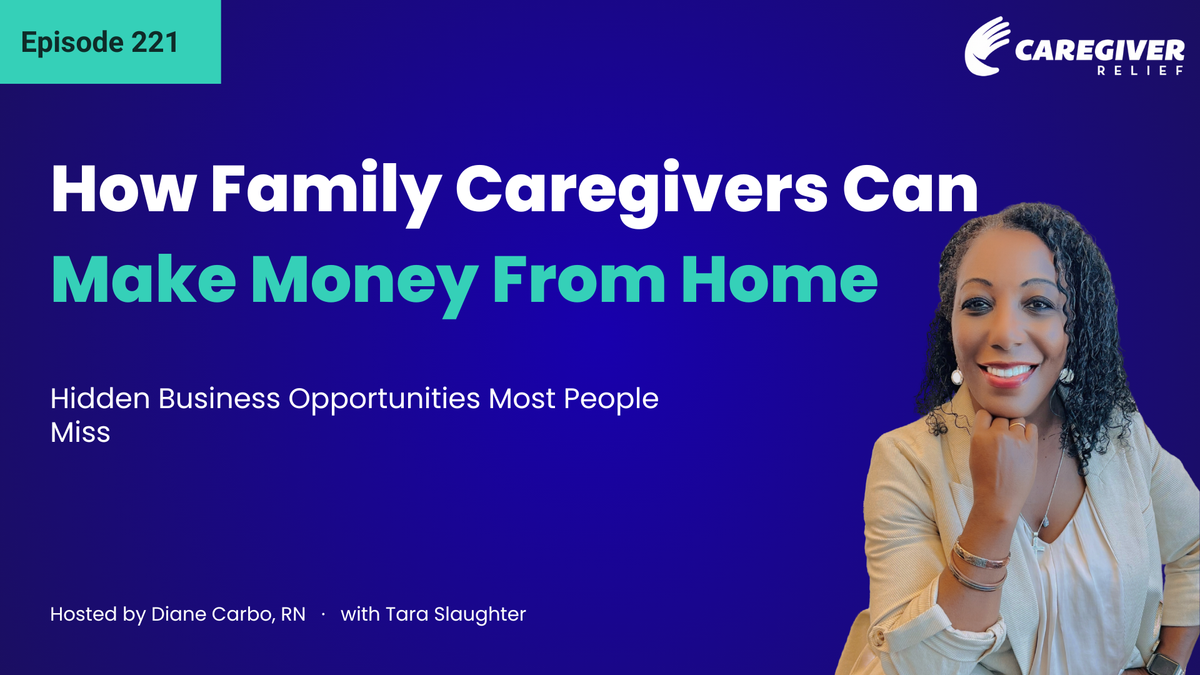
In this eye-opening episode of the Caregiver Relief Podcast, host Diane Carbo, RN, sits down with Tara Slaughter, a seasoned healthcare entrepreneur and government contracting specialist. Tara pulls back the curtain on a massive, hidden economy that most small businesses and caregivers completely overlook: Government Contracting.
Forget get-rich-quick scams or expensive coaching programs. This is a real, grounded conversation about resilience, adapting, and creating a financial lifeline for your life during and after caregiving.
🎧 Why You Need to Listen to This Episode
If you think government contracts are only for massive, multi-million dollar corporations, think again! Tara explains how federal, state, and local governments buy everything—from medical equipment to T-shirts, pens, and even laundry services.
Key Takeaways:
- The Caregiver Financial Reality: Learn about the staggering statistics affecting family caregivers, who currently provide over $1.1 trillion in unpaid care in the U.S. alone.
- The Bidding Myth: Discover why 40% of government solicitations receive fewer than three bids—meaning the door is wide open for small businesses.
- The "Middleman" Strategy (Subcontracting): Learn how you can win a contract and subcontract the physical work to local businesses, acting as the project manager from home.
- Free Resources vs. Paid Scams: Tara shares her secrets on how to get business certifications for free through local programs, saving you thousands of dollars.
- Life After Caregiving: Why dedicating just a few hours a week to building a business provides vital emotional hope and a financial safety net for your future.
📋 Episode Outline
- Introduction: Diane introduces the harsh financial realities of family caregiving and welcomes healthcare entrepreneur Tara Slaughter.
- Tara’s Journey: From an 18-year-old activities assistant in skilled nursing to launching her own durable medical equipment (DME) company.
- Cracking the Government Code: How Tara unexpectedly discovered government contracting and won her very first state hospital bid for warming blankets.
- The Hidden Numbers: Breaking down the lack of competition in government bidding and how the government sets aside funds specifically for small, women-owned, and minority-owned businesses.
- How to Get Started From Home: Step-by-step guidance on registering via Sam.gov, obtaining your UEI/CAGE numbers, and finding your industry's NAICS codes.
- Reclaiming Your Identity: A heartfelt discussion on why caregivers need a passion project to protect their mental health and financial wellbeing.
- Special Program Offer & Closing Thoughts: Tara shares how listeners can access her low-cost training program, and Diane reminds caregivers to practice daily self-care.

💡 Notable Quotes
"The family caregiver is now the decentralized healthcare workforce in the country... providing care that once was provided by healthcare professionals." — Diane Carbo, RN
"The government buys everything you could possibly think of. Pencils, pens, paper, toilet paper... approximately 40% of solicitations receive fewer than three bids." — Tara Slaughter
"If you're taking care of your loved one and you've given up everything, and God forbid something happens to the person... what do you have to lean on?" — Tara Slaughter
🔗 Mentioned Resources & Links
- Sam.gov – The official federal portal to register your business and find government contracts.
- USASpending.gov – Public record database to see what the government is buying and who is winning bids.
- Tara’s Consulting & E-Book: Visit CFS Solutions DBS to download her step-by-step contracting e-book and learn more about her weekly support program.


🌟 Ready to listen?
Click the player above to listen to the full episode and start building your financial backup plan today! Don't forget to like, comment, and share this episode with a fellow caregiver who needs encouragement and hope.
Podcast Episode Transcript
Diane: Welcome to the Caregiver Relief Podcast. I'm Diane Carbo, RN. Many family caregivers are struggling financially while trying to care for aging parents, spouses, or loved ones at home. Some reduce work hours, leave careers entirely, or quietly try to manage caregiving and financial survival at the same time At the same time, many caregivers are searching for realistic ways to create income from home without falling into scams, expensive coaching programs, or unrealistic promises.
Today's conversation is about resilience, entrepreneurship, and hidden business opportunities many people never realize exist. Joining me today is Tara Slaughter, business owner of CFS Medical Equipment and Supplies Inc., and CFS Solutions DBS Consulting. Tara is a healthcare entrepreneur, a durable medical equipment specialist, government contractor, and advocate for s- helping small businesses, caregivers, and women entrepreneurs explore opportunities many people assume are out of their reach.
Tara's companies hold multiple certifications, including SBA certified women-owned small business, economically disadvantaged women-owned small business, minority business enterprise, woman business enterprise, small business enterprise, and DBE/SBE certifications. She also serves as a Metro/TBAC committee member, and works as a, both a prime contractor and subcontractor.
In today's episode, Tara shows how government contracting unexpectedly became one of the tools that helped stabilize her business during difficult seasons, why small businesses often overlook these opportunities, and how caregivers may already possess valuable skills that can translate into business and income opportunities.
This is not a conversation about overnight success. It is a conversation about adapting, learning, diversifying, and realizing it's never too late to create another lane for yourself.
Diane: Tara, thank you so much for sharing your information with me to you, all of us today, because I'm excited. This is one of the top, top requested information from my site.
A lot of caregivers say, "How can I make money from home?"
Tara: Yeah.
Diane: So
Tara: I'm sorry, go ahead
Diane: can you first share
Tara: Yeah, I'll Start over.
Diane: This is not a conversation about overnight success. It is a conversation about adapting, learning, diversifying, and realizing it's never too late to create another lane for yourself.
Tara, I want to, thank you for joining us today and sharing some, awesome information. one of the most common requests I have from my caregivers is, how can I make money from home? And the other thing I wanted to share with you that you may not be familiar with is that many of, you know, I do several podcasts a week, and the s- common thread throughout majority of my podcasts are a family caregiver identified a need, an obstacle, a challenge.
And they developed a solution for that. So many of them are already reaching out and starting companies.
Most of them after their caregiving journey. But, this may offer a solution for some to start something earlier. So
Tara: Exactly.
Diane: Yeah. So before we get started, I know I ramble, can you first share your background on how you became involved in healthcare and medical equipment?
Tara: Well, first of all, I started out hi, everyone. I always love being on your podcast, Diane. It's so amazing, and I of course listen myself and learn something new every single time, so thank you for having me today. But I started out in medical equipment, oh my gosh, I would say, what, back in 20 when I was 18, actually.
And so I started out in skilled nursing. Let me say that. I started out in healthcare in skilled nursing, and, being an activities assistant and working with seniors, and then I moved up. I think I was in that position maybe four months, and then I moved into social services, and then I was in the administrative office.
And so it was really awesome, and I would help, take the state around when they would check, medical records and things like that, making sure that everything was in compliant. I would also help a pharmacist who would come in to give pharmacy, medication to some of the, people who were there, and I would handle his billing and things like that.
And so it just led from that to me opening up my own business, doing workers' comp, doing personal injury cases. I would go to court, negotiate liens and things like that. I kinda it was like, I would say it's kinda somewhat self-taught, and just kinda just really loved, the healthcare space, and I just kinda just got in there and start learning it.
Well, in the process of me working for, I end up going and then work for a pharmacy, and then we would do liens for medication. in the process of that
Diane: Oh
Tara: Yeah, right? So we would do liens, for medication for workers' comp and personal injuries, and so we would start to have, people ask for, like walkers and wheelchairs.
And we're like, "Oh, we don't do that." And so I was telling the owner, like, we constantly get these requests. We should, I'm gonna look into it." And he says, "Oh, it's on you." And I took it upon myself to start researching and found out that there was a huge need for people needing medical equipment, like knee braces and, all these canes and things like that.
And so I did the research, but at the time. We, and then so I did the research also to see how we could bill the insurance for it. And so we started doing that. And so the state sent in one of their representatives down, and actually me and her became really good friends. And she taught me a lot about how to bill for it and all those things, and so the rest is history.
And so with that, I really loved it, and I just went ahead and just started, working with my, own company, opening up my own company rather. And then I did that, and then I left there and went on to work for Apria Healthcare, which was a great, was I think it was the best decision I could have made because I learned a lot, because Apria is one of the largest DME companies
Diane: Yep
Tara: out there, as Yep. And so I learned so much. I started out doing, with billing from them and just moved up to a Kaiser liaison for them, where I would sit at Kaiser. And so it worked with palliative care hospice teams. And so it was just an amazing experience. And so I just kept learning and going from there.
But eventually I was like, I still always missed being able to help people directly, if that makes sense.
Diane: Yeah. Yeah.
Tara: Because you, when you work for a company, there's only so much you could do when it comes to sharing information and resources, and I've always been that person. and I was, telling my husband like, I really wanna go back and, reopen our business and, for medical equipment."
And he was like, if this is what you wanna do, go for it." And so we did. So we reopened in 2019, and so the rest is history. And so now, but in the process of us opening, I had no clue about government contracts, like at none at all. And so around, I think about around 2021, we started to look into it.
We noticed that people kept talking about woman-owned business, and we're like, "Okay, what does all that mean?" And so we looked into some of the certifications for woman-owned business, minority-owned business, which is a small business, and those certifications, and then we just start working towards them.
And then they had this one out called the 8, which is a certification that, it's really hard to get. And, I think before, back in the day, it was maybe like 8,000 businesses in the US that had 8s, if I'm not mistaken. And then it dropped down to like about 4,000 or something. So now I think it's even less now.
We end up getting the 8, but it took me two years to get it.
Diane: What does that certification mean?
Tara: Well, the certification is where you, like for instance, like if the government is looking for a particular, service or product, they do what's called set asides. And so what they do is they try to help small businesses grow.
And in the process of that, having that certification, if you don't have that certification, you can't technically bid on that particular opportunity.
Diane: Got it.
Tara: Now, you don't need certifications to bid on any of these contracts when it comes to someone thinking like, "Oh, I gotta have these certifications." only if it calls for that. So I'll give you an example. If you go onto sam.gov and you see a solicitation, say they want wheelchairs, an example. And on them wanting one of these wheelchairs, it might tell you there's a set aside that'll say 8A, WSOB, what have you, right? Which is women-owned small business and all these things, HUD, all these things.
Now, there's a lot of things have changed, over the years, so you just have to go and see if, what those certifications entail as far as, you being able to get those certifications, right?
And but they will tell you, and then it'll have SB, which just means small business. And so all of those matter if you're trying to get a particular contract based on that particular set aside, right?
And so that's how. And so basically we end up getting all these certifications. We end up paying for these certifications, but in the process, after I've just kind of learned, I found out that I didn't have to pay for these certifications.
Diane: Ah.
Tara: Yeah. yeah. But you don't know what you don't know, right?
Diane: Yes, that's right.
Tara: You don't know what you don't know. And so now let me say this. The people who did it for me, they are amazing, and they're amazing today. But a lot of people don't have thousands of dollars to spend on trying to get certifications. They just don't.
AND especially if, you're a caregiver or you're trying to take care of your loved one, and you've already tapped out of funds anyways.
Diane: Yes.
Tara: and all of that too, a lot of this stuff is free if you go through your local state and federal, programs. And a lot of these things are free. Now, let me say this. I know sometimes people will say, yeah, but it'll take forever to get it done," and that's true. But if you don't have the money, and then if you can do some of it on your own, you can manage to do it on your own without having to spend a whole bunch of money.
I'll say that.
Diane: You know, I've learned that over the years. Like, I've never done any government contracts, didn't really. I always assumed, little did I know, that they were for huge corporations.
Tara: Yeah.
Diane: So I, and they're not. as you're telling me now, and, so I love that.
One of the things that I want to address is that, you were talking about, women over 50. And is a big target. Well, I wanted to share the, a snapshot of the typical family caregiver. The typical family caregiver, it, 75% of them live within 20 minutes of the person they're caring for.
61% of caregivers are women, and the average age of, the caregiver is 51 years old. So, you know, that is who is providing care. And, right now we have over 50 feeling financially trapped right now, and of these caregivers. What, one of the things that has occurred, and you mentioned statistics before we started here about the amount of money a family caregiver spends, on providing care.
Tara: Yeah. One of the data it says that $7,200 per year is paid out of pocket from, on caregiver related expenses. And so that's just one in 53 million unpaid caregivers are in the United States.
Did you hear that?
Diane: Yeah. And they provide 53 Yeah. And they provide $1.1 trillion in unpaid care. I wanna say that the family caregiver is now the decentralized healthcare workforce in the country, and, they are being, providing care that once was provided by healthcare professionals. So
Tara: Yeah
Diane: now, before we get into what, how we can help caregivers, make money from home, you mentioned that the government contracts helped stabilize your business during difficult periods.
What did that realistic look like?
Tara: Oh my gosh. Okay, so at the time, when we first started, one of my focuses when we first started the business was it's always been about helping, how can we help the community, right? And in the process of that, when we were, pretty much was selling equipment, like inside of the store.
But we find, found out that as time went on, things started to shift. So where people would come in and purchase some equipment, like your regular wheelchairs, your regular transport chairs and things like that, we started seeing a slowdown on that. And that was just not us, it was across the board. Because a lot, as we see now, people are going online, they're able to get, obtain it quicker.
They can get, anything for maybe a little cheaper and all these things. Unfortunately, getting it cheaper has been a, problem for a lot of people because those products, the quality of them aren't great. And if you're using something consistently, eventually it breaks down, and now you don't have anyone to fix it and all that stuff.
So that's a whole different topic. But
Diane: Yeah
Tara: that's what we were doing originally, kinda sorta. That's what the focus was. I've always done insurance. I know how to do insurance. I come from that world. But I didn't really wanna do it at the time, but we started to do insurance. So I'm like, "Okay, we'll do this insurance," and we did.
But then I started to see that even the products that we were providing just wasn't solving a lot of people's problems.
Diane: Yes.
Tara: And so, you know, but at the same token, now I'm saying, "Okay, now I'm starting to have these up and down things going on in the business" So how do we pivot? How do we diversify to try to stay above water now?
Because any time you start shifting things, then it takes time, right?
Diane: Yeah.
Tara: So I've always done resources, I've always done consulting, but I wasn't doing it as a service, if that makes sense.
Diane: Yes.
Tara: And so I started, we started shifting and doing things like, "Okay, Tara, you." And I was telling how people were telling me like, "Tara, I don't know why you're not consulting families.
I don't know why you're not offering these type of services, because you do it automatically anyways, and you should be offering it as a service to your business." And so I'm like, "Okay, yeah, okay." So we pivoted into that, right? But that takes time, too, right? Okay. So now you're doing all this shifting, and in the process it's oh my God, we're things are. You can see the heaviness on the business right now, right? So we started going into products that really make a difference, which were, your more innovative products that really move the needle for families, and really help solve caregiver problem strain and things of that nature.
But in the process of that, I said, "Okay, wait a minute. Let me see what, how this government thing can work." So of course, I already had got, spent the money on getting the certifications. We had the certifications, but what do we do with them? No one like, that's the part where it's just a struggle to pull out of people, is you have
Diane: Yeah
Tara: these certifications. How do they work for you now, right? And so that's when we start looking into it more. And I tell you, it's so crazy because there's this gentleman named, Desmond, and Well, he was doing it live, these live things on Instagram. And all this time I was researching, looking high and low, and I'm like, "Man," "how can I figure out how to make these certifications work for us?"
Like, how do you get these contracts? What do they. I had no clue. So one Sunday, I literally sat down and I listened to his whole entire spiel on Instagram. And I end up spending $1,400. It was the best $1,400 on business, I tell you, that I had spent. I have to be honest. Because he wasn't just selling, fluff.
Diane: Yeah.
Tara: And I've heard that a lot. He was really digging like telling you how to set up your profile properly. My profile wasn't set up properly. My... None of these things were done. So when I took his course, I literally learned all these things and how my profile wasn't set up properly and all the...
And so all of a sudden, I went in, took the time, I added all my put my profile in properly, uploaded my certifications I had, all these things. And mind you, you don't need certifications, found that out too, to get some of these contracts. A lot of them, actually. and then all of a sudden, I get this email one day out the blue, and I'm like, "I don't know if this is real or not."
And I'm real leery about opening emails
Diane: Yeah
Tara: that I'm not familiar with, because it's so much fraud and things like that out there. So you just never know. To open up a link, it could just crash your system. And so I'm like, "I don't know if this is real or not." So I called the state. I called the I literally called the office where it had sent, who had sent me this, proposal.
And they wanted something that I really didn't even sell. It was warming blankets. Now mind you, I have access to thousands of products
Diane: Yeah
Tara: with my suppliers. But that wasn't one of the things that I was really like, "Ah" That wasn't something I was really focused on.
Diane: Yeah.
Tara: And had never I had heard of them, but it wasn't something I would be thinking like I'm about to sell in my store, right?
Diane: Yeah.
Tara: Because it's not something different.
Diane: Well, not where you live, but if you live in Minnesota or something, it might be a good idea.
Tara: Exactly. Yeah. It's so crazy to find out the one of the state hospitals wanted these blankets. They called want there was machines, right?
Diane: Yeah.
Tara: So I'm like, "Oh my God."
So after I made the phone call to make sure that this person was real, and it was so funny, I'll never forget it. One of the ladies picked up, and I said, "Is here? Because I got this email, and I'm not sure if it's real or not." And she said, "Yep, she works here." And I said, "Oh my God, thank you so much."
And we laughed about it. And then I went ahead and proceeded to get the product. And so I was like, "Oh my God." So I did the research, looked at the scope of work, what they wanted, how many they wanted, and I contacted the manufacturer who make that product, and I made the deal. And I submitted it, and we won.
Diane: Oh, my. I was like, "Oh my God." I love you won.
Tara: And we won. I was like, "Oh my God," because it was just a form. You of course, you gotta read through it, make sure you fill
Diane: Yeah
Tara: out the form properly.
Diane: Yeah.
Tara: It's like this, Diane, you have to give them what they want. That's anybody. If you order
Diane: Yeah
Tara: something, you go on there hey, you have a request for something, right?
Diane: Yep.
Tara: You're gonna make it, it's a recipe for food or whatever, that you want a cake and you need the ingredients. Okay, can you get these ingredients for me to make this cake?
Diane: Yeah.
Tara: Yeah. So that's pretty much the, I like to give that analogy sometimes.
So basically, I looked at the scope of work, I filled out the paperwork they had attached, and I submitted it, and we won. And we kept winning after that. So I was like, "Oh my goodness."
Diane: That's awesome.
Tara: Yes. And so then we, I'm like, "This is some real stuff."
Diane: Yeah.
Tara: Like, you know? but the thing of it is that
And I was so mad at myself because I was like, "Tara, this has been out here all this time and you had no clue." Had I not listened to. Now mind you, a lot of this information is public record, but it's so convoluted.
Diane: Yeah.
Tara: His so many layers to it. Someone literally needs to take you and explain to you how these things work.
Diane: Right
Tara: Now, there is a lot of things out there and people showing people how to do it, but some of it, the cost is so crazy that it's like, who can really afford to do that, right?
Diane: Yeah,
Tara: Who can actually spend thousands of dollars to pay, for that? And, and I just feel like, okay, Tara, how can you give back?
How can you share this information? Now, let me say this. It's not easy. It's not... what I just explained is not a simple, oh, it just happened. There's a lot of layers that went into that, right? That being my profile being set up properly, making sure I had, I have the proper credentials, like business license.
You know what I'm saying? You do have to
Diane: Yeah
Tara: have those things in place. It's not something where you could just be like, "Oh, yeah, let me just hand this off." No, it doesn't work like that. You do need to have, a business, and you do and it doesn't have to be a corporation or anything. It could be a sole proprietor, you start it.
It doesn't take rocket science. It doesn't take a whole bunch of money. Now, you do need to have money in order to. So for instance, going back to that, those blankets, now, if I didn't have the money to get those, then I wouldn't have been able to get them. Like the warmers?
Diane: Yeah.
Tara: Yeah. They do cost, right?
But at the same token, there's financial, there's, different ways to be able to get that where you can, get companies, like funding and factoring companies that can help you with the financing and stuff like that. And again, you need to have your ducks in a row, making sure you have things in order.
But once you set those things up and you may be already running a business, but if you're not running a business, once you set those things up properly, then you have the opportunity to bid on these things. And it's so funny, I was telling you earlier, a lot of times people have no clue that you can look outside of your home and see construction going on, and you don't even realize.
You're thinking, "Oh, that's just the government," whatever. But a lot of time it's a subcontractor. Somebody a company, an example, say I do construction and I'm a business and I submitted a bid for that work, and now I have that work to finish. they buy, the government buys everything you could possibly think of.
Pencils, pens, paper, toilet paper. stuff that you wouldn't even believe that they can.
Diane: Yeah.
Tara: And it's record. It's public record. It's not a secret.
Diane: Yeah.
Tara: USSpend.gov. And not only that too, I've known people who don't even do govern, federal, on the federal level. They only do their state. Some people only do their county, their city.
Every level of the government buys products and services. You may be an interpreter, they have contracts for that. You may be somebody who have access to pens and toilet paper, they need that stuff.
Diane: Yeah.
Tara: That's how the government operates. So people think that it's just oh, they just go to the store and buy it.
No, they're actually putting solicitations out and they're contracting with small businesses or a large business. And the crazy part of it, Diane, is sometimes only two to three people show up
Diane: to bid on something
Tara: Yeah. They'll submit it, they'll
Diane: Online
Tara: they'll bid. And you go
Diane: That's amazing to me.
Tara: It's crazy.
Like, we literally just bid on a contract about two weeks ago, I think it was, and we were. It was us and another company.
Diane: Wow. Wow.
Tara: Right? Whoa. Now, that doesn't always happen, but a lot of times I actually have the average numbers of, that I think I have printed it out. I think it was, like, 4%, four out of five contracts only get bid on.
So for every
Diane: Wow
Tara: solicitation, only four, four out of five, I think, says. I think it was. What is it, like Oh, the average solicitation receives only 4.5 bids. Approximately 40% of solicitations receive fewer than three bids.
Diane: That's fascinating.
Tara: Yeah. 'Cause people don't know.
Diane: Yeah. People don't know. They don't know.
Tara: Yeah. But you have to put the work in, too. and that's the thing, too, I think, that, is lost in this, because how do you have to have work ethic.
Diane: Yes, you do. You absolutely do. And that's one You have to be able to not only be motivated but you have to be, disciplined when you
Tara: Yes
Diane: work from home and or start your own business. Because you don't build it and they come. It just doesn't happen. No. And even on the internet, you can put people think, "Oh, I can't do, I can't do this. I can't put my products up until I have them all, because the... I'm gonna put it on the internet and I'm gonna sell like crazy."
And then you go years without making sales, with, product growing old on your shelves because the way things happen. So I really appreciate learning about this. I really do. Now, I wanna ask you, Can you explain how small businesses, women owned businesses, or service-based businesses may be able to slowly explore these opportunities?
Tara: Of course. Yeah, so basically, if you have a now let me go to if you have a business right now.
If you have a business right now and you have your ducks in a row, when I say that, I mean you have your business license and you would go into sam.gov and you would create what's called a UEI number and a CAGE number.
It gives you the process and the steps to do it, and you can, it is gonna tell you exactly how to do it, or you can use your friend AI.
Diane: Yes.
Tara: Say I have this type of business, now how do I need to. I need to go into sam.gov and create and, and register and things like that, and how do I go about doing it?
And it's gonna tell you how to do that. So you do need to get registered first for sam.gov. So once you s- register, you're gonna put what's called your NAICS codes, N-A-I-C-S codes. So you're gonna take what you do and find out what NAICS codes goes along with what you do and PSC codes. Those codes determine what type of solicitations that's gonna be out there for what you provide.
But let me say this It doesn't mean that you can't sell, 'cause sometimes people, sometimes maybe the government's not buying what you're selling.
So let me say that, too, 'cause then not all the time that you may put in, you're like, "Oh, man, I didn't find anything." I'm... It's something out there.
You wouldn't believe it. I sold the government Samsung phones.
Diane: Oh, Lord.
Tara: It's public record.
Diane: Yep.
Tara: It's public record. If you go on the uspin.gov right now, you will see I sold Samsung phones. And yes. what does that have to do with medical equipment?
Diane: Exactly. Exactly.
Tara: So but if you can get it, and you can get it at a reasonable price, and your business is set up properly, then you can do what needs to be done to get them.
They need these services. They need it. And it was the Department of Defense,
Diane: Now, many caregivers are searching for ways to make money from home. And many have skills they already have that may transfer into a business opportunity. And some have, I have worked with, some amazing caregivers who, have an idea for a business, but they didn't follow through because they didn't, they were too afraid, or they
Tara: Yeah
Diane: thought they were too old. Or it was too late to start something new because they were in the throes of caregiving. But what you're telling me is that they can actually, start the process of getting into the government system and then- creating whatever their product is, creating a, looking for codes for it and seeing if they can come up with some, sales, to get started.
It is hard work, but I can see it working.
Tara: Yeah. So I'll give you an example. Say if, the person a caregiver has, experience in they, maybe they created, they, they do T-shirts.
I'll just say that, or cup holders or, pens and pencils or whatever. And they do graphics on them or what have you, right?
This is something they wanna do, and they create it, they know how to do it, and they do it well. Say the government or whatever agency may be looking for that. They may be looking for a graphic designer. They may be looking for someone who can do that and create. They may be having a game or something, the government, and they need somebody to provide those, T-shirts or pens and pencils or cups or what have you. Then there you go.
Diane: Oh, I bet there's a lot for. This is gonna be the 250th birthday for the country. I bet there were a lot of government agencies looking for stuff.
Tara: There you go. See, you get it, Diane, right?
Diane: Yeah. Yeah.
Tara: Yeah. There's a lot, there's all... Like, so for instance, we have the Olympics coming here in, to California.
Diane: Yeah.
Tara: And there's gonna be different services needed for all types of stuff.
Diane: Yeah. and the soccer. What is that? The,
Tara: Exactly. The World Cup.
Diane: Yes, all Yeah, the World Cup's gonna be there.
Tara: Yes. All of those things. All of those things.
Diane: Yeah.
Tara: The government is always cons Now, mind you, it's a lot out here.
When we first started, we were just trying to grab at everything. Oh my God, we were. We were like, "Oh, we could do forklifts," All this crazy stuff.
Diane: Oh, no.
Tara: But you can. Now, I have some
Diane: Yeah
Tara: associates who do those, and they've done very well. But that's not our... That wasn't...
We had, again, you figure out what you're, what lane that you're gonna be in.
Diane: Yes. Yeah.
Tara: Yeah. And we've had to do that throughout the business, period, whether with government contracts or non government contracts. On, we do billing for, we bill insurance for things. We do private pay. We do consulting for families and make sure they have the right equipment.
That's on a commercial private pay side. We work with assisted livings and facilities and, skilled nursing, all those things. That's on that part. But then on the other side, we, and the diversification of the business, is we provide products and services to the government also.
Diane: Yeah.
Tara: Because they need products as well, And if you can do, if you can bring on the, a good service or a product, you can do that. I'll give you an example. They need people to wash some of the military clothing I know you gonna think that's not, what? What is that? What does that have to do with anything?
Yes, those clothes have to be cleaned. So who's gonna do that? They put out solicitations looking for people who can get the cloth. Now, you might not do the clean- cleaning, but you can find cleaners that may can do it.
Diane: Yeah.
Tara: If you can, you sub the work out to that cleaners to do the work. You gotta find out how, and you got...
But of course, following the scope of work, making sure that they meet all the requirements. And if you can find the job to be done for them, then you talk to the, you reach out to that particular company and say, "Hey, company, cleaners, do, are you able to do this job here, this scope of work?"
And they'll look at it, and they'll say yes or no. Now, it's a little bit sometimes interesting because some people are already going after the contracts. I had to learn that too the hard way.
Diane: Yeah.
Tara: So you know, but again, most of our contracts we've hadn't, the, we didn't experience that where someone else, the same company we was reaching out to was doing, trying to get the contract too.
That does happen. But a lot of times it does not, right? 'Cause they don't have time for that. They're like, "Yeah, we trying. we already have clients. We not trying to..." and some companies say, "Oh, I wanna do government," but they will do the work for you if you call them ask them, and then you tell them what's needed and make sure they can do the job, and they'll give you a price on how much it's gonna cost.
So give you an example. You reach out to ABC Cleaners, and I always say reach out to three different either suppliers or service companies for whatever you're asking for. And then you say, "Okay." You get those quotes, and when you get that quote back, and I always say always get it in writing, right?
So you know what they're getting, sending you. And then you'd pick out which one, and then you put your little margins on it or what have you. Now let me say this. The government, this is taxpayers' money. So with taxpayers' money, it's gonna be lowest price acceptable. Now sometimes they also wanna see just not lowest price acceptable, but who has the capability to do the job satisfactory.
You know what I'm saying? so
Diane: Yes
Tara: they don't want just no fly-by-night, people or company, So you wanna make sure yourself that when you try to sub out work to people, it's companies that do have a track record of doing good service.
Diane: Yes.
Tara: So meaning you need to research that company that you're trying to reach out to do this work and making sure what they have going on.
Do your research on them. Push them through AI, Yep. And search, make sure, see they pull something. Is there any negative on them? Is there, how their reviews, all those things you do, to make sure that it's gonna be a good fit for them. And then guess what? You get the quote and you maybe put 3%, 4% margins on it.
Some people will put more. it just depends what you have going on. And then you can also sometimes too see a previous contract, a previous incumbent that won prior to you. And mind you, some of these contracts you can get for three, four, and five years. Especially
Diane: Wow
Tara: yes. Yes. I have one right now with San Diego for five years.
Wow. Now, it's on an as-needed basis, but guess what?
Diane: Yeah.
Tara: Something's better than nothing.
Diane: Yep, and you're gonna be the go-to person for companies. There you go for whatever their that product is.
Tara: Exactly. Exactly. Yeah. and I just wanted to... It's oh my God. Like, and when I see people charging so much money to tell people this stuff, but I get it, though.
I, mean, I get what, why, I don't know why they, why it's so expensive to tell people that, but information is expensive. I get that. I know that. But I just feel like with caregivers, and plus I'm in this space with helping people with resources.
Diane: Yeah. Yeah.
Tara: Yeah. For me, it's not my job. It's not my only job.
I guess, let me say that. So
Diane: Yeah
Tara: I help families and give them resources and information, so for me it's a pretty cut and dry thing for me to do it. But it's not my only job, if that makes sense. Like not just doing government contracts. We do my, our main focus is helping families, with consulting and medical equipment to solve their problems when it comes to their health.
Diane: Tara, the average I just want my listeners to understand that the average, caregiver journey is five and a half years. Now, that means average. There are more that are, like, some can be as long as 20. And, people change their lives to provide care for a loved one at great personal and financial harm to their health, to their health and their, financial wellbeing even. And there are times when you're in the throes of caregiving. In the beginning, it may be just intermittent, and, it's always intermittent and unpredictable.
But it's in those times that if you do have a business, that you can start a process and learn it so that over time, you can, become a successful entrepreneur. And, I think this is amazing. I'm learning stuff that I didn't know, and I think that, to me, this is exciting.
I'm thinking, "Ooh, Tara, you're gonna have to tell me more about this."
Tara: Yes. Oh, my God. You know what? It's so crazy too, because, I'm gonna be going live to, live trying to, do Q&As for people. and so they can ask questions or what have you. And then I do have a program where I started where you can join the program and have, you'll get full-on access.
There's a e-book too that you can download, and it tells you the beginning, what to look for, how to set up your, business, what to look for, your EIN number, your tax ID, things like that, how to go about doing that. That's ane-book that's on our website at cfssolutionsdbs.com. And then you're also able to join, the program.
It's, $24 a month, literally. And you get the e-book with no, at no char- well, it's included with the program. But then you get a call with me as far as, like, weekly, once a week. Now, my schedule's very tight, Diane, so this is like
Diane: I know
Tara: as you know. But, if it's only even on weekend, I don't have anything going on a lot as far as on the weekend sometimes.
But getting on a call, answer questions, and then they'll be able to email me questions if they have any, and things like that. And then there's also a part of the program, there's different, documents and, PowerPoints that actually show you what to do. And also too, I share with people the contracts that we've won.
It's public record. It's not a secret.
Diane: That's awesome.
Tara: Yeah. That's awesome. So it, there's no fluff here. it's just showing people, "Hey, this is what we've done," and, we've won contracts. And of course, we've lost some too, 'cause you don't win every one. And that's another thing I want people to know.
That this is not something where you, like Oh, if you're stressed for money, then it's not a good thing for you.
Because it's not something that's gonna, "Oh my God, I need that check today." It doesn't work like that.
Diane: Yeah. Yeah.
Tara: But it is, and people have made a career out of it.
I know people have actually quit their job to do government contracts.
Diane: Yeah. Yeah.
Tara: I ain't, I'm not that person, but of course, 'cause I have a, I do, My purpose is something totally different, and what I do, but I do love government contracts because it's still able, it's still helping people, right?
It's helping the government
Diane: Yes
Tara: provide services of what they need and, and hopefully save taxpayers money at the same time.
Diane: This is wonderful information. tell them how they can find you again, Tara, and I will put links to your sites on the page that we, of the podcast. And you can always find Tara's information.
And I also have an Ask the Experts section on my site, and if you have any questions for Tara, you can go through there as well if you can't find her online. we'll get her. We'll find her for you.
Tara: I am available, Diane.
Diane: I know. I'm laughing because, you are, Tara is like a hummingbird.
She just goes from, flits from one job to the next. I know. and one of the things I love is that you truly have a heart for good customer service, and you do have a giving heart, and, you always, are giving back to the community, and I think that's important. And that's why, I love this, and I'm like, "I'm going to look into this now."
Tara: I do. Oh my gosh. And what's so crazy too, 'cause I share it, and I really in the past, I really just I just don't really pay that much attention. But of late I'm like, how can we. 'Cause I'm always thinking about how to give back. Like, how do we give back
Diane: Yeah. Yeah
Tara: to give information.
Diane: Me too.
Tara: We know where the resources and all that.
Diane: Yep.
Tara: But when it comes to, I see a lot of, I deal with a lot of caregivers, and I deal with a lot of caregivers 'cause, they're coming to us to get certain things. Yep. And they're taking care of their loved ones. In the process of that, they've given up their jobs.
Diane: Yep.
Tara: They've, cutting hours. they're like, "Oh my God, I need something now." This is not something they can just do overnight, but it is something you can add on. And What I say, especially for caregivers, if you're at home, you're taking care of your loved one, it may be, I know you'll probably thrashed by the end of the day, but if you have some time.
And not only that too, Diane, I think that when you're doing that, it probably would, just adding something else too
Diane: Yeah
Tara: that's gonna give you hope.
Diane: Yes.
Tara: Because remember, if you're taking care of your loved one and you've given up everything
Diane: Yes
Tara: and God forbid something happens
Diane: Yeah
Tara: to the person you're taking care of. What do you have to lean on?
Diane: Tara, you know I consistently talk about life after caregiving. One of the things that, that is disconcerting to me is the family caregiver gives up their jobs, their outside relationships. They give up taking care of themselves and taking care of their own health.
And, and they give up, their even financial wellbeing to the point where they have nothing. So many of them have nothing. Many of them end up at or below poverty level because they haven't had an income. Many haven't. have no friends when they finish their journey because this is silly, but I tell everybody relationships are like a garden.
You have to water them and provide sunshine to them- on a regular basis to keep it alive. And, if you don't do that, they, those relationships just die off, and you're left alone. And, you also are in the middle of an identity crisis because your whole identity for years has been, "I'm the caregiver of my loved one," and now that identity is, "Who am I?"
Tara: Yeah.
Diane: So I really love the fact that this is something you can do over time, a little bit at a time. if you take a couple hours a week and you just set aside that where you focus on this, over time- and over time it's go you can build something.
Tara: Yeah
Diane: like I said, one of the most common themes through my whole, podcast series is a family caregiver identified something that, and provided a solution for it,
To provide, to share with other caregivers, so they don't have to, have, the, not meet the needs of their cl- person, their loved one. So I think that this is really a beautiful way to, for those that are, have an entrepreneurial spirit
Tara: Yeah
Diane: and for those that, are tired and weary of taking care of others and not taking care of themselves, this is a way to take care, rebuild yourself financially.
Tara: Yeah. D- exactly, Diane. I like how you put that because at that token, like you said, if you're, you just, if it's a few hours a day, a hour a day you put into it and you're like, "You know what? Oh my God, I like this," and now that too, you're kinda, You maybe have some hope there.
You know
Diane: Yes, absolutely
Tara: you have something to look forward to, and then you can share it with the loved one that you're taking care of, right?
Diane: Yeah.
Tara: "Oh, my God, Yeah. "I think I might win this contract."
Diane: Yeah, you know what? It is. Yeah, definitely. It absolutely. Yeah. But
I love this, and that's why I was so excited when you started telling me about it. I'm thinking, "Oh, my God, this is one of the most request." One of the biggest requests I have is, how can I make money from home? I'm, you know Yeah when I'm caring for somebody. So Tara, I really appreciate your taking time and, sharing your information.
Again, tell them about how they can find the e-book and the software package. Is that what it is that
Tara: Yes, it's a program. Okay. So if you go under Program if you go under CFS, that's Charlie Frank Sam Solutions DBS.com.
That's where you can find that at. You can find the actual, And you'll see it, too. As soon as you go into it, it's gonna have
Diane: Okay ...
Tara: the government contracting, how the government. You can download. And it's a preview, a free preview that you can actually read and look at it.
And then we, also what we did is we shared, a snapshot of contracts we've won- so that you can see that, too, and just get an idea. Not to say you can win those or whatever, but it's doable. I mean, it's stuff that you literally can get from places. I mean, like, it's not
Diane: you know what? If you don't try, you don't know.
Tara: Exactly. Exactly.
Diane: And, I'm willing to try anything and give it a shot. And if it works, yay, and if it doesn't, at least I tried. And I learn something from every failure I have.
Tara: Exactly. Exactly. And I have to tell you, too, don't give up.
Diane: Yes. yes.
Tara: You cannot give up, because I think a lot of times I had a friend of mine, he's so funny, I think he told me he had submitted 40 bids.
Diane: Yeah
Tara: Right before he was like, "What in the world?" I'm done,"
Diane: Yeah.
Tara: And right at that last moment, he won.
Diane: Yes. And after that, he's won, what, about, what, 2, $4 million. I think 2 to $4 million in contracts
Diane: Wow. Yeah
Tara: over the last few years. So he
Diane: Fascinating.
Tara: Yeah. Yeah. Yeah. Yeah. it's out there.
It's not this, not a get rich overnight. It's not a No you have to. It's like this: You can't give up.
Diane: Yeah. Yeah.
Tara: It's like anything else that you're working on, if you're in business, if you have someone you're taking care, you don't, you try not to give up. If you can just- Yeah ... one more day Just one more day to hang in there.
You can, you can accomplish what you need to accomplish. You just gotta be focused, and you have to be, persevere. Keep persevering and keep standing and keep pushing, because it's out there. And I'm telling you, like for me, I've wanted to give up a whole bunch of times. Oh my God, I don't even know if I can do this.
Just it's a lot sometimes, and you feel like just throwing the towel in. But then when that one more person that you help, right?
One person, ooh, I was just today, I was like, Not today. I mean, like, over when you're thinking.
Diane: Yeah.
Tara: That moment that you wanna give up, you got that person that you still need to help, and that's what keeps you going.
Diane: I did marketing and sales and different things. I sold a vocational school for head injury survivors. So I was literally putting heads on beds, on, on pillows in facilities.
Tara: Yeah.
Diane: And, I learned to think every no is getting me closer to a yes. the odds are in my favor eventually.
Tara: So true. Yeah. You'd be surprised.
Diane: Yes. And I was very successful doing it. I mean, how many people do you know need a vocational school for head injury survival, I just
Tara: Yeah
Diane: Yeah. So and that was about 20, 20, 30 years ago, and I did very well.
Tara: Yeah
Diane: it's just, it's just, you just have to have faith in yourself and faith in the system.
Tara: You do. You do.
Diane: Yeah.
Tara: It doesn't happen overnight. So but Diane, thank you for your. And thank your listeners for listening.
Diane: Thank you so much. I appreciate you. to my family caregivers out there, you are the most important part of the caregiving equation. Without you, it all falls apart. So please learn to be gentle with yourself, practice self-care every day, because you are worth it.
Caring for a loved one can be overwhelming — but you're not alone. If you have questions, big or small, our expert team is here to help.
👉 Click here to Ask the Expert
Our Resource section can help you find the information and tools that you need. We have courses, videos, checklists, guidebooks, cheat sheets, how-to guides and more.
You can get started by clicking on the link below. We know that taking care of a loved one is hard work, but with our help you can get the support that you need.
Click here to go to Resource Section now!
You might also like this article:
 Diane Carbo
 Diane Carbo
 Diane Carbo
 Diane Carbo
 Diane Carbo
 Diane Carbo