Caring Smarter, Not Harder: Zemplee’s AI Caregiving Revolution with Aparna Pujar - Episode 135
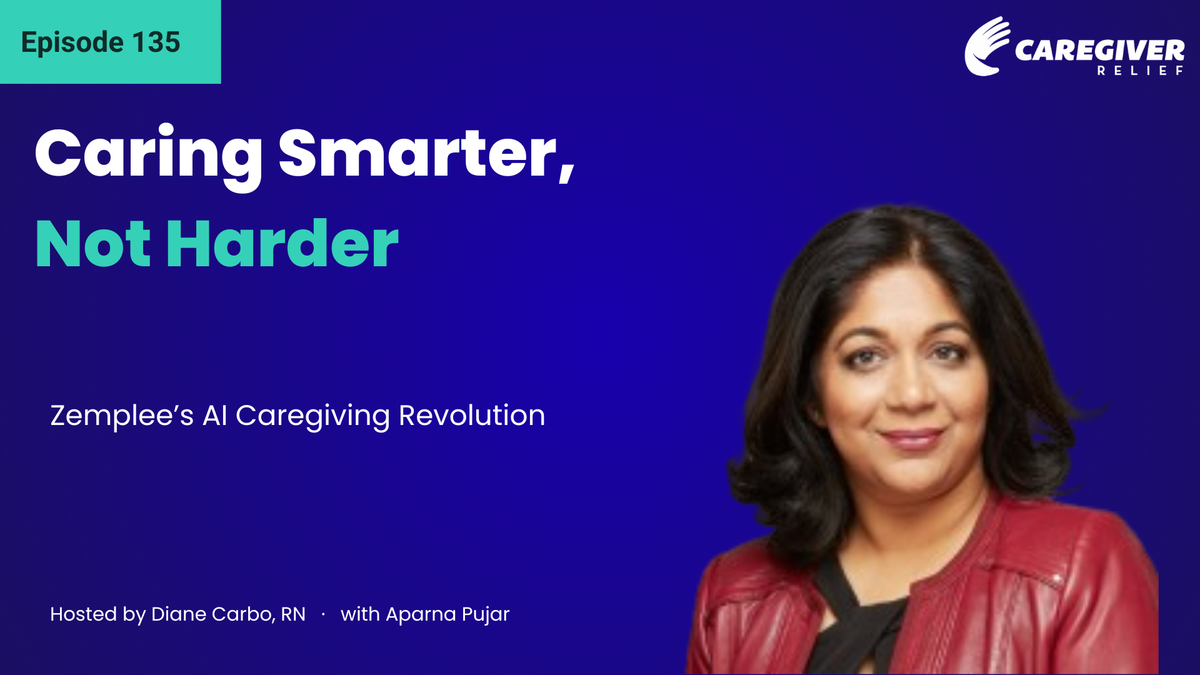
This episode of the Caregiver Relief Podcast features a fascinating conversation with Aparna Pujar, founder and CEO of Zemplee, an AI-powered platform revolutionizing elder care. Aparna shares her personal journey as a remote caregiver that led her to create this non-intrusive technology, and how it is helping family and professional caregivers provide better, safer, and more compassionate care.
The discussion dives into how Zemplee leverages AI and passive sensors to enhance caregiving without replacing the crucial human touch.
💡 Key Takeaways from the Episode
- Zemplee's Inspiration: Aparna was inspired to create Zemplee after experiencing the complexities of being a remote caregiver for her aging parents in India 🇮🇳. She realized the missing link was easy access to information and collaboration among the care team.
- Prioritizing Privacy: Zemplee consciously chose to not use video cameras 🚫📹 to uphold the dignity and privacy of seniors in their homes. The system is built on an array of passive sensors (motion, touch/pressure, door) that track movement and daily activities in the background.
- How Zemplee Works:
- Blueprint Tracking: Sensors are placed on walls, furniture, and appliances (like the refrigerator). They stitch together a series of events to form a "blueprint" of the senior's daily life.
- Anomaly Detection: The AI detects anomalies or significant deviations from the habitual blueprint (e.g., not waking up at the usual time) ⏰ and enters a "supervisory mode" to alert family members or facility staff for intervention.
- Enhancing Caregivers, Not Replacing Them: The tool is designed to make a caregiver's job easier by helping manage workflows and eliminating repetitive tasks, giving them more time for the qualitative aspects of care (the human touch) ❤️.
- Supporting Independence and Safety: The technology supports aging in place by monitoring for falls, missed meals, and changes in behavior without being intrusive.
- The system is non-intrusive and requires no training for the elderly person to use.
- It offers a sense of security and peace of mind for both the senior and the remote family caregiver 🙏.
- Addressing Social Isolation with Alexa: Zemplee integrated a customized Alexa device into its platform to combat loneliness 🗣️. It provides curated, voice-based entertainment like trivia, jokes, and music (listening to iHeartRadio or Daily Bread), which serves as a proxy for the system to know the person is engaged and okay. The care team can also "drop in" remotely to communicate with the client.
- Clinical Relevance: The data collected by Zemplee can be converted into reports for doctors 📄, providing evidence that can help refine a patient's care plan (e.g., showing a patient followed instructions to stay off their foot).
- Data Security and Privacy: Zemplee adheres to all HIPAA and HITECH rules 🔒. All AI is hand-coded and built on-prem (not using third-party tools) to ensure the data is only used for delivering value. The company maintains transparency and operates under the cultural mandate to always ask, "What would you do if this was your mom or dad's information or data?".
- The Future of Caregiving: AI will continue to improve operational efficiency in senior living, reduce the burden on the short caregiver workforce, and simplify documentation management 📝. Interoperability between systems (like Zemplee and EHRs) will also evolve to provide clinical providers with a holistic view of the person.

🔗 Connect with Zemplee
Aparna encourages listeners to visit the Zemplee website to learn more about the service.
- Website: www.Zemplee.com🌐
Whether you are a family caregiver feeling pushed beyond limits or a facility seeking to improve staffing and resident safety, Zemplee offers a powerful, non-intrusive solution.
Take a moment to listen to the full episode now to hear Aparna’s personal stories and learn more about this groundbreaking technology! 🎙️
Podcast Episode Transcript
Diane: Welcome to the Caregiver Relief Podcast, where we bring you insights, tools, and conversations to support family caregivers and aging adults. I'm your host Diane Carbo, a registered nurse, and today we're diving into the exciting world of technology in elder care. Our guest is Aparna Pujar, founder and CEO of Zemplee, the world's first AI powered platform that helps caregivers provide better, safer, and more compassionate care.
With a remarkable background in leading product strategy at eBay and Yahoo. Aparna is now using her expertise to transform how we support seniors, whether at home or in senior living communities. So join us as we discuss how artificial intelligence can make caregiving easier, safer, and more effective.
For everyone.
Diane: Aparna, thank you so much for joining us today. I know you're very busy. you've had such a fascinating career in technology. Can you share a little bit about your personal journey and what inspired you to create Zemplee?
Aparna: thank you all and thank you for having me on this show. I'm really excited to be here.
yeah. On, on my background, so I started my career as a programmer, so I have, served, worked in multiple roles, starting from a programmer, led engineering teams, led product teams, led business teams. So I've grown through the, in the tech industry, mostly working on technology platforms, building large.
Large scale technology platforms. Zemp actually started as a labor of love. I started Zemp because I became a remote caregiver for my aging parents who lived out in India. And just going through the day-to-day process of helping them. With their lifestyle and their needs and their care needs, was such a huge challenge for me because, part of it was they were halfway across the world.
Second of all, I, I had a, I was a mid-career executive, full-time job with kids at home, in high school age, kids at home. So realized the complexity of what it, what, A commitment to taking care of your aging parents, really was, and no one is prepared for this job, right? So you get into it and you are learning on the job, trying to figure things out.
And a large part of that, I felt was just this, the piece that was missing, right? Information, access and collaboration. because at any given point of time, I was relying on multiple people who had to give me inputs on, what's happening with my mom, what's happening with my dad, and that sort of set of people range from caregivers in the home to, clinical people.[00:04:00]
Physiotherapists. And to me it was just a matter of, tying all this information together so I could get a holistic view of, okay, this is what my dad needs, this is what my mom needs. And so make the right decision on their behalf. And I think in, in, regardless of, how the family and the social structures are, usually, an adult child is still required to make a decision on behalf of, the elderly parents.
I was, I'm, I have to make decision on this,I better have all the information I need because I don't wanna make thero, I don't wanna do the wrong thing. Definitely not for my parents. it became very personal at that point of time. And that sort of made me realize that, if I was going through this, imagine what a,a caregiver who's not connected to your family the same way is going through, right?
she's I have to, she has double the responsibility, maybe triple the responsibility of doing the right things for. Someone who's a paying customer to her. So I think as I realized, I could probably get away by not doing things on time, but a caregiver doesn't, right?
this is a professional relationship for her. So just felt like there was a need for, providing a tool that will just help with easy decision making, information access, better collaboration,and used all my knowledge that I had gathered through 30 plus years of my experience building technology products and brought it to this domain.
and. That's how Zemplee started. And I met my co-founder, who was also like a remote caregiver for his aging dad. So we just, it was a meeting of minds and we said, we gotta solve this and we gotta solve this the right way. And we had to bring the right technology to solve this. and understand, really it, the journey has been about just understanding the world of what a, a caregiver.
a caregiver, encounters, right? and then trying to find ways to see how we can be helpful to that person, and,in such a way that a, she feels. Good about what she's doing. First of all, she has peace of mind, the family that is caring for, for their elderly. loved ones also feel good about this and feel comfortable about this.
And then of course, the end, the most important person, the elderly person, right? how do we make sure that. They also feel good about this. So it's like a, you know what I call as,it's a village, right? So you have to bring all these people together and make it work for them. but two things that went into this was, we consciously decided to stay away from using video cameras, right?
As a, image recognition as a technology has been around for, the last 15, 20 years now. But we had to understand that, we were going to be in homes of these people. We had access, some parts of which was very private. And we consciously made a decision to not include video cameras in our on, in our server, because it's very easy to take a screenshot of something and say, oh, this person needs help.
So a, I think what we realized as we were, as we were going through this, was a large part of our, of the people that we serve are women. And as a woman, I felt I have to uphold the dignity. Like I don't want to be surveilled all the time. yes. how do I build a system?
How do I build a tool that allows me to uphold my dignity and my vanity? Right and still do what it needs to do in order to make sure that my, the people who are caring for me get a piece of mind, right? So I'm not starting to become like this, a concern for them. And yet the family also feels really good about, using the technology to do what they need to do.
So that's how, we came up with the product part. That's fascinating.
Diane: Yeah, we, it's fascinating to me because, I know I, I support family caregivers and seniors and, privacy, is one of their biggest issues. And I love that you took that into consideration when you were developing your product.
for those unfamiliar, what exactly is em and how does it work in a home or senior living center?
Aparna: Yeah. the product itself is, an array of sensors. So they are motion sensors. They are what I call as touch sensors or pressure sensors. Okay. And then they're door sensors, right? So we send a kit of sensors to a person's home, or if it's in a facility, it's either enterprise wide to a facility or even individually for a living unit in a facility.
And these sensors get placed on walls. they get ins, inserted into your appliance, into your furniture. And then, we have sensors that get placed on the refrigerator. So the design of the sensors in such a way that, we're not, they're passive in nature, right? They are in the background, observing you without really observing you, right?
Tracking your individual movements. And then every time you're moving from say, a point A to point B, or you decide to sit on a sofa or you're, opening a refrigerator door, it's stringing together a series of events. Then it stitches that together and forms, okay, here's a day in the life of Aparna or Diane for that matter, right?
Yeah. And then it uses that as a blueprint to start detecting anomalies. If habitually, you're the type of person who gets up at 7:00 AM and your next activity is, walking into a kitchen and grabbing a cup of coffee. It's Mapping that out, but for whatever reason, that doesn't happen.
Say it's Tuesday and you decide you didn't wake up by 8:00 AM the system gets into a supervisory mode and then informs someone, right? And that someone can be a family member or in an institutional setting. It will be the staff in a facility, and then they have the ability to now go. Intervene.
So how that, so for in the family case, it's very, if, especially if you're not, if your family's remote, they get an alert on their phone. And so obviously the actions that they can do is call and check on them, right? So simple, you. Or if they're nearby, they could drive home and check. and if sometimes we have seen people just, recruit their neighbors also to be this person to go and check in on them.
So we've seen like a little bit of that community part also build out as part of the rollout in a facility. It's a very, it's a more formal setting. So they change their workflows to manage an exception based,Intervention, with the resident.
Diane: So you're actually able to monitor, and detect changes in an older adult's, daily behavior or health?
That's correct. Yeah. That's fascinating. Now, caregivers often fear technology replacing human touch. How does Zemplee enhance rather than replace caregivers?
Aparna: we actually, the tool is designed for a caregiver, so this is to make a caregiver's job easy.
we don't foresee a world where, our technology will replace, replace a caregiver. For two reasons, because this is care and you are dealing with the vulnerable population. The human touch is an equally important part of,of this,delivery model. And we first of all believe in that 100%.
there are some things that our AI will not do. Like we, our AI will not help them with toileting and bathing. Yeah. that's something that a caregiver still ha is required. But to the extent that we can help the caregiver better manage workflow, her work, and then, help her, eliminate some sort of say, tasks that can, that the system can take over and do for her, giving her some time to, improve the qualitative aspect of care.
That, that's where we see a huge impact of. The tool, at the end of the day, any technology is a piece of tool. It's a tool. it's how you use it and how you derive the benefits from it that dictates the overall quality of the end user's experience. The focus for us was always, that we do not want to, we went with the philosophy, so we don't want to teach the elderly people to adopt to a new technology, which is why the passiveness was.
Part of this, a because I had experimented my dad and my mom were my Guinea pigs when I was building this product. I, I gave them a lot of gadgetry, I gave them a lot of things, but the shelf life of those were. At best three weeks, I would, so I said I needed a system that didn't need, require me to train my mom and dad to use something.
Diane: Yes.
Aparna: And so that became, very easy because, the only people who learn about our product, are the caregivers and the staff. who, who do it anyway. they're more,they do it because they're used to using other tools. So adding another tool to their kit doesn't prohibit them from doing, and then there's only value.
So what we have seen with the tool now is, Some in an institutional setting, they're starting to rethink how to change their care plans, right? one, one big advantage of that is, Accu Acuity based care plans, right? Some people have high needs, some people don't have as many high needs.
So
Diane: yes,
Aparna: the data now gives them like a map of, okay, here is, Mrs. Jones and room number three or two, I need to assign, I need to change the way my caregivers schedule. My, my caregivers are, interacting with her. So that's what comes out of the data. So the data provides a lot of evidence and then that drives the operational rework, in the facilities in the home setting.
It's really, peace of mind. the fact that, if I'm not somebody's watching my mom or dad. makes a huge difference,I
Diane: can see this being a really good, product for people that are working caregivers and long distance caregivers especially and there's so many, because it allows those from far away to monitor and see things going on in the house or, and as you say, it picks up changes in.
That in behaviors, and that's really important. 'cause the biggest things are you worry about falls, you worry about them not eating, you worry about them, having social interaction. And, one of the things that I do, Aparna, is I encourage people to develop a care team partner approach. Have people that you can count on to help with practical assistance, Making meals when you can't get to it or taking the dog for a walk or, picking up medications for you and stuff. So I really see this as a real plus for a lot of caregivers to, able to be able to even leave the house to run to the doctors themselves and not have to worry about what's going on because they can be alerted if.
Somebody's if their family member gets up and moves and they're not supposed to or something, it would be, a big impact, for them to be able to run home and or call and say to the one of their care team partners, Hey, could you check on mom while I'm at the doctors? that's really important.
Aparna: Absolutely. Absolutely. Yeah. and one of the, one of the things that we did, and this was, looking back, it was absolutely the right decision we made was we brought in Alexa and integrated it with our technology platform. Oh. So Alexa has been, a great component, for us to be able to interact with the end user.
And it's voice-based. It's very simple to use as a video. if they, if optionally they wanted to turn it on and, one of the things we were. Trying to address at that point of time is, how do I make sure that this person is engaged? So some, so sometimes when you have technology and you're collecting all this data, you tend to forget that there is a human aspect to this.
Yes. So we incorporated Alexa and. We worked with am we worked with Amazon, we are one of their developer development partners, and took the Alexa Smart Properties component and brought it into the home care market. And one of the things that we do now is we, program Alexa. it's a customized Alexa device for the, for the senior in the home.
We. We send a lot of prompts, like from our system into Alexa, so we could activate trivia or, funny, jokes and they,appear on your Alexa screen. And then, the, we can now, when we, when people engage with that, we know that okay, they're entertained, right?
So entertainment is a proxy for us to know that okay, they're okay. Not feeling lonely. and it addresses some aspects of anxiety as well. And it's just a fun thing. we've had, use, we have had very interesting stories where, one person actually prompted Alexa to give her like a knit, a crochet knit pattern, Uhhuh, and she knitted whole sweater just using the Alexa.
there are these fascinating stories we hear from our users. That just are simply stunning, right? We would've never imagined that to be an application. But, we know that, our, most of our people, are listening to our daily bread, for example. and that then we know, okay, there's the faith aspect that is being addressed through that.
They're listening to iHeartRadio. So we know that they're entertaining themselves and they can, we know we, they can change the channel. I don't like country, I'll use rock. So Alexa itself brings this entertainment component into the home, but it's curated entertainment. So obviously,we decide, we manage the programming part of it, so that, first of all, we ensure that it's safe and it's, it's HIPAA compliant.
we don't, because it's in a controlled setup. and of course the care teams are using Alexa to, communicate with the client so they drop in, they can check in on them in a remote world. So if, Zales shows something that is saying, okay, I'm not seeing something, this person needs attention, they will just use,a nurse station version of the Alexa to drop into the client.
No matter where they're in the world. So we have people going across the country now, someone sitting in Minneapolis is, can drop into someone in Florida and check in on them.
Diane: I love that. 'cause one of the biggest issues we have with our aging population is, social isolation and loneliness and it's rampant.
And, I love that you're addressing that because seniors, they need that help. And we don't have enough youth to take care of our seniors, so everything's falling on the family caregiver, which is putting a lot of pressure on the family Caregiver. so this actually helps support someone if they wanna age in place.
I, it's obvious you support independence and you're trying to keep seniors safe. How do you do that? what, like how do you support the independence but you're keeping them safe? what, can you tell me a little bit about some of your programs and what they entail for the home in the home?
Aparna: Yeah. So there are two way. So let's say, first of all, if you've decided to,In place, decided that you want to be in your home. you basically work with one of our partners and say, Hey, usually it's a family conversation, right? So the family also, decide, and then you work with one of our partners to bring em into your home.
So we work with,home care agency partners, across the country who will provision, who will set it up and, make sure it's working fine. there of assistance that we give. but there are two ways it can happen. We ship a kit to your home. You either a son or a daughter can install it.
it's very simple to install. We pe there are peel and stick sensors, peel and stick sensors that go on the walls or on your furniture, turn on a switch. there's a hub that collects all the data, so the technical part is very simplified. The minute you turn on the hub, we know you are live and we, it comes on, the data starts coming into our system.
and then from there on, it's on autopilot, right? we program who needs to receive the alerts, et cetera. So it's pretty much, a very, curated step to onboard you. when you work with your, our agency partners, they'll work with you. they go through a traditional intake form, they make sure you're the right candidate for it.
so that's on. And then we support both private pay models and then we are also working with different states on a special program that is sponsored under Medicaid HCBS waivers. So if you are a waiver patient, there's a way you can have Medicaid, pay for this product. Wow. Yeah. In other situations, and, an ideal candidate also someone who's in nursing home and, wants to go back into the community and live by themselves, they would be another candidate, the typical candidate for us to give them, because, a, it helps them provide the continuity of the nursing home through a remote care model.
Diane: Wow. Can you share an example or a success story or ex simply prevented a crisis or improved the quality of life, for somebody that, a senior that was out, that signed up for your program?
Aparna: oh yeah. there is a video on our website. this is, so we have a bunch of, testimonials on our website.
So obviously I think we love the crochet example that I talked to you about it. I love that. Yes. Out of the, it's something unique and different. couple of interesting ways how, people have used it as, Obviously the data collected from Zemp can be, con converted into a report and, you can bring that report with, show it to your doctor.
So in clinical settings, you can take that data and, work with your doctor to say, so one example was, someone who had just. Recently moved back from, a surgery, from a hospitalization into home. And, it was, it was something related to their foot. I can't obviously, share a lot of details.
But this was a di diabetic neuropathy related,procedure. And then the doctor had, in, had instruction was that, they should not put pressure on their feet, so they should not be walking. But there was a complication of the clinical,situ, clinical, incident there. And so the person actually took a report from our system and the system showed that, he used to be in bed eight hours a day and only would get up and walk when he had to go to the bathroom.
So he was able to show the doctor,Hey, I haven't been using my foot. The clinical, whatever is happening right now is not because I have not followed your instructions. so there, oh, I love that. yeah, so that sort of helps with, the care plan as well.
a lot of, people. Really like the independence part. mostly when we work with, with, women, aging women, they just like the fact that somebody is,there somebody other than themselves is caring for them, right? So it's not a person, but there's a system watching them.
So there's definitely I think, peace of mind for them and they just feel a security aspect, right? So that's a big part of what they feel. Just the notion that I'm safe, I
Diane: understand that because our so many seniors feel alone in their homes. And I can tell you right now, I have many seniors that have fallen and laid for.
Not just hours, but sometimes days. Because the family didn't check on 'em. So I really like this, approach where you're like overseeing, but you're not intrusive. Exactly. And I think that's gotta be very comforting to a lot of seniors. 'cause there's a lot, most seniors are very private.
They don't want anybody to tell 'em what to do, where to go, when to be there. they just wanna do what they wanna do when they feel like it and they feel. I, of course, as a nurse, I would say, I'm always told, you're so bossy. Yeah, I am. But this way, you could, I could actually leave somebody for a short period of time and feel confident that if there is an untoward episode, whether it's a fall or whatever, That, or if they haven't gone, they haven't eaten in for a few hours or they have 'em into the refrigerator, that I'd be alerted. So I could say, either call my care team partners and set one of them and say, Hey, could you run over to see my dad? he missed a meal today, I think, and I just wanna make sure he is okay.
those kinds of things. So I really like that and I, I can see how a fam it would give a family caregiver, that's even in the home with their parent. or even next door. And, they're trying to let that parent have, independence, really give them,a sense of confidence that, everything's going to go well.
And if it doesn't, they're gonna be alerted.
Aparna: Yeah. And I think one of the strongest, value proposition, each of the stakeholder gets to do what they want to do. The family can do what they want to do, Yeah. The senior is, can go about their lives and there's a system that's managing, not through technology, managing the relationship.
That's what we, that's what we like about it. can AI get to a point where. it can replace a caregiver. My answer, at least as of today, is never, I don't think,the emotional quotient of what a human can do, especially for. Caring for your elderly is way out there. I don't even see it.
I don't ever see that happening. Yeah. Only from my perspective. And I think as a society, we wanna encourage that. We don't want to robotify the care. no. so we feel like. so our focus is always, how to be sensitive to that, right? Yeah. I don't want to replace everything that a human can do, but how do I make a, the combination of that, exponentially better, and manageable, right?
At the end of the day, as a son or a daughter, you do have your own responsibilities. you have to care for your families. you wanna go on a date, watch a movie, et cetera. You wanna be able to do that. but not be worried about your elderly parents while you're doing that. And I do have a lot of friends, who,even socially in my own life, when we all have friends who have aging parents, and we see this, right?
we have to leave at nine o'clock because, mom is alone in the house. So
Diane: a and a mom that's had two sons and I've cared for my dad. My mom died when I was young. I have to tell you. I can see doing it in my own home while I'm at my dad's. So I know where my seniors, my, not my seniors, my teenagers are.
I can see that. 'cause I had boys and they were challenging and if they're supposed to be home in bed while I'm at, overnight at grandpa's. They're not there. this would be a great, but that's just me being looking at the, applicable side for, people that have so many are sandwich, the sandwich generation.
Like you, you had your seniors or your seniors, your parents, but you also had adult or children that were. In high school and stuff. And, so I can see that it would be, it would be good to have two packets, one for one house and one for the other. That's just my creativity.
Absolutely. Yeah. Yeah. So now data privacy is a big concern with technology. How does Zemplee ensure that the senior's personal and health data stay secure?
Aparna: so first of all, from a policy standpoint, we, we implement and, apply all the HIPAA and high tech rules, for our product. So going into the technology itself, we decided to lean in towards the HIPAA side.
so the data that we collect is. Only used for delivering value to the end user, which is either the caregiver or the elderly themselves. We don't share data with anyone. Because we don't need to. also it's very complicated, to find other applications for the data. So anything that we do is either going into research because that's, we do take that data too.
Train our AI models and everything that we've built is, is what is called as on-prem. So it's our own technology. We don't use any third party tools. so we handbuilt all our hand coded and built our, entire AI application. So it's private from that standpoint. The data, we again, Until we know for sure, where we want to, explore further with all some of this new technology that's coming up, like language learning models, et cetera. We're going to tread carefully, predominantly trying to keep privacy as one of our main, Main vector for that matter. the other way, we also are very transparent about what we do with the data.
when we are using it to train our models, we, if someone wants an explanation or reasoning of how we are doing it, we are more than welcome to share with them, how we. So we make transparency a big part of, our value proposition to the customer. and again, in terms of just the security infrastructure, et cetera, we use the best of the best where we use Amazon, for our hosting and use all, All kinds of, data security, data compliancy, protocols that are needed to ensure that the senior is safe in their home. and part of the reason why we do that also is, in addition to not just being, addressing the technology aspect of gathering the data, We also uplevel it by a little bit by saying, we are custodians of this data because oftentimes we work with clients who really don't know.
What this, what decisions they should be making about the data. So for example, I think one of the culturally in our company, what we say is we always ask the questions, what would you do if this was your mom or dad's information or data? So that culturally that brings that extra level of, Scrutiny on everything that we do, and that I think is important, especially if you're working in the senior space because, the laws are changing so frequently, in today's world, that having this, do the right thing and step. Go a step beyond and always question, would you do this if this was your mom or dad?
So answer is obviously no. And so that's, that's how we, that's how we ensure that whatever we do is 100% safe, reliable, and, trustworthy. that's our story on the transparency side. Looking
Diane: ahead. Looking ahead, how do you see AI shaping the future of caregiving or senior living over the next five to 10 years?
Aparna: so obviously we see a lot of, com,providers adopt more and more ai, I think to the extent that it is helping them with improving operational efficiency, reducing the burden on an already short, short caregiver workforce. Yes. making it simpl simplifying things for them.
So they can do, more with less. and that's the best use of technology, right? it helps with improving productivity, it helps with improving operations. I think documentation management is a big part where we see a lot of AI come in and help,with doing repetitive redundant tasks.
We also integrate with EHR systems. So whatever we collect in our system, if it has clinical relevance, we can push it back into a patient's health record. So a clinical provider who is seeing this data can also get a holistic view of this person. So I see a lot of that, the interoperability between systems, evolve.
Oh, that's fascinating. In the next 5, 10, 5 to 10 years in general, I think,the lack of financial support, and the lack of human resource support makes this a great candidate for bringing lot of automation and AI into the mix. And I think it, it'll only change for the better.
And we are already starting to see that. And we, it's only gonna get better. That's how we feel.
Diane: Zemplee is definitely something, that we need in the senior. industry, care industry, family caregivers are pushed beyond limits. They're expected to do things once done by, Healthcare professional.
So I don't know if you know this, but 63% of family caregivers become seriously ill or die in the US before the person, they're caring for passes. And I love the ability to be able to have people monitor more than one person monitor a senior's home. I just think that's really important. Aparna, how do they find Zemplee and learn more about it or find you?
Aparna: So the best way to find us is to reach us on our website,www.Zemplee.com. and where and if you are in the region where we are, offering the services, we'll connect you with a local partner to, get the conversation started about bringing Zele into your home. And if you're a facility,we work with, we'll work with you directly of, or one of our regional, representatives.
Who, who can help you with your scoping out. so the facility installations are a little more involved, but we do have regional representatives who will work with you to, to bring and onboard the product into your, organization. So we are currently available nationwide, so you know, no matter where you are, our theme has always been being remote, so we can serve you wherever you are.
Diane: I, I love that, especially, with assisted living. I, they are,with the memory care units and stuff, they're not, staffing to acuity level and, they're leaving patients in bed too long or they're trying to keep them from falling and they don't have, they don't wanna use alerts anymore, fall alert alarms.
So I love this ability for a facility to say, oh. Mr. Smith down the hall just fell, or he's trying to get out of bed even. Let's get up, get you there. thank you so much for sharing your information. I'm really excited To my listeners out there,
I just want my listeners to know that there is, we'll have a link to the website and we will also have a, the video that was referred to earlier in our podcast, because I want people to see. Product because it's amazing what it is accomplishing to my family caregivers out there, you are the most important part of the caregiving equation.
Without you, it all falls apart. So please learn to be gentle with yourself. Practice self-care every day because you are worth it.
Caring for a loved one can be overwhelming — but you're not alone. If you have questions, big or small, our expert team is here to help.
👉 Click here to Ask the Expert
Our Resource section can help you find the information and tools that you need. We have courses, videos, checklists, guidebooks, cheat sheets, how-to guides and more.
You can get started by clicking on the link below. We know that taking care of a loved one is hard work, but with our help you can get the support that you need.
Click here to go to Resource Section now!