Caregiver Guilt and Shame: Why You Feel Like You're Never Enough (And How to Break Free) with Judith M. Pilla - Episode 211

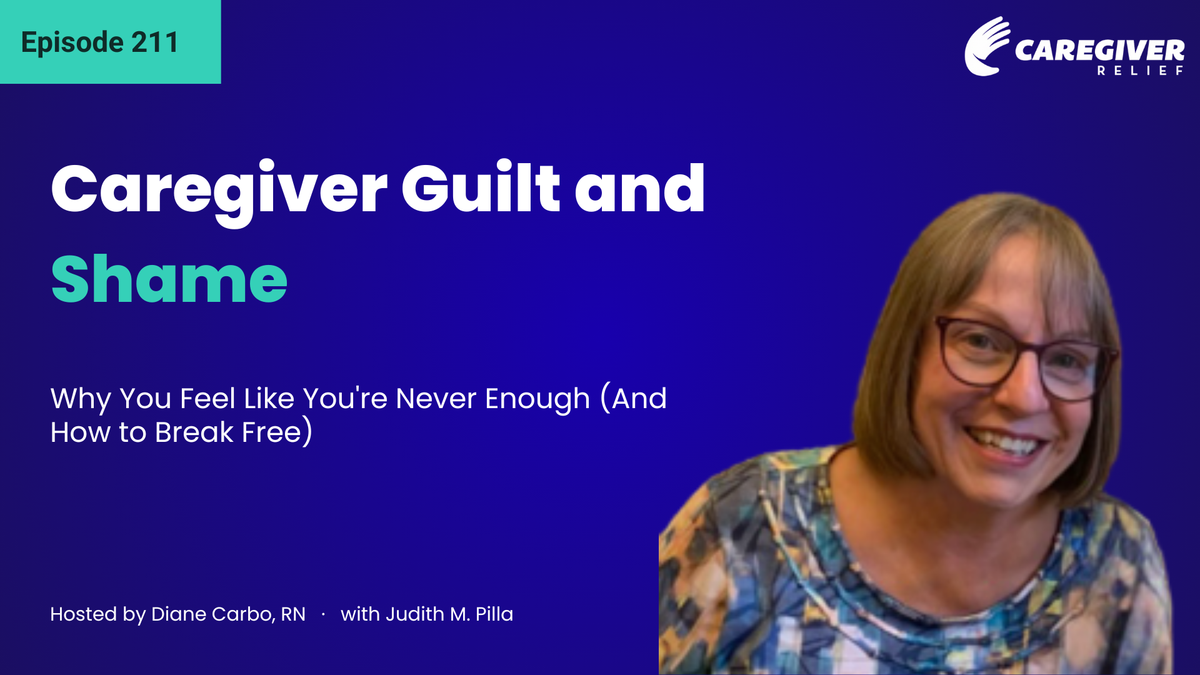
In this groundbreaking episode of the Caregiver Relief Podcast, host Diane Carbo, RN, sits down with Dr. Judith M. Pilla, a psychotherapist with over two decades of experience and author of How Shame Runs the World. Together, they pull back the curtain on one of the most powerful, destructive, and least-talked-about forces in caregiving: Shame.
If you are feeling burnt out, judged by uninvolved family members, or trapped in a cycle of resentment and exhaustion, this episode is your roadmap to emotional freedom. 🕊️
🎧 Why You Need to Listen to This Episode
- The Secret Code: Learn how to instantly tell the difference between guilt and shame (it changes everything!).
- The "Shame Bath": Discover why being an excellent caregiver actually makes you a target for other people's emotional trash.
- Stop Baking "Marble Cakes": Unpack Dr. Pilla's brilliant metaphor for how we mix healthy and toxic emotions, keeping ourselves paralyzed.
- The 1937 Warning: Hear the shocking truth behind the phrase "Shame may be fatal" and how it directly impacts caregiver mortality rates.
📋 Episode Outline & Key Takeaways
1. The Lightbulb Moment: Shame is Not Innate 💡
- A Foreign Object: Dr. Pilla shares the revelation that no baby is born feeling ashamed. Because shame comes from the outside, it can be unlearned and completely removed from your life.
- The Code of Silence: Why society—and even graduate psychology programs—silently avoids discussing shame, leaving caregivers to suffer in isolation.
2. Guilt vs. Shame: What Are You Actually Feeling? 🔍
- Guilt = Your Actions: "I forgot to fill a prescription." Guilt focuses on behaviors and is fixable, redeemable, and correctable.
- Shame = Your Identity: "I am inadequate." Shame is a permanent, heavy judgment about who you are. Because you can't walk away from yourself, you haul this burden around daily.
3. The "Shame Dumpster" and Family Dynamics 🗑️👥
- The Neighbor's Trash Metaphor: Uninvolved siblings and critical family members often carry massive amounts of unconscious shame (for not helping, for being repulsed by nursing duties, or for being absent). To feel better, they covertly dump their emotional trash at your feet.
- The Caregiver Paradox: The better you do your job, the more shame others feel about their own lack of involvement—meaning they will criticize you even harder.
- Spotting Family Tactics:
- The Charade: Disguising a controlling criticism as an "offer to help."
- The Vanishing Act: When a family member insults you, but completely shifts the focus to your angry reaction, making you look like the problem.
4. Pro-Social vs. Corrosive Shame ⚖️
- Pro-Social Shame (Vanilla Cake): The healthy, helpful boundary guide that keeps us thriving and making good choices (e.g., "I should be taking better care of my own health"). Use it, then lose it!
- Corrosive Shame (Chocolate Cake): Toxic messages from yourself or others designed strictly to demean you (e.g., "You're selfish for taking a break"). Refuse it, then lose it!
5. Reclaiming Your Life: Putting the Oxygen Mask on First ✈️😷
- The Balance Sheet: Dr. Pilla explains how to write down your life parameters side-by-side with the patient's needs. If it doesn't fit reasonably, you must set a boundary.
- A Healthy Caregiver Mindset: Embracing the truth that your needs are separate, valid, and deserve to be respected and honored just as much as the person you are caring for.
🛑 Self-Assessment: Is Unrecognized Shame Sabotaging You?
Ask yourself these questions from the episode:
- Do I frequently find fault with others or myself?
- Do I often feel unlucky, as if others possess a magic wand I was never handed?
- Do I suddenly feel "lesser than" or inadequate when using social media or around certain individuals?
- Am I terrified that saying "no" makes me a bad, irresponsible child/spouse?
"If you don't take care of yourself, you have no resources to take care of others. It's not just okay to think of yourself first—it is imperative." — Dr. Judith M. Pilla

🔗 Connect and Resources Mentioned
- Dr. Judith M. Pilla’s Website:
- How Shame Runs the World (Find blogs, events, and pre-order information for her groundbreaking book!).

💖 A final note from Diane: To all the family caregivers out there: You are the most important part of the caregiving equation. Without you, it all falls apart. Please learn to be gentle with yourself, practice self-care every single day, and remember—you are worth it.
Podcast Episode Transcript
Diane: Welcome to the Caregiver Relief Podcast. I'm your host, Diane Carbo, RN. And if you are a caregiver or you love someone who is, today's conversation is going to hit home in a very real way. So many caregivers tell me they feel like they're never doing enough, even when they're doing everything humanly possible.
They feel guilty for taking a break. They question their decisions, and often they carry a quiet sense that they're somehow failing. But what if that feeling isn't about what you're doing at all? What if it's something entirely different? Or what if it's something that has nothing to do with you? Today, we're talking about one of the most powerful and least talked about forces in caregiving: shame, and how it closely, how it's closely tied to the emotions and judgments so many caregivers carry every day.
Today, joining me is Dr. Judith M. Pilla, a psychotherapist with over two decades of experience and author of How Shame Runs the World. She's a leading expert on how shame shapes our thoughts, our feelings about ourselves, our behaviors, and relationships. In this conversation, we'll begin to unpack the connection between shame and you, what shame really is, how it impacts your decisions as a caregiver, how it's different from guilt, and that learning a secret code about shame will be the first step towards relief.
We'll also explore why caregivers are especially vulnerable to feelings of shame and guilt, how they contribute to burnout, and what you can begin to do to break free from that cycle without compromising the care you give. This is an important podcast today.
Diane: Dr. Judith Pilla, thank you so much for joining me today.
I'm excited to hear about this topic. What first led you to focus so deeply on shame in your clinical work?
Judith: Diane, first, I want to thank you for having me as a guest. If there's anything I can contribute to easing the responsibilities and experiences of being a caregiver, I welcome that chance. It's certainly an intense and a complex role.
I do think shame is a huge and important part of the caregiver experience, unfortunately, so I hope this podcast will bring relief to many I think there are three experiences that occur to me when considering why I've been focusing on the subject of shame for the past 10 years now. First, a revelation about a decade ago during a therapy session with a client that feelings of shame cannot be innate to us.
No baby is born feeling ashamed. That means shame must originally come to each of us from the outside. that hit me like a bolt out of the blue. If shame doesn't start from within, if it first gets embedded in us as a foreign feeling from outside, then ultimately it's a foreign object that's removable.
We can get rid of shame Second, when I started doing research about shame, I couldn't find much. The popular literature is really sparse, and the scholarly literature, it looks like a game of pick-up sticks. Books and articles piled up over decades pointing every which way, but not linked together in any coherent way to explain even the most fundamental ideas about shame.
Third, I started noticing that no one talks about shame. My clients don't, my colleagues don't, my husband, family, and friends don't. I don't. The subject of shame was never mentioned in graduate school books or courses. While people often talk about feeling guilty, everyone is silent about feeling ashamed.
What I eventually learned is that we're all too ashamed of shame to think straight about it or talk about it. We don't understand what shame is, we don't know that we carry a lot of shame inside, and importantly, we don't know how to get rid of it. So I became fascinated. What on earth is going on with shame?
Diane: I have to interject here. I am an adult child of an alcoholic, and I married, my second husband was Italian, and he used to talk about his mom going to, mother guilt school. So shame starts when we're children, I'm telling you right now.
Judith: It certainly does. It certainly does.
Diane: Now, caregivers often say, "I feel like I'm never doing enough."
Can you tell me what's really behind that feeling?
Judith: That's actually a great first question to lead us straight into understanding shame as an important topic. First, I'll contrast shame as different from guilt because all of us are familiar with feeling guilty. When a caretaker feels like he or she is not doing enough on a particular day or a particular week, that's a feeling about guilt.
Guilt says, "I'm not acting right. I'm not doing enough of what I should be doing as a caregiver." Guilt focuses on our actions, on our behaviors, on what we do. However, when you feel like you're never doing enough, no matter the day or the week, that you're relentlessly chronically behind the eight ball, you're actually feeling shame.
It's a much different feeling from guilt. Shame is about how you feel as a person. Shame isn't a judgment about what you're doing or not doing. It's a judgment about who you are. When you feel that your accomplishments are rarely or never enough, or that you often or constantly should be doing more, it's not that what you're doing feels inadequate, it's that you as a person feels inadequate.
Diane: Wow. That's, a very powerful statement there. So what's important for caregivers, to know about distinguishing guilt from shame?
Judith: Okay. When it's a question of guilt, when you're guilty of taking some wrong action, of doing something wrong, it's fixable. For instance, if you forget to fill a prescription, you can make a note on your calendar to remind yourself to fill it sooner the next time Even if it's a one-off mistake that can't be corrected, you can still help heal the situation by apologizing, making amends, or promising to change course next time.
Even if you're found guilty of a crime, you serve your sentence and then get released. Guilt feels redeemable. It's fixable. Not the same with shame. When you feel inadequate as a person, you carry that judgment around in you, and it's about you. It's a negative assessment about your worth as a person.
Since you can't get rid of yourself, with shame, you're always hauling it around with you. That's why shame is so heavy that we don't want to acknowledge it or talk about it. Shame feels like a permanent negative judgment about who you are. Therefore, we don't regard shame as redeemable. It doesn't feel fixable.
And I'll add a note here. My book can solve this problem.
Diane: I think you're a shameless opportunist. which I'm glad to have. There's a lot of important information that we're not gonna get to cover on this podcast.
Judith: That's right. That's right.
Diane: But I'm really relating to everything you're saying here. So why are family caregivers particularly vulnerable to shame?
Judith: For caregivers, the bugaboo about feeling inadequate, that you're never enough, is that in addition to you feeling that way about yourself, there's so many people around you that may be judging you the same way, telling you the same thing, or implying the same thing about you. I call this a shame bath. You feel submerged by feelings of being wrong, bad, inadequate, inferior, not measuring up, not making the grade, not being good enough
But there's a lot more to answering this question, Diane, and I believe my answer will make your listeners feel much better about themselves.
Diane: I hope so, Dr. Pilla because one of the conditions that, caregivers frequently have is they have judgmental, uninvolved family members, siblings, that are very cruel to them and make them, feel, shame.
I see it all the time, so I'm really, encouraged about what you're talking about here.
Judith: You make a very interesting and timely remark because that's exactly what I'm about to explain.
And here's a pivotal answer to this that's gonna shape what I say afterward. In fact, caregivers are particularly vulnerable to shame because they're doing their job so very well said. Let me explain that one.
Yes.
Okay. Dr. Gershen Kaufman is a psychologist who studied and written much about shame over years.
He says, "Shame is the most disturbing experience individuals ever have about themselves." yes, it is, and isn't that a tough load to carry? Most of us carry around a whole lot more shame than we're aware of. We're unaware because it's too painful to acknowledge how bad we often feel about ourselves, so we bury those feelings in our unconscious mind and deny them.
To try to cope, many of us attempt to manage our heavy load of unconscious shame by offloading it, by putting our shame onto someone else instead of ourselves. Very often, we're not even aware we're doing this Here we go again. In my book, How Shame Runs the World, I use a metaphor of a man with a trash bin full of his own shame.
His shame is piled high, and he wants to get rid of those awful feelings. Since he doesn't know how, he sneaks his overflowing trash bin across the street in the middle of the night and dumps his load of shame into his neighborhood's trash. He may not even realize he's doing this, like a sleepwalker, but he offloads his shame on top of his neighbor's trash bin.
When the neighbor wakes up in the morning, she can't explain the huge load of bad feelings that are now piled up on her curb. She has no idea how they got there, and now it's her responsibility to deal with them. This is a great metaphor for what happens for caregivers. The people around you, family members, close friends of the patient, as well as healthcare providers and others, have huge trash bins of their own shame, including shame about what's happening to your patient.
They have shame about not being there enough for the patient. They have shame about not contributing enough, shame about not knowing how to help, shame about not being willing to help, shame that they are repulsed by the nursing duties expected, shame that they're not relieving you. They may have shame that the patient is suffering instead of them.
And yes, they carry shame because they know they're being critical of you and all you're doing The huge trash bin of shame each of these people carries around is not something they wanna feel or acknowledge. In an attempt to get rid of those terrible feelings, they sneak across the street to your curb and dump their noxious critical trash bins at your feet.
They take up their own shame and foist it onto you. Maybe they do this directly by criticizing or faulting you. Often, it's done indirectly through innuendo, pointed barbs, snubbing you, ignoring you, or neglecting you. As I said, quite often they don't even realize they're doing it. Thanks to the psychological defense mechanism of projection, many people shame others unconsciously in an attempt to get rid of their own feelings of shame.
You know that friend who just can't help putting others down, who always has some remark about what you've done wrong, or who can always make you feel inadequate? That's her trash bin of shame being dumped onto you, and she may not realize she's doing it. However they accomplish it, some people will make sure you feel awful, that you feel that you're not doing enough or not doing it well enough.
I think it's fascinating, and also quite frustrating, to realize that the better you do your job as a caregiver, the worse you may be made to feel. After all, when you do your job so well, others feel more shame that they're not doing all that you're doing. Then they dump their shame at your feet.
Diane: I see this dynamic going on in caregiving all the time.
I've experienced as a professional nurse in the hospital, we always talk about nurses eat their young. And, that's very true. Nurses are cruel to one another often. And now I'm seeing it definitely in the family dynamic.
Judith: Yes.
Diane: So this explains why many caregivers feel resentment, but they feel guilty for feeling that way.
It's just a cycle. What's happening there?
Judith: The cycle can be broken. let explain what's happening.
Diane: Okay.
Judith: And at first, there's good news. The good news is it's healthy for a caregiver to feel resentful. Anyone who has to regularly deal with trash bins of other people's shame being dumped at their curb ought to feel resentful.
As a therapist, I'd be worried if they didn't feel resentful. It would mean they're not seeing reality correctly At the same time, caregivers can be perfectionists, expecting too much of themselves. They may think they should do everything well, treat everyone well, not complain, not feel resentment, not show resentment.
Also, they may feel so beaten down that they try to gain some self-esteem by trying to do everything perfectly, to be the consummate caregiver. They may insist on doing things their own way. They may resist others' help. They may ignore or reject others' good intentions or care In addition, caregivers may begin to treat themselves the same lousy way other people do.
Caregivers can come to trash themselves and be very self-critical. This poor self-treatment is based on caregiver's own internal loads of shame. Instead of hauling those loads across the street to dump on someone else, they keep their own load and their pile grows higher and higher. In these situations, there's a whole lot of anger in play for caregivers.
At the base of this anger, there's a whole lot of shame. Here are some examples. "No one will listen to me. No one can do this job as well as I can. I'm never allowed to complain. I'm never allowed a break. I don't get any respect." Each of these statements involves the caregiver not feeling good enough inside.
They're carrying a lot of shame themselves.
Diane: I hear many caregivers, say just those things, and I feel bad for them because, Dr. Pilla, they actually develop such intense rage inside them. It's incredible, and it just eats away at them. Is this how unaddressed shame contributes to caregiver burnout and emotional exhaustion?
Judith: Yes. Rather than acknowledging their own loads of internal shame, which again, none of us have been taught how to manage, caregivers suffer. Either in silent or in angry protest, caregivers burn out, become emotionally or physically exhausted, or get sick themselves. one of the illustrations in my book, it's a, is a healthcare poster from 1937 by a Works Progress Administration artist.
It's a healthcare poster about how when we feel ashamed about an illness, we may avoid getting medical treatment. In huge block letters it reads, "Shame may be fatal."
Diane: I know, I agree after listening to you.
Judith: I couldn't agree more also. Shame can kill. It can make us sick. At the very least, it can make our lives miserable.
If you're giving up so much of yourself and your own wellbeing to care for someone else, your life will become out of balance. When our lives are out of balance, there's always shame at the base. This is because shame, by definition, is an experience of feeling lesser than, of feeling undeserving. When life's scale is off balance, we feel lower than others.
Feeling lesser than is always an unbalanced situation where others somehow deserve more, get more, or don't have to sacrifice as much. Correcting such an imbalance can make all the difference. That's a question of healing your internal shame, a pivotal part of what I teach in my book and in my workshops.
Diane: Dr. Pilla, I'm not... I'm sure you're aware of this, but 63% of family caregivers become seriously ill or die before the person they're caring for because of the chronic stress. And now I realize it's the shame, the chronic shame that they're carrying that's a heavy burden. So what-
Judith: You know, I learned that statistic from your podcast, and I was astounded.
Except that it correlates so much with my research on shame. Your listeners might be interested to know about James Gilligan, who's a psychiatrist, a medical doctor, who for years was in charge of the whole Massachusetts state prison system, and he said he never saw an act of violence among prisoners that wasn't rooted in shame.
Diane: Yeah. I believe that. I believe that. So what are some signs that a caregiver is experiencing shame but may not recognize it?
Judith: I'm sure your listeners are familiar with making lists of things. So here's my list of questions caregivers can ask themselves to understand whether they're experiencing shame but may not be recognizing it Do I frequently find fault with others or with myself?
Do I feel or act resentful toward others? Do I anger easily? Do others say I anger easily? Do others often seem angry at me or put off by me? Do I often try to influence, persuade, or control others? Do others seem unappreciative or resentful when I try to help them? Do I envy others' lives or their circumstances?
Do I often feel unlucky, as if others possess a magic wand that has never been handed to me? Does anyone, including myself, often tell me I'm wrong or inadequate? Do I feel hurt or damaged by someone's comments about what I believe, think, or do? Do I feel controlled or disempowered by someone? Does someone ignore or negate my achievements, my lifestyle, my circumstances?
Do I suddenly feel lesser than, inadequate, unimportant, or wrong when I'm around a certain individual or when I use certain information sources, including social media? Is there someone, including myself, who expresses disappointment in me if I'm not always doing my best? Does someone find fault with me in ways that leave me feeling vulnerable, unsafe, or threatened?
If you answered yes to even a few of these questions, you're experiencing shame that's impinging on you and your functioning. There are more questions to ask yourself as well as explanations behind these questions. Where? In my book.
Diane: I can relate to all of these questions, and, I appreciate that giving my listeners an opportunity to realize that it's shame, not guilt that they're feeling a lot of times.
That's a big, important, point to make about this conversation.
Judith: Yes.
Diane: So what are some practical first steps caregivers can take to begin breaking free from guilt and shame?
Judith: In our society, breaking free from guilt and shame has been made very difficult because we don't think or talk about this subject in any clear way.
We don't think or talk about shame at all, which is where my focus is today. While I can only touch the surface in this podcast, you do have available what you need to break free. This is exactly why I've written Shame: How Shame Runs the World, to give you the tools to understand how shame influences your life and how to break free from it for good.
But let's start here with some first practical steps, and I'm gonna list three steps. Step one, take to heart this basic understanding about shame. Here it is. If you're feeling bad about yourself in any way, it's most likely because you're ashamed. This means that to begin breaking free of shame, you have to first recognize that shame is a fundamental problem for you.
Believe me, it is for most of us. So this acknowledgement is the place to start. If you're feeling bad yourself about yourself in any way, it's most likely because you're ashamed. Step two: Next, become aware of shaming messages you've been telling yourself. Shame shows up in specific familiar messages that you or others say to you.
These can take time to figure out, especially since you may have been hearing many of them over and over and in your head for years until they've become background noise. Here are some sample messages. "I often feel like an outsider. I regularly think I should do things better than I do. I tell myself I need more willpower.
Other people just seem to have it more together than I do. Other people are luckier than I am. For me, if it can go wrong, it will go wrong. I procrastinate a lot. I'm angrier than I want to be." These are just a few examples of the many shaming messages you may be saying to yourself and that you need to identify
Step three of three. The third step in permanently breaking free from shame involves referring to tools in my book, because this step needs a lot more explaining than I can provide fully in a podcast I lay out a stepwise path for eliminating shame that I call Five Steps to the Buddha's Moon. It's the first correct and comprehensive way available to you to solve shame, and it's groundbreaking simply because we haven't accurately understood shame before.
It works, and my clients will attest to it.
Diane: So you've talked about the secret code, you promised for solving shame. Can you share that secret with me?
Judith: Oh.
Diane: And, we'll do it quietly my listeners don't hear as well. We'll keep it a secret.
Judith: No, I don't wanna keep it a secret. It's been a secret, but my whole point is not to have a secret anymore.
So here goes. So again, although you really need to read the upfront of material in my book to understand how the secret code works, because shame is actually very complex. My job here is to make it simple. But here it is in a nutshell. There are two uses for the awful feelings of shame we carry around.
The first is actually quite beneficial, and we depend on this kind of shame every day, but we've never even heard of it. I call it pro-social shame, the shame that guides us toward good decision-making. I'll use a silly example to make this clear. It's actually pro-social shame that keeps you from getting fired from your job each day.
Diane: Really?
Judith: How does that work? Here's one way. I bet you would feel more comfortable and maybe even be more productive if you wore pajamas to your office each day. But pro-social shame makes you put on your business suit instead and tells you it's not acceptable to show up in pajamas. You'd feel ashamed to face your account team in your pajamas.
That's a simple example of pro-social shame at work. We use pro-social shame moment by moment all day long, but we don't even realize we're using it. Here's another example of pro-social shame. If you have a sibling who doesn't volunteer to help you out in caretaking, even though he has the time, he'll most likely feel ashamed, even though he well may never admit that to you.
Instead, you hear excuses. The shame he's feeling about not helping you out is pro-social. Pro-social shame is telling him that he should be making a different, better choice and pitch in. Since he doesn't even know about pro-social shame, though, he doesn't realize that it's important to listen to the message When we pay attention to all the messages of pro-social shame we experience, our lives improve dramatically.
Pro-social shame keeps us surviving and thriving in our lives every day, but we've never even been taught it exists. I don't want that secret to be a secret anymore.
Diane: Nope, we gotta break that yeah, share the secret.
Judith: Right. The other use of shame is what I call corrosive shame. This is shame with which you're familiar.
The purpose of corrosive shame is simply to make you feel bad, to insult or hurt you. Examples of corrosive shame sound like this: "You're irresponsible. You never do enough. You're too fat. You're too shy. You're too forward." Corrosive shame is never appropriate because it is never useful. It is imposed on you by others or by yourself only to make you feel inferior.
The secret code to solving shame involves understanding how to separate those two uses of shame, pro-social from corrosive. Once you do that, you'll be able to learn the helpful lessons of pro-social shame to improve your life. With corrosive shame, the task is the opposite. Your job is to reject all messages of corrosive shame because they're there only to hurt.
Their intent is always harmful, never legitimate. So in my method, Five Steps to the Buddha's Moon, I take you through the whole process of how to learn from pro-social shame and eliminate corrosive shame. In a nutshell, you'll learn if it's a message of pro-social shame, use it, then lose it. If it's a message of corrosive shame, refuse it, then lose it.
Diane: I love that message, Dr. Pilla. I have to tell you, most of my caregivers are demeaning, demoralized, they are ignored, they are told they don't do enough. They really are experience corrosive shame, for all the years that they're providing care. So I really get it. And instead of, And they all take it to heart, And it, it's the other, it's the people, their siblings and the extended family members that use that tool to keep them doing what they're doing and then, but not helping them in any way. So I like that. Refuse it, then lose it. I like that a lot. So how can caregivers set boundaries without feeling like they're abandoning their loved ones?
Judith: I think the first step in setting boundaries with family members and others, as well as with the person you're caring for, is to make an assessment about yourself. Think about your own life, your situation, what your own goals are, your limitations. Then consider your concrete needs, your finances, living space, relationships with spouse, children, parents, others, your own health and wellness needs, your time constraints and obligations.
For each of these subjects, decide, one, what you definitely need in order to take care of yourself, and then two, what you'd like to have in order to take care of yourself. It's important to take time to make this a clear written description of your life parameters. You deserve that.
Diane: Yes, they do.
Judith: Only after you've done that can you make a similar description of what the patient needs in all these dimensions.
Then, with both documents in hand side by side, compare them. Where do the patient's needs fit in with the time, effort, money, space, et cetera, that you have available to offer? Where there is no reasonable fit, you set a boundary. You say no to that need of the patient and say you're unavailable. For instance, if you have a full-time job and need to keep it, and the patient needs four hours of care a day, the patient's need infringes on something necessary for your life.
So you say no to offering such care. Perhaps you can say yes to two hours several evenings a week because your own children don't need you then Shame comes into this picture when we are worried we'll feel shamed by others or by ourselves if we say no. For instance, you might think, "I won't be a responsible daughter if I say no.
My mother did so much for me growing up. How can I say no to her needs now? My father has no money left and won't survive if we don't house him." In each of these situations, shame is at the root for the caregiver. You think, "I'll be a bad, irresponsible, insensitive, uncaring child if I don't do this."
Diane: Dr. Pilla, what you're explaining is the total opposite of what every caregiver in the country does. They don't consider their needs first. They consider the needs of their loved one first, and they put theirs aside, and it is causing havoc on their bodies mentally, physically, emotionally, and financially. So I really like that you pointed this out.
It's okay to think of yourself first.
Judith: It's imperative. And you know that old
Diane: Yes ...
Judith: that old phrase about if you're in an airplane, you put the oxygen mask on yourself before the
Diane: Yeah.
Judith: It's that. If you don't have, take care of yourself, you have no resources to take care of others.
Diane: Exactly. Exactly.
Judith: The shame that's showing up here in these statements, "I'll be a bad, irresponsible, insensitive, uncaring daughter if I say no," that shame is corrosive shame. It puts you down and makes you feel bad and serves no useful purpose. Telling yourself you're abandoning your loved one if you say no is a message only of corrosive shame.
It's there to demean you and make you feel miserable. You can learn to reject it. However, when you compare your list of needs with the patient's list of needs, you may uncover some messages of pro-social shame that you need to listen to but don't recognize. Here are some examples of messages of pro-social shame: "I should be taking better care of myself.
I feel unhealthy because I've gained so much weight. I know it's wrong for me not to make doctor's appointments for myself." These are pro-social messages that it's wise to pay attention to The problem is, and this is a very big problem, which you actually spoke of a few minutes ago, is that these wise lessons of pro-social shame get all mixed up inside us with the damaging messes of corrosive shame until we end up just feeling bad rather than making useful changes or saying no when we need to.
And you said caregivers just end up feeling awful.
Diane: Absolutely. And they...
Judith: Right. And that's, the metaphor I use in my book that really works with this is a marble cake, and I bet a lot of your caregivers know what a marble cake is.
Diane: Oh, yes.
Judith: If you think, a marble cake starts out as two flavors, vanilla and chocolate.
If you think of vanilla as pro-social shame, as useful messages that you need to know to live your life better, and you think of chocolate cake as corrosive shame that harms, the problem that we do is that we make marble cakes. We mix both types of shame together. And when you serve a marble cake, you can't serve a vanilla slice and you can't serve a chocolate slice.
It all just feels like bad, lousy, shameful judgments.
Diane: Yep.
Diane: And one of the biggest... Oh, I'm sorry. Go ahead. Go ahead.
Judith: No, I was gonna say, and so one of my huge lessons in Five Steps to the Mood is you have to stop baking marble cake.
Diane: Yeah.
Judith: You have to stop, you have to separate the pro-social from the corrosive shame, learn from one, ditch the other, and not keep making these marble cakes where it all just feels like lousy judgments.
Diane: I love that. One of the biggest problems I will share with you, Dr. Pilla, is that caregivers don't know how to say no. I'm a professional and a family caregiver or have been a family caregiver, so I know the people pleaser in me doesn't want to say no, and so many caregivers out there deal with that as an issue.
They don't know how to set boundaries. They don't know how to say no. So I think what you're sharing here is really important because it's taken me 73 years to overcome, and now I can say no, and I don't feel bad.
Judith: Right. Right. Absolutely.
Diane: Yeah.
Judith: So yes, the problem is that the wise lessons of pro-social shame get all mixed up inside us with the damaging messes of corrosive shame until we end up just feeling bad rather than making the useful changes or saying no.
These mixed-up confused feelings become just these shameful judgments, and they keep us paralyzed into inaction.
Diane: That's very true.
Judith: Or they keep us on paths that are dysfunctional, where we just keep being overly responsible and hurting ourselves and getting sick.
Diane: Yes
Judith: So it's with, and I'll say it because this is true.
It's with using five steps of the Buddha's Moon, my step-by-step method, you can learn to distinguish corrosive from pro-social shame and drop the lousy criticisms you make of yourself and that you hear from others. You can also learn to take better care of yourself by paying attention to the messages of pro-social shame.
Then you'll be much better equipped to set boundaries and say no.
Diane: I love that. We all need to get to that level very early in our caregiving journey. So how can shame affect family dynamics, especially when multiple family members are involved in care?
Judith: Family dynamics and shame are a complicated mix. I already talked about shame and projection earlier, where family members who feel ashamed will project that shame onto you to make you feel bad.
There are many other ways shame complicates family dynamics. I'm gonna describe two, and there's many others in my book, but I'll talk about these two. The first one I'll mention is a tactic I call the charade. The charade happens when a family member disguises a criticism by acting as if he's being helpful.
For instance, your brother might say, "Oh, I know you're already busy enough and don't have much skill with math, so I'll take over Mom's finances." The brother who's volunteering is actually shaming you by erasing you. He's erasing you by not considering your input or opinion and unilaterally taking control.
The charade is that the family member is disguising his offer as simply helpful when it really involves shaming you and taking control. There are many examples of charade that take place in caretaking situations.
Diane: Oh, yes, ma'am, they are. There are.
Judith: The other family dynamic I'll mention is what I call the vanishing act.
I bet you've had an example of a vanishing act happen to you within the past forty-eight hours. It's everywhere. In the vanishing act, one person criticizes, insults, or demeans someone else. Here's an example. Pamela says, "If you spent as much time taking care of yourself as you do your mother, you'd be able to consider dating again."
Susan then reacts, "Hey, lay off me. What do you expect? Do you want to take over?" Pamela then replies, "Come on, Susie. I was just telling you the truth. Don't be so emotional. You can really fly off the handle, can't you? You gotta get a grip." It's only Susie's reaction of being upset that Pamela focuses on.
Pamela's initial insult to Susie about dating has completely vanished. Pamela's insult is the first act of the vanishing act, and it's just disappeared. All the attention is on Susie's emotional reaction rather than on the shame that Pamela instigated in the first place I promise you, if you barely have to be awake to have this happen in your life and notice it.
You'll start hearing it everywhere. You start feel- something just happened. What just happened? I feel bad and I'm being criticized, but something else was just done to me. It'll be the vanishing act.
Diane: Yeah.
Judith: The vanishing act is a great way for family members to hide behind shaming insults and criticisms they make to others.
All the attention goes to the victim's reaction to being shamed rather than to the shaming act that started it all.
Diane: That's a very common practice. Yes, it is. I've lived it. I've seen it. I've experienced it. So how does shame influence decision-making when caring for an aging parent or loved one?
Judith: A lot of the decision-making for caregivers is about setting good boundaries around the decision. It's about balancing your needs with the patient's needs before a decision is made. When needs are out of balance, when you have too much internal shame going on to appropriately take your own needs into consideration, it's easy to make a wrong decision.
For instance, if your father has run out of money and wants to live with you in your house with your family, your own issues about feeling ashamed if you say no could get in the way. Feeling ashamed in this situation is about you feeling lesser than, about feeling undeserving or unwilling to give yourself due consideration.
This could lead to a wrong decision about taking your father in and then regretting it, resenting it, or feeling overwhelmed by the responsibility. Only by having respect for you as a full self can you include your own needs properly when deciding. There may be some hard truths to face about other options for your father, but they can only be healthfully faced and dealt with if you've taken balanced, unashamed care of yourself.
Diane: Dr. Pilla, one of the things I tell my caregivers is decisions made on emotions are poor decisions because they lack any kind of logic to them, and it really causes harm to the caregiver in so many ways. as we're going along, I wanna know what does a healthy caregiver mindset look like, and how can someone begin to move towards it?
Judith: A healthy caregiver mindset is a balanced mindset. It's a mindset that says, "While my loved one's needs may be more complex, intense, numerous, and time-consuming than my own, they are his needs. They belong to him. I have my own separate needs, and they belong to me and are to be as much respected and honored as his, for I am a person to be as respected and honored as he."
Diane: Wow, that's beautiful. That's real.
Judith: Absolutely. And shame is what is the dominant force that will unbalance this mindset because it places the caregiver's needs in an inferior position to those of the patient being cared for. So solving shame goes a very long way to enabling a caregiver to rebalance her mindset.
Diane: Thank you so much, Dr. Pilla, for sharing your vast knowledge about shame. It's really changed my perspective on a lot of things that I didn't understand. how do my listeners find you and reach out to you?
Judith: I have a website that conveniently is the name of my book. So www.howshamerunstheworld.com.
On there I have blogs that I update frequently. I have events. This podcast is one of those events that is listed on my website. and I'm on LinkedIn also. So there are ways primarily through the website, www.howshamerunstheworld.com. And there's also a QR code to pre-order the book, which will be out September 1st.
Diane: Awesome. To my family caregivers out there, you are the most important part of the caregiving equation. Without you, it all falls apart. So please learn to be gentle with yourself. Practice self-care every day because you are worth it.
Caring for a loved one can be overwhelming — but you're not alone. If you have questions, big or small, our expert team is here to help.
👉 Click here to Ask the Expert
Our Resource section can help you find the information and tools that you need. We have courses, videos, checklists, guidebooks, cheat sheets, how-to guides and more.
You can get started by clicking on the link below. We know that taking care of a loved one is hard work, but with our help you can get the support that you need.
Click here to go to Resource Section now!