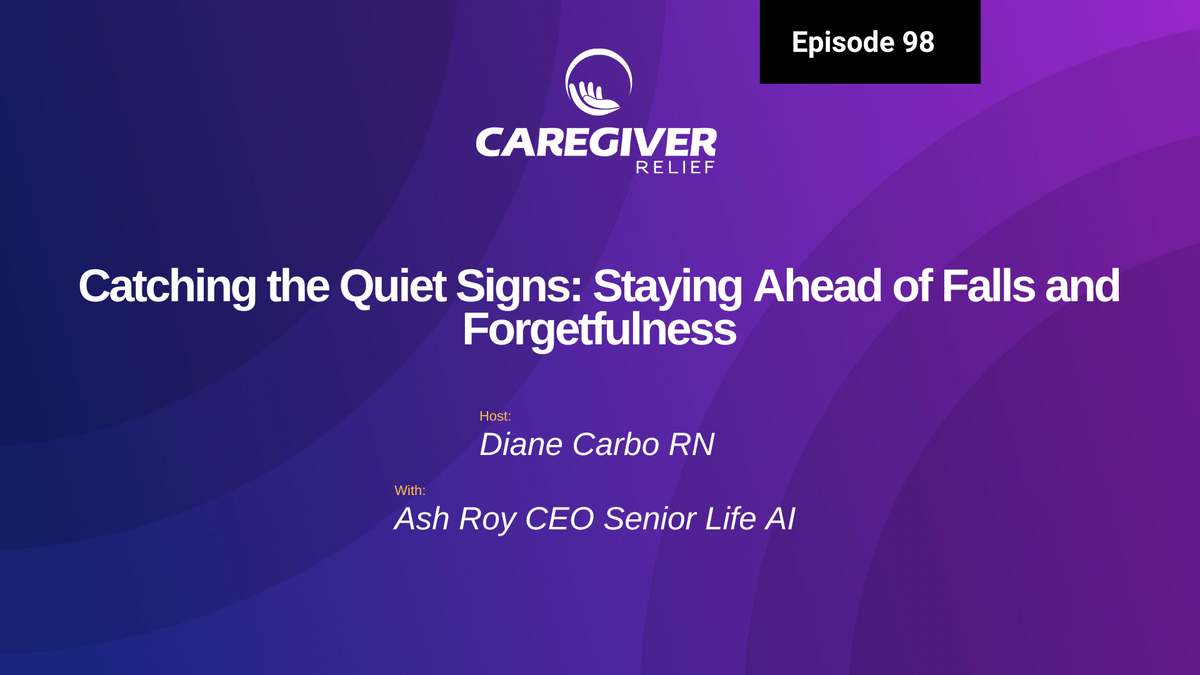
Catching the Quiet Signs: Staying Ahead of Falls and Forgetfulness With Ash Roy CEO Senior Life AI - Episode 98
Are you feeling overwhelmed as a caregiver? 😩 Do you worry about an aging loved one's health and independence? 😥 You're not alone.
In the latest episode of the Caregiver Relief Podcast, host Diane Carbo, a registered nurse and caregiver advocate, sits down with Ash Roy, the CEO and founder of SeniorLife.ai. They discuss the importance of catching subtle changes in a senior's health before they become major problems. 🧐
Episode Highlights
- Small Signs, Big Impact: Learn how to spot early indicators of health risks, such as changes in movement, memory, or behavior. 🚶♀️🧠
- The Power of Proactive Aging: Discover the concept of "aging smarter" by taking steps to slow down your biological age, not just your chronological age. 🏃♀️💨
- A Simple Tool for Peace of Mind: Find out how SeniorLife.ai uses a short, 20-second video taken with a smartphone 📱 to analyze a person's mobility and fall risk. 📉 The app provides personalized recommendations to address any issues. ✅
- Tackling Cognitive Decline: Understand the benefits of early detection for cognitive issues like dementia. The episode reveals how technology can detect signs of Alzheimer's up to 10 years before an official diagnosis, allowing for crucial lifestyle changes that can delay or even cure the condition in some cases. 🧬💡
- Privacy and Empowerment: Ash Roy addresses common concerns about privacy, explaining that the SeniorLife.ai app is HIPAA compliant and allows users to control their data. 🔒 The conversation also focuses on shifting the narrative from fearing aging to embracing a mindset of empowerment and preparedness. 💪
This episode is a must-listen for anyone who wants to help a loved one age with confidence and peace of mind. 🥰
🎧 Listen now on our Ghost CMS page to learn more about how you can take control of your health and support your loved ones on their aging journey. ✨
Podcast Episode Transcript
Diane: Welcome to the Caregiver Relief Podcast. I'm your host Diane Carbo, a registered nurse and a passionate advocate for family caregivers everywhere. If you're feeling overwhelmed, searching for solutions or simply want to better support the aging loved one in your life.
You're in the right place, and if you're a senior, this one is definitely for you.
Diane: Today's episode is about catching the small signs before the big problems show up. I'm joined by Ash Roy, the CEO, and founder of Senior life.ai of company that's redefining how we care for older adults using smart, compassionate technology.
Ash brings a wonderful blend of personal experience, professional insight, and innovation. His journey began with a knee injury while descending Mount Kilimanjaro. that gave him a firsthand glimpse into the struggles. Many seniors faced with mobility and safety. later, while leading a smart home company in Japan, Ash was asked to help develop a system to monitor older adults and experience that would ultimately shape his mission.
Now, it's important to recognize that Japan has been working on the challenges of. Aging for over 20 years. Nearly 30% of their population is over 65, making them one of the most aged societies in the world. In response, they have implemented national strategies that integrate technology, community-based care, and early intervention tools to support aging in place.
While the US is facing similar challenges, Japan is further along the curve and their experience gives us glimpses into what's possible when we plan ahead. In this episode, Ash and I are gonna explore how subtle changes in a senior's movement, memory, or behavior can be early indicators of bigger health risk.
We'll talk about how caregivers and families can recognize these sounds and gently step in before crisis occurs, and we will discuss how technology. Used Wisely can actually empower seniors to retain their independence while offering peace of mind to their loved ones. So if you've ever wondered how to support aging at home with confidence, this episode is for you.
Ash, thank you so much for coming on this podcast today. it's exciting. I'm glad you took time outta your busy schedule to talk with us today.
Ash: Thank you. Good morning, Diane, and thank you so much for the introduction. we're excited. so if I can take digress for a second.
So all of us are going to age, right? Yes. Chronologically. So my mission, our mission is can we slow down your biological age? Can you figure out early on, hey, these are, these can be, this could be problems if we can f. Find, spot it early on, whether it's cognitive or mobility issues and take care of it early on.
then our biological age is gonna slow down. So even at 70 you'll be playing tennis like you're 55 if you take, took care of it early on. So that's that's our big mission, age, smarter and everything else that the technology, the implementation, all that stuff that we are doing, falls from that.
From that we exist because we weren't. People to age smarter, slow down their biological age.
Diane: I love that. Age smarter. I've never heard that term before, but I'm going to use it feel free. As a 72 year old, semi-retired nurse, I could tell you my body is broken. I have so many things wrong.
My, as I told you earlier, as silly, but I tell people I used to pick up men for a living and we literally did a hot lot of heavy lifting as nurses. And I have chronic pain. My neck, my lower back, my si joints, my knees are shot. So I'm really excited about this tool because we all worry about two things.
Falling and developing dementia and your tool helps us with that. So can you walk us through how senior life AI works and how do your tools and sensors detect these early signs of cognitive or physical decline?
Ash: Sure. first of all, the only thing you need is your phone. That's it. You don't need anything else.
And, you take a video. By yourself or in a clinical setting, E either way is fine or your dear, or a caregiver or even your spouse or family member just takes a video this phone, right? And,then the video gets uploaded. They upload the video to our server. we analyze it in our server in fractions of seconds, right?
And if you send us a 22nd video, upload. We will analyze it, the 600 frames in there, 30 frames per second, and then we will come back and tell you whether you have a specifically what problem you have in your body that might, lead. To a risk of fall in the future and how to fix it. That's the most important part.
Even if you figure out what my problem is, what do I do about it, right? So we have a personalized recommendation that is also AI enabled, that takes into account your age, gender, BMI, medical history and all of that stuff, and personalizes, these are the four things you need to do, right? And then you can come back and check three months later or a month later.
So what happens is the, there are two situations where people use us. One is, annual wellness visits or at home. And the second situation is when people are rehabilitating from an injury or an operation or a stroke or something.
Diane: I recently had, a wellness visit and what surprised me is.
They don't address my mobility and they didn't give me, a mini mental status exam. And the thing is, people don't understand that is a baseline that you should have after the age of 50. We should all have it on a regular basis because, if it, you need to have that base know what your baseline is and then determine.
the changes that happen over a period of time if you are developing dementia. So one of the things that I love about this is something that they can incorporate into their wellness visit,
Ash: correct?
Diane: Correct.
Ash: Correct. Absolutely correct. So we actually, a very big, concierge clinic in Napa Valley is, working with us.
And as you might know, Mayo Clinic, which is an investor, a shareholder in our company, they are very vague and, we will come out at some more stuff in September. We will push it out to the annual wellness visit. A lot of companies are trying out our product. It has to be an annual wellness visit, and it's the key is it has to be extremely simple and doesn't disturb the workflow of physicians.
You, you are in the yes, you are in the other side. So you know, you disturb if you're a physician and you're introducing anything new to me. I don't wanna do it, right? Yes. So we, that's the first thing we took care of. No change in workflow. It's absolutely integrated to your EMR and, also it's extremely simple as, almost as simple as the patient himself or herself can use it.
so that's, so I, that's, I think that's why you would see, and without prevention,we can't handle healthcare here in the us. We have to go after prevention.
Diane: Exactly. we have a, we actually have a. Public health crisis right now. We have more seniors than youth as you do in Japan.
you've been dealing with this a lot longer than we have. Yes. Yes. But, we are totally unprepared. We have no one to provide care for our. Our seniors and it's very sad and, many of them are left to fend for themselves. And our Medicare reimbursement is so low that our doctors only get a 15 minute, visit.
They get reimbursed for a 15 minute visit. That's why you get in and you get out. But the wellness visit is 40 minutes. And I was, I have to tell you, I was really disappointed because they didn't do the mini mental and they didn't do my, mobility check on me because you know that those are the two big things that every senior wants addressed.
They don't know it. But that's I do. And I'm telling you what so what, so the problem.
Ash: Yeah. So the challenge for the physicians, if I can take their, from their side is it takes time, it takes, it takes somebody skills to do it. Yes. So what we have done in both in the cognitive side and mobility side is it's a 22nd video.
You could do it, and then it gets analyzed and presented to the physician in the way that he can understand with all kinds of details. Hey, this person might have scoliosis, for example. Uhhuh. So we have brought. This in a platter to the physician so that he can, he doesn't have to get outside of his workflow and he can do it really quickly.
And it's really cheap. There's no cost to it other than just taking a video.
Diane: You're right, the wellness visit is a time when, they have more time, but the physicians don't have time. They don't have the experience to do the mini mental, they don't have, they don't know how to check for balance in a short period of time.
I'd like to ask you if. You have it on your website that there is a client, an individual can, the assessment for free, and then they can take it into their physician. Is that correct?
Ash: Yes, that is correct. So we are, so there are two modes you can use our app. One is a, let's call it a caregiver, physician staff, like a professional.
the other mode is individual. If you're registering as a professional, then you can add your patients and so on. Registering as an individual, then there's no adding patients. You can just go in and you can take only one test. Okay. Which is the TUG. That's, and that's for free. We made it for free.
Okay. And, if you, once you take the test, you can ask, you can type in, your doctor's email address. It'll be the PDF will automatically be emailed to him.
Diane: That is wonderful.
Ash: Wonderful. it's all the d all. details would be emailed to him and of course to you as well. So you could take it either in print it or you can take it as a PDF or you can come back to our app and it's completely interactive.
Diane: Yes. Now, one of the things I know people are gonna be concerned about is privacy. So can you address that a little bit, because I know that's a concern for many,
Ash: very much. So we are HIPAA compliant and we are also FDA certified class two. Which means, it's a software as a medical device, that can be used for diagnosis.
So there are three parts to privacy. One is your personal information such as banking, et cetera. We don't collect any of that information. number two, we don't even require your name. You can just type in DC so that you understand who it is. but do, we do need an email to verify that you're a real person.
other than that, everything is, You don't need to chip, enter any information, and it stays de-identified in our system. De-identified, meaning our engineers don't have access by design. Nobody has access to the data other than you yourself. Okay.
Diane: Okay.
Ash: So
Diane: that's comforting to know.
Ash: Yes. And the second part is, so third part is you can decide to delete the video.
After you perform the test. You can just pack in like a, you just tap and say. Delete my data, your video data gets deleted, but your results stay.
Diane: Okay.
Ash: So we have detailed results, for your physician, and then, that in and in, in case of, our, cus our provider and payer customers, they like to put the data in their system so we don't have access to it anyway.
Diane: Ash, what advice do you have for a family caregiver, or a person who's not providing care right now, but they notice small changes in their loved ones, either their, mobility status or their cognitive status, but they're not sure how or when to step in.
Ash: Yeah, so good. Excellent question. We were asked that question in Japan.
by family caregiver, I assume you mean, like a daughter or a son or A friend or somebody. So a good way to do this is if you feel that person is limping and oh, that limping continues. Or if the person's left shoulder is down and the shoulder is down for a while, right? for a week or two, you just ask him, Hey, can I take, can we take this video, quick video?
And then you can do a quick check on the app and just completely anonymously. There is nothing you need to do. And if it comes back after an analysis that, hey, you have a medium risk and these are the reasons you have a risk. either at that point, either you go to a doctor or you do that test again in, maybe a month later, we will give you personalized recommendations, how to fix it.
Oh, that's good. yeah. So for example, let's say for sake of example, say, let's say the an rec exercise recommendation is squat right to do squat uhhuh. But if we figure out, if you gave us the information that you have high problems or knee problems, our AI will automatically adjust to your conditions to your BMI.
To your height, to your weight and many things and change the recommendations. but the still same goal of fixing that problem. And so it's, it's iterative. We tell you what the problem is, how bad or how serious the problem is, then we tell you what you need to do, and then you come back and check again.
Diane: Wow. And
Ash: you can share that
Diane: how. Now here's the big one , the even bigger than the mobility is the dementia. Correct. The cognitive status, correct? Correct. can you walk us through what that might be like as well? Because I know many family members think that there might be something and of course seniors will say, there's nothing wrong with me.
I'm fine. and, but they're repeating themselves over and over again. we live in a, we are, many are in denial and the families are fearful that if they say something, that indicates they're concern, they're going to be, admonished by their, dimen senior. So can you tell us how that test works as well?
Ash: Yeah. before we go into it, I think the biggest factor, biggest thing that we realized is, fear of shame. it's easier for, yes. the big difference between mobility and, cognitive is mobility is okay, I understand I got my knee injured, but I can fix it. There is, you find, you walk with a crutch, you can fix it most likely.
So it's not a, it's not as shameful as. I forgot where I was, where I left my remote. Oh, shoot. I found it in the fridge.
Diane: Yeah.
Ash: and, so it's a, it's so people don't talk about it. They don't even talk about to their, their, close family members and so on. So I think that is, so the other problem with the, cognitive side is we found if you get diagnosed, it's already too late.
Because the only thing that's available at this point is mitigation. Alzheimer's cost. Alzheimer's. so Alzheimer's cost $350 billion to the system. Yes. That's bigger than cancer. and heart disease as two other groups, right? and the reason is you just live longer and you forget. You are in a blissful state probably, but your family members, you get, become increasingly blissful because you don't know where you are, but your family members are going through this horrible.
horrible, experience, Yes. so what we, so we went after Alzheimer's first because Alzheimer's is about 70%, 70, 75% of all dementia. Yes. The other two being vascular and Lewy body. So what happens in Alzheimer's is about 10 years before,you are diagnosed Alzheimer's, your brain is still healthy, your hippocampus is fine, where the memory is.
But you start forgetting things. Your brain is still healthy, so your other parts of your brain is compensating for you. So your family members or anybody who's living with your spouse, whoever may notice it, but they may notice it from time to time. But, they can't really tell if you have Alzheimer's or not because you're still healthy.
Diane: Yes.
Ash: that state is called amnestic, mild cognitive impairment. A MCI. Okay. we released a, test that can effectively replace MMSE and which is a 30, which is a 50-year-old test, right? just with an iPad. Okay. And here's what, here's how it works. So just just watch my face as it imagine this is an iPad, and, you are asking me, our test is asking us to follow things or unfollow a doc.
And we're able to predict, look at your gaze, and we're able to predict, look at how late are you when I'm asking you to follow a dot? Or how correct are you when you're asking you to follow a dot? Even if your mental state, even if you're totally healthy, look healthy. Our software can now pick up 10 years before Alzheimer happens.
What is the risk of a MCI. A hundred percent of the people who have AD had a MCI.
Diane: That's amazing. So I want my listeners to know that Alzheimer's, or any form of dementia that can occur, 'cause there's a hundred different kinds, but it can occur as early as 20 years before you get an official diagnosis.
Ash: Correct? in fact, CMS as well as CDC. CMS would ask you to do your fall risk checks, as you mentioned in all, the annual wellness visits
Diane: uhhuh
Ash: after 65. Yeah. But CDC and CMS recommend that you check for your Alzheimer's, if there are any signs of it at 50, starting at 50, So yes, it,it does happen 20 years before, and yes.
Then when it declines, if you look at the curve, the cognitive functions decline really sharply.
It's very hard to capture, very hard to do anything once it declines like this. After that, you're basically on $40,000 a year drug that's just keeping you alive. Yes. But if you do capture 10 years before it's diagnosed, physical therapy change in diet cognitive therapy.
These three things can, in 70% of the times it can at least delay it by 10 years.
Diane: Yes.
Ash: And in 30% of the times it can cure it. This is proven. Yeah. And so the whole question is how can you accurately, correctly predicted 10 years before we couldn't do it until now because the technology was not there for us to capture.
Your eyes six, your eyes 60 times a second's. So if you're looking at it for one second, or let's say if you're looking at it for 10 seconds. 10 seconds. I have 600 data points. Wow. and we didn't want to bring a solution to the market where you wear all of these things and ledges today. You can do it at simple iPad.
Diane: And that's the key. one of the things I always, I hear when I say it can happen 20 years earlier, and it's better to know earlier than later. 'cause you can make those important lifestyle changes to slow,the process of the disease occurring. people. Are, hesitant because they don't want to know.
And I'm like, oh my gosh, you've gotta get over that because if you can make steps to eat right. Exercise, even they tell me that doing something different every day creates new neural pathways. Walk backwards, take a different way home. When you ride in the car, drive in the car, do things differently.
Try to write with your left hand, instead of your Is it a challenge? Yeah. But you're creating new neural pathways. So when people give me that argument that I don't wanna know because, I just don't wanna know. I don't, I'm thinking, but yes, you can do little things every day that can make a difference in your health in the future and delay the decline of your body and your mind.
it just makes a, gives you a better quality of life for a longer period of time. It just makes sense to me to know,
Ash: there are two issues there. One, you don't go to the wellness visit. 50% of the 64 million people that are seniors do not go to wellness visit in the us. And the second problem is you don't want to, I wouldn't want to know a lot of things that I'm a little afraid of unless it's absolutely private.
Yeah. Not even my doctor. So that's what we are bringing. We're bringing it directly to you. Yeah. You do it. If you find there is a risk, maybe you found it or problem, there's a risk and you don't believe in it, so you do it twice, that's fine, go ahead. But once you are convinced, once your awareness is heightened right, or my patient's awareness is heightened, only then I'll start taking actions.
Yes.
so we're bringing it to your complete privacy. Figure it out for yourself. And it's, you don't need any tool. You just need a phone or iPad or whatever. And,we couldn't have done that even two years ago. The models were not there. The AI models today, what they do, sorry, I'm digressing a bit, a little bit, but a little nerd, talk here.
Diane: That's okay.
Ash: So the way we can analyze, your gaze, your, where you are looking at on the iPad,
Diane: uhhuh, and
Ash: the speed at which we can do that on our computers because. Our money is our speed, right? The how fast we can do the process. Otherwise, it's very expensive. That has gone a hundred fold, meaning I'm able to do it a hundred times faster than two years ago.
So that's,we're in great times today. We're in great times. Oh,
Diane: absolutely. Yeah. now there's still a challenge of introducing technology can that will be met sometimes with resistance. It's the nature of the elderly. how can caregivers pre or family members present these tools in a way that empowers rather than alarms the senior.
Ash: Yeah, I think,it's, so first of all, we've been asked that question so many times. I think, our technology as it is just the same thing as phone. So everybody's used to the phone, right? We're not bringing anything, no sensors, nothing. I think the first thing we need to address, which is the white elephant in the room, and you've already actually talked about it, is privacy, right?
Yeah. And how I wanna know more about it, but. And, but I just don't want everybody else to know about it. And so that's something we have addressed by completely de-identifying and not even asking you for your data in the first place.
Diane: Okay?
Ash: Okay. the less you give, the more, the less is our personalization.
But, we can personalize a lot if you provide all the data in an anonymized way, meaning no first name, no last name,
Diane: Uhhuh. Okay.
Ash: And it could be your daughter's email, that's fine. but, and then you can delete the data after you get the results. But we, I think privacy is the biggest issue and making people understand that you can do it completely privately and absolutely easily.
Just like your phone, basically. Because everybody's used to an iPad. yep. And a phone. But having said that, we have found the biggest thing that people love about, our product is that it's super easy to use there. We don't have training. It's built like an Apple system.
Uhhuh, there is everything is, if the thing is not absolutely intuitive to you from the very beginning, then we have made some mistakes. we're not trying to Sorry, go ahead.
Diane: Go ahead. I'm sorry. Go ahead. No,
Ash: so that's one thing we have done. But, people are still apprehensive to know about themselves, and that's a human thing.
And I'm not sure we haven't fixed that problem.
Diane: that's the human, that's the way we are as humans. we fear things we don't understand.
One of the things you were discussing is the, Privacy and the reluctance. some of the reluctance, especially for some elderly, is they don't want to, have,if they've applied for insurance or something, they are diagnosed with,they know that they're going to get Alzheimer's or a form of dementia.
They don't want that on their record. So I love the fact that you, because they, it increases your insurance and other things. people are, they their fear of. Paying more for insurance overcomes their, sensibilities at making changes and lifestyle changes to delay the, delay the progression of the disease or even for it to occur.
Ash: Yeah, absolutely. And,we learned that a little bit with Mayo Clinic as well. So Mayo Clinic is very patient, centric. it is just such a great learning. They're such a great partner. You have to give, you have to look out from the perspec for the patient. And if that patient decides, I don't wanna share my information.
Okay. But give her or him all the information. If that person feels uncomfortable sharing that with the physician or the payer, whoever it is, that's their decision. But please know about yourself first, right? Yeah, we, and we don't need to keep the data. We don't need to. And the good part is, we're in an era where our cost of compute and, since we've already developed a lot of the models, is basically zero or close to zero.
So we're bringing, wow, our incremental cost is very little.
Diane: And in today's world where healthcare is out of control, that's a huge. Absolutely huge.
Ash: Yes. Yes. And, absolutely. If you, as you said at the very beginning of the podcast, I injured myself coming down Kilimanjaro. And what I didn't tell you in detail is, I had an knee surgery at hospital for special surgery in New York,
Diane: Uhhuh.
Ash: and I had a staph infection after that.
Diane: Ooh. So they
Ash: almost, yeah, so it was pretty bad. So they thought they're gonna just. my, my left leg is gonna be not there anymore. Yeah. But they somehow did a flap surgery. But as a result, here's the point. As a result, my left leg is about a centimeter, which is about half an inch shorter than my right leg.
Diane: Okay?
Ash: So I'm wa I, if I don't do anything, I'll walk like that.
Diane: Uhhuh.
Ash: So I am acutely aware of my posture, And I climb Yes. I climb a lot. Even today, I, we bicycle a lot, but I can't run
Diane: uhhuh. I cannot
Ash: run for more than, I don't know, 300 feet.
But, so I am, I'm super aware as an individual, and that's why I want other people who are in, just who were in their, either seniors or in their forties or fifties if they had injury.
To be aware of themselves, what's gonna happen when they age and if they can take care of it earlier, which I do. I always use a knee brace when I go up the mountains.
Always I carry two knee braces in my car. Just in case. Just in case. Just in case. but that's prevention because I'm aware of my left knee and that's all we are trying to do.
And, The best part is the tools are with you that you can check yourself. Are you recovering? Are you getting better? Are you getting worse? If you're getting better, great. And if you're not recovering, then you can come back and say, Hey, why? What's hap What's happening? Why is it, why am I not recovering?
But you know that you yourself, your own conditions.
Diane: Exactly. One of your goals, Ash, is to help seniors age with peace of mind and control. So how can we shift the conversation from fear of aging to one of empowerment and preparedness?
Ash: Yeah. that's a very philosophical question, right?
And we've been thinking about it. it's a loaded question. I've been thinking about it for a while. For example,what happens to me 30 years from now, right? I think the first thing that, and I'm speaking for myself. The first thing that I would like to do is to be able to do what I'm doing right now for as long as I can.
Diane: Yes.
Ash: Irrespective of the time making me chronologically older. and it's, and the earlier you find out what your issues might become later on in life. the easier for you to fix. The later you find out it's harder, unfortunately.
Diane: Absolutely. And
Ash: yeah, so if we found out really late, and we can help you diagnose, but unfortunately we're not gonna be able to do much.
So our goal is to help you find out as early as you can. And, age is just a. is a, is just a line. It now goes up with time. Absolutely.
Diane: Absolutely.
Ash: there is a 71-year-old, in Japan, he that he just went up and this is seven years ago, he went up Everest and came back Mount Everest.
Wow. yeah. So
Diane: that's amazing.
Ash: Yeah, exactly.
Diane: I know I've had many elderly patients. My grandmother lived to be 98. All her, I call them their little sisters. They were my little great aunts. They were very tiny. They were like under 4, 4 11. They were around to four 11 and they all lived well into their nineties.
and my uncle. My grandmother's brother lived to a hundred, and so I have longevity in my family on one side, and that frightens me because my body's so broken at this point in time. And if, I would've done things differently, maybe not did worked in rehab, nursing or whatever, but,
Ash: can I tell you something?
Sci-fi. Yes. Here, can I tell you something? Sci-fi Okay. most of your audience would know, but this would either freak them out or just get them exci excited. Okay.
Diane: Okay.
Ash: So two weeks, two a month ago, let's call it month ago, they found a gene called Fox O three. And this was an experiment done in China on Monkeys and Fox oh three.
So they took the crispr, which is the gene editing, gene editing software. And they overexpressed this gene called Fox oh three in monkeys, and they reintroduced it back into the stem cell in monkeys. and what happened is it created exosomes, meaning it created packages and went into tissues, brain tissue, heart tissue, your, lungs and so on.
Everything was about five years younger.
Diane: Wow. That means in
Ash: if for, in terms of human, it's about 15 to 20 years younger. They haven't found cancer yet with AI and artificial general intelligence, not too far off. We may break the paradigm of living.
Diane: Wow, that's fascinating. I So it
Ash: might freak you out or it might excite you.
No, I really,
Diane: I think that's awesome. there people are living well beyond a hundred. I just had a client whose mother-in-law turned 104. She's living alone in her home and has eight hours of care in the morning. She does her social life. and she could live to be 110 or 120. really, she doesn't have a lot of aches and pains and, I don't know what she did for a living, but she's, and she does have great genes.
I'll tell you. She must. Yep. Because to live that long and she still has all of her, she's. Very good. Cognitively and physically, she's able to do things. I know you won't know who Jack Lalanne is, but my grandmother, she worked out, Jack Lalanne was before Richard Simmons, and you may not even know who that is, but
Ash: I've seen Richard Simmons in and in some old footages.
Yeah. Yes. But
Diane: Jack Le Lane was the first on. Tv, exercise program and he did calisthenics and stuff. And that's how, why I learned to exercise because my grandmother was so adamant about it, We gotta watch Jack every day. And I did. I learned to exercise and, I think that's what helped her for so long.
And my grandfather had a stroke. I can remember I was probably seven or eight and all of a sudden We didn't have, we drank skim milk, not whole milk. we ate lots of veggies. We didn't use salt. our lifestyle changed. and I think that attributes to why she lived so long as well. And so healthy
Ash: ex exercise is sore, soaky exercise and diet, Yes. so I eat one time a day and I've been doing that for four years.
Diane: Wow.
Ash: So it was difficult in the beginning, but I just wanted to see if I can train my mind is sharper when I'm hungry.
Diane: Fascinating. Now I do this fast 'cause
Ash: I'm like, my body wants to protect myself, right? Yes. 'cause I don't have any, so my mind is way sharper.
Diane: it sounds weird looking at that.
Ash: Yeah, because
Diane: I do intermittent fasting, and I feel better because of it. I, yes. I really do. Yes. And I'm very careful, what I eat, but I eat fresh fruits, vegetables. Yes. Because I'm have the ability to do that, which I'm grateful for. And,I, it's just me, so I'm okay with that.
but, anyway, this has been fascinating. I wanna ask you one more thing. Sure. Ash, before we go, what's the one message you want caregivers and families to take away from this conversation today?
Ash: I think the first thing is know yourself, know thyself. what's going on with your body? Yeah. And if you are, if you think you want to do it privately, you can do that today.
Diane: Yeah.
Ash: but if you don't know, if you don't have the data on yourself
don't rely just on your intuition. Intuition might be a good starting point.
Yeah. For example, oh, I'm forgetting things, leaving remotes in the fridge, but get the data. And today you can get the data. For almost free, less than a book coffee. Cup of coffee. Yeah. And, in your privacy. And why not do that? And then make the decision. If you're great, it's great, but if you're not, if you're not, then figure out how to do, what to do about it quickly.
And, it's in your hands, it's totally in your palm today.
Diane: Yeah, I am totally curious about my health future. So when I'm off, I already downloaded your app, but I wanted to ask you a few questions before I did it. I'm gonna do it and,if I'm able, I'm going to try to put the post up, whatever's on my, on the page we create with your program and,I'm definitely gonna take it to the doctor the next time I see her.
Oh,
Ash: absolutely. As safe. Absolutely. Diane. So our support team, you do it with me, our support team. Yeah. Our support team is gonna send out an email to you.
Diane: Okay. With
Ash: your, because they have to, there's a system they have to approve test credits at the backend. Okay. So they'll approve enough test credits for you to do it.
Okay. To show it to your friends or to the doctor. And, but we, somebody will send an email to you.
Diane: Awesome. to my family caregivers out there, I want you to know you are the most important part of the caregiving equation. Without you, it all falls apart. So please learn to be gentle with yourself.
Practice self-care every day because you are worth it.
Caring for a loved one can be overwhelming — but you're not alone. If you have questions, big or small, our expert team is here to help.
👉 Click here to Ask the Expert
Our Resource section can help you find the information and tools that you need. We have courses, videos, checklists, guidebooks, cheat sheets, how-to guides and more.
You can get started by clicking on the link below. We know that taking care of a loved one is hard work, but with our help you can get the support that you need.
Click here to go to Resource Section now!