Rebuilding Life After Stroke: Inside Shirley Ryan AbilityLab’s Cutting-Edge Rehab with Holly Paczan and Caitlin Newman - Episode 152
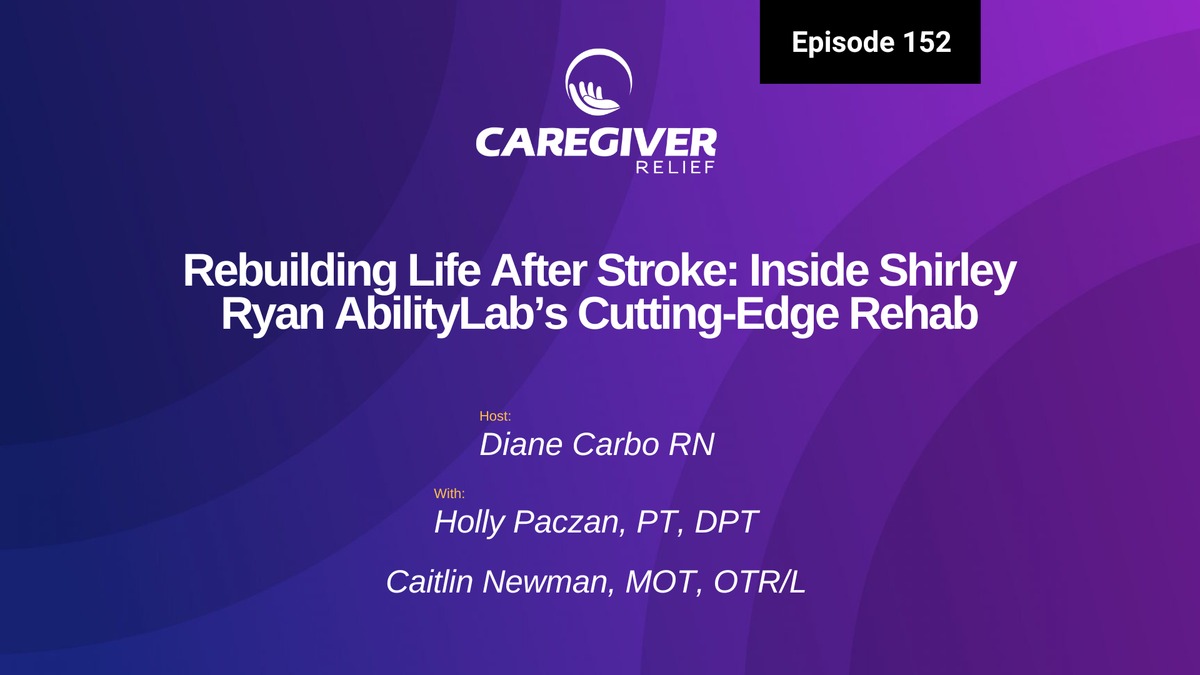
In this powerful episode of The Caregiver Relief Podcast, host Diane Carbo, RN sits down with two incredible experts from the Shirley Ryan AbilityLab—ranked the number one rehabilitation hospital in the nation.
We are joined by Caitlin Newman, an Occupational Therapist and manager of the Arms and Hands Lab, and Holly Paczan, a Physical Therapist and manager of the Legs and Walking Lab. Together, they pull back the curtain on how science, technology, and compassion are reshaping what is possible for stroke survivors.
🚀 What Makes Modern Rehab Different?
If you are familiar with stroke rehab from decades ago, get ready for a surprise. The "translational" model at Shirley Ryan AbilityLab means that clinical care and scientific research happen side-by-side in the same spaces.
Key Shifts in Recovery:
- Neuroplasticity over "Developmental" approaches: The focus has shifted from simple developmental movements to brain rewiring through high-intensity, meaningful repetition.
- Shorter Stays, Higher Intensity: With hospital stays shortening (now averaging 2–3 weeks compared to 8 weeks in the past), therapy must be smarter and faster to maximize that time.
🤖 Sci-Fi Tech Becoming Reality
This isn't just about exercises on a mat. Caitlin and Holly discuss the cutting-edge technology integrated into daily care:
- Exoskeletons: Used in the Legs and Walking Lab, these robotic suits help patients with balance issues or "pushing behaviors" retrain their brain to find their midline for walking.
- Vagus Nerve Stimulation (VNS): A groundbreaking FDA-approved implant that, when paired with therapy, sends signals to the nerve to help create new neural pathways for arm recovery.
- The "Ability Quotient": A data-driven dashboard that tracks patient progress against age-matched norms in real-time, allowing the team to pivot treatment plans instantly.
📋 What We Cover in This Episode
Here is a breakdown of the key topics discussed in today's conversation:
- Meet the Experts: Introduction to the team from the nation’s #1 rehab hospital.
- Why Therapy? Caitlin and Holly share their personal inspirations for entering the fields of PT and OT.
- Inside the Labs: A look at what happens in the specialized "Arms and Hands" and "Legs and Walking" labs.
- The Research-Clinical Link: Why putting researchers and clinicians in the same room changes patient outcomes.
- Robotics & Exoskeletons: How technology aids walking recovery and reduces caregiver burden.
- Vagus Nerve Stimulation: New hope for upper limb recovery through neuromodulation.
- How to Choose a Rehab Facility: What caregivers need to look for (specialized teams, discharge planning, and technology).
- The Future of Rehab: The emerging role of wearable sensors and remote therapeutic monitoring for home care.
- Advice for Caregivers: Why self-care is a marathon requirement, not a luxury.
💙 A Note to Caregivers
As Diane mentions in the episode, stroke rehab is a marathon, not a sprint. To maintain the gains made in the hospital, the caregiver becomes the most important part of the equation.
But you cannot pour from an empty cup. Holly and Caitlin emphasize the importance of finding support groups and taking respite to ensure you can continue to be the advocate your loved one needs.
Caring for a loved one can be overwhelming — but you're not alone. If you have questions, big or small, our expert team is here to help.
👉 Click here to Ask the Expert
Our Resource section can help you find the information and tools that you need. We have courses, videos, checklists, guidebooks, cheat sheets, how-to guides and more.
You can get started by clicking on the link below. We know that taking care of a loved one is hard work, but with our help you can get the support that you need.
Click here to go to Resource Section now!
You might also like this article:
 Diane Carbo
 Diane Carbo
 Diane Carbo
 Diane Carbo