Trust but Verify: What Every Caregiver Needs to Know About Trustee Responsibilities with Linda Mac Dougall - Episode 150
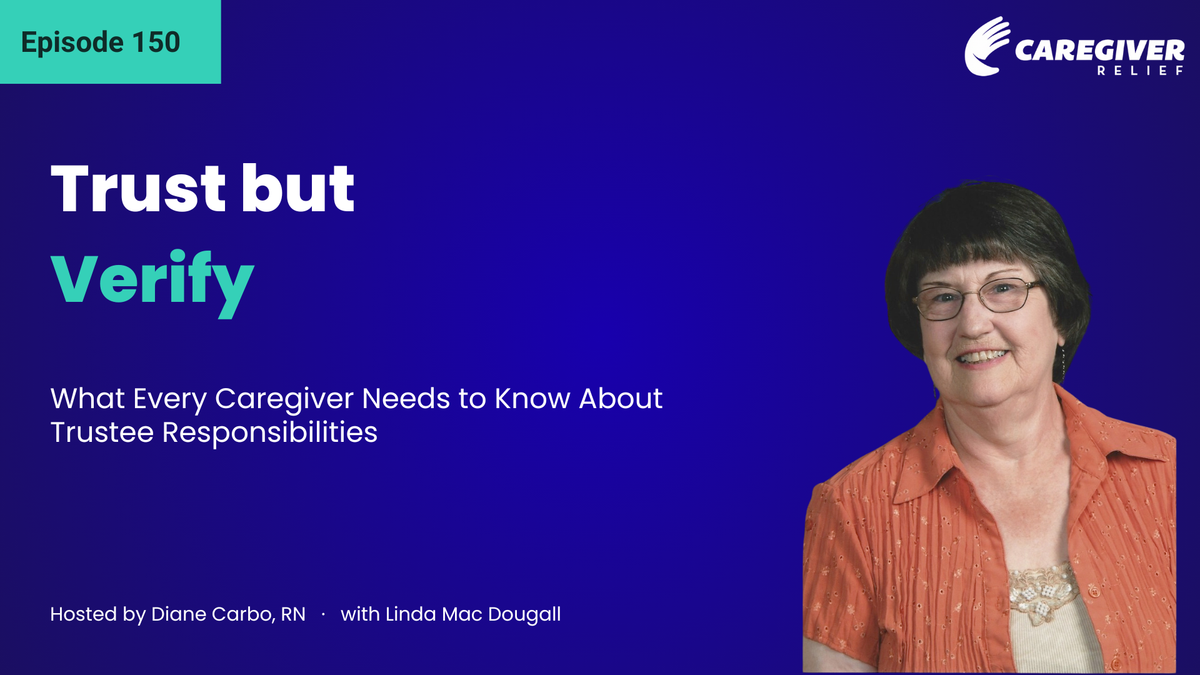
Many caregivers believe that being named a trustee is simply a matter of helping a parent or friend manage their affairs. But here is the hard truth: once you accept that title, you are taking on serious legal and financial obligations that, if mishandled, can affect your future, your finances, and your peace of mind.
In this episode of the Caregiver Relief Podcast, host Diane Carbo, RN, sits down with Linda Mac Dougall—a holistic health practitioner, former group home administrator, and federal advocate. Linda shares a harrowing personal story about a family trust gone wrong and offers critical advice on how to protect yourself while advocating for your loved one.
Whether you are already a trustee or just starting the conversation with aging parents, this episode is a must-listen to avoid the hidden pitfalls of estate management. 🎧
🔍 What You’ll Learn in This Episode
- The "Double Role" Danger: Why being both the primary caregiver and the trustee is a recipe for burnout and potential legal trouble.
- The Handwritten Nightmare: Linda shares a personal story about how a handwritten addendum (without a notary) nearly sent her family’s estate into probate hell.
- Financial Traps: The most common way trustees accidentally break the law—specifically "commingling funds"—and why you must keep a log of every penny spent.
- Advocating in Facilities: How to speak up for "resident rights" in nursing homes, especially regarding dignity, hygiene, and the controversial removal of wheelchair seatbelts.
- The Broken System: A frank discussion on why the current medical system provides only the "illusion of healthcare" and why families must be more vigilant than ever.
💡 Quotes from the Episode
"You may think you're just helping a parent or a friend manage their affairs, but once you're named as a trustee, you take on serious legal and financial obligations." — Diane Carbo
"If you get yourself in that double roll [Caregiver and Trustee], try to get yourself back out... If you take on this super heavy legal duty... you have to keep track of the accounts, the care, every little thing because you're responsible for other people's money." — Linda Mac Dougall
"The squeaky wheel gets the grease. And sometimes you just have to be squeaky." — Diane Carbo
🔗 Resources & Links
- Guest: Linda Mac Dougall
- Website: LoveYourLongevity.com
🎧 Listen to the Full Episode
Don't wait until a crisis hits to understand your legal responsibilities. Protect yourself and your loved ones by listening to the full conversation today.
Podcast Episode Transcript
Diane: Welcome to the Caregiver Relief Podcast, where we explore the real challenges and hidden truths of caregiving, aging, and navigating complex systems with compassion and clarity. I'm your host, Diane Carbo, rn. Today we're diving into a topic that often catches caregivers off guard, trustee responsibilities.
You may think you're just helping a parent or a friend manage their affairs, but once you're named as a trustee, you take on serious legal and financial obligations that can affect your future and your peace of mind. I'm joined today by Linda Mac Dougall She, holistic health practitioner, educator and former group home administrator with deep experience working with vulnerable populations.
Linda has also been a federal advocate, caregiver, and trusted resource for seniors and their families. So she understands these responsibilities from every angle. In this episode, we'll unpack what it really means to be a trustee beyond the title and help you make informed decisions, protect yourself legally, and support the person you've agreed to help.
Diane: Linda, welcome back, I'm glad you're a regular contributor. you provide such important information, so welcome.
Linda: Thank you. Thank you, Diane.
Diane: you've worn so many hats from group home administrator to massage therapist to federal advocate. What experiences made trustee issues stand out to you as an area needing more attention?
Linda: that didn't come in any of those arenas that came in a very personal arena.
Diane: Yeah.
Linda: yeah. my sister passed August 1st, 2021, I believe it was, and she left one of her daughters as her trustee. this daughter didn't want anything to do with learning any, anything about that. Ooh. So there was a lot of.
Craziness that went on and still has the potential to go on 'cause we aren't done yet.
Diane: Oh, wow. yes. and people don't understand what it entails. So when you have someone who's reluctant, that makes it even more challenging. So when a family member is setting up a trust, what simple steps should they take, or follow to make sure the plan is clear and easy to use?
Linda: they have to talk to the person who's trust it is.
Diane: That would be a good start.
Linda: Yeah. Make sure you get those instructions clear. Make sure there's an attorney involved. Yes. A trust attorney, by the way, because my sister was an attorney, but she wasn't a trust attorney, and what started this whole mess off was the fact that.
Myself, my brother and my sister all owned a large piece of property together. Oh boy. Okay. And it's still in play, which is why I said this isn't over yet. But now we had not only my trust, but we had my sister's trust and my brother who doesn't have a trust. So we had these three players and since my sister.
My sister had written her own trust, but she had made the mistake even as an attorney of adding a handwritten addendum to it now. Oh, wow. She should have had the property in the trust with the a PN number. It doesn't have an address. Yeah, but the partial number and all that. There for some reason, she mentioned and talked about the property, but she didn't have the legal description in there, so there was no telling what that property was.
Oh, wow.
Diane: Wow. So
Linda: the addendum is what she added, but she added it Handwritten. Okay. Now, when you have something handwritten as an addendum. You need to have a notary if you don don't, I knew you were gonna say that. Yeah. and she didn't do that. Yeah. Yeah. So when you don't do that could have put at least the property, if not the whole trust into probate and which is what a trust is avoiding.
Diane: yes.
Linda: So when my lovely niece was doing absolutely nothing. And I do mean that absolutely nothing with the trust by November or so, I went ahead and got an attorney myself. And he called her attorney. Her attorney said, oh, we're gonna get the property in their name. We're gonna get it all.
Get all that. Put together and we're, we don't worry about it. We'll have it ready in so long, So we waited that time period and then we went back and said, what's happening? Oh, nothing.
And so we said, okay, one more shot. And they said, okay, we'll have it done in January sometime. So again. The time period came and went with no word and it went a little longer because January's crazy with everything. Yes. In January. Yes. So we actually went a couple of weeks over before we got to phone them and say, what's going on?
Yeah. And nothing again, they were just stringing us along 'cause she didn't wanna do what she needed to be doing. Wow. And part of that was 'cause they didn't wanna sell the land, but. So they didn't have it in their name, so they couldn't sell the land.
Diane: Yeah. what is the biggest timing mistake people make when creating a trust?
Linda: they need to start, first of all, by seeing their attorney or the trust's attorney.
Diane: Yeah.
Linda: because they will set, tell you everything you need to do and get you started on the right path. But like my niece, she didn't make the first move, which is setting up the bank account and all that. She didn't do that for a year and a half.
Oh, wow. Oh wow. That's why I had an attorney. I knew things weren't being done.
Diane: Yeah. Yeah. So
Linda: I ended up challenging her trusteeship. Now she's never been taken off, but she now has a court that watches what goes on with everything.
Diane: Okay. Okay. But
Linda: I had to do that because nothing was going.
yes. It was just sitting there rotting because she didn't wanna deal with it.
And that's frustrating for all everybody
Diane: involved.
Linda: Oh, sure.
Diane: You
Linda: wanna get it done and
Diane: over with and move on with your life.
Linda: Exactly. She has three siblings that she was responsible for selling and my sister had more property uhhuh she had to get. I don't know what's happened with that because it's none of my business.
yeah. The only thing that is, is my property with my brother and my sister.
Diane: So now you focus on caring for the whole person. you've done this for decades. How does your work in health and wellness help you guide families when they make trust decisions about care, housing, or getting help?
They need,
Linda: you have to be able to look at the person and hopefully they're able to talk and tell you what they need and want.
But. You have to be taking care of that person in the way they want to. Now, there's a thing we'll talk about toward the end about resident rights. Okay? But they're also, if they're in your, in their own home, they still have those rights, pretty much.
And you need to, Be looking at those rights, and so we'll go over those rights in the end of this, okay? But know that you're looking at the whole person. You're asking them questions, what they want, what they need, what you can do for them, and actually attend to them because a lot of people ask that and then go and do.
Or something while they're thinking. And that doesn't show that you're paying any attention.
Diane: Attention. Yeah. Yeah. People don't understand the solemnity of this role. Oh no. they really don't. Now, most people are both trustee and the main caregiver. What problems happen because of this double roll?
Linda: Oh, they shouldn't be in that double roll number one. Yeah. If you get yourself in that double roll. Try to get yourself back out because being a caregiver is very impactful on your whole life.
Diane: yes.
Linda: And then if you take on this super heavy legal duty. Being a trustee is a super heavy legal duty where you have to keep track of the accounts.
You have to keep track of the care. You have to keep track of every little thing because You're responsible for other people's money.
Diane: Yes. Yes. And that's a tough one. That's really tough because uninvolved siblings, I've seen this where uninvolved siblings or extended family members will accuse you of stealing or taking funds, and so you really
Have to be careful and when you're providing care, that's even more challenging.
Linda: Oh yeah. You just don't need both roles. If you could, if you see that coming before you actually have to take it on, say no.
Diane: Yes.
Linda: you could. You could say no afterwards and get a court to provide a trustee for the estate uhhuh.
And if you can, that may be a way to go because. I would not want both roles. I just wouldn't.
Diane: Yeah. people don't know what they don't know. And I know most caregivers are people pleasers. They want to be, provide the best po possible care and they'll agree to everything and not knowing what they're agreeing to.
Yeah. And then, yeah. When, the poo hits the fan, reality sets in and it is, you're in shock because you're not able to provide quality care and cover everything that you're trying to cover with the bills and stuff.
Linda: No, and you can find yourself in court. Just like my niece did.
Yes. Yes. Because you have to do things in a timely manner. Yeah. Yeah. If you're busy caring for somebody, you may not be able to do that. Yes.
Diane: Now, what are most common ways a trustee can accidentally cause money or paperwork problems for the trust or the person they're helping? Especially when paying medical bills or handling senior care costs.
Linda: Everything has. To be accounted for, very seriously accounted for out of the trust's money.
Okay. You don't wanna commingle funds, meaning you don't want to spend the trust money on your grocery bill? Yeah. Or anything like that. They're separate accounts. They're separate everything. Yep. And if you don't maintain that, you can be taken to court for co-mingling and theft and God knows what.
So just again, I wouldn't do it. Yes. If I were for giving. Yeah. Just wouldn't do it. It's too much. people don't
Diane: understand, like you have to have a log of, if you write a check out of that account, you better know what you spend it on and have accountability for it. be and know that, if you pay for someone to come in and care for your loved one.
You have their name and what, they're a caregiver or, they're a companion housekeeper, or housekeeper or cleaning lady. you have to keep very stringent, yes records and, a caregiver. For a caregiver that's taking care of somebody 24 7, that's really hard to do. you're not even getting a chance to eat a proper meal half the time.
And, you can't take chances on, oh, I forgot my, I forgot money, so I'm going to use my mom's checking account. It doesn't work that way. it will come back to bite you for sure.
Linda: It can bite very seriously because this is a heavy fiduciary responsibility.
Diane: yes. So from your experience running group homes and working as an advocate, what challenges should new trustees expect when working with hospitals, nursing homes, or other care programs, and how can they speak up for their loved ones in these places?
Linda: This is where that residency,
Diane: yeah. Yeah.
Linda: Rights come in. I'll read 'em to you right now because that's an important thing and we'll have enough to talk about for that probably. Okay. Key areas covered by these rights, dignity and respect. Now, I don't know how many. Skilled nursing places you've been in, but I see very little dignity and respect in those places.
Diane: I was a regional manager for two of the largest nursing home chains in the country. And, there is no dignity and respect anymore. it's awful. And there they're more regulated than assisted living. assisted living has no regulations compared to nursing homes, and that's a whole nother ball game.
But continue.
Linda: that's one of the things you're going to have to speak up about and you're gonna have to insist on because you are a trustee. And they need to understand if they're gonna take on your relative, who has a trustee in place, then they need to listen to the trustee. And if they don't, you better go get some help, because otherwise you could be taken to court for that too.
What kind of help would they reach out for? That's a good question. I would go back to the lawyer. Lawyer. Okay. Okay. And they would know where to go and who to contact if that's not happening. There are also the places that license skilled nursings and. Ho a hospice or whatever they're in.
Diane: yes.
Linda: So you can have, what is it here in Cal, the
Diane: ombudsman, and you can get the ombudsman, but the ombudsman, it can do very little. It wouldn't have to be somebody at a higher level.
Linda: You'd have to get the licensing. And here in my area for. Skilled nursing and even for some of the regular homes, it's community care licensing,
Diane: uhhuh.
Linda: Other than that, it's God, I used to be under the other one and I can't think of the name of it. Too long ago.
Diane: Yeah. yeah. the licensing for the nursing homes or assisted living there, there is, licensing and their license has to be on a board somewhere in the facility.
So you just have to ask where that is and contact that. On the license,
Linda: but again, your lawyer will probably wanna get involved anyway because,
Diane: absolutely. You want the attorney, in fact, you'll have better response from, I can tell you right now, the squeaky wheel gets the grease. Yep. And sometimes you just have to be que squeaky.
Linda: Oh, so well, and one of the things you'll also find in these places is that if your loved one is in a wheelchair And we've discussed this on another program, they will not have a seatbelt.
Diane: Yes. Yeah. Because
Linda: licensing has will come in. If you bring them in with a seatbelt, they may not be allowed to come in with a seatbelt.
I don't know. Yeah. But. It'll get taken away when licensing comes in because licensing is looking after their tail ends and not the tail ends of the clients. Yeah. And so they see it as a restraint under the restraint and safety laws, and they take it away as a restraint. So you have to make sure your doctor.
Prescribes whatever it is they need and the PT OT referral gets done and they set up whatever it is that person needs and have it on the medical records.
Diane: I'm gonna share something I've learned recently that has just turned my stomach and made my hair gray. We talk about patient rights, okay? I want you to know that in the hospitals, in rehab, and in skilled settings right now.
We are actually having facilities that say if a patient does not wanna be turned or they don't wanna be changed, they have a right to say no and be left in their left that way. And I'm like, oh my God. I actually had a client come home a diabetic. He had a. a, a stage three wound to his foot, his heel, and it wasn't even documented because nobody ever made a move and he had an open sore on his butt because they didn't do skin checks, which I thought every facility was required to do at least a few times a week.
They didn't have any documentation that they broke down, but all they did was say the patient didn't refuse to move. And when I'm a nurse and when I'll tell you, when I went to nursing school, you learned you, you're, if you don't, you have to move somebody every two hours. You gotta get them to cough and debrief.
You have to get them up and about because they will develop pressure sores. They will pre develop pneumonia. They will develop clots in their legs that will go to their lungs. there's so many complications and I absolutely do not understand how facilities are allowing this to happen because it's causing harm to the patients.
Linda: that's one of the rights actually covered in this, however. It depends on, I would say it would depend on the mental state of the person, because if they aren't competent anymore
Diane: Uhhuh,
Linda: then I would think that as a trustee you would have the say, yeah, hopefully. But again, that's an attorney question and I would be looking at that because yes, they have a right to refuse treatment, but did they really?
Diane: I'm finding nurses are nurses are so overwhelmed with not having enough staff, the nurses' aides that they just, they don't, they're not pushing them. and this man was absolutely awake, alert, and oriented and he just did not wanna be moved 'cause it was too uncomfortable for him.
But, how do you do that? it literally cost hundreds. He may lose his foot. On his one, his foot. And that's, do I see that as malpractice and neglect of that facility for not falling? They didn't even know that he had it. He came home and we had to send him back because his, but his heels were so bad they hadn't even address, hadn't even ordered wound care.
there's patient rights and then there's, patients don't know what they don't know and what they're, the harm they're doing to themselves.
Linda: I don't know if this is in other places, but California, but in, in this state, the mentally ill don't have to do anything either. They can refuse everything.
Yeah.
Diane: That's everywhere. That's everywhere. Or even with somebody with dementia. And there has to be a fine line when you, I literally read an article yesterday that just made my head explode. Now people are saying. Hold on for this one. You should ask the baby's permission to change their diaper.
Sure. You froze. Oh my goodness. Ask the permission of the child that's wearing a diaper to change their diaper. Excuse me, Gino, you'll get excoriated skin. You're going to get so many things wrong with the diaper. I not change. And so you have to ask them, Lord have mercy. As I had two sons, sometimes he had to tackle him down.
Just to get them clean. I can't believe so now that's a wrong, have we gone too far to the other extreme? Yes. yes. Thank you. Because I'm thinking I'm outta my mind. I've been a nurse for 54 years and I have never seen these types of approaches. Oh, you don't wanna do it. That's fine.
what are you here for then? Send them home and the families can't take care of them at home. Yes.
Linda: Yes. And Should be part of the contract going in, that if you refuse certain things, that wouldn't be everything. I would refuse a lot,
Diane: but, you know what, I, I would, there's things that I would refuse sometimes.
I don't wanna take, I can't take some meds. Like I can't take pain medications 'cause they make me vomit. I don't want a cold shower. I want a warm shower, and when you're out in the hallways and stuff, I get why people don't want certain things, but hey, if you need to be cleaned or if it's gonna prevent you from getting pneumonia or breaking down, that's gonna cost you and compromise your immune system.
Or cause you to lose a foot or a leg. Lord have mercy. There's gotta be common sense that takes place there somewhere somehow. I think that should be in the
Linda: contract coming in.
Diane: Yeah. Yeah.
Linda: That, you must if asked, turnover so that they can
Diane: Yeah.
Linda: That kind of stuff, because.
Otherwise they're not there to get well.
Diane: Yes, that's right. Exactly. And you know what I, I feel bad because families don't know what they don't know about care and they don't know what they should expect from care. And if you're a trustee, you need to know these things so that you can advocate for your loved one.
Linda: Exactly. There's so many things. That's why I think if you're a caregiver or professional, Trustee. There we go. Yeah. Professional trustee is a better option for you because you could be worn out and
Diane: you know what? That's exactly right because I've advocated for other people. My whole life, I've done care management, discharge planning, all of that.
So I've advocated. I tell you what, when I was taking care of my mom, I was young. I didn't know anything then, but my dad and my son, when he was in the military at an active military facility. Then move to the va. I will tell you right now that I was both his advocate, but I also had to, take help, take care of him, and it is exhausting.
I. I'm fierce and he laughed. he used to say, mom, put your dime monster on to talk to the military. 'cause I had to go all the way up to the surgeon General's office. I don't know how people in the military absolutely deal with what they're, what their, the way they're treated.
And, it's tough. It's very tough. 'cause they're demeaned, demoralized, because they're soldiers. And I, because I was never in that military. I just like, hey. I'm his advocate. I don't care who you are. You could be a doctor, you could be the pope. I want what I want for my son because I know it's the right thing.
And, but it is, I'll tell you what, it is exhausting when you're doing both. it just, it. I still have PTSD from it because I was wor I was really worn out oh, it's hard now. You, Linda, are very skilled at noticing physical changes in people, and I would hope that our family caregivers and those that are trustees are too.
But then how can a trustee or family member use careful hands-on observation to make better decisions about someone's care and emotional needs?
Linda: You can just see if they're slumped. You can see, and usually you can tell if somebody is sounding depressed, and that may be why somebody doesn't wanna turn or somebody doesn't wanna do this, or somebody doesn't wanna do that.
they're depressed, they're not getting the attention. Maybe they want. Our need even, especially in a skilled nursing. 'cause it, they just run, people run around all over the place doing all sorts of things and they don't have time to sit and chat. And that's unfortunate because then there's a lot of lonely people and a lot of depressed people, even a lot of anxious people in those places because of that.
they're, the ones I've seen are hard.
Diane: Activ, the activities person should be there making a difference. And there's one activities person for the whole building, and it's not 24 hour a day activities, which they should have for those that don't sleep. but I, as a nurse. There were times when I, because I did rehab, I know the people need to get out and if I could get somebody in a wheelchair or even on a gurney, if they had to lay down because of a healing wound, I would take 'em outside.
I just made the effort and nurses don't have the time. Or, inclination to do that right now, but they really need to think about doing that. and the families and it's all, and I did it mostly 'cause a lot of people have, their family members still come, but it's the ones that don't have families that are the toughest ones to deal with.
And that those are the ones I would make special effort. I used to watch some of the nurses' aides, God bless them. They would be, so I had one that would, she, I loved her. She was a young, enthusiastic black female. She wanted to be a nurse, so she started as a nurse's aide. And she would take the long timers that were in the facility that have families, and on her shift, she would take time to make sure that they got in these, we had, warm bubble baths, bubble bath or.
Warm bath, where she would lower her in, lower her the, her, one of her clients at a time into the bubble bath and just do their nails and their feet and she was an angel sent from God, I'm telling you to these clients because. Others didn't do that. And there are some people that just love their job and go out of their way.
And that's why I think that it's really important that families, say, Hey, can you do this? Can you help me do it? Now they want families to, to bathe the people at their clients, but I also encourage My family caregivers. You know what? If you've got somebody in a facility, I don't care if they're in the hospital assisted living or whatever, you check out their bottoms, you check out their heels, you check out their elbows, you make sure that they're getting care and you make sure don't be I know people go, oh my God, I can't look under the covers.
I'm telling you, you need to. Absolutely get over it because you wanna see what's going on and make sure that if there are skin issues or any other kind of issue that's happening, that you,it is documented and that you ask for a doctor to see it and prescribe something.
Linda: Yeah, you've gotta be on top of so much.
Yes, it's yes.
Diane: we are, our family caregivers due to our broken medical delivery system, are now expected to do what was once provided by, Healthcare professionals and they have no training. why go to school to be a nurse? and nurses are leaving. they're staying in the profession two years, and they're leaving the hospital system because it's so broken right now, and they're not able, they're expected to do so much more with less help than they've ever had.
And it, it's hard.
Linda: Everybody in the medical system, from the doctors, the physical therapists, all of them are. If you're on LinkedIn at all, they're all complaining about such things and you just go, good grief, what's gonna happen? You know
Diane: it, you know what I,it's so broken and I fear that. right now, I will say this and I know people.
Don't appreciate it, but we only have the illusion of healthcare. We do not have healthcare because I agree. I will tell you because unless you can pay for the recommended, the doctor recommended treatments and services and medications. Our government policy makers are your doctor. They, our doctors are no longer the doctor patient relationship no longer, I is in place and the government policy makers dictate what we can have when we can have it.
And, Medicare's moved to a cost sharing plan and that's even more frightening. And that's why it's so important that trustees keep really good records because. Just in rehab and Medicare advantage and rehab and skilled facilities, Linda, I almost had a coronary 200 to $500 a day copays, depending on your plan.
Linda: and that's why I have never gone to one of those advantage plans because they lure you in with all these beautiful, oh, we're gonna give you this and we're gonna give you that. But then they take away on the other end.
Diane: Next
Linda: year
Diane: though, I'll tell you what, they're going after traditional Medicare right now.
they are, I just read where they are going to start having requiring. It's just gonna be on a study for a year. that just means in two years it's gonna be implemented. They're going to require, they have about 50 procedures, and one of them is interventional pain management, which I use, that you're gonna have to have prior authorization under traditional Medicare.
So they're moving everybody over to a managed care type of plan. And managed care is not, was so mismanaged, we can't afford anything anymore. And, I hopefully we're gonna get it all addressed, but. Now for my listeners who have not started planning yet, what is the one most important first step, legal, financial, or personal that should take, that they should take right now to protect their loved ones?
Health and dignity.
Linda: Wow, that's. Hard to say because there's so much as we just had. But again, have a very good conversation with your person. And really get clear on what they want because you are going to be the one implementing it.
Diane: Yes. Yes. Yeah. I've created my vital vault and one of the things I've done is it's a, a life, organization system, but in that, I've also included.
All the trustee responsibilities for each section from the homes Wow. To cars. Yeah. and, we're gonna be launching that soon and it's going to be very clear that they, people will be able to know what they are supposed to do, the trustees. But it is, when I was doing the research to create this. Oh my it, Linda, it's so involved and each page that I've created for the trustee, I give the person that they're caring for, the ability to write directions on what they want for that specific area, whether it's financial or health or, even for puppy care, pet care and stuff in the future.
'cause people don't understand when you're a trustee, you take care of everything. Yep. And they don't understand that
Linda: or it,
Diane: yeah, or it, yeah. Yeah. Exactly. Exactly.
Linda: And that's the problem. You're also it as a caregiver. Yes.
Diane: yes. Linda, I really appreciate your time today. You've put some clarity into some things that, I know our listeners don't know about.
Trustee, being a trustee is very challenging and,it takes a diligent, a person who's gonna be diligent and, you almost have to be like an a little accountant on everything.
Linda: A little lawyer. Accountant.
Diane: A lawyer. There you go. A lawyer, accountant. I hope that people when after listening to this, will do some research before they agree to be, a trustee.
Linda: it sounds like you and I are on similar paths. I'm not doing a trustee packet. Yeah. But I'm doing all sorts of other packets, like for caregivers and for facilities and things like that. So I would be doing those, probably starting them out on my website next year.
Diane: So tell people how they can reach you, Linda.
Linda: Speaker holistic@gmail.com is the email, website is love your longevity.com. That is old, but it will be updated sometime next year as well. I'm trying to get things updated. And new things on my website 'cause it's been a while. So I'm gonna be making all these forms and things to help people, guide them through different things.
And I'm already doing that, but I haven't put them anywhere yet. But I'm going to Texas next month I'll be in the senior living think tank in Texas. Awesome. And that's. I was already going to make some things and this project that we got ourselves into, just elevated that to, I'm gonna continue doing that.
Yes. Okay. That's where all these ideas for forms and things and guidance came in was I was already in that mode and I was already aimed where I wanted to go, and then I got my three partners and. They seemed a little unsure of what they wanted to do. And I said, look, I came in with a project if you guys just wanna jump on board and help.
Diane: Yeah.
Linda: Yeah. So that's what we're doing.
Diane: Thank you. and maybe let's, next month let's talk about what happened at the senior think tank. I would love to hear about some of that stuff.
Linda: Oh, it's gonna be fascinating 'cause there are many, there's at least 10, maybe more groups that are putting together different projects.
Oh wow. Wow. Ours is just one of them. We did a, and we still have it up if anybody's interested. We did a survey of, I, I have a longer survey, which I preferred, but the team wanted it shorter so people would engage instead of feel overwhelmed. But it was only, what is it? Multiple choice
Diane: Uhhuh.
Linda: So it's not a big deal, but it just, they, what's the
Diane: survey on?
Linda: It's on what you want and outta senior living.
Diane: Okay. Okay. And I
Linda: did a lot of things, what kind of security do you want? What kind of food do you want? What kind of,
Diane: I'll tell you right now, food is the biggest one. I'll tell you what you can go into at any facility, and the first thing people complained about is the food.
So make sure when you have go to a facility, they have good food. And I tell everybody when they tour, an assisted living or a nursing home, ask them to be there during a meal and ha ask to have a meal with them while you're touring. It will be
Linda: very enlightening. If there's somebody like me who eats a lot of organic, you won't find it except in I, there's one, one facility that has two homes.
One, I guess one business that has two homes out here that do feed organic, but that's the only one I've ever seen.
Diane: and baby boomers will absolutely insist on those types of foods that they, baby boomers are going to insist on a lot. They have the money that are, that I will warrant to meet their needs.
So that's gonna happen. One
Linda: of the things that was on there was if you choose to stay home, why? And we had the multiple choice there too. And it was funny because a lot of people, including me, 'cause I took the survey, I'm a senior too.
Diane: Uhhuh. Yeah. Yeah. But
Linda: most of a good portion of 'em wanted to stay home.
Diane: Yeah.
Linda: And it was funny, one of my teammates said. That's surprising and I'm sitting here going, why is that surprising? That's been all over aging in place has been
Diane: going
Linda: on for 20 years, being spoken about for 20 years. Yeah. And more and more of this generation is going to be doing that, not only for financial reasons, but for me, I don't want, I don't want strictly allopathic.
Yeah. Yeah. What More holistic.
Diane: Yeah.
Linda: And
Diane: and you're only gonna get that when you, if you are at home, because yes, holistic medicine is very hard to find anymore. It's always very specialized. Linda, thank you for your time and I'm very interested in hearing about the senior, seminar that you're going to, to my family caregivers out there.
You are the most important part of the caregiving equation without you at all falls apart. So please learn to be gentle with yourself. Practice self-care every day because you are worth it.
Caring for a loved one can be overwhelming — but you're not alone. If you have questions, big or small, our expert team is here to help.
👉 Click here to Ask the Expert
Our Resource section can help you find the information and tools that you need. We have courses, videos, checklists, guidebooks, cheat sheets, how-to guides and more.
You can get started by clicking on the link below. We know that taking care of a loved one is hard work, but with our help you can get the support that you need.
Click here to go to Resource Section now!