Grief Doesn’t Just End—It Evolves with G. Scott Graham - Episode 93
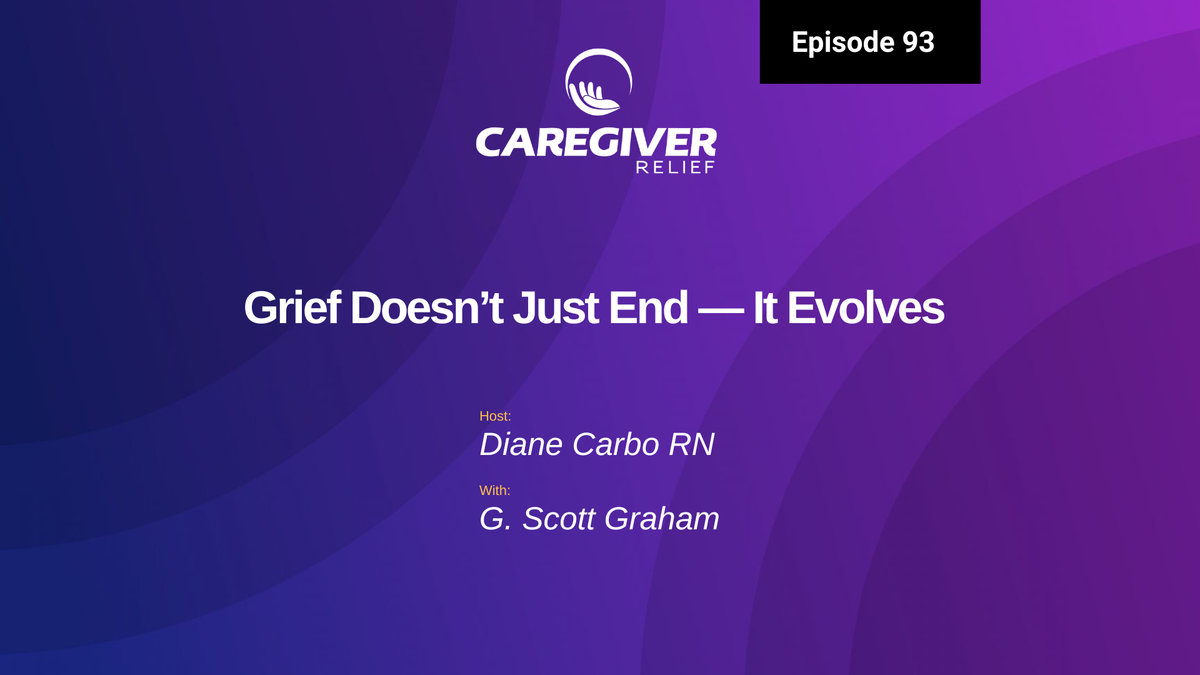
Welcome to the latest episode of the "Caregiver Relief Podcast" with your host, Diane Carbo, RN, where we're tackling a topic that touches all our hearts: grief 💔. This episode features a truly moving and honest conversation with G. Scott Graham, author, coach, and self-described "existential handyman." Scott, who experienced the profound loss of his husband, Brian, before daring to love again, offers a perspective on grief that challenges common myths and misconceptions.
A Tale of Unconditional Love and Caregiving 🫂
The episode opens with Scott sharing a deeply personal story about caregiving that perfectly sets the stage for the discussion on grief and love. He and his husband Brian took on the role of caregivers for Scott's mother after she broke her hip in her nineties. Scott recounts how Brian, without hesitation, decided they should move to Florida to live with her, prioritizing family above all else. In a beautiful act of mutual sacrifice, his mother, who had vowed never to move north again, saw their love and compassion and chose to move in with them instead, where they cared for her for five years.

Challenging the "Stages of Grief" Myth 🤯
Scott and Diane dive deep into a widely misunderstood concept: the stages of grief. Scott, a therapist for decades, admits he regrets the "book learned knowledge" he used to dispense, which he now knows was often inaccurate and even harmful. He reveals that the "stages of grief," developed by Elizabeth Kübler-Ross, were originally for people at the end of their lives, not for every type of loss, as they have been hijacked for. This expectation of a structured grieving process can make people feel like they're "not even doing the grieving part right," leading to more pain. Scott’s powerful takeaway is that there is "no right way to grieve".
The Unexpected Return of Grief through New Love ❤️🩹
The conversation takes a fascinating turn as Scott shares how falling in love again after Brian's death brought a new wave of grief. He describes this as "anticipatory grief," where he found himself filled with worry and anxiety, projecting a future loss and trying to "grasp and hold on" to his new partner, Peter. He candidly shares the profound realization that "all life ends" and that "pain always follows love". Scott’s insight is that avoiding pain would mean living as a "numb zombie" and that choosing to love again is an essential part of the human experience.
A Revolutionary Way to Offer Support 🤝
One of the most impactful moments in the episode is Scott's advice on how to support someone who has experienced a loss. Instead of asking how they are or avoiding the topic, he suggests asking a simple, yet powerful question: "How's your grief?". This approach acknowledges grief as a dynamic process—sometimes loud, sometimes quiet, sometimes intense, and sometimes not present at all. He shares how, after Brian died, people asked about his physical injuries far more than his grief, highlighting the deep need for a witness and a compassionate space to talk about loss.
Questioning "Complicated Grief" 🤔
The discussion also touches on the recently introduced diagnostic term "complicated grief". Scott provocatively questions the motivations behind such a diagnosis, pointing out that one of its criteria is that grieving "takes longer than the societal norms dictate". He uses the example of how being gay was once considered a mental disorder until the American Psychological Association voted to remove it from their list, suggesting that these diagnoses can sometimes be more political than factual. He even humorously admits that he embraced the diagnosis to train his dogs as service animals, allowing him to take them with him wherever he goes.
An Empowering Message for the Grieving Soul ✨
Scott leaves us with a truly uplifting and compassionate message: "how you're feeling is normal". He urges listeners to reject anyone who tries to put a timeline on their healing or push them through an "artificial process". Grief, he says, "is the price we pay for love". He even suggests that instead of offering condolences, we should congratulate those who are grieving for having had the courage to love so deeply.
This episode is a beacon of hope and a profound reminder that grief is an integral part of life's journey, not an obstacle to be overcome. It's about living with it, loving through it, and allowing ourselves to be gentle with our own healing process.
🎧 Listen to the full episode to hear more of Scott's incredible story and to find your own courage on the healing journey.
Podcast Episode Transcript
Diane: Welcome to the Caregiver Relief Podcast, a space where we share real conversations, heartfelt stories, and hard earned wisdom to support those on the caregiving and healing journey. I'm your host, Diane Carbo, rn,
Diane: And if this episode speaks to you, please take a moment to like, share or comment. Every click helps us reach more caregivers who need encouragement, resources, and hope.
today we're diving into a topic that touches all of us at some point, grief. And the unexpected ways it continues to show up in our lives.
My guest today is G. Scott Graham, author, coach, and what he calls an existential handyman. Scott is someone who has walked the path of profound loss and dared to love again. His new book. Come as you are five years later, is a raw and honest reflection on falling in love after the death of his husband, and how the new love stirred up grief in surprising, transformative ways.
This isn't a conversation about getting over it, it's about living with it, loving through it, and recognizing that healing doesn't follow a script. Scott, I'm so excited and honored to have you here today. I'd like to start by, saying thank you for taking time out of your busy schedule, to help me, share your story with us today.
can you share a little bit about yourself and about your husband and what life was like before his passing?
Scott: Yeah. I have to tell you, it's really a privilege to be here, and this podcast really provides a great base for caregivers. I, at one point in my life, before Brian died, we became caregivers for my mom.
Diane: Oh, God bless you.
Scott: she lived in Florida and she was in her nineties. She fell and broke her hip.
And that's like in your nineties. that's like the nail in the coffin type of
Diane: thing. it really is. People don't understand that, but it is,
Scott: and we were really, it was really funny.
this is a piece that I just really so. Admired about Brian and why we had such a sustainable, monogamous, loving relationship for over three decades.
Diane: Wow.
Scott: but here my mom was, broke her hip and, and most people would've been like, we're putting her in a home. we live in such a disposable society.
We send our kids to boarding school. we take our dogs to the rescue shelters when we've had enough of them and we ship our parents off to nursing homes and. This came up, it was like, what are we gonna do? And I remember this conversation with Brian. I said,I don't know what to do.
And he said, it's easy. We're moving to Florida and we're gonna live with your mom. And we, he, we owned a restaurant. He had a career, he had everything up here. And I said, we can't do that or can we do that? He's nothing is more important than caring for family and being there for family who have been there.
For you. she like wiped your ass for years. she put up with all of your bullshit while you were in grade school, had to go see the nuns who were like, you were just driving crazy. unwritten homework, carted your ass all over the place from music lessons, swimming lessons, the list goes on.
This is nothing he said in comparison. To what she has given you. Not even coming to a fraction of that. And it's the funny thing is that, when you meet someone who is genuinely giving Yes. the other person responds with compassion too. So when we told my mom we were moving to Florida, and that was that.
It wasn't a ploy. It was not a ploy. And she said. No, you know what, I'm gonna move up with you guys. We weren't doing it as a ploy to get, she had said she was never gonna move back up north from Florida. No more snow. But she did that. when she saw our sacrifice,
Diane: yeah,
Scott: she responded with a sacrifice on her own.
And she lived here till she died. and we had hospice care come in. And it was just two guys helping,a 90-year-old live with dignity and, cleaning her up, taking her to the bathroom for, we did that for five years. She lived with us. It was really hard. God bless
Diane: you. And you know what?
There are so many rigid seniors out there that are selfish and self-centered and they won't leave their home. But your mom had unconditional love and I love that about her because I could see me doing that, 'cause my son lives in New Hampshire and I'm like, I went up there for a year and my pain and body.
Hurt and I had to come back. but I would go up there again if I needed to be taken care of. only because I can't expect him to pick, he's got a ketamine clinic. He's very busy in his life and I can't take, I wouldn't take that away from him. So I get that. I really get that.
Scott: Yeah.
and. Go ahead.
Diane: I was just gonna say, I was just gonna ask, so what inspired you to write, come as you are five years later now, five years after that profound loss?
Scott: Brian died in a horrific car accident in 2019, right before COVID hit right around Christmas time.
And in my isolation. Of trying to get my together. with no support. 'cause the world closed down. Yes. It was a horrible time. and,
Diane: in some states it did. I lived in South Carolina and I was in New Hampshire and they were open and we still functioned in the rural world. not so many states that were shut down.
It was a terrible time.
Scott: Yeah. And so there was really no support around anything here, and so I really had to figure it out. So I wrote the first book, come As You Are Meditation and Grief, talking about how I got through that and I've been a therapist for many years.
Like decades since 1988. I've been working as a therapist and counselor. That's a long time and, it's like being a driving instructor who never drove a car. That's the kind of therapist I was. And I think a lot of therapists with grief are out there. they are like driving instructors who never drove, had to drive a car.
And so they're full of all of this book learned knowledge, which actually isn't true. Not true at all. Yes. And they dispense that onto people. I can't tell you, Diane, how much regret I have for all the damage that I caused as a therapist over the decades until I, myself, got out of the passenger seat and into the driver's seat and realized that I was just dispensing to people and hurting people, really hurting people.
Diane: one of the things I say, and a lot of my listeners may find this offensive, but I always say academia ruined nursing because they do all this book learning, but they're never taught how to practically apply,their knowledge. Then again, they've also taken the best parts of nursing, educating the patient, and spending time with them and teaching them.
they've taken that away from the nurse and it's, and given it actually into the hands of the aides. So I can relate to what you're saying about therapists. I really can because they haven't lived it. I also can relate that to people that live in chronic pain because our providers, our healthcare system knows nothing about managing pain, and they treat everybody like they're criminals.
So I really understand, that unless you've been through it and experienced it, you may not be the best person to handle different diagnosis or situations, so I really respect where you're coming from there. That's real honesty.
Scott: Yeah. Yeah, absolutely. and the biggest myth out there, and listeners do not take my word for this, you google this yourself, you'll see the biggest myth that is out there is this piece of the stages of grief.
People may have looked this up or have heard it. Most people have heard this up. In fact, a guy that I'm currently dating lost his job and he said to me, it's really appalling to me. Not that he said this, but that this model has been hijacked so badly. He just lost his job and he's I gotta go through the stages of grief.
there's denial and this about. Yeah. And poor Elizabeth Kob, LA Ross. Came up with this model for people who were at the end of their life. Yes. End stage. That was it. How people who had a terminal illness were coming to grips with it. And it has been hijacked from, for everything from addictions to losing your job to how to repop plants.
It's ridiculous. and you know
Diane: what I have to tell you. a hundred percent agree with you, and it makes me crazy because people think they have this process, they're going to go through to acceptance and they do not understand that what Kubler Ross was doing was it was people in the end of their lives.
It's, does it pertain to everything. In fact, it was for cancer patients. So you're absolutely a hundred percent correct that they've hijacked this and made this false sense of, oh, you can get through this and, you're going to be fine when you get through it. And it's not that way at all.
So I really, relate and I'm grateful for that because this is raw truth here today.
Scott: So people then go into therapy or they're dealing with something with this expectation that is totally fabricated.
Diane: Yeah.
Scott: And then when they don't experience this fabricated reality, they end up feeling even worse.
Because somehow, not only are they grieving, but somehow they're not even doing the grieving part, right?
Diane: yes. I wanna let
Scott: you know this. If you're listening to this, there is no right way to grieve. And if somebody tells you that, even me, if you read one of my books and you're like, oh yeah, this is it.
Don't buy it. Don't buy it. It's just not true.
Diane: you know what, I will tell you, I lost my mom at 17. I lost my oldest son to suicide at, when he was 35. He was a disabled vet with a terrible pain condition, and I recently lost my baby sister to suicide because she had the same paint condition my son had.
And, it always shocks me, with my mom. I still to this day, she, my mom went through cancer treatment. I was a young girl and she had lung cancer, never smoked a day in her life. Her family owned and ran a dry cleaning store, and they lived above it. So all my aunts and uncles of this very huge Irish family have had some sort of cancer in their lives.
So my mom died very young, in fact. What has prompted me to really, understand the grief and death and dying process is my mom I went through the whole summer of my senior year going into before nursing school, taking my mom back and forth to cobalt treatments at the time. So it's Christmas time, she's gonna take me home from nursing school, and she's got a doctor's appointment at the oncologist across the street from the school.
She literally was told Louise, you beat cancer. And she was so excited 'cause she was so excited to have Christmas with us. And her and I were going to go shopping to pick up last minute items for the kids. My brothers and sisters, I'm the oldest of four on the elevator on the way down.
To the lobby to come across the street to tell me the good news. She threw a pulmonary embolism and died that night in intensive care. And all through my life,I see people struggling to fight death and, they go through all these terrible, awful treatments and, Consistently I've seen the damage that the cancer treatments have caused them. And so many have come across and said to me as a nurse, 'cause I even worked at a cancer center for a while, that, if they had known what they were going through, they wouldn't have done it. And I actually, in all honesty, I got fired from a world renowned cancer center.
Because I told a young woman who was not doing well that she should consider going on hospice and in the cancer world, that's a no-no. You are not to discuss hospice because matter. The truth of the matter is research money is more important. I get so much of what you're saying, about, the miscommunication and the mis misinformation about grief out there.
you've said that grief can come back not in sadness, but in hope, desire and fear. can you talk about how that reemerged through your experience of fall in love again, because. That is something that I think is very important for so many of my listeners. I'm 72, I have so many that are losing their spouses and it's funny 'cause the men seem to be able to move on.
A lot of the women aren't. So I'd like to hear about how you do that because I struggle. Even though it wasn't a spouse, I lost, I divorced my spouses. but I,not to make light of anything, but, I breaks my heart when I see these women lose their spouses and they can't move on from it.
So how did you do that?
Scott: there really is no moving on piece. You're not really moving on. Yes. That's that. It's your, you are integrating and see what happened for me, and this is the reason that I wrote this book five years later, is that although I was telling folks over the last four years, there is no moving on for grief.
there was a part of me that thought I had moved on. And so I was sloppy around that piece. And then I fell in love again. And then what, for me then, created problems was this feeling of like eminent doom. Because I knew the truth. I knew the truth. I had experienced the truth that all life ends.
Diane: Yes. And
Scott: all things end. And when you, love something, Love someone. It could be a dog, it could be a kid, anything like that. The inevitable thing that's going to happen is pain. Pain always follows love. Unless you're an asshole and you don't care about people, that's the only way to avoid pain. but if you open your heart to other people, you're going to have pain.
It's just part of the process. It's not bad. It's not good. It's just the way.
Diane: I agree. I agree.
Scott: And so I tried to avoid this and then when I got in this relationship with Peter, there was this piece when I got in this relationship with Peter that I found myself grasping and trying to hold on.
grasping and trying to not let go as if I was trying to avoid the inevitable that I knew was that I now knew was there.
Diane: Yeah.
Scott: and so that's the piece that totally. Caught me off guard. I was experiencing grief before it even happened. And, Brene Brown calls it anticipatory grief.
Diane: yes.
Scott: I had to work through that. And the way to work through any of these pieces, just worry if you're, there's only three domains that we can live in life.
The past, the present, and the future. It's really that simple.
there's this piece that Brene Brown talks about called Anticipatory Grief. And that's where you're like waiting for the other shoe to drop. 'cause and so the reality, the simple reality listeners, and for Diane, you know this, there's only three domains that we live in, past, present, and future.
If we're in the past, we're full of regret and remorse. If we're thinking about the future or depression or we're thinking about the future, it's anxiety and worry. And the way to antidote stuff is to stay in the present and appreciate what you have right here, right now. And That was the key to working through this anticipatory grief when I found myself projecting worry and anxiety that I was gonna lose Peter.
or that, and now I have love again and I'm going to experience pain and I don't want that. I had to remind myself that the truth of our life is that the deeper your love, the deeper your grief. There's no way around that. Why would we want around that?
Otherwise we'd be like numb zombies. Yes. That's the other, that's the choice. And so I choose, not chose. I choose to love again and live again, because that's part of our human existence.
Diane: You know what? I suffer from anticipatory grief and I didn't lose a spouse. I lost a mother and a son, and I keep myself.
I know this sounds so strange, but I do keep myself from getting involved in a another love relationship because I don't know, I don't have. More to give. I don't wanna feel that pain. it was so profound both times and,I realize it. and I am not willing to change at 72 years old, which is sad becausemy life might be more complete, but I have a lot to do with other people and I support them and help them, and I have lots of friends and I always feel loved and wanted.
And, that's really important to me. But having a love relationship, even without losing a husband to death is still very challenging for me. It really is. yeah,
Scott: because you've experienced the sting and you know the truth.
Diane: yes.
Scott: And so what it takes is, once you know that stuff is, it takes courage.
Yes. To put yourself out there and, especially as we age, I realized this with my mom. I was talking earlier about my mom living with us. Yeah. And I had this huge insight, We say we wanna live to an old ripe age. But that's not really the, that's only half the truth.
The real truth is we wanna live to an old ripe age. and this is the important part, everyone and everything we care about, we want to outlive us. Yes. that's the real truth.
Diane: Yes. Yes.
Scott: my mom stopped making friends. I asked her one day, I'm like, I don't understand why you're not making friends.
She's in her nineties
Diane: uhhuh
Scott: and she said, I can't make friends anymore. 'cause all the friends I make die.
Diane: yes.
Scott: Every single one of the friends I make die and I can't do that anymore. she lived tha and part of me is thank God she died before Brian died. And she would've been totally heartbroken had she outlived him.
Yeah, but she outlived her husband. She outlived my sister who was killed in a car accident. She outlived my brother who died of cancer. She outlived all her best friend that she grew up with and hung out with. She outlived people that she knew at church that were friends of hers that died. They all died.
Everybody died.
Diane: Yeah. and it's devastating to the soul. I know. I did. Okay af my mom died when I was 17, and here's my son, 35 years old and with a severe pain condition, and he can't take it anymore. And he completes suicide. That pushed me over the edge. I just, it's, I have never. Gotten over it and it's gonna be 14 years in September.
and I can't imagine your mother lost two children.
Scott: Yes. I,
Diane: you're not meant to live like that.
Scott: Yeah. You're, you are not meant to get over that.
Diane: no. And you, do you, I love your wording 'cause it's e, e evolved because I have family members that say to me, aren't you over that yet?
It puts, I just, I'm shocked that the insensitivity of people that you know,it's something you can get over it, it just doesn't, it was a piece of me. I love my animals and I get sad and overwhelmed when they pass a child is. A hundred times worse. so it, it's really,it's really challenging and people don't understand that it doesn't go away.
it just, you're right. It e you evolve. So I wanna ask you, how did your new relationship challenge your, reshape your understanding of healing?
Scott: It's,it's. Brought it up. and I've, and that relationship with Peter has ended and I've moved on. I have a new relationship with a guy named Lou Who's just great. and what it has shaped with is that this is just part of who I am. It's like the fact that my car is red. It's not good or bad. And I've even had to, like Lou has said to me in recent conversations, oh, I don't wanna talk about that because, I don't wanna make you sad.
And I'm like, you're not making me sad. Yes. You're just, there's no sadness around this. there's grief isn't sadness as in I'm not sitting. Pining and longing and wishing, yes, you can do that. Yes you can. you can do that. Yeah. And that's not healthy. It's not. It is. It is. Here's the example I throw out to folks.
You don't want to fuel any emotion and you can fuel for people who have not experienced grief. You can fuel anger. Think of the person who, cut you off while you were driving two to the horn and gave you the finger. you can let that go at that minute. Or there are some people who days later are sputtering about that.
They're thinking about what a jerk that person was a whole week later. Sometimes people are months later, they're bitching and moaning about the person who gave them a finger while they were driving down the road a month ago. Yep. They just fuel that emotion. Yeah. and. That's not healthy no matter what emotion you have.
Anger, grief, depression, or anything. Yes. The other example I throw out to folks is that you probably have seen a funny movie, a hysterical movie that you just love and when you, think of the some scene for that movie or you're talking or telling somebody about that scene for the movie, you're probably gonna laugh.
Yes. it, it doesn't mean that you're crazy. Yeah. It doesn't mean that there's something wrong with you. Yeah. It doesn't mean that you're psychotic 'cause you're laughing and nothing else is going around you except something in your head. It means that you're human and you're allowing yourself to be vulnerable and open with your experience.
That's all.
Diane: Exactly. one of the things that I experienced with both the death of my mom and the death of my son is people have a tendency to avoid you. Yes, after the death for a very long time. And I was always shocked by that. And the other thing is,they avoid talking about the person you lost as if they no longer are important to you in any way.
and I just think I find that so hurtful and so insensitive, there's still times when. I talk about my mom and I can cry and it's 52 years later. or my son. there are moments when, a thought comes to me and, I think, oh, it's, I miss you.
it's grief. And people instead of. Acknowledging, oh, I may not understand how you feel, but I wanna support you. It's, let's just avoid the subject altogether.
Scott: That is. they do that all the time. Diane. Yes. and so listeners, I'm gonna give you a tip.
this was the kind of central thesis. I couldn't come up with names of the book, so I wrote, come As You Are, and then I wrote, come As You Are three years later, and then come as you are five years later, and probably five years from now, it's gonna become as you are 10 years later.
I'm just, I know it's not very creative. but in come as you are, three years later, I found this piece that people were totally avoiding talking about. Yeah. and asking me stuff. And so listeners pay attention to this. It's very important. This is the best thing. Now listen to this and I'll explain this.
This is the best thing you can do to help somebody who is grieving or some, lemme re rephrase that. This is the best thing you can do to help somebody who has lost someone or something. go up to them and just say these words. How's your grief? That's it. Not exploring about the person they lost. Just how's your grief?
This is the response you're going, I'm gonna ask you, Diane. And I, so we can show this to folks. Diane, as you think about, your son or your,your family, Uhhuh or your daughter, how was your grief yesterday?
Diane: Wow. if somebody had asked me that,
Scott: I'm asking you that right now.
Yeah. How's your grief? Yeah. Yeah. And answer that. How's your grief? Yeah. How yesterday, how was your grief? My
Diane: grief is, and I'm gonna use your words because it is evolving. I still have it. I'm still experiencing it. The loss even today, 52 years after my mom, and it'll be 14 years after my son.
And there are times in my life when the grief is still continues, like holiday times. 'cause my mom died around Christmas. that's really hard. My son's birthday is July 21st and he will be, he would've been 50 and it just, to me, he's always gonna be 35. Lucky him, but his memory's still strong.
It's there. And,I know this is silly, but there are things I do I, he was a big guy. He was in the military. I still have some of his, shirts and I have his suitcase that I still use and I can't get rid of it. There's several things like that just because. They remind me of him. And that's silly 'cause it's a disposable, crappy piece of luggage or the shirts are too big.
And, but I don't care. It always make, I sleep in them sometimes just to make me feel like I have a connection with them.
Yeah.
Scott: great answer. So listeners, what I want you to note. In Diane's response to that question is that she didn't fall apart. She didn't end up in a ball on the floor in a fetal position, crying and sobbing.
Yep. She talked about her grief. One step back from it. She talked almost like a narrator about her grief, like this meta description of her grief. you will help. People by asking this question. If you were to ask how was your grief yesterday, I would've said, I really didn't think about Brian at all until I was in a conversation with Lou in the evening and the day before.
I didn't think about Brian at all. I was busy with trying to, get ready with some physical therapy I'm doing 'cause I had a hip replacement. That's been top of my mind. And so what you end up doing. First of all, for the griever or the person who's lost you, help them see that grief is a dynamic process.
It's not constantly there. It's not. Overwhelming all the time. It's sometimes hot, sometimes cold, sometimes loud, sometimes quiet. And that's a great service. And then the second thing you do is you give them a witness and you become part of them. Giving them support. 'cause they may say, you know what?
This is going on. And you could say, I support you. The piece that brought this up for me was the fact that after Brian died, in those three years, I had two knee replacements. Yeah. and more people asked about my damn knees than they did about my grief. I'd be walking along and I'd stumble a little bit and people would say, how's your knees?
And I'd be like, oh, they're fine, or I'm okay, or this or that. No one ever asked about my grief. And so if you are out there and you're talking to somebody who's lost anything, just simply saying, how's your grief is so pivotal for them. So helpful for them. And so I'd encourage you to try it out. Try it out.
Try it out once, and you will see people are not gonna fall apart. People are just gonna have a clear, cogent conversation with you about how things are going. It's amazing.
Diane: You know what? I love that technique. 'cause I have a lot of widows in my life right now and, they're all struggling in some way or another.
But, I have to ask you, 'cause I've had this experience and I wanna know what surprised you the most about how grief showed up even after so much time and reflection. what kind of experiences did you have?
Scott: What surprised me the most was that in spite of what, what the world has told me and tells us, which is there's like this off switch to grief or this piece that we're supposed to be over with.
What surprised me was that, I had the courage to be present and allow whatever came up to come up. Yes. Yes. that's it. I guess maybe it shouldn't be surprising because I'm a person who steps up to the plate on things, but it was a pleasant affirmation that,there's this wholeness to who we are.
there's, and I want the whole picture. I want the good, the bad, the ugly. I don't want to fill my life with just desserts, right? I want to have exactly the full meal, because that's what a balanced life is about and. One of the, one of the huge myths in our world is that, if you read this book, if you do this thing, if you smoke this, whatever, if you give yourself this therapy, you will somehow be happy.
And everybody's chasing it all the time. Yes. we're not, some people buy cars. Because they think that's gonna buy them happiness. Some people get married 'cause they think that's gonna buy them happiness, but a lot more people, spend their life reading books and looking at themselves and thinking that there's something wrong with them because they're not farting rainbows 24 7.
Diane: Yes. one of the several experiences I've had since especially since my son died, I was visiting a friend, and I had never met her son. We're out on her front porch talking, and this is. Probably it was a few years ago, so it's 10 years after Jeff passed and I'm standing there and this big burly ginger man with the beard comes out.
And for a brief moment my heart stopped and I looked at my friend Beth, and I said I started sobbing. 'cause for just a millisecond. I thought it was Jeff. our brain plays those games with us. Yeah. And, and there are times when you just see someone and you think, oh my God, that's Jeff.
Or, and it's just really hard. and,I literally. 10 years later, I had such a visceral response. I had to excuse myself and get in the car and drive away and sob in private because it just, it was like he died all over again just for that brief moment. And people don't realize that. And, another time, which I think, it was, it, I walk on the beach.
In Myrtle Beach as much as I can. I'm very blessed. And it was in July. It was, in fact, it was Jeff's birthday. And I was feeling, I like to go to the ocean because we were in the water together and I figure that there's a connection there. in my mind that's comforting to me.
So I'm on the beach and this young man is on with a bike, one of those sand bikes. And he stops me and he says, ma'am, would you take my picture, with the beach in the ba or the pier in the background? I said, sure. He goes, yeah, I am, raising money. For vets the complete suicide.
Scott: Oh, wow.
Diane: I literally broke down and started sobbing and here's this young man. He had lost a dear friend of veteran to suicide and it just, it was like, it's divine intervention. Jeff was just letting me know, Hey, I'm here. I'm okay mom. And, this young man and I, shared a moment of grief together.
and I've had those moments in my life. So that have happened. it's much more, I think it's stronger for me with my son because my mom died at such a young age and I still had my aunts around and they looked like my mom and,and we had traditions and stuff, but yeah, my son is just, he still comes back to me.
But I can tell you holiday times for me. Since my mom died, are, have never been the same. They're just,painful, and I don't intentionally think about it, but around, from Thanksgiving on, I have this overwhelming, sadness. and it's not sadness in the sense that I sob, but it's just a sense of loss and, I miss her and I talked to her 'cause my dad didn't let us talk about death and dying, and he got married right afterwards, remarried, and we weren't allowed to talk about my mom. So I have complicated grief and I accept that and I work through it. But I like you. I feel people have to have, allow themselves to feel that emotion because it's like Pandora's box, if you keep.
Stuffing stuff in, it's going to come out somehow some way sooner or later.
Scott: Absolutely. And Diane, I think for a lot of folks the holidays are filled with such baloney. From what we're taught because yes, it's, we're it's filled with bologna from people who are trying to sell us stuff.
Diane: Yes.
Scott: Yes. Just,and if you're out there listening to this, and this may make no sense to you, but if it does, you're gonna be like, oh my God. There are some people in the world who are not complete during the holidays. Thanksgiving especially. Unless they have this weird green bean casserole that's made with cream of mushroom soup and topped with funions or something like that.
Yeah. that's it. somebody made that up. The pilgrims weren't eating that. That would, somebody made that up to sell you stuff and now it's Oh yes. That's my fondest memory of Thanksgiving. We are like, and that's just one example of all this stuff that's labored onto us about how the holidays have to be.
And so when you're grieving and you've lost someone, and then on top of it is this baloney about how the holidays have to be. That's an extra added weight that you have to slog through. It's Yes. And it's all put together so that you'll buy something. yes. And so don't buy into that. Yes. That you create your own holiday traditions. And it's not Christmas has to be this way, or that, or Christmas is, you to be one. Thing, and everyone who's listening to this podcast remembers the day when the Christmas stuff didn't come out until after Thanksgiving, and now the Christmas stuff is out in July.
yes. It's crazy. Yes. and it's, that should tell you something about the machine that is out there.
Diane: Yes.
Scott: And,you mentioned Diane. Complicated grief. people on this podcast should know that's a recent diagnosis by recent diagnostic criteria created by the American Psychological Association in the last five years.
Uhhuh, 20 years ago, there was no complicated grief. there wasn't. 15 years, 10 years ago, there was no complicated degree. And so it is a communication tool that people use to share things. But it's also, we, Diane and I were talking before this part podcast started about politics. It's also a political tool.
Because it's voted in or voted out. people get together and there's lobbyists, there's pressure, and they all get together and they vote and suddenly there's a new diagnosis that, alright, now there's complicated grief. There was a time, and the piece that stands out for this just recent history in the 1970s.
In 1973 or 1974, millions of gay men and lesbians were cured overnight when the American Psychological Association voted. To take, same sex attraction off their diagnostic list of mental disorders. Before that point. In the 1970s, if you were a gay man or a lesbian, you fit the criteria for a psychiatric mental disorder that they could treat with medication and all kinds of other stuff.
But overnight, they voted and everybody was cured. And so I think of that when I see things like complicated grief. and have to think who is, I'm not trying to be like all,oh, there's a conspiracy here. But I had a good friend Jordan, who would always say, when you read something, you have to ask yourself who's making money off of this decision?
where what's, why is this coming about now? And I think about that with complicated grief. Who's making money off of this decision? Because there's, because I'm on one end saying grief is normal. And there on the other hand saying, oh, it's complicated grief. It's got something that, that needs to be fixed.
And the core. Definition, listen to this. The core definition of complicated grief is that your grieving takes longer than the societal norms dictate. That's one of the diagnostic criteria that your grieving takes longer than what society that, and whatever society it is, thinks that it should be.
And because it takes longer you've got a mental disorder.
Diane: it's really sad because, when you love deeply, the loss is profound. It's going to stay with you. I appreciate that because, you're right. It, all. People feel what they feel. And, we're not, they act like we're not supposed to feel that way for such a long period of time.
But I, for me, for my mom, I loved her. I was a teenager and she was, I had a good relationship with my mom and, I cared for her when she was sick because my dad wasn't capable of doing the things and I was. Far too young to experience the what I saw and what I did to treat, help, treat to care for her.
but it's made me who I am. but you're right. she was taken away from me much too early in life. And, it's a loss that I've always had. And, yeah, you're right. It's complicated. the complicated grief, it shouldn't. It's just grief. It's just the way I deal with it.
my life has gone on. I've had children. I still do many things and I continue to help others through this because it's a cruel world out here, especially when it comes to death and dying, I think. Anyway,
Scott: it is
Diane: People are insensitive and and instead of they use the avoidance, I don't wanna feel pain, I don't want to see you feel, address your issues because I don't wanna have to face that either.
Because if they have to face grief, then they have to face the reality that pain comes from love. And that's really hard for people.
Scott: Yeah. It's even hard. I could hear your voice crack when you talked about that.
Diane: Oh, yeah.
Scott: Yeah. Yeah. and my voice is cracking on that piece. Yeah. And I'm not sad.
I try to tell this to folks. I'm not, this is not a bad thing. It's Yeah. The truth. Yeah. The pain comes from love and. We were back to this complicated grief piece, right? I just told everybody, it's a baloney thing. I'm diagnosed with complicated grief because it's like, who is the benefactor of this?
Who's making money? Yeah. And so I have two dogs. They help me immeasurably get through,get through COVID. After Brian died. Yes. I would be lost without these two dogs.
Diane: Yes.
Scott: and then they came up with this complicated grief. And so now I'm gonna be this, I'm admitting my hypocrisy here, this is this is like this, make money, cut or take advantage type of world we live in.
So because I'm diagnosed with complicated grief. I invested the time to train my two dogs as service animals because now I have a psychiatric diagnosis. Yeah. And and so even though I think the psychiatric diagnosis is baloney, I'll take it and you can diagnose the crap outta me because that allows me now to take these dogs.
Where I need to take them. And they're, they, I did went through a whole series of public access training with them. I can take them both to the grocery store. They both sit down. They're both people, I can literally, they can sit down in the vegetable aisle and I can walk around the store and not, and be totally outta sight and they will still wait for me.
They won't move. God bless
Diane: them. God bless. They're
Scott: well trained for public access and. As my grief has evolved, the truth is it's not as intense. It's like getting a burn on your hand. That burn is still there. The scar is still there. It's not as intense as that first burn when you put it on a burner.
Yes. and so the dogs are serving less of a factor of treating my psychiatric diagnosis, but I still hang onto it because I get to take the dogs places.
Diane: You know what? I'm a shameless opportunist. I would do the same thing.
Scott: Yeah. I'm like, yeah, gimme that diagnosis. I'll take it.
Diane: You know what, it makes me happy.
And you know what, damn it, I deserve happiness.
Scott: Absolutely.
Diane: Scott, if someone listening today is still in the early days of grief and can't imagine loving or even living fully again, what would you say to them?
Scott: how you're feeling is normal. Don't let anybody tell you that how you're feeling is wrong, or tell you that this needs to change by Tuesday or this will change by Thursday, or tell you if you do this or you do this journal activity, or you write this stuff, that somehow it's going to change.
Grief is absolutely normal. Yes it is. It is the price we pay.
Diane: For love.
Scott: For love,
Diane: yeah. Period.
Scott: Period. And so if you are feeling grief today, we really should say to people who are grieving, we should go up to them and say congratulations. We should go up to them and say, I'm jealous of you, because you made choices that let you feel so deeply.
Diane: Yes.
Scott: That. Yes. You are now experiencing the flip side of the coin. Yes. That is absolutely amazing. Yes, absolutely amazing. It's something to be proud about. It's something to be celebrated and not something to be medicated, swept under the carpet or pushed through some artificial process.
Diane: Exactly. Scott, I'm so grateful that you took the time today and I hope you'll join me again on I'll, I'd love to other subjects because,you, it is raw and it's reality and, We as a society need to change because, we all are gonna be in that situation where we lose someone or something, whether it's our animals even. And it's a process that, people say, oh, it is just a dog. no. Nope. Not to me. I love that creature. And it's when you love unconditionally that you have the deepest feelings for it of loss and that to love and lose is to live.
to my family caregivers out there, I wanna remind you that you are the most important part of the caregiving journey. Without you, it all falls apart. So please learn to be gentle with yourself, practice self-care every day because you are worth it.
Caring for a loved one can be overwhelming — but you're not alone. If you have questions, big or small, our expert team is here to help.
👉 Click here to Ask the Expert
Our Resource section can help you find the information and tools that you need. We have courses, videos, checklists, guidebooks, cheat sheets, how-to guides and more.
You can get started by clicking on the link below. We know that taking care of a loved one is hard work, but with our help you can get the support that you need.
Click here to go to Resource Section now!
You might also like this article:
 Diane Carbo
 Diane Carbo
 Diane Carbo
 Diane Carbo
 Diane Carbo