When Dementia Lifts: A Father’s Final Message and a Caregiver’s Journey Through Alzheimer’s with Dan Cohen - Episode 213
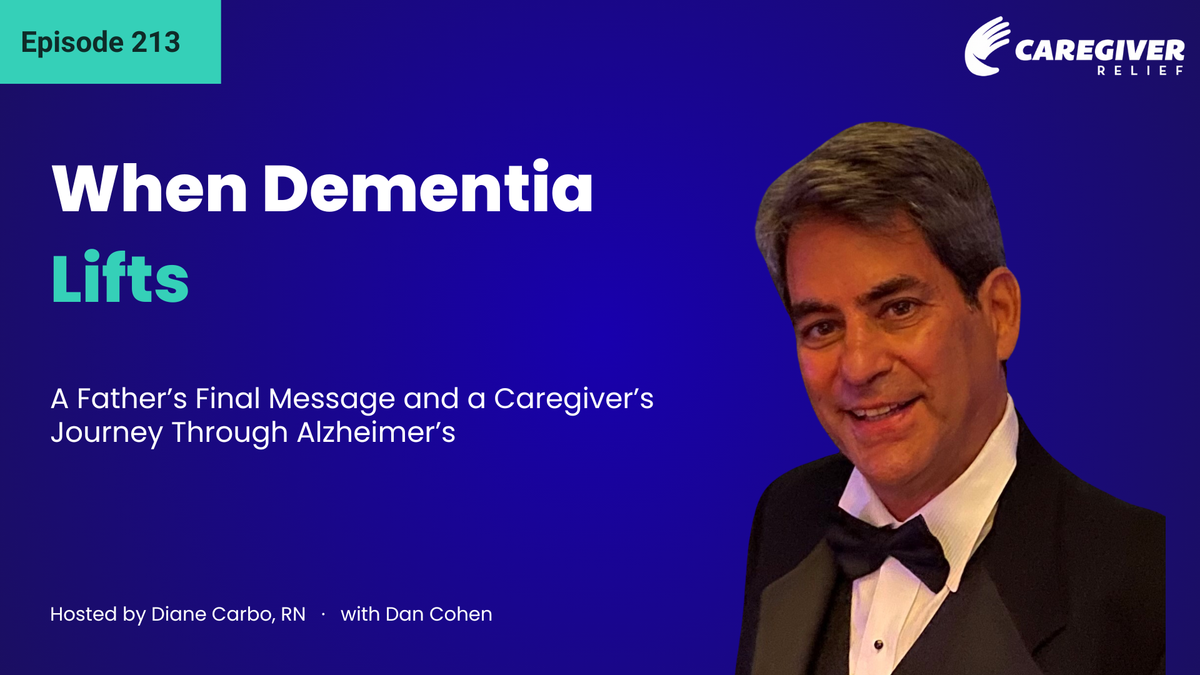
In this deeply moving episode of the Caregiver Relief Podcast, host Diane Carbo, RN, sits down with author and entrepreneur Dan Cohen to discuss a phenomenon that defies explanation. After a decade-long battle with dementia, Dan's father, Herbie, suddenly experienced a miraculous two-day awakening. He was suddenly able to recognize his surroundings, recount old memories, and share profound final messages of love with his family before slipping back into his dementia state.
This conversation is an absolute must-listen for any family caregiver looking for hope, resilience, and a fresh perspective on navigating the long goodbye.
📋 Episode Outline & Key Highlights
🔹 1. Who Was Herbie Cohen?
- A Loving Presence: Dan describes his father before the onset of dementia—a warm, demonstrative, ego-free man who was his best friend and ultimate confidant.
- The "One" Person: Dan shares a beautiful concept from his book about finding that one person in life who loves you completely unconditionally.
🔹 2. The Realities of the Caregiving Journey
- The Diagnosis: How a sudden stroke at age 75 unexpectedly led to a 10-plus-year journey through the stages of dementia.
- The 15-Minute Healthcare Crisis: Diane and Dan dive into the modern struggles of navigating a fractured medical system where family caregivers are expected to advocate fiercely with very limited resources.
🔹 3. The Power of "Acceptance and Inclusion"
- A Lesson in Acceptance: Dan highlights why challenging a dementia patient's broken short-term memory brings unnecessary anxiety—and why caregivers must extend grace to themselves.
- The "Argo" Movie Story: A humorous yet heartbreaking realization between three siblings that underscores why meeting your loved one exactly where they are matters most.
- Active Inclusion: Why keeping your loved ones included in life—trips to the movies or horse races—matters, because they are still absorbing your energy and living in the moment.
🔹 4. The Miracle: A Two-Day Awakening
- The Sudden Shift: While hospitalized for pneumonia, Herbie suddenly speaks with absolute clarity, answering questions accurately and mimicking 90% of his former self.
- Unexplained Awareness: How Herbie somehow knew grandchildren had started medical school and Ivy League colleges, despite these events happening while he was deep in his dementia.
- A Final Message of Love: From asking for his favorite napping sock to wanting to tip his nurses, Herbie leaves his family with the ultimate comfort: "I'm happy just to be here and alive."
🔹 5. Turning Mini-Awakenings into a Mission
- "Awakenings in Real Life": Dan talks about expanding his father's story into a book and a brand-new podcast featuring regular people who have experienced incredible moments of transformation and hope.
- The Screenplay Pitch: Dan shamelessly shares his brilliant screenplay idea for a courtroom drama based on his family's experience!

💡 Top Caregiver Takeaways From This Episode
"Change your perspective, change your life." Even when a loved one cannot clearly verbalize their thoughts, they are highly likely more aware of your presence, your love, and their environment than we realize. Treat them as if they are fully present.
- Hospice is about living: Dan reminds listeners that hospice care isn't just for the final days; his father was supported beautifully by hospice for eight months, emphasizing comfort and quality of life.
- Be gentle with yourself: Caregiving is one of the hardest things you will ever do. Practice self-care because without you, the equation falls apart.
🔗 Resources & Links Mentioned
- Dan Cohen's Website: Awakenings in Real Life
- Social Media: https://awakeningsinreallife.start.page/
- Dan's Book & Podcast: Awakenings in Real Life: Other People's Stories (Available on Amazon, Apple, Spotify, and YouTube)

💬 Join the Conversation
Have you ever experienced a sudden moment of clarity or a "mini-awakening" with a loved one suffering from dementia? We want to hear your story. Leave a comment below, or share this episode with a fellow caregiver who needs a dose of hope today! 🩵
Podcast Episode Transcript
Diane: Welcome to the Caregiver Relief Podcast, where we help caregivers, patients, and families navigate the healthcare system with knowledge, compassion, and hope. I'm your host, Diane Carbo, RN, and today's episode is one that will stay with you. What would you do if your loved one, lost to dementia, suddenly came back clear, present, and able to share what was on their heart?
My guest, Dan Cohen, experienced exactly that. After years of dementia, his father had a brief but powerful awakening, two days of clarity that changed everything In that time, his father delivered a message that continues to shape Dan's life and his mission to share stories of hope, resilience, and meaning through his book and podcast, Awakenings in Real Life.
Diane: Dan, thank you so much for being here today. I'm excited to learn more about your dad, your experience with your dad. but before we get started, can you tell us about who your dad was before dementia changed things?
Dan: Sure, sure. So Diane, thank you so much for having me on your podcast and giving me the opportunity to share what I really think is a remarkable story, and thank you for sharing these kind of stories.
So before my father had dementia, he was a very big presence in my life. he was my best friend, he was my confidant, he was, my problem-solver. He had a big personality, very warm and loving. I have two siblings, an older brother and a younger sister. My brother describes him as someone who exudes love.
He was very demonstratively loving, especially to his wife and his three children, and he played a very important role in my life. And interestingly enough, Diane, in my book, Awakenings in Real Life, not only do I talk about the awakening story, but I share other stories and reflections. My last chapter is who is your one?
So for me, that was my father, the... and I know, and a one can be a hero, but it can be slightly different. It's that person in your life that has no ego when it comes to you, that loves you unconditionally, that wants to see you do better than themselves. And I always said there's no statute of limitations, for having.
Doesn't, I needed him, I could use him today, I wish he was still around. There's no statute of limitations of how old you are that you don't need that person. So that's the role he was for me. He was a very important person in my life, and we had a very, very wonderful relationship, and helped me go through a divorce as a support system.
Was really there for me throughout my entire life.
Diane: Well, you were very blessed. So I'm sure when he had his diagnosis of dementia, you just were shattered. It just impacts the family so much. now I want to talk to you because can you describe the moment you realized your dad was suddenly awake?
Dan: So let me backtrack if I can.
Diane: Sure, absolutely.
Dan: Let me just give you the history of how we came to dementia.
Diane: Okay.
Dan: Because I think it'll give you some context to the awakening.
Diane: Okay.
Dan: So just to preface it, when he turned 75, we gave him a surprise party, and everybody from my mother down to the youngest grandchild got the opportunity to speak and tell my father how they felt about him.
So
Diane: It was a long night then.
Dan: and it rained. We had to bring it inside. But
Diane: Oh.
Dan: He... Just the smile on his face and the joy and then he expressed how he felt hearing these messages of love. But five short months later, he had a stroke. So my brother's a physician. And my brother's office took care of my father.
He happened to be walking into my father's office having a stroke, so they knew immediately. His one side of his face was drooping. He couldn't smile. That's if you ask someone if they can smile and they can't smile.
Diane: Yeah.
Dan: So he was having a stroke. He was bleeding in his brain. They were able to get him to the local hospital, and within 10 minutes they stopped the bleeding.
And he had a pretty good recovery. The first couple of years afterwards, he was able to drive. He was able to use a cellphone. He was pretty good. But from the stroke, that led to the diagnosis of dementia. So I don't, I'm sure you must, you might have gone into this with your audience at other points.
But I liked a lot of people don't understand or think Alzheimer's and dementia are two different things. So dementia is actually, a loss of mental cognition. It's a downward spiral mentally. It goes through seven stages, and it can be caused by a number of things. It can... The, most people are familiar with Alzheimer's, which is plaque in the brain. You can get it from a blow to a head or a stroke like my father had.
Diane: Yep.
Dan: Certain diseases can cause it, and then there's vascular dementia, which
Diane: Yeah ...
Dan: people used to think of senility. So
Diane: Yes
Dan: his came from the stroke, and he developed dementia, and his dementia lasted 10 plus years, and he went through all the stages. So before I tell you about the awakening event, let me share my feeling of the stages, 'cause you want my point of view as a caregiver.
Diane: I would appreciate that.
Dan: Right?
Diane: Yeah, because, you know, it's a learning experience, and people don't understand that there's over 100 types of dementias. And, most of them follow a pattern. some are stairsteps where it takes a little longer. Some are like a slide. They go from one stage to another.
But, yeah, I'd appreciate hearing about that.
Dan: So there's stages, right? Seven stages.
I never got caught up into the stages. I just felt if I knew if I, we, had a neurologist taking care of him. Whether he was in stage five or four or six or seven I just felt it was gonna give me more angst.
You as a loved one know what your person is going through. You don't need to be told, "Is it stage six? Is it stage seven?"
Diane: Yeah.
Dan: I think that can just bring, extra anxiety to the situation.
Diane: Yep.
Dan: So look, my mother lived with him most of the time. I was his son, would visit often, but we knew where he was at.
So-
Diane: Yeah
Dan: I never felt the need to find out exactly what stage he was in. So that's number one. The other thing is, and before we talk about The Wakening, I wanna share the things that I tell people that I learned through caregiving for someone with dementia. Because, and I'm not a medical professional.
I'm not like yourself. I don't claim to be a medical professional. I can just tell you my experience, as a son who visited often, and my message to people going through it is twofold: acceptance and inclusion, okay?
Diane: Yeah.
Dan: And what do I mean by acceptance is because it's a progressive disease and it gets worse over time, one of the first things people go through is a loss of short-term memory.
So they might ask you the same thing over and over.
Diane: Yep.
Dan: And they might repeat things, they might say things over and over. and naturally our instinct is to challenge someone. I told you this a minute ago." I-
Diane: Yeah
Dan: "Well, you're asking the same thing over and over."
That's our natural tendency, and when we can accept that this is not, this is a part of the brain that's screwed up and we can accept the person for where they are, that's number one. And number two is to give accept yourself and give yourself some grace that you're not often gonna be perfect.
There are gonna be times where you're gonna get frustrated. The other thing is people lament, "Wow, he or she was so much better six months ago. I wish they were like they were six months ago." But you know what? The reality is it's gonna get progressively worse.
Diane: Yeah.
Dan: So again, if you could accept the person where they're at in time, it's gonna be so much better for them and so much better for you.
So
Diane: That's a really good tip, Dan, and I really appreciate that. It's so important because it's so hard for families to do that. And, so I applaud you for and pay attention, listeners, to what he's saying because he knows what he's talking about. And I do want to make another point real fast, Dan.
The PCP or your doctors, your providers, they know as much about dementia as you do. They are there's not training the way it there should be, and, they're just not aware of it. So when you say, you're a family member and you don't, pretend to be a doctor, you probably know more about a dementia having lived through it than the majority of the physicians and providers, and nurses and providers out there at this point in time.
Dan: That's a very good point. And I tell people regarding all areas of healthcare, whatever you're going through, dementia, other mental diseases a physical condition, cancer, an illness, a disability, you gotta be your best advocate, or your family member has to be your best advocate.
Yes. Because, again, you know best, and you can't rely on doctors and the health institution blindly, because they have and if you think something is wrong or you think you want to make a point, don't be shy when it comes to your care or your loved one's care.
Diane: 100%.
Dan: Right.
Diane: And , You know, Dan, the problem with our healthcare system right now is Medicare only allots a 15-minute appointment, and in that 15 minutes, they are, the doctor's, expected to meet with you, assess you, try to diagnose, order tests to see if they can find a diagnosis, then they have to write down, what they did during that evaluation, and then move on to the next patient.
And 15 minutes isn't enough, so I really encourage families, you may not get heard like you want to, but don't let that stop you. Have a list ready when you're in front of the doctor saying, "This is what I'm seeing." and if you need to, ask to set up another appointment to discuss just that, because, doctors miss things all the time now.
And the other thing that we're having, Dan, is we're in a public health crisis. we are, the family caregiver is expected to do procedures and advocacy and so many other things once done by, medical health, medical professionals. we are in a real crisis right now, because you're not trained in anything.
And that's an issue that we're gonna deal with it over the next, decade or two.
Dan: You're right. And from my perspective, we're going the opposite direction. You're getting less and less person now doctors won't do sick visits.
Diane: Yes.
Dan: That's the emergence of urgent care.
Diane: Yes.
Dan: And now, my brother's a physician, used to be on call and used to see his hospital and the patient, and he still does.
Even though now they're a hospitalist. Yeah.
Dan: So you don't even see your own doctor
Diane: Yes ...
Dan: in the hospital.
Diane: Yeah.
Dan: And you're right about the 15 minutes, because I had this story with someone. Someone was telling me, and they're a cancer doctor, says ... "If you're gonna tell someone they have cancer, they cry for the first half hour."
Diane: Yes.
Dan: "How can you do a visit- yes ... in 15 minutes?"
Diane: yes.
Dan: So I'll tell you a quick story about acceptance. I was in a support group once, and someone wrote, "Isn't it great that a dementia patient or Alzheimer's, they're in their own world, they're happy in their own world, and-" that sounds good, but no, that's not my belief,
Diane: Yeah.
Dan: You got to treat them as part of this world. But my mother was going to Texas for her aunt's 90th birthday, and me and my two siblings had to watch my father overnight. So we all did. The next time we got together we said, "What did you do with Dad?" I said, "Oh, I took him to a movie." My brother says, "Oh, we took him to a movie."
And my sister said, "We took him to a movie." They said, "What movie did you take him to?" You know it's happening already, right? So I said, "Oh, we took him to Argo." That was the Academy Award with Ben Affleck.
And my brother says, "Yep, we took him to Argo, too."
Diane: Oh, God bless.
Dan: And we looked at my sister and she goes, "Yep, we took him to Argo, too."
And we all three laughed, because he didn't remember from night to night. You know, he forgot
Diane: Yeah
Dan: five minutes. And we had a good
Diane: Yeah ...
Dan: laugh. But I have to tell you something, Diane. I cried on the way home.
Diane: Yeah.
Dan: Because if we were accepting him for where he was at, even though he didn't remember, we would have taken him to three different movies.
Diane: Yeah.
Well, the other thing I have to tell you is you had crap communication between the three of you.
Dan: You're right.
Diane: I'm just gonna come right out and say it. But I want my listeners to understand that a person with dementia can't, may be able to remember some of their past. They have no hopes or dreams of the future 'cause they can't, think about that in their brains.
Their brain's no longer able to. So they just live in the moment. And I can see that your dad probably just went along because everybody was loving, everybody was happy, they were upbeat, and he was with people. So-
Dan: You're right. You're right
Diane: that, and that's the important thing because, the person with dementia is going to absorb your feelings.
So if you're anxious and angry and upset, rest assured they're gonna pick up on that and that's gonna be what they're going to be feeling. So you have to be mindful of your, of how you're feeling, how you're responding, how you're reacting, and always try to do it from an upbeat, although authentic, point of view.
Dan: And you're right. And when I use social, my second mission is inclusion.
Okay?
Diane: Yep.
Dan: Include your person in life. Don't let them sit in a corner 'cause you think they don't know what's going on.
Diane: Yeah.
Dan: So I weekly, or every other week when I could, would take my parents, my mother and my father, to a movie.
Didn't matter how hard it was getting him in and out of the car, whether it was the walker or the wheelchair. And a lot of times in the moment, just exactly what you said, especially if it was a sad movie, I could see the tears in his eyes.
Diane: Yep.
Dan: So he might not remember after he left, but he remembered it.
So
Diane: Yeah
Dan: I think it's very important that you include your person in life. We have a story that I'll always remember about, inclusion, a memory we have about the, a horse track, about taking my father towards the end. And, treat them as still present in their life. And, what happened when he had his awakening, I think really shapes that so much.
Diane: One of the things that is the most overlooked tool that a caregiver can, in their toolbox that they should use is activities. I don't care if it's sitting looking at photos. if they have a love of a hobby, like you took your dad to the horse races. that's awesome because somewhere in the back of his mind, that's something he's enjoyed in the past, and, that's so important.
But it could be they love to play Scrabble or play cards or whatever it is. if you can get them to do that, first of all, it's a way for you to connect with them because unlike m- most people, Dan, you had a rare experience of two days of clarity. But, most people have moments of clarity.
Dan: Yeah.
Diane: And that's why it's a long goodbye because you get that sense of, "Oh my God, they're going to come back. Things are going to be back to normal." And then it, and just as that, their eyes you make that connection, they glaze over and they're lost to you again. So it's really hard to experience. And every time that happens, we grieve.
We grieve the loss of what was and could have been. And, I love your message of acceptance because that is one of the most important messages. If you just accept the here and now, the way they are, it just makes your experience with them so much more meaningful.
Dan: Yeah, and include them in life.
Diane: Yeah.
Dan: And you're absolutely right. I describe it as, you're watching someone fade, but you're grieving someone
Diane: Yeah
Dan: that's still living.
Diane: Yes.
Dan: That's a tough thing, especially when they're a very big presence in your life.
Diane: Yes.
Dan: But I'll tell you something. You know, there were moments towards the end where he didn't know who we are, but for the most part he still recognized us, which I think was a great gift.
Diane: Yeah.
Dan: I think that would be the hardest thing, when you don't remember. But-
Diane: Yeah
Dan: towards the end he would just sit in his chair, take my hand, and he'd kiss it.
Diane: Yeah.
Dan: And that, to me, was worth everything.
Diane: Yeah.
Dan: That was, that moment was the essence of the loving man he was.
Diane: Yeah.
Dan: And my brother, a doctor, went out of his way to keep him going.
I mean, we had his blood checked weekly. If he was dehydrated, he got fluids. and another doctor said to me once. So my father's name was Herbie. "What are you guys doing? It's not Herbie in, it's not the Herbie we know. Why all these efforts?" and ain't nobody has a right to tell you how long. But you know what? whatever time we had with him was better than the alternative. He was still there.
And he was still Dad,
Diane: And that's beautiful. now there are issues with, I know, G-tubes, feeding tubes and stuff that people feel. and when they come to the point of hospice, people think hospice is killing their family member, when in fact that doesn't make any sense, 'cause they don't make any money if they kill them off.
That's terrible. but I have read so many. There's actually a Facebook, area where hospice killed my father, and hospice is gracious, and they make comfort, and they give you an opportunity to interact with your loved ones till the day they die, and I think that's a beautiful story.
But you know, other people want, to hold on it, to them to the very end, and they want them to be resuscitated or whatever. But yeah, you, acceptance is hard and inclusion is so important up until the day they die. I think that's very important.
Dan: We weren't gonna do extraordinary measures, okay?
We weren't gonna do a feeding tube. We weren't gonna do that thing. But we wanted to keep him home as long as we could.
Diane: Yes.
Dan: And you're right about hospice, and this is what a lot of people don't know. A lot of people think hospice is, you're gonna die in a couple of days, right?
Diane: Yeah.
Dan: And my father, when he after he reverted back after his waking, he was on hospice the next eight months.
Diane: Yeah.
Dan: And it's not just the very end of life. They're designed to and they were wonderful. They really, really were Wonderful. I tell people when I hear about circumstance, I said, "Think about calling in hospice."
And some people immediately think, then my loved one's gonna die." And I said, "No."
It doesn't mean that."
Diane: Yes, exactly. and I have to tell you, I, tell you a story about my dad. My dad, had, pancreatic cancer, and he had this procedure, Whipple procedure, and the doctor comes in and says, "Lee, you have pancreatic cancer, and you're not long for this earth."
And, my dad, his first thought was he couldn't go to Hawaii. He was a letter carrier. Every other year he went for six weeks. He had this timeshare, and he was supposed to go in the next few months for his six weeks. And I'm a smart ass, the old nurse in me. And I said, "Dad, you're not dead yet.
If you can go to hospice, or if you can go to Hawaii, you can go. If you're feeling well enough, you can travel there." 'Cause we were in Pittsburgh, Pennsylvania. And, I actually put him on hospice in Hawaii.
Dan: Oh, look at that.
Diane: Because we discussed, I'm very open about death and dying, and I said, "Hey, if you die over there..."
And my dad's like, "Oh." My family's like, "Oh, don't say those things." But I said, "Dad, are you okay if you die over there? That we need, we can bring you home." My dad actually had a spiritual awakening for six weeks.
Dan: Wow.
Diane: And the day before he came home, he started not feeling well, and he came home, died a few weeks later.
Very happy, and was laid out in a lei and a Hawaiian shirt.
Dan: Wow. Look at that.
Diane: Yeah.
Dan: That's so good.
Diane: So it has nothing to do with dementia, but it does have to do with
Dan: Yeah, no, that's
Diane: living your best life up until the end
Dan: You're right. Yeah. That's an interesting story.
Diane: yes. So
Dan: so I'll share what happened during the awakening now.
So
Diane: Yes, I'd love to hear
Dan: so in the summer of 2015, he had two bouts of pneumonia.
Diane: Oh.
Dan: The second bout of pneumonia, he was also hypertensive, I believe that's the term.
Diane: Yes.
Dan: And they loaded him up with steroids
Diane: Yes
Dan: and antibiotics, okay?
Diane: Yeah. Now my brother, because his practice took care of him, he was in the hospital the most.
But I was there a good lot of the time. So he's lying in the hospital bed, and he says, "Hi, Danny." Oh, let me just backtrack. Okay. So at this point he was incontinent, needed help getting fed.
Maybe you'd get a word or two. Would never initiate a conversation. Maybe a word or two you'd get out of him.
What was very hard is when he would be sponge baths or shaved, he'd cry out in pain.
And it's hard to hear that.
Diane: Yes.
Dan: When, your parents, they're not in pain but they're crying out in pain.
Diane: Yeah.
Dan: We were fortunate. For the most part he remained, amiable throughout. a lot of times you hear the patients get mean or mean spirited.
Diane: Oh, yeah So Yep
Dan: we didn't get a lot of that. He just would make up what we'd, like a foreign language he would utter. And we always made a joke out of it. So he was not in he was eating pureed foods. He wasn't in good shape. So I walk in the hospital room, he says, "Hi, Danny."
I said, "Hi, Dad." He goes, "You know I love you very much." I said, "I love you very much." He said, "What happened to me?" And I said, "Well, you have pneumonia. You're gonna be treated, and hopefully you're gonna go home soon." So I had a conversation like I had with him, my whole life.
Diane: Yeah.
Dan: That's the type where I'm doing.
And then all of a sudden it dawned on me, this is not the man I saw a few days earlier.
Diane: Yep.
Dan: This is a man that resembles the father that I knew.
My brother said that when he went in there, he had full conversations with him, and he answered every question correctly.
Diane: Wow.
Dan: You know, if I had to put it in percentages, I would say he was, like, 90% the guy that I had remembered.
My brother said the bar was so low, and he came back so high that he didn't put it in percentages. But again, he answered all, anything you asked him correctly. So that was the start of a two-day awakening where he really resembled himself and not the man in the throes of dementia. And we experienced some very interesting things during those two days.
Diane: That's, I can't imagine that. you know, it makes your jaw. It reminds me of the Robin Williams movie, Awakenings
Dan: Awakenings. Exactly.
Diane: Yes. And I realize that's where you got the in Awakenings in real life, and,
Dan: That's right
Diane: the exhilaration you feel when you realize, oh my gosh, they're back.
And I have to tell you, it goes against common sense to even think that because when you have pneumonia or any kind of infection, the elderly get confused more. And he didn't. He came out of his state for whatever reason or how, and, had clarity for a few days, which that must have been exhilarating but also, the heartbreak must have been awful when he went back to reverting to his dementia state.
Dan: It was heartbreaking, but we focused on the joy of the two days,
Diane: God bless you for doing that. Yeah.
Dan: Yes. And I'll share some of the things that happened, but someone asked me, "During those two days, did you ask him any, what's the meaning of life?" Or did you ask him, any, "You had an opportunity here to ask him all these questions."
AND we didn't. We just had our father back for two days.
Diane: Yes. I wouldn't have He was That wouldn't have even crossed my mind.
Dan: So at one point, he tells my brother let me back up. I also have a chapter in the book called Perspectives. I used to think there's nobody in this planet that has the relationship I do with my father.
Boy, it's so special. We're alike. We got similar personalities. look, I know he loves my siblings, but I'm the guy.
Diane: Yeah.
Dan: He called me Dan the Man.
Diane: Yeah.
Dan: But then when I heard my siblings in particular at that birthday party.
And my brother and I are very different, okay? And my brother says, "My father and I are so alike." they look more alike, but
Diane: Yeah.
Dan: And then he told three stories with my father and my sister said, my friends all love my dad 'cause he's so warm. Can you imagine being Herbie Cohn's baby girl?" And she was in her 40s at the time. So I realized that they have the exact same relationship with him that I do,
They feel as special, too. and I said, boy, if and we all look through our own life through our own lens. If we could see other people's perspectives. A, we'd be more empathetic.
Diane: Yeah.
Dan: And, all parts of life. We could see other people's point of views and perspectives. I think everybody would get along better.
Diane: Yes. I agree.
Dan: So my father says to my brother, "I'm happy to have a son like you." And to my brother, who loved my father as much as I did and worse, so my brother took on the mantle of, problem solver in the family, especially when it came to medical issues 'cause he was a doctor. But he also took on that role.
But despite that role, my father was always that guy for him when he needed him. He always played that role in life. So when he said to him, "I'm happy to have a son like you," my brother said it was one of the most seminal motioned, seminal moments in his life to hear that from the man he loved so much, who hasn't seen in 10 years.
Diane: Yeah.
Dan: So that was pretty remarkable We filled in my, his, you're gonna find this interesting, Diane. We filled my father in on what the grandchildren is doing, right? And he said that's great. That's wonderful. That's terrific." And then he says, "Isn't one of the grandchildren in medical school now, and didn't another one start an Ivy League school?"
And we said, "Exactly right, Dad." And then we remembered that those events happened while he was in the throes of dementia.
So we said to ourselves, "How did he know?" And then I said to myself that maybe, and you're right, there's all different kinds of dementia, but my gut tells me that even though he maybe couldn't verbalize it, that he was more aware of what was going on, and that these people are typically more aware of what's going on than we think because they don't resemble their own self.
He also knew what hospital he was in even though nobody told him what hospital he was in, just 'cause he recognized the surroundings. So we found that truly remarkable, and I think that, dementia sufferers or persons may be more aware of things than we think.
Diane: That's incredible that you say that because, we don't know what we don't know about dementia.
There's so much, and every- everybody that has d- has dementia, if you've seen one case of dementia, you've seen one. They're not, and nobody's the same. And, you just don't know. I think that's interesting that you say that. I just do because, like, I've taken care of patients with comas, and, you don't and head injuries, and you don't think that they're always were told we, to talk to them, explain things- that type of thing. And I've always done that, if, you're in a coma, I'll sit there and talk to you, read to you, tell you my life story.
And then, and I'm sure there are times when the, when whoever's listening to you
Dan: Shut up.
Diane: goes, "Oh, hell. She hasn't, here she comes again."
Oh. And but you don't know. And then there's times when people wake up, and, I've heard coma patients when they've awakened, say things. Now they may be discombobulated, but they'll come out with one or two words that tells you that they know that you, they were listening to you.
Dan: Yeah, we never know the, what the human is capable of
Diane: Yeah
Dan: And I think that's probably goes for not only dementia, but maybe other mental conditions and physical conditions.
Diane: Oh, absolutely.
Dan: and it's another reason to include your loved one in life,
Diane: Yes. Yes. Yes.
Dan: If they're more aware of what's going on. So
Diane: Yes
Dan: that was remarkable. Now, my mother, who, you know what's interesting? The one who, and maybe you can help explain this, so my mother lived with my father every day, but she was the last one that was really fully aware of all his symptoms.
We noticed it. I don't know if she just denied it or,
Diane: Dan, I will tell you right now, denial is one of the strongest coping mechanisms people use, and I see it all the time. That's why when you say, talk about acceptance, it takes a lot of hard work for people to accept or even listen to something because then people.
It's a coping mechanism. If they deny that it exists, then they don't have to make changes. because that they have fear then of the future and what may become. So it's very common, and I see it more often than I'd like to see it.
Dan: Yeah. So he's now awake.
And he tells my mother, they were married 62 years at the time, that she was the love of his life.
Diane: Aw.
Dan: Okay? And, oh, before I tell you what happened with my mother, he reminisced, he was a boxer in the Army, and he reminisced about his boxing career, and he said he was a little smaller than his opponents. He surprised his opponents. He was underestimated. Talked about this football player that he loved named Wayne Chrebet, was an undersized player who overcame tremendous odds to be a great football player, and he says, "Like Wayne, I was underestimated by his, by his opponents."
He remembered that he bought all the grandchildren this football player's jersey, number 80, and I have a great family picture of all the grandkids in the 80, and it brought tears to his eyes. he talked about the athletes he remembered. So getting back to my mother, my, my father had certain quirks in life, okay?
So when he used to take a nap during the day, he would put a long brown or black sock across his eyes to knock out any additional light.
Diane: Yep. Yep.
Dan: So he's lying in the hospital, and he says to my mother, "Do you have my sock? I wanna take a nap." remarkable, right?
Diane: Oh my gosh. Yeah.
Dan: And my father in life, especially in a service thing, he was a very nice tipper.
If he appreciated you, he gave you a nice tip. it didn't matter his lot in life. he was just a generous tipper. So he's lying in the hospital bed, and this he says to my mother, "Do you have any cash?" She goes, "Why?" He wanted to tip the nurses and the aides. That was so nice to him.
So it's amazing, And he hadn't
Diane: Yeah
Dan: done these things in 10 years.
Diane: Yeah.
Dan: So I wanted to get my kids there because they hadn't seen Grandpa like he was, and they were little when he was. And unfortunately, I got them there towards the end of the second day, and he had already reverted back
Diane: Aw
Dan: to where he was.
Diane: Yeah.
Dan: But we had videotaped, a lot of what he said. Oh. So we showed them a videotape where my brother asks him, "What are you happy about?" And he said, "I'm happy just to be here and alive."
Diane: Aw.
Dan: And that moment is the catalyst for an article I wrote, for the book I wrote, for this whole thing.
Because I think in that moment he was saying that he still appreciates life and wants to live, and that even in the dementia, he still appreciated life and wanted to live.
Diane: Aw.
Dan: That's what I read out of it. So I thought this was a great story, and I like to write, so there's a site called medium.com where you can write articles.
And I did this while he was still living in 2015. I wrote an article about it.
And not knowing what kind of response I'd gotten, a lot of people said, "Wow, that's a heartwarming story. It's your relationship with your father." But a lot of people who had family members going through it says, "Thank you for giving us some hope that my loved one still appreciates life and wants to live."
And that to me is the real profound message that I think came out of it. Whether he was telling it just to the family to say he's a fighter and wants to live. But, I think it's a message that everyone can appreciate. And if you look at it through that lens, you might treat your family member differently or with a different perspective, because they still have a desire to be part of life.
Diane: Dan, one of the things I tell my listeners all the time is change your perspective, you change your life. And you can choose to be miserable and unhappy and broken hearted that your family member is having dementia, and yeah, you're going to grieve them, or you can take your perspective that you're bringing that, this information that their loved one is still with them in somehow, some way, even though they're not able to express themselves or they're not able to speak clearly.
They are still somehow, some way, and we don't have any proof that this is not true, that they're listening and taking our information in. That's why I love the message of acceptance and I love the message of inclusion because,I hate when people have a loved one and they talk over them.
Or, they don't and I've always sat and talked with them. I have a story. My grandmother had dementia, and she was in the hospital. I had moved away. I got married and we were transferred, many times, so I lived away from home. And my grandma was, she was just such, so important in my life, similar to your dad, 'cause my mom died when I was young.
And, all, everybody in the family told me, "Your grandma's not gonna remember you. She's just not, so don't, don't get your hopes up." And she had a pacemaker, a battery replaced, so she was in the hospital 'cause she was in her 90s. And, I went in and sat next to her. She was laying there.
She was asleep and, she woke up and the first thing she said to me is, "You look like my Diane." And I was like, "I am your Diane." Of course, I had to go back to my family and go, "Na, na,na, na." "
Grandma remembered me cause I'm special."
And it made my heart soar.
Dan: Yeah.
Diane: And, we had that connection, and I sat there with her, and we talked about old times.
She wasn't there consistently with me, but she just laid there and smiled. And, I was massaging her hands and talking to her and visiting with her. And, that was a very special moment in my life that I still
Dan: Yeah
Diane: cling on to today.
Dan: Yeah.
Diane: It so I understand
Dan: Someone said to me, "Was this terminal lucidity?"
right before someone's gonna die.
Diane: Yeah.
Dan: A lot of times. Said, "No, this happened eight months before he passed away." I write in the book, I said, we try to look for an explanation. So my brother, the doctor, wants to come at it from a medical point of view. So his first theory was the steroids reduced the inflammation in his brain and allowed him to come back.
So that was his theory for a while. So I'm doing my own podcast about other people's awakening stories, and
Diane: Yeah
Dan: and I had my brother on as a guest, the first one, to talk about my father's story, and he goes, "I've done the research again. Steroids can actually have a negative effect. Now I think because he got better from the pneumonia, it had something to do with his dopamine levels and neurotransmitters."
And I'm saying to myself, okay. But I don't know. His neurologist said he never saw anything like it in 30 years of practice.
Diane: Yeah.
Dan: My brother asked his colleagues. None of them ever heard of anything like it. So I have a hard time thinking anything can reverse an irreversible downward trend. My second thought was maybe it's a miracle.
Now, I'm not necessarily the most religious guy. I'm more of a spiritual guy. But to me, that was as good an explanation as anything else.
Diane: Yeah.
Dan: The third thing is maybe my father, because he was a fighter, he was a street kind of guy who built a successful business in life, maybe he was and there were times during the 10 years where he'd be in the hospital for one reason or another, and my brother would say, "Well, his bodily functions are shutting down.
He may not make it till the morning." The morning came, he was back.
Diane: Yeah.
Dan: So maybe he's telling us that he's still you know, fighting and wants to live.
Diane: Yeah.
Dan: And those are the explanations I put in the book. But I did a little book signing, and a friend of mine came up to me afterwards and he said, I think your father maybe went through what he did so you could experience it, write a book and share it with the world."
And I said, "You know what? I like that explanation the best."
Diane: I, you know what? I do, too, Dan, because, you have a very powerful story, and it's one that, a positive message. It's a message of not only hope and resilience, but of teaching acceptance and inclusion. And it sounds like you have and you're very family oriented, and you continue to be family-oriented. And, most siblings all fight and argue, about things. Nobody wants to step up, to the plate and help. They find it a challenge. they'll say, I've heard family members say, they're not there anymore in, in the head." "So why do I have to be there?" And I'm like, "Oh, my.
Oh, my." I feel sorry for them.
Dan: Yeah.
Diane: So I really love your message. Dan, I do wanna, tell us, have you tell us about your podcast. What kind of stories are you sharing, and why are they so important right now?
Dan: Sure, and I'll do that, but I just want to, again, just tell you how I got to that.
Diane: Yes.
Dan: So when I decided to
I've been an entrepreneur and a businessman, and after my last consulting gig ended, I said, "You know what? I wanna share my father's story in a book."
And then I said, "But I don't know if this story's enough to fill a whole book," okay? And I said, "But I got other great family stories, but who wants to hear my family stories?"
So I actually found a wonderful publisher and editor in California, and I was talking And then I realized that when I started to my father's awakening allowed me to reflect back on his life and the family life. And when I reflected back on our stories, there were certain lessons learned or what I call, like, mini awakenings.
Okay? Now, an awakening, people think of it as something religious or spiritual in natureor something big like my father waking up.
Diane: Yeah.
Dan: But if you look in the dictionary, it's an awareness, realization, or recognition of something. So I share stories. I share stories of my when it's a time to fight for something and when not, in a story involving my story.
I talk about a story about a beloved uncle who always showed up for us, no matter. We came home in the airport 2:00 in the morning or 2:00 in the afternoon, he always was there, and I don't even think he knew what flight we were on that time. So the importance of showing up. Yeah. we had, my father liked to go to a track.
And there was always a valet who no matter when we would go, would help us. He'd help me taking out the wheelchair and, or the walking thing. Where we parked, it was like 100 yards away. He would get in the car and drive us back and forth. And how small acts of kindness were important.
Diane: Yeah.
Dan: So I have all those kind of things.
And then what I did in the book is I left reflection pages. I wanted to bring the reader in so that in these stories, like when was a time you accepted what you are going through with your loved one? And again, it can be any mental or physical conditions. Yeah. When was a time you had concluded them? When was a small act of kindness important to you?
And I give reflection pages. So I expanded it to other, what I call mini awakenings and other stories, some funny stories. Most having to do with my father, but a couple about my son and my mother. So how did I get to the podcast? I didn't plan on doing a podcast. So I was watching a report on TV about a gentleman who had a spinal condition.
He decided he's gonna leave his corporate life, learn to sail, and sail one man with his, I think his cat, across the Pacific Ocean.
Diane: Oh, my lord.
Dan: And his story went viral, and it was all over social media, and it was all over TV. And I said to myself, "He had his own awakening
Diane: Yeah
Dan: in his life." And I said, "Boy, there must be a lot of awakening stories out there that I could share, and why not me?"
You could tell that I, you know, I'm not shy about talking. And I'm the guy who went with the family parties with the videotape, was always interviewing everybody. So I started to research how to do a podcast. And I give you a lot of credit, Diane, 'cause it's not easy. There's a lot more work involved than people think.
And I reached out to certain, Facebook groups looking for guests and other people of awakening, and I got, 130 responses.
Diane: Wow.
Dan: And I narrowed it down to 18 And I talk about it as ins- inspiring stories of transformation, meaning, and hope. So I had a guy who was bullied his whole life, talking about Robin Williams.
And at 46, I don't know if you remember, Robin Williams did a movie called Patch Adams where he plays like a clown.
Diane: I love that movie. Are you kidding? Yes. oh.
Dan: So he saw that Patch Adams was looking for clowns to go on a mission to Russia.
Now, this guy was bullied his whole life. He decides to become a clown.
And since that coming, he's a clown on a mission. He goes to Guatemala and he brings joy and food. And he had an awakening moment at 46 to become a clown. So he went from as a kid to trying to be as invisible as he can
Diane: Yeah
Dan: to be as visible as he can. I got someone who lost a child and wrote a book, I think it's called Walk On or Carry On about the lessons.
You know, that was an awakening story. someone whose son was autistic and his awakening moment was the moment they really connected together. I've had couple of guests that have overcome trauma and turned their life around and now help and coach others. I got a woman who also lost their father in 2015.
And she was an atheist but now she's on a mission to prove that there's life after death. Really some really remarkable stories. and I share that in the podcast. And, I've enjoyed doing it. And I also call it Awakenings In Real Life.
I call everything Awakenings In Real Life.
Diane: Dan, how do they, how do people reach out to you?
Or if they have an awakening story, how do they share that with you?
Dan: Exactly. You're exactly right. So the book is called Awakenings In Real Life. It's on amazon.com, barnesandnoble.com, and select bookstores. The podcast is also called Awakenings In Real Life: Other People's Stories. That you can find on YouTube-
Apple, Spotify, or wherever you get your podcasts. You could also come to my website, www.awakeningsinreallife. You see the theme here?
Diane: Oh, yeah.
Dan: And, that'll have a link to where you can get the book. And my episodes are on there as well. you're right. In the book and on the podcast if someone's had an awakening story or they wanna share a reflection
they can email me at info@awakeningsinreallife.com and I'll share it on the website. Or if they have an awakenings story, they could potentially be a new guest for me. I also am on all social media under Awakenings In Real Life. So you mentioned the movie Awakenings, right?
Diane: Yeah.
Dan: I have a tab on my website.
I have an idea for a screenplay, almost like a new version of Awakenings
Diane: Yes. Yes
Dan: where in, in our case, the patient zero is treated with steroids, and he comes back, and there's two brothers Oh the non-doctor and the doctor. You see a theme here?
Diane: Oh, yeah.
Dan: and the non-doctor says, "We gotta figure out a way to keep Dad on steroids."
And the doctor brother says, "I don't know. There's risks to steroids," right? But he designs a protocol, and the father awakes, and then all the other people in the memory care that have Alzheimer's and dementia, they all wanna go on it. They all awake. They go on an adventure. But the father's starting to experience some sys- symptoms, and he's got an illness and other things, and the doctor brother ends the protocol, and he starts a reverse.
And the younger brother takes him to court, and he says, "Aren't we better having our father back for a short period of time?" So it ends in a whole courtroom battle. What's more important, the quality of life or the quantity of life? So if you're a producer out there or an agent and you think this could be a good movie.
Diane: Oh, you're shameless. You are shameless. I love it. I love it.
Dan: I'm pitching it to you.
Diane: So- You're an opportunist. Okay.
you mentioned the original movie, so
Diane: Yeah. you know that I love that movie
Dan: it gave me my opening
Diane: because it was so powerful and when in fact, that's the first thing I thought of when I was reading your story about your dad, so it just hit me hard. But, Dan, thank you so much.
It's been very enjoyable, and to my listeners out there, my family caregivers, you are the most important part of the caregiving equation. Without you, it all falls apart. So please learn to be gentle with yourself. Practice self-care every day because you are worth it.
Caring for a loved one can be overwhelming — but you're not alone. If you have questions, big or small, our expert team is here to help.
👉 Click here to Ask the Expert
Our Resource section can help you find the information and tools that you need. We have courses, videos, checklists, guidebooks, cheat sheets, how-to guides and more.
You can get started by clicking on the link below. We know that taking care of a loved one is hard work, but with our help you can get the support that you need.
Click here to go to Resource Section now!