Medicare Advantage and Medicaid Denials: Why Seniors Are Losing Care, Coverage, and Safe Discharge Support with Arya Rashidian - Episode 231
Medicare Advantage changes, Medicaid denials, and unsafe discharges are leaving seniors and caregivers scrambling for safe home care. Arya Home Healthcare explains what families need to know before coverage is cut or a loved one is sent home.
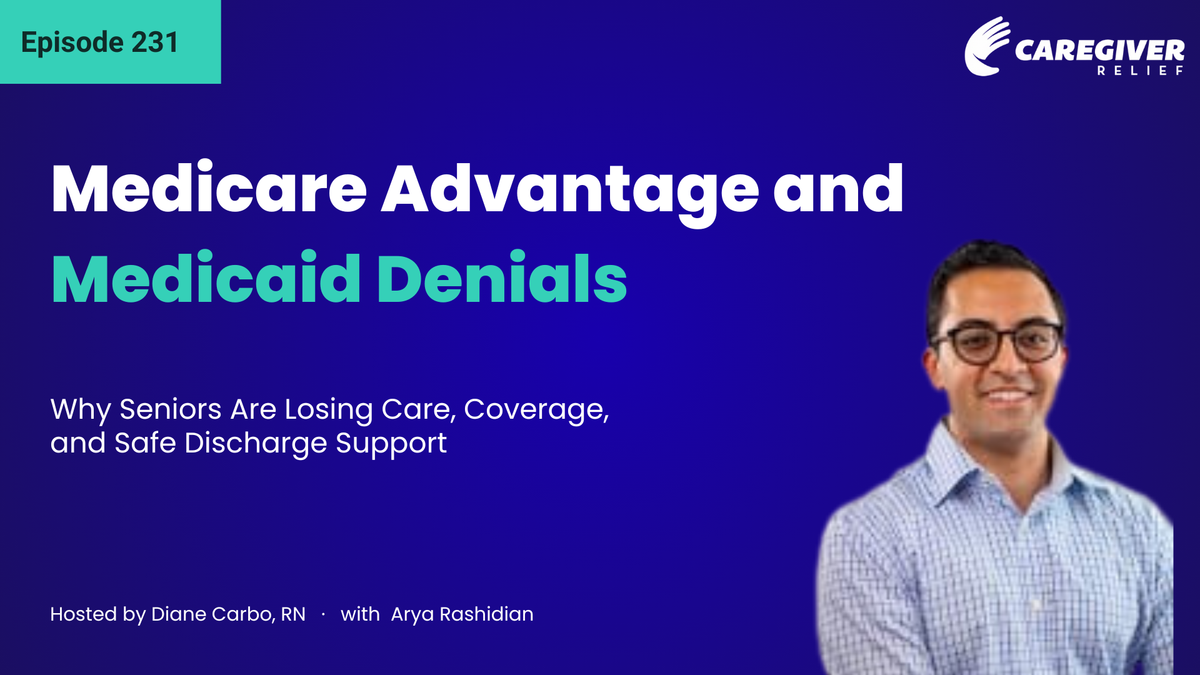
In this eye-opening episode of the Caregiver Relief Podcast, host Diane Carbo, RN, sits down with Arya Rashidian, alternative administrator of Arya Home Health Care. Together, they pull back the curtain on the confusing world of Medicare Advantage changes, Medicaid denials, shrinking provider networks, and prior authorization delays that leave vulnerable seniors without necessary care.
If you are currently caring for an aging loved one, navigating a hospital discharge, or trying to make sense of insurance denials, this is an episode you cannot afford to miss.
📋 Episode Outline & Key Takeaways
- The Unsafe Discharge Crisis: Why a written "discharge order" from a hospital or rehab facility is absolutely not the same thing as a "safe discharge plan".
- The Insurance vs. Care Gap: Understanding why having insurance coverage (like Medicare or Medicaid) does not automatically guarantee you will receive actual, hands-on care in your home.
- Red Flags to Watch For: The "Big Three" warning signs that a loved one is being discharged too early (wound care issues, fall risks, and general weakness).
- The Reality of Medicare Advantage & Medicaid Denials: How constant policy changes, cost-sharing models, and rigid 15-minute task increments are making it harder for home care agencies to support families.
- How to Fight Back: Your right to immediately initiate the Medicare appeals process if you believe a discharge is unsafe.
- The Power of Staying Hopeful: Practical advice on using modern tools (like AI) to find resources, fill out reimbursement forms, and advocate for your family.

💡 Why You Should Listen
Caregiving is incredibly rewarding, but navigating a broken healthcare system alone can feel exhausting. This episode provides the practical knowledge and advocacy tools you need to protect your loved one. You will learn exactly what questions to ask discharge planners, how to handle insurance delays, and where to find grassroots support when you need it most.

🔗 Listen & Resources Mentioned
- Need a Roadmap? Download Diane’s Safe Discharge to Home Checklist and the bonus guide, How to Use the Medicare Appeals Process When You Believe a Discharge is Unsafe.


Podcast Episode Transcript
Diane: Welcome to the Caregiver Relief Podcast. I’m Diane Carbo, RN, your host today. Today, we are talking about a growing national health crisis that is affecting older adults, people living with chronic illness, and the family caregivers who are trying to keep them safe at home. Across the country, families are being told their loved one is ready for discharge, but when they look at the reality of going home, the situation feels very different.
The person may still need help getting to the bathroom, transferring from bed to chair, managing medications, preparing meals, checking blood pressure or blood sugar, getting to follow-up appointments, or staying safe overnight. At the same time, families are facing Medicare Advantage changes, prior authorization delays, Medicaid denials, reduced home care hours, shrinking provider networks, and discharge plans that do not always match the real care needs of the person going home.
My guest today is Arya Rashidian, alternative administrator of Arya Home Health Care, serving families in Northern Virginia. Arya Home Health Care provides compassionate, customized in-home care, including personal care, respite services, medication reminders, blood pressure and blood sugar monitoring, meal preparation, light housekeeping, dressing and grooming, bathing, exercise and, mobility assistance, transportation, skilled nursing, palliative home care, chronic illness management, and individualized nursing assessments.
While Arya will be sharing what they are seeing through their work with families in Northern Virginia, this conversation is much bigger than one agency or one state. These issues are happening nationally. Seniors are losing access to care. Families are being asked to take on responsibilities that they’re definitely not trained for or
physically able to manage.
And home care providers are often becoming a bridge between an insurance denial, a hospital discharge, and a safe plan at home. That is why I created the Safe Discharge to Home Checklist, along with the bonus resource, How to Use the Medicare Appeals Process When You Believe a Discharge is Safe. Too many caregivers are feeling pressured to bring a loved one home before the right supports are in place.
They are often afraid to question the discharge plan, unsure what Medicare Advantage or Medicaid will cover, and unaware that they may have appeals rights when a discharge is unsafe. Today, Arya and I are going to talk about what families need to know before a loved one is discharged, before coverage is denied or reduced, and before the caregiver is left to manage care alone. Because a discharge order is not the same as a safe discharge plan, and insurance coverage is not the same as having real care in the home
Diane: Arya, I’m so excited. You and I have had several conversations, and you are right there on the grassroots, efforts to learn about what’s happening. Can you tell me what you’re seeing right now that families, when families contact Arya Home Healthcare?
Arya: Thank you, Diane, for that lovely introduction, and wonderful information. I’m very happy to be here. what I can definitely tell when families are calling, they’re calling and they don’t know what to do. Oftentimes they’re answering with, the problem, which is, “Listen, my dad or mother or loved one got discharged, and we want to make th- we want them to come home so they can basically have that build, rebuild that sense of independence again that they’ve long lost since they were in the hospital.” And most, many of the times they’re panicked and
they’re answering questions or they’re giving me questions with and repeating, “I don’t know, I don’t know, I don’t know.” And usually, to a certain extent we can try and help, the clients, especially who are on Medicaid, who are looking for home care services to receive in the home, by providing them with resources, state, specific, local, because as we know, Medicaid is funded primarily through the states and, limit, and small federal funding.
But they’re handled at the local level. So we, give them local resources, phone numbers, contact information and personnel, and we usually advocate on their behalf if they are willing and really need that extra assistance. So we do often go the extra mile for our clients and for generally anyone in need, to make sure that they can understand this process and know they’re really not alone.
Diane: You know, Arya, we’ve had previous conversations, and one of the things that shocked me, because I did home healthcare, is that Medicare no longer pays for a nurse to go out for home care. And that is the last frontier for safety. That’s the safety net. That home healthcare nurse is the safety net because the hospitals aren’t training the families, and we are seeing more unsafe discharges to home than ever before.
And you’re there at the patient level, patient care level, and you are seeing things, even more than I am, and hearing about. Now, you serve families in Northern Virginia, but these issues are happening across the country. What makes this bigger than one local home care problem?
Arya: So because it’s a state issue, it’s a state law, and also often there are county, local regulations, and that it’s unfortunately always changing. I’ve had MCOs, managed care organizations, which are Anthem, Aetna, Humana, United, and so on and so forth, they’re basically changing their policies per Medicaid state requirements or to accommodate or to add to the state requirement. So why this issue is bigger than just our agency is because regulations are changing way more
than they should.
Diane: Yeah.
Arya: r- rules, again, regulations that I mentioned, but also policies are always changing. And while they can be used, those terminologies synchronously, it’s very important to know that these things are happening, and they’re just confusing members and sometimes making it very hard for agencies to keep up because there’s shorter span windows, shorter time for us to really synthesize the information so we could actually communicate it to our current members, to our future members, and really to even have it in a conversation like we’re having today. So it’s something that I feel like we have to, really see if there is a way
where it can really provide that person level of care, but also at the same time be able to really, be able to assist, people in need while understanding the issue. Because a lot of agencies, unfortunately, unlike our local agency can’t or won’t
Diane: Yeah. it’s unsustainable. And, from my perspective, Medicare and
Medicare Advantage have cut reimbursement rates so low that the hospitals are… There are hospitals closing. they have cut the reimbursement for therapies in, rehab and skilled care to the point that many nursing homes are closing, community hospitals are closing, and you’re, an agency out there trying to provide the best possible care, and it’s you’re struggling.
And here’s the other issue we have. We have a silver tsunami. We’re here, and in the next five years, the number of seniors is gonna double. The baby boomers are going to. The oldest of the baby boomers are going to be are going to hit 80 years old in the next five years, and the youngest of the baby boomers in the next five years, four years actually, will be retiring. They will hit retirement age. We have more of a need, and now we have agencies struggling to provide the best possible care. So can you tell me what is the difference between having insurance coverage and actually having care in the home?
Arya: Fantastic question. they’re two different really, unfortunately shouldn’t be, but they’re unfortunately two different things. And really having insurance is basically just having the baseline coverage. In the instance of Medicare, there’s original Medicare, and then there are, Part B obviously, there’s Part C, there’s Part D, and Part E. And, so soon there’ll be F, G, H, and I think by my generation, by the time I’m 65, there’s going to be a Part Z, and I don’t know what’s going to happen then.
But anyways, to be- on a serious note, there is different, coverages. And just like Medicaid, there’s, original Medicaid, and then there is, you know, Medicaid and Medicare, which is, a dual plan, considered a dual advantage plan by some. And basically what that means is having insurance, while that’s good, it helps cover for your, inpatient, outpatient needs.
It does not cover specific services, like the nursing visits that you mentioned. Medicare doesn’t do that. And just like Medicaid, they won’t qualify you for long-term care services until you get an extra screening done at the county level, that they can later add on to your coverage. So nothing is guaranteed, unfortunately, just because you have the insurance.
Now, whereas receiving the care is very important, is that a lot of times people go through the mess of getting the insurance and then going through the local level to get the coverage when it comes to Medicaid, or just adding in the extra benefits, like Medicare Advantage, and then with a carrier like, Humana, or like Anthem, or like Aetna.
But what happens is that once they get it, unfortunately, then the issue comes at the provider level, where sometimes the providers aren’t there to give, the member really the best care that they’re looking for. Or there comes an issue of the in-network and out-of-network, providers that they also have to deal with.
And that also affects the care process because then that leaves the member wondering, “Should I book another session? Should I come and talk to this, doctor or physician some more?” Or something like that. And that basically, impacts the care they can receive, and ultimately, creates, the care that is not really something that, could be conduent really to, to either,
Diane: The bottom line is that our government, has forced the family caregiver, to take on the responsibility once provided of services and treatments and everything else once provided by healthcare professionals. And, right now, the family caregiver is the single largest pillar of the long-term care industry, and they are also,
They should, we should get unionized. I’m telling you so we can get. Because
they provide $1.1 trillion of unpaid care. That’s incredible. The other thing that people don’t understand is that Medicare and Medicare Advantage, they’re all moving, and Medicaid, they’re all moving to a cost-sharing plan. That means you’re going to have to pay more out of pocket for your services and recommended treatments than ever before, and it’s insurance isn’t going to cover it. Medicare in, traditional Medicare, because that’s what I have with the supplement, is rationing
services and cares that you can ask for. So it’s happening at every single level. So I want to talk about what happens when a senior is discharged before the h- before the home is truly ready. Arya, what are you seeing?
Arya: So the risks that we see when that happens is that they are some, most of the times, unfortunately, prematurely discharged. client, we’ve had clients who can barely walk being already discharged and coming home, despite being in a rehab facility
Diane: Yep
Arya: or their outpatient facility
Diane: Yeah.
Arya: So sometimes we have to advise the family members that it’s better if they stay or prolong their stay for a little bit time longer, and it usually is because either their insurance isn’t going to cover it anymore or because, the outpatient facility or the attending physicians or anything have made documentations, that the client is ready to go. But it’s rarely ever the member saying that, “I want to leave, and I want to go home,” although that does play a contributing factor at times. It’s a conversation we have to have all the time with our members b- for the safety and their security, whether they have to maybe prolong their stay or just move to another outpatient facility that works with their insurance, and usually we could do that by advising them to speak with the social worker over there.
Diane: You can try, but I can tell you right now, one of the things people don’t understand, and I, we were talking, your dad’s on Medicare Advantage. Right now there are Medicare Advantage programs that are charging 200 to $400 a day co-pay to be in skilled care or acute rehab. Nobody can afford that.
So the families are going to be forced to take them home, and that’s frightening to me as well because, and as we say, you know, your agency, you go out, you want to send a nurse, you want to set up a pair, care plan. You want to make sure the patients understand families understand their medications. I mean, I did home care nursing, so I know that there are lots of things that need to be done by a nurse, because our healthcare system at the hospital level is not educating our families on the meds. They’re not educating the families on how to do the treatments even, or wound care sometimes. So it’s very challenging. So what are some red flags that a discharge may not be safe?
Arya: Well, based on what I’ve seen and based on what Ms. Mojgan has seen, generally it’s always the wound care, it’s the fall risk and it’s general weakness, are big the big three that we’ve been seeing. it’s a myriad of lists, but those three are the biggest ones that we see as a red flag, and that’s when we generally advise the
family. Because we generally will assess the clients all the time, even while they’re in rehab or in a hospital setting first, if they’re approved for care, to monitor their condition, to check their, diagnoses, and do a holistic evaluation before we advise them of their next steps and of the plan of care that we have for them.
Diane: The holistic approach is dead. It just makes me sad because of what I’ve seen over 50 years of nursing. what should families ask the hospital, the rehab, or the discharge planner before accepting a discharge?
Arya: They should definitely get a discharge order. they should get a discharge summary. They should be able to, talk to the hospital social worker and get, basically the OT, PT, people involved, and have scheduled dates, of when they can come by. Because many insurances will cover, for a limited period of time, skilled nursing care, you know, wound care if appropriate, and part of their PT and occupational therapy. So it’s good that they talk to them and obtain also those two pieces of information, before discharging them.
And, lastly, which is the most ease- common sense of the reasons, is just to really talk to the client to see if they’re okay to leave, because many times they are, because the outpatient facilities is a very, maybe an uncomfortable environment, an unknown environment, very unfamiliar surroundings. But it’s very important that the member also is okay with the fact that they’re gonna also be coming home, the process can be very much straightforward.
Diane: One of the things I also want my listeners to know, if you as a family member feel that it’s an unsafe discharge to home, you have the right to, start right away the appeals process, Medicare appeals process.
And you need to do it immediately, because if you don’t, it’s too late. And, there will be times, and I’m telling you, this is happening all over the country too, the hospital say, “We’re gonna send your dad home tomorrow or the next day,” and you’re saying, “But he’s not ready,” you need to initiate that Medicare appeals process right away.
And then the hospital, when the appeals people say, “Hey, we need to review this,” they’ll say they haven’t written the discharge. And they play that game several days in a row while they’re putting the… This is what’s happening, Arya, at the hospital levels. These hospital, staff members are telling the families, if this is denied, then you have more money than just your co-pay to pay for this.” And they’re scaring
the families financially into taking that family member home, which impacts your business. now you deal at the home care level with insurance on a daily basis. God bless you. How are Medicare Advantage denials affecting older adults and their families?
Arya: Well, I mean, it really basically, limits what kind of skills, excuse me, treatments that they can receive, like that we mentioned, like occupational therapy, physical therapy, skilled nursing, and limited home health services in the home. so really, it has a huge effect on their emotional and really their financial states, because, usually it has to do with, paying such a high co-pay or, to receive
those services, or it’s just denial solely for the fact that, you know, they review the order and they justify it’s not medically necessary, which is a common reason that we see a lot, which absolutely makes no sense, because why would something
Diane: Exactly
Arya: be not medically necessary
Diane: Yeah
Arya: the member was just in the hospital?
Diane: Yes. Yes, yes. You also have to deal with prior authorization delays, that dis- or that disrupt care. Let’s talk about that. Tell me about what an approval process is like.
Arya: Oh, It’s a- it, they’ve tried to streamline the process, but not streamline it into the point where it’s optimized for an efficient turnaround time. We still have to do things by paper and by hand, so we still have to fax authorizations, yes, we do, to the insurance companies, and then we have to wait generally now it’s 7 business days instead of 14, what it used to be. And, any medical professional could be evaluating those decisions.
It could be anyone from a gynecologist to someone who is a family nurse, a fa- a family doctor. So it’s really a big, a variation of any kind of, medical physician to review the order. And if it gets delayed, which sometimes happens because of a note or an administrative hurdle, and usually it is more administrative than
anything else, that disrupts the care.
And we, at the very most, what we try and do is we try and work with the insurance and the member to not preemptively terminate any kind of services. But if something does happen, then that’s when we have to have a separate conversation with the family to let them know.
Diane: You know, Arya, I’ve worked both on the insurance side and on your side, and I can tell you that, the doctors at the insu- on the insurance side are paid very well to delay and deny care because it’s all about the, it’s all about the financial, bonuses at the end of the year. I’ve lived it, I’ve seen it, so I feel comfortable in saying that, managed care has just, when these CEOs get the amount of money that they do and they get, get the salaries they do- There, that’s at the backs of denying care for our most vulnerable p- populations now what should families know about Medicaid denials or reduced home care hours? This is huge.
Arya: This is huge, and one of the things that’s really big in 2026 and moving forward, part of the One Big Beautiful Bill that was passed in July, now we’re gonna be almost marking the one-year anniversary of the bill, is that w- you know, when Medicaid denies the services or the requested services that a member has always been receiving, that’s necessary for their care, is scary.
We have to have conversations. We have to involve their case managers. That’s usually a representative, of the MCOs, to also talk with the families to let them know that their benefits are changing. Now I see Medicaid, which used to be base pretty much like everything is free, quote, unquote. now it’s not. There are co-pays now involved for certain treatment.
Diane: Yep, they’re moving to a
Arya: There are
Diane: cost-sharing plan. Keep going.
Arya: Exactly.
Diane: I’m sorry.
Arya: And concierge services. No, you’re absolutely right. Yeah. And basically what that does is it limits the, the family members’, avenues of appeals too because- if a regulation is in place, think about it like in a big circle, right? A circle
overlapping another circle. There’s the big circle that’s Medicaid. Then there’s a smaller circle that’s the state. The state, federal tells the state on how to accommodate per the One Big Beautiful Bill. DMAS then, or Department of Medical Assistance Services in Virginia, then accommodates that and then sets it all into the local stages.
The local stages then communicate along with the MCOs, then the MCOs communicate it to the provider, and then they go ahead and deny that per the section of the code or, section of the statute or something like that. This is not appropriate for this, level of care, blah, blah, blah, pretty much that kind of thing.
And that really creates a huge friction between family members, agencies, and case managers unnecessarily because, the, it’s a big change that happened abruptly, and families did not have any chance to, to usually, look at their options or really understand the changes. Usually when something is passed, it usually takes about three years to take in effect. But with this particular bill, it pretty much gave agencies and basically Medicaid six months.
Diane: I have been a nurse for 54 years. I have done home care. I have done insurance work. I’ve done a variety of different settings, Arya, and I will tell you what 20 and 30 years ago, Medicaid Was nobody wanted Medicaid.
I mean, doctors didn’t wanna take it then, nursing homes didn’t wanna take it then. And I worked for a nurse, a home care agency that I thought, “Oh my God, it’s a visiting nurses.” They are known for their care, and they refused to take anybody on Medicaid. And they also, now this is 30 years ago, they also didn’t wanna take Medicare Advantage because they weren’t making as much money.
And what Medicaid and Medicare Advantage has done, it has cut the reimbursement levels to the levels that it’s unsustainable, for a company to be able to meet the needs. ’Cause we, you were telling me, that, you have. They’re cutting minutes. Explain the 15-minute thing that you were talking about, the
Arya: it’s very silly, and it hasn’t changed for as long as a time as you’ve been a nurse, unfortunately. Which is, it’s basically they’re putting all the tasks of the ADLs and the IADLs, and basically what that means is activities of daily living and, you know, that includes bathing, dressing, transferring, and those kinds of duties. And they’re basically saying that, okay, these tasks, which are then specified into smaller segments, like laundry, light housekeeping, like again, dressing, bathing, transferring, ambulating, and personal grooming to all be 15-minute increments.
And what that has done is basically has agencies specify, like, why the member needs X amount of hours for this particular task because the member is X, Y, and Z. And that includes further explanation to then define medical necessity and how it corresponds to that member. I think it is very, outrageous that it’s still 15 minutes, because even 30 years ago or 20 years ago, it’s not right for something to still be 15 minutes, ’cause obviously it, everyone takes their own time.
Diane: Yeah.
Arya: And especially if we’re providing care to seniors, then usually, the, it’s, it creates a whole amount of mess that, we have to basically, communicate to the insurance company, this client needs more than your average person, because I don’t even know who the average person is that they use to create the whole per 15
minutes. So
Diane: They
Arya: very silly.
Diane: The thing I’ve learned about Medicare and, Medicare Advantage is
they’ve cut. One of the things they used to do, and they still do, if you’ve, They want them out of the hospital right away, so they’re discharging patients out of the hospital, and they’re putting them in rehab and skilled care, and if they came back within the 30-day window, they got punished financially because they sent them home too soon.
Then the hospitals changed that, but because they would use observation status. And that’s something patients have to wear, wear, be wary of, is if their loved one’s on observation status versus inpatient. That took away their ability to have three day overnight stay to go to rehab or to skilled care. So now we have it to a point where everything, they’ve cut. They don’t, they take the human element away And it has just, it’s just not possible. It’s not sustainable. And our… You know, and they want to push free Medicare for all. That just means we’re just not gonna have any healthcare at all.
Arya: Yes, unfortunately
Diane: It is. And it’s sad. But, why do families misunderstand what Medicare will pay for at home? That’s a huge question.
Arya: Oh, that’s a big thing. I’m not the only one that has this kind of question, I know. because they feel like they paid into it. Just like you, you’ve, if you paid into your 401, or you paid
Diane: Yeah
Arya: into your taxes, your payroll taxes, then hey, at the end of the year, I’m not gonna be assessed for anything, right? Or hey, my, balance is, retirement balance is gonna continue to grow. It’s gonna com it’s gonna create compound interest, and it’s gonna produce dividends and all that kind of stuff.
And same thing here. People are like, “Wait, I paid into this, and isn’t this a big fund with investments that keeps compounding?” Sounds intuitive, sure. But what they don’t understand is Medicare overpays more than it collects, far more than it collects. So Medicare has now really entered into the point where, and it’s always
been pretty much, in a state of deficit.
So they’re paying out far more, and unfortunately we have m- more seniors now, going to be on Medicare because of the baby boomers. It’s going to create such a strain into the system that’s not going to be sustainable. And in, I feel like in the
next 10 to 15 years at least, some analysts are expecting that the, that it’s gonna either be privatized or it’s going to become even more naked than it is now.
And, so it’s a common misconception that just because they pay into it doesn’t mean it’s gonna help them with long-term care, doesn’t mean it’s gonna give them the PT, OT they want, unless they have a doctor’s order or a discharge order from the hospital, and that only provides the care for a very specified time.
I had a family member call me and they said, “Arya, the PT, is leaving.” She said, and it’s unfortunate, but she said it this verbatim, “Your insurance is not paying us anymore.”
Diane: Yep.
Arya: “So we’re gonna be stopping services.”
Diane: Yep.
Arya: Being very blunt like that, again takes the… And the reason why is, just like you mentioned, takes the human element out of it, is that people become very very monotone, very
Diane: Yeah
Arya: very just content with the way they just, are being blunt and being, truthful. And I understand we always have to remain truthful in our practice, but we also have to remain compassionate, and we also have to respect cultural, you know, mindsets as well if possible. And unfortunately, with the way they just mentioned it to him, I mean, I could tell he felt devastated. This member
Diane: Oh, I see
Arya: really needed the help.
Diane: Yeah.
Arya: And they just told him like that
Diane: They’re actually doing teletherapy for PT, and it’s going to be
the family caregiver is going to be ta- doing the therapy with the patient at the direction of the therapist. it, there are, it’s it’s unbelievable. But the reimbursement, we have a false, perception. We used to be, everybody stayed for 90 to 100 days in, with rehab and skilled care because that was where the reimbursement was. They have just they, they wiped that away. This is something that’s been going on, since, with managed care, and they have wiped that 90 days away so that now the nursing facilities or the hospitals or acute care and skilled
care will get a higher level of reimbursement only for the first 20 days.
And if they can send you home, they will.
Arya: Of course.
Diane: And the 90 days is no long- because they get a higher level of reimbursement for not providing therapies. So those, that illusion of 90 days of care or 100 days of rehab no longer exists.
Arya: It’s all about the stars. Absolutely.
Diane: Yes. Yes, yes. And it’s frustrating me because, our poli- government policymakers have slowly and consistently cut reimbursement.
Managed care was initiated in the ’80s, and ever since then, I have seen the impact of it personally. nurses are expected to do more with less. And, nurses are, they’ve cut down the amount of staff. We don’t have a shortage of nurses working in the hospital. We have a shortage of nurses that will put up with the, abuse, the unsafe conditions, and that’s where we are with what’s going on with our healthcare system.
Managed care, brought, was one thing, and then with Obamacare, it just brought everything to its knees because they used Medicare reimbursement, length
of stay and and levels, to pay for the private side. So we don’t have anything holding us up anymore. And, our, we have a broken and, it’s a serious public health crisis can you talk about, let’s say the typical home care, how can it help bridge the gap after discharge?
Arya: Well, I mean, again, as I mentioned, it helps support the activities of daily living, or ADL, or the instrumental activities of daily living, which I mentioned previously, the AIDLS. And basically that’s just, it’s a little bit more complex and specified tasks than your typical ADLs.
Diane: Yeah
Arya: And it helps do that because it helps the client regain that sense of independence that they have lost during the period where they were hospitalized or in a outpatient rehab facility.
So it’s very important for them, for them to receive that care, as soon as usually they’re discharged and they’re ready to come home. But obviously we have to bear in mind that these people are not miracle workers. These are very much frontline workers that, have to be also treated with dignity, respect, and also have to also understand that they’re only limited to a certain amount of tasks that they’re allowed to do.
And usually they’re, they can’t do any kind of skilled, nursing services or any kind of wound care or anything like that is also maybe, required by just some other professional. But it’s a great way to help bridge the gap after discharge, and really something I think lawmakers are looking at adding to Medicare. But right now it’s only unfortunately a Medicaid exclusive benefit, or if you have a long-term care coverage or rider policy through your life insurance.
Diane: I wanna talk about the role nurse-supervised home care plan plays
in safety, and why, it, it’s not always getting implemented because of
the changes in the rules of Medicare and Medicare Advantage.
Arya: And that’s fantastic question. we, as you mentioned, we help personalize care plans with a nurse oversight. So Ms. Mojgan, she’s been a nurse for over 37 years, and she’s had experience in home care for almost 20 years herself. And she understands basically when the client that I mentioned previously that, was informed that his PT and OT services and his wound care nurse won’t be coming to him anymore, Mojgan was also there.
And during the assessment, she noted a lot of discrepancies and a lot of issues that they failed to overlook at, which included some of his wounds, and how some of them have intensified, and that the nurses weren’t doing a good job. And some of the other aides that were temporarily sent to assist him when he got shortly released after hospitalization weren’t even doing the bare minimum for him.
So part of that also has to do with making sure they keep the staff accountable, make sure that they’re going off of Mojgan’s, personalized plan of care. And really, they’re communicative, the staff member with Mojgan, as well as Mojgan to the family, and also the care professional to the family members as well.
They’re not just a random person that you just may see and they may come here. Same thing with the nurses that will be there. They’re not just random people. They’re people that are sent with qualified, training, but also people who are communicative with you, which is a big, big thing.
Even though it is very simple in nature, you would, be amazed to know how many home cares or home healthcare agencies fall short of this very exact trait.
Diane: I just had a client call me and say, “A nurse was supposed to come out three days ago. They told me she was coming out, and she never showed.” And, clients don’t understand, that, you have 72 hours to get in there. And then they said, our PT was in there to see you, and we didn’t think you needed a nurse.” And I’m like, “Oh.” we need nursing more now than ever, and it’s being denied. I just don’t know where we’re going with this, Ari, I really don’t. God bless you, you’re young, and you’re gonna see things that, unlike I’ve never seen before.
Arya: Yeah.
Diane: What warning signs show the family caregiver needs more help?
Arya: So basically, when we see a situation like I told you, where a lot of things weren’t being done properly, and this gentleman certainly needed a lot more, services than what his insurance was offering. One of the things that we do, especially with our agency, once we, once you are our client, we make sure that you are using the most that you can from your benefits.
You know exactly who your care professional is. And if you do need nursing services, you do need any other services, we could add that to the care plan, if you are a private client or if you are a Medicaid client. we’d have to obtain the prior, appropriate prior authorizations.
But the beauty about all of that stuff is while it may sound foreign to the members, it’s really peace of mind, too, because we take a lot of the burden off of their shoulders for really no extra pay or anything like that.
Diane: Yes.
Arya: So please understand, when I’m mentioning all of these services, it’s not because just like a doctor’s office or anything like that, for touching your hand, I can bill a diagnosis code. I can’t do that here. I have to bill for, the set service. And once that service has been rendered, then we can receive a reimbursement. So a lot of people don’t understand, it’s not like a doctor’s office where we can directly bill for everything that we do, so a 45-minute consult comes out to $600 because X-
Diane: Yeah
Arya: Y, and Z were done. But all you saw the doctor would do, especially on a
dermatologist, and was just look at your hair and maybe brush your hair a few times.
Diane: Yeah. You know, Arya, you are a home care agency. you’re embedded
in your community. You want to serve your community well, and you want to do it with pride and dignity.
And the thing that I’m seeing is there are, and I know for a fact, there are home care agencies out there that are struggling, and they don’t have that commitment to their patients. They don’t have that interest in, providing that customer service, and that’s why, I’m I always enjoy talking with you because you and Mojan
are very, customer service oriented at the, at, to a degree that it’s you’re not making any money at that.
And that’s really, unfortunate because, but that’s your commitment to your community, and you want to stay in business and, and we’re desperately needed because at a time when we have more seniors than youth than ever before, we also are gonna need more home care agencies, and, they’re closing. There’s many of them are closing because of all the changes.
So Arya, if there’s any one message you want families to remember from this conversation, what would it be?
Arya: The strongest advice that I would say is, and it may sound corny to some, but really don’t give up. There is a lot of resources, more resources than you could possibly imagine, available at your fingertips.
Now, with the power of AI, it’s made finding different resources much more efficient. We spoke a lot of things about appeals. We spoke some about benefits. We spoke things about denials. All of these things are now automated. You could go on an AI bot and search for these things, either on their portal or using a third-party tool.
And there is a lot of good, AI tools out there that can articulate, that can really, find the resource that you’re looking for and find those extra benefits that you feel like you’re entitled to, to find that, you can then apply for and receive. Unfortunately, with more technology, there’s more confusion, too.
But again, really the important thing is really don’t give up hope because there are now you have a lot more tools at your fingertips that you can closely pick and identify things, and that a Medicaid or a Medicare denial is not the end of the world. I will part with also saying that my father is also I’m dealing with Medicare Advantage myself.
My father’s on Medicare Advantage. And I know that when he had to get his glasses, new pair of glasses, that was something that he had to pay out of pocket for. Now, his insurance says that he would be covered for
Diane: Yep
Arya: up to $125. Sometimes it’s $75. But what they don’t tell you is that, you have to submit a specific kind of form. So wait a second, I thought it was a benefit, so it would apply right away.
Diane: Yep.
Arya: Nope, it’s a benefit reimbursement. So they’re using a lot of terminology also to, to make you think one way, but it’s actually the other way.
Diane: Yes.
Arya: So really using an AI tool, I was able to help, find out the, of the form and submit it within a timely manner and receive the reimbursement.
Although that’s not great as getting it applied right then and there, but it’s something you’d have to take the time and look for. And unfortunately, I’m dealing with it on a personal level, and I’m not asking families to, to just assume always the best. every situation is very different. But the really my commitment and basically my message is the same. My strongest advice will always be the same, is don’t give
up hope
Diane: Well said. Well said. And thanks, Arya. I just want to tell you I really appreciate your honesty and, I appreciate your, commitment to bringing all this to light, because we are in a serious public health crisis, and I don’t know where it’s going, but we need young people like you with the passion and the knowledge that you have to help us get through this, and hopefully advocate for,
I think we need a total healthcare, change, a healthcare reform. And when I say that, people are going to go, “Ahhh!” It doesn’t matter. We need healthcare reform. so thank you so much. To my family caregivers out there, you are the most important part of the caregiving equation. Without you, it all falls apart.
So please learn to be gentle with yourself. Practice self-care every day, because you are worth it.
Caring for a loved one can be overwhelming — but you're not alone. If you have questions, big or small, our expert team is here to help.
👉 Click here to Ask the Expert
Our Resource section can help you find the information and tools that you need. We have courses, videos, checklists, guidebooks, cheat sheets, how-to guides and more.
You can get started by clicking on the link below. We know that taking care of a loved one is hard work, but with our help you can get the support that you need.
Click here to go to Resource Section now!