CRPS and Chronic Pain: The Hidden Pain Families and Caregivers Need to Understand with Lyndsay Soprano - Episode 247
CRPS is an invisible illness that can cause severe, relentless pain. In this episode, Diane Carbo, RN, speaks with Lyndsay Soprano about chronic pain, trauma, medical dismissal, caregiver grief, and what families need to understand.
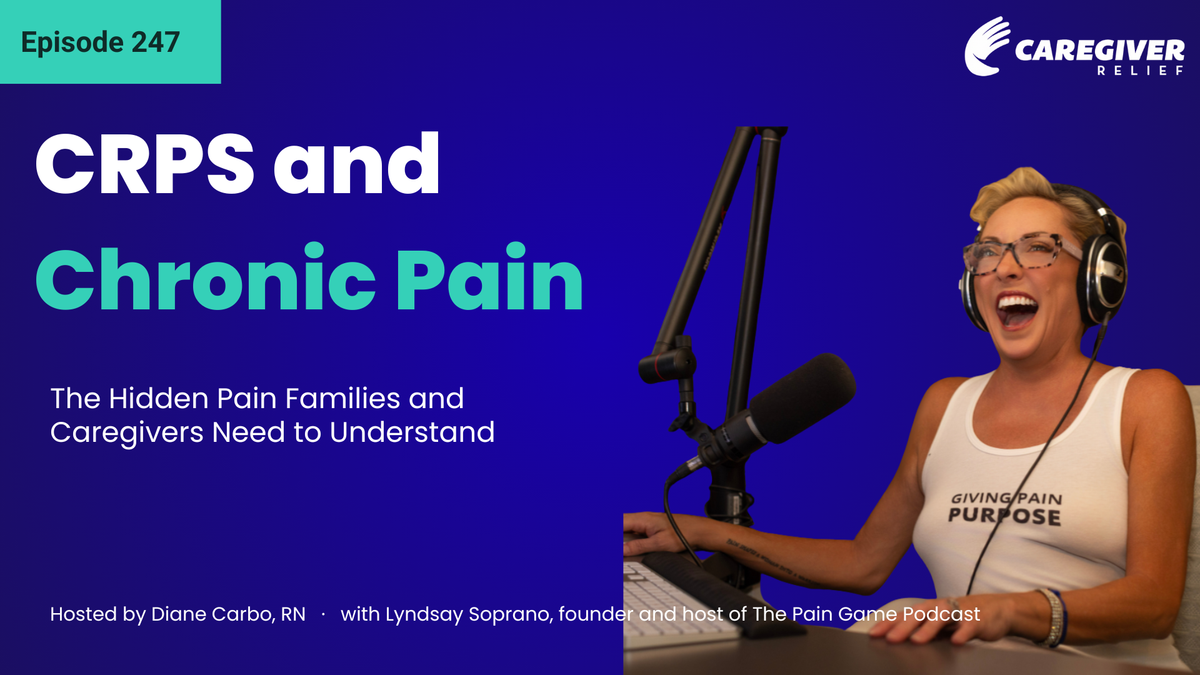
In this deeply personal and unfiltered episode of the Caregiver Relief Podcast, host Diane Carbo, RN sits down with Lyndsay Soprano, host of the Giving Pain Purpose podcast, to expose the raw reality of living with Complex Regional Pain Syndrome (CRPS / RSD). Often labeled "the suicide disease" due to its relentless intensity, CRPS is an invisible, devastating chronic pain condition that tests both patients and their families.
Together, Diane and Lyndsay share personal stories of resilience, confront systemic failures in healthcare, and discuss how to find hope and purpose through trauma and severe chronic pain.
🚨 Episode Overview & Key Topics
- 💬 The Reality of Invisible Pain: Lyndsay describes what living with CRPS feels like 24/7—from burning "hot coals" on her feet to sudden body-wide flares.
- 💔 Tragedy and Mental Health Awareness: Diane shares the heartbreaking story of losing her sister to CRPS-related suicide and supporting her veteran son through years of severe pain.
- 🏥 Medical Dismissal & System Breakdown: A candid critique of how Western medicine and emergency rooms often treat severe chronic pain patients as "drug-seeking" rather than validating their suffering.
- 🌿 Alternative Healing Therapies: How Lyndsay navigates her daily routine using non-traditional remedies—including acupuncture, infrared saunas, swimming, energy healing, and ketamine therapy.
- 🗣️ The Power of Trauma Processing: Exploring how unaddressed emotional and physical trauma stores itself in the body, and why speaking out is essential to healing.
📋 Episode Outline
- Intro & Sponsor Highlights: Diane introduces CRPS/RSD, shares her personal family ties to the disease, and sets a crisis resource reminder (988 Line).
- What CRPS Actually Feels Like: Lyndsay breaks down the daily physical agony of CRPS, sleep deprivation, and the constant "fight-or-flight" response.
- Stigma, Suicide, and Healthcare Stereotypes: A frank discussion on the "suicide disease" label, societal misunderstandings, and being dismissed by ER doctors.
- Coping Mechanisms & Humor: Using dark humor, naming pain flares ("Thelma and Louise"), and setting firm personal boundaries.
- Beyond Conventional Medicine: Discussing spinal cord stimulator failures, navigating interventional pain management, and exploring alternative/psychedelic therapies like ketamine.
- A Message to Healthcare Providers: What doctors need to stop saying ("It's all in your head") and why listening to patients is non-negotiable.
- Resources & Closing Thoughts: Lyndsay shares where to find her show and upcoming women's community (The Pain Hub), while Diane offers final words of self-care for caregivers.
🌟 Episode Takeaway Quotes & Insights
🗣️ "Pain may be invisible, but that does not make it any less real." — Diane Carbo, RN
⚡ "The only way out is through." — Lyndsay Soprano
🔗 Connect & Resources Mentioned
- 🆘 Immediate Crisis Support: If you or someone you love is experiencing thoughts of suicide, call or text 988 (US) for 24/7 support.
- 🎙️ Lyndsay Soprano: Visit givingpainpurpose.com or follow
@GivingPainPurposeon Instagram. - 🌐 The Pain Hub: Learn more about the upcoming online community for women at thepainhub.com.
👇 Click the player above to listen now, and don't forget to like, share, or leave a comment to help us spread hope to those in pain! 💜✨
Podcast Episode Transcript
Diane: Welcome to the Caregiver Relief Podcast. I'm your host, Diane Carbo, RN, and today's conversation is one of the most personal and important conversations I have had on this podcast. We're gonna talk about CRPS, chronic regional pain syndrome. It's also known as RSD, reflex sympathetic dystrophy.
It's a chronic pain condition that is often invisible, always misunderstood, and often devastating for both the person living with it and the family standing beside them. I've had two experiences.
My son was a soldier who developed CRPS while serving. He lived with severe, unrelenting pain for eight years. I saw firsthand how this pain is, how brutal it is, and how often people suffering from it are misunderstood by the healthcare system. Too many people in severe chronic pain are treated as if they are drug-seeking instead of as human beings in unbearable distress. My guest today is Lyndsay Soprano, founder and host of Giving Pain Purpose podcast.
And, Lyndsay is bold, unfiltered voice in the chronic pain and trauma recovery space. She lives with chronic regional pain syndrome, and has survived trauma, infertility, depression, anxiety, divorce, and years of medical frustration. Her mantra is, "The only way out is through." And she brings grit, grace, humor, and honesty to conversations many people are afraid to have.
This episode is for the person in pain who feels unseen. It is for the caregiver who feels helpless, and it is for every healthcare professional who needs to understand that pain may be invisible, but that does not make it any less real. Before we begin, I want to say we will be talking about chronic pain and suicide as well.
So if you or someone you love is thinking about suicide or is in emotional crisis, call or text 988 in the United States. Help is available 24 hours a day, seven days a week.
Diane: Lyndsay, thank you so much for sharing your story. I'm very familiar with the condition, so I'm anxious to hear, your challenges and about your journey.
Lyndsay: Well, thank you for having me, Diane. This is such an opportunity, and I'm so sorry about your son and your baby sister also who, suffered with CRPS. it's something that I tend to say that it almost feels like I'm an alien because it's alien pain versus, human pain because it's so
Diane: Yeah
Lyndsay: difficult to explain what you're experiencing, the sensations they like to tell us to use instead of pain.
Diane: Yeah.
Lyndsay: I'm like, "This ain't no sensation." It is pain
Diane: Absolutely
Lyndsay: 24 hours a day. I do not have a moment where I am not physically in pain. While I'm sleeping, when I do sleep, I get about two to three hours a night maybe, when I'm doing that, my husband is always telling me that I wake him up because I'm moaning in pain and I'm moving around in pain.
And it's turned into something that both myself and my husband and my immediate circle of friends and family have had to work around because
Diane: Yeah
Lyndsay: I can't show up to things sometimes, and I'm a big shower-upper in times where I probably shouldn't, but I still push the, I push the envelope. That's been my personality type since I was a little one. and it's a challenge for me to help my family understand- what I'm feeling, and also help support them through that even when I'm, like, suicidal. I have the suicidal ideations.
Diane: Yeah.
Lyndsay: I had medication from pain doctors that did that, which don't get me started on that 'cause that's a whole fricking podcast in and of itself.
What conventional medicine has done to people that live in chronic pain and chronic illness is just, it's unfathomable.
Diane: Well, our healthcare system absolutely is awful to people in pain.
I get a phone call from a cousin who says, "Diane, you need to check in with your sister.
She's getting plans, making plans for her end of life." Now, my sister was just gonna turn 65. We share the same birthday, May 4th. I'm seven years older. And, she had, my sister had a gallbladder surgery, a lap chole, and she, we have terrible reaction to anesthesia, and she vomited so bad she developed, she broke out all her stitches and was in intensive care for several weeks.
After she had that, she developed RSD.
Her daughter had the juvenile version of it, so we must have a gene in our family. But, I can tell you, she was in such pain with fentanyl patches and everything. She would go to the ER frequently and say, "Please help me." And one day they finally told her, "We can't do anything more for you."
So she tells everybody she's dying. And I said to my sister, I said, "Nan, you're not dying." You are being, they see you as drug seeking.
Lyndsay: Yes.
Diane: and, anybody out there who has somebody who's planning their, writing their obituaries, getting ready making everything right for, their end of life, and my sister was very young, at 64.
That's a sign. I, you know what? I knew, I just knew in my heart she was going to complete suicide. I just did.
And it did happen a year later. She waited a year. But, people don't understand what in the world, you go through when you have this condition. Now, for listeners who have never heard of CRPS, what is it and what does it actually feel like to live with it every day?
Lyndsay: Ugh, man. Well, there's two different types. One is usually from an injury or a surgery. I have a, a friend that I've made through the CRPS community who used to work with disabled children, and one of them had taken a stapler and opened it and hit her arm with the stapler. And from there, within three months she ended up being in a wheelchair from that injury, and in CRPS.
Diane: Yeah.
Lyndsay: She also committed suicide.
Diane: Yeah.
Lyndsay: And, on the McGill Pain Scale, it's higher than natural childbirth, so I'm walking around having fucking babies all day.
Diane: I know. you know what? I'll tell you what. and if anybody's, offended by any bad language I want you to know research studies show that intelligent people use, swearing and offensive language to relieve their pain, and I tell, when I say these words, and I use them often
I just want you to know that it is a relief for me. So if you're offended, you just Have to get over it because it is my way of releasing, having pain relief. And I'll tell you, when you're in the agony and the, a type of pain that Lyndsay, my sister, and my son were in, you have to use every tool in your toolbox.
Lyndsay: You certainly do. Okay, yeah. Because, like, when people ask, like you asked, how, what does it feel to live in my body all day? It started, I was diagnosed about 10 years ago. It started earlier than that when my right big toe went numb. And then I was walking our dogs, and this is my ex-husband, and I was walking our dogs and I came back.
I'm like, "My big right toe is, like, my right big toe is just, numb." And he's like, that's weird." Didn't do anything about it. It spread through my right foot, then it moved to my left, then it went up my right whole leg, then it went up my left whole leg, and then it's, now it's in my guts, it's in my arms, it's in my hands.
It's everywhere. And you wouldn't guess it by my personality type, the way I look, the way I dress
Diane: Yeah
Lyndsay: the, because I show up every day, to take care of myself and others, because I do have a podcast as well and a business that I've started to help support women who've been through trauma and live in chronic pain and, illness.
And but every single step that I take, I do have a wheelchair that I use for any long distance. I can't walk my dogs, I can't ski anymore. I can't Do the yoga I used to. I swim every single day because that's the only exercise that really I can do with my feet
Diane: Yeah
Lyndsay: and my legs. But every step I take feels like I'm walking on hot coals.
Legos has been a big one for people to go, "Oh my God, I've stepped on a Lego," and that's, super painful. That is every single step, and every single step is hot and cold at the same time. I could have three fingers on each hand, my right hand and my left hand, and they will identically be red, and the other two on the outside will be bright purple.
Same thing on my feet. And I'm hot
Diane: Yeah
Lyndsay: and cold in the same foot in different locations. And it's night sweats. I'm also perimenopausal, so I'm dealing with that on... Which is painful in so many fricking ways, it's unbelievable. So my hot sweats that are coming from that on top of the CRPS heat that we get, I am just
Diane: Yeah
Lyndsay: like naked all night long, sweating. And my poor husband is covered up 'cause the air conditioning's on, and he's bundled up with, like, down comforters on top of him. And it's, 80 degrees outside. And so all of that, and it feels like I have hot lava worms running through every vein of my body. It's like science fiction.
And now I have a new thing that just started about two weeks ago, where it feels like my mouth is being bit by thousands of little bees at the same time.
Diane: Oh.
Lyndsay: And so I had to take a break from podcasting for a couple weeks because I was finding it hard to speak. And I came from a performing background.
I was an opera major, actually, and so I'm pretty good with my diction and all of that. But I was working with a voice coach very briefly to help me through this, bee mouth thing that I've got going on.
Diane: Wow.
Lyndsay: And it's coming up whenever I flare. And so what I find is it's constant pain
Diane: Yeah
Lyndsay: but then you have these flares that pop up.
And because I'm always living in a fight or flight status
Diane: Yeah
Lyndsay: if one thing that I know that is a trigger, it immediately, in a second, it is a second, my feet immediately will change color.
Diane: Yeah.
Lyndsay: And the pain just shoots up my whole body and into my arms and my hands. And now that I'm having it in my mouth and my vision as well, it's like, you gotta be kidding me.
But one of the things that I pride myself on, and this is from me being a business owner, I believe, for 25 years I've run a marketing agency. Every mor And I've worked from home the whole time. Every morning, I had my routine of getting up and showering and going to my office as if I was leaving the home.
And so that has been very helpful for me because that's already been a pattern that I've established. Can I stand on the sharp tile in my, shower without a pad underneath them? No. Can I walk barefoot? No, I cannot. So we've I never can walk barefoot. It's so incredibly painful. So we've created these coping mechanisms, and one of them is swearing, like you mentioned.
Diane: Yeah, absolutely.
Lyndsay: And the other thing is being as honest and open and real and raw and true to who I am and the experiences that I've lived.
Diane: Yeah.
Lyndsay: And that's taken a while for me to understand how trauma affects our bodies. Our bodies keeps the score of the things that have happened, and I come from an unfortunate wave of years of sexual abuse and physical abuse, and it all added up and compounded until my body started screaming
Diane: Yeah
Lyndsay: at me, and its way of screaming at me is CRPS. And I also have Lyme disease as well, which is just a joy. So we're a bundle of fun over here, Dee. I'm
Diane: Sure this is all, you're just seeking a lot of attention.
Lyndsday: No. Oh, my God, the last thing I want is people giving me attention. I'm like, "No." I know. "Get away from me."
I know. "Stop away. Don't touch me."
Diane: My son Jeff had a, a, a pin put in his, a Jackson pin put in his foot due to a basketball injury. And when he was in the military at, a few months after he, he had it, he started having severe pain. And again, his foot turned purple. And people don't understand, your body goes into fight or flight, which means you constrict your blood vessels.
Everything is, you're all hyper, and it's very hard. Jeff was a big guy, huge guy, a big ginger. He was, in the military, really smart guy, Korean linguist, and very active. He loved sports, and this totally changed him. And it was sad. He literally wanted to sit next to a heater, and he loved being cold.
And he would have the rest of us sweating. Like, you're freezing your, husband out. Jeff was like, "Oh, my God, you know, I can't breathe." in the car with him, it was really hard. And, what I was shocked about, 'cause I've done rehab nursing. I've worked with quads, paras, head injuries.
I have chronic pain myself, not anything like what you guys, experience, but I have to tell you that, it's challenging, and, people are cruel. People are cruel. Jeff hated he would walk with a cane, but because you can't see it, he would get out of his car parking in a disabled person's spot.
He had his placard and stuff.
And people would say, "What are you doing parking there?" and it's like, are you kidding?
And then, when he was in a wheelchair, like if we would go something to a museum or someplace, people just walk right in front of you. They ignore you.
They act like you're non-existent in this wheelchair. It's really hard, and our healthcare professionals are even worse.
Lyndsay: Ha. No kidding. And I find it specifically with women because, of course, everything's in our head. I don't look... If you look at me right now, you would not know that I wanna go to Lowe's right now and get a chainsaw and chop my legs off because that's
Diane: Oh, I get that
Lyndsay: that's the pain that I'm in.
Diane: Yeah.
Lyndsay: But I have to make a decision every single moment of my life I'm very depraved, and so is my husband. So between the two of us, we're quite the show. We should have our own YouTube channel. But we laugh through it because the only other way is jumping off of a bridge.
Diane: Yes.
Lyndsay: And my acupuncturist actually told me to humanize my legs because I felt like my legs were not part of my body. It was almost like
Diane: Yeah
Lyndsay: phantom limb to a certain extent even though they were there.
Diane: Yeah.
Lyndsay: And so I named them Thelma and Louise. And when I'm like, God, Thelma is being a see you next Tuesday right now and
Diane: Yeah
Lyndsay: my, everybody knows it's my left leg. And so we've had to do that, and it helps me because I actually, talk to them and I'm like
Diane: Yeah
Lyndsay: all right, ladies, what are, we've got a whole lot to get done today, and I need you- to catch up and, like, be with me today because I know it's gonna be a, it's gonna be a rough day.
Last week, I actually, well, last week my best friend turned 45, and I threw her this big party. And a couple days before, my body already knew that I was gonna have to push through pain for three days straight to get this whole
Diane: Yeah
Lyndsay: I'm, when I go big, I go big.
Diane: Yeah.
Lyndsay: And I was down for 36 hours.
I couldn't even read. I couldn't brush my teeth. I believe that. I couldn't brush my hair, 'cause that hurts.
Diane: Yep.
Lyndsay: My teeth hurt. It hurts to cut
Diane: Yeah
Lyndsay: your fingernails and your toenails. Like, why? How is that possible? My husband's always like, "Why does it hurt to cut your toenails?" I'm like, "I don't know," but it is so painful.
Diane: Yeah.
Lyndsay: And, the things that we take for granted, you know?
Diane: Yeah.
Lyndsay: It just, I don't, That is one thing I have learned so much about, is being grateful. because I've had to choose that this is now going to be a blessing instead of a curse,
Diane: Yeah
Lyndsay: because I give pain purpose every day, and I am working so hard, not only in my show, but I just opened up a merch store, and I'm donating to CRPS foundations, and I've got, a new community that I'm building online called The Pain Hub, which is a, a community for women, built by women that have been through trauma and live in chronic pain and illness, and it's just who knew?
I retired my marketing agency of 25 years and I moved totally in the advocacy and pain space because this happened.
Diane: And It's necessary.
Lyndsay: Yeah. And I couldn't find what I was looking for.
Diane: Yeah.
Lyndsay: So I wanted to build it. And that's why I'm here, that's why I'm having this conversation with you, and it makes me sad about the suicide thing, because whoever coined it the suicide disease which is what they call it, I certainly hope they're doing okay.
Diane: Yeah.
Lyndsay: Because it's like, it just plants that seed in your head instantly.
Diane: Yeah.
Lyndsay: And I've had two scary experiences, both of which I do not remember. One was when I was given, I don't remember which triptyne it was, but it was one of the triptynes, and I don't remember anything.
My husband found me in our bedroom. And then, there was another thing that I ended up taking a ton of his Ambien, which is totally weird. I don't touch the stuff. Oh. And that also was a very scary experience. And then one of my best friends calls me, we're emergency contacts for each other, she called me, it was like a year ago, and she said, "I just asked Brian," that's her husband, "to drown me in the bathtub."
And so we've talked about suicidal ideation because it is something that is part of the disease, not just CRPS, but it is in the pain community. And with chronic pain, it And people are scared to talk about it because
Diane: Yes
Lyndsay: they think, "Oh my gosh, we're gonna- we gotta go lock her up, put her on suicide watch."
No.
Diane: Yes.
Lyndsay: We need to tell you that this is how bad the pain is, that we don't know if we're gonna be able to make it any longer.
Diane: Yeah. I want my listeners to understand that you can be at a low level of pain one minute, and a slight cool breeze or, a change in the temperature in your shower can put a person over the edge.
And think about it. For women who have had babies, think about this. It's worse than having a baby. It just is off the scale. So I suffer from chronic pain, and I can tell you I... One of the things I have a hard time with is our medical delivery system wants to not subscribe pain medications. They don't want to subscribe things to help you.
You really have to fight for it. You really do. Jeff, with the military, I had to get, fight to get him treatment, at Cleveland Clinic, and he had a spinal cord stimulator- ... in his back. And all he said to me was, "Mom, it doesn't take away the pain, but it makes me feel like a cellphone vibrating all day long
Lyndsay: Yes
Diane: in my butt."
Lyndsay: It does. And I had this. So I did
Diane: Yep
Lyndsay: the whole thing. I had the pain. You do the thing. Go see a pain doctor.
Diane: Yep.
Lyndsay: They put you on opiates. They do the... I did the whole Western medicine thing.
Diane: Yep.
Lyndsay: I did the spinal cord stimulator. I did the trial first. So they start you with the trial.
Diane: yes.
Lyndsay: Yeah.
One of the leads slipped out and was just electrocuting me, so I got it
Diane: Jeff had the same situation
Lyndsay: oh my gosh, I did it
Diane: Yes
Lyndsay: over and over again.
Diane: Yes.
Lyndsay: And I still... So I got back in there. He's like, "There's no chance it slipped." I'm like, "I'm telling you right now, this is what happened." Sure as shit, they put me on my stomach, they x-ray me, and there it is.
And he's like, "Ooh, our bad."
Diane: Jeff had the same thing. Yep.
Lyndsay: And I still went through the surgery to get the spinal cord stimulator because my thing was if I could get 10% less pain
Diane: Yes
Lyndsay: then I was willing to do it.
Diane: Yes.
Lyndsay: And I believe that my body, my brain convinced myself that I was getting 10% better, so I went
Diane: Yeah
Lyndsay: forward with it.
Diane: Yeah.
Lyndsay: And it ended up almost paralyzing half of my body, and I had to have an emergency surgery to have it taken out.
Diane: Oh my lord.
Lyndsay: So I was unable to have the, any kind of healing properties from it, and now it still feels 'cause I'm pretty tiny, I've lost, I lost a ton of weight, throughout this whole journey, 'cause I don't eat very much.
I call it pain puking, like anything I eat. I basically live on smoothies and stuff. really easy, digestible foods. and, I still have this big bump on my butt, you know, like, right on my hip.
Diane: Yeah.
Lyndsay: Because I'm so tiny, it's like a pocket that's still stuck there, but nothing's in there.
Diane: Yep. Nothing's in there.
Lyndsay: Oh, it feels like Jell-O. It's probably hard, too.
Diane: Yeah, yeah, yeah. Yeah. I understand that. Yeah. Yeah. Jeff had
Lyndsay: And for some people it has been absolutely a lifesaver
Diane: Yeah, it wasn't for Jeff
Lyndsay: yeah, it was not for me either.
Diane: No, no. Yeah it wasn't, and it was very frustrating. And, it's really sad because, now you're talking about East meets West.
What alternative treatments are you seeing that are, may help you? 'Cause right now, doctors don't wanna prescribe anything, and they mistreat the patient. and you're right, here's the cycle, because I have chronic pain and I've been a nurse for 54 years.
Lyndsay: God bless you.
Diane: You go to the pain, you go to, the doctors, they give you pain meds.
Then they give it to you to a point where you develop a tolerance. That tolerance means you need more of the medication.
Lyndsay: Yep.
Diane: So you go for more, and they go, "Oh, now you're a druggie," "Ooh, and we need to get you off." So they send you to pain management, which is, a joke, in some ways because, and forgive me, I do go to pain management, but, they're trying to get you off the meds, so they have other treatments.
You know, there's injections, there's, radiofrequency ablations. There's a variety of different things. but you'll love this, Lyndsay. They are now, in Medicare, and probably with Obamacare as well, they're limiting the amount of procedures, at in that you can have with interventional pain management so that, And it makes me crazy because interventional pain management is meant to, decrease or eliminate the use of narcotics.
Lyndsay: Yes.
Diane: So not only do they make it so you can't take narcotics, which I can't take anyway, so I was, that was never an option for me. and, they eliminate the procedures that relieve your pain a lot of times.
And unless you can privately pay for it, that's where we are in our healthcare system.
Lyndsay: Yes, we are.
Diane: You don't get that relief.
Lyndsay: Yeah, 'cause the money part of it, we were talking about alternative medicine, which is the route that I've ended up going down. I'm there, if I break a leg, I'm gonna go to Western medicine.
They're gonna fix my leg,
Diane: Yes.
Lyndsay: the things like, the, people are in the hospital right now, some loved ones, and they need a gallbladder surgery. And so that is
Diane: Yeah
Lyndsay: where Western medicine is good. One of my best friends is a, an ER doctor. He's talked to me about, you go to the ER, and when you go there, their only job is to make sure you do not die.
Then they get you out of there. They're not there
Diane: Yeah
Lyndsay: to help cure you.
Diane: Nope.
Lyndsay: And what, so I won't do it anymore because
Diane: Yeah
Lyndsay: it's so fuckstrating, one of my favorite words.
Diane: Yeah.
Lyndsay: And because you're there, and you're waiting, and you're waiting, and you're waiting, and you're waiting. And by the time they get to you, you're like, "I could've just done this at home."
Like, this is so stupid.
Diane: Yeah.
Lyndsay: And but when you get to that place where you wanna call 911, you're in that much pain, I gave up on it. And so what I ended up doing is I do, acupuncture. Massage is very challenging for me because it flares me. So it feels really good for the first day, and then I'm down for three days.
And it's like, oh my God, this is so stupid. I have an infrared sauna in my home. Like I mentioned earlier, I swim. I do a jacuzzi in the morning to help me with the circulation in my legs. I do yoga, but I have to do modified of that. and then I do a lot of energy healing. I do tapping and, Reiki, and things of that nature to help move energy around.
But another thing that I've done is I've started talking about my trauma. And that was something that I was never able to do until I started my show.
Diane: Yeah.
Lyndsay: Because if I was gonna be talking to people and asking them to be open and honest about what happened to them
Diane: Yeah
Lyndsay: the trauma that they've been through, then who am I to sit on the other side and hide from my own stuff?
So I started opening up slowly, and slowly, and slowly, and now I'm a floodgate. Ask me anything and I will tell you the dark and dirty, twisty shit that's happened to me, and it's very, very sad. And my body as a little girl, at nine years old, I started immediately I had insomnia, and nobody knew where it was coming from.
Now we know. And being molested by my uncle, and now I know that whole story, and then, it goes on and on. I don't wanna tell you all the horrific things that's happened to me. But in the middle of all of that, there's all these wonderful things that have happened in my life. And so I've had to focus more on those but also working on the honesty of the things that have happened to me too, because we have been shamed into not talking about the things that have happened to us as women.
Diane: Yeah.
Lyndsay: And when we open up our mouths, we're not believed, and we've seen that in the Me Too movement. And we're opening up our mouths.
It's just time, we're doing it. Whether you believe me or not, we have to because we're all sick because of it. We are
Diane: Yes
Lyndsay: all sick in some way, shape, or form. I don't know one woman, not one woman in my life that doesn't have some form of chronic illness or pain I can name one man.
Diane: Yeah.
Lyndsay: That's it. Other than that, it's all the ladies because we take on more too,
Diane: Yeah.
Lyndsay: We're not just the wife or the sister or the daughter, we're everything. We're business owners, we're dog moms, we're step-moms. I'm a step-mom. I'm, all of these different things that we are, and I'm a people pleaser, so I say yes to everything, and that's something I've had to learn, that I need to say yes more to me and no to others, and also put up boundaries.
And know that I have to... There are sometimes the people in my life know that I'm gonna have to cancel plans with them.
Diane: Yeah.
Lyndsay: And it's not because I don't wanna hang out with them, it's because I don't want my, how I feel to, ooze into their experience of whatever it is that we're doing. So I'm protecting them as well as myself.
Which I learned at a very young age. I protected my parents. They don't know shit about what's happened to me.
Diane: Yeah.
Lyndsay: And I'm still doing it at 48 years old. It's like, what?
Diane: Yeah. Yeah.
Lyndsay: But I told them one story, and they didn't believe me, and so I said, "Forget it. Then we're gonna just have a very surfacey relationship like we've had for my whole life."
I tried. And I must not, I'm not gonna, I'm not gonna keep pushing it with them. But it's lovely to be able to feel confident that I have people that listen and believe the stories that I've told, because they are our stories, and they're our lived experiences and poo poo on you for saying that what I've lived through is not true.
Diane: Yes, yes.
Well, and you know what? It's not just even your story about your, the abuse, but then it feeds into your pain.
Because if you have not been abused in some way, and most most women have been abused emotionally physically, financially in some way. I was a caregiver. And I was a caregiver very young in my life, and as a teenager.
And, I'm an adult child of an alcoholic, and I'm the oldest of four, so when my mom got sick, I was the one that took care of them
Lyndsay: Sure
Diane: while going to school and stuff. and it's very hard. But, when you go and you have pain, whether it's and what's sad is the very first thing any healthcare professional sees you at is you're drug-seeking.
They don't see the emotional pain. They don't see the physical pain. They, because they can't see it or they've never experienced it, and that's my personal take on it, they don't understand what we're going through. my pain levels, because of my nursing years, have, I understand when you say you're down for 36 hours.
I don't have the pain levels to any degree close to what you or my son or my sister had, but there are times when I just wanna crawl in bed and, just die because I hurt so much all over. And people with lupus and fibromyalgia, you know, people at, and, some with MS, when they hurt. And, we look at them like they're lazy.
I always felt like I was felt like I had to always lay down because a part of my lower back was so bad, I felt like a stabbing knife in it.
And I'd have to lay down, and people would look at me like I was lazy, I was non-productive. It's very frustrating. And that is just the tip of the iceberg for somebody who has minimal amount of pain compared to what a person with RSD has.
Lyndsay: Yes, and they changed the name of RSD to CRPS, and I don't know why they did it.
Diane: Yes, I'm sorry.
Lyndsay: 'Cause I was just... no, just for clarification because it was like, what were you talking about? Paula Abdul, for example, she was on, what was this? The, it was one of those voice shows.
It was the first one, American Idol, right? And she was so loopy all of the time, and people thought she was drunk. What the issue was with Paula Abdul is she had RSD, and, AKA now CRPS. Yeah. And she was going through an insane amount of trials of, and, all the things that they throw at us, the kitchen sink of drugs, and this that, and the other thing, trying to get her through her pain, and she was a dancer.
Diane: Yeah.
Lyndsay: She was a Laker Girl, man.
Diane: Yeah
Lyndsay: She lost her dancing ability. Yeah. And so you never know what's going on in somebody's life. I also use that when I'm on, when you're on the freeway and somebody's driving like a complete A-hole.
Diane: Yeah.
Lyndsay: Sometimes they are, that's just who they are. But I often look at it going, maybe their wife's having a baby in the backseat. Maybe
Diane: Yeah
Lyndsay: maybe they're trying to rush somebody. My sister passed away almost two years ago unexpectedly, and maybe we're rushing to the hospital to make sure that we see her before she dies.
Diane: Yeah.
Lyndsay: And, yeah, so you just don't ever know what's going on in the cars and the people around you. And yes, they're looking down at their phone, and then they're texting, and you just wanna shoot them. But it, there's so many things that are going around you, and what people are suffering with and through.
We just have to have a little bit more grace and open up a little bit more space for what everybody else is going on, going through in this world. And I also wanna make one thing, 'cause you've mentioned it twice, about comparing your pain to my pain. I always make sure, 'cause I have people in my life that suffer with some kind of chronic pain, like lower back pain.
They're like, "Oh my gosh, I'm sorry, I'm sorry, I'm sorry. I don't wanna complain about my pain." No. Please do. Oh, I'm very good Please do. because I don't always wanna be the one that's talking about it.
Diane: Yes.
Lyndsay: 'Cause I actually try to not. Where I talk about it is here
Diane: Yes, yeah
Lyndsay: in this forum on my show.
I talk to my husband about it all the time. Oh ... but I've gotten even better about that, because if that's all you're hearing all day, then and he feels completely helpless,
Diane: Yeah.
Lyndsay: He's just "What do we do?" When I have nights where my legs will be I have charley horses that go on, in my legs from my hips down for somewhere between, four to six hours almost every night.
Diane: Oh, wow.
Lyndsay: And on... Yeah, and everybody knows what a charley horse feels like. Yeah. And afterwards, like the next couple days, how bad your calves feel. Yeah. Yeah. Yeah. Try that for four to six hours almost every night of your life. My legs are like poltergeists. like, they will completely turn. My left leg will completely turn to a point, and it will stay there.
And I'm crawling across the bedroom floor and bathroom floor, and we're getting me into my tub, and I sit there in excruciating pain in magnesium until it settles down. And we know.
Diane: Yeah.
Lyndsay: And he's like, "I gotta call the ambulance." I'm like, "No, we know what's gonna happen." It ends up turning itself around again, and we just have to suffer through it.
But the poor guy is sitting there just like, "This is my baby." she's like, "What's gonna happen? Is it gonna get worse? Like, what do we do?" And I feel so terrible for caregivers and our family members that have to, not put up with
Diane: Yeah
Lyndsay: but for lack of a better term, feel helpless. Because we all feel really helpless in all of this. So the best thing that we can do is just continue to support and love and care for us. And, don't let us jump off a bridge, and don't let us drive off a cliff like Thelma and Louise.
Diane: I was working, as a nurse liaison for, the VNA of Greater Philly, and I was going into Hahnemann Hospital on a regular basis.
And this is, 10 or 15 years prior to when Jeff developed his chronic regional pain syndrome.
And at that time, there was a doctor, Dr. Robert Schwartzman, was doing ketamine comas in Germany.
And was having success. Now, our, you know, we weren't even anywhere near allowing ketamine to be used in that capacity, but I learned, that were, that the studies were being done, and so I contacted the military.
I, actually I went to the surgeon general's office to try to fight to get Jeff to be, go to Germany, 'cause there's always, the military's in Germany, and getting him a ketamine coma there. Now, Jeff's been gone 15 years
Lyndsay: Wow
Diane: and so it was, and he had it for eight. you know, so it was a long time ago.
It was before ketamine was approved here in the country, and, they wouldn't do it. And I was so frustrated because it was something that works. And, my son, my youngest son, who was also in the military, is a nurse anesthetist, and he opened a ketamine clinic as soon as ketamine was allowed on the market The irony here, Lyndsay, is that, it is because of the military that ketamine was approved as fast as it was considering the time it took, and was on the market because the veterans fought for this, the VA fought for this.
And now it's so hard to get them help because they have to jump all, through all these government hoops. And, one of the things, I wanted to punch the VA here in Myrtle Beach had a little, little, activity community thing where they were showing all their things, what they do and stuff like that.
And I went to a, one of the social workers, "Oh, I just want you to know we have a ketamine clinic here in, in Myrtle Beach." And no, it's not my son's. His is in New Hampshire. And I said, "You know, this is really good for the veterans." And he says, "Well, they have to qualify, and then they have to do this, this, and this.
And if they do, then maybe we'll let them." And I thought, I did, I literally wanted to punch him. Because this is and I would've if I hadn't had two dogs with me that were, were keeping me calm. I just felt bad because it you shouldn't have to fight this hard to get help. And I know that I have PTSD from dealing with the military medical delivery system just helping my son get the right treatment at the right place at the right time And, now I see it everywhere.
Nobody's getting good treatment. So I really, really, am excited that you're there pushing the envelope on getting the word out.
Lyndsay: Absolutely. And I like that. The psychedelic, that industry is going to be taking over the current trillion dollar industry that we have here
Diane: Yes
Lyndsay: in healthcare
Diane: Yeah
Lyndsay: because we are seeing, so many benefits of it. And, these, the Big Pharma's gonna make money doing it, too. It's just gonna be a switch from all of the pills to
Diane: Yeah
Lyndsay: something that's a little bit more, for me it's a much more, it's your spirit, it's your soul, it's your body. It captures so many other pieces within you that are broken
Diane: Yes
Lyndsay: that you can put back together or you can let go. And that, that's the part of me, I'm holding on to so much of it because it's all my body knows.
Diane: Yeah.
Lyndsay: And slowly but surely through, I've been doing ketamine therapy for almost a year now and, with good results. Sometimes it's a little scary.
Sometimes I'm, like, sick afterwards. It just kinda depends on
Diane: Yes
Lyndsay: what's going on, how my body is that day. You just never really know. And but I wanna do ayahuasca and I wanna do some of these other retreats that are out there, to kind of get we're all spiritual. We're all souls that are here that have had terrible things that have happened to us now, and it's also ancestral.
I mean, we've got I've I often joke about the fact that I've lived, a million lives. This is just one another one of them. But this kind of pain, is like I must have just raped and pillaged an entire village of people in a past life to be in this kind of pain.
Diane: In this kind of pain.
Lyndsay: Yeah. Yeah,
Diane: yeah.
Lyndsay: It's a terrible joke- Like, that's what I think too but like I said, I'm depraved. I don't know what else to do. Yeah.
Diane: I look at it too as like, what did I do in a past life that I 'cause they say from other, religions and stuff, they say, you keep coming back until you get it right.
When you move up the chain.
Lyndsay: And that we choose, that we choose-
Diane: Yeah
Lyndsay: to go into this particular like, body it's
Diane: Yes
Lyndsay: fascinating to me. Well, whether you believe in it. I want everyone to, you know or not, it's certainly worth reading some books about it because
Diane: Absolutely
Lyndsay: you might
Like, The Untethered Soul is one that's really good. there's so many of them that we talk about certainly on my show. But there's. be curious. I mean, if you're not curious, then you're just gonna be walking the same path, and you're never going to
Diane: Yeah
Lyndsay: go on that vacation that you really wanna go on.
And I travel
Diane: Absolutely
Lyndsay: even still with my, I'm in my wheelchair, and I've done the Colosseum in Rome in my wheelchair. I do 5Ks in my wheelchair. I am like, I am still going to move and groove and be part of this world as long as it'll have me. And you know, I have a phrase that I used to use that my family and friends told me to stop using, and that was, "I'm writing letters."
So if they got a text from me that I'm writing letters, that meant that I was in the worst pain and I was thinking about the old
Diane: Yeah
Lyndsay: the old Thelma and Louise. And so they all asked me in a roundabout way from over a span of time, "You really have to stop telling us this and stop thinking it." And I'm like, "Well but what do I do?
How do I communicate how bad it is today without saying that? Because that's a way of saying it without saying it. And so I've had to, I've had to learn how to communicate my pain issues and when to keep them in and when to really say, "This is a bad one right now, guys. we've gotta everybody, like, get out of here right now." "'Cause you're driving me nuts, and it's making me flare."
Diane: It's just like you wanna get into a vat of lidocaine so that you- God ... everything in your whole body becomes numb.
Lyndsay: Numb. I get that. Yes.
Diane: Yes, yes. For sure.
Lyndsay: That's one of the things that I do love about swimming, is that you...
I feel light, and I can see the bubbles of my breath. And my dance background, I'm in there dancing and doing whatever, like a little mermaid in there, and that's been very helpful for me as well.
Diane: That's beautiful. Now I'm gonna ask, what should healthcare professionals stop saying to chronic pain patients?
Lyndsay: Oh, my gosh, "It's all in your head."
Diane: Yeah, I hear
Lyndsay: I mean, that's the one that we, certainly as women, we get, and I hear it over and over and over again from women. And, really I want, practitioners to listen. I've gone, gotten down to the point that I'm interviewing you, right?
You're not interviewing me. You're the one that I'm paying to take care of. So
Diane: Exactly
Lyndsay: I'm interviewing you for your job. And I come in, and when I check into a new doctor, I have a document, it's a couple pages now, that has all of the medication that I've taken
Diane: Yeah
Lyndsay: all of the things that I've tried, all of it, and I say, "Please have the doctor read all of this before they come in because
Diane: Yeah
Lyndsay: I am not gonna go through all of this again. I'm tired of telling this story over and over and over again." And if they don't come into the room because they don't think that they're gonna be able to handle me, fine.
Diane: Yeah.
Lyndsay: Then I will leave, and I want my copay back.
Diane: Yeah. Yeah.
Lyndsay: Because we have to advocate for ourselves because we have to. We're in charge here.
Diane: Yeah.
Lyndsay: And so for me, the... I have been... In fact, I have a doctor's appointment this afternoon for something for my silly Lyme disease, and when I first found him, he had been very, very sick and was in a wheelchair, and managed to get himself out of it from a chronic pain perspective.
And so I met him, and I said, "All right, here's the deal. I am a lot, not just because of my physical stuff, but my personality is big and bold and loud and in charge, and I don't know if you're gonna be able to handle me. If you are not, tell me. Just
Diane: Yeah
Lyndsay: tell me."
Diane: Yeah.
Lyndsay: "You know what, Lyndsay? I'm not gonna go home and talk to my wife about you tonight."
"I want you to. I want you to go home and go, 'You know what? I had this patient today who really, really needs my help.'" "What can I do?'" That's what we need from our practitioners. Please don't throw me a bunch of shit I've already taken. Have you taken gabapentin? Oh my God, yes. Everybody's taking gabapentin in the pain world.
My Lord.
Diane: And it's true, they don't take time to read your history, and then when you say, "Done it, been there, done it. Let's try something else," they oftentimes don't have another solution, because they're thinking- Most of the time "Oh, maybe if I do it to, with you, and I give you the right dose, that it'll work."
And it just doesn't. I've seen that. I know the struggles that we had with Jeff, and it's really tough. and I get frustrated with us, with all of this. now if the healthcare professionals remember only one thing from this conversation, what do you want it to be?
Lyndsay: I want it to be to listen to us 100% and believe us.
Diane: Yeah.
Lyndsay: Even though I look, it's the invisible illness thing that is so challenging, because I don't look sick.
Diane: Yeah, yeah.
Lyndsay: You're looking at me, Diane. Do I look sick? No, I don't.
Diane: No, you're beautiful. Oh. When you told me your age, I went,
"Oh my God." Thank you. "She looks like she's 20, late 20s or early 30s."
Lyndsay: Thank you, Zoom filters. Really. So I have bags under my eyes that are heavier than any
Diane: No, you don't ...
Lyndsay: Oh, no. That's the filter on Zoom. I need that filter. You're gonna tell me about it. I have to get it. Zoom, Zoom filter does the Botox. It does it all. Even though I won't put that crap in my body. But it's yeah, I mean, I feel like yeah, I look younger than I am, which is amazing considered the crazy road that I have lived.
I have been a party animal. I have seen it all. I have done it all. and I take responsibility for some of that contributing to some of my health issues as well. but I also don't have any regrets. so one of the, I mean, the regret doesn't do anything. What are you gonna do with it? Absolutely nothing.
Absolutely. Beat yourself up about it?
Diane: No, don't do that. Yeah, and it just drags you down when the pain is already dragging you down.
Lyndsay: Yeah.
Diane: Yeah.
Lyndsay: So Cause that's the hardest thing in my mind with pain when, now that it's been a decade, which is hard to believe.
We're really, really tired, 'cause living in pain every moment of your life is an exhausting thing to do.
Diane: Yes.
Lyndsay: And the fact that we still show up the way that we do, Yeah ... is pretty miraculous, and it takes a lot of strength to do it.
Diane: Yes.
Lyndsay: And, if we need to nap in the middle of the day, please let us. Exactly. It's not 'cause we're lazy.
Diane: Yeah.
Lyndsay: It's because we're doing everything that we have to do for everybody in our lives
Diane: Yeah
Lyndsay: while we're living in the pain that we are, and still trying to do it with a smile on our faces.
Diane: You know what? That's what, perfectly said because, women, we push through. I'm guilty of that too. Yeah. I push myself beyond what I should with my pain levels.
And, then I suffer And again, it's, I have to lay down.
And I'm 73, but I hate to have to take a nap or whatever, but I... You know what? I had to learn. For me, it was hard, but I had to learn to be gentle with myself.
Lyndsay: Amen. Yeah. Absolutely. Yeah.
Diane: Lyndsay, I want to thank you so much for your honesty, [00:46:00] your courage, and your willingness to talk about what so many suffer through in silence.
To my listeners, if you're living with chronic regional pain syndrome or chronic pain or the invisible illness, I want you to hear this clearly. Your pain is real. You are not weak, and you are not a burden, and you deserve to be believed. Lyndsay, how do people find you?
Lyndsay: You can find me on Instagram at Giving Pain Purpose.
You can also find my show at givingpainpurpose.com. we have our merch store that is the Giving Pain Purpose shop, and we also have that community that's gonna be launching soon called The Pain Hub. And you can go to thepainhub.com and put in your email address into there. You can learn a little bit about it and get updates as to when the launch is coming out, that online community for women built by women to help you through your chronic pain, chronic illness, and trauma.
Diane: I'll be signing up for that.
Lyndsay: It is a pretty special thing that I'm doing, and I feel like it's the reason that I was given what I was given. What else am I gonna do with it?
Diane: And your spirit is still strong and willing to do this because you do get worn down
Lyndsay: Yeah
Diane: after over time.
Yeah, absolutely. I understand that.
Yeah.
I know I'm feeling it with my age. And I want my listeners to know if this episode brought up thoughts of suicide or fear for someone you love, please know you can call or text 988 in the United States. Support is available right now, and it's available 24/7.
To my family caregivers out there, you are the most important part of the caregiving equation. Without you, it all falls apart. So please learn to be gentle with yourself. Practice self care every day because you are worth it.
Caring for a loved one can be overwhelming — but you're not alone. If you have questions, big or small, our expert team is here to help.
👉 Click here to Ask the Expert
Our Resource section can help you find the information and tools that you need. We have courses, videos, checklists, guidebooks, cheat sheets, how-to guides and more.
You can get started by clicking on the link below. We know that taking care of a loved one is hard work, but with our help you can get the support that you need.
Click here to go to Resource Section now!
You might also like this article:
 Diane Carbo
 Diane Carbo
 Diane Carbo
 Diane Carbo