Dementia Engagement Activities That Bring Joy, Purpose, and Connection with Ju Tu - Episode 264

In this uplifting episode of Caregiver Relief, host Diane Carbo, RN sits down with Ju Tu, former management consultant and founder of Aegeliss. Ju shares her personal journey caring for her grandparents, which inspired her to create cognitive accessibility tools, visual supports, and dignified activities designed to keep individuals engaged and independent. Together, they discuss why engagement isn't just a daily pastime—it's essential caregiving medicine.
📌 Key Highlights & Insights
- 💬 Engagement is Vital Medicine: Meaningful activities stimulate cognitive pathways, preserve remaining capabilities, and can often be as powerful as medication in reducing anxiety and slowing decline.
- 🧩 Dignity in Activity Design: Adults living with cognitive challenges deserve age-appropriate, beautifully designed activities—not toddler toys or infantized puzzles.
- 🗣️ The Power of Positive Framing: Reframe tasks using affirmative, emotion-led statements (e.g., "Mom, you've always been the best chef in our house—we’d love your help with the tomatoes") instead of asking open-ended questions that trigger a "no".
- 🎯 Stepping Into Their Reality: Stop testing memory or correcting mistakes. Meet them where they are, embrace their world, and let them lead the conversation.
- 👁️ Visual Supports Reduce Anxiety: Combining simple text, eye-level placement, and clear icons reduces cognitive load, allowing loved ones to navigate daily tasks independently.

📝 Episode Outline
1. Introduction & Welcome
- Diane Carbo, RN opens the episode with a reminder that caregiving goes far beyond physical tasks; emotional connection and joy are essential.
- Introduction of Ju Tu, founder and CEO of Aegeliss.
2. Ju’s Caregiving Story & The Founding of Aegeliss
- Transitioning from corporate management consulting to addressing family needs.
- Observing her grandfather's cognitive decline and her grandmother's caregiver burnout.
- Spotting a glaring gap in the market for dignified, high-quality cognitive activities for adults.
3. Redefining "Engagement" in Dementia Care
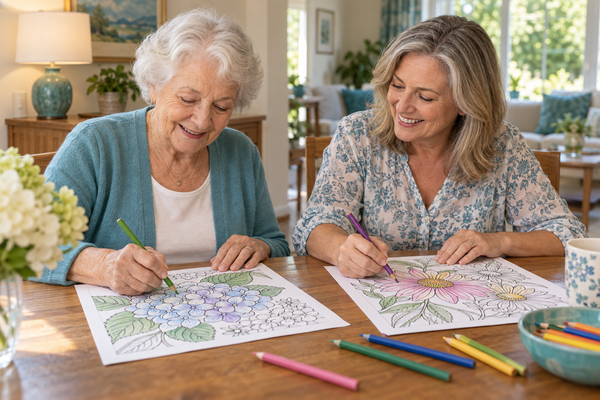
- What true engagement looks like: finding the intersection between individual interest, remaining strengths, and the right challenge.
- Why engagement includes everyday household tasks, not just formal scheduled programs.
- Preserving long-term abilities through regular cognitive and physical stimulation.
4. Practical Strategies for Caregivers
- How to re-engage a loved one who refuses activities.
- Practical examples: washing vegetables, polishing silverware, sweeping, or simple guided baking.
- Utilizing visual aids to break multi-step routines into manageable tasks.
5. Common Mindset Pitfalls to Avoid
- Shifting from correcting facts to preserving confidence.
- Avoiding the urge to interrupt or complete tasks too quickly for them.
- The importance of non-verbal cues: warm eye contact, relaxed body language, and authentic smiles.
6. Inclusive Products & Closing Thoughts
- Overview of Aegeliss’s slim book 2-in-1 jigsaw puzzles and customizable visual support systems.
- How to connect with Aegeliss online and on social media.
🔗 Resources & Links Mentioned
- 🌐 Aegeliss Official Website: Aegeliss.com
- 📱 Follow Aegeliss on Instagram: @aegeliss
 Aegeliss

Podcast Episode Transcript
Diane: Welcome to Caregiver Relief. I'm Diane Carbo, RN, your host today. When someone we love is living with dementia, it is easy for daily care to become focused on tasks: medications, meals, appointments, bathing, safety, and even supervision.
But the person living with dementia still needs something deeper. They need connection. They need purpose. They need moments of success. They need joy, and they need to feel like they still matter. Today we are going to talk about why engagement is not optional in dementia care. It is essential. My guest is Ju Tu, founder and CEO of Aegeliss, a cognitive accessibility-focused company dedicated to helping people living with dementia and other cognitive challenges experience greater independence, joy, and connection in everyday life.
Ju's work is deeply personal. Her experience as a care partner to her grandparents helped her understand how important it is to create tools and activities that meet people where they are, instead of expecting them to fit into a world that no longer feels easy to navigate. Through her company, Aegeliss, Ju develops visual supports, engagement activities, and educational resources that help individuals and their care partners live fuller, more connected lives.
This conversation is for every caregiver who's ever wondered, "What can I do with my loved one now?" Or, "How do I keep them connected when dementia is changing everything?" Today we are going to talk about how small moments of meaningful engagement can bring comfort, confidence, dignity, and joy back into the caregiving day.
Diane: Ju thank you so much for sharing, taking time out of your busy schedule. one of the things that I find is activities are the most neglected but most important tool in, a caregiver's toolkit. So thank you for joining us today.
Ju Tu: Wow. Diane, I really appreciate the intro. That was really heartwarming, and really in depth overview of June and Aegeliss.
Yeah, like you said, engagement is such a vital medicine, and sometimes it can be as equally powerful than, medication itself.
Diane: I will tell you it's more powerful than medication itself. As a nurse, I can tell you that.
Ju Tu: Yeah.
Diane: I've had personal and professional experience, so I love what you, what you're sharing here.
Before we start talking about the product and your services, I would like to start by sharing your personal caregiving story and how your expertise with your grandparents led you to create Aegeliss.
Ju Tu: Yeah, absolutely. So like you mentioned, it started from a really personal space. prior to creating, Aegeliss, I have been in corporate US for about a decade, starting in a program management role and then transitioned into one of the, most, prestigious management consulting company.
While that was extremely fulfilling, I really felt like I haven't met the need for social impact yet. And then it wasn't until, the spring of 20, 24 that I visited my grandparents and realized that, the forgetfulness talked about in our family was beyond normal aging. It was definitely, a sign of cognitive decline.
Diane: Yeah.
Ju Tu: And my grandfather has always been an people leader and very inspirational, family member, someone I look up onto, all the time. So seeing someone that I have loved with all my life and aspi- a- admire so deeply his life like shrink into, someone who can only watch TV all day long, and there was not much that my grandmother can do, can engage him for a
Diane: Yeah
Ju Tu: prolonged period of time.
Diane: Yeah.
Ju Tu: What that entails is a really, mentally exhausting, physically draining grandmother who was hospitalized twice.
Diane: Oh, God bless her.
Ju Tu: Oh Yeah, and it really pains me to see how, like, how life can happen for a primary caregiver The quality of life just wasn't there
Diane: Yeah. Yeah
Ju Tu: So then it quickly, I realized that I have to, you know, bring something to my grandparents so my grandpa can be more independent, stay engaged, and do more on his own so my grandmother will be less worried all the time.
Diane: Yeah.
Ju Tu: I thought it would be an easy task. I thought it'd be easy sourcing, go onto Amazon search for activity for older adults or people living with dementia. There will be tons of great brand names out there with evidence, research, and high quality.
And to my great surprise, it was the complete opposite.
Diane: Yes. Yes.
Ju Tu: And when I saw colored products just with a repurposed, title in there, I felt like something, my heart was sinking, and I know that was the moment I have to make a change.
Diane: Yes.
Ju Tu: Where the world needs, where my passion is at, and what I'm good at really intersects. So that's why the cal- calling and why I started Aegeliss.
Diane: Well, you know, we have a common thread through almost 99.9% of my podcasts. a family caregiver identified an issue, a problem, an obstacle or challenge, and they decided to do whatever they were doing and focus on providing a solution.
So I applaud you for, doing that. can you explain to me, when we use the word engagement in dementia care, what do you really mean?
Ju Tu: Yeah. When I think engagement means, different things, to many people. But I think the way I see engagement is through the person where their interest level, where their remaining strength match with an activity.
Diane: Yes.
Ju Tu: And then when a person was doing the activity, he or she is in their flow moment, not thinking about, other distractions and just fully focused on something that give them sense of purpose and a good cognitive stimulation, and feeling very happy and accomplished. So I feel like that is the perfect scenario of engagement.
So what that means is an activity is, one of the prerequisite, but an activity does not necessarily lead to engagement.
Diane: Correct.
Ju Tu: and then an engagement does not always mean, a, a scheduled program or, a tabletop activity with a activity supply. It can also mean a daily routine that a person enjoy doing and be encouraged to do, even it's just the most mundane, activity of daily living. So
Diane: Exactly.
Ju Tu: Yeah Yeah. So that's how I see engagement as the overarching, state where strength, interest, and the activity self really come together.
Diane: I see engagement is really important because you were talking ab- I love that you talked about your grandfather sitting watching TV all day long, and what people don't understand is when you stop walking and you're, you mindlessly watch TV, you're, you actually increase the progression of the how fast you will decline.
And it's really important to keep people physically and mentally active as, as long as possible, even if it's just getting up to walk around the house or getting outside. But you have to have physical and mental, stimulation in order to, slow the decline of the, the dementia, or cognitive decline at as well.
Ju Tu: Absolutely. And I also believe that the cognitive stimulation is a really overlooked, Yes aspect . And people took it for granted that, the people living with dementia no longer have problem-solving skills.
Diane: Yeah.
Ju Tu: But if we prepare the environment in the right way
Diane: Yep
Ju Tu: offering them, the cognitive ramps and with a the right amount, the right level of conversation, and then also the activity itself, the person can definitely be in their deep problem solving mode, navigating the things, they enjoy at their own pace.
Diane: Yes.
Ju Tu: Yeah. So the cognitive stimulation is so important to prolong the preserve abilities and strength.
Diane: Exactly. And that's the key here. To my listeners, a person with dementia will lose an ability. they will, and they will not regain it. But by keeping them engaged, what you're doing is actually preserving, that long-term memory and allowing them to, be able to function at a higher level for a longer period of time.
So I love that. I love that because that is one of the most overlooked, like I said before, tools in a caregiver's toolbox, and it could make life so much more pleasant for them if they would just take time to look at activities or different engagements. Now, many caregivers feel overwhelmed and say, "I don't know what to do with my loved one anymore."
What would you say to that caregiver?
Ju Tu: That is the million dollar question that is, That is, pretty hard. Yeah. I got asked, this question very, very often is where do I even get started?
So I think it really depends on what a person's interest is what their remaining strength level is.
Diane: Yeah.
Ju Tu: And then coming up with a few choices that meet a person at where they are, and then offer then the cognitive ramps that allow them to enjoy the activity for as long as possible. That sounds really, you know, vague.
Diane: Yes. Yeah.
Ju Tu: And I'm go
Diane: But you know what? it's the basic concept, I understand it.
So I'd like you to, elaborate on that a little bit more, please.
Ju Tu: Yes. I definitely, will elaborate more. So as an example is, let's say, mom lives with, early to mid-stage dementia and no longer really want to engage in anything.
Diane: Yeah.
Ju Tu: And the daughter tries really hard to say, "Mom, do you want to do puzzle?
Mom, do you want to go out for a walk?" And the answer is, 99% of the time, no." And then the daughter gets frustrated. Mom also up get upset at, so nobody wins.
Diane: Yeah.
Ju Tu: How I would, like really looking at a situation is, looking at, like Mom what she used to love, what she has always been good at, especially in her early, adulthood. Let's say Mom has always been the, the chef in the house, always taken great pride in, preparing up elaborate
Diane: Yeah
Ju Tu: family meal. So if she is still able to do things like, polishing the silverware or preparing vegetables, fruits then a wonderful activity would be encourage Mom to help preparing meals like
Diane: Yeah
Ju Tu: washing tomatoes, washing a potato, peel off, carrots.
Diane: Yes. Yeah.
Ju Tu: Chop them or, you know, silverware polishing. Those takes a lot of time, but it's absolutely necessary.
Diane: Yeah.
Ju Tu: And how the daughter can introduce it is- Use affirmative statements led by positive emotion.
Meaning, a better way that could be said is, "Mom, you have always been, the best chef in the house, and we would really love, your help, 'cause you are the best person, preparing the meals for us. Come here. Here are some tomatoes. I would love for you to show us how to wash it properly."
So when you lead with affirmative statements there's no chance for them to say no.
Diane: Yes.
Ju Tu: Even if they feel, you know, reluctant, as you see if they see you demonstrate the washing process they will feel naturally, it's deeply ingrained in their, long-term memory.
Diane: Yeah.
Ju Tu: They'll know how to wash tomato. They'll know how to wash potatoes.
Diane: Yeah.
Ju Tu: And then the other thing that could make this more likely to succe to succeed is having the visual aids that says, "Please wash vegetables"
Diane: Yeah
Ju Tu: along with an icon that truly reduce their cognitive load. So as they're engaging in the activity, they will never lose train of thoughts or feel disoriented.
That visual aids
Diane: Yeah
Ju Tu: will always re-anchor themselves back into the reality and allow them to understand, what am I doing here? so that will be just an example of how, just using the most mundane activity
Diane: Yeah
Ju Tu: and then providing the, the accommodation that allow Mom do what she enjoys for maybe 30 minutes, if not one hour.
Diane: Exactly. You know,... families, don't want Mom cooking, they don't want Mom cleaning, they don't want her baking. But, if you would make I had a wonderful experience during COVID. I moved in with a woman who was losing her sight, and her husband was in the middle stages of dementia.
And I was so impressed with her, because here she is, she's, like, 82 years old, and she loved to bake. but her vision was bad. So she used to. But she knew her recipes off by heart. She used to make sure that her husband helped her bake every day. He would put the flour, the sugar in. He would ... She would make him manually stir.
She had a KitchenAid mixer there. Wow. And she would make him manually stir so that they had that interaction, and that was almost a daily routine. And he liked to eat what they made, cookies, cakes, whatever. So it was a beautiful activity. And she also, which I know people think this is terrible too, she'd make him sweep the floor because she wanted the house to be tidy.
Defa was their dog and she had fur, and he would just swe- and it was just a broom. It was just a push broom. But it kept him busy while she was putting, washing the dishes or putting the things in the oven or getting dinner started. So she, used just what you're saying, to make, keep, interactive and in, and he was engaged.
'cause he had lost his ability to speak or communicate, but he had. He was like Jim Carrey. He had the most amazing facial expressions. You just knew that whatever he was trying to tell you, you understood what it was. so I love that. can you, give me some dementia engagement activities that tend to work well, especially when memory, attention, or communication skills are changing?
Ju Tu: I, yeah, that's a great question. the examples are endless. It can be anywhere from, like I said, the most mundane household you know, cleaning or preparing meal, those activities, all the way to, a tabletop activity like a jigsaw puzzle- or to, more physical oriented activity like a walk or a aero-the water, the exercise in the water.
Diane: Yes. Aerobic, yeah.
Ju Tu: Exercise, yeah or hand massage.
Diane: Yeah.
Ju Tu: So I feel like the best is a combination that both the, care partner enjoy as well as the person enjoy, that offer the person just the right amount of challenge that keep them engaged for a prolonged period of time- say 30 minutes to an hour.
Diane: Yeah.
Ju Tu: And also giving them a sense of accomplishment and purpose. yeah, so those are the, like, it's a wide range.
Diane: Yes.
Ju Tu: but I would say the best is the one that the caregi- partner also has to, enjoy doing. And-
Diane: You know what? That's, I was just gonna say that. It relieves so much stress and anxiety, and it gives the family caregiver absolute, relaxation to, really in a way you're, you're so busy in the enjoying the activity with your loved one, you forget about all the other things you're, you think you should be worrying about, The, you know
Ju Tu: Yeah
Diane: calling the doctor, following up on things and it gives you a moment of satisfaction and happiness for just a brief moment, but it's wonderful to have.
Ju Tu: Yeah. And when a person is deeply engaged or they're doing something together that both enjoy
Diane: Yeah
Ju Tu: the care partner doesn't have to, you know, always be on the lookout for the next alert, next thing.
Diane: Yes. Yes, yes.
Ju Tu: You never want your mind to be in high adrenaline, high alert mode.
Diane: Yeah.
Ju Tu: When everyone perform best when their minds are relaxed, and that's when creativity shine, that's when a lot of great thinking happens. So that's why, for me, it's deeply meaningful and important to create tools that allow that flow moment happen as frequently, as easily as possible.
Diane: Now, you talked about visual supports. How can visual supports help people living with dementia or other cognitive challenges feel more confident in daily life?
Ju Tu: Yeah, I love that question a lot. It took, so I would say visual aids or visual support systems are crucial in I agree.
Allowing the person to be as independent as possible.
Diane: Yeah.
Ju Tu: Reduce the need for repetitive question from the care partner as much as possible. And the most importantly is it allow the person to feel able, capable, and no longer being talked upon, anymore. So I think it's a really important benefit that, that I wanted to, highlight.
So not all visual aids are created the same. In dementia care because of the fluidity of, the person's, everyone's memory journey is very different.
Diane: Yeah.
Ju Tu: So I think the best visual aid needs to be, you know, something combined with both, very simple text and icon. Think about our experiences navigating a busy, Costco or, a mega airport.
Diane: Yeah.
Ju Tu: Every traveler instantly look up to the signage.
Diane: Yes.
Ju Tu: And then all the signages at the airport always have an icon as well as, text.
That's how regardless of the traveler background, regardless of nationality, cognition level, they can always find their way to the from drop off point to the gate.
And then using that same principle into home care, we want the visual aids to clearly tell the person where things are within the first few seconds. Not only it needs to have high contrast but also it should be a combination of icon and text, and it should be totally personal- personalizable based on the person's unique needs. what that means is, the caregiver and the person can choose, what visual aids to apply, and then the person apply it themselves, and then to make sure it's at eye level so they can see clearly. So it really help them to follow, to find the things on their own, whether it's as simple as TV remote or a utensil.
And also, it can also contain step-by-step process of how you do a typical household activity, like running dishwasher, taking trash out. Those are the things we took for granted. But if you truly think about how you would operate it, it is a multi-step activity
Diane: Yes
Ju Tu: that, involves a lot of thinking and problem-solving.
Because their brain is operating at a capacity, the best thing caregiver can do is breaking it down to provide, break it down into step-by-step process so the person can follow the, using the, the help of visual aids.
What that entail is that a person, you know, although it may take them long to understand it, and then think about it, but you allow them to, process that and follow it versus, being all done by the caregiver. That is already burnout.
Diane: Yes.
Ju Tu: So there are many things I think the visual aids can help the independence and family dynamics, but giving them the, agency to, choose what are helpful, and then to apply them on their own and then support their daily independence is just a few benefits that I think the visual support offer.
Diane: I like that because, as it can actually prevent, or decrease the amount of emotional outbursts, the amount of frustration, anger, and that a person with dementia feels when they try to do a task and they don't have the capacity anymore to remember the steps.
And they know what they want to do, or they try to do it, but they're unsuccessful, and it can cause a lot of angst and heartburn for the family caregiver for sure, as well as the person with dementia that is just wants to be able to, sit at a desk and, or go to work. That's a big one.
The men, want to go to work. And, so how do you deal with that? Well, you know, you get creative about it at different levels of the caregiving journey and their progression in the disease. you talk about being positive. how can caregivers shift from correcting or testing memory to creating moments of connection?
Ju Tu: That, I think it's... I usually like to describe it this process as turning the switch of the mindset. So instead of inviting them into the reality we have to respect them because they may live, they may live in the reality that is true to them but it might be 20, 30 years ago.
Diane: Yeah.
Ju Tu: So instead of forcing them into the reality and a person gets extremely upset at, upset and so are you, I would often, wanted to switch, turn on the switch and allow us to go into their reality. So what that entails, I always found it super powerful, is that as a granddaughter, I got to hear my grandpa talk about the proudest moments of his life for, a good 45 minutes above if I want him to.
So that's where, you know, you truly listen to the family legacy, what makes him a, wonderful person, leader, and all of the, things happened 20, 30 years ago that was, quite, powerful.
Diane: Yeah.
Ju Tu: And then also, I think that's where I got to, no longer to be an uptight Ju in the business mode-but to be, in a little bit of silly and fun Ju mode as a family- Yeah caregiver. there could be some times what they say don't make any sense. Yeah. And then I would say, "Wow, I love that. Tell me more about it."
Diane: Yes, yes.
Ju Tu: You know, I bet that's, how things worked back then. That was so cool.
So I, even if what they say don't make a lot of sense
Diane: Yeah
Ju Tu: I think always led by positive emotion engage the nods smile and then say, "What they said was so powerful, so meaningful, or so fun. I would never thought about it. I wish more people know about this. You are so good at this."
So I think just building that emotional resilience and, channel all of that to a combination of, silly and fun and creativity, you can keep the conversation flow for
Diane: Yeah
Ju Tu: a very, very long time if I want to.
Diane: Yeah. Yes, exactly. Exactly.
Ju Tu: And this strategy like, works not only for my own family
Diane: Yeah
Ju Tu: but also for almost all the residents that I work with, in assisted living or memory care.
Diane: Yeah.
Ju Tu: I respect where they wanna lead me. So I let them take the lead. Yeah. and, whatever they wanna, share with me, I will, follow their lead. And if start, if things make sense, that would be great.
Diane: Yes, yes.
Ju Tu: If things don't make sense, that is also okay. I just, I feel like people, always, wanted to focus on the facts and evidence, and that's what society trained us for. And, that's okay in a normal world, but in dementia care world, we have to be extremely flexible because of the fluidity of the, cognitive condition.
Diane: Yeah.
Ju Tu: And then I think this is where caregiver can, be creative and lower their guard and just tap in their reality and let them take the lead. when that happens- magic story happened.
Diane: Yes. Yes.
Ju Tu: Yeah. yeah. Hope that helps.
Diane: And even if it's a person who makes no sense at all, one of the things that I want to point out to my listeners is, if you are communicating with somebody in any level of dementia, they may have communication problems, they may not be able to express themselves.
It may take them a while to learn something or to process what you're saying to them. But if you do it with, first your face in front of them so that they see you, but they also know how you're feeling. So if you're stressed and anxious, and your face is all curled up and gnarly and your teeth are grinding, they're gonna feel that tension.
So it's really important that you take time to take some breaths, roll your shoulders, get comfortable, and get in front of them with a smile. Now, it has to be authentic. It really does. But, you know, don't let them... They will sense every emotion. They may not understand or hear what you're saying, but they see how you're acting, and that is really important, to use when you're working with them.
And, be sincere and, I know I have fun with it. I've taken care of dementia patients or people with cognitive issues for decades. And, there's just, people that can't speak at all and they, they just want to walk and be busy. And then you change your activity for them.
Or I had a little old lady, I've talked about this before, who was so delusional. She was adorable. Oh my God, she was adorable. She was like five foot, tiny little thing, effervescent, just happy as can be. And she had a boyfriend, and he traveled all over the world. And I would say to her, "How are you contacting him?
How is he keeping in contact with you?" And she picked up her hand and said, "We talk on the phone every day." And it was, I thought about the tin cans we used as kids with, tied to a string that we would
Ju Tu: Yeah
Diane: pretend we were communicating, and I just would we would have hour-long conversations.
"Tell me, what is he doing? Where is he? What's he seeing?" That type of thing. And it made her happy. Her family was They actually put her in the hospital to address this and get her over that delusion. And it's like, why would you do that? She's happy, she's interactive, she's enjoying her life the way she thinks it's should go.
So and, that's a hard thing sometimes for families to do, is to actually go with the flow, Ju, as you were saying. So what mistakes do families often make when trying to engage a loved one with dementia?
Ju Tu: Oh, that is a really great question, Diane.
Diane: Thank you.
Ju Tu: Really, really great.
From my observation, I believe with that when the person is trying to engage an activity, let's just use puzzle as an example, I always feel like engagement is is paramount, and it's more about letting the person's thinking take them where they wanna be, allowing them to solve the problem, like, where do I make the piece happen, at their own pace, without correcting them.
Sometimes, because how our society values, you know, accuracy and speed and, facts, one thing I've seen a lot is family caregiver took away that independent, slow, but independent thinking away by quickly pointing it out that this piece goes in here.
Diane: Yes, yes.
Ju Tu: You put it there. You put it there. That was wrong.
Diane: Yeah, yeah.
Ju Tu: So I think quickly correcting them without giving them the space to think and pause is really what disrupts the flow moment.
Diane: Yes.
Ju Tu: And when a flow moment was disrupted, and there were a lot of, like, verbal redirection the person's self-confidence was quickly destroyed.
Diane: Yes.
Ju Tu: And then when there's, you know, destroyed confidence, the person will disengage very quickly and say, "Okay, I'm not gonna- not gonna do this."
So I think despite the best intention, not correcting the person- is something I would highly recommend. Just sit back.
Let them explore at their own pace, giving them the chance to problem-solving on their own terms. Yeah. even if it's wrong, that's okay.
Diane: Yes, it is.
Ju Tu: Yeah. We,
Diane: They're still making the attempt, and that's the important thing. And the and the other thing that family caregivers do is they'll say, "What do you wanna do? Let's do this, or this." And, you know, there are times when you can only use one or two word sentences as they move through their dementia journey. It depends on your family member. So and you don't wanna give a lot of choices. And, so you have to be patient. I'm an old rehab nurse, and rehab, you encourage people to do things, and people take offense. They see you as lazy or uncaring. But, I'll step in if a person needs me to do something for them, but I want them to do as much as possible for themselves, before I step in because it gives them a sense of wellbeing, it gives them a sense of accomplishment, and you don't want to create dependence.
Now there will be a time in dementia where your family member will be dependent on you for so many things, but try to encourage independence for as much as possible. I think that's important.
Ju Tu: Yeah, Diane, that was a really great point. when you're encouraging their independence Yeah you're also doing yourself a big favor by pre
Diane: Absolutely.
Ju Tu: By preserving their remaining ability. Yes. And that will give both of yourself and the whole family higher quality of life.
Diane: Yes.
Ju Tu: And that's all that really matters in
Diane: Exactly
Ju Tu: dementia caregiving.
Diane: Yeah.
So how does Aegis help caregivers and people living with cognitive challenges create more connections in everyday life?
Tell us about what you've developed and created.
Ju Tu: Yeah. so we, like you mentioned earlier, we developed, dementia inclusive visual aids and engagement activities, because greater independence, joy, and connection are what I value deeply and what I believe to be, fundamental to high quality of life.
By like, even, on, so on the activity side we currently have a two-in-one jigsaw puzzle in a slim book format. And it has many features embedded in there that really shifts the fundamental caregiving dynamics from caregiver setup, caregiver introduced, and caregiver, facilitated into a somewhat, more of a, a person driven activity that they can spontaneously start on their own and then being supported with a visual aid embedded that allow them to, accomplish it at their own pace.
Diane: Yeah.
Ju Tu: It can be adapted to from easy to hard based on the person's cognition and hand dexterity level. It also has been proven to be a really powerful socialization tool in community where multiple residents with different ability come together and solve the problem. and it's wonderful at creating flow moment where, you know, when you're done right, the visual support, the instruction guide, the right amount of challenge. I've seen anywhere from 15 minutes to two hours, engagement almost on the person.
Diane: Yeah.
Ju Tu: And even the care team told us that it felt like a flow moment.
Everything is effortless. I don't have to do much. I never feel the need to, correct, and then everything feel like so easy. so that's where I think the activity design for people living with dementia should be is encourage spontaneous engagement. It allow them to enjoy just the right amount of challenge for a prolonged period of time, and then it make them so good about themselves that leaving becomes the hot conversation.
Diane: Yeah.
Ju Tu: yeah, so
Diane: One of the things I have a hard time with is, and so many memory care units have, equipment that is for children. And I get some of that, but, they don't encourage engagement. And, you know, I had a big issue with that because I think that is so important, when you can have, people sit around and, they're trying to do something and it's just So many of them will say that it's baby stuff.
And for the lower, for those in with the later stages of cognition, maybe, this thing where it has, liquid and it's like a balloon and it has things in it to watch, they can touch it and it'll make things move is great at some level, but it doesn't increase interaction with anybody else, and it's just, it's not, it doesn't...
I just didn't think it was appropriate at times because it's, it doesn't encourage initiation at all by the person.
Ju Tu: Yeah. Diane, I resonate
Diane: And that's a problem.
Ju Tu: Yeah. Yeah. I resonated with that deeply. I say that, anything, that we offer to people living with dementia needs to hit a mark of dignity and visually appealing,
Diane: Yes
Ju Tu: visuals.
Diane: Yes. Yes.
Ju Tu: If something that a healthy adult will deem inappropriate for themselves
Diane: Yes
Ju Tu: And then it's a instant tell that the person is having a cognitive decline, and that's what they deserve I think that's an instant tell that it's inappropriate. Just because their mind is operating at a capac- at a percentage to the full capacity or hand is not as dexterous as before
Diane: Yeah
Ju Tu: does not necessarily mean that, opting for toddler pieces is the go to.
Diane: Yeah.
Ju Tu: You know, they are still entitled to adult appropriate, dignified activities with beautiful modern visual that does not make the home look ugly or it does not make the people like caring for him feel like, "Okay, that's what he only can do now, kid's act"
Diane: yeah.
Ju Tu: so I resonate with everything you were just saying.
Diane: I've been around a long time, and I love the new solutions being presented, and this is an, a incredibly awesome one. Ju, how do people reach out and find Aegeliss and your products and, or reach out just to ask questions to you?
Ju Tu: Yeah, Aegeliss is spelled S-A-E-G-E-L-I-S-S.
we have a pretty active Instagram where you can see a lot of, residents or families engaging with our tools and products. and then you can also go into our website, to explore the latest collection of visual aids and, and engagement activities. We also go to a lot of, local trade shows and conferences to share the importance of engagement and cognitive accessibility.
We were just at Indianapolis at, 2026 Gen Con, the North America's, largest tabletop gaming cultural
Diane: Yeah
Ju Tu: and convention.
Diane: Wow. Wow.
Ju Tu: Yeah. I know that is not where you would think, dementia or designing for older adults was, a, a mainstream concept at all. But we're really glad that we hosted two workshop and it was really well-received.
And there were really engaging conversations. So find us on Instagram, LinkedIn, and also please support us, by, shopping directly at Aegeliss.com. And, hopefully Aegeliss can benefit more and more families who are going through this really hard and challenging chapter of life, and can bring a lot of light and, joy to
Diane: Yes
Ju Tu: your family.
Diane: Absolutely. To my family caregivers out there, you are the most important part of the caregiving equation. Without you, it all falls apart. So please learn to be gentle with yourself. Practice self-care every day. And if you have somebody with dementia or cognitive issues, I'd definitely look into Aegeliss.
Caring for a loved one can be overwhelming — but you're not alone. If you have questions, big or small, our expert team is here to help.
👉 Click here to Ask the Expert
Our Resource section can help you find the information and tools that you need. We have courses, videos, checklists, guidebooks, cheat sheets, how-to guides and more.
You can get started by clicking on the link below. We know that taking care of a loved one is hard work, but with our help you can get the support that you need.
Click here to go to Resource Section now!