Age Spots or Skin Cancer? A Senior’s Guide to Aging Skin with Morgan Kelley and Hannah Hewaij - Episode 229
Aging skin changes can be confusing for seniors and caregivers. Learn how to spot warning signs, protect fragile skin, understand sun damage, and choose safe cosmetic skin treatments.
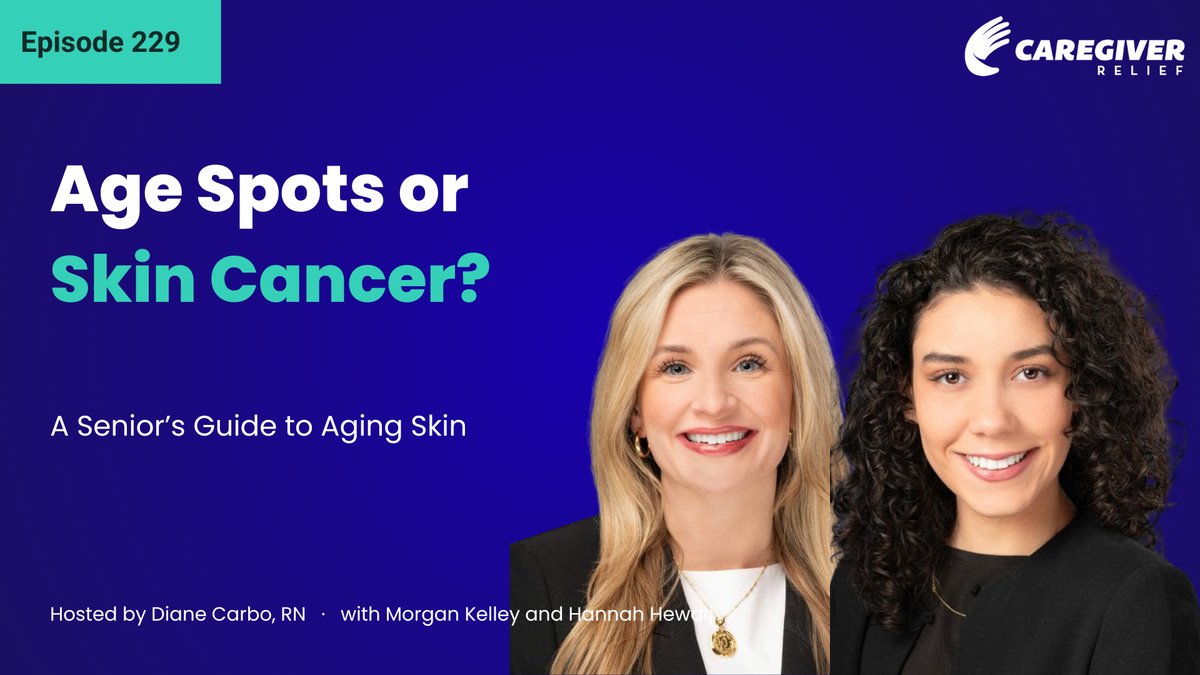
In this episode of the Caregiver Relief Podcast, host Diane Carbo, RN, sits down with the experts from Purvis Dermatology—Family Nurse Practitioner Morgan Kelley and Clinical Aesthetician Hannah Hewaij. Together, they break down the mysteries of aging skin, sharing professional medical and aesthetic tips to help seniors and family caregivers know exactly what to look out for.
Whether you are noticing new spots on your own skin or helping a loved one with their daily care, this episode is packed with essential, lifesaving advice you won’t want to miss! 🎧👇
📋 Episode Outline & Key Highlights
- 🎙️ Introduction to Aging Skin Diane welcomes Morgan and Hannah to discuss why our skin becomes thinner, drier, and more fragile as we age, and how years of sun exposure start showing up.
- 🩺 Personal Journeys into Dermatology Hear what inspired Morgan and Hannah to dedicate their careers to skin health, including Morgan's personal experience surviving skin cancer in her teens.
- 🔍 Age Spots vs. Harmful Growths Learn the difference between harmless sunspots (lentigines) or raised growths (seborrheic keratosis) and potentially dangerous changes.
- 🔤 The ABCDEs of Melanoma A simple, easy-to-remember breakdown of the warning signs:
- A - Asymmetry
- B - Border irregularities
- C - Color variation
- D - Diameter (larger than a pencil eraser, or 5mm)
- E - Evolution (any spot that is actively changing!)
- ⚠️ Actinic Keratosis Explained Why you should never ignore rough, scaly, or crusty patches on sun-exposed areas.
- 🧴 Caregiver Tips & Managing Dry, Itchy Skin How caregivers can spot skin changes during daily routines. Plus, easy home remedies to protect fragile, "rice paper-thin" skin (including why switching to bar soap can help!).
- 💆♀️ Safe Aesthetic Treatments for Seniors Hannah shares gentle, life-refreshing treatments—like the Diamond Glow Facial—and discusses which products (like retinols) seniors should use with caution.
- 🔪 Understanding Mohs Surgery A look into this highly effective, micrographic surgical technique that removes skin cancer while preserving as much healthy skin as possible.
- 🧴 Simplifing Your Skincare Routine The ultimate "less is more" routine recommended by the pros: a gentle cleanser, moisturizer, exfoliant/retinol, and peptide creams.
- ☀️ Sunscreen Secrets You Need to Know The importance of SPF 30+, why you shouldn't forget your ears, neck, hands, and the tops of your feet, and the benefits of tinted mineral sunscreens.
🌟 3 Key Takeaways from the Experts:
- "Evolution" is the biggest warning sign! 🚨 If you notice a spot changing in shape, size, color, or texture, don't wait to see if it goes away. Get it checked out.
- It is never too late to start protecting your skin! 👒 Sunscreen is the number-one anti-aging product available. Pair it with a wide-brimmed hat to protect your scalp and ears.
- Caregivers have a powerful role. 🤝 Helping a loved one apply lotion or get dressed is the perfect, stress-free time to monitor their skin for new or changing lesions.
 Purvis Dermatology
👂 Listen to the Full Episode Now!
Don't let fear or embarrassment keep you from protecting your health. Your skin has taken care of you for a lifetime—now it’s time to return the favor.
Podcast Episode Transcript
Diane: Welcome to the Caregiver Relief podcast. I'm your host , Diane Carbo, RN.And today we are talking about something many seniors and family caregivers notice, but may not always know how to interpret: changes in aging skin.
As we get older, our skin becomes thinner, drier, and more fragile. Years of sun exposure can begin to show up as brown spots, rough patches, discoloration, bruising, or changes in moles. For many older adults, the question becomes, is this just an age spot, or could this be skin cancer? Today I'm joined by two women from Purvis Dermatology here in Myrtle Beach, South Carolina, who are going to bring both medical and aesthetic expertise to this conversation.
Morgan Kelly is a family nurse practitioner and Myrtle Beach native. She earned her undergraduate nursing degree from Francis Marion University and her advanced education with a family practice practitioner degree from Loyola University in New Orleans. Morgan has a deep passion for dermatological care and is committed to helping patients maintain healthy skin through prevention, education, and treatment.
And we are also joined by Hannah Hewage, a clinical aesthetician who joined Purvis Dermatology in 2025. Along with her South Carolina aesthetics license, Hannah has completed advanced aesthetic certifications and is trained in lasers, medical grade chemical peels, RF microneedling, dermaplaning, microablation, hydro, dermabrasion, lashes, and brows.
She is dedicated to providing safe, professional skincare treatments and lasting cosmetic results. This episode is for seniors, for family caregivers, and anyone who has ever looked at a spot, rash, mole, dry patch, or skin change and wondered, "Should I get this checked?"
Diane: Ladies, I know it's the end of the day.
You're anxious to get home, so I really appreciate you taking time to do this because I'm 73 years old, and I'm seeing all my friends are all going to the dermatologist and having skin cancers removed. And some of them are having these Mohs procedures, which we can talk about later, but they're, they're having a lot of skin removed, so we can't take for granted our skin.
So I want to thank you for being here. Thank...
Morgan: Yeah. Thank you for having us, Diane. No, it was very nice. Appreciated. Yes.
Diane: Before we get into the skin cancer and age spots and treatments, would you each share what drew you into dermatology and skin care?
Morgan: I'll go first. This is Morgan. Okay. So I actually experienced a skin cancer when I was, in my teens.
I had a basal cell skin cancer. I did indoor tanning, and so it kind of prompted me to start, studying the skin outside of what I was learning just in my regular nursing education and, and be more preventative. And then it just became a passion of mine,
Hannah: Yeah. And then, this is Hannah speaking here too.
Something that definitely got me interested in, becoming an esthetician, I have, a family history of skin cancer, and I've just always grown up with the fascination of skin care and skin products. I definitely, grew up in a generation of time where technology was right in front of everyone's face, so it's definitely something we saw all the time.
And I was just super grateful to have, a lot of knowledge and upbringing with that. And so that's definitely what got me interested in what it is that I'm doing.
Diane: Morgan, many seniors grew up before sunscreen was part of daily life. I used to put baby oil on. Oh, lay out in the sun. But I'm very fair.
I quit that very early in my teens because I didn't, it didn't do well. But what are some of the most common skin changes you see in older adults who have had years of sun exposure?
Morgan: For those that have used baby oil, iodine, oftentimes we do see, what we call lentigines, or sunspots, and they're flat brown spots that can show up on the skin.
These do, have the risk of evolving, so we watch them like we would watch a mole. Of course you can develop new moles, but there is genetic predisposition to acquiring moles as well.as well as, seborrheic keratosis. So these are more so raised growths on the skin that are typically, so they are harmless, but, we always recommend here that patients call us if they do see any new, changes or growths on the skin, because sometimes melanomas can mask themselves as those things.
So we do to monitor, any new growths. But those would be the most common things that we see here.
Diane: Can you explain the A, B, C, D, E warning signs of melanoma in plain language for seniors?
Morgan: Yeah. So A stands for asymmetry. B is border, so any irregularities in the border. C is coloration, so multiple colors in one spot.
D is diameter, so it's a five millimeter or greater. That would be bigger than the, back of a pencil eraser.
Diane: Oh.
Morgan: And then E stands for evolution, so anything that's changing. And I always hit home with that one. The changing lesions are the ones that we really watch for the most. But of course, if you did wake up and you suddenly had a lesion that was greater than five millimeters, then we always advise getting you in here quickly to have it assessed.
Diane: Now, you have mentioned, actinic keratosis.
Morgan: Yes.
Diane: Now, can you explain why seniors should pay attention to the rough, scaly, or crusty patches on sun-exposed areas like the face, ears, scalp, hands, neck, or lips?
Morgan: Yes. So the actinic keratosis, they are, considered pre-skin cancers, and usually they're like a red or pink scaly area.
They can feel tender to the touch as well, and we only see these in sun-exposed areas. They have about a one in four likelihood of turning into squamous cell skin cancer. So we do, make sure that we get rid of these whenever we see them in the office.
Diane: Morgan, could you, talk to us about, when should a senior make a, or a family caregiver, anybody listening right now, make a dermatology appointment, instead of waiting to see if a spot goes away?
Morgan: The recommendation by the American Academy of Dermatology is any concerning lesion, to present it for a skin check or evaluation.
And then typically from there, we usually advise living, in our area at the beach, to be seen either every six months or once a year for maintenance.
Diane: I know since I've moved here, I'm seeing you guys a lot more than I thought I would. But it's really, you know, I can tell everybody, my listeners, Morgan is my dermatology practitioner, and, she has helped me get through and identify some issues, that I had. And I'm very careful 'cause I've always avoided the sun for the most part. But, years, here I am, 73 years old, and I had a spot on my head, I had no idea what it was. And I asked my hairdresser, and he says, "It's ringworm. "I said, "No, that's not ringworm. "Yeah. And I just decided, I can't wait.
I needed to get in. And, you were able to treat it right away, which, was really important for me. I hated it. It was making me crazy worrying that something was wrong. Now many caregivers help with bathing, dressing, wound care, or applying lotion. This is a time when they can check their loved one's skin and look for different skin changes.
What kind of skin changes should caregivers report to a healthcare provider?
Morgan: I always recommend any changes.so we think about those ABCDEs, but then also, we consider things like if there's sensitivities in the skin, if you have a new painful area of the skin or itchy area, I always recommend that patients get that assessed as well.
Diane: Now, here's a problem, 'cause I'm having it. I have old lady skin right now. Dry, itchy skin is very common in older adults. What causes it, and what simple steps can seniors take at home to protect their skin barrier?
Morgan: So finding a good moisturizer one that you'll be consistent with. I don't really recommend one over another, just it's whatever the person tolerates, whatever you can use consistently. And then a bar of soap is what I recommend. A bar will help strip less lipids from your skin, which can cause that dryness and itchiness that you feel. This is also another, reason that you are predisposed to that drier, itchier skin.
But of course, we'd want to make sure that it was nothing internally causing that as well. Although there are changes that naturally occur that do make the skin drier and just more itchy.
Diane: Yeah, I lotion myself twice a day. As I've gotten older, I've had to. But, I hate looking at my skin and seeing how frail and it's like rice paper thin right now, and it's whoa. I've taken care of people forever and I wasn't prepared for this for myself.
Morgan: Yes. Yeah, and the, reason we get thinner skin is we lose collagen in our skin. It starts to, deplete in about, the mid-20s and every year thereafter.
So, collagen acts like the shock absorbers to the skin. Oh.so that's what makes it feel thinner. That's what makes you bruise easier as well.
Diane: I've always bruised easy. Now, I have a question. You're saying we lose collagen. Should we be...I feel like it's too late for me for the collagen, supplements, but should we be considering taking a collagen supplement very early in our lives?
Morgan: There's not any literature currently that links, Gotcha. I figured that early collagen intake, but Yeah
Diane: yeah.
Morgan: Okay.
Morgan: I just wanted to check because, I thought, that what I could find, is that it wasn't effective, so I wanted to check and see if, from a professional, if I knew what I was talking about.
Morgan: Right. Yes.
Diane: Now, Hannah, many older adults want to look refreshed but are nervous about cosmetic treatments. What aesthetic treatments can be helpful for aging skin when they are done safely and professionally?
Hannah: Yes. So I definitely think that's something we certainly wanna be cautious with. And, when we're introducing any type of cosmetic treatment to the skin, we wanna make sure we're taking, a gentle but effective approach.
I love to refer people to our signature facial we have here at the office. It's called the Diamond Glow Facial, and this facial works to extract, exfoliate, and infuse the skin. So it's gently, extracting and exfoliating any dry skin cells and buildup that we may have on our face while, gently infusing a hydrating serum or custom serum to whatever the concerns may be.
That's, a very effective facial from teen acne all the way to aging skin with collagen loss that I tend to see wonderful results with. And, I can treat all skin types and skin conditions with this facial.
Diane: What age would you recommend a person have that type of facial?
Hannah: Yeah. I see all sorts of age ranges with it.
I say, I like to see people, I'd say every four to six weeks for a facial if that's something you're able to do for maintenance. But for an age to start at, I see people who start in their early 20s all the way up into. I see the people who are in their late 80s, I would say
Diane: Yeah
Hannah: that I treat this facial with.
So there's really not a specific age that it caters to. But thankfully, we're able to treat a bunch of different skin types with it and concerns.
Diane: Now how do you decide whether someone is a good candidate for treatments like chemical peels or lasers or microneedling dermaplaning or, hydrodermabrasion?
Hannah: Yeah. that's why I love consults. I love just getting a little bit of history, you know, history of any skin concerns and skin conditions. Also, what may be any family history, just so I know, what type of sensitivities someone's skin may have before deciding whether or not they would be a good fit for a chemical peel or a laser treatment.
We like to always set you know, treat people conservatively but aggressively. I like to make sure you're getting results and you're pleased with the results you're getting, but I don't want to over-treat the skin type. I normally love to consult people, and that would include, a good thorough look at the skin and hearing about what type of products you're using on the skin, what you're sensitive to or have been in the past.
That's why I always love to tell people if it's something that you're interested in doing, definitely consulting with your provider beforehand, what next steps would look like is the best way to start.
Diane: Are there treatments or products that seniors should be cautious about, especially if they have thin skin, fragile skin, diabetes, poor circulation, or a history of skin cancer, or they take blood thinners?
Hannah: Yes. I mean, there are definitely some things. I say you don't wanna over-exfoliate the skin, and be cautious with any type of retinols on the skin. They're very helpful, when they're used correctly, but they can definitely be overused, and that can cause some sensitivity when you're looking at skin types that are pretty, sensitive and prone to redness or irritation
Diane: I have very fair skin.
And I tried the retinol products when I was younger, but I couldn't...I had, one of the things I absolutely had to do to be careful is wear sunscreen all the time over, it, because it really, made me very, photosensitive,
Morgan: Yes
Diane: when I was out in the sun. And people don't realize that. And that's one thing that I have learned is the importance of sunscreen.
Morgan: Yes.
Diane: And wearing it, and reapplying it if you're out. I actually wear, 'cause my arms are so fragile, right now, I actually wear, I don't have tattoos, but you know the sleeves that they wear to cover their tattoos?
Hannah: Oh, yeah.
Diane: I actually wear those, 'cause I'm around dogs too, and they scratch me, and I bleed in a minute, or very easily.
So I wear those to help protect my skin when I'm out driving and stuff. And I know people think I'm silly, but I don't wanna take a chance. So and 'cause we are in Myrtle Beach- I get out early. I'm not a hat person, but I make myself wear a hat when I'm on the beach. But I don't go out in the heat of the day.
you know, one of the problems I have here in Myrtle Beach is they don't open the pools usually till around 9:00. And I like to be in the pool at 7:30, 8:00, do my workout, and, in the outdoor pools. And, 'cause we don't have many indoor pools available to us in the area unless you drive really far.
'cause I would prefer an indoor pool any old time to work out, because it's so much better for my skin.
Hannah: Oh, yeah. And I agree with what you're saying. It's definitely important, and it's never too late to start working to protect the skin. I definitely love to tell people the good thing is you have a wonderful product that we have access to that you can buy over the counter.
That's the number-one anti-ager, and it's sunscreen, for sure. And reapplying it, and like you said, wearing a hat .We don't think about our scalps all the time until we get older and our hair starts thinning, and it's "Oh, my goodness. the times I pulled my hair back so tight or laid out on the beach and didn't have a hat or protection over my scalp."
That can definitely be places where we see a lot of concerns as well too.
Diane: Yes. Like you said. And that spot on my head that Morgan treated, it real made me realize, you gotta start wearing a hat, girl. You gotta get over the fact that you don't look good in a hat, but you gotta wear one anyway.
Hannah: Yes. Oh, yeah.
Diane: And at 73, who's gonna notice me on the beach anyway? Yeah. Morgan and Hannah, what would you both say to a senior who feels embarrassed about their skin or who has delayed coming in because they're afraid of what the provider might find?
Morgan: Well, the earlier detection, the better, Yeah. And, for the most part, most things skin related can be treated even if they are delayed, with the exemption of, some skin cancers. But there are, more systemic therapies in those cases as well. Delaying unknown doesn't necessarily delay outcome, typically our response is that patients don't feel it's as bad as they were anticipating, , once they come in to meet us, but
Hannah: Yeah. And it's very important.at least where we're at, being super thorough is, something that we are grateful that we get to do. And like you said, if somebody's coming in, we're making sure we're checking head to toe, and addressing all of your concerns, and seeing if there's anything more that we, can find to help guide you, and, get you the help and products or treatments it is that you need to be preventative or, address whatever the concern may be.
Diane: I have friends that delayed and delayed looking at their skin and going to the dermatologist, and one of the things that occurred that surprised me was the what looked like a small spot ended up being huge. Morgan, can you talk about the Mohs procedure?
Morgan: Yeah. Mohs is a micrographic, skin technique, a surgical technique that is used to take the least amount of skin, while still ensuring that all of a skin cancer is removed.
So here at this office, we offer Mohs surgery for basal cell carcinoma and squamous cell carcinoma, which, are the most and second most common type of skin cancers. We usually reserve Mohs surgery for, lesions that are greater than two centimeters, or in high-risk areas, so like on the head and neck, area, or are recurrent. So if we've seen one of those skin cancers that comes back after it's already been treated, then we will, use Mohs surgery for it. But the positive thing is Mohs, you do know that the skin cancer has been removed by the time that the procedure is over. It is all done on one day, and tissue's processed in-house as the procedure is ongoing.
So Dr. Purvis is our physician that does offer Mohs surgery. You want a provider that is Mohs-certified. So he, will take the tissue, processes that in our lab, and then reads it under the microscope and is able to tell if there's any skin cancer cells near the edges or base of the specimen. And he determines if he has to go back in for another cut based on that.
So it can be a lengthier procedure, but it has a very high cure rate to it.
Diane: I'm amazed at the results,
Hannah: Yes
Hannah: after Mohs procedure. I have several, clients that have had the Mohs, had Mohs, and one, it took all day long because they thought they got it all, and each time they had to go back- and do just a little bit more. And while people are impatient and wanna get it, you know, wanna go home, it's better to get it all cleared up right away and know that, you're going to be healing and on your way to recovery faster.
Morgan: That's right.
Hannah: Oh, yes.
Morgan: Exactly.
Diane: What is one skincare routine you would recommend for older adults who feel overwhelmed by all the products and advice online?
Hannah: My typical approach is a gentle cleanser, so you want to do twice a day gentle cleanser, a gentle moisturizer. I always recommend that a patient has some sort of a retinol on board. This helps with cell turnover on the skin, so it helps prevent aging. I am very into peptide creams right now, so I have been recommending peptides to anybody that's over the age of 30 really.
And then hyaluronic acid for very dry skin, so that's gonna help to plump up the skin or plump up the fine lines and wrinkles. Those are my three favorites.
Diane: Yeah,
Morgan: I- What is it a
Diane: Oh, I'm sorry, Hannah. No, you're good. I was gonna ask you next, but-
Hannah: Yeah
Diane: I just wanted to know, what is it about the peptides that you like?
What- Yeah ...tell me about that.
Hannah: So peptides kind of act like, almost like a Botox in a bottle.So that's a less invasive procedure for just kind of smoothing out the skin texturally.
It does help to give you a bit of a glow. But it is replenishing those peptides that are in the skin. Essentially it works hand-in-hand with the hyaluronic acid
Diane: Okay
Hannah: and retinol
Diane: And Hannah, what, do you recommend?
Hannah: Yeah, similar to what Morgan was just saying. I definitely like to tell people I love taking the approach of less is more, especially if we're starting out. If you're doing something, then that's a step in the right direction.
But like she said, a gentle cleanser twice a day, and then a moisturizer, and, sunscreen. And in the evening times I do recommend, definitely some type of exfoliant. I see a lot of people whose first, thing they're telling me is their skin is dry and they want to moisturize it, and they're overcompensating by just trying to moisturize. But a lot of times it's a lack of exfoliation. So I say at nighttime doing some type of gentle cleanser and, exfoliant, whether that's a retinol.
There are even some type of exfoliants out there that are a less aggressive retinol or a, plant-based one. So you can really be using. All skin types should be able to tolerate some type of exfoliant, and then a moisturizer as well. Moisturizer is a great, great way to keep the skin hydrated and leave a good protective barrier over the skin as well, too, as we're putting all these products on.
Diane: Now I'm gonna ask you a question about the, moisturizers that have sunscreen in them. Is that enough, or do you recommend absolutely putting an- another, layer of sunscreen on?
Morgan: The recommendation is SPF 30 or greater, so if your moisturizer has SPF 30 in it then that's okay as a baseline. You want to reapply it every two hours when you're outdoors. And then wearing a wide brim hat is the other thing that is recommended by the American Academy of Dermatology.
I have to- patients that, will use moisturizers with sunscreen in them with their SPF 30, and then I just remind them, get, a 30 SPF. Or my favorite is a tinted sunscreen. That's what I personally will wear. And then just to be reapplying either the tinted or there are mineral based powdered, sunscreens as well.
So a lot of females do prefer those, just as their reapplication goes. We have a, wonderful sunscreen here. Actually, it's, it is a tinted, sunscreen that can act as a moisturizer, and it actually has a peptide in it too. So it has, multi benefits to it. There also is a DNA repair enzyme in it, so it helps to reverse photo aging in the skin.
Diane: That's amazing.
Morgan: Yeah.
Diane: Yeah. Now, should people put sunscreen on their ears and the back of their neck? I know that everybody wants to take care of their face, but I see that's someplace I've seen a lot of my, my, clients have, ears that have had, the Mohs procedure or something cut out.
They're missing parts of their ears because they didn't put sunscreen on them.
Morgan: Yeah, so you wanna protect any skin that, you don't wanna develop a skin cancer in essentially.
Diane: Yeah.
Morgan: So yeah, I would recommend, putting sunscreen on top of the ears, behind the ears. And the wide brim hat helps with that too when you're out and about.
Diane: Yep.
Morgan: But, if you're going to run errands, and running into, to a building, then obviously some people won't want to wear a hat. Yeah. I just recommend, having that good base coat all over the exposed skin
Diane: Yes is good. Yeah.
Hannah: I always say you can definitely see, you can see people's age from the elbows and the hands and the neck.
And so something I always recommend is go down on your neck, go over the tops of your hands. With the any excess you have left over, definitely make sure you're applying that anywhere that's gonna be exposed to the sun too. Because like you said, a lot of times we'll wanna put it onto our face, but we're not thinking about our neck.
And so it's almost just kind of like you're, business just on the face, and then party everywhere else. Yes. So we definitely wanna make sure we're protecting it all.
Diane: And you know what? I have to tell you what I learned here in being in Myrtle Beach, is you gotta do your tops of your feet if you're wearing sandals.
Yes. Definitely.
Hannah: Oh, yes. Yeah. You'll get the sandal straps in the summertime with how hot and how much sun we get here for sure.
Diane: Yes, yes. And, because I do burn easy, I definitely cover everything with sunscreen. And I hate wearing sunscreen, 'cause I always it just attracts all the dirt, but, if it keeps me feeling better, that's okay. Just, I just shower it off at night. But, or reapply after I get into the water or whatever, ladies, do you have anything more you can share that I might have missed?
Morgan: I think that you've covered the basis of everything that, I usually recommend in the office. we do tailored skin checks based on if you've had pre-skin cancers or, malignant lesions.
So any skin cancers, we do see patients more frequently in those cases. But, in general, we recommend here at the beach at least once a year seeing our patients in. So we're welcome, to anybody that needs a skin check or has any lesions that are worrisome.
Hannah: Yes.
Diane: Well, we have a shortage of dermatologists in the country, and Yeah
It's desperately needed, so I appreciate all that you do. So how do people find Purvis Dermatology and talk to you guys if they need to reach out or make an appointment?
Morgan: Our telephone number here at the office, you can always reach out and book an appointment at 843-887-7546.
Or we have a website. We're not currently offering, appointments to be booked on the website at this time. But our website is purvisdermatology.com.
Hannah: Yes. And if you ever have any questions or anything, we have a lot of great, helpful information on our website as well too. So I definitely say refer to our website.
And, definitely give our office a call if you're looking to book, with any of us. It's never too late, and we're here as, your professional guidance with any questions and concerns you may have. We're honored, and, it's a privilege to get to work with the people we do every single day.
Diane: I love what you guys do.
I love coming into your office. You always make everybody feel special and beautiful.
Hannah: Aww. Well
Diane: and that's nice because I've, I was told that women my age are invisible, and you don't make me feel invisible, so I appreciate that. Thank you.
Morgan: You're so kind. Thank you.
Diane: Thank you. Oh, thank you ladies so much for sharing your valuable information.
I really appreciate it.
Morgan: Of course.
Diane: To my family caregivers out there, you are the most important part of the caregiving equation. Without you, it all falls apart. So please learn to be gentle with yourself. Practice self-care every day, and look at your skin, and go get taken care of if you need to, and wear sunscreen, because you are worth it.
Caring for a loved one can be overwhelming — but you're not alone. If you have questions, big or small, our expert team is here to help.
👉 Click here to Ask the Expert
Our Resource section can help you find the information and tools that you need. We have courses, videos, checklists, guidebooks, cheat sheets, how-to guides and more.
You can get started by clicking on the link below. We know that taking care of a loved one is hard work, but with our help you can get the support that you need.
Click here to go to Resource Section now!