How to Avoid Knee Replacement Surgery: Non-Surgical Options for Seniors and Caregivers with Dr. Sean Altman - Episode 232
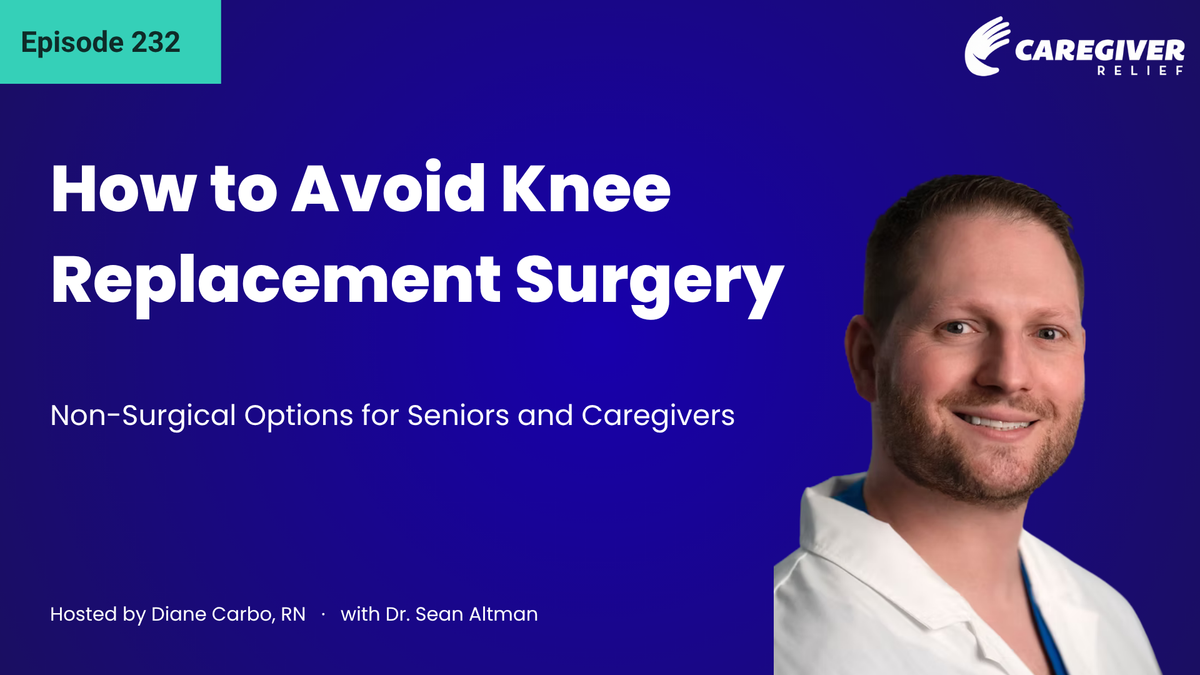
In this episode of the Caregiver Relief Podcast, host Diane Carbo, RN, sits down with Dr. Sean Altman, an orthopedic care expert with over 15 years of experience. Dr. Altman specializes in orthopedic functional medicine—a holistic approach that looks at the biological systems of the entire body to stimulate natural healing and help patients delay or completely avoid surgery.
Whether you are a caregiver trying to make the best decision for an aging parent, or you are managing your own joint pain, this episode offers powerful insights, hope, and the confidence to explore all your options!
📋 Episode Outline & Key Takeaways
1. The Reality of Knee Replacement Surgery 🔍
- The "Surgery Begets Surgery" Cycle: Many joint surgeries do not solve the underlying, systemic issues, which can lead to further procedures down the road.
- Surprising Statistics: Dr. Altman highlights a study showing that up to one-third of knee replacement patients felt the same after two to three years, and another third actually felt worse.
- Suitability Concerns: Retrospective research suggests that nearly two-thirds of patients who received knee replacements may not have been appropriate candidates for the procedure in the first place.
2. What is Orthopedic Functional Medicine? 🌿
- The Holistic Difference: Functional medicine practitioners focus on the root cause of pain and how the body functions as a whole, rather than just looking at a static X-ray.
- Finding the Real Driver: Many factors cause knee pain beyond bone-on-bone arthritis—such as meniscus tears, tendonitis, bursitis, or knee instability (like a loose medial collateral ligament).
3. Spotting the Tech: What is UltaPoint? ⚡
- Percutaneous Needle Electrolysis: This innovative, ultrasound-guided therapy inserts an acupuncture-sized needle into the injured site and delivers a targeted galvanic electrical current.
- How It Triggers Healing: The electrical current creates a charged environment that recruits the body's "cleanup crew" (macrophages) to destroy damaged tissue, allowing healthy new tissue to remodel and heal.
- Who it Helps: Unlike other regenerative treatments, it does not rely on a painful inflammatory response, making it an excellent, well-tolerated option for autoimmune patients and cancer survivors recovering from chemotherapy.
4. What to Expect During Treatment ⏱️
- The Sensation: Most patients describe the procedure as a minor muscle contraction or a "weird, uncomfortable" feeling—often much more tolerable than a standard cortisone injection.
- The Timeline: Recovery typically involves just two treatments spaced 10 to 14 days apart, followed by targeted exercises to rebuild structural strength.
- Real-World Success: Dr. Altman shares the incredible story of a 68-year-old skier with severe arthritis and multiple ligament tears who fully regenerated her cartilage and healed her ACL without surgery!
5. Dr. Altman’s Advice for Caregivers & Seniors 💡
- Ask Questions First: Before agreeing to surgery, get an objective evaluation to see if muscle imbalances, weakness, or minor ligament tears are contributing to the pain. If these aren't fixed beforehand, they will still cause pain after surgery!
- Be Your Own Advocate: You deserve high-quality, individualized care. Don't let a rushed 15-minute insurance-driven consultation pressure you into a major decision.
- Exercise is Medicine: There is no drug or supplement more powerful for longevity, balance, and joint health than staying active!
🔗 Connect with Our Guest!
Want to learn more or schedule a consultation with Dr. Sean Altman?
- Website: drseanaltman.com
Podcast Episode Transcript
Diane: Welcome to the Caregiver Relief Podcast. I'm your host, Diane Carbo, RN. When someone you love is struggling with knee pain, it can feel like surgery is the only path forward. But what if there are other options worth exploring first? Today's conversation is about hope, informed decision-making, and understanding what may be possible before making a life-changing choice.
I'm joined today by Dr. Sean Altman, who has spent over 15 years in orthopedic care, helping patients recover from injuries and chronic pain using non-surgical approaches. His work focuses on stimulating the body's natural healing processes using innovative therapies that may help delay, and in some cases, avoid surgery So if you're a caregiver trying to make the best decision for someone you love, this episode will give you the insight and confidence to explore all your options.
Dr. Altman, thank you so much for joining us today and sharing your information. I personally did orthopedics, and I know the challenges. In fact, I'm dealing with knee issues right now. I'm very interested in hearing about your, your journey, and how you... First, let's start with what led you to focus on non-surgical treatments for knee pain?
Sean: Absolutely. So my background is basically, non-surgical management and rehabilitation, for joint issues in orthopedics. And early on in my career, I noticed that with joint surgeries, we'll focus on, say, knee replacement surgeries, I realized how challenging the rehabilitation was.
I saw how many people struggled with it, and were not always necessarily happy with their outcomes. and it just got me to thinking that, you know, perhaps at least in some cases, there are other options. And, that led me along the path of looking into things like regenerative medicine, and even just broadening, my ability to diagnose why these people are having pain.
There is, a term or, kind of an approach that I've started to use or call what I do, I like to call it orthopedic functional medicine. So I spent
Diane: I like that term
Sean: So I've spent a lot of time, studying orthopedics and neuroscience and all of that. But then, it wasn't until I studied functional medicine that I really started to think about the body and all of the, biological systems that work together.
And once I applied that to orthopedics, I realized that it's often very obvious and very clear why people have joint pain and why they, are not getting better or, why they may not have a great outcome in terms of something like a joint replacement. There, I'll start you off with, like, there's this study that was published in 2020, it's called the METEOR Trial, where they looked at total knee replacements.
And after five years, they had two groups, one that received total knee replacement, and the other that did not receive total knee replacements. And No, sorry, wasn't total knee it was meniscus repair. Sorry. Meniscus surgery. You could, so they had, meniscus surgery, and at the end of five years, there was no difference between the two groups that had the meniscus surgery and did not have the meniscus surgery, except that the meniscus surgery group was five times more likely to need a total knee replacement.
And when I start to read things like that and realize that, we kinda know in orthopedics that surgery begets surgery, and and that it, you know, if it's not solving the underlying problem, that things just, they tend to evolve and get worse. So it just, it made me look at the body a lot more differently once I started to uncover some of these stories.
Diane: Dr. Altman, I told you before we were started recording, I was an ortho nurse when I first got out of nursing school, and then I moved into rehab, and then did a lot of other nursing. But now I'm dealing with, I'm 73, everybody around me is having total knees. And, I'm having knee issues right now, and I was so excited to be able to learn about your approach because I wanna do anything and everything I can to avoid surgery.
Number one, I can't take pain meds, so I have to manage my pain differently than other people. the pain meds make me sick. I can't tolerate anesthesia very well at all. I have an issue with that. and I'm not liking some of the results I'm seeing. Not only do you have to, I'm trying to avoid surgery, but I know if I absolutely have to have surgery, you need to, investigate what approaches is the best way because some surgeons have better success doing than others, and there's a lot of investigating.
So my goal is to prevent surgery for as long as possible or even avoid it. So you've developed Altpoint percutaneous needle electrolysis.
Can you explain what that is in simple terms and what this
Sean: Sure
Diane: treatment actually is and what it's designed to do inside the body?
Sean: So basically, percutaneous needle electrolysis, or you may see it in the literature also, now they're calling it ultrasound guided electrolysis technique. It's basically, ultrasound guidance of an acupuncture needle into a site of injury and then delivering a galvanic, so like a, an electrical current into the area of injury that triggers a healing response. this technology is not new. It's, it was actually invented in 1999 in Spain. and they've been doing it overseas for more than 25 years.
And it works incredibly well. it does not rely upon an inflammatory process, like PRP or stem cells does. So it's especially helpful in the autoimmune population, or even in patients that have a more chronic or more serious injury that might be a little bit, resistant to healing but, you know, more importantly than even the all point itself is identifying and using the ultrasound to figure out where the injury is, where the problem is.
Why is your knee hurting? Why is your hip hurting? everyone goes to the ortho, they get their X-ray, and they say, "Okay, you've got arthritis. You... That's why your knees hurt. You need a joint replacement." But there is a lot more to it. There, there are external sources of knee pain.
There are internal sources of knee pain. There are many potential reasons to have knee pain beyond just the lack of cartilage. They... You can have a meniscus tear like we, I talked about earlier, and that can be causing the pain. The, opening and closing of the tear and the resulting inflammatory response. You can have tendonitis, you can have bursitis, you can have, proper tracking of the kneecap.
There are a multitude of things that can cause knee pain other than arthritis. So the most important thing is to figure out why are you experiencing knee pain, and then once you understand the driver, the true root cause diagnosis, then to come up with a plan as to how to address that. And, in a very small amount of cases, it really is bone on bone.
It really is, a significantly deteriorated joint that needs a replacement. But I think in today's day and age with the science and the technology that we've developed, it's probably really closer to maybe only 10 or 15% of people that really truly need knee replacements. There was a study done in 2022 where they did a retrospective study.
So that's when they look back on knee replacement patients and what they did. It was, I believe, 350 or so individuals. And they found that of those individuals that had the knee replacement, one-third of them had a positive outcome One third of them had felt about the same after two or three years, and then one third of them actually felt worse after two or three years.
So that's a one-third success rate.
Diane: Yes.
Sean: And then additionally, when they looked back on the patient profile of those people that got the knee replacements, their estimate was that only about 34% of them were appropriate for a knee replacement, meaning that more than about almost two thirds of the group, it was actually not appropriate for them to even get that surgery.
They should have tried other, treatments or the metabolically, you know, systemically, their body in terms of anesthesia risks, et cetera, it was not even appropriate for them to do it. So we think about stuff like that and, that's why I tell patients, you gotta ask questions right out of the gate.
Diane: Yes.
Sean: Get answers. Figure out what the real problem is, and then figure out if there is a solution to it, that doesn't
Diane: You know, I want my listeners to know out there that functional medicine doctors are the only doctors in, that practice holistic care. They look at the whole person, and, you're the last frontier of good medicine, sadly.
And, you know, a lot of functional medicine is on a cash basis, and people want to re- want to avoid that. But what they don't understand, Dr. Altman, is that there is a movement for cost-sharing in, our insurance industry, whether it's Obamacare or Medicare Advantage. You are going to have to pay a large or part of your, the recommended treatments or whatever you need.
So it behooves a patient to investigate and explore all their options, because if you can avoid surgery, you're saving yourself time, energy, and I'm 73, and one of the things you have to worry about as you get older with anesthesia is you may not come out of it the same cognitively after surgery.
So there's a lot of things doing, you know, to, think about when you're looking. Some people go, "Oh, just do it." they don't know what the, how challenging the recovery period is. But anyway, let's, now I wanna talk about how does targeted electrical stimulation through a needle trigger healing differently than traditional treatments like injections or physical therapy?
Sean: Absolutely. So without getting too much into the weeds with the science
Diane: Yeah
Sean: basically what the treatment does is it stimulates the, it creates a charged environment, so it delivers electrons to the area. The area becomes electrically charged, and that causes the body to bring, macrophages to the area, and macrophages, are, part of our cellular immune response.
And what they do is they Eat or destroy or remove damaged tissue. They remove debris. you know, I like to call them the cleanup crew. So basically the body responds to this, charged, electrolysis reaction by cleaning up damaged and diseased tissue. And then that catalyzes this response where new tissue is brought in, new tissue is laid down, new scar tissue, good scar tissue, and that area starts to repair itself.
And that is the exact process that happens when you have a wound. So if you have a large wound, the body does exactly that. It... it removes damaged tissue, it fights off infection, if there's an infection, or it prevents infection. And then it lays down that initial scar tissue, and then that scar tissue begins to thicken and remodel.
Eventually it becomes a scab. Then the scab comes pops, comes off, and then you have a more natural, mature tissue. And then that tissue gets further refined through movement and exercise and stretching. Let's say I have, a cut on my wrist. First there's gonna be scar tissue that forms over it to close off the wound so it doesn't bleed.
Then a scab is gonna form. Then the scab is gonna come off. And then simply my movement of that wrist, bending and straightening the wrist, will stretch out that tissue so that it normalizes itself and the scar doesn't become hardened or fibrotic or, even, like, chelated. I know people may have heard of, a chelated scar.
Those are like those thickened, kinda knobby scars. So all of this goes on internally, inside of our body, when there's, an injury inside of a joint. We just don't see it. but it's a process that's well-documented, very un- easy to understand. and it can be... the...
Anyone's body is capable of healing. It doesn't matter how old you are, or, what your medical history is. As long as, we apply this functional medicine lens and we make sure that their body is regulated properly, their health is optimized, then they're entirely capable of healing these things.
And I've seen some pretty miraculous healing, to injuries with this technique over the past three years that I've been doing it. This year I've helped five patients with complete ACL tears heal their ACL with a bracing protocol, and the electrolysis treatment. I've helped people with Achilles tendon ruptures, hamstring tears meniscus tears in the knee.
Just really, significant injuries where they were told that surgery was the only option, and we were able to get them to heal it on their own. So it, it just says a lot about the, what the human body is capable of.
Diane: Absolutely.
Sean: And I think that in itself is very empowering.
Diane: Yeah
Sean: My background, I've been working with chronic pain, so that's people who have pain, you know, in multiple joints. They have things like rheumatoid arthritis, fibromyalgia, chronic inflammation for years. And when you have pain in a particular area for a long period of time, psychologically, you tend to develop this sense of helplessness.
And the medical system doesn't make you feel any better about that because, you're very reliant on the providers around you to help you. They take this medication, do this injection, do this procedure. They're in the driver's seat. So my goal with my patients is the opposite. It's empowerment.
It's using your own body to get you better. It's helping your body to get healthier. It's helping you to feel stronger and more capable, because that makes a huge difference in terms of what we call healthspan. So healthspan is the concept of how many healthy years you live. Lifespan is how long you live, but our emphasis should be on healthspan, like maximizing our time and the good, healthy years that we have.
Having good, happy, healthy, active, vibrant years, rather than being in pain or being sick or, being limited in terms of our activity level.
Diane: Quality versus quantity is really important Absolutely. And as a person who does have chronic pain from my decades of nursing, I relate to what you're saying very clearly, and that's why I also know the medical delivery system, and I know the questions to ask and what to look for, and I'm also intelligent enough to go out and explore different options like you're offering.
So can you walk us through what a typical treatment session looks like?
Sean: So it's you know, this... I call it this orthopedic functional medicine evaluation. It starts with their basic medical history, reviewing, where they have their pain, reviewing X-rays, MRIs if they have them, doing a physical exam, doing testing, getting the big picture of, like, how their body moves functionally, orthopedically.
But then also diving deeper into the other factors. Are there medical factors like chronic pain that are exaggerating their inflammation or their pain response, or are there deeper issues going on in terms of, at the joint level? So one of the things I do is diagnostic ultrasound.
So I image a person's knee. We locate the area of the pain, and we look if there's any pathology in the area, if there's any specific injury that is the source of their pain, as opposed to it just being an arthritis or bone-on-bone type issue. And identifying that helps us to come up with a very precise, targeted treatment plan one of the things that I see very often that gets missed, and I think it's because MRIs are not dynamic like ultrasound is.
When you're doing an MRI, you're still. Like it's a static picture. Where ultrasound, you can move and manipulate a joint while imaging
Diane: Yeah
Sean: so you can see movement, think about, like, pregnancy ultrasound, you can see the baby moving.
Diane: Yes.
Sean: One of the things I find with knees is that there can be underlying instability in the knee that we don't know about that's a big source of pain. I will see undiagnosed things like MCL tears. So the MCL is called the medial collateral ligament. it holds the meniscus in place. If that ligament is torn, frayed, or just insufficient, it allows the meniscus to keep popping in and out of the knee joint. And that can cause these catching sensations, sudden sharp pains, the knee giving out, that, often get written off as arthritis.
But in reality, it's an instability. It's a, it's literally a dislocated fragment of the meniscus that's getting pinched. And that's very treatable, with taping and bracing and the appropriate energy modalities. That ligament, that MCL can tighten back up and hold the meniscus in place.
And then even if it's only a little bit of meniscus you have left, only a little bit of cartilage, so long as it's in the right position, it can work very well, and you can eliminate all of your pain. So knowing where the pain is coming from and what really is going on under the surface is so important, because sometimes it's something very simple like that is treatable.
And uncovering that, with the initial consult is really, it's beneficial for the patient 'cause now they have an answer, we have a plan. we can really just move right into the right direction.
Diane: So what does a patient actually feel during the procedure?
Sean: It feels like a, like an acupuncture needle being inserted. And then a bit of a surge of electric stimulation. similar to a NMES, so like a electrical muscle stim, like where the kind of the muscle, contracts or tenses. It really... It... Most patients describe it as, weird/uncomfortable.
Not. I would say not as painful as, a joint injection.
Diane: Yeah.
Sean: like a cortisone shot or the like. But, there's a little bit of discomfort. I'd say it, very tolerable, especially for chronic pain patients or for people
Diane: Yes.
Sean: who've been in a lot of pain for a long time. They're like, "Sure, bring it. If that's gonna help"
Diane: Yep
Sean: I can handle that little bitty needle if that's gonna get me-"
Diane: That's my approach. Yep.
Sean: Exactly.
Diane: So I totally get it. so how many treatments does a patient typically need, and over what period of time?
Sean: So it's typically two treatments, spaced out by about 10 to 14 days. And then I track them, with ultrasound imaging and usually within about two weeks we can see that initial scar tissue. And, by about six to eight weeks they're completely healed. And along that continuum, the first two weeks is like a rest interval where, you're minimizing activity to allow for the healing, and then, the next two weeks is like a gradual return to activity.
And then, the remaining four to eight weeks, four to six weeks is exercise because, you need to strengthen the muscles around the area in order for that joint to work properly and for you to be able to do the functional activities that, that you wanna return to. And, in the populations I work with, sometimes it's just going back to walking, but then sometimes it's going back to, bending to pick up their grandkids or playing pickleball or tennis or golf or, you know, like.
And, our goal is always to help people to return to the things that they want to do, their passions the things that make them feel vibrant and go into that kind of healthspan, thinking.
Diane: Will this require ongoing maintenance of some sort?
Sean: No. I mean, the only maintenance really for those, for those individuals that are not physically active is just the education and the understanding that, we should all have an exercise program, as we age to adhere to maintain our muscle strength, our balance, you know, our physical fitness.
Many longevity and functional medicine doctors, they all say the same thing. The best drug for longevity is exercise.
Diane: 100%.
Sean: There is no, there is nothing, there's no supplement, there's no medication.
Diane: Yeah
Sean: There is nothing that is as powerful and helpful for your body than exercise.
Diane: And I hope my listeners pay attention to that message because, we need to stay strong, we need to stay active, and especially for seniors as they age, balance is important because one fall can prevent you from ever returning home, ever again. It just one... It only takes one fall. So it's good to stay active and have an exercise plan in place. So who is not a good candidate for this type of treatment?
Sean: Probably those it's not a lot, but it's probably two groups. I'd say the minor joint issues that can be managed without an invasive procedure and just with exercise and stretching and the appropriate strategy.
Or the major orthopedic issues where there's, evidence of, joint erosion and significant damage, But those are, as I said earlier, we're realizing those are very few.
The major ones, the people who really need joint replacements, they're usually fairly easy to spot. Those are the patients that have, say it's the knee, they have knee pain all the time. Like from the moment they get up to the moment they go to bed. As soon as they put weight on their leg, there's pain.
They have trouble sleeping because there's pain. It doesn't abate. It doesn't get better. That's, when someone tells me that, I'm suspicious that the joint may be beyond a point of saving. And, you know, I'm pretty honest with every patient. If a patient like that comes to see me, I will certainly try my best.
I will do my evaluation. But I will warn them, right off the bat that they may, they may be beyond that point of repair, and they may need a surgery. But then I still try to give them the best possible advice. 'Cause I want to empower, I wanna arm my patients with knowledge, with information.
As you said earlier, there are things like surgical approach and things that really do affect outcomes.
Diane: Yeah.
Sean: So, for that individual who does need it 'cause there's a really bad problem, I still wanna optimize their available muscle strength, mobility, how their body is functioning, and then, get them connected with the very best surgeon for their body type, for their injury so that they can get a good outcome.
And I think that, my goal in a larger sense with some of the stuff I do on social media and even with just my individual patients, is to help people to become their own advocate, to help patients and the people, listening to this show or anything that I share, to understand more about how their bodies work, about the types of questions that they can ask, and about how to access and get better quality care.
Where really like I think of it as just the care that you deserve. 'Cause everyone deserves better care. Everyone deserves good care.
Diane: Yes. Thank you.
Sean: It's not, you know, Yeah, there's no reason why you can't. You might have to be a little forceful. You might have to be your own advocate and ask for things, but that's okay. Like asking for you to get better quality care in no way is wrong. It's a good thing.
Diane: Well, our system sets us up for failure for good quality care because Medicare only reimburses the doctor for a 15-minute visit, and that 15 minutes, they're to assess the patient, there's to determine tests or whatever to, for diagnosis, then to, give the instructions to the patient for the next step, document, and then get on to the next patient.
And it's just good care, quality care is not a standard anymore. you really have to, as you say, advocate and fight for that care. Now, I work with many clients who've had chemotherapy or complex medical histories, and they're often told they are not a candidate for knee replacement. Could this type of therapy be an option for them
Sean: Yes
Diane: or are there limitations?
Sean: This is a great option for those patients because as I said earlier, it doesn't rely upon an inflammatory response. So it's a much easier healing pathway. And it also is better tolerated because it doesn't have that inflammation surge- Yeah ... that other regenerative therapies do.
There's no, flare-up period, and, you know, it tends to be, it's quicker. It's a quicker recovery, which is very important in that chemo complex patient population. But then there, I have, I've lately started to work actually quite a bit with chemo neuropathy patients, which is another thing that I treat. And, as part of their treatment, you really wanna optimize their physical system their energy levels, their, detoxification pathways, their baseline inflammation so that they can function better. Because if their muscles and their energy level is low, then their exercise potential is low.
You know, that would be something for me that's essential as part of their recovery process and treatment plan is to get their health to be better so that they can, then go onto a structured exercise program, continue to get their strength back, get their energy back, and, start doing the things that they want again.
Yeah. But I've really developed a soft spot for cancer patients, chemo, et cetera. The last several years I've had, friends and family members who've gone through the process. And I realized that from an insurance perspective, the treatments, are well-researched, well-documented, many of them are covered, but the aftercare is, in a lot of cases, nonexistent. And there are.
Diane: It totally is
Sean: and there are people who are crippled and in
Diane: Yep
Sean: pain and
Diane: Yep
Sean: very sick and very weak after cancer treatment, and they are, they're not given any guidance or help or, any support afterward. And to me, that's really a shame because, you know, fighting cancer and going through these treatments is one of the hardest things that those people have to go through.
Diane: Yeah.
Sean: And, then, they're at the end, and they win. they, they succeed, and then, you're not helping them after that? you just leave them to themselves? I, that... I have a big problem with that.
Diane: Yeah. I have a dear friend who ha- is 50 years old. She's eight years post, leukemia treatments and, is in severe pain with her knees. And they told her, "Sorry, you're not a candidate." And it's just been devastating for her, and she's young. she wants to live a full and, a full life, and her quality of life is impaired because of that, because of the lack of aftercare that we offer our patients. So for someone with advanced knee ar- osteoarthritis or, the bone-on-bone knee, is there still potential for improvement with this approach?
Sean: Yes. Okay. 'Cause if, the majority of cases, even in the advanced cases, there are typically still tears or damages to the joint itself that can be repaired. And if the ligaments or, the cartilage can be, made healthier then whatever is left can function a lot better.
There are people with grade four, which means severe knee arthritis, basically, a very thin layer of cartilage, but it's healthy cartilage, and the muscles around it are healthy, and those people are running marathons, and they are in no pain whatsoever. So fascinating there are, there, there's a tremendous ability to get to where you need to go. And as I said, it's really only in these very severe cases that, surgery's the only option.
Diane: Got it.
Sean: And it's worth finding out, Yeah. It's worth finding out if it really is needed. you know, It's, and you're not gonna get an objective opinion from a surgeon. You're gonna, you need to
Diane: Trust me, I understand
Sean: who's outside of that sphere to get an honest opinion.
Diane: Yeah. That's why I haven't gone to an orthopod about my knees yet. I've been... I have a pain management doc, and I've been working with him. But, he's pushing me and nudging me towards surgery, and I'm like, oh. So I'm, that's why I was very interested in this conversation today.
Now, Dr. Altman, you mentioned imaging confirmed healing. Can you explain what you've seen on an MRI or ultrasound that may have surprised you?
Sean: Yeah, I think I'm constantly surprised by how quickly people can heal with these treatments. But yeah, but with any of my UltaPoint patients, I typically re-image them every two weeks, to track the healing process. And you can see on the ultrasound, I save the images and I save videos so I can compare, two weeks prior to the current scan. And you can see the underlying changes and how the body is able to repair. I have gotten some post-treatment MRIs. those are very hard to get covered by insurance.
Diane: Yeah.
Sean: I've had to get on the phone and fight with several insurance companies, and I've gotten some of them covered. and I've been fortunate, I've had a handful of patients who've been willing to pay out of pocket for those MRI images for their personal benefit to confirm that healing has taken place. But it is hard to get those post-treatment MRIs done. Hey,
Diane: it's hard to get- But
Sean: it's beneficial for
Diane: pre-diagnosis MRIs approved. any diagnostic test i- is awful right now you have to fight for it, and it's really sad. I had experience with the military medical delivery system, and it's delay, deny, and wait to die, and that's what our Medicare system has presently become.
Sean: I like that. That's good.
Diane: Yeah. Delay, deny, and wait to die, and that's what they're trying to do with us, just wear us down so we quit trying. So now, Sean, can you share a few real patient examples when someone was headed towards surgery but had a different outcome?
Sean: Sure. I think probably the best example is, my first ACL patient that I started working with, about, yeah, almost a year ago now.
She was... She's 68 years old. She was skiing in Utah. She went to turn. One of her bindings released, the other didn't. Her knees kinda spun and twisted on one another. And she had one of those kind of, we call it, yard sale injuries where you're sprawled out. And she tore her ACL, MCL, medial meniscus, lateral meniscus, and had a small fracture in her tibia.
You know, and she was put in, one of those long leg braces and, told that she needed surgery. She came to see us for a second opinion. We looked at her imaging, and her arthritis was already pretty severe, in several areas. So from, a prognostic or even, just future planning standpoint, we told her, "If you have knee surgery now for the ACL, it's extremely likely that you will need a knee replacement, a second surgery probably within the next few years."
And, she was like, I don't even know how I feel about one surgery. Now you're telling me I'm gonna... Like, if I do this surgery, I'm definitely going to need a second surgery in two or three years." she was not really... That, that really bothered her, 'cause she loves to ski and walk and go outside and be active.
So we said, "Okay, let's see if there's something we can do." So we did the electrolysis procedure to the ACL, and then we did PRP and BMAC, which is a bone marrow derived stem cell, treatment to her cartilage. And she was able to regenerate some of her cartilage. She reversed the arthritis, and healed her ACL.
And she was... We have a six-month MRI post where everything was healed. That's amazing ...
And she was back skiing the next ski season. She didn't even miss a season. And now this woman, she went from grade four, which is severe arthritis, to grade two to three arthritis in all four of her knee joints.
So now not only is her knee better, but in all likelihood she will never need a knee replacement. and that's the type of stuff we get to see, in this regenerative medicine, non-surgical world. and it's inspiring. It makes you realize, there's hope.
Then, and everyone's capable of this if given the right time and circumstances and treatments.
Diane: Right. For my listeners out there who feel pressured into making a surgery decision quickly, what should they do first before moving forward?
Sean: I think, you need to have the knee or whatever joint you're looking at looked at more objectively in terms of why is that joint bothering me?
Are there issues other than the arthritis that are contributing to it? Are there muscles, tendons, ligaments, tissue, other tissues that have damage to them? Is there muscle weakness? Is there some sort of additional stress being put on that area? because you need to find that out first. If those stresses exist and you do not address them before the surgery, they are still going to be there after the surgery.
And that will also make the healing process worse. And in a lot of cases, that is the reason why people will have really challenging recoveries from surgery, is that there were additional problems that existed that were ignored or just not identified prior to the surgery. And then of course, they're still there afterward, because, a muscle imbalance isn't fixed with a surgery or I'm learning more and more that, they're, they don't always necessarily fix small ligament tears or connective tissue.
But, you know, it's not necessarily guaranteed that they're gonna fix those little things unless you identify them and you know that's a problem, beforehand.
Diane: Yeah. So how do my listeners reach out and find you, Dr. Altman?
Sean: So you can find me on my website, drseanaltman.com. and then you can also find me on LinkedIn, Facebook, Instagram.
But please feel free to send me a message, or, fill in, fill your information out on my website if you have any interest in a consultation or even just in learning more about, how to understand the pain that you're experiencing. 'cause as I said, my goal here is to educate and to empower.
I want people to better understand what's going on with their bodies and to be able to play an active role in the decision making.
Diane: Yeah.
Sean: It's your body. You should be able to make the choice
Diane: Absolutely
Sean: of what you want to do.
Diane: Yeah.
Sean: You should not feel pressured or feel like there's no option. I spoke, earlier this week with a patient, and I feel bad, honestly. She's in Manhattan, she's on Medicaid, she's on disability, and she's got knee arthritis, and the only thing that her insurance will cover, the only thing that she can afford is a knee replacement. and it's really unfortunate to be pigeonholed there.
Diane: Yeah.
Sean: Because she doesn't want to do it.
Diane: Yeah.
Sean: But the only way for her to get out of pain and to feel better other than taking painkillers is to get this surgery, and that really isn't fair. Like, you should have, the ability to be autonomous with your own medical decisions.
Diane: Exactly, yeah. I just want to make you aware, and to my listeners out there, all Dr. Altman's information will be included on the podcast page that we create, so you'll be able to find him in a variety of different ways. Dr. Altman, thank you so much for sharing this information. I think you're gonna be hearing from me.
Sean: That would be great. I'd love to help.
Diane: Yeah. To my family caregivers out there, you are the most important part of the caregiving equation. Without you, it all falls apart. So please learn to be gentle with yourself. Practice self-care every day, because you are worth it.
Caring for a loved one can be overwhelming — but you're not alone. If you have questions, big or small, our expert team is here to help.
👉 Click here to Ask the Expert
Our Resource section can help you find the information and tools that you need. We have courses, videos, checklists, guidebooks, cheat sheets, how-to guides and more.
You can get started by clicking on the link below. We know that taking care of a loved one is hard work, but with our help you can get the support that you need.
Click here to go to Resource Section now!