Chronic Inflammation and Aging: The Hidden Cause of Disease (and How to Fight It Naturally) with Samuel Shepherd - Episode 230
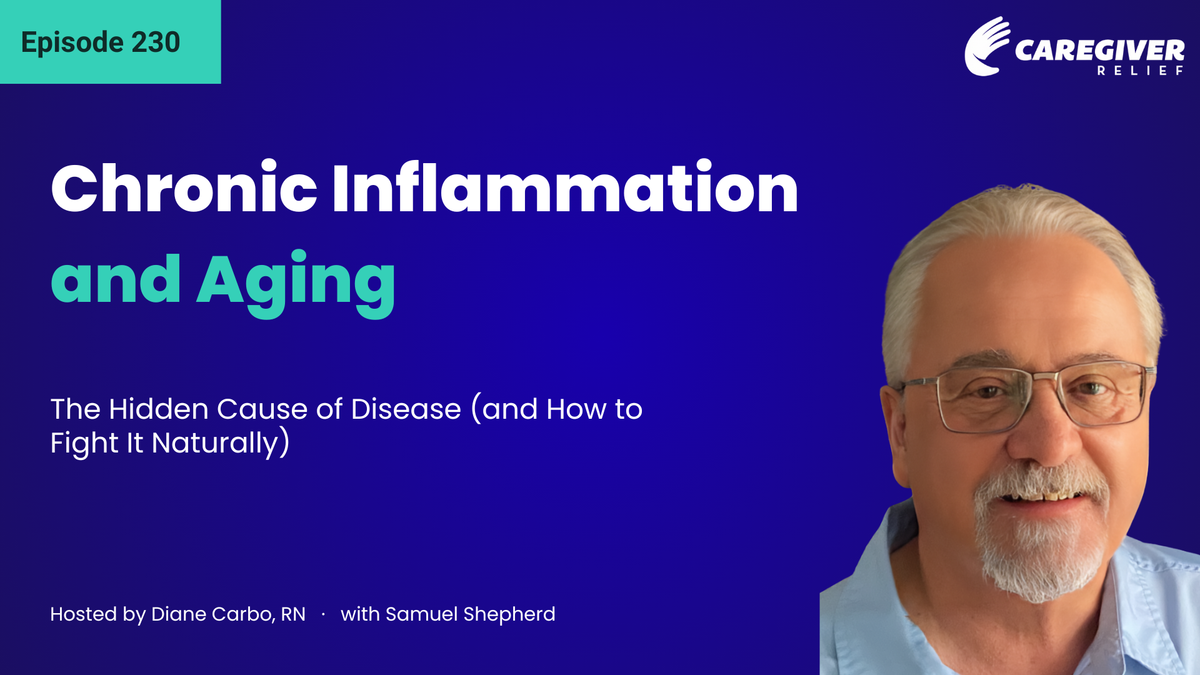
In this mind-blowing episode of the Caregiver Relief Podcast, host Diane Carbo, RN, sits down with Samuel Shepherd an award-winning physicist, inventor, and engineer. After surviving a rare, terminal bone marrow cancer, Samuel used his 50+ years of scientific expertise to trace chronic diseases back to their root cause: free radicals and inflammation.
Even better? He developed a patented, natural solution that stops inflammation at the source! 🌿✨
📝 Episode Outline & Key Takeaways
- 🩺 Introduction: Diane introduces Samuel Shepherd and discusses how unrecognized chronic inflammation drives aging and disease.
- 🛑 A Shocking Diagnosis: Samuel shares his personal battle with polycythemia vera—a rare, terminal blood cancer—and how his thick, "sludge-like" blood put him at immediate risk of a stroke.
- 🧬 The Solution to Pollution is Dilution: How Samuel tracked his own hemoglobin levels and used calculus and biology to find a natural way to stop his body from mass-producing red blood cells.
- 🔋 Free Radicals: The "Poop" of Cellular Life: A simple breakdown of the Krebs cycle, the mitochondria, and how the highly reactive hydroxyl free radical steals electrons, causing proteins to misfold.
- ⏳ The Aging Wall: Why our bodies naturally stop producing vital antioxidant protectors (like glutathione and catalase) around age 42 for women and 50 for men.
- 🍬 The Mechanics of Type 2 Diabetes: How free radicals physically warp insulin proteins, leading directly to insulin resistance and diabetes.
- 🦞 The Pink Flamingo Secret (Astaxanthin): Why Samuel studied the five animals that rarely get cancer (including salmon and naked mole rats) and discovered the power of natural, left-handed (glucoside) Astaxanthin.
- 🏥 Clinical Shocks & Successes: Samuel shares incredible stories of hospice and cancer patients becoming cancer-free, and how the NIH is now heavily researching Astaxanthin.
- 🐕 Beyond Humans: How this patented formula (Velasta) is helping pets, racing horses, and even soldiers by neutralizing lactic acid and stopping joint pain.
- ❤️ Self-Care for Caregivers: Diane wraps up with a reminder that caregiver health is paramount, encouraging listeners to investigate natural ways to manage their own pain.
🌟 Why You Absolutely Have to Listen!
- Understand Your Body: Learn exactly why your body starts aching and losing energy as you age—in terms that actually make sense! 💡
- An Incredible Survival Story: Hear firsthand how a terminal diagnosis forced a world-class physicist to outsmart his own cancer when medicine gave up. 🎓
- The Walmart/Amazon Warning: Discover why standard store-bought Astaxanthin doesn't work, and why the molecular "shape" (chirality) of what you eat makes all the difference. 🧐
- Real Hope for Pain & Disease: From diabetes to arthritis, learn how targeting a single free radical can turn your health—or the health of someone you care for—entirely around. 🙌


Podcast Episode Transcript
Diane: Welcome to the Caregiver Relief Podcast. I'm Diane Carbo, RN, your host, here to support the caregiver behind the care. Today we're talking about something that affects nearly every caregiver and aging adult, but often goes unrecognized. That's inflammation. Many of the symptoms we associate with aging, fatigue, pain, brain fog, slower recovery, may actually be signs of chronic inflammation in the body.
Joining me today is Samuel Shepherd, an award-winning physicist, inventor, and engineer with over 50 years of groundbreaking work in science and innovation. After being diagnosed with a rare terminal bone marrow cancer, Samuel turned his experience towards understanding the role of inflammation, and ultimately developed a patented solution designed to target it at the source.
His story is one of resilience, innovation, and a deep commitment to helping others live with greater energy and vitality.
Diane: Samuel, thank you so much for sharing your information. As I was saying to you before, we we're recording, it's such an inspirational in, story that you have. And, it's obviously one of success.
You are definitely a survivor. and I'm laughing because you have 50 years in science and I've got 54 years in nursing. So we've
Samuel: Yep
Diane: seen it all. Yes.
Samuel: Yep.
Diane: So welcome
Samuel: It's been an interesting period to be alive. Thank you, Diane.
Diane: Yes, it has. So Samuel, you've had an extraordinary career, but can you share what led you to personally, from your scientific innovation, led you to personally start over?
Samuel, you've had an extraordinary career, but, can you share what led you personally from scientific innovation into health and inflammation research?
Samuel: Sure, Diane. my career was not in, the health industry or the medical field at all. I looked at medical field and some projects that I had worked on, and I had worked on, environmental solutions that were, in a lot of cases, biological in nature.
For example, the absolute destruction of pathogens, viruses, and, helminth ova in wastewater sludges to take away the infectious nature of those sludges. Those sludges were being placed on the ground. People were getting sick. I was a forensic, examiner in some death cases, and had to testify as to what was the cause of those deaths, and it turned out to be the, those pathogens and septicemia primarily, or chemical asphyxiants that come off of those, sludge fields.
Well, that was, the basis of me really understanding more in depth about how important biology is to our health. Prior to that, I worked on projects that were heavily laded in the physics world, in the electromagnetic pulse weaponry development, auditory weapon, weapons development, and bio weapons development.
And I was pretty good at it. I could hurt a lot of people very quickly. But, all of those aspects, the chemistry, the physics, the thermodynamics, the kinetics, all of those things that all, from all of those projects that I worked on, came to a single point in my life, and that happened in 2003, and I was diagnosed with a bone blood cancer called polycythemia vera.
Very rare form of cancer.
Diane: Oh, wow.
Samuel: And I may have gotten a little too close to a chemical or radiation, electromagnetic radiation or but for some reason, I developed that cancer. For the longest time, they thought I had a coronary problem. My blood pressure was 280 over 160. I knew I was gonna stroke probably, and be very, rely very dependently on my family because my body was in good shape. And The, all of the things come back. I remember my mother taking care of her mother for three years after she had a stroke, and we lived in the same house. And she was paralyzed and could only see out of one eye. For three years she toiled like that. And I thought, "I'm gonna end up the same way."
So when I got that diagnosis, if someone who has ever been told that they have a terminal illness, it's shocking. Because
Diane: Absolutely.
Samuel: my life was absolutely great, very adventuresome. I was in great health. I knew something was wrong. My heart was fluttering at night. My blood pressure was uncontrollable, very erratic.
Pounding headaches. And when I went in and the doctor rolled up to me 7:00, 7:30 in the morning in one of those chairs that had wheels on it. He had no notebooks, no nurse, nothing. He just rolled up, put his hands on my knees and said, "I've got some bad news." And I said, "What's that?" And he said, "Your heart's fine, but you have a cancer called polycythemia vera."
And I'd never heard of it before. And I said, "Well, is there a chemo or a radiation protocol or surgery or how do you combat this?" And he just scooted back and shook his head no. I said, "What are you telling me?" He said, "This is a terminal cancer." He said, "There is no treatment at this point.
We can manage some of the symptoms, but it's, an untreatable form of cancer."
And I had, I gotta tell you, an out-of-body experience. It was as if I popped out and I'm watching me and this doctor have a conversation. That's how much shock
Diane: Yes
Samuel: I think that, that came to me. And I finally got back into being focused on the conversation and I said, "What are you..." or I asked him, I said, "What are you telling me?"
He said, "This is terminal." And I said, how much time do I have?" And he said, "In your current condition, you have 10 minutes to 10 years." And I said, he said, "97% of the people will perish within 10 years." And I said, "What about the 10 minutes?" He said, "Your blood is so thick right now that you could throw a blood clot to your brain, your heart, or your lung and it would take me 10 minutes to declare you dead."
And from there, I had, if anybody's familiar with it, but I had a hemoglobin of 27.
Diane: Oh, my lord.
Samuel: A hematocrit of 81.
Diane: I've never heard of that.
Samuel: And
Diane: Never. Oh
Samuel: he was pretty urgent, so I drove myself. I left his office. He told me to go to the hospital, and I just drove myself. It wasn't that far away.
And, I went in. he had already called the office to expect me, and that was my very first phlebotomy.
Diane: Basically, your blood was sludge.
Samuel: Sludge. I'm
Diane: Yes. Yeah
Samuel: I'm pumping mud. I had an enlarged heart because of the maintenance of the high blood pressure.
Diane: Yes.
Samuel: So I got a slight enlargement in the heart.
And it would get You know, I thought that maybe my skin color was changing because I was in the sun or getting tanned or whatever. It turned out it wasn't. It was coming from that thick blood in the capillaries. Actually changed my appearance. it made me darker. And it all sort of came together at that point.
So
Diane: Wow ...
Samuel: I go in, and the first phlebotomy, they take out, two pints of blood. And what came about, because I spent so much time in the environmental field, the solution to pollution is dilution. And that That's good and that, yeah. Good. And that's what came to mind. I'm laying there. I've got blood being pumped out of me, and they come in with another, I have a feeling it was saline, on the other side trying- to keep the volume up and
Diane: Yes
Samuel: but it does mess up your electrolytes. It messes up, you know, the way you think. Yeah. And you're tired. So I went in, then, had two pints out. I waited three days, went back in for blood work. my hemoglobin was, still 19 to 20. They scheduled another phlebotomy.
And that one got me down, under 18. And then I had a, HGB, a hemoglobin tester.
So I could test it. So each day I would prick my finger, and I would check the rise in my hemoglobin. And they told me when I got up to 19 to 20 that I had to be phlebotomized again. So I could track it, so I could develop a nice data line that showed how my hemoglobin changed over time, and it was pretty linear.
Each day I got a little bit higher number.
Diane: Yeah.
Samuel: So
Diane: Sam
Samuel: Yeah
Diane: before you go on, would you explain to our listeners what hemoglobin means? be- just because I want them to understand.
Samuel: Sure. Yeah, hemoglobin is a measure of the number of red blood cells that you have in your bloodstream.
Typically, the normal human being produces anywhere from three to six million a day. I was producing 40 to 60 million per day. So the stem cells in my bone marrow were totally out of control from this cancer.
Diane: Yes.
Samuel: And, so I was mass producing red blood cells.
Diane: Yeah.
Samuel: there was no more liver and onions in my life.
There was no more red meat in my life. Anything that contained iron was another part of the dietary protocol for the type of cancer that I had, to try to bring down my ferritin levels and stop the generation of these red blood cells. Some people, and we have, we've, we're treating several now, are, have polycythemia where it's the white blood cell count or the platelet count is affected.
And they get out of control from the same sort of JAK2/STAT3 mutation in the bone marrow. so the hematocrit is really interesting because the hematocrit normally should be three times your hemoglobin. Now, if your hematocrit is, lower than three times your hemoglobin, that is a measure of your dehydration level or hydrated level in your blood.
Diane: Okay.
Samuel: So that's why they like to look at the hematocrit number, and the hemoglobin together. But normally, if you take your hemoglobin and multiply it by three, that should be your hematocrit.
Diane: Okay.
Samuel: If your hematocrit is higher than that means you're dehydrated. If it's lower than that means you're super hydrated.
So they can govern that from your blood work
Diane: So could we start with the basics? Why is inflammation now considered a root cause for so many chronic diseases?
Samuel: Absolutely. when I got into studying this, it took me about eight years when I finally figured out, what was causing these sort of inflammatory diseases.
It turns out inflammation is a result of the accumulation of primarily four free radicals.
The superoxide, singlet oxygen, the peroxyl, or the hydroxyl free radical. The hydroxyl free radical is the most dangerous. It has the longer half-life. It has an immediate attraction to any proteins, phospholipid membrane, fatty acids, in the cell membrane, and it also attacks readily the guanine in the DNA.
That's what we now know is initiating these DNA-related cancers, these mutations. So that hydroxyl free radical is the cause. Now where does the hydroxyl free radical come from?
Diane: That was gonna be my next question.
Samuel: I could see that look in your eye.
Diane: Yeah.
Samuel: In the mitochondria, we process sugar and oxygen into energy and CO2.
So just think of that as the... in the reactant side, we have glucose plus oxygen with water, but, but it goes to CO2 plus ATP- or and, CO2 and ATP is primarily the output of that mitochondrial reaction. In chemistry, it's known as the Krebs cycle.
Diane: Yes
Samuel: but there won't be a test, so I don't need anybody to
Diane: I just want our listeners to understand in simple terms, how that impacts these four radicals that you talk about.
Like, where do they come from, and, how they are in our bodies, and what can we do to get rid of them?
Samuel: Great, great question, Diane. These free radicals are the waste of the process to keep us alive. They're the poop of our life.
Diane: Okay.
Samuel: So when we take in food, there's always waste. entropically, we have to generate waste.
Well, that waste manifests itself in the mitochondria as these free radicals. These are bad actors, and, where they come from is during the electron transport in the process of making ATP from, pyruvate in that Krebs cycle, we get these free electrons that zoom around, and it's called electron transport.
Well, some of those electrons are extracted from an oxygen, and that oxygen, in its outermost orbital, is now deficient an electron. That becomes, a singlet oxygen. It's an oxygen. Or it can be, combined with a hydrogen and it becomes, a OH, a hydroxyl. And a hydroxyl, typically when we talk about electric charge, in this case, we look at the protons which are positive and all the electrons around it.
Now, if there's eight protons floating around an oxygen atom and there's eight electrons around it, it's electrically neutral.
Electrically balanced But when you look at the diagram of it, out in the outermost orbital of that, there has to be a missing electron. That makes singlet oxygen having a neutral charge to be extremely reactive.
Whatever it bumps into, it's gonna steal that electron, whether it's a protein, whether it's another atom, it will steal that electron from another large protein, and now that protein becomes a free radical. It's missing an electron. So this cascade can happen. So the hydroxyl free radical is generated as a byproduct of common metabolism in our mitochondria from when we're born until the day we die.
Now, the reason we see this as an age onset type disease is we can do a lot of stupid things when we're young. Our diet, we can eat fruit, we can drink alcohol, we can stay up late. I could eat pizza. I could get highly stressed over chasing women. All of those physiological aspects of stress would generate these free radicals 'cause it had a direct impact on your metabolic rate.
So
Diane: So the free radicals are bad?
Samuel: They're terrible.
Diane: Absolutely. Okay. That's, I want my listeners to understand that the free radicals, so when we eat something and it, our, it goes through our metabolism and what the result is we create free radicals if we make bad food choices.
Samuel: Yep. Okay. Now, when we're young there's some children that aren't, that are deficient in cellular antioxidants like glutathione, catalase, and superoxide dismutase. Those are three antioxidants that we naturally produce in our bodies to protect us. When we're young, we produce a very large quantity of those.
Diane: Of antioxidants?
Samuel: Yep, of cellular
Diane: anti- And those are good?
Samuel: Yes.
Diane: Antioxidants are good. Okay. I just want my listeners to understand that.
Samuel: Yeah.
Diane: Okay.
Samuel: So up until age 42 in women on average, and age 50 in men. Nature maintains our cellular antioxidant levels at safe and healthy levels.
Once we reach that senescence age where at 42 for women and older, and 50, in men and older, nature begins to cut off our ability to produce glutathione, catalase, and superoxide dismutase.
Well, if you all of a sudden decrease the extraction capacity of these free radicals and you're still at the same diet level, drinking, eating the sugar, eating the fruit, drinking the alcohol, smoking cigarettes, guess what happens to the free radical concentration? It goes out the roof, because so there's nothing decreasing it
Diane: So we don't, we no longer produce the antioxidants in our body, so as we get, when we hit those certain ages, women at 40, men at 50,
Samuel: Yep
Diane: all of a sudden we don't have that protection in our body anymore. So if we're continuing to eat like we did, and drink and party, then everything, then our, we no longer produce those antioxidants to keep us well and healthy.
Samuel: That's correct. Yeah, what was the song? Party Like It's 1999 or something?
Diane: Yep.
Samuel: There was a song like that. we can no longer party like it's 1999.
Diane: we can't party, no, no, no.
Samuel: Yeah, it, yeah, that might be a title of a nice book, but in reality, that's sort of what's going on.
And now the inventory of these free radicals are, they never go away. So when a free radical, they're always active, they're always reactive. So when a free radical steals an electron from a protein, the protein misfolds. The electrical configuration of that protein, it changes because it loses that electric neutron or, electron.
So now the protein is non-functional. We see this with, type 2 insulin. When our bodies produce– Let me see if I have an analogy here. when our body produces insulin from the RNA from our DNA, it produces it in a
In a segment, a straight line segment. So this might be an amino acid like a cysteine, thiamine, glycine. Cysteine, it's randomly C-T-T-A-G-
Diane: So that's all on a straight line
Samuel: All on a straight line like that.
Diane: Okay.
Samuel: Now, the electron configuration of all these amino acids and the way that it's structured dictates how it's gonna be folded.
It looks for its lowest energy state.
Diane: Okay.
Samuel: So it folds up and makes a big old gloob, glob of, of protein. So you have this glooby looking, gobby, group of amino acids all wadded up together.
Diane: and this is, this is, something that's bad and detrimental to our health?
Samuel: no.
Every single cell has to be folded like that to be functional.
Diane: Okay. Okay. All right.
Samuel: Let me see if I can do this a little better demonstration. So we end up coming from our DNA- to the messenger RNA. The RNA goes out into our cells.
And a ribosome attaches to that string of DNA coded material.
Diane: Okay.
Samuel: And it reads it like a barcode, and there's three of 'em.
And it's called a codon. So these three will read and match, for example, C-G-T.
A C can only be matched to a G. A G can only be matched to a C. A T can only be matched to an A. Yeah. So when it rides down this RNA that's reading our code it reaches out into the cytoplasm, grabs an amino acid and sticks it, and it makes, it looks like a pearl necklace. It poops out and attaches an amino acid right out through the ribosome like this. And now I, and then when the ribosome hits an A-U-U, an adenosine uracil, three amino acids, it cleaves it.
And now you have this insolent straight chain piece of spaghetti or a pearl necklace and it's like this. Well, the water molecules here are bumping into it, and this thing goes to its lowest energy state by folding over on itself over and over again. Until you have a glob of protein
And it has a single functional group right there So let's say it's this tip right here.
Now, this insulin, protein goes throughout your bloodstream, and it circulates, and it fits perfectly into the insulin receptor of a cell. And when it fits perfectly in there, at that specific point, is the only way, this thing has to be folded perfect. That's why there's a God. Man cannot do this.
Diane: Okay.
Samuel: This thing folds perfectly.
And it sets perfectly inside that, that insulin receptor on the cell wall. so I have this receptor sticking up, and right here, it's called a tyrosine, it fits perfect. When it does that, it releases an electron down the cell membrane until it gets to a protein that's sticking through the cell membrane of the cell called a glucose channel.
Normally, it's closed like this, but when it sees that electrical impulse from the insulin receptor, it goes whoop.
Diane: It opens.
Samuel: It immediately opens up. it's depolarized. So now sugar that's floating up here in your bloodstream can travel through that glucose channel into the cell. The glucose goes to the mitochondria, and it's, and that's where we get our energy from.
So those are very basic steps as to how we can even carry on this conversation. That's happening right now in, in our bodies trillions of times. So
Diane: So what happens when you have diabetes? That closes?
Samuel: No. Type 2 diabetes
Diane: Or the protein doesn't fit into the cell?
Samuel: Well, the protein is created perfectly
Diane: Okay
Samuel: off of the, off the RNA.
Diane: Okay.
Samuel: Now I have this evil hydroxyl free radical over here that's missing an electron.
Diane: Gotcha.
Samuel: and it bumps into this thing.
Diane: Okay.
Samuel: Its field, now it changes the electronic configuration, and that's called protein misfolding.
Diane: Okay.
Samuel: Now the protein unwinds.
Diane: Okay.
Samuel: Now, when this protein tries to find this receptor statistically, and this is the only end that is functional, statistically, the probability is it will never find it.
That's called Type 2 diabetes. That is insulin resistance caused by inflammation. The hydroxyl free radical is the cause of inflammation. So when that happens, now you have Type 2 diabetes. These proteins of insulin are useless because they've electronically misfolded. Now, if this, and the susceptibility of this protein to extract an electron by bumping into another molecule is very, very low because the molecular weight of this protein is so high it resonates and it becomes stable in this misfolded form.
That's about the best analogy that I can give. So the problem is that hydroxyl free radical stealing that electron from that perfectly folded insulin protein. And if we can stop that hydroxyl reactor, reactant from stealing that electron by decreasing the concentration of those hydroxyl free radicals, type 2 diabetes goes away
Diane: Whoa, that's powerful.
So you created a product?
Samuel: Correct.
Diane: And it's patented. It is. Tell me about that and how it works to, create these, I'm assuming it has antioxidant benefits.
Samuel: Yeah. Astaxanthin, when I had cancer, I went out and found the five animals that apparently very low or no reported cases of cancer.
And those are salmon, pink flamingos, sharks, elephants, and naked mole rats. And I was in a position where I could, analyze molecule by molecule the tissue samples of these animals. And I had a screening algorithm in to screen out proteins, carbohydrates, any sort of biological molecule that, that would typically be produced by the organism.
And I wanted a list of all the molecules that are not indigenous to the animal itself, and yet is found in all five of those species, because they were all different species.
Diane: Okay.
Samuel: So when we analyzed and screened all that out, we only found one molecule that existed in all five of those animals and shouldn't have been in any of them, and that was a molecule called astaxanthin.
And I found out that astaxanthin was produced by an algae. I began growing that algae. I got the algae species from the University of Texas. I began growing that algae in my backyard. I would float the algae to the surface, skim it off, put it in a dehydrator. I knew it was 3.8% astaxanthin. So I could dose myself by how many grams of the algae I was gonna eat.
So I started out at four to five milligrams a day, 'cause it's a deeply red algae.
Diane: Okay.
Samuel: And it's as red, than those red flowers in your background. And it is, it stains. It's electrostatically active, very active. I start out at four to five milligrams a day. My phlebotomies was once a month without any of this.
At four to five, after about four months, I was now being phlebotomized every other month. So the slope
Diane: Oh, wow. So it
very Changed.
Diane: Yes, yes.
Samuel: So this was the control over 30 days. How quickly my hemoglobin increased. And then, when I started taking this, now it was every two months to reach the same level.
So since it was a red algae, I wanted to make sure I wasn't killing my kidneys, 'cause usually red things are poisonous in nature.
Diane: Yeah
Samuel: So Wanted to make sure I wasn't killing my kidneys or my liver. My blood work came back wonderful, except for my hemoglobin. It was still a little out of whack. So I said, "Okay, let's triple the dose."
So I went from four to five to 12 to 15 milligrams a day, and my phlebotomies got pushed out to once every four months. Statistically, that was significant.
Diane: Oh my gosh, yes.
Samuel: And now instead of being phlebotomized every month, I'm now being phlebotomized about every, every four months or about three times a year.
And now, but now, mathematically, the most critical part was I had three slopes of the curve. I had the control I had the five milligrams
Samuel: and I had the 12 milligrams. So from that, I could calculate from a pharmacological equation that every pharmacy uses, how much do I have to take so that I'm never phlebotomized for the next 50 years of my life?
And what that is, I gotta get the slope to zero.
Diane: Okay.
Samuel: So that's where calculus came in. and whoever thought they'd ever use calculus, But here's a classic case. So when I ran it through that algorithm, it came out that if I took 96 milligrams a day, I could decrease that slope to zero, and I would never be phlebotomized ever again, and that's the science behind how I figured this out.
So I started taking the equivalent of 100 milligrams per day in the algae biomass. I'm eating a lot of red algae, and my phlebotomies ended. It absolutely ended.
Diane: Wow.
Samuel: I no longer had a climb out of my hemoglobin. My blood work normalized. My health improved. I was as shocked as anyone else in, in those findings.
And now I'm the only guy, the only person that knew this. my wife and I agreed to go ahead and give it to family and friends who were at stage four cancers, and their cancers went away in 30 to 60 days. The doctors couldn't figure it out. And I get a phone call from Eastern Ohio, where I'm from, my family's, was there.
I get a call from Ohio Valley Medical Hospital.
Diane: I used to work there.
Samuel: Really?
Diane: Yeah. Yeah.
Samuel: There was a... You may know her. Her name's Trish. I'm not gonna tell you her last name. Oh,
Diane: it's been decades since I was there, but I'm from Pittsburgh, Pennsylvania.
Samuel: Oh, sure.
Diane: yeah. But
Samuel: So the oncologist there called me on the phone, and she said, "Mr.
Shepherd," she says, "I've got eight patients that are, on your product, and, they don't know each other. They're all, with hospice now. we transferred them all to hospice. And, they're all on this product." And she said, "They've all come back in. They're not progressing. And hospice has been with them now, and it doesn't appear that they're, that, that the cancer is progressing at all."
So she said, "I brought, three of them back in, and we can't find any cancer in them."
Diane: Oh, my Lord.
Samuel: and they all said, when they asked, "Did you change your diet?" they start inquiring as to, "Why are you cancer-free?" and she said, "I know we didn't misdiagnose these people." And, so we ruled that out.
But she says they're all cancer-free. and, I said, "Yeah." I said, "Let me explain to you why that is the case." So she was shocked. She said she's got eight other patients now, and they're now, they were cancer free. These people were given two to four months, three to six months to live.
Diane: Yeah.
Samuel: And now they're cancer-free.
And we, I started explaining it to her. "Well," she said, "I'm calling you for another reason." She said, "My husband just got diagnosed with stage four prostate cancer, and it's in his bones." And she said, "Would this work with him?" And I said, "Absolutely." And, I said, what about chemo or radiation, or seeds, or, surgery?"
And her comment to me rattled me. She said, "Nobody in my family is doing chemo or radiation."
Diane: I worked at a cancer center, and I feel that way.
Samuel: I was shocked when she made the comment to me.
Diane: Yeah.
Samuel: That, and I said
Diane: Sam, I wanted to, I wanna share this with you. My mom beat cancer the, on her way out the door after the oncologist said, "Louise, you beat cancer."
On the elevator on the way over, on her way to tell me at nursing school, she threw a pulmonary embolism and died from the complications Came on of the radiation.
Samuel: Yeah.
Diane: So, you know, I have a different view of, cancer and the treatments than other people because I've seen so many die from the complications of the treatment.
But I would love to understand, or tell people about your product. how can they find it? Where do they get it?
Samuel: Sure. it's over the internet, or it'll just show up at your door. There's no prescription needed. It's called Velasta, V-E-L-A-S-T-A.net. And we're now in 26 countries. We're in all 50 states.
It's moving very rapidly. the NIH has, completed over the last three years– I testified in Congress, or in Washington to a bunch of congressmen and, the five majors, John Hopkins, Sloan Kettering, MD Anderson, Mayo, and the Cleveland Clinic. There were about 200 people in the presentation. Went on for about two hours.
I explained to them why we get disease, how we can stop it. It turned out 92% of all, human disease can now be prevented, and they were shocked, to put it mildly.
Diane: Oh, the big pharma doesn't want you to
Samuel: Oh, no
Diane: anybody to know this. I'm sure they're giving you grief.
Samuel: They, they came after me, but not now.
Diane: I'm sure.
Samuel: I ended up, outflanking them and winning against them. But,
Diane: God bless you
Samuel: Yeah. but it was tough. Yeah So after that call, the oncologist from John Hopkins agreed to allocate money to the NIH to understand how this could possibly, if they could duplicate my results- basically is what it was about. And I volunteered to help, and they said, "No, you just need to go away." And you know, I thought then that they're just gonna mothball all of this research.
Diane: Yeah.
Samuel: Well, they didn't. Now you can go onto a search engine and you can search for NIH and astaxanthin and whatever disease, cancer, heart disease, irritable bowel, Alzheimer's, Parkinson's, MS.
We can stop them all now And in most cases, if we do it early enough
Diane: Yes
Samuel: we can actually prevent you from ever getting those diseases. Now-
Diane: Sam, that's pretty powerful
Samuel: oh, it's a powerful statement.
Diane: Yeah. And, what I'm going to do is, for my listeners, I'm going to put links to the NIH, studies so that they can actually see them for themselves because
Samuel: They don't have to, they don't have to believe me, and I've got-
Diane: I know, and that's the important thing and I've got my yeah. yeah. You have nothing to lose, I mean, as far as that, But if they, if the research studies are there, then people, and people will want to know about this then.
Samuel: Sure.
Diane: Yeah.
Samuel: And there's no side effects to this. so that's the, it's its own natural
It's in a natural form. Astaxanthin, is a natural food. It's a we can get into chirality, but this is why we have to eat living things. Our bodies are designed to only deal with left-handed molecules.
Diane: Okay.
Samuel: It's called chirality. And when we produce an organic molecule in the laboratory, we make a 50/50 racemic structure concentration of right-handed and left-handed molecules.
But in nature, living things only produce left-handed molecules.
Diane: Oh, okay.
Samuel: So that becomes, why we have to eat living things.
Diane: Okay.
Samuel: We can't produce food in a laboratory because 50% of it is useless. It's the old thalidomide. If you remember thalidomide?
Diane: Yes, I do.
Samuel: The thalidomide babies.
Diane: Yeah.
Samuel: What they did is they produced thalidomide in a laboratory, and they made both a left-handed and right-handed molecule.
The left-handed molecule stops morning sickness in pregnant women.
The right-hand molecule terminates the growing arms and legs of a fetus.
Diane: Oh, my lord.
Samuel: So that's when we really began to figure out how important the three dimensional shape of the molecules, the levorotary, dextrorotary, how it turns
Diane: Yes
Samuel: and polarizes light. So the, so that's how important this is.
Astaxanthin, produced by the Haematococcus, is only a left-handed molecule, so it's totally natural. Your body uses it. It can process it. It knows how to get it in and out of the cells. So when I was eating the algae I thought it would be clever as an engineer to extract the pure astaxanthin out of the algae cell we're not eating algae.
Diane: Right.
Samuel: Well, it turned out that when I did that, and I was very successful in doing that, through a process called, supercritical CO2 extraction. So I could get the pure astaxanthin. When I began eating the pure astaxanthin, my cancer came back.
Diane: Oh.
Samuel: so the astaxanthin that's actually sold by Walmart or Amazon, whatever is not effective.
Diane: It's not effective, okay.
Samuel: And the reason being, it has to do with, absorption. In the small bowel, and... when I analyzed the difference between why was the astaxanthin in the biomass working, but the pure astaxanthin, which was counterintuitive, why was it not working? And when we did a mass spec, we found that the astaxanthin inside the cell is in a slightly different form.
It's in what's called a glucosidic or a liposomal form. It has a fatty acid attached to it, or it has a glucose molecule attached to it, and that's how the algae can move it to its cell membrane to protect itself like a suntan lotion against ultraviolet, Got it rays as its pond dries up, and it's, and the sun will kill it.
It'll bake it. So it pushes the astaxanthin to its cell membrane to absorb the UV radiation, and that's, that algae can live for 100 years in the mud. The next rainfall, it comes back to life again. That's how it uses the astaxanthin. So when I
Diane: So it has to be in its natural form?
Samuel: Yeah its natural form is the glucoside form.
Diane: Okay. So the So that's why yours different from other products.
Samuel: Correct. And when we extracted it, we cracked that glucose off of the molecule in the unit operation of the extraction.
So I know how to put glucose onto organic molecules. it's called, the glycosidic, reactions.
And I could do it electromagnetically from stuff that I had done previously in my life. I knew how to put certain glucose molecules on sarin, on ricin, some real toxic, bioweapons.
Diane: So then when you and now you're using that knowledge to do something healthy and well for people, and help them to
Samuel: Correct.
Diane: Sam, You know, you have so much information and I know my listeners, really are going to want to check out your product. Tell me about it again. Where can we get it?
And, I'm just impressed. I'm gonna go check it out when I'm off here.
Samuel: Please do. Yeah. and it will in fact, change your life. I have nothing. I'm 73.
Diane: Awesome.
Samuel: I have no arthritis. I still lift weights. I lift 300 pounds, twice a week, a deadlift.
Diane: We're the same age, and my body from all the years, I tell people I used to pick up men for a living
Samuel: Yeah, but
because I did and
Samuel: Not in a good way.
Diane: Not in a good way at all.
Samuel: Yeah.
Diane: And my body is, broken with chronic pain, so I'm very interested in this because, if it would help me, it would be great. But, again, tell people how they can find you.
Samuel: Sure. it's at Valasta.net, V-A-L-A-S-T-A.net. And we also now are providing it to cats, dogs, horses, and we now have it being fed to chickens to increase the antioxidant level in the yolk of eggs.
Diane: Oh, wow. That's powerful.
Samuel: So now your eggs become extremely healthy from an antioxidant point of view. The interesting thing that we found was that in the brooder, chicken brooding, they lose about 5% of their chickens. When they feed them this Valasta, they have no death rate from their eggs.
All the eggs survive.
Diane: Oh, wow.
Samuel: So it stops the inflammatory, diseases that arise in these brooding chickens. with dogs, we stop cancer, we stop arthritis, and it happens quickly. Seven days, for dogs and, horses. Wow. this is a little different. we put it and gave it to racing horses.
Well, about three years ago. There was a horse race called the Kentucky Derby, and one of the horses came from a farm that we've been supplying astaxanthin to. They won't talk to us about it, but, the advantage we have is that it stops the buildup of lactic acid. So the last furlong of a horse race, you're measuring the genetics of the horse and its ability to modify or manage its lactic acid buildup in its muscles.
This horse had no lactic acid buildup, and the Velaste neutralizes the lactic acid. We now are providing it to, the armed forces, where soldiers can now run 100 miles nonstop with no lactic acid buildup if they're on this product.
Diane: Unbelievable.
Samuel: So it changes the physical. It changes lives. Yeah.
Diane: I wanna thank you for your time and all this knowledge. You have such valuable information for us. to my family caregivers out there, you are the most important part of the caregiving equation. Without you, it all falls apart. So please learn to be gentle with yourself. Practice self-care every day, and you might wanna check out that Valasta, dot net now, because you are worth it.
Caring for a loved one can be overwhelming — but you're not alone. If you have questions, big or small, our expert team is here to help.
👉 Click here to Ask the Expert
Our Resource section can help you find the information and tools that you need. We have courses, videos, checklists, guidebooks, cheat sheets, how-to guides and more.
You can get started by clicking on the link below. We know that taking care of a loved one is hard work, but with our help you can get the support that you need.
Click here to go to Resource Section now!