What to Expect in the Final Days of Life: A Hospice Nurse Explains with Gabrielle Elise Jimenez - Episode 234
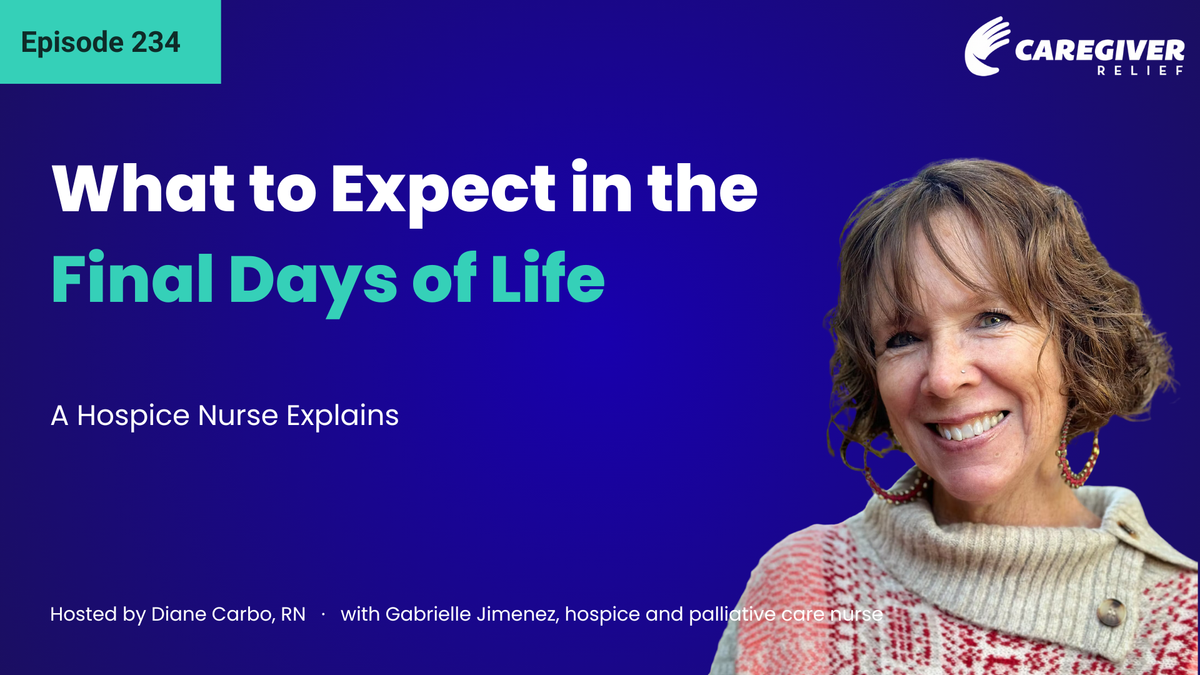
Navigating the final days of a loved one's life can feel overwhelming, frightening, and deeply uncertain. In this powerful episode of the Caregiver Relief Podcast, host Diane Carbo sits down with Gabrielle Jimenez—a hospice and palliative care nurse, end-of-life doula, and educator who has been present at over 2,000 final moments. Together, they break down the physical, emotional, and spiritual realities of the dying process to dispel myths, replace fear with confidence, and remind caregivers that they don’t have to go through this alone.
Key Highlights & Takeaways 💡
- Demystifying Hospice Care: Hospice isn't about giving up or ending life early; it focuses on maximizing comfort, symptom management, and quality of life so individuals can live out their final days with dignity.
- Understanding Physical Changes: As the body naturally shuts down, increased sleep, loss of appetite, decreased fluid intake, and changes in breathing patterns are normal parts of the journey—not signs of starvation or neglect.
- Managing Terminal Agitation: Restlessness, moaning, or sudden fight-or-flight energy can occur. Gabrielle explains how targeted medication combinations (like Morphine, Ativan, and Haldol) ease anxiety and allow the body to stop fighting.
- Dignity & Communication: Hearing is often the last sense to leave us. Speaking directly to your loved one, explaining what you are doing before touching them, expressing love, asking for or offering forgiveness, and saying goodbye are vital acts of respect.
- Releasing Guilt & Embracing the Sacred: Caregivers must offer themselves grace. Whether a loved one passes while surrounded by family or during a quiet moment alone in the room, it is a personal, natural process—not a failure of care.
Episode Outline 📝
Topic / Discussion Area
Introduction Diane introduces hospice nurse Gabrielle Jimenez and shares community resources.
Gabrielle’s Journey How caring for a dying friend inspired a career shift into hospice nursing in her 40s.
Recognizing the Signs of Decline What actually happens as the body ages and enters its final months or days.
Medication Management & Myths Why hospice doctors streamline prescription lists and focus on symptom relief.
Food, Hydration, and Feeding Tubes How the body's digestive needs change and why forcing food/water causes discomfort.
Navigating Respiratory Changes & Agitation Normalizing death rattles, apnea, and addressing terminal agitation with comfort meds.
The Emotional & Spiritual Moments Releasing caregiver guilt, reading the room, and understanding why some wait to pass.
Practical Advice & Closing Thoughts How to honor your loved one's space, the importance of final words, and self-care.


Ready to Listen? 🎧
Don't go through the caregiving journey in the dark. Listen to the full episode below to gain insightful tools, find peace of mind, and feel supported by those who truly understand. 💙
Podcast Episode Transcript
Diane: Welcome to the Caregiver Relief Podcast. I'm your host, Diane Carbo, If you've ever sat beside someone you love and wondered, "What's happening? Is this normal? Am I doing this right?" you are not alone. The final days of life can feel overwhelming, uncertain, and even frightening for caregivers who simply want to provide comfort and dignity.
Today, we're joined by Gabrielle Jimenez, a hospice and palliative care nurse, end of life doula, and educator who has been present at the bedside of over 2,000 people in their final moments. Gabrielle's work has helped thousands of caregivers better understand the dying process, not just medically, but emotionally and spiritually as well.
Today, she's here to guide us through what to expect in the final days of life so caregivers can feel more prepared, more confident, and less alone.
Diane: Gabby, thank you so much for joining us. We're both seasoned nurses, not old nurses. And I really appreciate you taking the time to share your wisdom and knowledge about this subject because it's a taboo for so many, and I'm so grateful that you're here to dispel some myths and also to...
We'll talk about the realities of it so that people can feel more comfortable, I think.
Gabrielle: Thank you for having me, Diane. I'm excited about this conversation and ready to see how many ways we can help maybe remove some fear
Diane: Yeah
Gabrielle: honor curiosity, and help those who are at the bedside, whatever role that might be, providing care
Diane: Yeah
Gabrielle: how we can make that a little more, for lack of a better word, maybe comfortable for them.
Diane: Yes. and I'm hoping we'll alleviate some fear and anxiety as well from
Gabrielle: Yes
Diane: from, 'cause they don't know what they don't know, and things get ugly in people's heads sometimes. And, that's uncomfortable as well for many.
Now, you've been present for over 2,000 end of life experiences. What inspired you to do this work, and what keeps you going?
Gabrielle: I definitely did not foresee this as being a career that I would've chosen or work that I would've ever done. I was working in commercial real estate and and construction and safety for contractors.
So this was definitely not in my vision. But I had a friend who was one of the kindest men I've ever known, and he mattered to me. And his wife, let me know that he was declining. He had been diagnosed with cancer. It happened kind of quickly, and she couldn't do it by herself, so she asked me to help, and I did.
And towards the end of his life, she asked if I could stay with him while she worked, because she had to bring in money, and so I did. So for several weeks until he died, I stayed with them, and I slept in the twin bed next to his twin bed, and I helped him shower and eat and just get through every day.
And I watched this strong, powerful, wonderful man become so dependent on others. And I watched the hospice team come in and take care of him, and the caregivers, and I think it was just one of those moments where you say to yourself, "I think this is what I'm supposed to be doing." So I started caregiving at that time, and then about...
And I was in my early 40s, and I realized that the elderly especially are often dismissed because of their age, as if their brain is somehow less than because they've aged.
Diane: Yeah.
Gabrielle: And they were ignored or dismissed or treated poorly especially around their decline in medical questions.
Diane: Yep.
Gabrielle: So I decided I wanted to go into hospice so that I can help maybe improve the way people are cared for at the end of their life. And so I became a nurse in my 40s. I was the oldest one in the class, and it was not easy. That's a whole 'nother story. But I wanted to make a difference.
Diane: You certainly have found your calling, because that hospice nurses, let's say they have one of the highest, rates of leaving the burnout, and they leave because it's so hard. But there you are, you're thriving. And, but you know what? I say I believe that it's your perspective that keeps you going.
You are doing God's work, and you believe that, and you're helping people in a, in their final days, which is so desperately needed. so let's talk about the biggest question caregivers have. what actually happens in the final days of life?
Gabrielle: Well, a lot of things really. But when you're watching someone decline and you're curious, is this part of age or is it more than that, right?
I think things to really focus and pay attention on, things to recognize in your person is if they're sleeping more, if they're eating less, if they're having trouble swallowing, if they're not as cognitive as they used to be, if they're maybe becoming more irritable or less communicative.
Maybe they either are too, for, you know, not the right word necessarily, but clingy or the opposite of that. Maybe they pull away. These are all signs that someone is probably aging or declining. It's hard to determine it's at the end of life. I think it starts there and you watch. And then as it gets to be more consistent or maybe these things are increased, that tells me. You know, often it's at this time when someone will go to the doctor and say, "Hey, things aren't right. This is happening." And the doctor will do some tests and it'll be determined that perhaps they're at the end of their life and their body is starting to shut down in so many ways.
And that is usually when they might start hospice, if they've been given six months or less to live. And it's at that time what we look for, people that do this work, is, that those same things only increased. They are going to more than likely sleep more. Their bodies are tired. They are working so hard to just get through each day.
Food stops being as enjoyable as it was. Sometimes it's harder to swallow. That might, elicit fear, and they're just not finding joy in the things that they used to. Maybe they're losing weight. These are significant body changes that, that let us know that the body is starting to let go.
Diane: And it can be a process over a year or two for some people, and, caregivers don't understand that.
Now, I did hospice nursing as well decades ago. My father was on hospice, and, my now this was... you'll get a kick out of this 'cause it was in the '80s when they just started hospice, and my dad was, had the, a Whipple procedure and that, that's when they told him he had pancreatic cancer.
And my dad would wanted to, every other year he would go to Hawaii for six weeks. He was a letter carrier and he had a timeshare. And I tell this story because the doctor says, "Lee, we're gonna put you on hospice. You have six months less or less to live." And my dad was like, his first words out of his mouth, "I'm gonna have to cancel my Hawaii trip."
And, I was in my 40s then and I looked at my dad and said, "Dad, if you're not dead yet and, and you're still able to go, you can go. We can do that. We can set up hospice over there." You probably couldn't do that now, I don't know, because they're so funny about hospice. But I did,
He was able to get over to Hawaii, and for six weeks he was there. A day or two before... And they took him off hospice because he was doing so well. But, you know, isn't that a typical thing where people rally when they're happy and they're, it does happen. my dad was for six weeks, which was, it, I'm sure unusual.
But he came home. He wasn't feeling well. We put him back on hospice as soon as he got home, and, he lived another month. But You know, people see hospice as the end, but I see it as a way for people to control everything about their life up until the end. you can choose, to die at home, you can choose to die in a clinic, in, a hospice home if they have them.
Some places have hospice units. And, the other thing is, nowadays people have life celebrations. have friends over and celebrate your life before you go. and so death doesn't have to be dark and dreary and, and sad. It could be, "Hey, I've lived a good life and I'm moving on, to the next world, but let's celebrate before we do it."
Gabrielle: First I wanna say, just going back to what you said about encouraging your dad to go to Hawaii, I love that. when you are on hospice, and maybe you're gonna go see a family member or travel, I don't know if it's okay as far as Hawaii, but you can connect with the hospice there and hand over the information so that they can keep an eye on them while you're there, and then come back and be with your current hospice team.
Diane: Yeah.
Gabrielle: So it is something that can be arranged. You know, each place does things differently.
Diane: Yeah.
Gabrielle: But yes, and what you say, people p- you know, they say six months or less to live, right?
Diane: Yeah.
Gabrielle: That's kind of a criteria for hospice. But the truth is, that's just a random number, a date a time that people on average, once you've been given a diagnosis, it's about six months or less.
People can live years longer, and some
Diane: Yeah
Gabrielle: can live only a few days. That is unpredictable. But you're right. I think when people start hospice and their symptoms are managed, it, we can't change the outcome, right? the end is gonna happen to all of us
Diane: Yeah
Gabrielle: diagnosis or not.
Diane: Yes.
Gabrielle: But what we can do is help improve the quality of life
Diane: Yes
Gabrielle: at the end of life, which will often give people more time.
Diane: Yeah.
Gabrielle: You and I were talking before we, we started this conversation which is people think, and I've heard this often, "My dad was on hospice, and he died." No, he died because he was, he had a terminal illness. His body was navigating diagnosis and the disease process that ended his life.
Diane: Yeah.
Gabrielle: When he started hospice, he was given a team that could, collaboratively come together to honor all the different ways that he was affected, for him and the people who love him.
Diane: Yeah.
Gabrielle: So could you have more time? Yes. Yeah. Are you going to die? Yes. We're all going to die.
And when you are given this diagnosis, it might happen sooner, but hospice can give you more time. And sometimes you're discharged from hospice, like your dad was, because there weren't symptoms to be managed, and
Diane: Yeah
Gabrielle: he was pretty much at his baseline and doing relatively well.
Diane: Yep.
Gabrielle: But I will say that some families actually struggle with that because when you are on hospice, you've got the
Diane: Yeah
Gabrielle: hospital bed, and the different pieces of equipment, and the supplies and the reduction in cost of medications, and you've got a team. When you're discharged from hospice, while that means you've been given more time, it also means that now your loved ones are on their own, and that's hard.
So It's hard for people. It's this, weighing one of each. Do I want more time with them or do I, how do I work this out and still feel supported?
Diane: Yeah.
Gabrielle: So it's a kind of a, an bumpy path.
Diane: Yeah.
Gabrielle: But at the end of the day, I would say that while hospice can't cure you and and, they can't fix you, they can often give you a better quality of life at the end of life
Diane: Yeah
Gabrielle: often extending your time.
Diane: One of the things I know that I had experience with people in the past is I have people tell me hospice is killing my father and, or my mother, and I'm like, "That's not how it works." But you know what the issue is, you stop medications. You stop, you know, if they had a tube feed, or they stop those, and people don't understand that's not cruel.
It's comfort measures that the body has a process what it goes through when your death and dying process starts. Can we discuss a little bit about that? 'Cause people just feel like, "Oh my God, my dad's blood pressure medicine or the cancer medication they were taking, now the cancer's gonna come back."
I know it's emotional and irrational thoughts, but they do occur.
Gabrielle: People say this all the time, my mom started hospice. They took her off all of her medications, and she died."
Diane: Yeah.
Gabrielle: What people need to understand is one of the benefits about hospice is that they do cover many of your medications.
They are related to your hospice diagnosis and symptoms from that diagnosis, so they won't cover all of them but they will cover a good amount of them. And hospice has a formulary that lists all the medications they cover. So you come on to hospice, and you've got 72 of these medications that you've been taking for 25 years, and the first thing that happens when you are admitted to hospice is the doctor goes over the m- medications, reviews all of them.
And he looks at these and says, she's been on this, but this really, there's no reason to take this anymore. why is she spending the money? Why is she doing it? She doesn't need this anymore," right? Also, maybe it's not covered under the formulary, and in hospice you get some medications covered, so why not save some money?
But they're gonna go down your list of medications, see which ones pertain to your diagnosis, which ones seem beneficial, and which ones are covered under that formulary. And then they'll say, you don't need to take all these anymore." It's not because they think, she's dying anyway, so she no longer leads, needs her blood pressure medicine."
That's not the way it works. So what I really want people to know is that the hospice doctor will review the meds. They may suggest that you discontinue some of them. There is a very good reason for that, and you can ask the why. Don't be afraid to say that. And if there is one medication that your mom or dad or whomever is deeply attached to and has been taking
Diane: Yeah
Gabrielle: forever and still wants to, you can probably still take it. The doctor's not gonna argue with you. But what they will say is it won't be covered under hospice. That can be your choice. But the truth is, are any of these really benefiting you right now? Whether you were y- whether you were dying or not the question is are these doing anything for you? you've taken them for 25 years. you've just been taking them. But are they really helping? Are they benefiting you? And so when the doctor reviews them, he's doing you a favor
Diane: Yeah
Gabrielle: both physically and financially. But if there is a medication you're attached to, ask them if you can stay on it.
But always ask the why. Why are you stopping these, and what will happen if she stops this? Will her body notice, have a noticeable change? I think that's the problem with people. I think they think hospice is the boss of them, and it's not. You can ask questions. You can be curious. You can say no.
Like, that gets to be your choice. Hospice is coming from a perspective of complete understanding of your diagnosis and the symptoms that you may or may not have or will not have. And they can foresee, okay, this might happen, so let's plan for this. But really they, the purpose of them meeting with you every week is to see and navigate and witness and assess the decline and the order that it's going and the speed that it's going.
And when they do that, they can determine whether medications are beneficial or not, or if they need to be changed or increased. The other thing I want people to know is that if a medication is not on the formulary, there might be another brand of that same type of medication just with a different name.
So you can always ask, "Okay, if that's not covered, is there one that would be?"
Diane: The other thing, the families have to understand is as they go through their decline, their inability to swallow is going to impact the meds they get. And people don't, you know, people don't understand that, they can't always take their meds because their body is shutting down.
The other
Gabrielle: Absolutely
Diane: the other big thing, Gabby, is people absolutely freak out and think they're starving or dehydrated their family member when the feeding tube is removed. could we talk about that a little bit?
Gabrielle: So generally in, when you start hospice, you would not have a feeding tube. You would not have life-saving measures.
You would have stopped any type of treatment, chemo, radiation, dialysis. So when you start hospice, it's because all measures to, all curative measures and life-saving measures are stopped. So we usually would not continue someone who is on a feeding tube. We would not continue that. I think that's, situation specific.
It may be a discussion you can have with your, hospice doctor. But here's something that people don't understand. When someone is dying, the body does not require food, nutrition, or hydration in the way that a healthy, strong body does. So when we're strong and healthy, we need that. That's the gas for our car.
We need that. We need that maintenance, that care, that support. But as our bodies are starting to shut down and dying, water and food actually becomes almost a hindrance to the body. It's uncomfortable. In fact, a body would die with more peace without food and water initiated. Now, at the end of life, if they are dying, are they gonna die from starving, starvation or dehydration?
No. and that's important for people to know. You are not starving your person because they're not eating anymore. The human body is miraculous. It knows what to do. It knows how to live, and it knows how to die, and it needs to have permission to do it in the way that it needs to. And when we get in there and we pull people out of bed because they should get up, maybe if they get up, they'll have more energy.
Maybe if we force them to eat this, they'll have more energy. Maybe they'll live a little longer. It doesn't work that way. In fact, what you're really doing is making them more uncomfortable.
Diane: Yeah.
Gabrielle: So we have to be mindful. If that person is want, choosing to sleep, let them sleep.
And if they're choosing not to eat and don't want anything to drink, respect that.
Diane: Yeah.
Gabrielle: You brought up, you know, trouble swallowing. What people don't understand is that as we age, just aging in general, our throats close, right? That's why some people need chopped up food or pureed, right? So as we're dying, it tightens, it closes even a little more, making it harder for things to go up and things to go down.
That also causes fear.
Diane: Yeah.
Gabrielle: So when someone is experiencing that, they know this is happening. They feel it. They might be refusing because that's scary to them because their body is shutting down and it's not working in the way that it used to, and our role, whether we're personal or professional caregivers, is to honor that.
Now, if they're starving but they can't eat, maybe there's other things that we could talk about. Maybe a feeding tube would be initiated. Could they do that while on hospice? No.
Diane: Yeah.
Gabrielle: So if they come onto hospice with a feeding tube, chances are we would say, "We'll no longer do that."
Diane: Yeah.
Gabrielle: Because it's just not part of the hospice protocol.
But we also don't want someone to be uncomfortable, so if they're uncomfortable because they're hungry, maybe they've got months to live. That is something to discuss with your team.
Diane: Yeah. I know it's so different, but with everybody, you have to look at the individual. But I know families have a hard time thinking about, hospice isn't killing their loved one.
Like you say, it's helping them to pass with dignity and comfort. but the families are frightened. they become frightened by changes like in the breathing patterns or decreased responsiveness. How do you talk to your family members and work with them on what they're going to be facing as their person actively, starts actively dying?
Gabrielle: Great question. first of all, I'm super honest.
Diane: Yeah.
Gabrielle: I don't baby talk. I don't skirt around the obvious. I ask permission to be frank.
And usually I'm given that permission. I prefer to tell the family members, those at the bedside, what could and might happen, whether it does or not.
Diane: Yeah.
Gabrielle: Because my thought is that when it does, they'll think, "Oh, Gabby told us this might happen."
Diane: Yeah.
Gabrielle: And there's less fear. There is less uncertainty. And so I will talk to them about food and water, about sleeping, about communication. I will talk about things like the death rattle that people are so afraid of.
I will explain that in more detail. I will tell them about the way the body moves, the way the eyes might look, the blank stare, the skin color changes. I will say these are things that, like apnea, changes in breathing. If I tell them all of these things and none of it happens, that's great.
Diane: Yeah.
Gabrielle: But if I tell them and it does, there is less fear because, I don't like the word normal necessarily. I do want to normalize what happens during the dying process so other people won't see it as a shock or as something to be frightened of. The body knows how to die, and while the sim- there's a lot of similarities, the bodies don't die in the same way.
Diane: Yeah.
Gabrielle: So we can't tell a person, "This will or will not happen." But what we can do is say, "This might happen. This is what it would look like, and this is how you can care for your person." And maybe that would honor the peace part of the dying process. You know, I've heard people call it a good or beautiful death.
I don't know if those words are really make sense to people. I would say more peaceful.
Diane: Yeah.
Gabrielle: And for me, that would mean reducing symptoms that cause struggle. Yeah. If we can reduce that and give them more peace that is ideal for me. But not just peace for the person dying, peace for the people at the bedside.
Diane: That's important because, I know I have, a family caregiver that, experienced with her loved one, her husband had terminal agitation, and she was a nurse, and she felt like hospice... it caused her anxiety, but she was already a person who had a lot of anxiety.
And, she struggled with the feeling that nobody was doing enough k- so can you address a little bit about, the terminal agitation and what people might see and experience with that?
Gabrielle: You know, I say this a lot, and I've said it already, but the body knows what to do.
Diane: Yeah.
Gabrielle: And we wish for people to just take one last deep breath and just die with this peaceful, right? It doesn't always work that way.
Diane: No.
Gabrielle: A lot of times the breathing changes can be a little frightening because it's so fast or so loud. Sometimes the body is moving around and the arms go up and the legs are going out, or maybe they'll moan out or they'll, they can't stay in their bed, or they'll sit up
Diane: Yeah
Gabrielle: and lie down, and sit up and lie down. And all of that is really hard to witness.
Diane: Yes, it is.
Gabrielle: and while I'm not a big pusher of medications, I like to try to do more tactile and verbal
Diane: Yes. Yep
Gabrielle: things that can help calm someone.
Diane: Yep.
Gabrielle: I do see the value in medications.
Diane: Yeah.
Gabrielle: And when you start hospice, for instance, you're given a kit of medications that should generally reduce symptoms that happen at the end of life.
You've got pain, you've got agitation, and you've got delirium. One of the medications that we use, commonly is haloperidol, which is also called Haldol.
Diane: Yeah.
Gabrielle: Even in the smallest of doses, it can help reduce the body's fight energy.
Diane: Yeah.
Gabrielle: And reduce it so it just relaxes into what it's doing. And sometimes we'll pair medications together, like morphine and Ativan, also called lorazepam.
We might do that because together those medications can simultaneously bring down some of the anxiousness. So is that a common thing that happens at death? Absolutely. Does everyone do it? No.
Diane: No.
Gabrielle: But it is frightening and and no one wants to see their person going through that. So what I want people to understand is that when the symptoms are not being managed by the smaller doses that hospice will start with initially increased medications are usually the case.
But it's important to know, and I try to tell families this, these medications are not gonna end their life. Their diagnosis and the disease process are.
Diane: Yeah.
Gabrielle: Could they die after having these medications? Yes, because their body's already trying to let go, but it's fighting so hard that when these medications are given, it allows the body to slow down, stop fighting, and succumb to what they were already trying to do anyway, which is die.
Diane: Yeah.
Gabrielle: So the delirium, that moving around, the restlessness, the anxiety, the agitation, all of that is the body's fight mode. and I know that's not the techno- doctor terminology
Diane: Yeah
Gabrielle: but I think it makes sense in that
Diane: Yes
Gabrielle: it's hard to die,
Diane: Yeah.
Gabrielle: It's not always close your eyes and go to sleep peacefully. So that might happen.
Diane: Yeah.
Gabrielle: And it's in that moment where I want to help those at the bedside make peace with increased medications
Diane: Yeah
Gabrielle: because my goal is always to reduce symptoms so they can die with more peace
Diane: Yeah
Gabrielle: which goes back to what we were just saying. So in those situations, positioning is probably not gonna help. You know, moving them, talking to them might not help.
Diane: Yeah.
Gabrielle: It's almost as though the body now at that point speaks a language no one else can speak.
Diane: Yeah.
Gabrielle: And so it's really hard to meet it where it's at.
So do medications help that? Yes. Do they maybe make a person more sedated? Yes. Could that mean that they're at the end of their life? Yes. Could they die? Yes, but they were already dying.
Diane: Yes. Yes. Yes. I know families really struggle with, terminal agitation, and they always ask, "Am I doing enough?
Should I do more?" What do you say to people that, carry that guilt with them?
Gabrielle: I just wrote a blog about this because I think that people carry a lot of guilt.
Diane: Yeah.
Gabrielle: "I should have done more. I should have said more. I should have known that." How would you ever know that?
Diane: Yeah.
Gabrielle: I would not know what I know if I didn't do what I do.
Diane: Exactly.
Gabrielle: And when my I was there when my mother died, I was there when my father died, and I sat up against a wall and I watched them. I wasn't at the bedside. I didn't hold any hands. I didn't say last words. I didn't even say goodbye because I didn't know. I didn't know what the nurses and doctors were doing or if it was helping.
I never, in that even at that young, I didn't think they're killing my mom or dad. I was very realistic. I knew they were dying.
Diane: Yeah.
Gabrielle: But what that reminds me is that you're not supposed to know that And you're doing the very best you can with what you have, and that's okay And you're human.
You're not failing. You're not letting someone down. You are doing the very best you can with what you have. and I want people to know that. I want them to know that you are not supposed to know all of this. And that ch- is another reason why hospice is such a great add to the care, because you do have all of these resources, and you have people like me and like you who can sit at the bedside and say, "What you're seeing right now, that's part of this process.
It's all right."
Diane: Yeah. Yes.
Gabrielle: and I think caregivers especially, personal or professional, need to give themselves some grace
Diane: Yes
Gabrielle: and know that you're doing everything you possibly can. And there isn't a rule book. I mean, there's 150,000 books out there right now about how to sit with someone who's dying, and you can read all of them and still not know.
Exactly. And I'm a great example of that. you mentioned that I've witnessed over 2,000 last breaths. I have a lot of experience.
Diane: Yeah.
Gabrielle: But when my brother was dying, I sat at his bedside for 18 days, and there were times when I didn't know what to do.
Diane: Yeah.
Gabrielle: I didn't know what to say.
Diane: Yeah.
Gabrielle: I'd given this advice to so many people
Diane: Yeah
Gabrielle: and yet even I found myself completely lost.
Diane: Yeah.
Gabrielle: And I think what it came down for, to me, was that I couldn't save him.
Diane: Yeah.
Gabrielle: And I tell people all the time, we can't save them. We can't fix them.
Diane: Yeah.
Gabrielle: But I think there's this part of us when we're sitting with someone who's dying that we want to save them somehow, and it makes you feel so incredibly helpless
Diane: Yeah
that you beat yourself up about it.
Diane: Yeah.
Gabrielle: And we have to understand that's not our role. The fact that we showed up, the fact that we're sitting there, let that be enough.
Diane: Yes. I was very blessed. my dad, came back home and, we put him on hospice, and he started his, to actively dying, about 48 hours before he passed.
So we had the hospice bed, or the hospital bed brought in. And, my stepmother and my brothers and sisters, were there. Well, my one brother was in Florida, and he was, he's my younger brother, and him and my dad had a special relationship. So when my dad started his act of dying, we called Paul, 'cause he was...
We lived in Pittsburgh, Pennsylvania, but Paul was on a vacation in Florida with his kids. So they were young. So Paul, said, as soon as he, my dad started actively dying, I said to my... I called Paul and said, "I think you need to come home." Now
18 or 20 hours, 'cause he drove. So he gets home and, you know, everybody... My dad just was hanging on and hanging on. And as after Paul came in and Paul says, "Dad, I'm here." And I told him, "Hey, talk to Dad, he'll, he's still here," you know. And within an hour after Paul showed up, my dad died.
It's like he was waiting for him. And my brother holds on to that, my dad waited for me to say goodbye, and I thought that was so touching. But we all believed that, you know? I'm the oldest of four. I'm the bossy know-it-all sister.
Gabrielle: I believe that the, there's this amazing sense of awareness that happens to people who are dying.
Diane: Yeah.
Gabrielle: And they know you're there, they know when you're not there. They know what you're saying, how you're feeling, what you bring into the room. And I have heard so many times where someone, you know, was waiting for their, their family member or their partner or someone to, to hurry up and get there, right?
Diane: Yeah.
Gabrielle: That they were gonna hold on until that moment. Who are we to deny that, right?
Diane: Exactly. Exactly.
Gabrielle: But with that, I also believe that they know when someone leaves the room-
Diane: Yes
Gabrielle: and choose to have that moment to be when they take their last breath.
Diane: 100%, yes.
Gabrielle: Some people want an audience. Some people want their favorite person.
Diane: Yeah.
Gabrielle: Some people wanna say goodbye to every single person until they've got to everybody before they say goodbye. And some don't want an audience.
Diane: Yeah.
Gabrielle: Some want some privacy, and they don't want that to be the last thing you see.
Diane: Yes.
Gabrielle: So when you just walk out or before you walk back in and they take their last breath, it's not personal.
No. It's permission.
Diane: Yes.
Gabrielle: You've given them permission to do it- Yeah ... when they were ready.
Diane: Yeah.
Gabrielle: I tell people all the time if this happens they don't take with them who was there at their last breath. They take with them who was there all along.
Diane: Yeah.
Gabrielle: Whether it was from a distance, whether it was over the phone
Diane: Yeah
or text or whatever, or at the bedside for every single day
Diane: Yeah
Gabrielle: and you missed that one moment, that's not abandonment. You didn't leave them.
Diane: Yeah
Gabrielle: You didn't let them down.
Diane: Exactly. Exactly.
Gabrielle: You gave them permission.
Diane: I had a situation, I was working at a cancer center, and this lovely young woman, was actively dying, and her family had been there 10 days round the clock just st- sitting by her.
nobody left, nobody they were brushing their teeth and washing their faces in the sink in the you know, the patient's room, 'cause they wanted to be there. And they all got to a point where they said, "We're going home to shower, take a nap, and we'll come back." And it was within an hour after they had left- She passed.
And I agree. there are just times when she didn't want the drama, she didn't want whatever. She just, they, she just wanted to be peaceful, and that's how she passed. And it was a lovely thing for her, 'cause one of us nurses was there with her, but, it wasn't her family.
Gabrielle: I think that they, you know, there's so much we don't know.
We speculate, we guess, we romanticize death and dying and you can see 2,000 last breaths and have a lot to pull from, but the truth is it's magical and miraculous and wondrous and all the things that cause us to go, "Hmm," you know? Like, we can't predict the way someone is gonna die. No. And so if we could just take a moment and step back and just know that our presence is often enough
Diane: Yes
Gabrielle: that this will play out in whatever way it needs to
Diane: Yeah
Gabrielle: and that there is someone, especially if you have a hospice team there, that will show up for you and help you navigate that.
Diane: Yeah.
Gabrielle: You're not doing this alone. As caregivers, I think that's so important that they know that they're not only are they not doing it, they don't have to.
There are people, there are resources, and that's kind of I've made it my life's work is to help the caregiver
Diane: Wow
Gabrielle: to have the tools to feel confident enough at the bedside that they are not afraid, and that's really our role, you know? and I think people put a lot of pressure on themselves to have all the answers, and they don't have to have all the answers.
Diane: Right. What is the most meaningful thing a caregiver can do during those final moments?
Gabrielle: Respect the person in the bed. Remember that's their space. That's, that when you come into their room, don't turn on the light right away. Let them know you're turning on the light. Don't just take their covers off or raise or lower the bed.
Tell them that you're doing that. If you're gonna give them medications, tell them you're putting something in their mouth. Talk to them. They have feelings. They are still alive, and that is a human being in the bo- in that bed, and they deserve respect and dignity, compassion and kindness. and slow down.
Why are you in a hurry? Yes, I know. If you work in a facility, you have 30 other people that you have to do this same thing to, but in that moment when you are in their room, in their space, remember that is a human being.
Diane: Yeah.
Gabrielle: They are alive, and they know everything that's happening to them, even if they can't talk to you.
And if you just take a moment to say, "It's okay, Mr. Jones. It's me. I'm right here. I'm just gonna change your brief, or I'm gonna reposition you so you're a little more comfortable. I just want you to know I've got you," and let that be enough. I think that we have to treat people with more respect and humanize and this whole experience, and come from a heart-centered way of being.
I think hospice has gotten so busy with protocols and how many patients you can see and how charting is going that they're forgetting, in many ways, that's a human being who is about to have the end of their life, and there is someone at that bedside who's preparing to say goodbye, and that is real and heavy and beautiful and sacred. We have to slow down and just be in that moment and show respect.
Diane: My dad was, we were, I was raised Catholic, and he used to say a special prayer, to St. Joseph every day. And, as he was taking, he was chain stoking where he was, there were long periods of no breathing, then all of a sudden he would breathe again.
So I had my hand on his chest, and I could feel his heart beating very rapidly. So I started pray reading his prayer to him, whispering it to, in his ear, and, that's why I could feel his last heartbeat. And that's how I chose to honor him when he passed by doing that. And I think family members don't, realize that you still, they...
Hearing is the last thing to go. tell them good news. Share, you know, whatever. Or, some people that you just have to say, "Hey, it's okay to go," because, don't hang on. But people don't understand when they still hang on that you, you can't control just because you're saying it's okay to let go that they're going to let go.
They may have some unfinished business somehow some way that they have, they want to get done. So I think that's-
Gabrielle: You know, I think people, they're sitting at the bedside, and their person is no longer talking, and they know that they're dying. They're realistic. They understand all of this.
But there's this hesitation, almost an emptiness in, as they're sitting there. They're afraid to do or say the wrong thing.
Diane: Yeah.
Gabrielle: And much like you, I... Tell them you love them.
Diane: Yes. Yeah.
Gabrielle: Tell you're sorry if you need to.
Diane: Yeah.
Gabrielle: Offer forgiveness. Accept unsaid forgiveness.
Diane: Yeah.
Gabrielle: You know, tell them that you're going to say their name all the time, that you're going to tell their story, that there's no D at the end of love because you
Diane: Yeah
Gabrielle: love them and you always will.
Diane: Yeah.
Gabrielle: Say goodbye. You know? Yeah. Say the things that you need to say because if you don't, when that last breath is taken and you move on and try to get through your life without them, there is going to be this underlining of regret. I should have said I was sorry.
Diane: Yeah.
Gabrielle: I should have said goodbye. I should have said I love you one more time.
Diane: Yeah.
Gabrielle: You don't have to do that. Yeah. But if you think that you're going to regret not doing it
Diane: Yeah
Gabrielle: then do it. And do they hear you? Absolutely. I believe they hear you. So
Diane: I do too
Gabrielle: right? And that's comforting. Imagine they get to take that with them. What a gift that is.
Diane: Yes. Yes. Yes. If you could leave caregivers with one message about being present during the end of life, what would it be? I think you just addressed it right there.
Gabrielle: I would say You know, all of what we've talked about, for sure.
Diane: Yeah.
Gabrielle: But when that last breath has been taken and you're sitting at a bedside and you're realizing the reality of what has just taken place, don't rush that.
That is sacred time, and this person will never do that again, and you will never witness that again with them. And so that was a moment that you were gifted, regardless of how hard it is.
Diane: Yeah.
Gabrielle: That is for sure, but you were the one chosen to be there at that moment. and that's an honor, and it's sacred.
And just let it be. There's no rush.
Diane: Yeah.
Gabrielle: Just let it be. Sit with it for a moment. I still believe that even after last breaths, there's some sort of energy that they're picking up, so I might continue something. Like, for me, for my patients, my clients I will say, "Thank you for trusting me with your care."
Diane: Yeah.
Gabrielle: "Thank you for letting me be here. I wish you a peaceful journey."
Diane: Yeah.
Gabrielle: "I, thank you, and goodbye." You know?
Diane: Yeah.
Gabrielle: I want to make sure I say goodbye. That's important to me.
Diane: Yeah. That's beautiful. Thank you so much, Gabby, for sharing your experience and your wisdom and knowledge. I think you answered a lot of questions that, people wanna know about but are afraid to ask, so I really appreciate you.
Gabrielle: Well, thank you for having me. You asked some really great questions, and I think that at the end of the day, we need to make sure that caregivers have the tools to be able to feel confident at that bedside, but also the resources for people that can help them, because that's a really tough place to be in.
Diane: It absolutely is. Absolutely. I've been there, professionally and personally, and it's never easy, no matter which you know, whether you're a professional or But I feel like it is a beautiful gift. I see it too as a gift, and humbling to be at somebody's bedside as they pass.
Gabrielle: Absolutely. I really do.
Yeah, so I agree.
Diane: To my family caregivers out there, you are the most important part of the caregiving journey. Without you, it all falls apart. So please learn to be gentle with yourself. Practice self-care every day, because you are worth it.
Caring for a loved one can be overwhelming — but you're not alone. If you have questions, big or small, our expert team is here to help.
👉 Click here to Ask the Expert
Our Resource section can help you find the information and tools that you need. We have courses, videos, checklists, guidebooks, cheat sheets, how-to guides and more.
You can get started by clicking on the link below. We know that taking care of a loved one is hard work, but with our help you can get the support that you need.
Click here to go to Resource Section now!