When Is It Time for Assisted Living? Warning Signs Family Caregivers Should Never Ignore with Cory Fosco - Episode 253
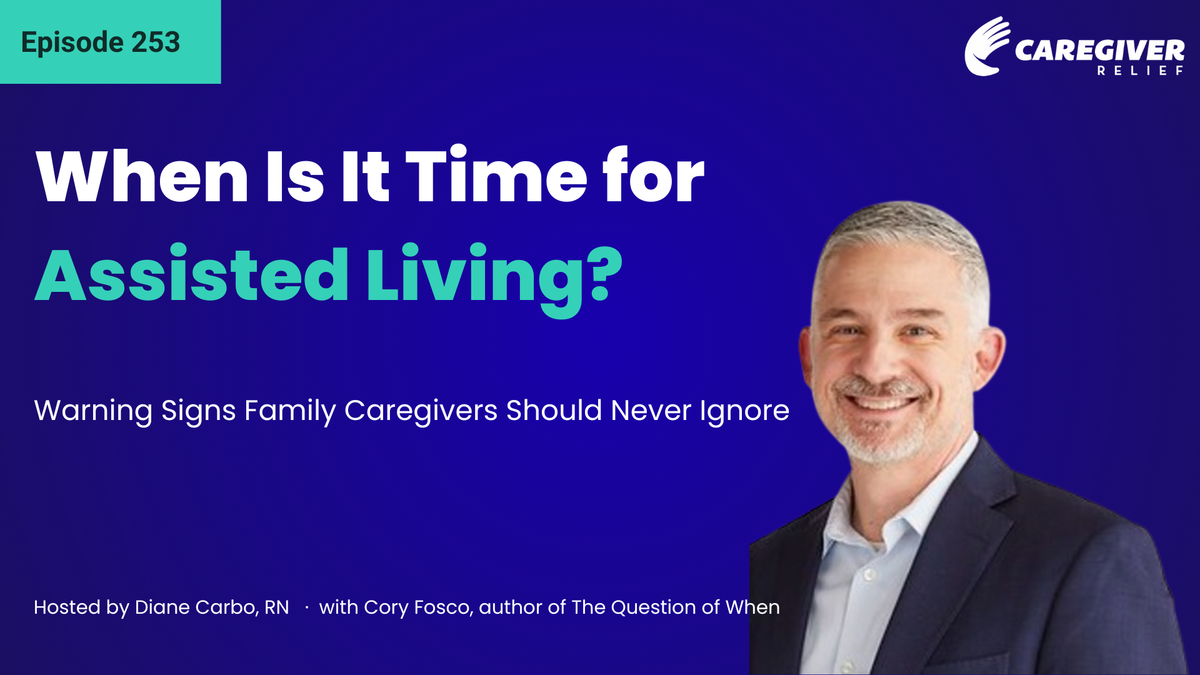
In this episode of the Caregiver Relief Podcast, host Diane Carbo, RN, sits down with Cory Fosco, a long-term care expert with over 30 years of experience and author of The Question of When: A Practical Guide to Knowing When It's Time for Assisted Living, Memory Care, or Skilled Nursing.
Together, they break down the critical warning signs every family caregiver needs to know, how to navigate complex Medicare/Medicaid coverage, and why making a placement decision is an extension of care—not a failure! 💡✨
🎙️ Episode Highlights & key Takeaways
- 🚨 Early Physical & Cognitive Warning Signs: Learn how repeating conversations, missing meals, medication errors, or getting lost on routine trips signal that it's time to seek extra help.
- ⚠️ Caregiver Burnout Metrics: Shockingly, 63% of caregivers become seriously ill or pass away before the person they care for due to chronic stress. Protecting your own health is essential! 🩺💔
- 🏥 Unsafe Discharges & 72-Hour Crises: Why current Medicare reimbursement changes and shorter rehabilitation stays are leaving families unsupported after hospital stays—and how to protect your loved one.
- 🤝 Compassionate Deception & Memory Care: Tips on how trained memory care staff handle agitation and cognitive decline through empathy rather than re-traumatizing loved ones.
- 💬 Starting the Conversation Early: How to approach placement conversations gently before emotions, guilt, and emergency situations take over.

📋 Podcast Outline & Timestamps
- Introduction by host Diane Carbo, RN: The painful question of knowing "when it's time".
- Sponsor & Caregiver Relief Community information.
- Welcome Cory Fosco & the inspiration behind The Question of When.
- Unsafe discharges to home and why "waiting is not the same as loving".
- Key warning signs: Cognitive red flags, nutrition issues, and caregiver isolation.
- Workplace impact & utilizing Employee Assistance Programs (EAPs).
- Breaking down care levels: Assisted Living vs. Memory Care vs. Skilled Nursing.
- The reality of Medicare coverage, copays, and the 72-hour discharge crisis.
- Common mistakes families make under pressure & how to tour facilities properly 🔍.
- Overcoming guilt and starting placement conversations before a crisis hits.
- One crucial piece of advice: Building a strong foundation early 🏗️.
- Where to find Cory Fosco’s book and accessible resources 📚.

🔗 Guest & Resource Links
- 🌐 Cory Fosco's Website: coryfosco.com (Access free checklists, book links, Braille/NLS formats, and resources)
Podcast Episode Transcript
Diane: Welcome to the Caregiver Relief Podcast. I'm Diane Carbo, RN, your host today. One of the most painful questions family caregivers face is this: how do I know when it's time? Time for assisted living, time for memory care, time for skilled nursing. How do I know when it's time to admit that caring for someone safely at home may no longer be possible without risking the health and safety of everyone involved?
Many caregivers wait until crisis forces the decision after a fall, a wandering episode, a hospitalization, an unsafe discharge, medication mistake, or complete caregiver exhaustion. Today's guest, Cory Fosco, has spent more than three decades working in long-term care, skilled nursing, admissions, discharge planning, and family support.
He is the author of The Question of When: A Practical Guide to Knowing When It's Time for Assisted Living, Memory Care, or Skilled Nursing. Today, we're going to discuss the warning signs families should not ignore, the emotional guilt surrounding placement decisions, what Medicare really covers, and why timing matters more than most families realize.
This is an important conversation for every family caregiver trying to balance love, safety, exhaustion, and reality.
Diane: Cory, thank you so much for joining us today. This is such a timely book with, like we were talking about before we started, with the Boomers hitting 80 in the next few years, and the youngest of the Boomers hitting 65.
This has never been a more timely topic.
Cory: Yeah, thanks for having me. as I was telling you, before we started here, I've got bookends. My mom turned, 80 this year, so she was born in '46, and my oldest brother was, born in '64. So I see it all the time. I see it with friends, with family, and, it was about time that,the book came out, and, I'm excited that it's out.
Diane: Well, what inspired you to write The Question of When?
Cory: Yeah, so as you mentioned, I've been in the industry for 34 years. So it was the industry I started right out of, university. I went to Loyola University in Chicago. It's where I'm from. And, my first job in 1992 was as an outreach worker, for the Mesa Senior Center in Arizona.
And so that was my first opportunity to understand. What I did was I went to people's homes, and I helped set up caregiving services, home delivered meals, homemaker services. I started to understand, that there were, The needs of this vulnerable population, and not everybody knew that there were services that were available.
So I started to understand what advocacy meant. Then I went into skilled nursing, and I was a social worker. Wanted to do admissions and marketing. And it was back then, in about 1997 that I was seeing families have the same issue, the struggle of when do I make this decision.
Diane: Yeah.
Cory: And I had it on the spectrum with that as well.
It was those families that you mentioned, a 72-hour decision, a fall, a fracture, some kind of, urgent situation that pushed the decision. But then there were those who were starting to make a placement or at least get information. And there was everything else in between. And so I said in 1997, "The, the thing I'm always seeing is the question of when."
And I started to write the book back then, and, it only took a little while. I raised two children. They're both out of the house. They're adults now. Got my degrees in creative writing, stayed in the industry. The phone never stopped ringing. I'm on the healthcare technology side. But, I just, I always knew, that this book was, necessary, to help people build that foundation.
I love that the phone calls still happen.
Diane: Yeah.
Cory: But now I can go, "Here, read this." This book.
Diane: Yes. Well, you know, Cory, when you talked about unsafe discharges to home I don't know if you're aware of this, but we are seeing an unprecedented number of unsafe discharges to home than ever before.
Reim- Medicare reimbursement has cut the reimbursements for therapies, for skilled care and rehab so low that facilities get a higher level of reimbursement not providing care.
Cory: That's right. Yeah.
Diane: And
Cory: And that's the frustrating part, right?
Diane: Yeah. Oh, yes. and so the family caregiver is now doing, the responsibilities of the family caregiver and the expectations of them is to now provide services once provided by healthcare providers, and it's just not possible.
Cory: No.
Diane: And it, So
Cory: Yeah, not
Diane: at all ... it just isn't. And I, so that's why when you,wrote this book, I was like, "Oh my, this is really a really important timely topic because families wait way too long before discussing assisted living or memory care off options. You say waiting is not the same as loving. I like that. What do you mean by that?
Cory: Yeah. I think the way I look at that is, people are gonna push themselves to the limit. "I'm gonna wait as long as I possibly can to make this decision," because they see that making the decision is potentially failing their loved one, failing the one that they're providing care for.
When in fact, it's the complete opposite. the way I like to describe it is, when you make that placement decision, you're extending the caregiving circle. You're now bringing... You, 'cause you're not gonna... You don't admit the person or have the person, move into a assisted living or memory care and then walk away.
It's not like you're never gonna go visit anymore.
Diane: Exactly.
Cory: You're not gonna be there, every day or several times a week. it's that you're extending to others who have maybe more skills to do it and provide that relief to the caregiver so that they can take a breath. And when I say waiting is not the same as loving, it's don't wait for the last minute.
Actually take the time to make to build that foundation.
Diane: Yes.
Cory: Make the decision sooner rather than later because on the other end, oftentimes you'll see that the person you're providing care for might get some relief themselves too. Get that extra activities, the extra stimulation, et cetera.
Diane: I don't know if you're aware of this, Cory, but the statistics for the family caregiver are very grim.
Cory: They are.
Diane: Oh, yeah. And 63% of them become seriously ill from the stress of caregiving, or they even die before the person they're caring for passes. And that's why, and now it we're gonna have 100% with the way the reimbursement.
I'm, I just tell my listeners that we have the illusion of healthcare. We don't really have healthcare anymore because the family caregiver is the single largest pillar of the long-term care industry, and they are expected to do tasks and things that are not sustainable.
It's just not possible. So that's why it's really important. So can you tell me what some of, are the earliest warning signs that a loved one may no longer be safe living independently or at home?
Cory: Yeah. and there's the physical as well as the, the cognitive signs.
Diane: Yeah.
Cory: And I think a lot of us who are in this industry focus on the cognitive signs because those are the ones sometimes that are even more stressful because of
Diane: Yeah.
Cory: the fear of the person, maybe exhibiting some wandering or getting tripped up. and so some of the signs that I see is if you're having that same, similar or same conversation more than once.
You know a conversation mentioned at breakfast, then again at lunch. I do that oftentimes, but if that happens on a more frequent basis, then you gotta start paying attention a little bit, more to that. Or, I've often heard about somebody, going to the grocery store who maybe they did get an early Alzheimer's or memory care diagnosis, but they're still trying to hold onto that independence. The keys haven't been taken away, and then they get tripped up on the way back from the grocery store, and then they, I've lost my way."
So it's those daily tasks. the other things you have to look at are they, taking medications safely? And if not, how do you fix that? 'Cause that's an early warning sign. how is their nutrition? Are they losing weight? Are they skipping meals? Like when I was setting up home delivered meals, one of my, at 22 years old, one of the, the signs that I was trained to look for is the meals that we're delivering Monday through Friday, are they still stacked up in the, person's home?
Have they been touched? Have they been eaten? Are they, are they touched at all? So it's all those things. And then the final thing that I would say from that perspective is the caregiver's health Right? And I also often talk about how the world gets smaller and smaller.
The caregivers are making up excuses. They're not socializing with friends. If I, if you played golf, three times a week and you're not doing that anymore, if your health is starting to decline, your weight is starting to go down, those are signs that might not be present in the person that's getting the care.
Diane: Yes.
Cory: But the person providing the care is doing that as well. So it, there
Diane: So many are feeling a need to leave the, their employment, their place of work.
Cory: That's right. Yeah.
Diane: You know, and many of them can't afford to do that, and that's a real big issue as well. that's when they should consider, and I know this is hard.
People do not want to place their loved one in any kind of alternative setting. the thing is, their role is not gonna change in the sense of they're still gonna be advocating.
Cory: That's right.
Diane: And they're still going to be monitoring their loved one. But they're not going to have to do all the hands on care every day and have the stress of worrying.
A perfect example, I had a client call me yesterday and say, "What do I do? my father's started wandering. I've got the house all locked up, and my neighbor just came over and said, 'Dad's walking down the street.'" I went, "Oh my God." and here she's quit her job, and we had to have a come to Jesus meeting, Yeah, it's tough. You really have to be careful here because, the heat can really destroy a senior really fast, but then the winter can too. So what ... She said, "I had monitors in the rooms. I had" "the door lock," but he was a Houdini, and, there's some long-term memory things that they can still undo things. So her, her tools that she was using weren't effective enough to keep him safe.
Cory: Yeah, you bring up the employment issue. And that's actually one of the groups of, professionals that I've been trying to coordinate with are employee assistance programs.
Diane: Yes.
Cory: If we, you know, with your podcast and some of your work or with my book, if we could get to those employee assistance programs and get to them before they make the decision that, "I have to leave my employment"
Diane: Yes
Cory: So that I can be the primary caregiver," and provide them with the extra support
Diane: Yeah
Cory: and provide them with the extra knowledge that maybe they could
Diane: Yeah
Cory: skip that part.
Diane: Yeah.
Cory: 'Cause like you said, they're gonna continue being the advocate.
Diane: Yes.
Cory: So those employee assistance programs that are out there probably with every large organization, small to medium as well.
Diane: Yes.
Cory: Because what do they wanna do? They wanna keep their employees i- working work for them, right? And
Diane: And not
Cory: lose them
Diane: yes. And the working family caregiver, they lose productivity.
They have a big impact, and most of them don't even tell their employer that they have, that they are taking care of a loved one at home. Which is one of the biggest mistakes because employers are desperate to retain good employees.
And they are, and they're finally getting to a point where they have got to do something.
They've got to be open to helping them. So if an employee comes in and approaches them, the HR person should be able to say, "Hey, let's work with this. Let's help you." But also have somebody, offer that book, your book. To say, "Here's some options. Maybe we can help you make a decision."
Because, and, a lot of them, they balk, but then when they're doing the sandwich generation, they're taking care of, their children. They're taking care of their parent. They're taking, trying to work at the same time, managing two households often. It's just too much, and it's just not sustainable, and things get missed, and things get lost, and crisis occurs.
Cory: Yeah. Crisis occurs.
Diane: Yep.
Cory: And you know what it is, that they're afraid to say to their employer that they're struggling.
Diane: Yes.
Cory: and or they're doing this extra work. there's a bit of shame there.
Diane Yeah.
Cory: There absolutely is. And quite frankly, yeah, they're getting, eliminating that shame-
Diane: Yes
Cory: to see that there's support available. Just open it's that part of the thing I want to advocate in the work that you do as well is just have the conversation. Whether you're having that conversation with your family
Diane: Yes
Cory: you can have the conversation with your employer if you're still working, right?
Yeah.
Diane: Absolutely. Yeah. And that's one of the biggest challenges that I try to make my listeners aware of. You gotta have those conversations. You gotta have, you have to be realistic because I'm telling you, your health is at risk. And every year, Corey, I lose two to three caregivers to serious illness or death because they've neglected their own health.
They've neglected their own, ability for outside help because they've, focused just on taking care of their loved one. So all their outside relationships have dried up. And they're isolated. They feel alone and helpless, and they, don't eat right. They don't exercise.
They're not getting sleep. There's so many things that go wrong. And if they would just take a step back and look at, well, maybe I need to have an alternative placement.
Cory: Yeah. They need to have options.
Diane: Yes, they, yes. At least consider them. That's right. You know, learn about them. now can you explain the difference between assisted living, memory care, and skilled nursing?
Cory: I can, yeah. and I think some of that has to do both with physical needs that has to do with cognitive needs as well. And one of the things that we need to talk about is the investment as well, how those three different levels of care get paid for.
Diane: Yes.
Cory: Right?
Diane: Oh, yes. yeah. Let's talk about that.
Cory: and it doesn't you know, those things don't always happen in a row either.
Diane: Yes.
Cory: It's not like somebody goes, "Okay, now it's assisted living." Next week it's memory care.
Diane: Yeah.
Cory: Next week it's skilled nursing.
Diane: Yeah.
Cory: And even within skilled nursing, there's a couple different levels of care as well.
Diane: Yes, exactly.
Cory: So again, me, you and I, we understand these things because we're part of this industry, but there's so much complexity to it. So when you look at, If you start with the, what we'd call the lowest level of care, because there's actually some levels of care before that too, before assisted living.
If you look at independent living and home care services. But, assisted living is where, somebody needs additional assistance with activities of daily living. Bathing, dressing, activities, et cetera. Maybe medication, management as well. But In the instance of, assisted living that there isn't memory care, concerns involved they're still active, within the community.
They're participating in the activities, but they just need that extra assistance, and that's typically covered by private pay funds, and by maybe even long-term care insurance if somebody has a long-term care insurance policy. Medicare does not pay for assisted living.
Diane: Yeah.
Cory: If you move into then memory care, that's when you start looking at somebody with a cognitive decline, whether that be an early stage diagnosis or somebody in the middle or late stage. And memory care can be a unit within an assisted living community. It could be its own community as well.
And even some skilled nursing facilities might have a separate higher level memory care unit. but what that's really catering to is somebody with a cognitive impairment, and typically again, those later, middle or later stages, somebody who might have elopement concerns or wandering. I remember one of the first facilities I worked in, we had a secure unit.
Back even in the '90s and before that, there, people would call them locked unit. We don't call them locked units. They're secure because you wanna keep people safe. But in that environment, people are free to wander around. People are free to roam.
Diane: Yeah.
Cory: But the great part of a memory care unit isn't just about it's called one.
It's got the right staff. It's got educated and skilled staff to be able to provide those extra, parts of, or needs for those, residents, because somebody might have an agitated day, and they're gonna need to know how to manage those, that person's, concerns for that day. They also are gonna you know, it's living in their world for somebody who's got memory care.
I remember early on too where somebody had forgotten that their spouse had passed away. What Yeah. "Where is my husband? Is my husband coming?" And if you told them, "Oh, don't you remember your husband died?" They're living through that trauma every single time you see them.
Diane: Like they, it was the first time they ever heard it.
Cory: Yeah, and so if you, it's not lying to them. and the staff need to understand the differences for that. And so providing that support and saying It's compassionate
Diane: deception compassion.
Cory: That's right. Yeah. Yeah, and saying, "Oh, he'll be here at 2:00." that'll give them the calm and relief that they need, and might ask you 10 minutes later the same question.
But again, in memory care, it's really keeping the, the resident safe. It's keeping them active with activities. It's keeping them structured. And, again, as far as payment is concerned, that is typically gonna be covered by private pay funds, maybe a long-term care insurance. There are some states that do have some, Medicaid funds for, assisted living, but that's very, very specific and very few.
And if somebody has a VA, policy that, or benefit, that might be helping them as well. Then you transfer into skilled nursing facilities. For the, the acute care where somebody goes into a hospital with an urgent need and maybe needs rehabilitation, that's where Medicare kicks in.
It's after a three-day hospitalization, and it's very specific to, criteria that Medicare's gonna require. and I go into all of that in, in the book as well. But that's typically reserved for somebody who just needs short-term rehabilitation, and the, intention is for that person to return into the community, or if once they're in the place that they might decide, oh, they might need to go to assisted living memory care, et cetera.
And then there are skilled nursing, excuse me, long-term care within a skilled nursing facility where that could be covered under Medicaid, as well as private pay funds. But then that's somebody who just can't go home, needs a higher level of care than would be required in an assisted living community.
Maybe they have incontinence, maybe they have just some extra physical needs. and that is typically going to be, long-term as well. That, they're not necessarily going to be returning home.
Diane: Well, Medicare has moved to a cost sharing platform, and that means patients are going to have to pay more out of pocket for the services that they need or whatever.
A perfect example, I have had a client who had a Medicare Advantage plan and was told her copay for, rehab or skilled care was going to be 200 to $400 a day. So the, who can, who can pay that money out of their pocket? It's just not sustainable. And what I'm seeing is that with traditional Medicare, the facilities, are, the rehab and the skilled care units are actually keeping a patient for 20 days and sending them home.
And, you know, we had the ill that's why I say we had the illusion of healthcare because while we used to have, a 100 days of coverage, we still do, but it's highly unlikely that you're going to get that 100 days. In fact, one of the things that, is occurring in the industry right now is, people are going home, with, Medicare Advantage between the 11th and 14th day.
We have a big crisis here because, they've also cut home care benefits, and one of the things that they no longer cover is a, a nurse's visit to the home. Which is, was the last place that, the family caregiver would have some sort of support.
They would have somebody assess their their loved one. They would do education on meds and help them with treatments and stuff. Yeah. Because that's no longer reimbursed, it's facilities, the nursing homes or the home care agencies aren't providing that care.
Cory: Yeah, yeah. it's changing.
Diane: And we're really in a trouble.
So that's why I'm bringing up, this up because there now is a 72-hour discharge crisis families face after hospitalizations, more than they ever did before.
Cory: Yeah. and the other thing, so I know a lot of great operators. Amazing operators across the country. And, one of the things I also talk about is value-based care.
I'm not sure if that's something your listeners are familiar with. But that's a shift to, really focusing on quality outcomes and finding those providers that are going to focus on what we like to call the length of need versus the length of stay, which is what you were referring to on those 11 to 14 days.
So if we can help our, our, operators show the Medicare Advantage plans by allowing somebody to stay an extra five days, seven days, whatever the number might be, they're not going to re-hospitalize if you send them home with or without home care services. Because that's the loop that patients get in, in, into.
And that's the vicious cycle that they get into where they have that, that fall, they go into a skilled nursing facility for, rehabilitation. That's not a guaranteed 100 days like you said. maybe they discharge after X amount of time, go back home. And if they're not getting the proper care back home or if they were discharged too early, they're going to go right back into the hospital, maybe then go right back into the skilled nursing facility, and that's not good for the caregiver, and it certainly isn't good, good for the patient.
So this vicious cycle has to stop.
Diane: Well, it's also not good for the hospitals because if a patient goes in the, back into the hospital within a 72-hour period they don't get a reimbursement.
Cory: That's right.
Diane: They, you know, so they put the patient on observation status
Cory: Yeah, same boat.
Diane: Which we're still seeing, which means they al- after three, they're not getting their three-day overnight stay in the hospital again because the hospital's trying to function with their finances the way they do.
Cory: Yeah.
Diane: So they're not, they don't qualify for going to skilled care or rehab.
I mean, there's so many things. So when I hear value-based, I have to tell you, not in today's world.
Cory: Yeah.
Diane: It's just not happening. I'm sorry. I'm open about that. I've been a nurse for 54 years.
Cory: Yeah.
Diane: And what I'm seeing is astonishing me and it's frightening me. I have family, home care companies, telling me what they're seeing when patients are discharged, and we really are in a public health crisis right now.
It is a crisis. And it's only going to get worse. And that's why I think that your book is very timely, because patients can't, families can't afford The 200 to $400 a day co-pays.
Cory: Oh, no.
Diane: They can't afford... and the, you know, if they're going home and they're not having a nursing visit, which I have witnessed myself, on several cases that needed, a nurse involved, we're in trouble because they're going to go back to the hospital, and the hospital is going to try to put them in a situation that families have to be, noticed, or notified
And be aware of what's going on. They have to check what status. There's so much that you have to do to protect yourself nowadays, but, it's very technical.
Cory: And they might not know that they need that protection. They might not have the knowledge. They might not have the terminology. Or the experience really is what it comes down to.
Diane: Yes.
Cory: To know what questions to ask.
Diane: Yeah.
Cory: To know what statements to make.
Diane: Yes.
Cory: And to know about... they're gonna be in their own, circle of that, their advocacy, right? We need to educate and let them know that there are things that they can push for.
There are questions they should be asking.
Diane: Yes.
Cory: And, it's a lot of information to take in, that's for sure.
Diane: Oh, it is, Corey. What mistakes do families make when trying to choose a facility under pressure? And boy, do I know this one.
Cory: Yeah, yeah. And that's the thing. So what often do they have, do they do?
It's close to my home. The doctor said to go there. And, they were given a piece of paper by the discharge planner that had a list of facilities on it. That's mistake number one. That list, I literally just had a friend who went through this. She was in a hospital. She needed to go into a skilled nursing facility.
Thankfully, they picked up the phone and called me. I helped them get into the right facility, but then they got a seven-page document on, seven pages of all these places to go to, and they were overwhelmed.
Diane: Overwhelmed, yes.
Cory: So the, the mistakes they make is, "I have to make this decision right now because that's what the hospital's saying," because the hospital's all about throughput. And one of the things is just making that decision based on the piece of paper
Diane: Yep
Cory: or based on the fact that it's close to my home or the doctor said to go there. The first thing they should consider doing is Taking a tour. If they have the time, which they should make the time, go to at least two or three facilities
Diane: Yes
Cory: and take a tour, and ask questions, and make sure, activities are going on. And what does it smell like? What does it look like? If... Then don't just pick, don't just pick based on a really nice lobby or a nice, parking lot.
Diane: Exactly.
Cory: Those are other And Because we're just, we're bound to make quick decisions. We're bound to go
Diane: Yeah
Cory: I just want to get through this right now. And this is what I'm... This is the decision I'll make. Sorry, I cut you off. You were gonna say something.
Diane: No, I just want to say, you need to go unannounced because you want to see things. And I know facilities don't like that, but catch them off guard. That's really important. And always look at their, what they're eating. One of the, the big It's a big part no matter what, in every setting, you can have the best food in the world, and the seniors will complain, and, "Oh, this wasn't right.
This is too much." But, you know, if you have a facility, I encourage people to sit and have, ask to have a meal.
Cory: Of course.
Diane: If you can. Yes, yes, yes. You know? Yeah. Of course, they're, like, feeling stressed, and they don't want to. But I'll tell you what if you have a decent meal, and they're willing to provide it, that's a, an indication that they care.
Cory: They're proud, right? And then they don't want to look at, Nursing Home Compare to look at the ratings and the what, the scores that they've received. Again, that's what you and I are for, is to provide that that level of support and education, and unpack what those star ratings mean, and what the, inspections mean.
But ultimately, if they're doing this on their own, they want to ask things about staffing, and they want to ask about evenings and weekends, and they want to make sure that... 'Cause they're going there for therapy. What is, what kind of therapy is the person gonna get, and how often are they gonna get that therapy?
As well as, making sure that the right level of support will be there and that you can participate. There will be care conferences that they would participate in. One of the things I always recommend is asking if there's a family portal that they can get access to.
Diane: Yes.
Cory: Because everybody's using
Diane: Yeah
Cory: an electronic medical record.
Diane: Yeah.
Cory: Can I see how they're progressing along the way? And the one thing people forget, and I remember this, that I was always grateful when people asked this, ask for a reference. Ask to speak with a family who's either currently staying there
Diane: Yes
Cory: or has already discharged from there. We're gonna look at Google maybe. We're gonna look at Yelp maybe. And those are, those are okay. Those are great places to go for a restaurant or maybe a hotel, but you're you might not possibly get the right... that's a, an anonymous level of a review.
Like, talk to a family member. And if they say, "No, I'm sorry, you can't do that," that might be a place you want to leave and not consider staying there.
Diane: and that's important. When you're talking about what, how much therapy and, Yeah ...there's a movement towards group physical therapy versus individual.
There's a move to, just PTAs with an oversight of a PT. And, this, all that makes a difference. That's why they're, they try to do group therapy. It's not possible when you're at that with that level of care that's needed.
Cory: Yeah.
Diane: It's just not. But the facilities are trying to cut their costs.
They're trying to meet within the guidelines that Medicare has set, and, it's struggling right now because again, it's people are not getting the quality of care or any kind of value based care at all that I can see. That's, and I'm just an old nurse who says I can't believe what's happening here."
I'm just shocked.
Cory: The challenge we have is we have a staffing crisis as well. S nursing staffing crisis, a probably a therapy staffing crisis as well, and to get those quality staff, is a challenge. and so to deal with that.
Diane: Well, the other thing is we don't have a shortage of any of those. We just have a shortage of people who won't work in those conditions.
Cory: Yeah, I know.
Diane: That's in the hospital, wherever. I agree. What's happening right now is the reimbursement is so low for the, the skilled facilities, nursing homes are closing.
Cory: Yes.
Diane: It's an unprecedented number of Nurses of community hospitals and nursing homes closing at a time when we're going to have the biggest influx of seniors that we have ever seen, and those beds are gonna be needed.
But we also have a shortage of doctors and a shortage of specialists because doctors are making less now than they were 20 years ago because of the reimbursement. And the, government hoops that they have to jump through, they need triple the amount of staff. So it, we are really in a crisis.
But, I love the book. now how do caregivers start placement conversation earlier before emotions and crisis take over?
Cory: Yeah, I think this is a big part. And this could be for again, it, the, a lot of times people think it's home Or facility or community.
Diane: Yeah.
Cory: Or like they- just even starting to open up the conversation.
"I've noticed that some things were happening," or, "I've noticed that this is happening." and just having this, "I'm not making we're not making any decisions. We're just gonna have a conversation." That's the easiest way to start. Rather than saying, "Sit down. We're all stressed out right now. We have to make this decision right now."
Which when our stress level's high
Diane: Yep
Cory: that's the inclination that we wanna have is to just get it done and let's go. Take a step back, take a breath, and say, "Can we have a can we sit down? Can we just talk about the options?" Yeah. Again, it doesn't have to be we're making a decision today.
But if you're having that gentle conversation, and then three weeks later you're having the same gentle conversation, and then three weeks later you're having the same gentle conversation, and I'm sure the stress has actually gone up, it's not as gentle anymore. That's when you start getting into rushed or, arguments.
And that's not when a conversation will happen. guilt plays a lot into
Diane: Yes
Cory: even opening the conversation. And at the end of the day, I don't even think having the conversation or making the placement decision or the care decision takes away the guilt.
Diane: Yeah.
Cory: But it just changes the landscape of it.
And maybe you'll eventually change from guilt to calm, to I see what's happening now.
And, you have to come to, whether you're making a decision to get more care in the home, maybe you're doing some respite care, which is a great way to test out, a placement decision.
Or you're actually going into a community, you have to come to, "I made the decision."
Diane: Yeah.
Cory: "They're happier there, and I didn't fail." Placement is not a failure.
Diane: Exactly.
Cory: Placement is absolutely not a failure.
Diane: Yes.
Cory: It's going back to what I said earlier. It's extending the care, loop. It's extending the care, the circle of care.
And all you have to do is have that initial conversation. And likely, you might have to have it, if you've got siblings, you might have to have a couple of those conversations with your siblings.
Diane: Yeah.
Cory: 'Cause you always got the ones who's local and taking care of, mom or dad. You got one who's 3,000 miles away who's like
Diane: Yep
Cory: "I just saw... When I was in town last week, everything was fine." and you got to find that middle ground.
Diane: Yeah. Well, one of the things I tell my listeners all the time is, decisions made on emotions are always poor decisions.
Cory: Oh, that's great.
Diane: And, it is. you just you know, emotions, there's no logic involved in it at all.
So I like your approach that soft little approaches
Cory: Yeah
Diane: on a regular basis will get you to a point where, you know... And the other thing I tell people is guilt is a wasted emotion. I know we all have it with shame and guilt, but the other thing about guilt and shame is it negates all the good we do. and, why do you wanna do that to yourself?
You're, you have good intentions and you wanna help, but you wanna help in the best way that's good for both of you.
Cory: Yeah. Yeah. That's right. Yeah.
Diane: I encourage my listeners and my caregivers to create a circle of care or a care team, approach.
Cory: Sure.
Diane: So they have people help with, things around.
And I think that if they would do that, they would not only be able to, see what's going on from a different perspective from other people. It's not hands-on care for the caregiver or for the care recipient, but it's, people coming in to help with activities or maybe do shopping or cleaning
Cory: Yes
Diane: or bringing food.
Cory: That's right.
Diane: But their observations of what's being seen, 'cause I also encourage everybody to have a friend, a caregiver who, the overseer of the caregiver so that
Cory: Yeah
Diane: the caregiver has someone that's saying, "Hey. You need a break. You need to do this. You, y- let somebody else take over."
Cory: Somebody you trust that's gonna tell you
Diane: Yes
Cory: now is the you, now is the time for you to take a break.
Diane: Yes.
Cory: Now is the time.
Diane: Yes.
Cory: You need to let go.
Diane: Yes.
Cory: And they're gonna not fight, 'cause
Diane: Yes
Cory: that's when they say, "I'm fine. I'm fine. I'm fine."
Diane: Like, oh, they all do. They're all, you know hey, I'm a people pleaser.
I, you know I've been there, I've done that, Hey, professionally and personally, I've been a caregiver, so
Cory: Yeah
Diane: I understand that. And there's just a time when you just can't do it. It's not
Cory: Yeah
Diane: realistic and, it could lead to severe harm for you. The consequences of the chronic stress of caregiving can be felt as long as six years after a caregiving journey is over.
Cory: Oh. I've not heard that stat. Oh, wow.
Diane: Yes, yes. So that's really important to say, hey, you're done with your caregiving journey, and all, and I can't tell you how many end up in the hospital or I have horror stories I can share with you. But, I just feel sad because I have caregivers that they thought their journey was over, and then they're dealing with health issues, and there's nobody to take care of them.
Some of them have no place to live because they were living with the person they were taking care of, and their, their health, their friendships, everything around them is not there anymore for them. So it's really challenging.
Cory: Yeah.
Diane: So. Now, Corey, if you could give caregivers one piece of advice before the crisis happens, what would it be?
Cory: Yeah, I would say it's build a foundation. I often say we put a lot of effort, and I mentioned it a little bit, we put a lot of effort into, going to a restaurant or vacation planning or like just, the amount of hours we put into, to those kinds of activities.
Diane: Yeah.
Cory: But then the amount of time we don't put into building because what you're doing is building a foundation.
Diane: Yep.
Cory: So by building a foundation for, again, whether it's for home care or anything else in between, those bridge options all the way up to a placement decision, the earlier you start building that foundation even if you're faced halfway through that foundation building with that 72-hour crisis, you're a little bit more educated than you were if you just waited till the last minute
Diane: Yeah
Cory: to then start building that foundation. Because what a lot of people do is start building folders, and those folders are filled with brochures. And those brochures
Diane: Yeah
Cory: are either outdated or something changes. And so you have to continually refresh that foundation
Diane: Yeah
Cory: and make sure that it's there and, You're not caught off guard then.
You're not going to answer all the questions. when you actually finally make a placement decision, and I was telling somebody about this earlier, is it's almost like when you're, when you, or maybe if you've got kids, were making a decision to go to a university. you had to go out and you had to take tours, and you had to figure out which one feels comfortable.
The most, this, this pair of pants or this jacket
Diane: Sure
Cory: feels the most comfortable. And, at the end of the day, the, that's building a foundation as well. So there's a lot of things that I can reference that we build these foundations to. So the one thing that they could do is start to build that foundation, listen to podcasts, read books, go to seminars, or start building a relationship with the community as well.
Maybe even start if you've got time. Listen, I'm saying a caregiver who's 24/7 with somebody that they're caring for, go volunteer somewhere. That might not be possible. But
Diane: Yeah
Cory: if you start establishing a relationship with a place that maybe is where your loved one might go
Diane: Yeah
Cory: that decision will probably be a little bit easier down the line as well.
Diane: Yeah. And you know what? I encourage the family caregiver, do, like you say, do the research. If you want to be, if you're looking for an assisted living in the future, maybe not at that moment, but do it while you have time, while you while your loved one's still good.
Check it out, but, and follow up on a regular basis
Cory: That's right. That's right
Diane: at different places, like the nursing homes around you. And go at different times, and, check it out and see, because what they're doing, are they getting care after dinner?
Cory: Yeah.
Diane: Is everybody sitting around watching TV?
That's right. or show up in the morning, and do it at times when, before so you know what you're looking for and get comfortable with making a decision.
Cory: The other thing, I know you said just one bit of information, but, or advice. The other one would be, Make sure you're having the conversation with the person who's, receiving the care
Diane: Yes
Cory: as early as possible. you reminded me of that when-
Diane: Yes
Cory: when you made a comment. It's because when you can honor their wishes that they
Diane: Yeah
Cory: verbalize to you
Diane: Yeah
Cory: and said, "This is important to me. it's really important to me that they've got services for my religion," or, "It's very important
Diane: Yes
Cory: to me that they, there's a, there's card games that I can play on a regular basis," or, "There's a garden."
Diane: Yes.
Cory: The more you can honor that
Diane: Yeah,
Cory: 100% ... the better you're going to feel as well, right?
Diane: Yeah.
Cory: You're going to feel lower guilt.
Diane: Exactly. Yeah. Exactly. Exactly. Yeah.
Diane: Cory, you've got a great book that's very timely.
How do people reach out and find you?
Cory: Yeah. The, my website is, coryfosco.com. I've got a lot of resources on coryfosco.com. There's a free checklist that's on there as well. Certainly, there's links to my book on there. It's available, in all the retailers, Amazon, Barnes & Noble, audio, as well as, and there's one thing I always like to point out.
So my wife is vision impaired. and, I made sure that it was available in braille as well.
Diane: Awesome.
Cory: And it's available free, through the, NLS and Bookshare for anybody who's vision impaired, because accessibility, even those that are vision impaired
Diane: Yes. Yeah
Cory: need those kind, this kind of information.
My website's all accessible as well. So I always bring that up because I think that's, hugely important, is to make sure that things are available.
Diane: Oh, absolutely.
Cory: Yeah.
Diane: Now, we're going to have a link to your information on
Cory: Okay, good. Yeah
Diane: The page I create. But would you spell your name so that people
Cory: Absolutely. Sure
Diane: get it right, please?
Cory: Yes. It's C-O-R-Y F-O-S-C-O. So it's F as in Frank, O, S as in Sam, C-O, coryfosco.com. Thanks for doing that, 'cause a lot of people throw an E in my name, right?
Diane: And well, that's what I was afraid of.
Cory: Yeah.
Diane: I thought
Cory: Thank you
Diane: let me... 'Cause if they're listening and they're not on the website
Cory: yeah
Diane: I want to make sure that they can find you.
Cory: Thank you. Yeah. That was great.
Diane: Yeah. thank you so much. To my family caregivers out there, you are the most important part of the caregiving equation. Without you, it all falls apart. So please learn to be gentle with yourself. Practice self-care every day because you are worth it.
Caring for a loved one can be overwhelming — but you're not alone. If you have questions, big or small, our expert team is here to help.
👉 Click here to Ask the Expert
Our Resource section can help you find the information and tools that you need. We have courses, videos, checklists, guidebooks, cheat sheets, how-to guides and more.
You can get started by clicking on the link below. We know that taking care of a loved one is hard work, but with our help you can get the support that you need.
Click here to go to Resource Section now!