Caring for a Parent With Dementia: Burnout, Guilt, and the Support Families Need with Bonnie S. Heisse - Episode 272
Caring for a parent with dementia can be exhausting and emotional. In this episode, caregiver advocate Bonnie S. Heisse joins Diane Carbo, RN to talk about burnout, guilt, and the support families need.
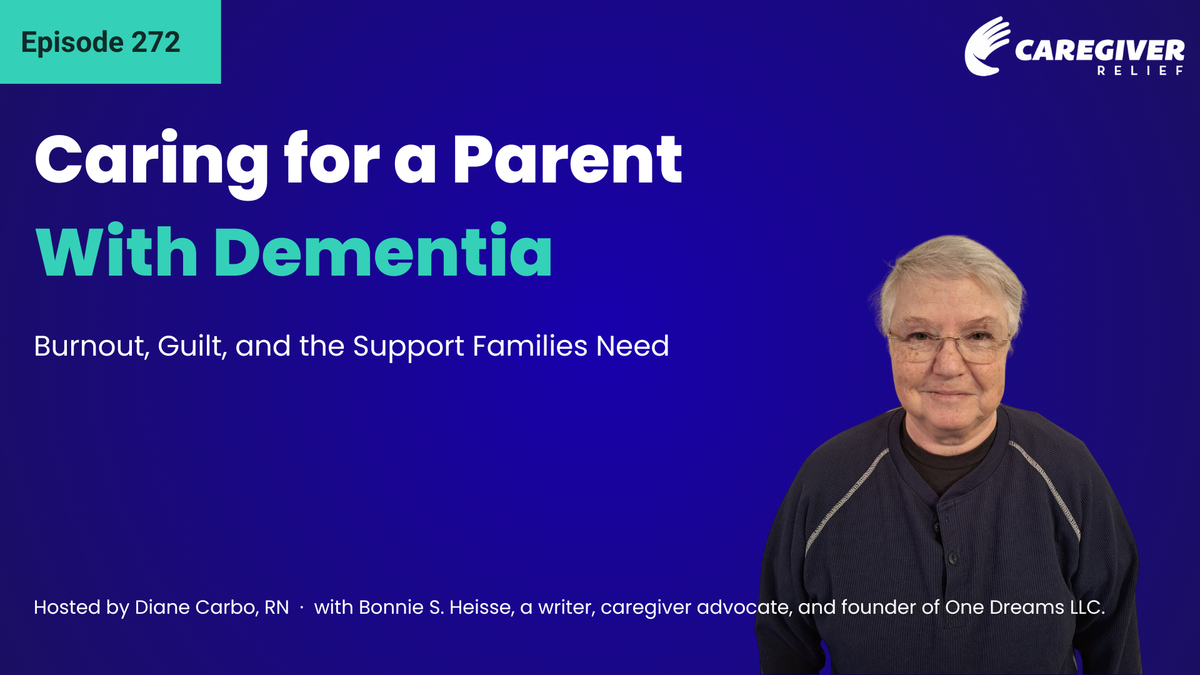
In this episode of Caregiver Relief, host Diane Carbo, RN speaks with Bonnie S. Heisse, a writer, caregiver advocate, and founder of One Dreams LLC. Bonnie is the creator of The Quiet Courage, a publication that supports family caregivers through practical resources, encouragement, and honest conversations about the realities of caregiving 🌿.
Together they talk about caring for a parent with dementia, the burnout and guilt that can come with it, and the support families truly need 💙.
🔥 What You’ll Learn in This Episode
- 👵 The Reality of Dementia Caregiving: An honest look at caring for a parent with dementia.
- 🔥 Caregiver Burnout: Why it happens and why it is so easy to miss.
- 💔 Caregiver Guilt: How to talk about the feelings many caregivers keep to themselves.
- 🤝 The Support Families Need: Practical resources and encouragement for the road ahead.
- 🌿 The Quiet Courage: Bonnie's publication for family caregivers.
📋 Episode Outline
- 🎙️ Introduction: Diane introduces the challenges of caring for a parent with dementia.
- 👤 Meet Bonnie S. Heisse: Writer, caregiver advocate, and founder of One Dreams LLC.
- 🌿 The Quiet Courage: Honest conversations about the realities of caregiving.
- 🔥 Burnout and Guilt: What caregivers feel and why it matters.
- 🤝 Support Families Need: Practical resources and encouragement.
- ✅ Key Takeaways: What to remember if you are caring for a parent with dementia.
🎧 You Are Not Alone
If you are caring for a parent with dementia, press play and share this episode with another caregiver who could use some support 💙.
Podcast Episode Transcript
Diane: Welcome to the Caregiver Relief Podcast. I'm your host, Diane Carbo, RN, and today we are going to talk about a challenging subject, caring for a patient with dementia. Caring for a patient with dementia can slowly take over every part of a person's life. Caregivers may find themselves managing medications, medical appointments, personal care, household responsibilities, financial decisions, behavioral changes, and constant worry.
At the same time, they might be trying to maintain a career, protect their relationships, manage their own health, and continue meeting the needs of the rest of their family. Too often, family caregivers are expected to carry these responsibilities without adequate training, respite care, financial assistance, or emotional support.
Many experience exhaustion, guilt, isolation, grief, and burnout, while believing they should simply try harder or do more. My guest today is Bonnie S. Heisse, a writer, a caregiver advocate, and founder of One Dreams LLC. She is the creator of The Quiet Courage, a publication that supports family caregivers through practical resources, encouragement, and honest conversations about the realities of caregiving.
Bonnie is the primary caregiver for her father, who is living with dementia. Her caregiving experience, combined with extensive caregiver research, has given her a deep understanding of the unrealistic expectations placed on families, and the changes that need to make caregiving more sustainable.
Bonnie is a retired United States Marine Corps officer, a former postal carrier, and author whose work explores caregiving, resilience, faith, and finding meaning in everyday life. Today, we will discuss caregiver burnout, guilt, isolation, financial strain, relationship changes, and the practical support families need when caring for a parent with dementia.
Diane: Bonnie, welcome, to Caregiver Relief , and thank you for your service.
Bonnie: You're welcome, and I'm glad to be here.
Diane: Oh, a Marine, you're a tough cookie, then.
Bonnie: Yeah, well, they tell me I got the trifecta, because with my, gardeners are stubborn, then I was in the military, then I was in the postal service,
Diane: Yeah, well, my dad was a letter carrier, so I understand that as well.
Bonnie: So, yeah.
Diane: Oh, God bless you for that, though. The Marines is tough. Both my boys served in the Army, so I appreciate your service. Bonnie, before we discuss the challenges of caregiving, would you tell us a little bit about your father and what your relationship with him has meant to you?
Bonnie: Over the years, when we were growing up, Dad was, because he's of that generation, because my dad is 89 years old he's of the generation where it was pretty much gender specific about what was expected, and plus his father was very much a this is the man's role, this is the female's role.
And Dad, when we were growing up, that was pretty much the way it was. Dad went to work, you know, made the money, and then Mom took care of the kids. but as we got older and stuff, he slowly started changing. We used to joke with him when he'd send, notes to us at college with, some money.
It'd be, "Dad." We'd go, Dad, you could put, love at the bottom of it." "It wouldn't hurt. Looks like a business note you're sending to us." So over the years, he's loosened up, and with, because my mom also had dementia, my dad was her primary care physician for years. we had been trying for years to get Dad to let one of us come and help him out, but he absolutely refused.
He's a very stubborn man. And finally, in 2022, he finally admitted, he said, "I can't do it on my own." So I had retired in October of 2022 from the Postal Service and moved down here with my parents in December of 2022. I helped Dad with, Mom's caregiving for nine months, and then she passed away in September of 2023, and then I've been down here ever since taking care of Dad.
And both my dad and Mom has dementia.
Diane: Yeah. That's tough, both of them. How has your role changed as your father's dementia has progressed?
Bonnie: I've taken on more responsibilities because he can't.
Diane: Yeah.
Bonnie: I mean , When I first came down here, I was just basically helping with Mom's care.
Dad was still taking care of the financial issues, of their financial issues, And her medication and his medication, and then slowly he started handing those things over to me, he was relinquishing his, partly because he was starting to realize that he was missing some stuff that was important, and that I needed to take over so that things didn't slip through the crack.
I mean, one of the first things I did when I came down here was because my dad had told my sister and I years ago that he, they had done a wills for my mom and dad. Well, after being down there a couple months realizing, yes and no. They had the paperwork, but that was as far as they'd gotten.
They hadn't done any of the... Now, my dad is a, was a planner, and he was very good about planning things. But that was, like, one of the first signs that I noticed that he was starting not
Diane: Yeah
Bonnie: to be able. and then also found out that a lot of what he was telling us about Mom wasn't all accurate.
He was just giving us little bits and pieces, but it wasn't giving us the full picture of what was going on.
Diane: He didn't want you to worry.
Bonnie: Exactly.
Diane: Oh, that's typical male of that generation. I know it well. So, now, this is one thing we could talk about for a long time, but what are some of the unrealistic expectations placed on family caregivers who are caring for a parent with dementia?
And this goes across the board for anybody caring, with a parent at all, pretty much.
Bonnie: Or even a child that they've had to take care of from, that's a special needs child.
Diane: Thank you. Yeah.
Bonnie: Special needs child or anything, a disabled child. It goes even, it cover, encompasses that. 'Cause what people don't understand is it's not a job that's turned on and off.
It's a 24/7
Diane: Yes
Bonnie: day job. There aren't
Diane: Yes
Bonnie: there aren't breaks unless you have somebody come in. And even when you have a break, sometimes your mind is still working on that stuff even when you're not there.
Diane: Exactly. Exactly. That's one thing that, that we, caregiver guilt is so strong in people. And even though they do amazing things for their family members, if they go away and have somebody else provide the care, and I see this all the time, they think all they care about and think about when they're gone is what might be happening at home.
And instead of living in the moment and enjoying maybe... A perfect example is I had a client who her, it was her daughter's first dance recital, and she had a dad at home. And he, she had someone come care for him for a few hours, literally a few hours, and all she could think about was her dad. So she left the dance recital to go home and make sure he was okay, and missed her daughter's her daughter was, she's a little girl.
She was heartbroken.
Bonnie: Right, I understand that. The one thing is that when I go away, my sister, I have a twin, my twin sister takes, my place, and I trust her with everything. So she's one of the few people that when I go away, I don't really worry about what's gonna happen. That's good. because that and I have a caregiver that comes in that I don't worry about.
Because I trust her with Dad. So and that really helps because we switched from first Dad didn't want to, Have somebody come in.
So I was like, "Eh, we need to start working you that way." So it started out as, three times a week for a couple hours. And then it started getting to the point where I was like, "Okay, I'm not getting what I need done."
So
Diane: Yeah
Bonnie: now my dad, and the other thing is, my dad, did plan well for that because he, Mom and him both have long-term care insurance.
Diane: Ah.
Bonnie: Which I don't have.
Diane: Yes.
Bonnie: A lot of people don't have. But I will tell you, it has been a blessing in disguise because it paid for all of Mom's, caregivers that came in.
There was nothing paid out of pocket. And with Dad, pretty much the same thing. And so if they have it, I don't feel guilty about using it. you need to use the
Diane: Oh, no. No, they paid into it
Bonnie: that resource. Yeah. Well, yeah, they paid into it. They paid into it for a reason. Yeah. So use that resource. It gives you a break because the three hours a day that Courtney comes in makes it so much easier for me to get things done that I couldn't get done because I was taking care of Dad. Because I'm also trying to run a business. So
Diane: Yeah
Bonnie: so that three hours doesn't seem like a lot. But believe me, it is definitely, it is, taking a massive load off of my shoulders with her comet, coming in.
And when she can't come in, I can tell the difference.
Diane: Oh, absolutely.
Bonnie: Because when a different caregiver come in, or nobody at all
Diane: Yeah
Bonnie: it makes a huge difference on how my days go.
Diane: Yes. they must have had a cost of living rider, because, one of the problems with long-term care insurance is, if you didn't get the long, the cost of living rider, which is very expensive, you get a bill or you start looking at what they were going to pay, and, if they had this 20 or 30 or 40 years ago, the rate of health, home healthcare at that time and what it is now is totally different, and you're going to get the rates if you didn't get the cost of living rates for the year that you actually purchased the product.
And that is, I've seen it so much where it's only gonna pay maybe a third of what the home care, hourly rate would be. But, you know, there are ways people can save for their health, home health care, or their retirement and long-term care without having to buy long-term care insurance.
But they need to save early, just like they do for their
Bonnie: Oh, yeah. Oh, yeah ... retirement.
Diane: Yeah. Yeah.
Bonnie: But most people don't realize that because people don't like to plan in advance. It's something you don't want to talk about.
Diane: Yep. Yep.
Bonnie: I mean, because when I first, like I've said, when I first came in and realized that Mom and Dad did not have a will
Diane: Yeah
Bonnie: that was my top priority. Because Mom had dementia, and I wanted to get it done before I had to get a doctor to say that she was still competent. Still able to do what she needed to do. Yeah. And the one smart thing I did was is that while I was doing Mom's will, I was doing Dad's stuff right next to it.
Diane: Good. Good.
Bonnie: So while I was doing Mom's medical, I was doing Dad's medical. So by the time I finished, both Mom and Dad's were done,
Diane: You were so smart because it makes life easier if you get things done ahead of time. Even, prearranged funerals is really important. I recommend it be all done early, because But,
Bonnie: see, the topic is most people don't like to talk about that.
Diane: Yes. I
Bonnie: know. It's a topic they don't like to approach
Diane: Yes. Yeah
Bonnie: with their families. And I understand why, but here's the thing, and this is one thing I've learned about it is- If I hadn't done it when I'd done it, I wouldn't have known what my mom and dad's wishes were for what they wanted, and then you have to make the choices for them.
Yeah. And you're hoping that those choices are the ones they want. So doing it early, you get what they want. Just like my mom says, "I want to be cremated." Okay, fine.
Or, you know, "I want to be buried." What whatever the thing is, but at least you know now you're honoring their wishes.
Diane: Yes. Well, you know, it's also if you have siblings, it's important that everything that they want is in writing because Lord have mercy, somebody's going to say, I don't like that. No, they should have a feeding tube. No, they should be, have, resuscitation done. We need to keep them alive for as long as possible."
And clearly in their advanced directive they said they didn't want that, and that's so important because that way you know that whatever their wishes were, you're honoring them. and if your siblings aren't happy, that's on them. But you know, this should all be discussed in a family meeting, but families are dysfunctional.
They're not going to do that.
Bonnie: Oh, yeah. I agree with that. And the thing is you're right, you're definitely right about the DNR because they both, my mom and dad both had one.
And I've already told all my siblings, I said, "They both have DNRs."
It's not going to help their quality of life.
Diane: Yeah.
Bonnie: It's going to hurt it more because of they have to do CPR, especially on my mom. She was like 80 pounds dripping wet when she passed away, so doing compressions would have pretty much crushed her and she would have been miserable. And you got to look at the quality of life, too, and that's
Diane: Absolutely
Bonnie: you know, is it a matter of quality of life or you just living life? My parents want quality of life,
Diane: Yeah. Yeah. People have a hard time with that. they want quantity but not quality sometimes. And, you know, I think it's really important. I'm very vocal about it, I don't want, I don't want anything. Do not extend my life, If something happens to me, I don't want it. And my son, who's the power of attorney, knows all of this. So it's really important because, it's just, and siblings, the ones that are always the biggest and loudest about all this are the ones that also are not contributing to providing care.
Bonnie: Oh, most definitely. That, that definitely works true in my family. Now, I will have to defend my older sister. She can't take of herself, care of herself. She has vascular dementia because she had a stroke about
Diane: God bless her.
Bonnie: about seven years ago, so she's been living with her daughter for quite some time, Okay, yeah.
Bonnie: She can't even take care of herself,
She said she wants to come and help, and I'm like, "I can't deal with two people that I have got to
Diane: Oh, no. No, you don't need more
Bonnie: " I said, I can't handle that
Diane: yes
Bonnie: responsibility,
Diane: Absolutely.
Bonnie: But there are siblings that... Now, my sister would like to do more, but unlike her, I'm retired.
She's not. She's still working.
Diane: Yeah, yeah.
Bonnie: she still works, but we got a trade-off because she takes care of my son, who's 32. He has a lot of mental health issues, so she's helping me out with that while I'm down here with Dad.
And, like, when I had my house fire, she's dealing with all of that.
Diane: Oh, my.
And how do people know... I'm going to laugh, tease you here a little bit, 'cause my dad was a twin, you know. How do they know it's not you that is interacting with them?
Bonnie: some people don't know because, like I know. I just finally just, this last trip that I made up to Manassas last weekend, I finally met my contractor.
From the fence, because Connie's been the one that's been there and talked to him. And so I finally actually met the contractor who's re-building my house.
Diane: Oh, my.
Bonnie: So he goes, "Well, I'm glad I finally met you," you know. Yeah. And he says, "I've been talking to Connie." And I said, "Yeah, well, I only come up here once, typically about once a month because of doctor's appointments and stuff."
Diane: Yeah. But I think Well, I'm glad to hear you're taking care of yourself.
Bonnie: And that's one thing, yes. One definite thing you gotta do. Because I have learned if you don't, then you can't take care of the person that you've, that you're there to help.
Diane: Amen. Amen. That's what leads me to, what are the hidden emotional, financial, and personal costs of caregiving that people outside the experience may not recognize?
Bonnie: Especially dealing with dementia
Diane: Yes
Bonnie: constantly having a slow goodbye, because they slowly lose part of themselves.
Diane: Yes.
Bonnie: You slowly see them. They change and they're not the same people that you used to know. And they have no control over that. So instead of it just being like a one goodbye when somebody just dies, it's
Diane: Yeah
Bonnie: it's a daily slowly grieving process throughout the whole thing. As far as, So that's a toll on you emotionally.
Diane: Yeah.
Bonnie: And just being responsible for somebody else's life
Diane: Yeah ...
Bonnie: and trying to give them... the one thing I've tried with my parents is to give them dignity.
Diane: Yes.
Bonnie: Because they're still a person. They deserve that dignity and respect.
Diane: Yeah. And That's very challenging
Bonnie: Oh, very ...
Diane: making them do that, yeah.
Bonnie: Very, because sometimes I think you forget as a caregiver, you concentrate on the task and not the person.
Diane: Yes. Yeah.
Bonnie: So you're just like... 'Cause I'm a very task-oriented person.
God has taught me to be a little bit more people-oriented. Which I needed because I used to say at work, "People get in my way. Get out of my way. You're in my way of doing my task."
So you have to really be a people, learn to deal with people because they are a person, and they're more important than the task.
Yeah. Yes, it's probably gonna take longer. and the other thing I do is I allow them to do what they can do, because this is one of the biggest arguments we had with my dad when he was taking care of Mom. We kept saying, "Dad, let her do what she can do, because there's gonna come a point where she cannot do it and you're gonna have to do it."
Diane: Yes.
Bonnie: But he didn't listen to us, so he ended up doing a lot of the stuff that she could have done for herself.
Diane: Those- But the words that you said to him are words of a rehab nurse, because, you know, rehab and I tell this to all my listeners out there, you don't do everything for them. I know it's hard.
It's painfully slow to watch somebody dress themselves or eat, and the spoon is shaking, and it's getting to their mouth, and they're getting little bits. But it gives them a sense of personal wellbeing and accomplishment if they do it. and they don't... And the thing is, if you create dependence, that means they'll be calling you for every little thing, and you don't want that.
The other thing with a person with dementia, if you lose the ability to do something, you will not get it back, and that's really important. So you want people to try to do as much as possible for themselves. And it's a painful process, because I know you're all in a hurry all the time and just want to get it done, but the, the truth of the matter is you're actually doing something that's really good for them and let them struggle to do stuff for themselves.
Bonnie: Yes. And as far as financial, I think that's one of the biggest thing you'll, people don't realize is that you- You take on that, because I deal with my dad's, well, I took on my mom and dad's finances not, at first not, with me not personally paying for stuff, but monitoring and making sure the bills got paid and all that stuff. Now, there are some times where it's like, okay, they're not gonna be able to. We need to do this. And
Diane: Yeah
Bonnie: and you contribute. And what people don't realize is that- Just 'cause you're not getting paid does not mean you're not working. And that's one thing about the care gift system that really bothers me, is that people are having to cut back work hours or retire early or, Well, even, there's a major epidemic about younger caregivers and what they're expected to do as far as, and I was reading a, a post on LinkedIn about how many children that are and we're not talking, we're not talking simple task.
Diane: No.
Bonnie: We're talking about, giving a diabetic person their
Diane: Insulin
Bonnie: insulin and maintaining all the medications. And we're not talking just simple stuff. We're talking stuff that they should never have to do.
Diane: Yeah. And I was a child caregiver, at well, I was a teenager, but, my mom had lung cancer and she'd never smoked a day in her life. But she had a diagnosis, and they put a thoracotomy, it's an incision, on, by their clavicle, and it empties out fluids in the lungs when it would get, they'd get full.
And I was the oldest of four. My dad worked all the time, so I was left to provide care for my mom. And her skin was burned on both sides, like severely burned from their cobalt treatments. And when the gallons of liquid came out, I felt scared and I mean, seriously frightened and hopeless and helpless.
And I know that kids are out there doing those same tasks and, it's just awful. and, it's hard. And they rarely, if ever, have any support.
Bonnie: Oh, yeah, because if, obviously, if the child is doing it
Diane: Yep
Bonnie: then the adults are obviously not in the picture or not helping.
And they're missing out on their youth, their education their, opportunities outside of all that stuff.
Diane: Yep. I felt old very early in life.
Bonnie: Oh, I believe that there's a reason why that is because
Diane: Yeah
Bonnie: you're taking on responsibilities that, as a child, should never have to
Diane: Yep
Bonnie: do.
Diane: Yep. And Yep, I saw things and then I went into nursing school, you know, My mom died. Actually, she beat the cancer and died from the complications of the treatment, and, that was devastating. But I stayed in nursing. everybody wanted me to quit, but I stayed in nursing and, I still miss my mom to this day, and that's 54 years ago.
But there is a big toll that people take, and it's not realized. In fact, the average person spends several hundred dollars a month of their own financial, finances to provide care. It might be food, it might be picking up, medications that they're on the way home. The average, and if you are a long distance caregiver, you probably are spending about $1,200 a month.
It's just you don't realize how much you're spending of your own money. 'Cause a lot of them don't have access to their parents' finances right away. And one of the things that I encourage, Bonnie, as my caregivers, is to create a, get a family caregiver contract in place so that they can say, "I can do this," and to treat it as a job.
That's the important thing. And caregivers are terrible at setting boundaries. So I encourage them to put this family caregiver contract in place where they say, "I will do this, but if you become incontinent, I don't want to provide personal care. It's too hard for me. Then we're going to have to put you in a home, or we're going to have somebody from the outside come in to help with you.
If you become sexually or aggressive, and violent and I fear for my safety or your safety, I won't be able to take care of you anymore." But there's also a way that if you are spending down to qualify for Medicaid, it's a way for a family caregiver to get paid through and it's legal, and, you can't go back to say, "Oh, retroactively I've provided all this care."
It's got to be from the time you start the agreement till they pass. But there are things or they qualify for Medicaid. But there are things and different ways a family caregiver can get paid, but it's challenging to figure that out.
Bonnie: Oh, yeah, I've been just learning as I go. Some things I learned from my mom's experience that I've been able to apply to my dad's experience.
Diane: Yes.
Bonnie: As far as financial, my dad was very insistent when I came down there that I got my name put on all of his bank accounts. And all of his stuff. That's smart.
Diane: That's just so smart.
Bonnie: And yeah, it was like, okay. I just didn't like the way he approached it. He'd go into the bank and go, "I'm dying, so I need to put her on my account."
And I'm just like, Dad, I really don't think we really need to go out, say that." But,
Diane: Hilarious. Your dad has a sense of humor.
Bonnie: He does, and I'm just like
Diane: God bless him
Bonnie: I'm like, "Dad." And of course, the, the teller would look at me, I'd go, "Just-" Just ignore that part, okay? Just, he's not dying right this moment, so we're good.
But, yeah.
Diane: Oh my God. Oh, that is... Now, I also want to talk about how caregiving affects a person's, retirement plans, their relationships, their own health and sense of identity. How, tell me about this with you, because it's obvious, you've made some major changes in your life.
Bonnie: Yeah, and they don't all come at once.
And interestingly
Diane: no
Bonnie: interestingly, the, the last issue of the Quiet Courage is about a caregiver and them losing themselves in the caregiving. It's actually what the topic was of this August, newsletter that I did. But you do, and it's a slow process because you see your friends and you can't do things as much.
And especially with, dementia, and the further it goes, you have to do a lot more planning. It's not just a matter of, "Oh yeah, I can switch plans," because I've had my doctors call and go, "Well, we got an appointment here." It's like, I can't do that. I have to arrange for somebody to be with my dad 24/7 while I'm there.
So it's not a matter of me just switching my schedule to match your schedule, but I have to get the other person's schedule to match
Diane: Yes
Bonnie: mine and their work schedule, and it's not just a simple, "Oh yeah, we can do that."
Diane: Yes.
Bonnie: and
Diane: It's logistics, major logistics to get it right.
Bonnie: It is definitely major logistics.
And you do, slowly are unable to, because of the commitment, to, see your friends as often. Do a bunch of that stuff. and you kind of look at it as I'm losing myself. But in the news- letter that I put, I said, maybe for a season you might be losing that, but what are you gaining in that time that you're losing?
Because you're gaining something at the same time."
Diane: Yeah.
Bonnie: It's hard, and you... Like, I used to go on walks all the time and not worry about it. I would go too far from the house, but I could go a lot farther. Now I pretty much stay in front of the house, as long as I can see the house, because my dad tends to wander.
So I stay to where I can see the front and the side door. So I get not as long Or walk as I would like. And that's one of the things that I enjoy doing that helps me with, keeping myself healthy and stuff, And I'll find myself going, yeah, let's not do that because if I twist an ankle or something then I can't help Dad."
So then my mental state is different in the fact that I have to, weigh the risk of if I get hurt, who's gonna take care of Dad? Yeah. And in reality, there's not really anybody that could take my place. Yeah. 'Cause like I said, my sister, she works full time. So she can't. My brother, well, he's in his own little universe.
Diane: Yep.
Bonnie: So it's just basically me.
Diane: Yeah.
Bonnie: So it's like, okay, really can't do that because I can't afford to get hurt. And as far as taking care of myself, I make sure that I go to all my doctor's appointments and stuff.
Diane: That's really good.
Bonnie: Because I have a lot of my own health issues that I've had before.
Yeah. And so I'm trying to keep them so they don't get worse, but that is one of the things you've got to make time, to keep up your health. Because if you don't, you're not gonna be there for the one that needs your help.
Diane: Exactly. Yeah.
Bonnie: I remember I gotta tell you this story. My dad was, my mom, made my dad go to the doctor 'cause he had kept complaining of heartburn really bad for a couple days.
"I'm good. You're going to the doctor." Finally, he went to the doctor. His doctor's telling him, "We need to take you to the hospital now." He was having a heart attack.
Diane: Oh, my Lord.
Bonnie: And he's like, "No, I can't. I've got to figure out, I've got to get somebody for my wife to take care of my wife. Once I get that taken care of, then you can take me."
Diane: Yeah, and let me die on the way so that nothing is
Bonnie: Yeah. No, seriously, I mean, he would not
Diane: I know
Bonnie: let the doctor... because I've talked to his doctor, and she goes "I was there. He was having a heart attack, and he absolutely refused to let us take him anywhere till he got everything taken care of for his wife.
He just would not go."
Diane: Yeah. You know, I have a dear friend. Her sister was taking care of, her family or her parents and, she wasn't feeling well. And she works part-time, they had help in the home, and, she got up in the middle of the night and drove herself to the hospital, and by the time she got there she collapsed and died.
And, it's like who's going to pick up the pieces after that? And caregivers just deny themselves the ability to have relationships, take care of their own health, and it's not good for them. And the expectations forced upon them by the medical delivery system right now is more than any one human can, endure.
It's not humanly possible or sustainable for anybody to provide the level of care that's required at home right now by the family caregiver. And it's really it's frightening to me.
Bonnie: Oh, it is, because I just read today on LinkedIn for, from a Holly Lawrence, Larson about she added up all the hours. We all have the same amount of hours.
Yeah. But when it's all boiled down, you have 9.6 hours to do whatever you need to do after all the caregiving, and that's not a guaranteed 9.6 hours.
Diane: Yes. Yes. and that's not enough. That's why I really encourage my, caregivers to, create a care team partner approach. Have people that can support you in other ways.
Have someone to do the yard work or bring in a meal once in a while, or have someone sit with your loved one and do an activity so that you can have respite care for, to go to the doctor's or, to just sit and, or like you, be able to go on a walk, without worry. Have somebody there. There are things that you can put in place so that you get more time, because respite care is not affordable and it's not available for the average caregiver and their senior.
So we have to find ways, and I think that creating a team approach helps you, not to provide care to your loved one, but to support you. Hey, unload the dishwasher. Load it back up. Help me fold laundry while, you know, I'm taking care of Dad or something. Have those kinds of people support you, and, we really have to get back to that, a sense of community, to help our growing aging population, because we are in dire straits right now with what's happening, and, I fear for the health of every caregiver out there.
Bonnie: Oh, yeah. Well, and the other thing I think, one of the valid points you made is I think part of the problem too is that some people don't know when you say, when they ask "Can I help?" they don't know what you need, and sometimes giving them a specific task, like you said, "Unload the dishwasher" or, "Could you pick up the medication, for me?" But to give them something specific. Doesn't necessarily have to be with the person that you're caring for, but would save you a trip to the grocery store
Diane: 100%
Bonnie: to go get the medication.
Diane: To People, if they say, "Help you," don't say, "Oh, I don't need anything" or, "I'm okay."
No you're not. And just take, be gracious enough to accept health, help, and be gracious enough to say, be specific about what you need. You need the yard work done, ask them to do it. You need groceries picked up or stuff, some people don't want to have their groceries delivered to the store for their produce and stuff.
You know, have someone go pick it out for you that will be, aware of what you're looking for and what you like, so it's not somebody just throwing a bag, something into a bag because you ordered it online. There's so many things. ask somebody, "Can you bring a meal or, or, a couple times this week?"
Or, "Can you, sit with dad while you know, for a while and do an activity with him?" there's different things that people can do, absolutely. And people want to help, but they just don't know how to help or what you need. The other issue I have is there's caregivers out there, God bless them, but they think their way's the only way, and if they're watching somebody to help around the house, I literally had a person unload the dishwasher because they didn't like the way I put the dishes in the dishwasher.
And I'm like, "Are you a crazy lady? What the hell's wrong with you? If those dishes still get clean, that's the end result. You just want clean dishes." So I consistently tell my listeners out there- If they don't do it the way you do it, you have to suck it up, buttercup, and, and don't get your panties in a wad.
Just let them do it as long as they get the same result. it's really important. if they take, what can they... They can't break anything. And if they do, take a deep breath and let it go. It's just you have to do that. but that's one thing that caregivers do consistently, is that they don't know what to ask for and, or don't say, "Yes, I'll take your help."
And then when they do something, they want to step in and tell them how to do it. you do it. People have different ways to get the same task done.
Bonnie: Oh, yeah. But I have great neighbors on the one side. They've been here for almost a year now. Oh, I have called them, they come. We have, I have alarms on my doors because my dad is a wanderer.
Diane: Yeah, yeah.
Bonnie: And the alarm is so loud on the side door that one time the alarm went off, Robbie, who is my neighbor, tells his wife Cindy, "Go outside, he's on his way over." Because they heard the alarm going off. Because thankfully, when my dad wanders outside
Diane: Yeah
Bonnie: he goes to one place. He goes to their house.
Diane: Oh, that's a blessing.
Bonnie: Yes. So he goes to their house, so I know that... And that's the other thing, and people feel guilty, and I do sometimes too. but I can't keep an eye on my dad 24/7. And even when they're in like a hospital or something, there's not somebody constantly watching them either, so
Diane: Right
Bonnie: why do you feel guilty? Because you can't do it as one person when they don't even do it in the hospital or rehab.
Diane: Yeah.
Bonnie: They don't do it either, so you know, you have to give yourself some grace in there when, okay, because my dad is smart and he has figured out some of the alarms, and so it's like
Diane: He's a Houdini
Bonnie: he is most definitely a Houdini.
Diane: Yeah.
Bonnie: and so
Diane: I've met many of them in my life.
Bonnie: But I am so thankful for Robbie and Cindy, and their dog Ollie, because my dad loves their dog. And my dad was really upset, and we took him over there, and when Ollie came out he calmed my dad down. So pets, they are great because they know and they sense things that we as humans cannot sense.
Diane: Yes. Yeah. And I do want people to know out there, my listeners to know out there, there are, robo pets now that look like real cats and real dogs. And if for a person in later stages of dementia that are used to having an animal around, that can be very comforting to them.
And I know many get upset because their moms or dad is walking around with a baby doll. It's okay. If they're comforted by that, that is the most important thing. So, you know, they just have a need to take care of something or, and that's okay. We all have that need. So if it's a robo pet of some sort, there are really some awesome ones out there that I've seen that, somebody in the middle to late stages of dementia wouldn't even know they weren't real I mean, they're not big dogs, but they're little dogs, But, I think... And that's another thing, have somebody if you're... I'm a big dog lover, Oh, I am too. I, dogs sit, I love dogs. And, I would love to have a dog come visit me if I couldn't have one, so I think that's... I took my Greyhounds as therapy dogs in the nursing homes and stuff.
I think it's really important.
Bonnie: Yeah. I think that's one of the biggest things I miss, because I had two dogs. My, my soulmate as a dog passed away, in 2023 before my mom did.
Diane: Oh.
Bonnie: And we were gonna thought about bringing them down, but they're, mixed pit bulls, and Mom didn't like big dogs.
So we decided not to. Then when Mom passed, we thought about bringing down Sierra because Aries had passed away.
And I was like, 'cause Dad loves dogs.
But I was going, she's, she just turned 15 in July." Oh, God bless. "But she's an energizer bunny." She's
Diane: Still.
Bonnie: She's still on the go.
Diane: Oh.
Bonnie: And that tail of her would unintentionally hurt him, so I just decided
Diane: Tails hurt.
They Yeah. I used to 'cause four Greyhounds, you're trying to dress them and their tails are going, and they're, like, hitting you with a stick. It's like, "Damn, God."
Bonnie: Yeah, exactly.
Diane: Tails hurt. That's what I used to go, "Don't wag your tail."
Bonnie: So I decided not to because
Diane: Yeah
Bonnie: his balance is not that great either, so I said
she would unintentionally, you know
Diane: yeah
Bonnie: bump him.
Diane: Well , And the other thing is you have to think about the extra responsibilities you would have. And that's why I say, if somebody has an animal that your loved one is especially fond of, have them bring them over because that gives you a break to, for a little bit while they're enjoying company.
What do you see as the largest gaps in support for family caregivers today?
Bonnie: I think the financial support. They expect the caregiving system expects, families to take all the burden of the financial stuff and all the administration. I mean, you walk out of the hospital, if they go to the hospital, and you're given this, this plan.
Okay, I don't know how to do that. I don't know how to do that. I've never done that before. But yet, they expect- The caregiver to be able to do all of that stuff
Diane: After being shown one time
What, If that, yes, yes, yes
Bonnie: And then all the financial responsibilities that come with that
Diane: Yes.Yes
Bonnie: And because a lot of people have, like I said, retired early, so now they've lost an income, or they're still trying to work but they have to take off, so they, promotions and all that stuff go by the wayside.
Diane: Yes
Bonnie: So they lose an income.
Diane: Yeah
Bonnie: And so
Diane: And respite care, there is no affordable respite care.
Bonnie: Oh, yeah, no.
Diane: And, one of the things that makes me crazy, I have two things that make me crazy. Well, there's more, but, on this subject. one is that, they always talk about the government talks about, "Oh, we're going to give you tax credit for providing care." Well, I'm sorry, but that's bull caca.
I don't want tax credit. I want some, how about contributing to their Social Security, in some way so that they, 'cause you're not contributing Social Security, so you have an issue there, when you need the help. And the other thing I have a hard time with, and this is going to offend some people, but the big organizations like the Alzheimer's, the Parkinson's, and even the diabetic organizations, they raise billions of dollars a year for research.
And shame on them. This research is always ongoing. It's like they don't, there's nobody, they make advances, and then they don't. I've heard this for 20 or 30 years from so many different organizations, while they provide very little, if any, funds for respite care. And I think that they should be cutting back on the research money and providing lots more respite care and support for the family caregivers because we have a silver tsunami upon us.
We don't have enough youth to take care of our elderly as it is, and the family caregiver is being... And with the changes in the reimbursement with Medicare are so bad that the hospitals are throwing everything on the family caregiver to a point where, it's unsustainable. They, there's so many issues there, and we are at a point right now where, the caregivers are going to be dying off at massive rates because of the stress that they're under, and the poor family member they're trying to take care of is not getting the care that they need as well.
Bonnie: And there is a, I don't remember what the statistics is, but caregivers tend to die younger because of the caregiving.
Diane: Absolutely
Bonnie: they do. And by the end of this year- They will have more baby boomers than they will have any other population
Diane: Yes. Yeah
Bonnie: And there's less younger generations
Diane: Yes
Bonnie: than there are
Diane: after the baby boomers, no generation after the baby boomers replace themselves in numbers. In fact, we are at a critical low birth rate in the world, and it's very frightening because, I know they do this they push this agenda because of climate change and all that, which they now say isn't really happening.
I don't know, but, you know, we need to have babies. We need to have people that are going... Our youth are our tax base, and our youth are our workforce, and if you don't have those, the future generations are gonna really struggle. They're going to pay, paying twice the amount of taxes or triple what they're paying now just to get services and care.
It's gonna be ugly
Bonnie: Excuse me.
Diane: Bonnie, what would you like healthcare providers, policymakers, employers, and public, the public to better understand about caring for somebody with dementia?
Bonnie: It's a constant, battle. Things change at the drop of a hat. what worked today may not even work later this afternoon with him because of the difference. you have to appreciate the moments that you get when they're coherent. and there's so many things that, you know, there's, like you said, there's a lot of studies out of there, and some things are good news, others is not that you can do anything about.
Diane: Yeah.
Bonnie: But you really need to support financially, emotionally, physically, you need to help those caregivers. Because not only are they trying to live their lives, they're trying to help somebody else live their life.
Diane: Yes.
Bonnie: That's a huge burden to carry alone.
Diane: It is. It absolutely is.
Bonnie, I want to thank you so much for sharing your caregiving experience and for speaking so honestly about the emotional, financial, and personal realities families face. Your work through The Quiet Courage reminds caregivers that strength does not mean doing everything alone. So I want you to explain to my listeners how they can reach out to you, Bonnie, and find you, because you do have a newsletter that's amazing.
Bonnie: I have a link to The Quiet Courage, which is
Diane: Okay
Bonnie: I'll spell it for you because people are not gonna spell my last name right.
Diane: Okay.
Bonnie: It's, B-O-N-N-I-E-H-E-I-S-S-E.substack.com.
Diane: That is the, URL for Quiet Courage, for, my, That's the monthly, newsletter about caregiving that comes out the second Wednesday of every month. And then my One Dreams Writing at Yeah.
Bonnie: Substack.com, that's my, daily, post that I do.
And then you can also look me up if you wanna connect on Bonnie, S. Heisse on LinkedIn. I'm also on LinkedIn.
Diane: I will, have all those links on, I think you provided me with them already, all the links on your page. We create a permanent page in Caregiver Relief with, this podcast and all the links to you so that people can find you in the future.
Bonnie, thank you so much for, joining me. I really appreciate it. and to my family caregivers out there, you are the most important part of the caregiving equation. Without you, it all falls apart. So please learn to be gentle with yourself. Practice self-care every day because you are worth it.
Caring for a loved one can be overwhelming — but you're not alone. If you have questions, big or small, our expert team is here to help.
👉 Click here to Ask the Expert
Our Resource section can help you find the information and tools that you need. We have courses, videos, checklists, guidebooks, cheat sheets, how-to guides and more.
You can get started by clicking on the link below. We know that taking care of a loved one is hard work, but with our help you can get the support that you need.
Click here to go to Resource Section now!