What Is an Aging Life Care Manager? Geriatric Care Planning Help for Aging Parents With Nina Pflumm Herndon - Episode 278
What is an Aging Life Care Manager, and when does a family need one? Nina Pflumm Herndon explains how geriatric care planning helps families support aging parents, reduce caregiver stress, improve quality of life, and make better care decisions.
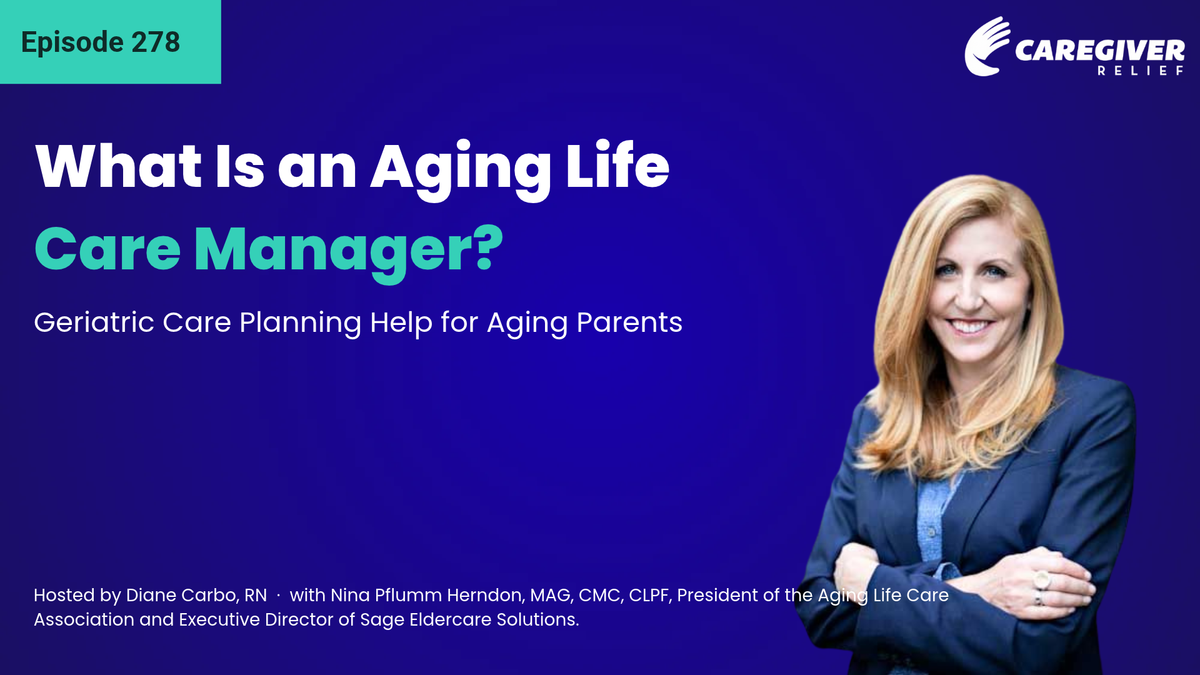
In this episode of Caregiver Relief, host Diane Carbo, RN speaks with Nina Pflumm Herndon, MAG, CMC, CLPF, President of the Aging Life Care Association and Executive Director of Sage Eldercare Solutions. With a master's degree in Gerontology, certification as a care manager, and licensure as a professional fiduciary, Nina brings deep expertise in aging, care planning, ethics, and quality of life 🏡.
She explains what an Aging Life Care Manager does, how geriatric care planning can reduce stress, and how families can avoid crisis-driven care decisions 💙.
🔥 What You'll Learn in This Episode
- 🧭 What an Aging Life Care Manager Does: How these professionals guide older adults and families through complex care needs.
- 🗓️ Plan Before the Crisis: How geriatric care planning helps families make decisions ahead of an emergency.
- 🔔 When to Call for Help: Signs it may be time to bring in professional guidance.
- 🌟 Quality of Life: Why it should sit at the center of every care decision.
- ⚖️ Ethical Decision-Making: Navigating medical, legal, financial and emotional choices with confidence.
- 🌍 Long-Distance Caregiving: How coordination and advocacy can help when you cannot be there.
📋 Episode Outline
- 🎙️ Introduction: Diane introduces the question every adult child eventually asks: am I making the right decisions?
- 👤 Meet Nina Pflumm Herndon: President of the Aging Life Care Association and Executive Director of Sage Eldercare Solutions.
- 🧭 What Is an Aging Life Care Manager? The role, the expertise and how they advocate for quality care.
- 📝 Geriatric Care Planning: Coordinating services and planning ahead.
- ⏰ Knowing When to Bring in a Professional: Recognizing when your family needs more support.
- ✅ Key Takeaways: How to age with dignity, safety and support.

🌐 Learn More
🎧 You Don't Have to Figure It Out Alone
This is an important conversation for adult children, spouses, long-distance caregivers, and anyone trying to help an older loved one age with dignity, safety, and support. Press play, then share this episode with a family member who is making care decisions right now 💙.
Podcast Episode Transcript
Diane: Welcome to the Caregiver Relief Podcast. I'm Diane Carbo, RN. Today we are talking about a resource many families do not know exists until they are already overwhelmed, the aging life care manager.
If you are caring for an aging parent, spouse, or loved one, you may be trying to manage doctor appointments, home safety, care choices, family disagreements, finances, legal concerns, and quality of life decisions all at the same time. It can be exhausting, confusing, and emotional. My guest today is Nina Pflumm Herndon, President of the Aging Life Care Association, and Executive Director of Sage Eldercare Solutions.
Nina has a master's degree in gerontology from San Francisco State University, and has dedicated her career to improving the lives of older adults and their families. She is a certified care manager, a licensed professional fiduciary, and a contributing author to the Geriatric Care Manager's Handbook.
Today, Nina will help us understand what is an aging life care manager, what they do, when a family may need one, how health care planning supports quality of life, and why planning ahead can help families avoid crisis-driven decisions.
Diane: Nina, thank you so much for joining me today. I was real ... Like we were saying before, we got on, I've been a nurse for 50 years and I see how care management has changed over the decades.
But before we talk about aging life care management, would you share a little bit about your background and what led you to the field of gerontology and eldercare?
Nina: Sure, I'd be happy to. Thanks so much for having me, Diane. I think the story goes back longer than I ever realized. I had a, fully developed, public affairs career, and I started specializing more in healthcare and, and in older adults.
And, ultimately, was working for Ken Dychtwald, who it's coined the term age wave. And so we did a lot of research, around, the aging of the baby boom and the coming, you know, silver tsunami, if you will. And, I came across one of our clients who was a geriatric care manager, and I thought, "Oh my goodness," you know, I love my work doing this research, but what if I could work with people during the day and, interact directly with families and try to solve problems?"
And it turns out there was a big thread of working with older adults in gerontology throughout my whole life. I'd written my college, essay on, somebody who I volunteered with at a nursing home every Friday. So go figure. Life has a way of conking you over the head with what you're meant to do, even if it, isn't immediately evident.
So that's where I came from. but I'm been the last 25 years really focused on problem-solving and helping families navigate the challenges of caring for an aging parent and really connecting with the older person themselves to help them, experience a life of autonomy and quality of life, even if they have cognitive or functional limitations.
Diane: Yeah. For families who have never heard the term before, what is an aging life care manager?
Nina: Yeah, it, so many haven't. It's sort of, we hear all the time that it is one of those, hidden gem professions that people wish they'd known about.
Diane: Yes.
Nina: So an aging life care manager is a health and human services professional, generally with a master's degree, in the field of social work, gerontology, occupational therapy, physical therapy, and other sort of public health, domains or nurses, are very often care managers, as, as you say, there's so many different iterations of what it looks like. But in the, domain of an aging life care manager, by nature of calling ourselves that, we are members of the Aging Life Care Association, and there are certain standards, and criteria that we have to have in terms of education and experience.
But, another really important thing about aging life care professionals is that we uphold the standard of practice and ethics that are an important part of how we show up for families. So yes, those are our backgrounds, and then our job is to help people understand what it is they need, make good decisions, navigate crises, hopefully avoid crises and, really shepherd them through the process. Because as you said when you opened up, Diane, so many people, when they're tasked with caring for an aging parent, it's a whole new world. it's an education unto itself. And as, and you described all these different domains. There's the legal financial domain.
There's the family dynamic domain. There's the living and what, how much care do I need, and it's complicated, and people are navigating this on their own, but they don't have to be.
Diane: You know, and the thing is, with the changes in reimbursement from our insurance, I like to say everythings roll downhill, and the hospital is doing less.
And the home care agencies are doing less because of the reimbursement, and everything is falling on the family caregiver to do things that were once provided by, professionals, healthcare professionals, and we're really in a, a serious state right now. but I'd like to know from you, what are some of the most common reasons a family reaches out to the aging life care manager?
Nina: Usually something's changed. So, if you use the example of, sort of a physical condition, somebody, heaven forbid, has landed in the hospital and there's a new diagnosis, and that's a whole new world. So they might have been, you know, out hiking last Friday, but something's happened and now there are like a number of different things afoot.
And a lot of, coordination to happen, a lot of care to be put in place and it's, you know, it's very it can be very overwhelming.
Diane: Oh, it's absolutely overwhelming.
Nina: Yeah. And,
Diane: And if you've got a managed care platform, you are in big trouble because you have to work within the network that they provide.
They, and they don't even keep their websites up to date. Would you... You'll look on it and say, "Oh, I can do this home care, company," and then you learn when you get your bill that they weren't in the network anymore. Those things happen all the time. And, so I really liked when I could, when I did this to, to help people understand what they need and where they go for the resources.
So how can an aging life care manager help adult children who are worried about an aging parent but don't know where to start?
Nina: It's a great question. I wanted to add one more thing about another time that people often come to us. Is they may have noticed some cognitive changes for some period of time.
Diane: Yes.
Nina: Yeah. But then, like, something usually tips them over the edge and says, "We can no longer look the other way." Yeah. "And we have to take action, but we don't know what to do." Yeah. And, and so wanting to make good choices in those situations and really respect what their parent wants, but also, navigating some of the components of people maybe not having insight into their cognitive changes, and so then how on earth do you talk to them about it and what needs to happen if they don't agree that's what's happening? So anyway, I just wanted to mention that,
Diane: No, that's a good point, and I want you to know that what I see out here is I have, friends, family, neighbors, and even, my listeners who have called and said, you know, "My mom's, we think she has something cognitively wrong with her.
What do I do?" And you know, you always send them to their PCP and say, "Ask for a comprehensive test, for cognitive status." And it's, because it's not covered by some of the insurances right now, all they'll do is a mini-mental. Yeah. And it's frustrating, and people don't understand. They'll come back and say, "There's nothing wrong with my parent."
And, the first mini-mental is just a baseline. You don't know. But there are other tests like the SLUMS that they could do that would, will pick up on things. and that's frustrating because even our PCPs, and I know people will say, "Oh, no," but it's true. They don't know what they're doing when it comes to dementia or a change in cognitive status.
They don't, because they only have a 15-minute window to, see the patient, identify what their problems are, write, prescriptions or tests, and then go, document, and then go on to the next patient. So they don't want to take time to do a comprehensive, cognitive status test, and it's just very frustrating.
So that's what, again, an aging life care manager can tell you and educate you, "Hey, don't get worried. We'll ask for this." And, you know, or have us, give me the power, to, with HIPAA, sign off on HIPAA for me so I can talk to your doctor. 'Cause it just makes so much difference.
Nina: It does. It's a really important point you made, Diane, about under- like, getting a diagnosis and rather than just sort of having like a poorly performed MoCA on, in the file. those, are intended as screening tools. And yes if the primary care physician is not the one sort of driving the search for a diagnosis, then families don't often understand that they that they can be or, yes, and so that's something as aging life care professionals, we like work with families, as you suggested, to really understand, you know what? The way we take a look at a vascular dementia process versus a Lewy body, dementia process versus an Alz- mixed type or the new late dementia
Diane: Yeah
Nina: Then, you know, it's like well my gosh, what is that sentence you just said? I have no idea what you're even talking about. Because it, because the primary care physicians many times aren't talking about the importance of a differential diagnosis and why it matters.
And why it matters is because how you're going to navigate that course of dementia is different depending on what kind it is. And, the good news is that throughout the whole course of my entire career, I've been waiting 25 years for there to be some meaningful, you know, meaningful medications to combat, the progression of Alzheimer's and other dementias. And, we're on the precipice of starting to see some new things that, you know, the data, can, suggest that you can, you know- slow the roll, if you will of the dementia. And so it gets complicated, and the fact that like
Diane: I will tell you, I have heard those words for the last 40 years. I've been a nurse for 50, and I went on my website because it's so old. I had to take down pages because all these things that were right on the cutting edge to address dementia weren't even effective.
And I just think that it's gonna be a long time till we see any changes because it's... Nobody can afford to pay for it if, even if, because Medicare has changed to a cost-sharing plan. Even for traditional Medicare, they're rationing what procedures and things we can have. so we're limited to...
Our government is now the overseer of our healthcare, not the doctors.
Nina: Yeah, and that idea that people are, like, the insurance, you know, that there's gatekeepers,
Diane: Yes
Nina: all the more reason to have an advocate who knows
Diane: Exactly
Nina: What to basically ask for, who can push it a bit and say, here are, is my rationale for why this is why this is important for this human." Yes. and, that's a big part of what an aging life professional, care professional does is because how, navigating this system and sort of what you have access to and what you don't have access to is huge. And you were starting to say earlier, and I'm afraid I interrupted you, but about this notion of transitions of care and people, you know, sort of getting, less for their insurance dollars than they used to. And then the implication being that people go home sicker.
Diane: Oh, absolutely
Nina: Yeah. And so adult children navigate transitions of care. I mean, there's a lot of moving parts there, right?
There's, like, what is the insurance covering and how do we support this person at home afterwards, and what resources are available to do so? All of those questions, are really essential in transitions of care. And the data tells you if you don't get the details right on the medication or the follow-up, then it really, It's really, like, a risky situation that they'll land right back in the hospital, and we don't want that for people. Because generally, the hospital is like the healing happens when you get home or when you get home medicated Yeah. so we want to keep people out of the hospital.
Diane: We are also moving to hospital in the home.
And it's very real. It's here now. And, what I find, more challenging about that, that's why, an aging life care manager is absolutely needed in this situation, is They are providing a doctor to come out even daily, but they're not providing a nurse to provide care or an aide, a nurse's aide to help take care of that.
So all that pressure of taking care of their family member is again put on the family caregiver that is not educated in the complications of immobility. They don't know about, you know, skin breakdown, or, nutrition or even doing regular oral care. And it makes me sad because, we went to nursing school to be able to...
I went to nursing school to be able to give people good, quality care to help them and educate them. You know, I had an instructor tell me, or a head nurse tell me one time, "Your nursing school taught you about educating patients." And I said, "Yeah." 'cause I had moved to, from Pittsburgh, Pennsylvania to Memphis when I first got married, and that was my first job.
And she, and I was... She always, complimented me that I took time to educate people, And I guess I wanted to be a teacher at one point, and I just felt that's a normal thing, and I'm still that way. I want to teach people. That's why at 73 years old, I'm still trying to educate people their options and stuff. But it's necessary that we do that because, we are in a public health crisis, and the family caregiver doesn't know what they don't know.
Nina: It's so true.
Diane: Yeah.
Nina: And so, you know, so I think I should, explain that, an aging life care, professional is not part of the hospital system.
They're a separate, independent consultant, if you will, or guide, navigator. we have been known as quarterbacks and, you know, the whole litany of ways to think about somebody managing all the different components. But it is a private pay, situation, so some people might be able to manage, you know, an relationship with an aging life care manager.
But if not, a consultation to get some advice and some guidance and be on your way, still continuing to be the person who's providing the care and support, but also with, a little bit of guidance, a little bit of knowledge underneath your belt that came from somebody whose job is to advocate for your parent and to get the very best outcome for them.
Diane: Well, right now the situation is if you want good quality care, you're going to have to pay out of pocket for it, for everything across the board. And we're going to see a major growth of, private pay nurse, concierge nurses, concierge therapists. They're even doing PT telehealth, where they'll send you the equipment with little computers in it, and you and your, the family caregiver have to use this equipment, and it'll tell on you if you didn't do your session.
I mean, you know, it's just crazy. So, what does a good care plan include, and how does it help families make better decisions?
Nina: That's a great question. So from my point of view, a good care plan really starts with an assessment and really understanding sort of what the needs are in a range of ways.
So there's the whole health equation, medications, how are chronic conditions being managed, and then there's the functional piece of, what is this person able to do? Are they able to like navigate, their home? Are they able to manage their home? Bill pay, housekeeping, meal prep, grocery shopping, all of these things.
Diane: Yeah.
Nina: And taking a look at that. And then, where they live, their living environment, whether there's like home safety needs in their own home or whether a care setting would really serve them better. And if so, oh my gosh, let's not get started about the 12 different vocabulary words that you can use to describe senior living and what that looks like and how are they different and what does that mean. and then also, there's like a legal financial component of, a good care plan is understanding are powers of attorney for healthcare in place. Does that power of attorney for healthcare understand that is actually, like their name is the name on the paper?
Do they know what that person would want in terms of level of medical intervention should they be called to act on their behalf? And then, taking a look at like their quality of life. And so I look at that both from what we call quote unquote like psychosocial, but what it really means is like are you connected to what gives you like to what and who gives you a sense of purpose and meaning? So do you have friends? Do you have family?
Do you see them or is everybody at a distance? what do you do during the day? How do you occupy your time, and like what matters to you? So a care manager, who specializes in aging life care can really take a look at that total picture and come back with a set of recommendations to say, "Looking at this person holistically, here is what we recommend."
And often a part of, the care plan is some guidance on how to talk to the older adult about the kind of, you know, recommendations you want to [00:20:00] implement. So it's not about, us wrestling away somebody's autonomy. It's about working together, and sometimes that means starting where they're at even if- you and I look at it like, "Well, this is the priority."
But if it's not the priority to the older adult themselves, then we may need to start where they are. It's like an age-old time-honored, social work tradition of starting where the client is, and that's really what an aging life care manager needs to do. and then helping families understand that, like, okay, we might, need to use, a little patience here.
That, as we navigate, we need, a early win of something that the older adult has found to be meaningful, helpful, and, having good value, and then maybe we can continue to work on the other things in the care plan. but a care plan is really holistic and it looks in, a range of different domains, as I described.
Diane: I love the word holistic, and I want to tell you, and I want my listeners to know, that there is no, medical, anybody in the medical delivery system that takes a holistic view of our healthcare except the care managers, because we are really... I mean,the doctors only have 15 minutes to meet you, see you, assess you, and then move on to the next patient.
we have, our... the reimbursement again has been cut so low, everything's so fast that I mean, I go to a pain doctor, okay, for chronic pain. I tell people I used to pick up men for a living and I've injured myself. I did ortho rehab. But you know, the thing is even when I go to the pain doctor, he'll say, "Well, what's your level of pain?"
And I need to, I always have to ask, "Are you talking overall or do you want a specific?" And they really identify one little part on my body and want to know where is the pain level in that part of my body, and it's, absurd, But that's the way we, you know... And when I first went into orthopedics, an orthopod did- All the joints, all the bones, and now you've got the hand doctor, the, the foot doctor, the, hip guy, the knee guy.
I mean, everything's and the shoulder guy. Everything is specialized that we do not even see a holistic view of our healthcare, and I think that's the most important thing, is to have someone such as yourself that, has the ability to step back and look at everything. Because you're not just looking at safety and medical needs, you are supporting quality of life.
Nina: Yes. They don't call it social determinants of health for nothing, right? Yes. it's like they are, these are related, just like the, knee bone is connected to the- Yeah ... knee bone. it's, it, the, so it is with your sense of wellbeing- Yeah ... your sense of meaning, your sense of purpose, autonomy, all of these things.
you know, they may sound fluffy, but they really matter. Yeah. [00:23:00] And, and paying attention to them is, I think, a really important piece of the equation of having good outcomes for someone.
Diane: I agree. Now, what role can an aging life care manager play when family members disagree about what is best for their older loved one?
And I see that all the time.
Nina: Yeah. Yes. We're often, that's often the reason we're involved- Yep ... because, a family member, they may be not able to agree with one another about, you know, sort of what the path is for mom. and by the way, the associated cost, because that can be part of the emotional trigger of it all.
Diane: Yeah.
Nina: But often they can agree that- They will heed the recommendations of an objective third party. Yeah. And so we will come in, and we'll render our opinion and do a care plan, but not without actually deeply listening to each of those siblings and their why.
So why do they, feel this way about the, thing that's at issue, and untangling some of that and seeing, gosh, what, this son said versus what this son said, there's like a very narrow gap. And so here's an idea about how we thread the needle where mom gets what she needs, both of them feel like they've been heard.
And it starts to, like, deescalate. When you have somebody who's done this before, it takes some of the panic away and some of the fever pitch. Yeah. And so if things aren't at a fever pitch because you've got somebody shepherd you, shepherding you who knows what you're doing, it can kind of deescalate things sometimes.
But then also, aging life care managers have a specific set of skills about, you know, navigating that dynamic. So yes, we have this, like, magical elixir of being an objective third party, but there's also ways that we really help people step through the conflict.
Diane: Yeah. Well, you know, I come from a very dysfunctional family, as many of us do.
And, what I liked about the role of the life care manager was that, in a family situation, the old family dynamics start playing. You could've been away from home 30 years, and you're coming home now to help, and you were the, the middle child or the baby or whoever, all of a sudden, and you could be a successful businessperson and all that, all of a sudden you go into that role of whatever you were as a kid, and they all treat you they all take on that family role all over again. And what I liked about the, the life care managers is we are actually taught to, deescalate. and sometimes it's just allowing each family member to, tell us about what they see, what they need, and to work it out. and that's we're the objective third party who also has knowledge about what is needed for that person.
Makes a huge difference. It really does.
Now, you are also a licensed professional fiduciary. So tell me about that, 'cause I know many people don't know what a fiduciary is. And how do the ethics, decision-making, and trust come into elder care planning?
Nina: Well, my gosh, that's a, huge topic.
So, Yeah I think one way to think about a, professional fiduciary is someone whose job it is to carry through someone else's wishes, whether they be legal... or excuse me, whether they be financial or related- Yeah ... to care and, incapacity. And I actually, while I have that training, the, I actually just use that training- in my role as an aging life care manager. So I don't function as both a trustee who's no ... managing the money, and the healthcare. now, this is my opinion, but I really like it in situations where you have the, like, it's not often you find, you know, us gerontologists being, like a master financier.
And or I mean, at least that's not why I, you know where my strengths lie. I feel like if you could have sort of the master of both domains working on your behalf making sure that your financial wishes are carried through both
Diane: Yes
Nina: throughout a period of incapacity should you have one, and then after, someone's passed, and have somebody who really understands on the healthcare side- What are your sensibilities about the levels of medical intervention you would want?
And what are your values, and how do I get really well-equipped to make healthcare decisions on your behalf if you are incapacitated and aren't able to tell me yourself? So, there's a lot of misnomer out there that as a power of attorney for healthcare, your job is to, make the best decision you think.
Well, actually your job is substituted judgment, and what that means is to do what the older adult themselves would've done whether or not it's something you agree with. So it's a little you know, it's a nuance, but it's an important one, right? Yes. Because it's not your job to do what you think is best, it's your job to know what they think would've been best.
Diane: Yes.
Nina: And some people are finding themselves in that position of making those decisions and never having had these conversations with people. Yeah. And, or just, like, referring to the advance directive that says, "Do not prolong my life." if you pull that apart, there's, a whole bunch of questions in there.
Exactly. So that's how I bring my, fiduciary lens and, my, healthcare decision-making lens- Yeah ... to Aging Life Care is really, I want, as part of the, the whole picture, this holistic thing, and helping an adult child feel really competent at taking care of their parent, by their side, I think, it's my job to also make sure that adult child who's a decision maker gets into the mind of their parent, and about, about what they would want before they're ever called to make a decision.
So you talked a, a little bit at the beginning about, like, well, how do you plan ahead, and what is this planning process, And, as the baby boomers have gotten a little bit older, we've had many, many... We used to just only ever get calls in a crisis. Yeah. and over the last sort of, like, 10 years, I would say, people who had really rough parent care experiences themselves- are looking at the road ahead and saying, "I wanna have much more agency over this. And I don't, I don't want to put that kind of stress on my adult child. And so how do I, make really good decisions about, in advance, and how do I sort of rule the narrative?" Even though I can never be in charge of what details and what comes to pass in terms of my health and, you know, how my end of life winds up looking like, but you can sure set yourself up, by asking yourself some really important questions and documenting the answers so people have a roadmap.
Diane: And I see a very big need for the [00:30:00] solo agers and the childless couples to have, somebody in the aging life care manager role, management role to help them because we have a shortage of caregivers out there right now. And, it's, things are not as they think if they have the money to pay for things, that it's going to be, they'll find somebody.
But you know, it may take, you to interview six, seven, eight people before you find a person who's right for you to provide just in-home care.
And I strongly recommend that everybody, if they are a solo ager or a childless couple, to really invest early in a, aging life care manager.
Because let them get to know you and what your goals are and what your needs are for the future because, you don't know what you don't know. and, things are changing quickly and, you know, there's caregiver robots [00:31:00] now, ... it's the life care manager's going to know whether what robot may or may not be ready for you.
It's just there's so much into it that as we age that we need. And, we really have to really, put forth more effort because we have to take responsibility for our health because our government isn't doing it in any way, shape or form. Yeah. So we have to personally be responsible for the decisions we make, and having somebody like an aging life care manager makes things clearer, to you and gives you options so that, you can plan comfortably what you want, where you want to be, and, what you need to do to get there
Nina: Yeah, you make such an important point, Diane, about, solo agers and childless couples and the LGBTQ plus community, and, folks who, really feel like they have to go it alone. They don't have to go it alone. And building that relationship, can be really important. and I would also add to that, crowd, those who have decided to age in place.
So I always tell them kind of like, you know, pulling back, deciding to age in place is a decision, not a plan. Yes. So when the other proverbial shoe drops, like, who on earth are you gonna call? and are you gonna feel well enough to do it? And so if you can have a relationship with somebody you've asked you these questions, you've gotten to know them, and they're ready to spring, if a need arose, I feel like that's the way to kinda get your arms all the way around this issue versus just ... I mean, I know there's a lot of people out there who are, like, wringing their hands and really thinking about this issue, but don't have an idea where to bring these questions. Exactly ... and that's why I'm super grateful for your, featuring Aging Life Care as part of the, as part of the solution because I really do believe that, while we can really help people who are in a crisis, we can also really help people who are looking ahead, and
Diane: I was in, a, DON of, an assisted living, very posh, upscale, very wealthy people.
And I had a situation where there was a gentleman, who his wife had died, they had no children, and his attorney was overseeing his care. First, that made me crazy. And the man was not getting his needs met. he had dementia, he was incontinent, he needed a one-on-one absolutely in the facility.
And what people don't understand about assisted living, and I say this all the time, it makes people angry, but assisted living is the most dangerous of all of our medical delivery systems, only because it's built on a social model, not a medical model, and you should be, you're supposed to be able to direct your care.
And when they're taking in people with dementia and stuff, that's not happening. And the family has to realize that [00:34:00] you're paying big bucks for independent living, and you need to be, continue to be involved. That's why I encourage, people, that are, solo agers or childless couples to get a, an aging life care manager involved early, because this poor man had stool all over his bed, his chair, and nobody was making sure he was showered.
It was just a nightmare. And I literally had to call the attorney and say, "Hey, he needs a new bed. He needs this, he needs that." And he was okay with that. But, you know, he wouldn't have had to do it if he wouldn't have had to spend all that extra money for new stuff if he had a care manager in the, in checking on this gentleman.
And that happens more often than people realize. And that's why if you're in assisted living, you absolutely, and you don't have family members to oversee you or even friends, an aging life care manager is the best thing that you can buy for yourself it's just the way it is.
Nina: Yeah, assisted living is very interesting because, it's a particularly, unique situation because in all the rest of the care system it's for the most part, like, driven by insurance or what have you, right?
Or that, and then there's this category of continuing care and assisted living and independent living, and I think when you talk to the marketing people, God, God bless them, who are talking to you about assisted living, they're really presenting it as a total solution. Yes.
Here's your meals, here's your apartment, here's your- Yeah ... here's your activities. And the truth is, that is true to some extent, but, nobody's entire needs are met by, you know, some programming, some, delicious food, and, an apartment studio. And so when you sort of buy that idea that this is a total solution, unfortunately it's a little bit, of a misrepresentation of what somebody needs, if you
Diane: want- it's 100% a misrepresentation, and people think, oh, they're paying big money, that everything's gonna be done. Not. I can tell you right now, the people in these facilities, 'cause I know, I've worked in them.
I was a director of nurse of one. It was the most unsafe place I ever worked, and I had to leave that role because I wasn't putting my license on the line because of the things that were happening in that building, and people were paying big bucks. You know, it was one of those places with the Steinway in the, Yeah
lobby, and the chefs with their top hats, their white hats and stuff. But it was probably one of the most dangerous places, and I found so many things at... the older gentleman that I was telling you about [00:37:00] was just one of many- ... that just frightened me. and that's why I think having an oversight by a care manager is absolutely imperative.
It absolutely is. You need
Nina: a customized solution, whether it be their adult- Yes ... daughter who do it, or whether-
Diane: Yes
Nina: there are gaps between what they offer and, sure, a family member can do it, absolutely. Yeah. But, they can do it in partnership with an aging life care manager, or if they're at a distance, an aging life care manager can own that piece.
Diane: Yes, exactly. That's what's so important. So what should families look for when choosing an aging life care manager?
Nina: Well, I really encourage them to go to aginglifecare.org, and there's two really wonderful things that I'd like to call people's attention to. The, the first is, a little button that says Aging Life Care Manager.
So, that can help you find somebody in your area, and see who's available. And then there's another button that has, what to ask when looking for an aging life care professional. And there are various questions related to not only somebody's, background and skills, how long have you been in business, what's your training, but also the whole level of, how does this work?
How do you bill for your services? what can I expect? And, and then there's a certain, you know, je ne sais quoi, that whole sort of unknown of like a rapport between, the aging life care manager and the, older adult themselves, as well as the adult child. so there's a whole different, whole range of components to consider, when hiring an aging life care manager.
And I really encourage people to ask those hard questions, because very often they've never, they may have worked with an attorney, they understand that you go to an attorney for legal advice, but they don't understand that you go to an aging life care manager for parent care advice.
Yeah. or a caregiver coach like you are. And so, having that list of questions to ask and [00:39:00] really exploring is this right for me, and what can I expect, and here's the process. you know once you do the assessment, then what? and you present a care plan. then what?
How does this work? And, for many aging life care managers, it's like how it works is that we, like, stay with you and your parent for the rest of their lives. Yeah. Yeah. And that's the beauty of our work, is having- Yeah ... you know, the opportunity to, and that's why I always say shepherd people, 'cause I really do feel like we are with them by their side, you know often for years at a time.
Diane: Yes, yes. and that's what I love about that as well, 'cause when you're in early, you get to know everybody's personality, the dynamics of the situation, and it helps you better manage the, outcome because you're either proactive and trying to, answer questions that you know they're going to be asking because of their personalities, and, providing information to be calming, which is very nice as well.
Nina: I know. it's interesting when I'm on, the phone with a family who's considering- ... working with us, you know, I sort of tell myself like, okay, I'm doing... if I can feel sort of the tension in the room- ... start to dissipate- Yes ... as we talk- Yes ... then, I'm on the right track, and Yes
it feels good for me to know when families are feeling like, "Oh my gosh, I'm not at such a loss"-
Diane: Yeah ... of
Nina: what to do.
Diane: Absolutely.
Nina: Then, you know, that's what makes us tick as aging life care managers. Yes.
Diane: Yeah. Yeah, absolutely. So what advice would you give to a caregiver who feels overwhelmed, guilty, or unsure about whether they need professional help?
Nina: Well, very many aging life care managers offer a complimentary consultation, so I would encourage you to take advantage of that. I would really look inward and say, like, I want to do a great job for my parents. Yeah. is there some valor to doing it alone, or could I have somebody by my side that makes me feel more competent at it, who makes me feel like I'm doing a really good job, who then, when I go see Mom on a Saturday, it's not about what the, what doctor's appointment needs to be made or what medication needs to be picked up, but, the quality of life piece that nobody else can do like that adult child can.
Diane: Exactly. I want to thank you so much, Nina, for giving us so much information. How do my listeners find you?
Nina: Oh, thank you, Diane. what a pleasure to be here, and thank you for helping people know what to do when caring for an aging family member. I really, really respect and appreciate what, the education, that sounds like it's in your DNA to do.
Diane: It is.
Nina: So thank you. so to get in, touch with me,there is the aginglifecare.org,is a great way to get a whole bunch of information, and if, you're looking for help in the San Francisco Bay Area,and beyond, you can reach us atwww.sageeldercare.com.
Diane: Great. thank you so much. To my family caregivers out there, you are the most important part of the caregiving equation. Without you, it all falls apart. So please learn to be gentle with yourself, practice self-care every day, and look into getting an aging life care manager, because you are worth it.
Caring for a loved one can be overwhelming — but you're not alone. If you have questions, big or small, our expert team is here to help.
👉 Click here to Ask the Expert
Our Resource section can help you find the information and tools that you need. We have courses, videos, checklists, guidebooks, cheat sheets, how-to guides and more.
You can get started by clicking on the link below. We know that taking care of a loved one is hard work, but with our help you can get the support that you need.
Click here to go to Resource Section now!