After Traumatic Brain Injury: Caregiving, Marriage, and Starting Over With Juana Libedinsky - Episode 277
When Juana Libedinsky's husband suffered a severe traumatic brain injury, doctors gave him little chance of recovery. Juana shares caring for a spouse through two comas, protecting her children, and preserving her identity while rebuilding her marriage.
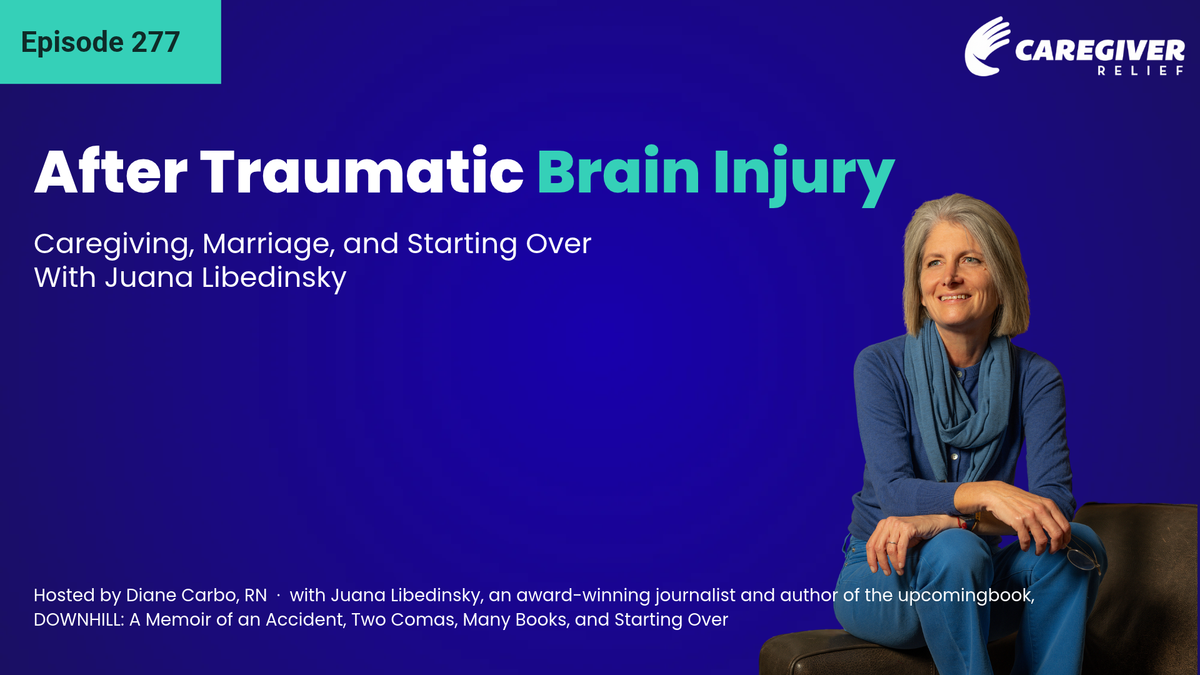
In this episode of the Caregiver Relief Podcast, host Diane Carbo, RN talks with award-winning journalist and author Juana Libedinsky. In 2019, Juana's husband, Conrado, suffered a severe traumatic brain injury during a family ski trip. At only 53, he was given a devastating prognosis: a 90% chance of death or remaining in a permanent vegetative state 🕯️.
What followed were two comas, ICU waiting rooms, overwhelming medical decisions, insurance calls, international moves, and the slow, unpredictable work of rebuilding a life 🌱.
🔥 What You'll Learn in This Episode
- 😶 Caregiving Without Preparation: The shock of suddenly becoming a caregiver.
- 💔 Ambiguous Loss: Coping when a loved one is alive but profoundly changed.
- 💍 Marriage After Brain Injury: How traumatic brain injury can transform a marriage.
- 📑 The Mountain of Responsibility: Medical decisions, paperwork, insurance and family life.
- 👨👩👧 Protecting Children: Shielding kids during a prolonged medical crisis.
- 😔 Caregiver Guilt: Why stepping away is so hard, and why caregivers should not be expected to become martyrs.
- 📚 Holding On to Yourself: Work, friendships, hobbies, books and humor as survival tools.
- 🌈 Nonlinear Recovery: Building a new life instead of chasing the old "normal."
📋 Episode Outline
- 🎙️ Introduction: Diane introduces the realities of spousal caregiving after a brain injury.
- 👤 Meet Juana Libedinsky: Award-winning journalist and author of the upcoming memoir DOWNHILL.
- ⛷️ The Accident: A family ski trip, two comas and a devastating prognosis.
- 🏥 The Caregiving Crush: Medical decisions, insurance, paperwork and family responsibilities.
- 💔 Ambiguous Loss and Guilt: Grieving someone who is still here, and the guilt of stepping away.
- 💍 Marriage and Identity: Rebuilding a marriage while protecting your own sense of self.
- 🌅 Starting Over: Accepting that recovery is nonlinear and building something new.
📖 About the Book
Juana is the author of the upcoming memoir DOWNHILL: A Memoir of an Accident, Two Comas, Many Books, and Starting Over. Her story offers an honest and compassionate counter-narrative to the belief that a loving caregiver must abandon her own life 💙. Learn more about the book.
🎧 Your Life Matters, Too
If you are caring for a spouse with a traumatic brain injury, dementia, stroke, or another life-changing condition, this conversation will help you feel seen. Press play, then share this episode with another caregiver who needs to hear it 💙.
Podcast Episode Transcript
Diane: Welcome to the Caregiver Relief Podcast. I'm Diane Carbo, RN, your host. The Caregiver Relief Podcast is a place for family caregivers to find education, encouragement, practical support, and honest conversations about the realities of caring for someone you love.
Today we are going to talk about traumatic brain injury. A traumatic brain injury does not just affect the person who is injured. In a matter of seconds, a spouse may become a caregiver, medical advocate, decision maker, household manager, and the person trying to hold an entire family together. But what happens to the caregiver's identity, marriage, career, relationships, and emotional well-being during that journey?
Today we are discussing the caregiving experiences that rarely appear in hospital discharge instructions, the guilt of stepping away, the grief of caring for someone who is alive but profoundly changed, the pressure to sacrifice yourself, and the difficult work of creating a new life after a medical crisis.
Diane: My guest today is Juana Libedinsky, an award-winning journalist and author of the upcoming book Downhill: A Memoir of an Accident, Two Comas, Many Books, and Starting Over.
In 2019, Juana's husband, Conrado, suffered a severe traumatic brain injury during a family ski trip in the Patagonia Andes. He was only 53, and doctors gave him a 90% chance of dying or remaining in a permanent vegetative state.
What followed was a caregiving journey that no family is prepared to navigate: two comas, medical uncertainty, complex decisions, insurance and paperwork, raising children during a crisis, moving between Argentina and New York, and rebuilding a marriage around uncertain recovery. Throughout this experience, Juana made an important and sometimes controversial decision.
She would care for her husband, but she would not completely abandon herself. She continued to make room for reading, tennis, work, humor, and parts of life that had helped her remain whole. Her memoir is not simply a story of survival. It is a story about love, identity, caregiving, marriage, and discovering that starting over does not mean returning to the people you were before the accident.
Diane: Juana, thank you so much for joining me today. I'm grateful to have you here. before we get started talking, I want to hear about the accident and your caregiving journey. And as you just told me before we started this, you're going to the place where all of this happened.
Juana: Yes, exactly. I am right now in Buenos Aires, that's the capital city of Argentina.
And tomorrow I'm going south, way south to the Patagonia Andes, to a town called Bariloche. That is where it all started because it's the place that, my family is from, and where every holiday, no matter we're, we were living in the world, my husband worked, was a lawyer, worked for a British law firm.
The compromise, the marriage compromise was that holidays would always be back home, and in those glorious mountains and lakes. That was, I love this expression that the Americans have, which is the happy place.
Diane: Yes.
Juana: Because it's so evocative. It's like this place where you feel you can really relax.
It's really safe. It's your family. It's your friends. It's everything you've ever known and love. And especially when you live in a city like New York that is so competitive, and we're foreign. It was exactly the going back to Patagonia, for us it was exactly where you can let down all of your defenses and just enjoy. Yes. And, perhaps we let our defenses down a little too much.
Diane: Oh, I don't think that. I don't think so. You know, it's so funny because I live in Myrtle Beach right now, and I used to live in New Jersey, was in New York often. And, even just down here in South, a little bit south is
We're a little bit laid back and slower, than, up there in the city, Now, I'd love for you to take us back to your family ski trip in 2019.
Juana: Yes.
Diane: You want to tell us about that?
Juana: No, of course. So I go there. My parents are, in their late 70s, late 80s. They're all skiers, and we were having, a family outing in the mountains.
And then at one point, my husband Who's the most risk-averse person, your emblematic lawyer, the first person ever to wear a helmet when it was so uncool decades ago to wear a helmet, and everybody wanted to wear headbands and, be really cool, and he didn't care Suddenly, he lost control.
I don't know if there was some ice, covered by powder snow. But it was very strange because he started bouncing like in cartoons, like head, toe, head, toe.
Diane: Oh, yeah.
Juana: And then in one of the bounces, his head, his helmet flew off. In the second bounce, his head went straight into a huge rock, and then he fell onto a frozen creek.
Diane: Oh, my.
Juana: So it was like out of a movie. You know, a horror movie.
Diane: Yes.
Juana: And we were skiing with a friend who's an, a former Olympic skier, so he threw himself downhill chasing him. He managed to grab him with one arm, and hold him in the creek while calling for the emergency patrol to come. And, the patrol, it
I mean, we were so low in the bunny slope that not even the, the patrol came, no? It was just like their regular ambulance that could go up the mountain because we were so low. And that's when they took him to the hospital in Bariloche, in this mountain town, and they told me that he had this traumatic head injury with a diffuse axonal injury.
And I don't know if I'm saying the, the, the correct English words, but it's something more or less like that. I went into ... There wasn't that much AI in 2019, but Wikipedia was really strong. So I checked to see what was that. And what I found out were now these terrible statistics that it's generally 90% death or a vegetative state, and the other 10% is also very complicated because so many times
Diane: Yeah
Juana: It is a severe impairment, either in the brain or quadriplegic, or like the worst case of all, no, which is to be conscious but trapped inside your own body. There was this great movie, by Julian Schnabel, The Butterfly and the Belger. And, so there, I immediately realized, okay, we're seriously not going back to New York and our life soon.
So I went into this automat mode, and I started moving forward with all that had to be done. and so the book really is a story from that very strong, to say the least, accident that, that happened to our journey. both what happened to my husband, what happened to us as a family, what happened to me as a caregiver.
But also, it's an interesting story in the sense, Well, first of all, because I wrote it, so I think it's interesting. It got really good reviews when it came out in Argentina. So I'm very happy that it's coming out in English in the US. But also, when you are in this gray area between science and miracles
Diane: Yes
Juana: It's, very different than with other ailments, what people feel they can tell you, what is expected of you.
Diane: Yes.
Juana: And so the whole journey had very different levels, that when I would share it with friends, many of them journalists, at one point they were, you know, it's kind of horrible that we say this, but as a journalist, you don't have this kind of big, big story thrown onto your lap that many times.
And then, like, to make matters more complicated, my mom, for totally unrelated reasons, also falls into a coma because of a septic a, infection. So, it was like a very extreme case. And again, this area between science and miracles, but also this area where the influence of the people that surround you for good and bad, and especially for good, the, becomes so key, from the media to community to the kindness of strangers. And I wanted to share this story, and now happy to share it with you and the people that follow you in such an important podcast. So very honored.
Diane: Thank you. Well, you know, one...
You went from one moment, you were a wife, a mother, a working journalist, and in a second that all changed where you were also a caregiver, an advocate, and a decision maker. what were you suddenly expected to understand and manage without any preparation? Like you said, you went and looked up in Wikipedia, what the, what they were saying to you
Juana: So I've always been the kind of insufferable nerd since I was a little kid. the kind of kid that teaches, herself to read even before school. And I'm super a compulsive reader, that I will read... Even as a kid, I would read, the bill for electricity or like the indications for a medicine for a grandmother. Whatever was in front of me, I would always read. So one of the things that I found that was weird was that I had worked most of my life writing in the culture section, so
Diane: Yeah
Juana: partly book reviewer, also writing about books, and I found that in many ways, and this was a strong way, I continued to be myself even in the worst or most demanding situation. And one of the books I read during this time was The Year of Magical Thinking of Joan Didion.
Diane: Ah.
Juana: And it was this incredible book that is written in a very dry tone, which was great because I was... I cannot handle someone writing about perfect sunsets and
Diane: Yeah
Juana: like kumbaya.
Diane: Yeah.
Juana: Even though she was also writing about her husband who had died after being very briefly in the same coma my, my husband had been, and her daughter that was in a coma.
Diane: Yeah.
Juana: And what she said, one of the things she said, was that she let her journalistic instincts get the best of her.
And she would read everything that was available about was, what was going on, and she would be very pushy with doctors and nurses, second-guess what they were doing. And... No? And as I read it, I was, "Okay," there's also a temperamental thing, and I was, "I can't do that."
Diane: Yeah.
Juana: So I reacted totally against it.
And I was... I read that Wikipedia entry, and then I was, "Okay, I'm putting my husband and then my mom's life in the hands of doctors and the people who do really understand." "But I will not be doing the scientific, follow up of". And also I had this panic because what happens if what I found out doesn't coincide with the treatment they are doing, I don't
How do I choose the path? So in a certain way, I made this act of faith with a doctor and the team that he chose, and it wasn't the very expected doctor, because in Argentina, I think in New York, I don't know now in this southern paradise you're in if it, what's the equivalent, but I know in New York it's Bellevue, which is a hospital where the police bring, you know, the painter who fell from the seventh floor balcony, you know? All of these cases.
And so, the doctor that I chose was the head, the equivalent of the head of, the head of intensive care at Bellevue at our at our value. So it was of a municipal hospital in a third world country, but at the same time my reasoning was, okay, this guy, by the time he takes his mid-morning coffee he must have seen so many destroyed brains that whatever is the case that I'm bringing to him.
Diane: Yeah
Juana: It won't be nothing new. So when everybody was saying, "Oh, this is so bad, so bad," okay, this guy will know what to do. His name is Dr. Ignacio Previgliano. He was extraordinary. And so one of the big burdens that I see that many of the caregivers put onto themselves, which is choosing or trying to choose the correct path in terms of the medical expertise.
There I went this alternative route that was, okay, I'm choosing this guy for this, for this thing that for me sounds like common sense, but others were saying, ... And I had a lot of pressure, the best kind of pressure, but from my friends in the US and they were saying, "You should send your husband back to the US because you have US medical insurance, or at least get a doctor in the US to supervise what they are doing at your Bellevue equivalent."
And I was, "No, I don't want to bother this guy." I put it in his hands, and in my case it was the, the correct decision, and I'm very thankful for that.
Diane: That's very good. Now, you describe caregiving as a logistics problem w- and you're wearing an emotional disguise all the time. beyond the fear and grief, what practical responsibilities that became part of your daily life?
Juana: So I didn't have time for any grief or for any kind of emotional reaction because I had small kids, I had an older family, my husband's older family. So, that's another thing of the caregiver journey, no, that I became extraordinary effective in what I was doing, and people would always tell me, "Oh, you know, when things get back to some kind of normal, you will realize what happened, and you will have a very strong case of post-traumatic stress."
Diane: Yes.
Juana: but in reality for this very long time, logistics consumed me.
Diane: Yeah.
Juana: And it was, everybody talks about health insurance, dealing with the US health insurance in another country, dealing, with day-to-day, decisions. And for me, what was key was, what I was talking, no, about, the community and the kindness of strangers.
I love that in the US people quote many times this, African proverb that is that Hillary, Clinton popularized, that it is, "It takes a village to" "It takes a village..." It's actually, she was using it to raise a child.
Diane: Yeah.
Juana: But in this case, I felt that there was this kind of very big village that went from the south to the north of the continent of people that in different ways were helping us, holding us, and not letting go, and that made an enormous change. But also, there's this issue of the kindness of strangers. And when you're in a hospital room, for example, sometimes the other people in the ICU unit are the people that can really understand better than any other what you're going through.
And again, these practical questions that you'd be so embarrassed to ask someone else, suddenly there's like this immediate and weird community where so many people are trying to help each other with the unspeakable.
Diane: Yes.
Juana: And that made another big, big difference.
Diane: That's beautiful. you know, I'm glad that you had a good experience.
One of the things to your benefit is, he speaks Spanish. you're both from there. And probably having the caregivers and the language was also helpful to him, in his recovery, maybe.
Juana: Well, not really because, and apparently this, so when he starts coming back, he started speaking Italian.
And we were all like, "Whoa, okay." Because, apparently it's relatively common for people when they come out. And he was like, "There are 40 days that have disappeared." And he was in this coma, that there are different levels of coma. And my husband what I tell in my book Downhill, is that he was in the coma that is the closest to brain-dead, the one that is most difficult to come out.
Diane: Yes.
Juana: But sometimes you hear the stories about people, for example, that were adopted. And when they come out from a coma, they are talking in this language they learned as very young kids and had never, used again. But Conrado was born in Argentina of Argentine parents, and he had learned Italian as an adult after going as a, with a backpack in his, like, teens and having what is very common in Argentina, a very Italian sounding name and last name, and everybody speaking to him in Italian. He said, "Okay," "This is a sign that I should learn." So it was this very weird thing that first he started, talking in Italian. Then he switched to English, and eventually he landed in Spanish.
Also, the things he said, of course, made no sense in any of the languages, and it was a long process until they did. But again, it's this thing that so many of the things that happen to you, particularly when it is these very extreme cases of comas, it's been so romanticized in movies, and not to mention for us in telenovelas.
It's like the typical plot device to have, things go on while you can have the protagonist away for a while.
Diane: Yeah.
Juana: That there are all of these things that you expect to happen, and then they might or might not happen. And it's a very weird situation because of all of this Hollywood and our own Latin American Hollywood take on the situation.
Diane: Yeah. Hollywood makes every, even death and dying, they make it look like you just go to sleep. And it's not anywhere close to that. So yeah, they have romanticized so many illnesses, and it's just, unrealistic. And that's why so many people are shocked when they go through these experiences, because this is not they have something in their head of what they expect, but it's totally different.
Now, a severe brain injury can change memory, emotions, behavior, communication, roles, and intimacy. How did your husband's injury change your marriage, and what did it mean to renegotiate your relationship during his recovery?
Juana: It was very interesting because we were always told when he started getting better hold your horses because at any point he will plateau, and we won't know if he will plateau
Juana: In one stage or another stage forever. So it was very strange because in many ways I also wrote this book because, I felt that I was going against many of the established truths about what you go through.
Diane: Yeah.
Juana: And we, so I was expecting, and I was told, "Look, even in the very extreme case that he does have, some kind of recovery, that he does have, some kind of a, he comes back, even if, like, he even goes back to work, et cetera, expect a very profound personality change."
Diane: Yeah.
Juana: So I was ready for all of that I was not ready for someone to come back very much the same person that I knew.
And it was also a shock because you know,when we would... It was a shock for me, but especially a shock for other people because there was this kind of narrative. And, after the pandemic, the trauma memoir became a genre that sold very well. It was, it became a thing in the publishing business.
And there was this very typical narrative arc, that is you have something really bad happening to you, and then after that, you have a really bad time. Eventually, you learn from that, and you come out a better version of yourself, illuminated or at least ready to give a TED Talk.
And it doesn't happen to us at all. And people were so shocked that, you know, my husband just wanted to take his midtown bus and go back to his windowless office to revise documents on telecommunication mergers in the Third World.
The kids wanted to go back to their school in the US.
I wanted to go back with my laptop to Starbucks and once again start writing my stories. And we were, you know, all the time we were told, "Don't you want to go to an ashram in India? Spend more time with the family. At least, leave everything behind and go apple picking to Upstate New York or" "to the fields to Patagonia for a while." And somehow we had, all of us, this very deep desire for the kind of normalcy we had known.
Diane: Yes.
Juana: And, something very interesting happened to me, which was when this book came out in Spanish, it came out in Argentina and in Uruguay. And we had gone back to the beach in Uruguay, and, and we had left to go back to the US.
And it was the Feast of Epiphany, and in the local church, it's a, it's one of the important masses. And, the, the local priest of this little fishing town where we would go on holidays had come to my book launch, and he had bought the book and brought it to, and brought it to mass.
And he did his, homily based on my book. So I was in New York, and everybody was texting me, "You can't believe what, what's going on. No, the priest is mentioning your book," and which was so bizarre. And, what he said was that in some strange way, my book was very Augustinian in its outlook. And I will be a, do a horrible paraphrasing, but St.
Augustine said something along the lines that happiness is desiring what you already want. And that all of Downhill, my book, was really about this quest of finding what, once again, or finding back the joy of these everyday things And that maybe it's not a big life change. Maybe you're not illuminated.
Maybe you don't give TED Talks. Yeah. But it's like finding that these things you loved that were like friends and family and work, and they still have this, extraordinary appeal and worth. But w- we disappointed a lot of people by having that as our conclusion.
Diane: That surprises me, because I've worked with head injuries for many years, and I've seen marriages struggle.
Most don't make it because the person they are living with is not the person they were married to, and they don't know them. They've totally changed. And you're telling me your husband came back as the same person he was, is, amazing. I mean, that's, just shocking to me.
Juana: Yeah. No, no, it was shocking to
It was shocking to
Diane: Yes
Juana: to everyone. But since the beginning there were signs that this was to be.
Diane: Yes.
Juana: Do you want me to tell you one giveaway that was, very unexpected?
Diane: Yes, please.
Juana: Okay. So at one point, you know, you're desperate. And again, with brain injury
Diane: Yeah
Juana: people will tell you things that perhaps with other kinds of injury they wouldn't normally do, because it's, again, nobody really knows with the brain, no?
And so I had a friend from New York, from this group of Hispanic moms, who called me and said, "You know, I have this cousin who was in Mexico, and her son was run over by a truck
Diane: Oh
Juana: in the countryside. And this kid remained exactly like your husband. But my cousin never gave up on faith.
And so she had him at the hospital, and every day she would send a mariachi band To play, and after 15 years the boy moved his hand a little. And I was, "Oh, God, shoot me," as if it wasn't, like, what I'm living through. But, you know, she was like, "Does Conrado like traditional Mexican music?" And I was like, "No, Argentina is, tango, totally different."
But it Mariachis in Patagonia would be, like, an interesting mix, but perhaps not for the situation. But, like his, and they were all extraordinarily well-meaning ideas.
The only thing that were, that some were like, okay, maybe I don't know if it was the best thing to offer. Then another friend came up to me.
And do you know how everybody has this gorgeous friend from childhood, the one that is always, like, sublime while you are at the most cute in the parties or whatever. so my friend Marina, my parents call her, like, the Brigitte Bardot of- Ah ... Argentina. She's very voluptuous and blonde- wide, and her lips are always slightly parted. And she works in the wine industry and is married to this French guy. And she had been away for a couple of months and, and she came back, came to the hospital. Whole situation explained. You know, we commiserate. And after a while she tells me, "Look, I've been away for three months, and I put on, five kilos."
I don't know exactly in pounds, but it's, like, a lot.
Diane: You gained weight.
Juana: Yeah,
I gained a lot of weight. My body's the same, but I put on five 2.5 kilos in each boob.
So what I suggest we do is I'll put Conra- And, you know, I'm married to a French guy, so very liberal. I talked with him. We're all decadent.
We're all fine with this. So what I'll do is I'll put his head between my boobs while you give him a blow job. If we don't wake him up with that, then it's clearly, it's very unlikely that he's ever waking up.
Diane: Oh, yes. Yes, yes.
Juana: Long story, but this was at a hospital run by German nuns. TVs all over, In the end we had to abort the mission.
Diane: Yeah.
Juana: But, on one hand when we aborted, we laughed, and it was so weird to laugh, and it had this great effect, no? To suddenly, like, a weird physical effect of laughing and how good it does to you. But also when Conrado did start coming back very little he had someone from his office come visit him, from his office in New York.
And he was a very serious guy and, like, a dear friend, and we adore him. And he was updating Conrado in all of this. You know, very boring stories about lawyerly work. And Conrado, who was in tubed and was looking at him with sparkling eyes
And my friend Marina was like, "Oh my God, you're looking at him and not paying any attention to me. Let me tell your friend from the office the story of what I was ready to do for you to wake you up." And so she tells the whole story, and she's, very like an actress, no? She moved she did the story super engaging. And Conrado very politely looked at her. And the moment she finished with this very outrageous story he moved his head as much as he could back to his work colleague so that the work colleague could finish talking about con- telecommunication deals in Bolivia and Paraguay.
So my friend turned to me and said, "No matter what everybody says, Conrado is coming back, and he's coming back exactly like he always was."
Diane: Oh, that's funny. That's funny. That cracks me up. now brain injury recovery is often slow and non-linear. There may be some improvement, setbacks, and no reliable timetable.
When did you realize that recovery would not mean returning to exactly who you were before the accident? And how did your family begin creating a new version of normal?
Juana: I think that work is very important. Because it's like a way that ties you back to reality, and it's a way of saying, "You have all of these problems, but you need to deliver the goods."
Diane: Yeah.
Juana: So, and I include school in that, right? that was, I think that, it was very important that, my husband was able to go back to work pretty soon, as you say.
It's very weird. So for example, at that time, when we went back to the US, he could refinance a sovereign debt but he couldn't walk a straight line and not bump, you know against something or ride a bike. So the, the brain doesn't, move forward in a linear way.
Diane: Yeah.
Juana: And, I think that in my case, being a writer the fact that I always felt that I didn't want to write a book that was a way of exercising inner demons. I felt I'm a professional of this. I just have this really incredible story, and I want to share it, but I want to do, like, a literary project that has its own dignity, that it's not a vanity project, and it's not like an exercise for me to avoid, post-traumatic stress.
Juana: Having said that, I do believe it worked for that. So I am a big believer in the power of words and the power of stories, and how we were talking about how other people can help you move forward. This community that goes from total strangers to your closest friends ready literally to do anything to wake up your husband, but also the written word.
And the magic of books very much extends- and I'm not saying anything that there's not been a lot written about how much people turn to literature many times during crisis, and the effect that can have both writing and reading. So I guess that was, an important combo in my case.
Diane: Well, you share your story with such honesty, compassion, and humor. I love it. Because you, if you don't have a sense of humor to get through some of the tough times, I know as a nurse, I have a dark sense of humor because I've dealt with death and dying and so many brain injuries, people changing that, you know, people don't always get a nurse's sense of humor.
But, I know that I've been with so many caregivers like yourself, and I love that you're sharing your story. it reminds us caregivers can love deeply and remain committed to the person who needs them without disappearing from their own lives. I love that. Now, how do people find you, Juana?
Juana: If anyone wants to find me, they, in social media. I think that's the easiest way. Okay. it's @jlibedinsky, L-I-B-E-D-I-N-S-K-Y. The book is called Downhill, and, I'm super happy to get connected with anyone. I had this very weird situation, which is, again, now going back to the magic of books even though it sounds like this tremendous cliché.
But, I never had any ambition for this book beyond doing like a literary project with dignity.
But I am no one to give any advice to anyone, no? I was just, I'm sharing my story.
Diane: Yeah.
Juana: And once the book came out, it received a lot of press when it came out in Spanish, and I would do these presentations, and this very weird thing happened that was that a lot of people, read it as a self-help book.
And at the beginning, I was taken aback because I felt this is a huge responsibility on me. How can I recommend, how can I be seen to be recommending anything when I just, like, barely went by? And, but at the same time many said something that was very beautiful, and they said that my book had felt liberating as caregivers, and that there are That,
Diane: that's amazing
Juana: that is amazing, that there are all of these expectations.
Diane: Yes.
Juana: And on top of the stress of the actual situation-
Diane: Yeah
Juana: the expectations on the caregiver.
Diane: Yeah.
Juana: And that it had this, what I was telling you, no? That I was disappointing people of the time, all the time with our narrative. They were as if they were sharing this dirty secret.
You know, I went through this very horrible thing also, and I'm not on, I'm not emerging a better person either. and to share even that, as banal as it sounds, some people found it to be something that had a good effect on them. And for me, that was the greatest and most unexpected gift that could happen, and I stress the unexpected part, on, on publishing a book.
Diane: Yes. Well, you know, you're giving other people hope, and that's important. One of the things, and I always say at the end of my podcast, to my family caregivers, you are the most important part of the caregiving equation. Without you, it all falls apart. So please practice self-care every day because you are worth it.
Now, that's how I end my podcast, but today I'm going to end it differently because you are promoting people practice self-care, and most of them don't do that. You're doing things to make, to still be you in some form or fashion while you provided care to your husband. And tomorrow you're going to the mountains.
Juana: And tomorrow I'm going to the mountains. My husband has already been back skiing. And, once again, they're all very practical minded. I am the memory keeper, as many caregivers are. But, it's part of this thing now of recovering normalcy.
Diane: Yeah.
Juana: Part of recovering normalcy is recovering the happy place that had been the happy place for your family for generations. And, so tomorrow the deep snow, here I come.
Diane: Well, thank you so much. I really appreciate you spending your time and sharing such a beautiful story. Have fun in the mountains tomorrow. I'm here in Myrtle Beach, and I'm going to the beach.
Thank you so much, Juana.
Juana: Thanks to you, and congratulations. I think it's extraordinary and of extraordinary importance what you're doing with this podcast, so an honor to have been part of it.
Diane: Thank you very much. You have a good rest of your day.
Juana: Thank you. Bye-bye.
Diane: Thank you. Bye.
Caring for a loved one can be overwhelming — but you're not alone. If you have questions, big or small, our expert team is here to help.
👉 Click here to Ask the Expert
Our Resource section can help you find the information and tools that you need. We have courses, videos, checklists, guidebooks, cheat sheets, how-to guides and more.
You can get started by clicking on the link below. We know that taking care of a loved one is hard work, but with our help you can get the support that you need.
Click here to go to Resource Section now!