Caregiving, Dignity and the Courage to Begin Again With Stephanie Georges - Episode 276
After her mother's Alzheimer's diagnosis, Stephanie Georges faced the weight of caregiving and protecting dignity. She joins Diane Carbo, RN, to discuss legacy, women's invisible burdens, community and the courage to begin again.
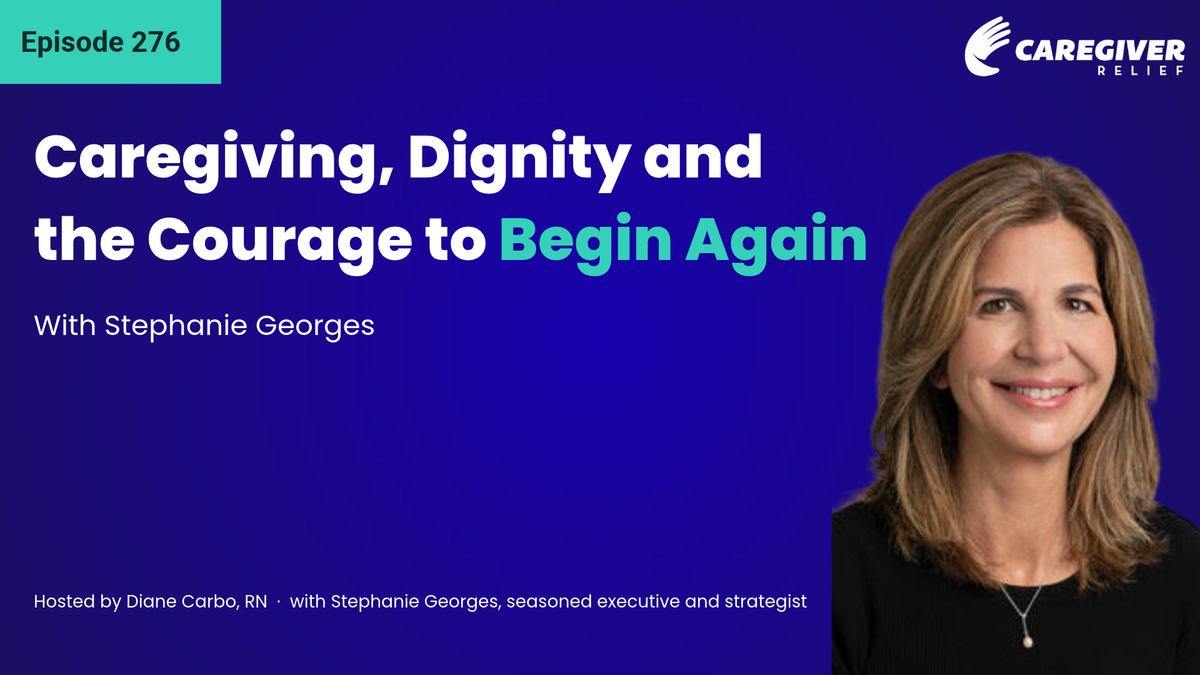
In this episode of the Caregiver Relief Podcast, host Diane Carbo, RN sits down with Stephanie Georges, a seasoned executive and strategist with four decades of experience guiding organizations through disruption and reinvention. Her understanding of transformation became deeply personal when her mother was diagnosed with Alzheimer's disease 🌿.
Together they talk about dignity, legacy, the invisible burden carried by women, and why caregivers need community, not just another list of resources 🤝.
🔥 What You'll Learn in This Episode
- 💜 Stephanie's Journey: How her mother's Alzheimer's diagnosis changed her understanding of caregiving.
- 🌸 Preserving Dignity: What dignity looks like as Alzheimer's disease progresses.
- 🕊️ Honoring Choices and Legacy: Respecting a loved one's identity and wishes when she cannot voice them.
- ⚖️ The Invisible Burden: The compounding toll of executive stress, caregiving and carrying everyone else's needs.
- 🤝 The Power of Community: Why caregivers need connection and shared perspective, not only practical resources.
- ✨ Reclaiming Your Identity: Finding yourself during or after caregiving, and the courage to begin again.
📋 Episode Outline
- 🎙️ Introduction: Diane introduces the question of protecting dignity when a loved one can no longer advocate for herself.
- 👤 Meet Stephanie Georges: Executive, strategist, Harvard Advanced Leadership Initiative Senior Fellow and co-creator of The Meraki Dignity Project.
- 💔 The Diagnosis: Stephanie's journey following her mother's Alzheimer's diagnosis.
- 🌸 Dignity and Legacy: Honoring a loved one's choices and identity as the disease progresses.
- 👩 Women and the Invisible Burden: Why women so often carry everyone else's needs.
- 🤝 Community Over Checklists: Why connection matters as much as resources.
- 🌅 Beginning Again: Reclaiming identity and finding the courage to start over.
🌐 Connect With Stephanie Georges

🎧 Your Identity, Needs and Dignity Matter, Too
If you are caring for someone with Alzheimer's disease or navigating another major life transition, this conversation will remind you that you matter too. Press play, then share this episode with another caregiver who could use some encouragement 💜.
Podcast Episode Transcript
Diane: Welcome to the Caregiver Relief Podcast. I'm Diane Carbo, RN, your host. When someone we love is diagnosed with Alzheimer's disease or another type of dementia, the journey affects far more than memory. It changes relationships, family roles, and the way important decisions are made.
As the disease progresses, family members may be asked to speak for someone who can no longer clearly communicate their wishes.
How do we preserve that person's dignity? How do we honor their choices, protect their identity, and carry their legacy forward? At the same time, women often carry an invisible and compounding burden.
They may be managing demanding careers, family responsibilities, caregiving, and everyone else's emotional needs, while quietly setting aside their own health, identity, and future. My guest today understands transformation from both a professional and deeply personal perspective. Stephanie Georges is a seasoned executive and strategist with four decades of experience guiding organizations through disruption, reinvention, and large scale transformation.
She began her career as top ranked Wall Street as a top ranked Wall Street analyst during the telecommunications deregulation era. She later moved into C-suite roles in telecommunications and technology, where she led major transformations that drove strategic growth and market leadership.
Stephanie brings deep expertise in developing solutions that align with organizations around their mission while prioritizing people and their unmet needs. Her understanding of caregiving and dignity became deeply personal following her mother's Alzheimer's diagnosis.
That experience contributed to her work co-creating the Meraki Dignity Project, a woman's movement dedicated to restoring dignity and supporting women as they navigate caregiving and other pivotal life transitions. Stephanie is also a Harvard Advanced Leadership Initiative senior fellow.
Today, we will discuss Stephanie's caregiving journey, the invisible toll carried by women, honoring a loved one's choices and legacy, and the power of community in finding the courage to begin again.
Diane: Stephanie, thanks for joining me today.
Stephanie: Oh, thanks, Diane. Thanks for having me.
Diane: Oh, I'm excited about this topic, 'cause as I told you before, every single, podcast that I do has been, someone who has cared for a family member in some fashion or form or fashion.
They identified a product or, an obstacle, a challenge, and a solution. So I love that you have a solution for us.
Stephanie: Yeah.
Diane: Now, before we discuss Alzheimer's caregiving and the Meraki Dignity Project, please tell us a little bit about your mother and, your journey through Alzheimer's.
Stephanie: Oh, oh, it's going to, it's going to be hard for me to do this without getting a little teary, but my mom, immigrated from Greece, thus the word Meraki, which I'll explain later. Okay. I'll keep you hanging on that. but she came when she was 14, alone, well, with her sister. Anyway, she kind of self-educated, went to the school, spoke, no English when she started, kind of bootstrapped her way to being a cancer researcher, interestingly at Sloan Kettering in New York City.
Diane: Oh, wow. That's impressive.
Stephanie: It was impressive. I know that I could not have done what she did. and that's something that I still admire, and just see glimmers of that even today in her. but she, she was really central. She ended up giving up her career to raise three children. and we all went our own ways and continue to be close knit as a family.
Again, we were first generation, so there was a lot for us to sort of trailblaze. But she was certainly a, a role model and exemplar. About, oh, six years ago, we started to notice there were... my dad was, is still alive. He's 98. and he is, started to notice some things that were changing in her, her ability to make sense of things, getting lost, very much typical what you would imagine coming with Alzheimer's. But I think we all didn't really want to believe it. we got almost impatient with her in hindsight to didn't really know, didn't really want to admit that something was changing Needless to say, we actually took a family trip in 2019. We took a family trip back to Greece, which in hindsight was such a gift.
I don't know why. We all went, my siblings, my parents, my kids, my daughter's children. Anyway, we all, went there, and it ended up being the last time my mom went to Greece. She's still alive, but she cannot travel. But we were there, and we came back, and we decided we should check it out, and we did.
And since then, and she was diagnosed with Alzheimer's definitely early stage, and we went through COVID. My sister and I had her move into my home, and my parents stayed with us, and we have been sharing the caregiving pretty much ever since. We do have the luxury of having caregiving help, but even with that, Diane, I think there's this, you know, you just, there's no one like family to feel like they have the intuition of knowing
Diane: Stephanie
Stephanie: what someone suffering needs.
Diane: You're absolutely right. In fact, Dolly Parton, we know of her recent death, but she was a caregiver to her husband. And yes, she has, she's a very wealthy woman. She, but she felt that nobody could take care of her husband as good as she did. She missed doctor's appointments, typical caregiver.
Even with all her money, she wanted to be home with her husband till he passed, and she did. And then she waited too long, and she developed a cancer that was far beyond what they could save. So it's the typical caregiver. and people think because you have money and that outside help does help somewhat, it's still the family is the most when you're really a true sense of community, you're all willing to take care of your loved one.
Stephanie: Yep. It's so true, and I'm really glad you brought that point up because it's this pull to feel like it... And it's not an obligation. It's more like you know, we can sense, and I think even more so with someone who has dementia or Alzheimer's, not that it's less so with other, caregiving requirements. But I think because that person can't articulate for themselves, there's this, this connection that you have that you just sense.
Diane: Absolutely.
Stephanie: You sense when something's going wrong. You sense when they want something. Yeah. And, and that comes with a lot of emotional, that requires a lot of emotional attention.
Diane: Yes. Yes. Yeah. And it's draining. It's absolutely draining. Yes. I know I've been, my family members didn't have dementia, but it, I was, but I still was there, and it is draining. I had a son who had, reflex sympathetic dystrophy while he was in the military. It's a serious chronic pain condition.
They call it the suicide disease, and I literally... I've been a care manager, I've been a discharge planner. Dealing with the military medical delivery system broke me.
I literally... I was trying to work while I'm making phone calls. So I understand, you know, it's really hard. And then those with dementia, it's even more challenging because you don't, you can't come home and it, you don't know what you're going to expect when you get back.
Like, if you go to the office for a few hours and you come back, you don't know what you're going to find.
Stephanie: Exactly. Exactly.
Diane: It's tough. Now, you spent decades helping organizations navigate disruption and transformation. That tells me that you know how to handle dementia.
Stephanie: I know. When you said 40 years, I was like, "Oh, ouch."
It's been that long.
Diane: Hey, I've been a nurse for 50-some years, I,
Stephanie: I'll- Just creeps up on you, doesn't it?
Diane: Yeah. Oh, yeah. I'm still that young nurse that I want to be, but that's- My body says, "Nope, nope."
Stephanie: Oh, no. That's what I see. I get it.
Diane: Yeah. I get it.
Stephanie: No, I think one, I don't know that, you know, like many things in life, they make sense in hindsight.
Diane: Yes.
Stephanie: And I think that in hindsight, being in a place where I could, help organizations
Diane: Yeah
Stephanie: navigate change, have the ability to see, you know, to not get caught up in the little things and really see the, look past the horizon, but know you need to take step forward, was, I think, important training for navigating change and navigating, the change that my mom and my whole family, I shouldn't even say my mom, my whole family, including my children and my partner, that we all had to go through in, the change that my mom was going through.
So I did feel like, I don't know whether I was drawn to that or skilled at it, because it was preparing me for something, or just the fact that I was able to really draw on those skills in that moment, and that's served me extremely well. It hasn't made it easier, but it's definitely given me some tools that I felt have been important in a surprising way.
Diane: Absolutely. One of the most difficult things for people that have managed other people is if you do have outside help come in, and they're there on a regular steady basis, it's really hard to manage because you'll, you may see things you want the family caregiver to get somebody else. Or the family, your mother or dad to get somebody else.
You don't like the way this person is, or you don't feel good about them. But they've had so much intimacy with bathing and dressing, and your family member is drawn to that person and so bonded, they don't want to give them up, and it's so frustrating. But that's a whole nother story.
Stephanie: Oh, no. I'm so glad.
I mean, and I don't want to take us down another path, but in fact, my sister and I were just dealing with that. We love our family caregiver, but there have been some, you know, when they, there have been some misses, and there have been some things that just didn't go the way
Diane: Yes
Stephanie: any of us including her.
Diane: Yeah.
Stephanie: And there is this tension as the caregiver, and we have my dad involved who's present but really can't help my mom. Like I said he's 98. But then he has all this anxiety about not wanting to lose this caregiver because he feels so beholden, and appropriately But then we don't have, my sister and I don't have the ability to maybe structure things the way we need it for the outcomes that we want.
And so you feel like you're, there's this constant dilemma of you know, am I not giving, am I not enabling the care that I want? Can I talk to my caregiver in a way that doesn't alienate me and my sister from her work? How do we navigate that with my dad? I mean,
Diane: all of those questions .
Yeah. Well, you know, I have seen this so much, and it's really hard because the patient or even the spouse of the patient, like your father, they will blame you versus the family the caregiver because they are, they feel so, attached to them and they know that they're meeting their needs when you may not be meeting their needs.
Stephanie: Yes. yes. And there is, and it's generational too because I think that was a generation that sort of, you know, would take, I think this generation is more apt to challenge, Yeah ... challenge the system, challenge the medical professionals, are more informed. And that was a generation that was much more, complicit and obedient and
Diane: Oh, yes. Yes. Whatever the doctor says is word, and they're God, and they make no mistakes and all.
Stephanie: Yeah. yeah. That's a whole another topic.
Diane: That's a whole another problem. But now you spent decades, helping the organizations navigate these. you also describe the compounding weight of executive stress, caregiving, and carrying everyone else's needs.
What did that invisible burden look and feel like in your own life?
Stephanie: Well, I think that, I'm, that is a really good question that gets to the point of what we're trying to do at Meraki because that's the problem that I saw that I was trying to solve. What I found was work, managing and navigating work with other caregiving responsibilities that were growing wasn't just about my mother's health.
Diane: Yeah.
Stephanie: It ended up being a holistic project, right? So where I saw it was affecting my own personal health, my stress. there was a story, one of the experiences I had was I was literally at a dinner meeting with one of my colleagues, and we were sitting and eating, at a high-top table in a restaurant.
I had just flown back from New York. I was in Denver, and sitting there eating, and literally collapsed, like passed out, at the table. And, ambulance, the whole bit. And not it wasn't, it, everything was fine. It was dramatic. It was literally just complete exhaustion exhaustion and stress.
And there I was just, sitting at the dinner table, sitting at the table talking, thinking I could just power through. So I think the personal stress. I think understanding what the benefits are and what my work requirements were, what my schedule could be, how I could negotiate that, how I can navigate it, I didn't really have...
I noticed that I didn't really have the tools or the information, or I didn't even know where to start.
Diane: Yeah.
Stephanie: It wasn't that my organization was withholding, it's just not accessible, and you don't even, when you're in this situation, you're at such a high needs state. you're navigating this personal change in your life.
You don't really think about, what am I gonna ask my HR representative? And what are benefits programs? And let me go to the manual. you know, you're in sort of a distress.
Diane: Yes.
Stephanie: And then, there was the money. Can we afford it? What has my dad done? How do I ask my dad?
What do I, you know, what is, what are his wishes? What are my mom's wishes? How does my sister play into it? So there was a whole, so there was health, there was my work, there was money, my own money, my family's money. How are we gonna navigate this financially? And then relationships, my own marital strain, my own challenges with my kids around where I'm gonna spend time and how am I gonna be home to help them do their homework versus going through this, the little time I had to give.
How do I split that between the various pulls in my life? So it was a whole life problem.
Diane: And it is. And some, in some cultures, and I've seen this over my decades of nursing, some cultures absolutely feel that the oldest daughter or one daughter in the family, they could have a whole, bunch of sons, but if there's a daughter, she must take on that burden, and that she must quit her job and do the work.
Nobody considers her, Social Security, her health. I have seen these men say, "Well, I need to work for my family." Meanwhile, this young woman or a spouse, they need help. But it's the expectations placed on them, their uninvolved siblings, and extended family members who are judgmental, it's hard.
The pressures, the unrealistic pressures. And with the changes in our healthcare system right now, that, they're cutting back. They've, they're cutting back on benefits so much and making... I don't know if you're aware of this, but if you have a Medicaid or Medicare Advantage plan, when you go to a skilled facility, you may be charged t- $200 to $400 a day for recovery, for rehab.
And I'm seeing more unsafe discharges to home than ever before. even with traditional Medicare, they're sent home on the 20th day because the reimbursement's so low for therapy, Stephanie, that a facility gets a higher level of reimbursement if they don't provide therapy.
Stephanie: It's un like so distorted.
Diane: Oh, it is, and we are really at a serious breaking point in our culture right now. one of the things you talk about is, preserving dignity, and I love that because it's hard when, to feel dignified when your, extended family members or siblings are telling you it's, you're not doing it right, you're not doing it good enough, and they don't offer any help.
So can you tell me what dignity means to you and how families preserve a loved one's dignity?
Stephanie: No, we were, when I began looking into how can we support, in our case women, because they were disproportionately affected, with a lot of the responsibilities. And the, to your point, the workplace had changed for them, and the sort of the system that require, what it required of them hasn't changed. one of the things that we stumbled on was we started thinking about what we were doing in terms of equity, and pretty quickly we realized that equity, while we believe in equity, the word had been co-opted as a zero-sum game.
Someone wins at the expense of others. If, you know, women win at the expense of men, you know minorities win at the expense of others. And so it felt like, you know, and even in the example you described, that, oh, the caregiving system, someone wins at the expense of the other.
Diane: Yeah.
Stephanie: When ultimately we realized that we needed to get away from zero-sum language, and one of the words that allowed us to do that, or one of the concepts, was dignity. And dignity ultimately is, it's a really hard one to describe, and it's kind of a big word, but for me it's inherent. it's everyone has it.
Everyone has it, and it cannot be taken away.
Diane: Yeah.
Stephanie: So we can honor it and we can violate it. and ours can be honored or violated, but it is what makes us all connected. It connects us all. So it felt like the most common grounding way to create connection and to create community and a shared, belief set, in a pretty chaotic and split world.
Diane: Oh, absolutely. Now, Alzheimer's sometimes causes others to see only the disease. That makes me crazy. They don't see the person anymore. And they still are, maybe have changed a little bit, but they're still the person that you grew up with or knew your whole life. How can families continue to honor the person's identity, life story, values, and legacy?
Stephanie: Oh, that's a really ... We, you know, you're right, and I think even as a caregiver and a daughter or someone in the family, sometimes you lose sight of that too because you're so fixated on solving an immediate problem. But what I've found, and what we, what we've tried to build into our, our, into our product, is really an understanding that the person is still there.
And so you can see those glimmers. Like, my mom's personality is still the same personality. She's feisty, and she's, and she's stubborn. And while those may look like Alzheimer's, traits, they actually are her traits, but just magnified. And so I think one of the things that we saw was an opportunity, was to just kind of look at her behavior in the context of who she is, and it just sort of more humanizes her.
And it may be more exaggerated, and it may be more clever, but it's not, it's not so much a, symptom of the disease, but maybe just an exaggeration of who she is. And that, that's fun. It's funny, and it's fun, and it's, and it allows us to see her in a human way. And I will say, Diane, it also generates stories.
Which is the second thing that we found. Like, just- Sitting with my mom and telling stories about herself and about her and her, us growing up and just reminiscing, we find you can just see these moments where she connects. So I think that not only, in my mind I hope it helps her or supports her, but it also helps us remember that she is connected to those moments.
So those are two things that, we feel, you know, I think it's both about seeing her as human and reframing the symptoms as, part of who she is as opposed to attacking her
Diane: Now, I wanna talk about the power of community. You have created, the, your project. I want you to talk about the power of community and, the Meraki Dignity Project.
Stephanie: Yeah, so really the, the concept is women are navigating change. It's for women who are navigating moments of change, and caregiving happens to be one of the more prominent ones that we see on our platform. The other one is women, navigating a change in their work. Whether they wanna reenter the workforce or exit the workforce.
And what's interesting, Diane, is that those are not necessarily mutually exclusive. Sometimes women re- navigating their workplace because they've had a caregiving event in their
Diane: Yes
Stephanie: in their household. So what we found was there's a lot of connection between those two. So women can, you know, women who come to our platform, and we've really for now focused, we've really focused on women because we believe that women bear the burden.
So women come to our platform generally knowing that they're navigating some sort of transition or they're about to. A change, a life-changing moment for them and their family. And we initially just support them with resources and knowledge, so just like what you were talking about earlier. And we use, an AI capability, but the capability is really just a guide.
So this AI capability will really synthesize what your specific situation is, and perhaps give you some information about Medicare or about what it, what might be going on with the latest rules around, therapy and physical therapy. So that's the first step. The second step is we can then, Sophie, who's our guide, can then potentially connect you with an expert, a knowledge expert.
It could be you, Diane or it could be it could be women, it's generally women on our platform who have knowledge about specific aspects of navigating a transition or change. And then the third piece is we also give you the opportunity to connect with community on your own terms. So this is women who are navigating a similar life-changing moment.
So we have a community of women who are navigating caregiving. We have a community of women who are navigating work change. We have a community of women who are recently divorced. So these communities are much more about- Not being, not feeling alone
Diane: Yeah
Stephanie: and being seen and supported. So that's what we do.
That's a beautiful, that's a beautiful concept because we lack the sense of community in our culture anymore. And, one of the big things about the boomers is nobody wants to be a burden to their family member, and I take issue with that because if you had a sense of community, it wouldn't matter.
And I really, my example is I, worked at a, a Quaker home a nursing home, and assisted living, and they had intergenerational living on their campus. And everybody, as part of their faith, would be doing things like passing water, passing snacks, sitting vigil when somebody was dying those types of things. And they even they built this building, both assisted living and the nursing home, and in the center of it is a daycare center so that the seniors can see the youth of their community and then they get to interact with them when it's healthy, they're healthy and well or whatever.
But, then people aren't seen as a burden. They're just seen as part of the community, and it's a fact of life. We support those in our community. We have totally lost all of that.
Stephanie: Yeah.
Diane: And it makes me sad, so I love when you're talking about this, as offering a sense of community in so many different arenas because, we are lost out there right now, and we need, a sense of community.
So I really want to, appreciate or tell you how much I appreciate what you're doing. Thank you. Thank you because I know as a caregiver, even with all my experience and stuff, it just, it gets challenging, and you do feel alone.
Stephanie: Yeah.
Diane: Yeah. You really do feel alone. I understand that. And,
Stephanie: And maybe, you know, the community may not have you know, it's not really designed to provide that answer, but it is designed to provide the compassion and the empathy
Diane: Yes
Stephanie: that allows you to feel like, "Okay, I felt seen. I left feeling seen." Yes. There are other places we can get knowledge and resources. Yes. and I'm not saying the community doesn't bring that as well, but it's not the burden of the community to have all the answers.
It's just
Yeah I've been there.
Diane: Well, the majority of caregivers- Family caregivers feel invisible to the system and to everyone around them. And so even being seen and acknowledged is such a huge thing for so many of them, because the caregiving journey can be as, short as a few months to as long as 10 to 15, sometimes 20 years.
So we really have, you know, we really have to focus on, creating spaces that people feel encouraged to come to and feel welcomed and heard.
Stephanie: Yes.
Diane: That's awesome. So Stephanie, what would you say to the woman who feels exhausted, invisible, and afraid that it's too late to begin again? And how can she take that first small step towards a new chapter?
Stephanie: Yeah, I mean, I think that, the first step is really just Breathing.
Diane: Yeah. Yeah.
Stephanie: And giving yourself the space to... this is, I'll speak for myself. For me, just acknowledging that you can't do everything. And so really letting go and creating space, and living a little bit in the uncertainty.
I think so much of our society is we have to know everything, and have to have everything organized and solved and in a box, and in a compartment,
Diane: and done right away.
Stephanie: And done right away. And yes, yeah and I think that I really appreciate your commentary about losing the sort of the threads of community.
I think similarly, we've lost the ability to be, not have the answer right away. We have we have Google, we have chat, and we have all these ways that we can get an immediate answer. But sometimes the immediate answer is not necessarily the right one. sometimes
Diane: Exactly, yeah
Stephanie: we give up more than we should, or we're not giving ourselves time to think about what are the, what is a broader set of possibilities.
Diane: Exactly. When there are-yeah.
Stephanie: No, I was just gonna say, I think, yeah ...
Diane: if there are many solutions to a problem.
And it doesn't, and what you see as a solution, somebody else may see it another way.
Stephanie: Right. So. And we tend, when things become stressful and we're under, when something changes, and this is what I learned in disruption in organizations, and I think it applies to humans, 'cause organizations are just in a, you know, just a amalgamation of individuals
Diane: Yeah
Stephanie: that are going in a direction.
But we tend to narrow our focus, and I call it looking through a straw. And I think giving yourself a little bit of time, and the ability to be uncertain, which sometimes can be described as taking risk
Diane: Yeah
Stephanie: is okay. Like, taking some risk or not having the immediate impulse to do something, maybe give you more degrees of freedom.
There is emergencies and there is things that you have to do something immediately, but most of the time Taking a breath and giving yourself the chance to sort of take a step back opens up more options, and it feels, less confining. And I think that's what the combination of knowledge and wisdom of a community bring.
Diane: Exactly. Exactly. Stephanie, I want to thank you so much. how to, how do my listeners reach out to and find you?
Stephanie: They can go to merakidignity.com. That's our website, and on there you can learn all about us. You can sign up for our platform. Right now it's free because we are running it as a beta so women can, you know, it's focused on women, so women can sign up and be part of our community, be part of our knowledge base, and, give us feedback.
So that's
Diane: Great
Stephanie: that's how you can find us.
Diane: Spell Meraki for them.
Stephanie: It's M-E-R-A-K-I, dignity as it's spelled, .com.
Diane: Thank you so much.
Stephanie: Thank you.
Diane: This has been pleasurable, and it's just you've got so much to offer, my listeners out there. I appreciate that.
Stephanie: Thank you.
Diane: To the family caregivers out there, you are the most important part of the caregiving equation. Without you, it all falls apart. So please learn to be gentle with yourself. Practice self-care every day because you are worth it.
Caring for a loved one can be overwhelming — but you're not alone. If you have questions, big or small, our expert team is here to help.
👉 Click here to Ask the Expert
Our Resource section can help you find the information and tools that you need. We have courses, videos, checklists, guidebooks, cheat sheets, how-to guides and more.
You can get started by clicking on the link below. We know that taking care of a loved one is hard work, but with our help you can get the support that you need.
Click here to go to Resource Section now!