The Truth About Type 2 Diabetes: Insulin Resistance, Blood Sugar, and What Standard Labs May Miss with Dr. Jason Shumard - Episode 258
Dr. Jason Shumard joins Caregiver Relief to explain why Type 2 diabetes is more than a blood sugar problem. This episode explores insulin resistance, metabolic dysfunction, inflammation, hormones, stress, and why standard labs may not always reveal the full picture behind chronic blood sugar issues.

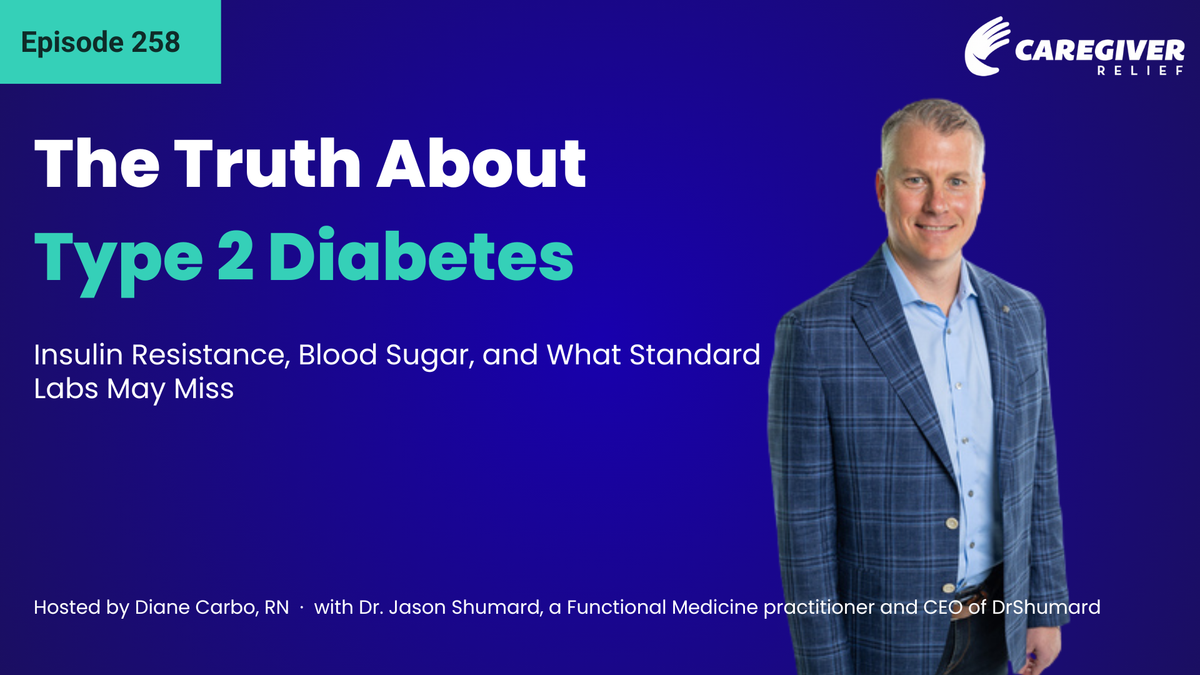
In Episode 258 of the Caregiver Relief Podcast, host Diane Carbo, RN, speaks with Dr. Jason Shumard, a functional medicine practitioner and CEO of drshumard.com. Together, they unpack why Type 2 Diabetes is much more than a blood sugar issue, how cellular damage and systemic inflammation drive metabolic dysfunction, and why standard lab tests often miss early warning signs for decades.
Whether you are navigating a new diagnosis or caring for an aging parent, this episode offers an eye-opening look at root-cause healthcare and proactive steps to restore metabolic wellness ❤️.
🎧 Episode Breakdown & Key Highlights
- Welcome & Introduction
- Host Diane Carbo introduces Dr. Jason Shumard and sets the stage: Type 2 Diabetes isn't just about glucose—it's tied to stress, hormones, inflammation, and cellular health.
- The Gas Tank Analogy: How Insulin Resistance Really Works 🚗
- Dr. Shumard breaks down how our bodies convert glucose into fuel and explains insulin resistance through a simple car engine analogy.
- High blood sugar is a symptom, not the root cause—the real damage occurs at the cell wall long before labs flag high glucose.
- What Standard Labs Miss (and What to Look For Instead) 📊
- Why serum insulin levels and the Triglycerides-to-HDL ratio (ideally below 1.5–2.0) reveal metabolic issues 5 to 20 years before an A1C or glucose test spikes.
- Systemic Inflammation & The Myth of Diet Alone 🔥
- How environmental toxins, seed oils, stress, and processed foods inflame cellular walls.
- Why simply losing weight or eating "better" doesn't always reverse diabetes if root cellular damage isn't addressed.
- Historical Feeding Habits & Pediatric Type 2 Diabetes 👶
- Diane and Dr. Shumard discuss how dietary advice has evolved over decades and explore the alarming rise of Type 2 Diabetes and metabolic issues in children.
- The Truth About GLP-1 Weight Loss Drugs 💊
- A critical look at GLP-1 medications (like Ozempic): microdosing benefits vs. high-dose side effects, muscle loss, gastroparesis, and rebound weight gain.
- Root Drivers: Liver, Gut, Adrenals & Toxins 🌿
- How cortisol/stress, poor gut health, fatty liver, thyroid imbalances, and mold/heavy metals block insulin receptors.
- Investing in Your Future Health vs. Sick Care 💰
- Why relying solely on insurance "sick care" leaves people trapped on lifelong medications, and how proactive health choices pay dividends in quality of life.
- A Message of Hope & How to Connect 😎
- "Type 2 Diabetes is a diagnosis, not your identity."
- Practical steps for seeking functional medicine analytics and accessing Dr. Shumard’s educational resources.

😄 Key Takeaways for Caregivers & Families
- Look Beyond Standard A1C & Fasting Glucose: Ask about checking serum insulin and calculate your Triglycerides to HDL ratio to catch metabolic dysfunction years earlier.
- Address Systemic Fire: Systemic inflammation from stress, processed foods, toxins, and poor gut health blocks insulin keys from opening cell doors.
- Focus on Muscle & Protein: Rapid weight loss without strength training or adequate protein leads to muscle wasting and long-term metabolic slumps.
- Invest in Root-Cause Health: Proactive lifestyle adjustments and functional health tests cost far less over time than decades of managing chronic disease symptoms.
🔗 Mentioned in This Episode
- Dr. Jason Shumard's Educational Webinar: Register and learn more at DrShumard.com.

Podcast Episode Transcript
Diane: Welcome to the Caregiver Relief Podcast. I'm Diane Carbo, RN, your host, and today we are looking at type two diabetes in a way many families have never heard it explained before. When someone is told they have type two diabetes, the conversation usually centers around blood sugar numbers, medication, diet, weight, and the A1C.
Those things matter, but they do not tell the whole story. Type two diabetes is often connected to insulin resistance, metabolic dysfunction, inflammation, hormones, stress, sleep, and lifestyle patterns that may develop over time. And for many families, the most frustrating part is hearing that labs are normal until suddenly they are told they have prediabetes or are in full-blown type two diabetes.
My guest today is Dr. Jason Shumard, a functional medicine practitioner and the CEO of drshumard.com. He has more than 20 years of experience in helping people understand and address the root causes of type two diabetes and insulin resistance. Through a personalized lab-based approach, he helps patients uncover the metabolic, hormonal, and inflammatory drivers behind chronic blood sugar issues.
Today, we'll talk about why type two diabetes is more than a blood sugar problem, what standard testing may miss, and how stress and inflammation affect blood sugar, and what practical steps and care practical steps patients and caregivers can take to better understand metabolic health.
Diane: Dr. Shumard, thank you so much for joining us today.
This is a very important topic, as we have type two diabetes rampant in our country, even in our youth. So I appreciate... And I want my listeners to know, functional medicine doctors are the truly the last frontier of good medicine. it just is. a functional medicine doctor continues to look at the holistic approach, whereas we are so specialized now in everything.
They, nobody looks at the whole person. So thank you for joining me, Dr. Shumard. I appreciate it.
Jason: Thank you so much for having me. I think you're right. You've hit the nail on the head. This, this information is so valuable.
Diane: Yeah.
Jason: We've come to a system or, and society that people believe the symptoms are based on what their health is really all about, and we need to look beyond the symptoms, but pay attention to the symptoms, but look beyond them. Look deeper to really what's going on in the body.
Diane: Yes. Now, most people hear type two diabetes, they immediately think of blood sugar. Why do you say Type 2 diabetes is more than a blood sugar problem?
Jason: Yeah.
Well, see, the blood sugar is essentially a symptom or a, a signal to the body there's something going on, right? When we look at the, the simplistic of the body, we consume food. That food gets converted to glucose, our fuel source, and we have to utilize that as an energy source. And so I always compare it to the car, right?
If you have a car, you put gas into your gas tank. Now that gas has to get to your engine. So how does it get to your engine? Through the fuel line. It goes through a fuel filter to clean the gas up, gets into your engine, and then the gas will then combust into energy. The same thing happens in our body.
We consume food. Our gas tank is our digestive tract. It converts it to glucose. Our fuel line is our bloodstream, and then it has to go through our cell walls, which is essentially our filter, and then enter into the cells into our mitochondria, which is our engines of our cells, which now we can convert that glucose to energy.
That's a very simplistic way of looking at it, but it's one of the most basic, fundamental functions of the human being. Now, there is one more other component that has to go on there in the human body, and that is something called insulin. Now, insulin is produced by your pancreas, and the purpose of insulin is essentially to grab the glucose, drag it over to a cell, and now the insulin will attach itself to what's called an insulin receptor.
This is... Think of it as like a key to unlock the door, if you will. So the insulin attaches to that receptor. It unlocks the doors. The doors open in the cell, and then now the sugar can enter the cell into the mitochondria. Now, what happens in many, in cells, in individuals who are dealing with insulin resistance is it's not that your body's no longer resistant to insulin It's that your cells become resistant, 'cause the ability for your insulin to attach to that receptor becomes deficient.
So if your insulin can't attach to that receptor, the cell door never opens. Now, in a one or two cells, it's not that big of a deal, but let's talk about 10%, 15%, 20% of your cells now this is happening to over many years and decades. That's why it takes 10 to 20 years before someone actually gets the diagnosis of diabetes.
But eventually, when those cells can't open their doors, that sugar starts to pool back into the bloodstream. So it rises in the bloodstream. So you get a blood test done and your doctor says, "Oh my gosh, your blood sugar's 200, 300. You have Type 2 diabetes." And immediately it's saying, "What can we do to lower the sugars?"
Now, of course, we don't want high sugars in our bloodstream. It's very problematic for the arterial walls, cardiovascular system, nervous system. There's many problems that can happen with excessive sugar. We do wanna drop that. But that's just the initial stage, right? It's like the Band-Aid, right? If you're bleeding, put the Band-Aid on, but then there's the healing process starts to happen.
So unfortunately, but all of the response is to help try to lower that sugar when the reality is the cells are where the damage occurred, which caused the sugars to go high. And nobody is evaluating the cells, identifying what's causing the cells to be damaged, and fixing the cells, because if you can get your cells to do their job again, your sugars will naturally go lower.
They'll naturally go back to what they're supposed to do because that's the normal function of your body. It makes no sense to have somebody standing in your engine pouring gas into the engine, which is essentially what's happening. Let's get the f- whatever the problem is you can't get the gas from the gas tank over, fix that.
But in the human body, the, the mindset is just totally different. We don't look for a solution. We look just to make sure we're feeling better.
Diane: So what lab markers do you look at when trying to understand the bigger metabolic picture then?
Jason: Yeah, there's many markers I can look at. Obviously, you said one of them hemoglobin A1C.
I think insulin, serum insulin is a very important marker because we can identify if your pancreas is producing too much insulin. These are the... What happens in the early stages of this metabolic dysfunction is your body will naturally, or I should say your pancreas will naturally start producing excessive insulin.
That's its job because I got high sugars, we got to push into the cells, push into the cells, so we'll increase that. but what, what happens over time when you have this substantial amount of insulin in your bloodstream, it's like throwing too much water on a plant. It destroys and kills the plant.
When you put too much insulin around a cell , it destroys the cell, and it perpetuates the, this insulin resistance situation here. So we have to look at the big picture, and so we can really see if your insulin levels, let's say your glucose levels are 95, your A1C is in a good range, but your insulin's at a 12, then you're developing this problem going on, right?
You're just not seeing the other picture happening yet because these things fall like dominoes. And so we can look at different things. We can look at things like triglycerides to HDL ratio. That can identify if there's some early signs of insulin resistance or this problem going on. That's why we can see these issues 5, 10, 20 years before the person ever gets diagnosed because it takes that long for enough of the cells to be damaged that we now see a symptom of elevated sugar.
Diane: The average, practitioner, the PCPs of the world, let's say, aren't trained to look for these things ahead of time.
Jason: Yeah
Diane: They we are a, a society, a culture where our doctors, our medicine it actually responds to symptoms and doesn't try to prevent disease. So I'm very interested in learning. This is the first time I've heard of this approach. But, now how can inflammation contribute to insulin resistance and chronic blood sugar problems?
Jason: Yeah, 'cause inflammation is like fire. That's how I explain it, right? It's... And fire is very damaging, it destroys, it kills. And when people think about this inflammation, they're thinking like their joint's hurting or they're thinking like their elbow or their shoulder. That's a portion of inflammation.
That's not the type of inflammation that we're talking about. We're talking about the systemic inflammation. It's in your arteries. It's being circulated. There are multiple different things that we can look at that are inflammatory type markers, and these will get into your tissues, get into your cells and your organs, and they literally damage them at the level, right?
It's like a fire starting in a portion of your home that eventually destroys your entire home over time, and that's what happens in the body as well. So there's lots of things that can create this systemic inflammation, and we have to understand the different mechanisms. We know lifestyle can be a, a strong contributor to inflammation.
If you're eating the wrong types of foods, if you're eating processed foods, if you're eating a lot of fast foods, seed oils, these things like that are causing major internal inflammatory reactions and just destroying the ability for their cells to do their natural job. You know, environmental toxins, like heavy metals, molds, and things like plastics, pesticides, herbicides, these are all can get into our body and create havoc inside the system.
We know stress, right? Just from a mental stress, a physical stress, chemical stressors, the water you're drinking. If you're not consuming the right types of nutrients or you're drinking lots of sodas and sugars and stuff, all these things can be contributing factors. But the problem that I want to really people to recognize is the belief pattern is, if I just change my diet, if I just exercise, if I just lose weight, this is going to fix my diabetes.
I can tell you with absolute certainty, it will not in a majority of the cases. In some cases, you may find that nut. That blind squirrel can find that nut sometimes. Yeah. But the reality is for a majority of individuals, you will not be able to reverse your diabetes, and this is what becomes so frustrating, 'cause they're...
I meet people every single week, and they're like, "Doc, I'm eating properly. I'm exercising. I've lost 25, 30, 40, 50 pounds, and I'm taking more medication." I'm like, "I know, because your belief pattern is that if you just do those things, it's gonna fix it." Unfortunately, that's not the reality
Diane: Wow. That's a lot of information there
Jason: Yeah.
Diane: I'm, it's against everything we're ever been told, and I find that fascinating. And so many of us... I wanna share a story just because.
Jason: Yeah.
Diane: I was born in 1953. My mom died when I was 18, and, we have diabetes in the family. But when I was going through the papers and stuff, the...
My prescription for the formula that they ordered for babies in those days was whole milk with Karo syrup in it.
Jason: Oof, wow.
Diane: And when I saw that, now That was 50-some years ago. When I saw that, I thought, "This is..." 'Cause I was a nurse. I became a nurse in 1974. So you start learning about diabetes and stuff, and I wanted to try to prevent it and teach my sons proper eating.
I was shocked that, our government, our medicine, our, physician's associations were ordering Karo syrup in milk and liquid vitamins for babies to start off their life. It's oh.
Jason: I got one for you here too. So when I was a baby, I had a lot of, I had allergies, asthma, in and out of hospital for most of my first years of life.
But when I was young, the doctors told my mom that I was allergic to her breast milk and recommended Gatorade.
Diane: Oh, my lord. Oh, my lord.
Jason: Gatorade.
Diane: Oh.
Jason: And they wondered why I had so much energy. I was all over the place, running around.
Diane: Yeah.
Jason: You know, considered the crazy, out of control kid. The bad kid who just wouldn't listen.
I was being fed basically pure sugar at a
Diane: Yep
Jason: I mean, from zero to one
Diane: Yeah
Jason: because I was allergic to my mom's breast milk
Diane: The alert. You know what? There was such a movement for pushing people away from breastfeeding, women away from breastfeeding.
Jason: Yeah.
Diane: And it's really sad because that's the best thing a, a child could have.
And if moms... I know women are also feeling inadequate if they couldn't breastfeed.
Jason: Yep.
Diane: But there were solutions to that nobody offered women. and I don't know if that's still going on today, but, breast milk is the best for babies. It just is. But
Jason: Every single mammal you can see across the world
Diane: Yes
Jason: human and animals, they need breast milk or animal... their mom's milk only for a minimum the first year or plus.
Diane: Yeah.
Jason: And so, you know, our kids, we have twins, I think we did two years of doing, because it just, we just knew the benefits of it.
Diane: Yeah.
Jason: And, we introduced other things along the way, like, you know, fish oil, omega-3s, vitamin D. We introduced a lot of other things to help them through their initial stages. My kids have never had a major cold. They've never taken a pharmaceutical medication in their life. They're now, they'll turn 11 in December. They've never eaten anything from a fast food.
They don't even know what fast food even is. We do take them to get, they get hamburgers and french fries and stuff but we typically go to, like, grass-fed burgers and, you know good oils that they're eating from their french fries. So this is the type of food they're consuming.
They don't know anything different. Our kids, when they go to like a party, they ask the adults, "Is this gluten-free? Is it..." that's the type of communication they have. They probably Don't even know what it even means , but they're just so used to it because that's what we
Diane: Yeah
Jason: We actually are allowing them to consume, and they have amazing health. They have good brains. they're functioning well. They're thriving. And other people around us are like, they're deprived." I'm like, "No, your kids are deprived 'cause you're the ones feeding them this type of stuff I would, and you, you and it's messing with their body."
Diane: You know, you have a right to raise your children the way you want, and you want to make the, give them the best possible health as you can. So your kids are deprived. You know what? I'll tell you what. If they're deprived, they'll feel, They wouldn't act...
They wouldn't be responsive to other your message that you're giving them, so
Jason: Yeah
Diane: especially if they're around other kids. it just is.
Jason: Not and there's so many behavioral problems these days with kids.
Diane: Yes.
Jason: There's ADD on the rise, ADHD. Yes. And everyone's like
Diane: Yeah
Jason: "We don't know why." I'm like, look at the school food. Look what people are eating." Yeah. They're, they're they're feeding them, "Oh, this is the only thing my child will eat." Well, guess what? Then they go to bed hungry.
Diane: Yeah.
Jason: I have to tell you. That's how we do it in our house ...
Diane: what fear...
what shocked me is the, epidemic of type 2 diabetes in children.
Jason: Yeah.
Diane: I was shocked. I was like, where is this coming from? And again, it's fast food. schools don't provide good, nutritious meals, and they've taken away, Playtime or recess
Jason: Yeah
Diane: for kids,
Jason: Yeah.
Diane: And there's, it- kids are just not getting the exercise or activity.
I don't understand how we have moved to that, to that far off from what is good for people or good even for good for children. But, it, and now we're relay relying on these GLP-1s or whatever to bring everything down.
Jason: It's become a new purple pill.
Diane: Yes. Yeah.
Jason: And that's the thing.
I meet, I would say, eight or nine out of the 10 people that I meet with on a weekly basis are typically on some sort of GLP-1. And I'll ask them questions, "Are you doing X? Are you doing Y? Are you doing Z?"
Diane: Yeah.
Jason: And "No." I'm like, "Where's, did your doctor not tell you to do these things when you're on this?"
They're like, "No." And so it's so common. It's like they're, yeah, we know they can help them lose weight.
Yes, we know we can help them, lower their blood sugars and everything, but the reality is the consequences of what you're doing by not giving them enough protein, making sure they're exercising strength training, things of that nature because you're... and then you're using high dosage of this, increasing the risk for, gastroparesis and other problems going on. They're now seeing vision loss. There's a $2 billion, lawsuit right now against Ozempic because of vision loss and gastroparesis.
Diane: Oh, my god.
Jason: It is getting out of control because the dosages they're using are very high dosages, whereas someone like a functional medicine or an integrative office that are using those, they're doing microdosing, which has a better, longer impact and less negative side effects when you're utilizing it appropriately.
'Cause we do know it creates sensitivity at the cell for, for insulin sensitivity. We know that it helps lower, sugars through lowering the amount of sugar releasing from the GI, slowing down the dumping, if you will reducing the hunger cravings 'cause people have this, like, a affinity to the food, and they can't just control it.
So it's like suppressing that communication, which can be beneficial. But we're also seeing impacts to the brain that are improving. We're seeing cardiovascular benefits, but it's at these microdoses that are happening and not these major high dosage that a lot of physicians are just giving these patients.
Diane: I have several clients and friends that are on these medications, and what makes me sad is they're vomiting. They're, you know
Jason: Yeah
Diane: they're having to take, antiemetics, anti-nausea pills
Jason: Nauseas, yeah ...
Diane: to over as a side effect, And, and I'm like, "Why would you take a medicine that makes you nauseated?"
Jason: Yeah.
Diane: I don't get, 'cause I have a bad stomach, and I have times when I had m- massive migraines, hormonal ones, when I was young. And, it just I couldn't keep things down. So anything that makes me vomit, I don't even wanna touch.
Jason: Right.
Diane: It's like, "I'm good. I'm fine." Yeah, I, yeah, I am. I'm good.
Jason: and what we've, what we have found is if you can keep your protein levels up-
if you're eating, like, half a gram to a gram of protein per your body weight, then the chances of the nausea are less, especially with the microdosing. But what's happening is the nausea's increasing 'cause people don't want to eat.
They have no there's no... they're not eating, so they're losing the weight, which is great, but the, it's because their body's getting no nutrients, so they're becoming nutrient deficient. It's impacting their negatively to the system. And when they smell or think about food, it just makes them nauseous 'cause they're not consuming the right types of foods.
Or they're eating, when they are eating, they're eating the wrong type of foods 'cause they are not been educated on what to eat, and they're eating high-fat foods or oily foods or seed oils, and it's causing that, the, that, that discomfort. Like someone who's had a, a bypass surgery in the GI when they eat too much food, and it creates that nauseous feeling 'cause they're eating the wrong type of foods 'cause they're just eating whenever they can, whenever they want.
And that's not, that's... So it's education is what the problem is.
Diane: Well, that's the one thing that it shocked me. You these people are spending a fortune on these medications, and yet
Jason: Yeah
Diane: they're still drinking their high calorie, high sugar sodas. And they're, and The
Jason: sugary coffees
Diane: yes, yes. And, junk food, Yeah. And I'm like
Jason: But I'm losing weight, I look good. yes. Yeah, but your face is sunken in.
Diane: Yes.
Jason: You're losing muscle mass.
Diane: Yes. That's why...
Jason: Yeah.
that's the problem. And then
Diane: I heard that most people aren't exercising.
Jason: Yeah.
Diane: And I was shocked to hear that because if you're gonna spend all this money to lose weight and get healthy, and you're not eating and you're just losing muscle mass, and you're getting weaker, and you're gonna look like crap.
Jason: Yep. And the one thing, the hardest muscle to gain back is facial muscles, are the most challenging muscles to gain back.
Diane: Okay.
Jason: And what we're seeing also is, gym memberships are decreasing because of GLP-1s, 'cause people are losing weight without not having to work out, and they're thinking, "Oh, I don't have to work out, don't have to do anything," and they're actually causing more harm.
And when they get off the GLP-1s- It comes,
Diane: yeah
Jason: immediately comes right back again. Now you have less muscle mass. Yeah. You already have higher percent body fat 'cause you weren't losing the percent body fat fully. but and now you're gaining more body fat and less muscle mass. I think we've got a huge issue coming our way with, osteoporosis, osteopenia, and other metabolic issues 'cause these patients didn't, weren't educated and taught, they just were thrown on these GLP-1s. And now that Medicare is going to cover it with a $50 copay I think, or something like that, copay.
Diane: Yeah. It's a $50
Jason: copay. So now we can get the, the 65 and older
Diane: Yeah
Jason: will be able to get access to it as well.
Man, I think
Diane: I
Jason: we have a huge storm coming our way.
Diane: I literally get emails and texts from my insurance company saying, "$50 copay for"
Jason: Yeah
Diane: And I'm like, "Oh my gosh," The, and the thing is, it's not helping people in the way that it should if they don't follow. I have three clients that, or friends, that have literally lost all this weight.
They were looking good. They stopped taking the medication, and they ballooned right up to where they were and more. Just like you did if you were dieting and, doing a caloric restriction diet and you started eating normally again. And that's the tough part. there is, Now I wanna know, what are some early signs that someone may be developing metabolic dysfunction before they receive a diabetic diagnosis?
Jason: Yeah. So symptomatically we can see things like, you know, you're gaining more belly fat is a big one. your energy is decreasing. You're not maybe sleeping as well.
Maybe you're get getting some more brain fog. But again, oftentimes those things people tend to or think of that as being aging and
Diane: Yes
Jason: I'm getting older. And it's just part of the process, and their doctors are telling them that as well 'cause their tests are saying normal glucose and everything.
Those sort of things. From a testing perspective, if you wanna look at your, from like a analytics, you can look at your blood test because everyone's getting a, a lipid profile, right? Your cholesterol, ADL, HDL, LDL profiles. That's happening all the time because they wanna pump the statins out there.
It's a top 10 medication given in the United States. So if we look at those markers there's two things you can look at to find early stage, metabolic syndrome and some resistance that can lead to things like type 2 diabetes. So that is looking at your triglycerides to HDL, which is the good cholesterol, if you will, ratio. That should ideally be below 1.5, for sure below a two. Anything above a two, you're starting to get into a danger zone and you're developing this problem. So you could see... Let's just say you look at your triglycerides and they're 130, and your, your HDL is, 35. you're gonna be above that two, right?
And so you're now seeing that, but your glucose, your A1C, and your insulin can all be normal ranges. Because you're now starting to see this spectrum starting to occur, and now the next domino that will fall will likely be your insulin will start to increase over time. And if you were to see that, you'd eventually see it go above a four, which is telling us that your pancreas is now trying to produce more insulin because your sugars are going higher.
It's taking longer for your sugars to drop after you consume food, where it should take no longer than two hours, it may take two to, two and a half to three hours longer, so you're having to produce more insulin. As you put more insulin on your cells, they start damaging the cells faster, and then and eventually you start seeing the increases of your sugar, the A1C starts to go up, and this is the cascade that typically happens for an individual.
So you could see someone could right now could be 30 years old, and they look at their triglycerides HDL ratio, and it's above a two. That's indication this is already developing, that you need to make changes now. Even though you may not feel any problems or issues or see your sugar's high, you, if you start making lifestyle and metabolic changes now, the likely of it going into a full-blown problem will be less likely.
But just like someone, with, early stage dementia problems, if they don't notice the dementia problems you can do MRI tests through volumetric studies and identify if areas of your brain are downsizing, but if they don't recognize that, they're not interested in making changes because they don't feel it yet.
Diane: Yeah. Yes.
Jason: Most people have to feel in that pain sensation. What's even scary about diabetes is that you could have someone with blood sugars over 500 and have zero symptoms. None. No symptoms.
Diane: Yeah.
Jason: And they get on medications, they stabilize their sugars, they still feel fine. They're still like, I know I'm diabetic, but I feel fine.
I'm gonna continue eating the way I wanna eat, doing the things I wanna do." Yep.
Diane: Yep.
Jason: And it's not until finally one day they start feeling the symptoms, and that could be a heart attack. That could be a stroke. That could be kidney failure, you're on dialysis. It could be neuropathy that you lose a toe.
This is the things that can happen, and that's when they finally start saying, "Oh, I gotta do something about this," when they should've done something about it 40 years ago.
Diane: Yes. Now, beyond diet, what lifestyle strategies can support better insulin sensitivity?
Jason: The biggest thing is there, what, number one, we need to find out and identify what mechanisms that are driving the cellular damage.
We mentioned some earlier, like inflammation. so we know lifestyle, the proper foods can calm down the inflammatory response. There are supplements you can take to do that, like omega-3, vitamin D, glutathione, NAD, SOD. These are things that are help, that are natural anti-inflammatories. The ACEs, the A, vitamin A, C, E, selenium.
These are all things that can help calm down the, the inflammatory cascade. But we, but there's other things that could be contributing to the cellular damage as well because we know there are other organs that are involved in things like blood sugar regulation, like your liver. So if your liver is sick or if you have fatty liver disease or if you have poor detoxification skills, then you're gonna start to have problems with the liver, and then the liver's gonna impact, your ability to regulate sugar at the cellular level.
Your adrenal glands, especially your adrenal glands or your stress glands. So if you have a very high stressful job or relationship or your finances are stressing you out or you're not eating properly, it can create a systemic stressful environment, and you can produce cortisol at high levels continually for many, many, many years.
Cortisol will essentially block the insulin receptors from doing their job, and it's, and clogging the cells from doing their, what they're supposed to be doing, impacting blood sugar regulation. We know the gut is heavily involved. It can cause things like leaky guts, inflammatory bowel diseases, decreased microbiome.
All these things can impact the ability to have proper blood sugar regulation. The thyroid hormone, massively involved in, and at the cellular level, your cells need thyroid hormone. If you're not producing or have enough thyroid, production, if you're not converting your T4 to T3 appropriately, you're gonna have dysfunction at the cellular level.
Toxins, right? We know things we mentioned like environmental toxins, heavy metals, molds, have shown to directly cause damage and envelop your cells and damage your cells, not allowing them to do their normal job. Not only just Blood sugar regulation, optimization for, oxygen levels, optimization for, the energy output, ATP production, and chronic infections like Epstein-Barr virus.
These are... I mean, these are... There are so many things that could be going on in the body that can be contributing to the cellular dysfunctions. So this is where functional medicine thrives because we can do proper analytics to identify what it is for the individual. Does this person have a liver problem, kidney issue, and an adrenal issue, and then inflammation?
Does the next person have multiple toxins with a leaky gut problem, with a liver problem, and a thyroid issue? Like, we can really identify what's going on with the individual. We can then customize the nutrition plan with the holistic protocols. 'Cause the good news is everything I've mentioned here, doesn't matter if it's an infection pattern or if it's toxins or if it's inflammation, all of those things can be addressed through holistic avenues using supplements, herbs, and nutraceuticals.
It's interesting to me, and probably to you as well, is that people have such a, skepticism around holistic protocols that have been around for thousands of years
Diane: Yes
Jason: but have so much trust in a pharmaceutical industry that's been around for 100.
Diane: Yes.
Jason: Like, that is crazy to me, and it's because of the marketing, right?
And it's because of the belief patterns that are out there. If you see something enough, your doctors tell you enough, you have to believe that. And it's oh, I don't think that, a, omega-3 is gonna help my cardiovascular function and re- and help me have, natural blood thinning support there.
Yeah, that's what the research says it does, by the way, which is why your doctors won't allow you to take your Plavix with omega-3 because it has a natural blood thinning situation there, and they wanna control with the pharmaceutical rather than you do something with, with a natural product.
Or something like red rice yeast extract, right? Not too long ago, I think about 10 years ago, the FDA required every manufacturer to take red rice yeast extract off the market because it was having such an impact on cholesterol levels, and they didn't want to lose the market for cholesterol medications.
And so the Yep the FDA agreed and said, "Okay, well, here's the deal. As long as you don't make the levels of the red rice yeast in your product at this level or higher, we'll let you keep it on the market," which is why you can still buy it today. But because it had such an impact on lowering cholesterol, they didn't want that.
That's crazy.
Diane: That doesn't surprise me. Big pharma is greedy. And big pharma doesn't care if we are well or not. They like us to be sick and unwell because they make money off of us with that. And if we are healthy and well and don't need medications, then, we put them out of business, and they get...
They lose all their big incomes, their multimillion-dollar, salaries and stuff at those at high levels, so oh, I understand that. Yeah, big pharma is not our friend.
Jason: No, it's a big fat pig, right? Yep. look at diabetes as an example.
Diane: Yep.
Jason: There's... it's a roughly 50-plus billion dollar a year industry profit off type 2 diabetes alone.
Diane: Yes, yes. Like,
Jason: Do we really think there's... They're looking for a solution?
Diane: No. Oh, hell
Jason: No. Because once you become a, once you become a buyer, they want you to be a customer for the rest of your life. You buy until you die.
Diane: Exactly.
Jason: And that's why when you're being told, "Oh, you have to be on this medication for the rest of your life," I mean, think about that.
Diane: Yeah.
Jason: That is insanity to think that you have to be on this medication for the rest of your life. Does that mean you are deficient in this medication, and that's why you're, have this disease process now? No. No. No. It's because there's no other option. We look at medicine, they are phenomenal in emergency situations.
Diane: Yeah.
Jason: But when you get into chronic diseases, they don't really do as well of a good of a job. And that's why they have to use things like pharmaceuticals, injections, or surgeries. And if anything falls out behind, beyond that model, then they don't really have any answers for you, so you have to look outside the box.
I mean
Diane: That's exactly right. Yeah
Jason: the perfect world, and at least this is my biased opinion, right? If somebody goes to the hospital because they have a heart attack, and the, in the emergency situation, the medical system does an amazing job 'cause they're really good at emergencies and they're the best.
Diane: Yep.
Jason: And they save that person's life, right? They patch them up. Yeah. They say, "Okay, you're stabilized." And what's being told now? Go see your primary care physician, your cardiologist, and they'll manage your situation. But what if there was another way? What if they handed them a list of doctors, functional medicine doctors, said, "Here.
Go... Now that you're now stabilized, you need to go meet with one of these doctors to identify why this happened in the first place."
Diane: Yes.
Jason: And then also make sure you're seeing your other doctors to manage this just in case because now we can find out, okay, why did you have this heart attack? What is actually going on in your body?
What's happening at the cellular level? And if we can address that appropriately, then maybe, just maybe, you no longer need those medications anymore." But that is unlikely going to happen in our lifetimes. I wish it would be the case, and that would be a totally different system. A totally different healthcare system that's really truly based around health and not management.
Diane: Everything, in our healthcare our healthcare system is terribly broken.
Jason: Yes.
Diane: And, I am seeing more unsafe discharges to home than ever before. I'm sure you're aware of this, but my listeners may not be aware that our healthcare system has moved to a cost-sharing plan. So if you want the treatments, the services, or the medications recommended by your physician, you're gonna have to pay out of pocket for it.
Jason: Yes.
Diane: And what our government has done with, the beginnings of managed care has actually caused a shortage of doctors and specialists because the reimbursement rate has been cut so low. Doctors are making less now than they were 20 years ago, and they have more government, strangulating government regulations to jump through.
Our, I have, a personal experience with the military medical delivery system, and I was shocked to hear when I first got involved with it, I had two sons in the military, that, the vets say, or the soldiers say, "Delay, deny, and wait to die." Yeah. And that's what our present system is like.
They'll delay and deny, and we're seeing more payments for denial than ever before, so families are getting, having huge bills. Yeah. So that's why I really encourage everyone, if you want a, a good doctor, you're gonna have to pay out of pocket for everything anyway. Yeah. Go to a doctor who's going to look at you holistically
Jason: Yep.
Diane: Yeah.
Jason: It's so true, and I always use this analogy, right? there's this big push, and everyone's been hearing about this for the last 20 to 30 years, to save for your retirement. Put your money away into a 401, into an IRA
Diane: Yeah
Jason: or to a whatever it is that they're recommending based upon your financial advisors and
Diane: Yeah
Jason: people who are working with you. And people tend to do that because we know when we get to a certain age, we wanna say, "Okay, I no longer wanna work, and I wanna make sure I'm, I will not run out of money until I die."
Diane: Exactly.
Jason: And that's fantastic. But how many of us are actually investing into our future health?
Because what sense does it make to actually to have money when you're, in your retirement, but you're so sick you can't get off the couch? You feel so crummy you don't wanna go travel. You have no energy. You don't wanna do anything, and your health is gonna decline even faster. You're not gonna live the life you wanna live, and that's why people are so scared of making it to their 80s and 90s.
"I don't wanna be decrepit. I don't wanna be in a home," et cetera, because that's how they view it. But if we invest into our health today, that pays dividends into our future, and it can be very small amounts. It doesn't have to be huge amounts, right? Making sure, yeah, you're gonna spend a, a little bit extra money because you're buying the organic food compared to the non-organic food.
But the reality is when you buy that organic food, the impacts it has in 5 to 10 years from now is massive, and you're saving more money because the amount you're spending. In diabetes alone, the American Diabetic Association states that if they're... that a person's gonna spend anywhere between 3 and $5,000 per year out of pocket.
Diane: Yep.
Jason: Out of pocket. And every time I tell this to a diabetic, they always say, "Oh no, that's not me. My insurance covers everything."
Diane: Sure.
Jason: And I'm like, "Do you know how much $3,000 is a year?" Yeah. That's roughly $7 a day, right? Yeah. It's not that much. And how many times are you recognizing you're spending $7 a day?
Probably not. If you look through your stuff- The amount of Starbucks you go and buy, the amount of the lunches you go and buy, these are things that are happening on a regular basis that you don't even notice 'cause it's small incremental amounts, and that's the same thing that happens with your diabetes, and they don't recognize.
But think about it. If it's $3,000 a year, over 10 years you've now spent $30,000 and you're still diabetic, and you still have the same issues, and you're probably taking more medication and you're sicker. So wouldn't it make more sense to invest 3,000 or more on a yearly basis for your health to get that benefit of positive health in, for the future?
But people don't see it that way because they're looking at it like, "It should be covered by my insurance." Well
Diane: we're gonna have to break that theory be or that thought process because I can tell you right now, I took an insurance course recently. I wanted to hear what they're saying went to the agents that are gonna be selling insurance, and what I learned shocked me.
Our government policymakers literally decided they couldn't manage the healthcare costs, which they have destroyed. They actually create high deductibles and high co-pays to deter use of benefits.
Jason: Yep.
Diane: So we are literally, we only have the illusion of healthcare because people that have even just Obamacare are not being able to use their benefits.
So They should look at a functional medicine doctor for, to stay healthy while they... it's better investment to do it when you're young and on a regular basis than to wait till everything's broken. Yeah. And that's what our Western medicine does at this point in time, is I go to...
I started orthopedics 50 years ago, and then an orthopod or orthopedic surgeon would do your whole body. You broke a bone, he'd fix it. Now, you got somebody for the fingers, somebody for the hands, somebody for the ankle, the foot, the, the shoulders. They are so specific about what they cover that we've lost the total holistic approach and that's why I really
Jason: It's so true.
Diane: I know. I know, so It's so true.
Jason: I went to a, I went to, It was... I had a... I broke my leg twice when I was just coming out of high school playing soccer. I just had kept having bad luck there. And I remember going and speaking to him. it was my tibia. and he specialized in, knees and, like, the femur And the... Basically the femur, knees, and tibia, and I was like, "Yeah, but I'm having, like, this ankle issue." He's like, "Oh, no, I don't look at ankles."
Diane: Exactly.
Jason: And I was like, "You do know there's a song that says the hip bone's attached to the... You know, these are like"
Diane: Yeah. "
Jason: it's part of the whole thing.
It's a part of the whole mechanics, like the foot" Yeah ... "and everything can..." I'm like, "No, no, you gotta go look at the foot. Go talk to the foot doctor about that." I'm like, oh my goodness. I couldn't believe it. It was like mind boggling to me.
Diane: Yeah. Yeah, and when I go to my pain management doctor, I have, from my years of nursing and picking up, patients, I tell people I used to pick up men for a living, used to get
Jason: Literally.
Diane: Yeah, I literally did. My back is challenged right now. I have issues with my back And then I fell from a horse. I have a bad shoulder, and now my knees are bone on bone. Whatever. I'm an old lady. But when I go to the doctor's, I have to clarify what they're seeing me for that day.
Jason: Right.
Diane: Because They'll say, "How's your pain level?" Well, you know, I... Do you want me to be overall, or you want me to be specific to a certain body part? And that's what they do, and it's it's very
Jason: Yeah
Diane: frustrating because they're not
Jason: Yeah
Diane: looking at the whole me.
Jason: and that's the big problem, right?
Because you are
Diane: Oh, absolutely
Jason: essentially you started from two cells and that's you became this amazing human being. So if the cells are where things starting, or started from
Diane: Yeah
Jason: why are we not reverting back to identifying why the cells are damaged? Because when you really trace back, literally every single disease is created by poor cellular function.
And so if you can get the cells back to optimized, as, or as optimized as possible
Diane: Yep
Jason: then you can address nearly every single disease. Doesn't matter if it's autoimmune, doesn't matter if it's cancer, doesn't matter if it's, an inflammatory disease, cardiovascular disease, brain problems, or, kidney issues.
They all go back to the cellular problems. But it's not as, sexy, and it's not as profitable than just using that, diagnosis to treat the disease and calm things down, if you will, manipulating the body's physiology rather than looking at underneath the surface and fixing it from, the real underlying root issues.
And no one's really doing cellular drug therapy That's not a, that's not something that's happening out there because, how are you going to do that? It's just not... It's easier to say, "Oh, we're going to suppress your immune system and, with steroids and immune suppressors, and yeah, it's gonna help your autoimmune disease."
Or, "We're gonna use, medications to reduce the inflammation, but it's gonna cause a side effect like cardiovascular disease or something else," right?
Diane: Yeah. So there's... it just, it's... And it's not as profitable, right? When you can have a pharmaceutical you can charge the insurance company X amount of dollars for, it makes more sense to do that than trying to find a solution to get someone healthy.
Diane: And one of the things that frustrates me, I've worked in long-term care. I did agency nursing and I like to... I wanted to keep my hands in nursing, when I was doing other things like care management or whatever. And I would go in, I would have 30 patients to pass pills for in a nursing home. It just a hallway.
Jason: Yeah.
Diane: First of all, way too many patients for one nurse. And you would be... You wouldn't be surprised, but a lot of people would be surprised. I would literally give people 30 pills.
Jason: Yeah.
Diane: And, when I would go through things, I... And that makes, that made me crazy. But the other thing is that when people go home from the hospital, the medication reconciliation does not occur.
Patients will have two of something, two types of medicines with different names that do the same thing. And my point is we are our doctors don't decrease or stop medications. They just keep adding on.
Jason: Yeah.
Diane: and that Yeah,
Jason: there's
Diane: it's very dangerous
Jason: there's an interesting story I'll tell you real quickly.
I had a, a patient, that I was working with. This is probably 10, 15 years ago. And, you know, she was, I think, at the time, 92, right? She was god blessed. She was... And she lived alone.
She was part of the Red Hat Society, just like this, like
Diane: Oh, okay
Jason: she was a very...
She was a ball of energy and just... I literally think she went to more parties than I did at the time. it was crazy. But she went to a new doctor 'cause she's been outliving her doctors, right? The other doctor died, so she had to go to a new doctor. Oh. So she's... the doctor's reviewing her paperwork with her, and he's he looks at her and he goes, "Oh, I think there...
You made a mistake here." And he goes, you didn't write down any medications." She goes, "I'm not taking any medications." Oh. And he goes, what's wrong with you?" So we live in a society now that if you're not on medications at a certain age
Diane: Yes
Jason: there's something wrong with you.
Diane: Yes.
Jason: That is a big problem.
That is a massive issue That is a very big,
Diane: yeah
Jason: where we believe we should be on medication at a certain age. That's, that, to me, that is a society that I don't wanna live in right now.
Diane: That's the big pharma message all the time.
Jason: Yeah.
Diane: You have to be on a medication for every... You know, and that makes me crazy.
But I wanna get back to type 2 diabetes
Jason: Yeah
Diane: because you have such amazing information. If someone listening today feels discouraged because their blood sugar keeps rising despite what they're doing everything they were told, what message of hope can you give them?
Jason: Number one, that this is not your identity.
You are not a type 2 diabetic. It is a diagnosis.
Diane: Yeah.
Jason: There is something broken inside your body. There is something not working properly. The system is out of whack, or there, there's a kink in the system, if you will.
Diane: Yeah.
Jason: So we need to identify what that is and through comprehensive testing. Now, I am not referring to the type of, testing like your doctor's running on you because they're just identifying what pharmaceuticals you need.
And again, there's a time and place for medications. We all agree there's a time and place.
Diane: Yeah.
Jason: But the reality is if you're not looking at things on a more underneath a microscope, if you will, you're gonna miss a lot of problems that are going on. And yeah, you're gonna be frustrated 'cause you're following the traditional methods of eating better, exercise, losing weight, and taking pharmaceutical drugs.
And so if you find someone, like a functional medicine practitioner that can help you, they can then take you through the identification process of analytics. Yes, it's gonna cost you a little bit of money 'cause these things will not be covered by medical insurance because if they were, you would've already had them ran at this time, and they're not going to, unfortunately. So we'll have some out-of-pocket expense. But most practitioners, even like myself, will give you our costs. whatever we pay for the testing, we're just gonna have you pay for that because we wanna make sure we get the analytics. That's the most important point.
Diane: Yeah.
Jason: Then we can start to put together a plan of action.
And trust me, I have had lots of patients tell me once they see the analytics, they are blown away. No one's evaluated them this way before. No one's ever told them any of this stuff. No one's ever said anything at all, and they're frustrated. And I get they're frustrated, but let's not talk about how frustrated you are.
Let's talk about the solution now. What can we can do to start getting you out of this, this roller coaster ride and get you healthy again? And that's what we typically recommend. That's what we can do for most patients.
Diane: How do people find you, my listeners find you?
Jason: The easiest way is my website. Very simple.
DrShumard.com. That's D-R-S-H-U, M as in Mary, A-R-D.com. Now, the... On, at that website, we have a lot of education information there. But more importantly, we have a registration page where you can register for my webinar. And I go and I do a webinar. It's about an hour long, and people always say, "Why does it gotta be an hour?"
Because there's a lot of information
Diane: A lot of information.
Jason: that I need you to understand because you're not getting this information in the traditional
Diane: Yeah
Jason: medical model.
Diane: Yeah.
Jason: So trust me, if you go there, if you're more interested in learning about what we do and how we identify things stay the whole time.
You will not regret it. Yes. roughly 60 to 70% of our viewers stay the whole time anyhow. We have a really high viewership on that because of the information that we're providing, because of the information that we're, we are, we're giving you, and it will be worth your time. Have a pen.
Have a piece of paper. Turn off your phone because it will be worth it. You don't wanna miss anything, during that conversation.
Diane: I laugh when you say you do an hour long presentation. A doctor's visit, Medicare doctor's visit and probably Obamacare as well, is, get a 15-minute visit.
Jason: Yep, that's right.
Diane: And in that 15-minute visit, the doctor has to identify what's wrong with you, decide if tests that need to be done, possibly give you a potential rule-out diagnosis or whatever, then transcribe all that information and get on to the next patient. And they, in order to make... And doctors now make less than they did 20 years ago.
Jason: Yep.
Diane: So they have to see 25 to 30 patients a day
Jason: Yep
Diane: in order to make money, while they also have triple the amount of staff required to handle all the strangulating government regulations. Your doctor doesn't have time to talk to you. They don't have time to educate you. They don't have time for that, and that's what has made, our healthcare system so broken.
And that's why I really encourage check out functional medicine because it can actually change your life.
Jason: Yeah, no, no doubt. I think it's, it, I think you said earlier, it's the future
Diane: Yes
Jason: of medicine, right?
Diane: Oh, it absolutely
Jason: is. Now, it's, now traditional medicine's not going to go away, and thank God it's not because we do need them.
Diane: Yes.
Jason: but the one thing that will, the one thing that is killing the health, of our society is insurance. It's the insurance model's killing it because people
Diane: Yes
Jason: believe that they have this, this over here to save them when something happens.
Diane: Yeah.
Jason: and rarely are they taking control of their own life and investing into their own health. And I believe that if a medical insurance changed to a car insurance model
Diane: Yep
Jason: Where your car insurance doesn't cover your new brakes, your new tires your oil changes, and your transmission work on, et cetera, but the car insurance covers your medical or your emergencies.
And the same thing with medicine. If we had a model that can, that, that took care of our emergencies that are going on, we had to take care of our own health
Diane: Yeah
Jason: you better believe the society would change in the regards to their health.
Diane: Yes, absolutely. I really appreciate you spending your time and your, and sharing your knowledge with us today.
To my family caregivers, you are the most important part of the caregiving equation. Without you, it all falls apart. So please learn to be gentle with yourself. Practice self-care every day because you are worth it.
Caring for a loved one can be overwhelming — but you're not alone. If you have questions, big or small, our expert team is here to help.
👉 Click here to Ask the Expert
Our Resource section can help you find the information and tools that you need. We have courses, videos, checklists, guidebooks, cheat sheets, how-to guides and more.
You can get started by clicking on the link below. We know that taking care of a loved one is hard work, but with our help you can get the support that you need.
Click here to go to Resource Section now!