The Guardian’s Gift: Preparing the Heart and the Legal Paperwork for Caregiving with Dr. Judy Butler - Episode 198
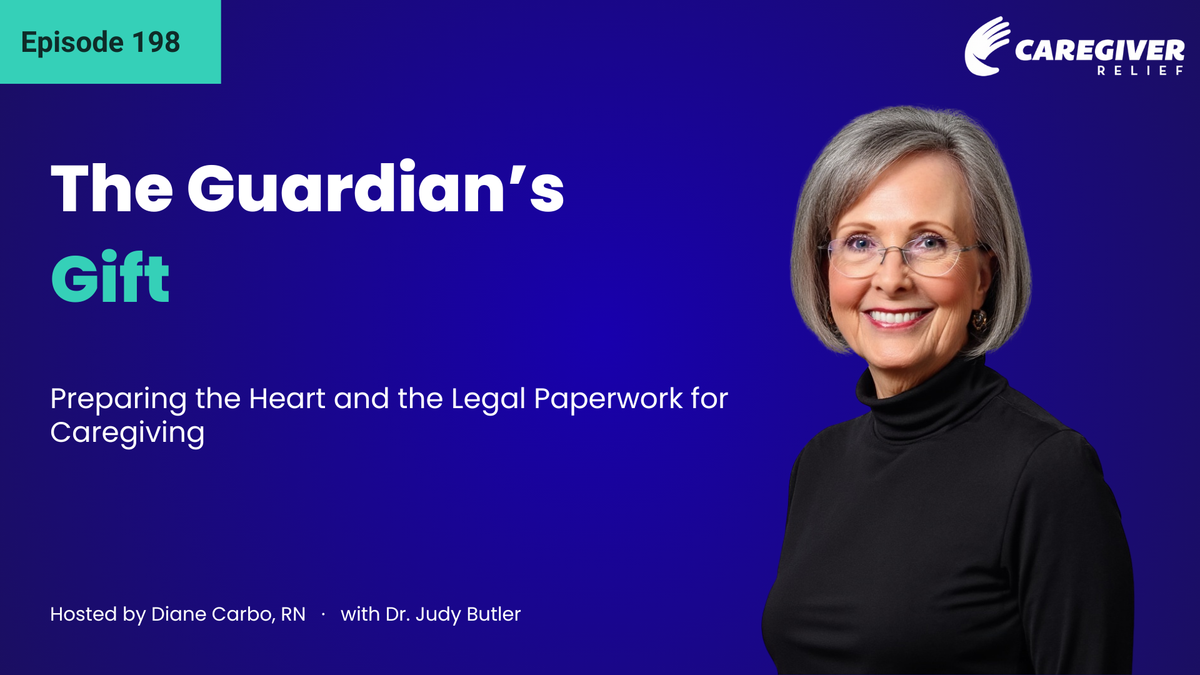
Caregiving is often a journey we are thrust into without a map. Whether you are currently caring for a loved one with dementia or want to ensure your own future wishes are respected, this episode provides the compass you need. 🧭
Host Diane Carbo RN sits down with Dr. Judy Butler—a Pastoral Psychotherapist, hospital chaplain, and dementia caregiver—to bridge the gap between "doing the paperwork" and "preparing the soul."
📝 What We Cover in This Episode
- The Emotional Weight of Paperwork: Why legal documents aren't just "dry forms" but an act of love for your family. ❤️🩹
- The Chaplain’s Perspective: Navigating the spiritual and psychological transitions that occur when roles shift from child/spouse to caregiver. ⛪
- Dementia-Specific Challenges: Real-world advice on managing the legal hurdles unique to cognitive decline. 🧠
- Starting the Conversation: How to talk to aging parents or partners about their wishes without it feeling "morbid." 🗣️
- The "Guardian’s Gift": Understanding the ultimate gift of clarity you leave behind for your survivors. 🎁
🎧 Episode Highlights
01. Introduction Meet Diane Carbo and Dr. Judy Butler as they define what it means to give the "Guardian's Gift."
02. The Heart Prep Managing the "Caregiver Grief" and the emotional toll that starts long before a loved one is gone.
03. The Legal Essentials A deep dive into the must-haves: Power of Attorney (POA), Living Wills, and Advanced Directives.
04. Dementia Realities Why timing is everything when legal capacity is at stake and how to act while your loved one can still participate.
05. Pastoral Support Finding peace and spiritual resilience during the long, often exhausting, haul of caregiving.
06. Closing Thoughts Actionable steps you can take today to protect your family's future.
💡 Why You Should Listen
"Preparation is the greatest act of advocacy."
If you've ever felt overwhelmed by the "what ifs," this episode will help you replace anxiety with a concrete plan. Dr. Butler’s compassionate approach ensures that you don't just feel like a legal administrator, but a supported human being.
Podcast Episode Transcript
Diane: Welcome to the Caregiver Relief Podcast. I'm Diane Carbo, RN, your host. Today's conversation is about something many families avoid until it's too late. We're talking about preparing not only the hard paperwork, but also the heart. My guest today is Judy Butler. Judy is a pastoral psychotherapist with a background in clinical laboratory science.
She supervised the blood bank,
And she is also an ordained pastor with experience in parish ministry and hospital chaplaincy, including assisted living, skilled nursing, and dementia units.
She's walked alongside families in crisis. She supported patients at end of life, and she has personal experience caring for a father with dementia. Out of all that experience, Judy created The Guardian's Gift Legacy Estate Planning Experience, a comprehensive approach that combines documented personal stories, legal and mental directives, financial information, second half of life decisions, end of life wishes, an obituary, and an executor checklist all in one place.
This is estate planning reimagined. This is clarity instead of chaos. This is a gift to your family.
Diane: Judy, thank you so much for being part of Caregiver Relief Podcast. I'm so excited you took time out of your busy schedule because this is information that's desperately needed and not talked about enough.
Judy: Thank you for having me. I'm so excited, to speak to you and to your listeners today, and I'm just ... it is. It is something that is desperately needed and people avoid like the plague.
Diane: Yes, and Judy, in the next, we have 63 million family caregivers providing care for seniors. We're doubling that in the next four years with the tsunami of, baby boomers, so it's even more imperative that we get this information out there.
Now, you have worked in hospitals, churches, academic settings, and therapy. What first drew you to combining faith, psychology, and healthcare in your work?
Judy: Well, that's a long story, ... but it's a spiritual one. It's a calling for me. What I do, I am very, very passionate about. I came to, again, it was just a calling.
Right. I started out as a lab person, working in a hospital laboratory. That's my early career. So I'm a scientist by nature. but in the middle of my life, God said, "Okay, it's time to do something different." And, so here I am. I went back to school and studied religion, philosophy, psychology, and learned that sometimes we as human beings need something more than the church is prepared to provide for us.
So that's how I got into psychotherapy, but from a spiritual bent. as an ordained pastor, it's very important that people have a place where they can talk about their spirituality and their differences about what they grew up believing and what they are, they have questions about. but The Guardian's Gift piece, I came to, as, you said personal experience.
It was through caring for my father, who had dementia. He died in 2018, and, out of my experience with that, The Guardian's Gift came into creation.
Diane: I know that you supervised a blood bank, and I know that, you witnessed medical crisis shape, that shape where you were headed as far as provide- creating Guardian's Gift because people in crisis, is a common occurrence in hospital settings and, it's not being addressed early enough.
Judy: Yeah. More recently in the last few years, doctor's offices and hospitals, clinics, medical facilities have begun asking for, whether a person has a healthcare power of attorney, an advanced directive or not, and to bring that with them to, their doctor visits or hospital stays because it is so important.
I had a lady this past week tell me that, she knew of a family that the 18-year-old was in a car wreck, but because the state that they were in you know, recognized this 18-year-old as, quote unquote, "an adult"-
Diane: Yeah ...
Judy: And there was no healthcare power of attorney, the family actually encountered a little difficulty getting some treatment for the person.
At 18 years old, we don't think about needing a healthcare power of attorney.
Diane: Judy, I've seen that scenario play over and over again in my years of nursing, and I, when I tell people I believe that an advance directive for everybody should be put in place from the age of 18 years on, people look at me like I have two heads.
But they don't understand, how important it is when a, their adult child, still a child to them in their minds at 18 and maybe even still dependent on them, is seen by the government as, or a specific state, as, an adult. And not having HIPAA information or anything really challenges families.
That's why I think that, the Guardian's Gift can help people in so many ways that they didn't realize they needed help in.
Judy: Absolutely. we are very much about pre-planning. people talk to me about the Guardian's Gift, and one of the first things they say is, I have a will," or, "I have some legal documents."
And the Guardian's Gift is very, very comprehensive. we start out with people telling their life story. Start at the very beginning. Where were you born? And, we actually refer to it as a documented story because we want people to put in place the document that supports the story or the picture that supports the story.
Example, we like for people to have a copy of their marriage license in this, their booklet, their binder if you will. or divorce papers if the case, if that's the case. Yeah. or both.
Diane: Yeah.
Judy: So that, there are questions that come up along the way after they've passed on or even during emergencies or crises situations where that information is very helpful sometimes.
So it's about being able to have it documented. We ask, where did you get married? Tell us about your love story. But then we say, please put in a copy of the birth certificate, the marriage certificate, the divorce papers to support the story.
Diane: That's what makes you very different from typical estate planning because, estate planning to most is just a will and maybe a power of attorney.
But you're actually creating, this documented story, as you say. can you explain why the story component is so important to... Because, families don't understand the need for that.
Judy: Well, part of the storytelling, we ask about, since we're talking about hospitals and crises situations- Okay ... we ask questions about health.
And, did you have mumps and measles and all those things growing up as a kid, and what kinds of things- run in the family. So along with the health, there's a genealogical component, and we ask them to document those kinds of things. For example, in my family, strokes are a big thing, and so sometimes adult children know that mom or dad had a stroke or a heart attack or something, but they don't know the entire health history.
They don't know the things that happened when they were a kid. Maybe they had a broken bone or something, and they find out these things through the crisis, and it's a little late then to try to- Yes ... talk about it and figure out what works best, not only for mom, dad, or the patient, but also for themselves going forward.
It informs us as adults to know what kinds of things run in our family.
Diane: I know we're talking about hospital crises, but I have to tell you, this, from what I've learned about Guardian's Gift, this is a platform in which you should start considering when you have children, 30s, 40s, or 50s, as,solo agers or people with no children or people with children, even adult children.
It's time to put those things in place because as a rehab nurse, I can tell you, I've seen, terrible tragedies happen, and people are so unprepared at very early ages. And it's, that's why I was glad to be able to have you on as a guest, to promote Guardian's Gift.
Judy: Well, one of the things, you know, people don't like to talk about death and dying.
Diane: Yes.
Judy: We're all very superstitious human beings. Yeah. And we believe that if we talk about it, it's gonna happen. But I got news for people. It's gonna happen. But sometimes when it comes out of seemingly nowhere and it's unexpected, which death is always expected but not expected-
Diane: Yeah ...
Judy: We're not prepared.
Yeah. And so in those moments, the things that people find out, either a spouse or the adult children, that they thought, "Well, I knew my mom wanted this or that," or, I knew that they had this kind of insurance or don't." But what happens a lot of times is that people, as we age, sometimes we let things lapse or lose things or forget about things.
I worked with a couple, and their insurance had lapsed, and there was, a crisis, and they did, the wife did not know that the insurance had lapsed, and so they were caught in a real financial bind. This was nothing to do with death or dying, but the insurance had lapsed, and so they-
Diane: That's medical insurance?
Judy: That was actually, property insurance.
Diane: Oh. Oh, okay, property insurance. Okay.
Judy: Yeah. And so, you know, the community rallied around these folks and helped them out. But, it was because one person in the family, the spouse, the husband, didn't know that this had lapsed, and the wife- ... w- was responsible for paying it, and she either forgot or missed a payment, and it lapsed.
So there's all kinds of things like that. We talk about financials. people don't know what it costs to age until they're in the middle of it.
Diane: Exactly. Exactly. And it's costing more as we age now because of Medicare changing reimbursements and moving to a, pay-as-you-go platform, so to speak. that's what's happening there.
It's a cost sharing plan that Medicare is doing, and, Medicare Advantage clients are having to pay 200 to $400 a day co-pay for skilled care. PT, OT, and speech have 25 to $45, a visit co-pays, and three times a week for people on a fixed income at those rates is unsustainable. So we really have a lot of things that families don't understand, and that's just the medical side of aging that, there's so many other things that are involved as you move forward.
Judy: One of the things, several things, but one thing is people don't recognize that they're going to need some help at some point in the future.
Diane: Yep.
Judy: Before COVID, long-term care insurance was expensive.
Yeah. after COVID, it's almost nearly impossible to get, if you can get it and qualify for it. Yeah. but it's also very expensive. Yeah. So people don't recognize what their options or resources are. Yep. And people think, "Well, I'll just go to a nursing home and Medicare will pay for it." no, it doesn't work that way.
Diane: Yeah.
Judy: And it's very, very expensive to have aging at home, to have someone come into your home, but it's more expensive to go to a nursing home. Yeah. And for me personally, part of my story was that my dad was to a place where we could not physically care for him. We couldn't lift him. We couldn't help him get showered and those things, so he needed to go to a nursing home.
Well, in that process, Department of Social Services says, "Yeah, we'll pay for it, but you have to sign your house over." Yeah. And so my mother was like, no, I don't think so." And so we had to work around that and figure out how we could get Dad the help he needed- ... get my mother the help she needed, and not lose the house in the process.
Diane: Yes. you mentioned long-term care insurance, and I want you, my listeners to know out there, I have seen seniors that purchased long-term care insurances 20, 30, 40 years ago. They've been paying for it for a very long time. They didn't get the cost of living rider on it at all, and so they're, they are shocked when they hear what a visit to the, to have in-home care come to the house or what they're going to have to co-pay for the nursing home or assisted living because they didn't take that cost of living rider whatever year they, decided to purchase their long-term care policy.
Here it is, insurance has gone probably up, and care in the home or even in nursing homes has gone up probably, up 200% since then. That's, I'm just saying that, I'm not sure, but I know it's gone up extraordinarily high, and they are shocked that they're still going to have to pay. So unless they have an insurance policy that has a cost of living rider, then it's even, and it's so exorbitant to even think about paying for that over the years as you become older.
It's a challenge. So there's all those issues that I'm sure once you start doing your research, you, and that's probably what you would help people with, to help them know when they would call, a long-term care insurance to let them know they're in the hospital. There's a whole process. And if you miss that process, you may not get paid for, or get that, the, waiting period where long-term care insurance will set in, will kick in because you haven't notified them 30 days within the time you were in the hospital.
There's all little bits of things that, I'm sure you would as a, with your platform would be able to say, this is important to know," because you're going to review all the paperwork.
Judy: Right. That's one of the things that we do with people is they say, "We already have all the legal documents."
And I'm like, "Yay, that's great." Yeah. for your listeners, if you don't have them, please get them. We will help you if, that's part of our platform is, we help supply that. I'm not an attorney. I'm not a financial planner. Yeah. I want to clarify that right up front. Yeah. But I will help you get that, so as part of The Guardian's Gift.
But it's, after COVID, people couldn't even buy long-term care insurance because-
Diane: Wow ...
Judy: The fact of the matter is that most people 65 and over are going to have some event in their lifetime before they die where they will need long-term care. Absolutely. Whether it's at, whether it's at home or in a facility.
Diane: Yeah.
Judy: And that information is not anything that I came up with. That's from, a friend of mine who is a specialist in long-term care insurance.
Diane: Yep.
Judy: And so it's so hard to get now. You have, if you have any pre-existing conditions, or any problems whatsoever, insurance companies are hesitant because they know you're probably going to need help more than someone who is fairly healthy.
So if you can even get it, it's really difficult these days, and then it's more expensive, like you said.
Diane: Yes, yes.
Judy: But one of the things, too, that I think is really important is to review the documents. If you already have-
Diane: Yeah ...
Judy: All of your legal documents, people get them one time when they're maybe, younger, and they put them away, and they don't think about them anymore, and they think, I got a will."
Okay. But I was working with a lady and she said, "Well, I don't have a will." And I said, let's get one." And she's like, "Well, I did have one." And I'm like, "Well, guess what? You still have one. If it's still in place, if you haven't changed it or made a new one, that one's still effective." And she said, "Oh, I had that one when I had, I was married to my second husband."
I said, I don't think your current husband would appreciate your second husband being the executor of your estate." So- Exactly.
Diane: And those are real issues. It's, that's- I mean,I have come across that. Oh, I'm still, the will I created was with my first marriage, and all of a sudden I'm on the third or fourth marriage.
I mean, I have seen that. it's a real situation
Judy: And, so there's life situations that people just, they're living life- Yeah ... but they're not really considering this part of it. you know, you need to think about your, if you have your children listed as, somebody who's gonna take care of you, or be your healthcare power of attorney or the executor of your estate, what kind of situation, are they in?
Yeah. One, one lady that I worked with, her son was a, he was a drug addict. Yeah. And we don't like to think about our family that way, but because I don't have a personal connection to that, I can say to them, "Your child has drug issues." Yeah. Or, "Your child has debt issues." Yeah. So do you really want that person to be the one in charge of pulling the plug if you're, in that situation?
I don't think so. and I do try to laugh about it a little bit and bring a little bit of humor because it's really important to be able to discuss it in a comfortable way.
Diane: Absolutely. And, I'm laughing when you say about pulling the plug. My two sons, one has, is now deceased, but the, he was the oldest, the responsible one at the time, so I made him over my finances and then I made my son, who was at the time in nursing school, he's now a nurse anesthetist, I made him over my power of attorney of healthcare.
And my oldest son would say, "Mom, you're gonna have a hangnail and he's gonna pull the plug on you." 'cause I'm very open about all of this stuff, I don't want you to do any extraordinary measures, and I have my things in place. And one of the things that, I also that you address is they don't, review it.
I tell people, my listeners out there, if you're going to put papers in place, you should review them yearly. Now, nobody rarely, or very few people rarely do that. But do it, every decade. When you turn 20, 30, 40, 50, because what you want at 20 and what you want at 50 are two different things.
Review those papers because people have died, people have changed their situations, and it's really important that they make those decisions, and changes wh- as they're l- living their life and not waiting till a crisis happens.
Judy: Right. You know, what I see, and this is to me it's funny, it may not be to your listeners, but that people, the only time they make changes is when they get mad at their children or grandchildren, and then they decide they're gonna cut them out of the will.
Diane: Oh, yes, yes. I've seen it too, and to me it's funny as well, But it's very real. It's-
Judy: It is very real.
Diane: Yeah.
Judy: And you may have a legitimate reason for doing that, but we help people walk through those decisions, and what that looks like. And we talk very openly with our clients about these decisions and how to make them.
We talk about what's gonna happen when you die. Let me just say it that way, 'cause that's what's gonna happen.
Diane: Yeah.
Judy: What, what's gonna happen to your body, and how does, what does that look like? Because it has been tradition in this country for many years to have a burial. that's changed a lot in recent years, and people do- Yeah
More cremation, but there's lots of options that people are not aware of. Yeah. Like green burial and those kinds of things.
Diane: Yep. So- And people are donating their body to science now too more than they ever did before. or your, people are donating their brains to, science for studies of Alzheimer's and different types of dementia.
And-
Judy: Let me speak to that for a second. Yes people, you cannot just say, "I'm going to dane, donate my body or my brain to science." It doesn't work that way. Yeah,
Diane: Exactly.
Judy: There are forms you have to go through and make- Yeah ... sure that the school or the university or the medical situation where you're trying to make your donation will accept you, and will accept your body, will...
there's a lot to go through. I worked with a lady, who said, "I want to donate my body to science." And I'm like, great." Okay. So we have to, there are- committees, there are places to go to fill out the forms, to make the contact. And your family has to know that you are doing that.
Diane: Exactly. Yeah.
Judy: Because you can't just up and die and your family doesn't know when the doctor walks in and says, "Oh, by the way, your father donated his body to science." And they're like, "What?"
Diane: Yes. yeah. and I've seen that happen as well,now, I- we've talked about advanced directives. I want to ask you, what happens emotionally to families when there are no clear medical directives or end of life wishes documented?
Judy: Well, typically the first thing happens is in a family situation, there'll be a person who sort of takes charge. and sometimes they're gonna make some decisions the rest of the family members don't agree with. So there's a discord right at the beginning. and so they argue about it, which creates more tension.
Then sometimes they're like, "Well, do I do this or not do this? What do I do?" They feel guilty. ... they feel some sense of shame sometimes. Yeah. That they're making the wrong decisions. Or this is not, what if I pull the plug and it's not, and mom dies, and she could have lived if I had not pulled the plug?
So there's a lot of anxiety that's produced around this.
Diane: Yeah.
Judy: And,you have the fighting, the infighting with family members, but then sometimes there's one person and they're like the only child, and that's a really lonely, horrible place to be for some adult children- Yeah ... when their parent is there and the other parent's already gone, and this is their last parent remaining.
Yeah. And they have to make that choice. So there's a lot of emotional upset that goes into, that decision making. but not only that, but before you get to that, there's a part in the advanced directive that's do they get, still get nutrition? Do they get hydration? What does that look like?
If I, what does pulling the plug really mean? And it's not just turning off a ventilator. Yes ... so those are discussions that I walk people through and help them understand, what does it look like to a person when they stop hydration, when they stop nutrition? What does the body, what happens to the body through that process?
So there's a lot. And because people don't know, and they see it and experience it in the moment, they're like, "Oh my gosh." when there's hesitations in breathing, when there's hesitations then, and the, their parent starts mumbling or their spouse starts mumbling or- Seeing things, and that's a common thing, especially- Yeah
with people with, Parkinson's dementia.
Diane: Yes. you, one of the things I liked about Guardian's Gift is you actually include an executor checklist.
Judy: Yes.
Diane: So why do executors need more than just legal authority?
Judy: because there's so many subscriptions these days. there are things that we, all of us subscribe to.
Some of us have subscriptions we're paying for and don't even know that we're, got it and paying for
Diane: it.
Judy:... yep. and there's TV commercials about that. But what happens is people don't recognize all the different things that need to happen after someone passes, because they haven't been through it.
And even if they've been through it and been an executor for someone else, other parent, it's different with the second parent. So there are estate things, there are legal measures that need to happen, the way that things are filed. one thing, this is a small thing, but it's not. After someone passes, you need to run an ad in a local paper and say, "This person has passed.
If there's anybody that has a debt against the estate, please, you have 90 days to, notify us so we can rectify that." And a lot of people don't know that you need to run an ad in the newspaper. and that's a simple little thing, but it's part of the- Yeah, it is ... executor checklist.
Diane: Yeah.
Judy: what happens to family pets?
what happens to, if there's a certain money set aside that goes to a charity organization? Yeah. How does that, how is that to be handled? So there are lots of if this, then that sort of situations, that we lay out in the checklist. Have you turned off, have you turned out, turned off the subscriptions to the newspaper, to magazines, to online, to Facebook?
I frequently hear people talk about, that their person, their loved one's Facebook st- keeps popping up as reminders. Now, yeah, sometimes that's good for some people, but some people it's not. Yeah. And you c- you can't just go turn it off. You've gotta have No ... the password to that,
Diane: Yeah.
I've experienced that with my son. my oldest son was a disabled vet that completed suicide 14 years ago, and, he pops up in my, memories, from his Facebook every once in a while, and it, I remember him, and for me, it, brings sadness when I'm working, and I It's just something I've had to deal with.
now I guess with Facebook you can actually go and, contact them somewhere in the hierarchy and have them turn it off, but it's a process. Yeah. Correct?
Yeah. Yeah.
Judy: Yes, and you need a death certificate for that. yeah. most of the funeral homes or crematoriums in the United States-
Diane: most of them, not all, but most of them are really good about guiding people through, but sometimes people don't even know what questions to ask.
Yes.
Judy: And so we just give you a checklist of things. Did you check, on this? Did you do this? And if, say an example, your loved one is still living in their home, you may not necessarily want to turn the power off or, turn off the, the internet or something.
You may want to keep that- Yeah ... for a time, because a house will decline very quickly once the power's turned off. Yeah ... and so there's little things like that we talk about with people.
Diane: Yeah. Now I want to talk about the second half-of-life choices. what kind of decisions should families be discussing before a crisis?
Judy: The big thing is, how do you want to be treated if you become sick? And we all want to be treated with respect and dignity, but it means different things to different people, surprisingly. so if you want to, if you're at the end of life and you have a terminal illness, you may decide that you are ready to go and you do not want to go to hospice, for example, or you don't want hospice care.
So those are things that I would, as a provider for my loved ones, I would say hospice is a good thing, but some people don't agree with that. Yeah. So you need to be able to say those kinds of things. I don't want X, Y, Z. I don't want hospice, or I don't want- Yeah ... this particular, person in my home. So are you gonna die at home?
Are you gonna die in a hospital? Are you gonna die in a nursing home? And those are things that you may think, I'm in a nursing home, but I really would like to go home, if that's possible." That may not be possible any longer. But, it's about discussing how you want to be treated, where you want to spend, your last time on this earth, and how you, who you want to spend it with.
What does that look like? Make those choices because your kids, your adult children, your spouse, your loved ones, your grandchildren, nieces, nephews, whatever, they may know you in one regard- Yeah ... but they may not know what you really think and feel.
Diane: Yeah, exactly, and that's why, I really like the thought of having conversations frequently and often about death and dying.
I know people go, "Oh, that's awful." But it's not like you see it on TV. It just doesn't happen that way, and people need to be prepared. And, that's really, being prepared and being educated makes the process less stressful.
Judy: Right. This is an overwhelming topic for a lot of people because-
Diane: It is.
It is ...
Judy: Because it involves, legality. Yeah. People get confused with the legal aspect of it.
Diane: Yeah.
Judy: And the verbiage is very difficult to understand.
Diane: Yeah.
Judy: It's also some of the financial verbiage and the way that's handled is difficult to understand. just the way that it flows and how it works, some people get confused by.
So the conversation is critical, and I just want your listeners to know I have a downloadable PDF that I will give to any of your listeners if they will just send me an email. If they'll just email me and say, "I heard you on, with Diane Carbo and Caregiver Relief, and I want to get the Closer to Closure PDF."
I will send it to them free. ... it's conversation starters. And it's, reminders of different things that are important to talk about and how to talk about it. So if they're interested in that, I will send that to them. But by all means, please, please start having these conversations with your family.
Diane: Yes. Now, I want to talk about families dealing with dementia.
When is the right time to begin those conversations?
Judy: As early as possible.
Diane: Yeah. Yeah.
Judy: Because dementia is one of those things There's, so your listeners will know, there are over 100 different types of dementia Yeah And people say dementia is, it's an umbrella term.[00:33:00]
Yeah. Alzheimer's is just one type of dementia.
Diane: Yeah.
Judy: there's Parkinson's dementia, there's Lewy body, there's vascular. I could go on and on. There's lots of different types of dementia. Yeah. So when somebody is diagnosed with dementia, it's already at a point where it's very noticeable. But dementia occurs, much earlier than that. So I encourage people, when you think that you're having an issue remembering something or, handling certain t- daily tasks- Yeah ... that you go ahead and get evaluated, and go ahead and start having those conversations, because you don't wanna wait till you get a call from the police saying your mom is sitting at a, in her car somewhere and doesn't know who she is or how to get home.
Diane: Yep.
Judy: But you also need to understand what dementia is and how it works and what the symptoms are for, these dementias. my dad had vascular dementia, so his dementia looked very different than somebody who has Parkinson's- Yeah ... dementia. and so it's how to handle that and work with the, your loved one so that they can function for as long as possible on their own.
Diane: We have under Medicare a, we're giving one time a year a visit to the doctor's office where they wanna cover, over, talk about our conditions and where we're going with those. I was surprised to learn that they are, at that time, they should be discussing advanced directives with us and those end of life wishes.
I don't care how or, young or old I am, I think that needs to be done, and it's not being done. And I was really disappointed to hear that many doctors aren't doing that. and I don't know why, because y- you have 40 minutes. Yeah, there's a lot of things you can discuss with your conditions and your overall health, but that must be a key piece that we have to be introduced to us, as patients at, as early as possible, because they need to start planting the seed- Yes
that this needs to be done. And even if you're not ready or you think you're gonna live forever, that's fine. But, I know different, but,people feel that, they're, it's threatening or whatever, but I think just planting the seed is really important, and I think our healthcare system fails us in that respect.
Judy: I think you're right. doctor's offices are getting a little better. I know when I go, the, they always ask, "Do you have your healthcare directive?" And I'm like, "Yes, I do." And, I said, "As a matter of fact, you have a copy of it in my file." So it is important. and this is one of those things that you can't do it, you can't wait to do it until you need it.
Yeah. Because then it's too late.
Diane: Exactly.
Judy: and talking about dementias, let me just say there's a dementia that's called FTD, and it's frontal temporal dementia.
Diane: Yes.
Judy: And one of the significant, symptoms of it is it happens in younger people. Yes. It happens sometimes with people in their f- late 40s and 50s.
Diane: Yeah.
Judy: And it is, it's an awful, terrible disease. But that is a type of dementia that even younger people get.
Diane: Yes. And, it's one of the dementias where it's, you might not see the symptoms at home, but when you... Most people that are starting to suffer from and expose those symptoms.
What I've seen, Judy, with, FTD is they may miss the symptoms at home, because of the way life happens, and they just, put it, aside to stress, whatever. But when they are at work is when people are seeing, the signs and symptoms of dementia, not being able to do their job.
I have had secretaries cover for their bosses in high positions when, and these are young men in their 40s and 50s. And, so I've seen it, and it's devastating. Usually, they get fired from their jobs, and that's when the families start to realize what's going on.
Judy: And again, the conversations don't have to be so serious.
They don't have to be so- no ... such a downer. and don't wait if and maybe the family hasn't really noticed or paid attention, 'cause we're all busy living our lives.
Diane: Yes, yes, yes.
Judy: and sometimes we miss those things. Yes. But, as a parent, one of the things that happens is parents will want to talk about it with their adult children.
Yeah. And the adult children are like, "Oh, Mom, you're still young. You've got plenty of time. Let's don't talk about that." Yeah. Or the reverse happens.
Diane: Exactly.
Judy: The adult children will say, we don't know all about what you want or how you want things conducted. Let's talk about it." And the older person will say, I'm not dead yet."
So-
Diane: I've heard that many times.
Judy: Yeah.
Diane: Yes.
Judy: Yeah. So it's not about- and I tell old people, myself included, they'll say, "Well, all my kids want my money." And I'm like, "You're right. They do want your money because they gotta take care of you, and it costs money to take care of you."
Diane: Yeah.
Judy: And, but they don't want your stuff, however.
So I do tell them that. They don't want all your stuff, but they do want your money so they can take care of
Diane: you. Exactly. Judy, I really appreciate your knowledge and your passion in regards to your Guardian's Gift. for somebody listening right now who feels overwhelmed by the idea of planning, what is the first step they should take?
Judy: the first thing is if they will send me an email, okay? I'm gonna send them that PDF I talked about. Send it to judy@theguardiansgift.org. It's not .com, it's .org. And I will send them this conversation starter. Great. It's a way for them to begin having conversation with their family members.
And sharing, be open and share at least that you've got a will and where it is. Yes. one of the things about The Guardian's Gift that's simple, is that we want everything in one place. We encourage people to create a binder and put all this information that we have them collect, pictures and everything, and legal documents, in a binder so that when their family members go, "Where is this?"
They can say, "It's right here."
Diane: Yes. That, and that's such a blessing after having had, taking, helped with both my parents. I know, it was everywhere. My mom died young, and I was just a teenager, but I remember my dad being angry and upset all the time because he couldn't find everything that he needed to find all the time for that.
So I know that as he got older, I made sure. I'm the bossy older sister, I made sure that he had his things in place so that I, if I had to deal with it. I know my stepmother would have to, but I wanted it to make it easy for all of us at a time, when it's very stressful and there, you're overwhelmed with grief and a lot of other emotions.
Judy: That's true. One of the things for me was when my dad passed, we couldn't find his discharge papers from the military.
Diane: And- Yes, that's a big one.
Judy: Yes ... that is a big one. And people- Yeah ... they get them, they get out of service. It's been years ago. Yeah. They put them to the side somewhere, and then when they pass, the family they want to have a military funeral.
Yes. And you have to have the discharge papers.
Diane: Exactly. Exactly. that's very true. thank you so much for your time. Judy, tell people how they can reach you again.
Judy: Judy@the, T-H-E, Guardians Gift, G-U-A-R-D-I-A-N-S-G-I-F-T, .org.
Diane: To my family caregivers out there, you are the most important part of the caregiving equation.
Without you, it all falls apart. So please learn to be gentle with yourself. Practice self-care every day, because you are worth it.
Caring for a loved one can be overwhelming — but you're not alone. If you have questions, big or small, our expert team is here to help.
👉 Click here to Ask the Expert
Our Resource section can help you find the information and tools that you need. We have courses, videos, checklists, guidebooks, cheat sheets, how-to guides and more.
You can get started by clicking on the link below. We know that taking care of a loved one is hard work, but with our help you can get the support that you need.
Click here to go to Resource Section now!