Elder Financial Abuse: How a Caregiver Stole Nearly $1 Million From a Woman With Dementia with Charles Chip" Wallace Jr. - Episode 196
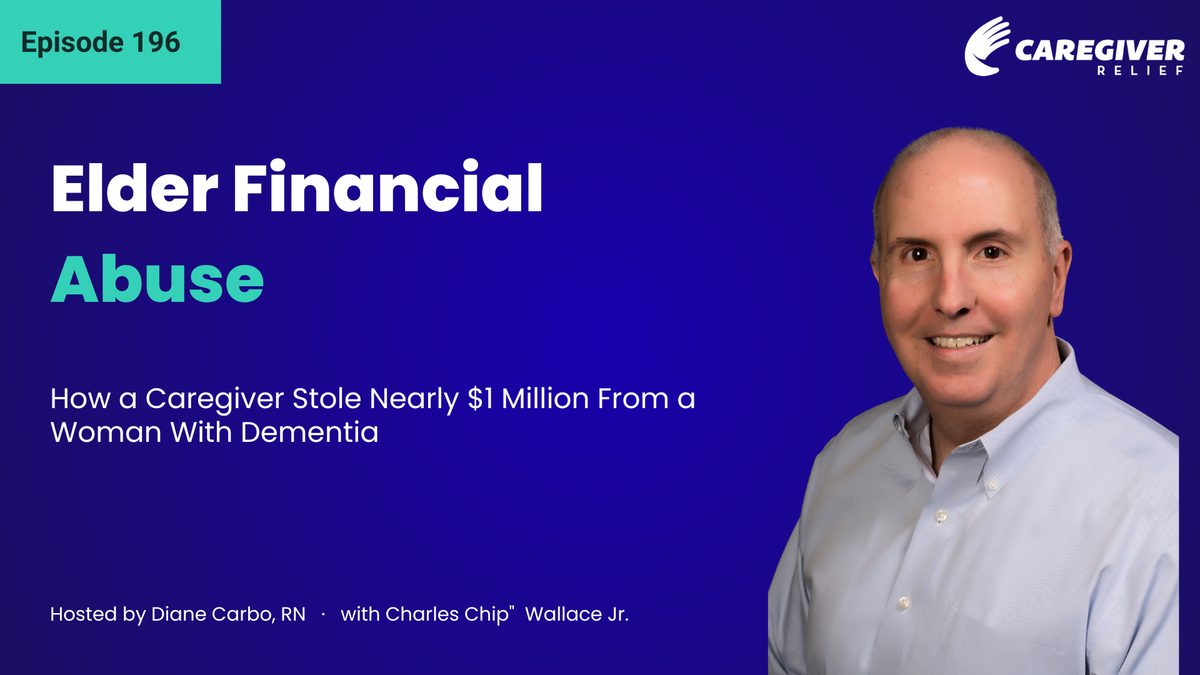
The latest episode of the Caregiver Relief Podcast dives into a chilling reality: financial exploitation of older adults is one of the fastest-growing forms of elder abuse in the U.S.. Host Diane Carbo sits down with Charles "Chip" Wallace, author of The Caregiver’s Game, to uncover how a trusted caregiver manipulated his mother and siphoned away a fortune under the noses of family and professionals alike.
🎧 The Story: "Watching a Cancer Metastasize"
What started as a son suggesting a cook for his aging mother turned into a forensic investigation involving over 3,000 fraudulent transactions. After his mother passed in 2022, Chip discovered:
- The Grooming Process: The caregiver began by overspending on groceries and gradually isolated the mother, eventually moving into her home.
- A "Shadow" Will: A new will and an annuity were created, totaling nearly $500,000 for the caregiver—entirely out of character for his mother.
- The Financial Playbook: The caregiver used small, frequent transactions at discount stores (like Target) to avoid triggering the alerts that large luxury purchases might cause.
- A Serial Offender: Investigation revealed the caregiver had used a similar scheme to marry and defraud an elderly man back in 2009.
🚩 Institutional Failures: Where the System Broke
Perhaps the most shocking part of the episode is how many "safety nets" failed to catch the abuse:
- The CPA: Managed the mother's bills but didn't notice the change in spending patterns, stating, "She’s got plenty of money, so this is fine".
- The Banks: While some institutions flagged activity, others allowed the caregiver to open accounts and redirect digital communications to her own email.
- Adult Protective Services (APS): A previous case against the caregiver was closed without action, and in the current case, she was able to forge a letter that convinced APS to sign off on her care.
🛠️ How to Protect Your Loved Ones
Chip and Diane share critical advice for every family:
- Be Physically Present: There is no substitute for being in the room and observing the dynamic between the senior and the caregiver. 🕵️♂️
- Control the Mail: Never let a caregiver have access to the mailbox. Have mail forwarded or use digital scanning services. 📬
- Hire Carefully: The family, not the senior, should be the employer. This ensures the family retains the power to fire a suspicious individual. 📝
- Shared Monitoring: Set up view-only access to bank accounts and use technology (like nanny cams or monitoring tools) to keep an eye on activity. 📹

📌 Key Takeaways for Caregivers
"The caregiver would have her phone on speaker, prompting her... they know who they have, and nobody else understands it." — Charles Wallace
- Trust your gut: If a senior’s personality changes or they become suddenly secretive about money, dig deeper.
- Capacity letters: Be aware that "friendly" doctors may sign off on capacity without doing the necessary neurological testing.
- Don't wait for proof: You can contact APS based on suspicion alone—you don't need a finished investigation to ask for help.
🔗 Listen to the Full Episode
Don't let your family become a statistic. Hear the full, gripping interview with Chip Wallace to learn the specific "red flags" he missed and how he eventually caught the predator.
Read the Book: The Caregiver's Game by Charles Wallace is available on Amazon and Barnes & Noble.
Remember: You are the most important part of the caregiving equation. Practice self-care and stay vigilant. You are worth it. 💙
Podcast Episode Transcript
Diane: Welcome to the Caregiver Relief Podcast. I'm your host, Diane Carbo, registered nurse and founder of Caregiver Relief. Before we begin today's episode, I want to ask you a few questions. If you suddenly reviewed your aging parents' credit card statements, would the charges make sense? Would the groceries match which they actually eat?
Would the purchases match what you know that they do in their daily life? Or would you discover something that didn't add up? Financial exploitation of older adults is one of the fastest growing forms of elder abuse in the United States, and in many cases, the person responsible isn't a stranger.
It's someone the family trusted, or in some cases, it's someone within their own family. Today's episode tells the story of what one son discovered after his mother died. What started as a few confusing credit card charges turned into forensic investigation involving more than 3,000 transactions, institutional failures across multiple national banks, and the caregiver who had used the same playbook before.
My guest today is Charles "Chip" Wallace, author of The Caregiver's Game, a true story that exposes how caregiver fraud can hide in plain sight, often for years. This conversation is both a powerful true crime investigation and an important warning for every family caring for an aging parent.
Diane: Chip, thank you for joining us today.
I feel blessed that you had the courage to, expose this, and you really have quite a story. Welcome. I appreciate you taking the time today to spend with us.
Charles: Thank you for speaking with me.
Diane: Chip, before we, before this experience, what was your relationship like with your mom, and how involved were you in managing her care?
Charles: Well, we weren't. Growing up, what my siblings and I usually heard from my mother off and on as far as medical issues, it was pretty random. We never really knew too much was going on financially or medically with her.
At one point in the mid-'90s, all three of us siblings had moved away.
So she was there in Dallas. I was in Southern Illinois in the Missouri area, and my other s- two were in, on the West Coast. So she relied basically on who she knew. She lived in a high-rise condo, same place where her mom had lived, and knew the folks there in the building, and was married to a gentleman who was a few years older than her and had been getting along pretty well.
But in '17, she started having some issues as far as memory a little bit, but we chalked it up to, she's getting older. She was getting, over 75, close to 80. her husband seemed to be somewhat with it, but suddenly seemed to take a turn where he moved out and had left her on her own .
Diane: Wow.
Charles: So she had always been someone who, would keep herself thin and, but when I saw her in '17 after the husband had moved out, she was a little more thin than normal. Oh. And I said, "Oh, you know, the fridge is kind of thin. Why don't you hire someone to be a cook for you? There are a lot of people in the building that I'm sure are doing the same thing."
Diane: Yeah.
Charles: And she thought about it, because when I sat down with one of those little tools to see, how many calories a day she was eating-
Diane: Yeah ...
Charles: And I got to almost 1,000, and I said- you need to be eating close to 12 to 1,500, not under 1,000."
Diane: Yeah.
Charles: And so I s- she said, "Okay, I'll think about it."
So that was in September of '17. And then in the spring of '18, my sister calls me to say, "Hey, Mom calls and says she has a new friend." And we were like, "Okay, she's never said that before, but, if that helps her out." I went and met them in March of '18 and suspected the woman was probably starting already to spend a little more on groceries.
The fridge was pretty full.
I had no idea of the potential, I'll call it disaster that- ... that was heading, because I didn't know signs of dementia. And so when I had seen my mother in '17, her hand shook a little bit, holding silverware was a challenge for her- ... and thought it was more of Parkinson's, and didn't think anything of dementia whatsoever.
And went on, and it turned out she opened the door to a lady who was working next door for somebody else- And said, "Oh yeah, I'm looking for a new client. This one, she's gonna move out, and I'm looking to start my own business and do this on my own." And my mother said, "Oh sure. I need someone to cook."
Started cooking, and within six months the lady was spending the night, overnight with my mother. She had an extra bedroom. But my mother was inviting her 'cause she was, didn't want to be by herself. and it went from there. She just we called it grooming at the time a little bit, but we didn't really know we were really actually, it actually meant it.
Diane: I want my listeners to know you don't have to have dementia to have financial fraud brought against you from a professional caregiver. I've seen it millions of times. And, we're gonna get more involved in this and talk about the ugliness and the dark side of needing care. when did you first notice that something wasn't right with your mom's finances?
Charles: The initial time when I first met the lady that spring of '18 when she first had started working there, I noticed the groceries were, a little high, and I asked her about getting receipts. And the lady declared, I work for your mother. If she wants the receipts, your mother will ask for them."
Diane: Oh.
Charles: To my mother. And my mother sat quietly, which was not my mother's personality. And so I was like, "Okay, I can't do anything about this." I didn't have access to my mother's accounts. I was able actually to get my mother's password and look at her brokerage account, which is where checks were coming from.
And noticed a little bit going on, but suddenly the password was changed there in '18. So I didn't see anything active until after my mother passed in the spring of '22.
Diane: Who was your mother's power of attorney?
Charles: It was her CPA who she had been working with since the mid-'90s.
Diane: Okay.
Charles: And when my sister spoke with him in early '19, she was told by him, it's not like she's drooling."
Diane: Oh, dear God. Yes. this is a big tip I want every caregiver out there, and senior out there to really understand and realize. You have to have a power of attorney that is going to be overseeing your stuff on a regular basis. If they aren't, if you have a fiduciary, that's fine. But, you have to give the family access to everything too.
I see this so much, and it makes me crazy because, somebody should be monitoring those monthly credit cards. Somebody should be monitoring the banking a- the banking account, to know what The amount is in that account and it's not being depleted. You need to have access to the information on the savings account.
It's really important, and families don't understand that. There's a dynamic that happens with seniors when they need a caregiver, Chip, that even the best human resource person or manager has a hard time understanding. Your senior needs somebody to provide care for them. They need, certain things, and they, the intimate care they receive also put, gives them a special bond.
And as we were talking before the, we started the podcast, Chip, you said, that these caregivers groom them, and you're absolutely right, they do. And, but the seniors are so afraid to be alone or to have nobody else caring for them, that they will do anything to keep that person in their lives, even if it's financially draining them.
Charles: And let me go back to the CPA's role. Yeah. He actually, in the s- fall of '19, so we finally got, we asked him to start... Actually, it was earlier. It was in late '18. We noticed some of my checks, the checks my mother was sending us, the handwriting was different.
And realized that she was having someone else write the checks.
So we approached the CPA for him to pay the bills, and he agreed. So he was paying the bills, seeing the bills, writing the checks in, starting in fall of '18. And throughout this whole process, the caregiver would hand him the statements, and then he would, that came in the mail, and then he would go and write the checks.
So he saw the balance, and the comment I heard from him was, "Oh, she's got plenty of money, so this is fine." And the, what was going on, and I mention it in the book, is the caregiver seemed to have paid attention to what those statements were averaging. And in this case, it was about 2,000 a month.
So when she got ahold of the credit cards, that's what she spent. But she changed the dynamics of the spending from going to your higher end stores, your Neiman's and your-
Charles: She changed it to going to Target and Tuesday Mornings and discount stores. So she was ringing up $500 per, a transaction every 7 to 10 days, where you might buy one or two things at Neiman's at that price.
At Target, you're buying two bucket loads of stuff, and she was doing that regularly, 7 to 10 days, and he never paid attention to it. I didn't see the statements until- Six months after my mother passed as part of discovery. that's how much we were out. He even refused to run a credit report on her, my mother, after my mother passed, 'cause I wanted to verify nothing had been opened, and that's how I found out about one credit card being opened that was in my mother's name, but being used at a retail shop that my mother would never have gone to.
Diane: Wow. Wow. This, I've seen this before. I have. I can't even begin to... In fact, I just saw it recently. I had a, a neighbors, they're not clients, neighbors, that have, 90-year-old parents, late in their 90s. They're socially isolated. They had a private, caregiver come in, one that was, not with an agency.
And this still happens with agency, I will tell you right now, if you go through an agency. But that woman took them, and he took them, she'd had four shifts each week with three or four hours, just for socialization, taking them shopping, taking them, out to eat. He paid for everything.
She had him doing, paying her car, servicing her car, buying her new tires, doing , her, overall of her engine. just simple things like that which cost very much. I can't believe it. So this does happen. So what are the some of the first financial red flags that made you start digging deeper?
Charles: Well, after we, it was kind of interesting, the week after my mother passed and we went down to Dallas to take care of, settling her estate, the CPA brought in the sheet that described what was gonna be part of probate. And he showed us outside of probate the savings account, which we were aware of, and then he showed us a $250,000 annuity that was for the caregiver that my mother had bought in the spring of '19.
And then we saw the new will, which we were unaware there was even a new will, and it was from January of '20, just before the pandemic, but it was then, and she was gonna get $300,000. So basically a total of half a million.
Diane: Oh my lord.
Charles: My mother had no history of giving large sums of money to anybody outside the family.
Diane: Yeah.
Charles: he was cheap. And so she, even giving to charity, she wasn't gonna write large checks.
Diane: Yeah.
Charles: So you saw that, and you were like, wait a minute, that doesn't make any sense at all." And it kind of rolled from there. about a week or two later when I went out back to the house, I was able to actually get into my mother's broker account.
And once I did, I started seeing all the checks and all the other activity, and that's when I found, for example, there had been a jewelry appraisal done in December of '19, or sorry, December of '20. there should've been no reason for a jewelry appraisal. Any nice jewelry found should have been put in the box at the bank and left.
And that wasn't done. And there was never any question about it. So we... It just rolled into just snowballing of all kinds of activity.
Diane: Now, you uncovered three, more than 3,000 transactions. that's incomprehensible to me. But how did you even begin reconstructing what happened?
Charles: It was a combination of things.
One, once I got, I was able to take the, from the brokerage account, I took all her bank her statements from there and saw all the checks. I didn't get the credit card accounts, and there were two of them on the same bank, but two different cards that were active. I didn't get those until October of '22, so almost six months later.
And I scanned them and just every night, it drove my family nuts. Every night I would go down and put in transactions into a spreadsheet until I got back four years roughly of activity. And then from there, I had it categorized by merchants and spending type, and you could then see a pattern pretty easily that it was increasing her groceries.
It was suddenly increasing in discount. You could see by zip code suddenly instead of being concentrated in what we used to call her quadrant of town- ... she lived in all year, all her life. She'd lived, she lived in that part of town probably, 70 years of her 80 years. Suddenly their dots started spreading out all over the county, because I threw it into a map tool.
And I call it watching a cancer metastasize. That's what it grew all through the county. the lady lived in South County, and suddenly it's all over South County. and it just went from there.
Diane: Oh. One of the shocking elements of this story is how many institutions missed the warning signs.
Where did the system fail your mother?
Charles: It was a combination of things. one, the CPA who was hands-on, seen her for decades, didn't... My mother was still somewhat social if you were around her for 15, 20 minutes.
So he didn't see her doing any activities. We tried at one point in early '19 to get the broker who had been around her since, 1980, for the two of them to take her to lunch.
And I had emailed and said, "Take her to lunch." I said, "And don't let her order soup." And so I want... So that they could see her actually work and with whatever she was gonna have, was gonna eat.
And the response I got was, I spoke to my mother a few days later, and she goes, "What do you mean telling Bob I don't like soup?"
And I said, "That wasn't the question."
Diane: Yeah.
Charles: And so they obviously never did it. but there were four banks involved. Two of them called APS, two of them didn't.
The two that didn't, one of them was the one with the credit cards. The other one was the one where my mother was actually going down into the bank regularly, and it's where our safe box was.
And I know why she didn't, because I know she took the caregiver into the branch. Introduced her to the personal banker. the caregiver ended up opening an account there so that she could run her checks through. Oh. So whenever large checks came through, they were, "Oh, no, that's so and She's working for her. She's fine." But the other thing the lady did when she went in there is in early '19, she started converting all my mother's communications, emails, to the caregiver's email account.
Diane: Oh, wow.
Charles: And I know this because I was able in '24 to finally get into the caregiver's email account.
Okay. And I got 6,000 emails, which my attorney laughed at, said, "Here, have fun." I said, "Sure." And it, but it went all the way back to '09, which was before, I was shocked, which is how I found out about her having the prior experience with an elderly, older gentleman back in '09 through 2011. Where she worked for him directly, got his attorney POA to give her access to credit cards, married the guy in January of '11.
She, and filed the, POA and discovered that. I thought it was created in '11 when they got married. No, it was created back in '09, three months after she'd been fired from an agency because she had been caught misappropriating or handling, data for a client, which I'm sure it means she was opening up credit cards.
And then four months later after getting married in '11, he passes away. She gets the house and his brokerage account. So she walked away basically with close to half a million on that transaction.
Diane: Geez. Now, I have to ask you because- ... I, this CPA, was he not a certified fiduciary?
Charles: He was, no, he was, he was a certified CPA.
He was, he had been filing taxes for my mother since, like I said, the mid-'90s. Worked with a broker through a large financial institution. he was, appears to have been above board. There wasn't any reason
Diane: Yeah. Just an ignorant,
Charles: Just not paying attention, and we knocked it off to, you know what?
They liked getting her fees, and so they kept saying yes
Diane: Yeah. You know what, it's very disturbing because we have a lot of solo agers out there, and we have couples that have never had children. what's frightening me right now when you're talking about this, Chip, is we have 63 million family caregivers.
The silver tsunami is here. It's been here for a while. And what's happening now, we have by 2030, just four years from now, we're gonna have double the amount of seniors that require care. So we're gonna go from 63 million to 127 million caregivers out there, the family caregivers. We don't have enough family caregivers so you're going to have to depend on, and there's a shortage of this too, have to depend on, a professional caregiver.
And this is really frightening, 'cause I always thought that fiduciary, certified fiduciaries paid the bills and followed up with things and monitored things so that people couldn't be taken advantage of like you're talking about.
Charles: Right. And yeah, he was ... I don't know that he was a, necessarily a certified fiduciary.
But he was a CPA. He registered. Yeah. we had a broker, had an attorney that was working for them as well. the attorney was a, I'll call it a piece of work, because it, I got his emails, through discovery in '23, found it in '19 before that first annuity was created. He was online looking at listserv websites where other attorneys, communicate, asking about signs of adult, financial elder abuse, actually asking about it.
And then he actually went and did it again in late 2019 before that new will was created, and they actually gave him a list of questions he could come back and ask, and they were ignored. And the leadi- the reason was, in 2019 in the fall, they were able to get a doctor's note from a friend of my mother's, who was a doctor.
Diane: Lived
Charles: In the condo with her, used to go to lunch with her, and got a doctor's note that said he didn't see any signs of any issue, that she should have capacity. Ooh. Now, the doctor's note is another piece of work. Have you ever received a doctor's note that was ever typed in all caps?
Diane: No. Oh, no.
Charles: And the first line where it mentions the patient's name, the name's misspelled.
Diane: Yeah. It wasn't a real doctor's note. Heard-
Charles: And, but it was signed by the guy. But I'm sure that the caregiver's daughter, she had three of them, typed it up, because they used to misspell her name in other activities as well
Diane: Oh, dear
Charles: But my attorney doesn't believe it was fake.
And I was like, there's no way a doctor's note was all in caps.
Diane: Well, first of all, that puts that doctor liable.
Charles: He was in the process of retiring, so it wasn't to him. He didn't, he was a friend. But to top it off, that was in October of '19. In July of '19, we gave them a capacity letter from a neurologist that my mother was seeing that said she did not have financial capacity.
Charles: And the response was my sister and I were promptly, within 10 days, kicked off the medical power of attorney.
Diane: Wow, she had her claws into your mama, I'll tell you what. Yeah. Yep. Now, you talked about this list that, or the questions the CPA asking lists of early signs of, or ear- early warning signs of financial abuse.
I know caregivers are listening to this, and they're worrying about how this might happen to their family members. what are the, or what did the, what was the response to the from the group to the CPA about what are the early warning signs? Oh, the
Charles: List? Oh, the list. No, the list came from the attorney.
He had gotten it from- Oh. oh ... his staff. But that's okay, yeah. But they're, they seemed to ignore it, but I think the one thing they responded to was I believe there was a thing on there about getting a response from a doctor, and so that's why that second doctor letter showed up.
Diane: Gotcha. Yeah.
Charles: But when it came time to sign the new will in January of '20, just three months later, the attorney decided to try to cover himself. So he turned around and asked the broker and the CPA to write letters of capacity. The broker wouldn't because he worked for a larger agency and they said, "No, you can't do that."
The CPA who worked on his own wrote a letter to the attorney and said, "I've been working with her for months, for years, and I don't see any issues why she can't make financial decisions. I've been writing checks for her since 2018." And the follow-up question should have been, why were you writing checks for her in 2018 after working with her for three, for, you know- Okay
20-plus years? But no one did, and he wrote that letter and the attorney said, "Thank you," took his fees and off he went. and they filed the new will
Diane: You know, what's really hard about this is doctors don't want to write these letters about capacity, they really don't, and there's so much extensive testing that should be done before you make that determination.
Because, the, even somebody in the middle stages of Alzheimer's, let's say, can still come across and appear as if they, are fine when in fact they're not, and there's just certain times of the day they'll present themselves better. But you don't even have to be a person with that's not capable of making financial decisions.
When seniors get, are socially isolated and feel alone and frightened, like my little couple that I was telling you about. She, he's 97, she's 96. He was in the military. he's a proud man, and COVID just killed him, not because they were sick, but because of the isolation.
So they finally get a person who's going to come, and she brightens up their day. They have freedom now. they're able to go, 'cause she has to drive her car. They go out to eat to fancy places. They go grocery shopping. They go clothes shopping. it's just they, she's opened up their world. And, so he's giving her money, and the only reason why we found out about it, one of the big things was she was taking them to the bank to get cash, like lots of cash, like 5,000 at a time.
And, it just so happened that the ... His name is, let's just say it's Frank. it wasn't, but let's say Frank takes the caregiver with him to the bank, and she drops him off and takes his wife home and then comes back to get him. he's standing in line and she's, the banker, the bank teller was actually his best friend's daughter, and she started noticing things, and she called up her dad and said, who's also in his mid-80s, "Hey Dad, something's gone wrong with Frank.
I don't like what I'm seeing." Otherwise, it would've been missed.
And here's a man that's of, he's intelligent. He's still running the show. He's, he responds appropriately. He was so afraid to be alone and lose everything, of that freedom, that he was gonna give her anything and everything to keep her happy
Charles: Yeah.
No, it was, yeah, it's definitely something that was, I'm sure, going on in my mother's head for years
Diane: Yes, absolutely. what bothers me is you discovered that the caregiver has allegedly used a similar scheme with other elderly victims years earlier. How in the world was she able to continue working in caregiving?
Charles: There's no system to check.
Diane: Yep. I know this.
Charles: And so if you, just if, if you're a broker, and I discovered when I did research on the broker that early in 2000 he had been fined for selling an inappropriate annuity, even though the broker had been with the family since 19, 80 or so.
But my mother had said, I want to... I don't want her to leave, so I want to buy this for her." So we bought the annuity for her. And so we did-
Diane: That's a huge red flag. Oh, yeah Didn't somebody say, "Oh, wow, let's talk to your power of attorney. Let's-"
You know, "Do you have a family member?"
That astonishes me beyond belief that there's people out there that are in, responsible positions like bankers, brokers, CPAs, that are totally ignorant, clueless, and, or have a tendency just to look the other way so they can collect their fees while harm is being done to their client.
Charles: Yeah.
And it was interesting because when we saw some of the, email communications, there was a note in there that she said that she didn't want to tell, find out or let her kids find out because they would have been mad. Yeah, we would have been mad. But you talk about, capacity and being able to communicate.
Diane: Yeah.
Charles: In late 2018, my mother finally went to her first neurologist, even though she was showing some signs, and scored a 16 out of 30 on, I think it's called the MoCA test.
Diane: Yes, yes, yes.
Charles: Well, I was in the room when this happened. I never got the results, but the caregiver was in the room too. She also then took her to her next appointment in early February and apparently scored basically the same thing, and I wasn't there at the time.
From there, that's when then the woman put her claws into her then because she already, she knew what she had. Yeah And nobody else understood it
Diane: And you know what's sad is this is a serial financial abuser.
And, she just, it just astonishes me that there were no, no flags that anybody saw that, or there were there, they ignored them and which is, which hurts my heart that these people are taken advantage of.
But now what role do attorneys, financial insti- institutions, and adult protective services play in preventing or missing these cases? I'm real interested in that.
Charles: Well, basically it's just like myself. You just are not aware. You've never been trained, you've never been shown, you don't understand because dementia takes a number of years to really take hold of you.
And if you have the ability to really communicate in short periods of time, people around you don't realize you're actually having an issue. I never realized my mother had a dementia issue. I just knocked it off as, she's getting a little older. Her response is what I would expect.
She probably should get some hearing aids, things, stuff like that. I know, like I said, I noticed her hand shaking a little in '17, and we were given a, the diagnosis for it. the others, the financial folks are rarely trained on what this looks like and how to step in, and how to have a, more of how to have a conversation with the person.
Yeah. Because I was talking to somebody other, yesterday or the other day, who works with, technology tools to help families, with monitoring. And one of the things the financial people come to that group and say is, "How do I talk to them about dementia?" And the person would say, "You don't." You talk to them about, I know we're all busy, how would it, can we help you out with, watching and monitoring, your accounts.
And there's some tools that you can share with that the banks don't do because the banks are siloed essentially. One credit card is one credit card. You may have three credit cards with that bank for different reasons, but if they've, if your caregiver gets a hold of them and starts spending, the bank only is looking at one c- card activity.
They do not combine the, combine them at all. And if you've got banks cards at different banks, then you're really siloed and it's really unfortunately up to the person who owns the cards or who's ever helping you with the accounts, to combine the in- the activity to figure it, to see it.
Because the woman was getting declines on the credit card, and she would just swap out cards and use the other one. And there was, there's apparently no real descri-, not description. Apparently no real, statistics as far as how the banks look at transaction comparing as far as if you are going to a high-end store all the time compared to a discount store.
They're looking, seem to be looking at dollar amounts, how much you're spending, the normal stuff. If you travel, they'll ding you otherwise. 'Cause my mother's card suddenly started racking up dozens of declines. and- ... just the change of going, having basically no declines in the past 15 years to suddenly, you know, 15 to 20 declines, in six months to a year.
Diane: Wow.
Charles: They would notify her with alerts coming through her phone. Caregiver was watching her phone, and she would see them, ignore them, delete them and whatnot. So there was never any real approach to say, "Hey, we need to talk to somebody 'cause there's been a real change in your activity."
Diane: Yeah.
Charles: But that conversation I don't think ever really came up. and if it, something of that sort came up, my mother would have had her phone on speaker, and the caregiver would've been sitting there prompting her. 'Cause we had a couple of those conversations with her.
Diane: Now, you were talking about the other cases that she- people she's taken care of. Was Adult Protective Services ever involved in any of the previous frauds that you know of? I'm aware of when the place that she was, we'll say fired from in January of '09, yes. Yeah. There were care- the, Adult Protective Services was called. I don't know the activities around it.
Charles: I just know that she mentioned in a letter that had been resolved, and they were gonna close the case for whatever reason they were closing the case. I have no idea. but in our case, they came and talked to her, and they, after a couple months, the caregiver got a letter that was written.
My mother supposedly signed it, I don't think she did, that said this, "We were doing this and this to watch, to monitor her activity," and the caregiver would be the one watching her, and the Protective Services representative said, "Okay," and they signed off on it. Now, there's no way at that point in time my mother would've been capable of writing a letter like that.
Diane: Yeah.
Charles: And I found out later on the caregiver wasn't either. Somebody else- ... wrote that letter, I found. Because I found the draft in the caregiver's email from a third party who wrote it for her
Diane: You know, this is disturbing and I want everyone out there, my listeners, to understand Adult Protective Services aren't all that they're cracked up to be, and they are disappointing seniors and their family caregivers all over.
It's just the nature of the way the system is set up. But, they also are not there. They're really not protecting seniors from anything. I can tell you that right now. it's just I've been interacting with seniors for over 50 years because of my nursing, but as I got more and more into senior care, I think Adult Protective Services lets us down as well.
And that makes me, upset because it's like there's no, safety guards or, organization out there that's going to really help provide, protection for people for not just, financial abuse, but physical abuse and neglect that goes on. So now, Chip, from your investigation , what are the three most important steps families should take to protect an aging parent financially?
Charles: The biggest one, and unfortunately we were distant, is to physically be there. Be in the room, be in the house, the condo, wherever the parent may be so that you're there regularly. The lady next door to my mother, her daughter, adult daughter, would come over every day at different varying times, so she was always there.
The other is to have a conversation. Unfortunately, you've got to have it earlier when they're really cognizant to discuss having, a shared monitoring process of some sort.
Diane: Yes.
Charles: So you can do that. the other was when my mother wasn't capable of handling her bills, when my sister had talked to the CPA, the bills should have been directed to the CPA directly.
Diane: Yes.
Charles: The stray credit card from that other store that showed up in '21- ... that bill would have gone to him, or actually the card itself would have gone to him because they opened it because of a shopping, day. they offered- ... the card as a discount. And so that card never would have been used.
Diane: Yeah.
Charles: Now the caregiver did pay part of the balance on that card, but she would pay it just enough so it would never go to collections. And so she was clever enough, but at the end she ended up leaving the last bill and that's how I found it, because I found the last bill. But I tried to call it in and the CPA paid the last bill.
And so when I called the retail establishment, they said, "Oh, well, there's no issue here because the bills have all been paid." Oh. So I couldn't move any forward.
Diane: That's one thing I always encourage all family caregivers to do. long distance ones, working ones, even if you're there in the neighborhood.
Do not allow the person that is providing the care in the home to get the mail, have access to the mail. Have that mail forwarded to you or have, the bank now has, or the post office now has things where you can... they'll scan all your mail, and you can see who, what's going to somebody.
Put those in, those, implement those in place so that, you have something. But, big step is get the mail forwarded to somebody else, or, and that is one big thing. And the other thing I really encourage is a nanny cam or, there's, senior technology platforms out there now, I'm just gonna mention one that I, ElliQ, and you can have interaction with your family member on a daily basis.
But, one of the things, I had a client who was in Switzerland. He was a banker in Switzerland, and his mom was in California, and he wanted to know how, he could monitor her and what was going on in the home. I had him install security cameras in the house, and this was about 20, 25 years ago.
She was... And I had him, also have the mail and all the bank accounts and stuff, information sent to him because she was having people come in, that were taking care of her, and it's really sad. Even these individuals came through agencies. They were bringing their laundry over and doing their laundry at her house.
I couldn't believe it. And they emptied... She had, she was very wealthy, had a cabinet of, a full bar. And he flew me to California, from where I was living to,look at the house, and I did it, started doing an inventory, and her supposed full freezer was empty. she had a freezer out in her garage, which is, and for a single woman, that was but she used to entertain a lot, and then she had two refrigerators.
That full bar was empty. There was zilch, not a nothing in it. And what I found was just astonishing. I encourage, get if you're that concerned, you have to have cameras in the house. And I don't care if they're, not make people aware of it. You know, I go into clients' houses and they tell me, "Hey, you're being recorded," and I'm okay with that.
It's all right. But you have to put protective services in place. In fact, Chip, the reason why this is so important right now is in the next four years we are gonna double the amount of seniors and their caregivers out there, and the financial fraud is going to be even more rampant because we have people that have never had children, we have those single agers, and those are the people that are going to be ripe for fraud.
Let alone, I mean, you guys, your mom had children, and you guys were all far away, the long distance caregivers. That's why it's really important that, you haveaccess to, if you can get access, there's family or... I know the elderly person that doesn't want their family to know their finances at all.
I see it all the time. But then it's you have to have good communications with the bank, which fails you.
Charles: Right. Yeah. And one of the things you mentioned about what can you do to help protect, and I had never thought of it at the time, is if your parent, aging parent needs a caregiver- Yeah ... you need to be the one that does the hiring because then-
Diane: Yes
Charles: fire. Because- Yes ... he was working for my mother, and my mother had the strings.
Diane: Yeah.
Charles: And when I would, I mention in the book at the end, I give you a list of ideas, and if you hire someone you also need to have that conversation is, "I'm gonna put as many cameras as I feel comfortable in that condo."
Diane: Yeah. "
Charles: And if you're not comfortable with it, then I'm sorry, this isn't the job for you." Yeah. "I'm also gonna control the amount of money access you have- Yeah ... by giving you a, a shopping card that may have $40 on it." Yes. "And that's what you're gonna get for the week."
Diane: Yes. "
Charles: Time you get a new one, you're gonna give me the receipts for the last one."
Diane: Yeah.
Charles: And so that way we can kind of put a cap on the activity because at the end my mother only needed a handful of things because the facility she was at had three meals a day.
So they didn't need much, but the woman was still shopping. The week before my mother passed the woman went and spent $1,000 at Sam's.
Diane: Oh, dear God.
Charles: Two different stores, and another 300 online somewhere else on, on, clothing that was supposed to be for my mother, and about 20% was. And that disappeared as well. And she spent that last 1,000 on the broker account because the CPA finally put his name on the two credit cards. And so Three days later, she starts using the broker account statement,or credit card, and he wasn't gonna see it 'cause it was buried at the bottom of the broker statement, and that wasn't gonna show up for another 30 days.
And so again, his thought was, she's got enough money. It's no big deal." But those are some of the easy things to do. Make sure you're the one hiring.
Diane: Yeah.
Charles: Get the mail or any of that information. Yeah. Try to share accounts. Tell them you're gonna put cameras up. Tell them you're gonna film all the time.
Yeah. and kind of go from there. And if you say that type of information to the person and you can watch their eyes.
Diane: Yeah.
Charles: And if they look concerned, then it's a good thing you're having that conversation with them, and you can go on to the next person.
Diane: Another thing I recommend is if you have valuables in the home, and people do, I strongly recommend that you take an inventory of pictures.
But I also think take them out. I don't care if it upsets your senior loved one. I know that's hard sometimes. But take those valuables and put them in a room that's locked that nobody has access to, you have a special key, because things walk. I've seen it. Yeah. I worked home care.
I know what I saw in home care as well, and it's fortunate. In fact, recently I had a client call me. Their... They were a long distance caregiver, and, she, the daughter was living in Vegas. the father was in an assisted living in Florida, and he died. And she gets to Florida to his room, and it's been picked over.
Everything's gone, even his scooter, a very expensive scooter. And it turns out some lady was allowed to go into these this assisted living, and she takes these scooters and resells them, and they're not even hers. And the facility let her do that. She was just somebody that off the street that would come in and take things.
It just shocked me. it shocked me that even in assisted living you're not protected.
Charles: Yeah. it's crazy. I know that I've talked to researchers, for example, that look into this type of information, and most of their research, the easiest research, is on facilities. Yeah. So this home care issue is something that, you're only getting based on what's reported, and it's not even scratching the surface.
Diane: Yeah. Writing The Caregiver's Game must have been emotionally difficult. I know it would be for me. what motivated you to tell this story publicly?
Charles: The first, piece was I first was putting the information together just in case I need it for probate, any of that The conversation had come up.
But then I realized that the caregiver's daughters were also doing this, and they were still gonna be active in town. And so it was basically to be a warning, watch out for her and her daughters. and that was where I was going. Unfortunately, three months into it, the caregiver supposedly dies.
Diane: Get out.
Charles: But the purpose was still, watch out for the daughters.
Diane: Yes, yes, yes. Oh, my. What do you hope families and caregivers take away from this book?
Charles: Be prepared. You know, when your parents are getting older, take steps for precaution. my sister, when we got the capacity letter from the doctor, I had the conversation with my sister.
"What do you mean? Oh, there's no way that's gonna happen. that's ... she doesn't spend too much on the grocery. Why would you think anything else would happen or snowball- Yeah ... into such a problem?" And it did. So you know, you have to, prepare upfront. I'm hoping ultimately, there should be some type of registration or register list for caregivers.
You do it for real estate agents, you do it for brokers, and you do it and whatnot. You can report on finra.org to see what's going on with brokers, and financial advisors. There ought to be a tool that allows, or I say allows, that you register using somebody who's working in Arkansas, for example, with fingerprints.
So that you can track and monitor caregivers, and it ought to be a national group. There's, some other tools like that, that if someone goes across state lines and whatnot, that you can at least monitor them. and that, that type of realm is hopefully where it goes because like you said, this problem is just gonna get worse in the next decade.
I'm just into my 60s, and I know I'm the back end of the baby boomers. Yeah. And so it's just going to snowball.
Diane: Well, you know what's even more frightening is there are family members taking money from their loved ones. I just yesterday, I get lots of calls, and yesterday I got a call from a man who has moved his mother with dementia into his home, and it's really been challenging for them.
Mom is, mean, nasty, and abusive towards them. it's her stage of dementia. But they can't put her in a nursing home because the sister Actually was taking out 2 to $5,000 at a time. She was on a shared account with her mom, and she was taking this money out for her own, personal use.
And it turns out that she's taken out, $100,000 over a period of four years. the thing is, in South Carolina here, we have a look-back period for Medicaid to qualify for Medicaid. And all of a sudden, they're finding all this f- this financial abuse. And, the, in order to qualify for Medicaid now and for the mom to be admitted to a nursing home that they can afford, they literally have to financially come up with 100 do- $100,000 that was spent to, in order to c- get her to qualify for Medicaid.
And that means they have to go to the nursing home, pay for the how many months, two or three months, and then Medicaid will kick in. So people that are s- stealing money, they, the family members, that's a whole nother ballgame that is really disturbing that I see just as much- ... as I see, the professional caregiver taking advantage.
Charles: Now, Chip, if someone listening suspects financial exploitation, al- that may be happening already, what should they do first?
As we mentioned, Adult Protective Services is really probably the, a really good place to start. we were not aware that you could call them if you just suspected something.
We, were in the mentality that, and it was wrong, that you had to prove it.
Diane: Yeah.
Charles: And so that was one of our, that was an error on our part, that we could have called in earlier. Yeah. and that's probably the first one. The next one is get as much information as you can, get present, contact whoever she's working with, whether it's, a bank, a CPA, or whoever it may be, and find out what's going on, to see if, say, "Hey, it looks like something fishy is going on.
We need to look into this." Yeah. but it's, it all depends on the situation, but being present is the b- usually the best place to start, physically being in there.
Diane: Very good. And even when you're physically there,the caregivers, some of them are so manipulative that you still ha- i- it's the, one of the biggest challenges families find is that dependence.
Chip, how do people find you and your book?
Charles: My book is The Caregiver's Game. It's on Amazon. It's on Barnes & Nobles. there's a website out there called thecaregiversgame.com, and there's some information out there. I'll be putting some more information, what we've talked about, things, options, ways to help protect yourself.
As I mentioned, there's some finan- some technical tools that you can look at now that'll help as well. but those are probably the best place to start.
Diane: Great. To my family caregivers out there, you are the most important part of the caregiving equation. Without you, it all falls apart. So please learn to be gentle with yourself.
Practice self-care every day because you are worth it.
Caring for a loved one can be overwhelming — but you're not alone. If you have questions, big or small, our expert team is here to help.
👉 Click here to Ask the Expert
Our Resource section can help you find the information and tools that you need. We have courses, videos, checklists, guidebooks, cheat sheets, how-to guides and more.
You can get started by clicking on the link below. We know that taking care of a loved one is hard work, but with our help you can get the support that you need.
Click here to go to Resource Section now!