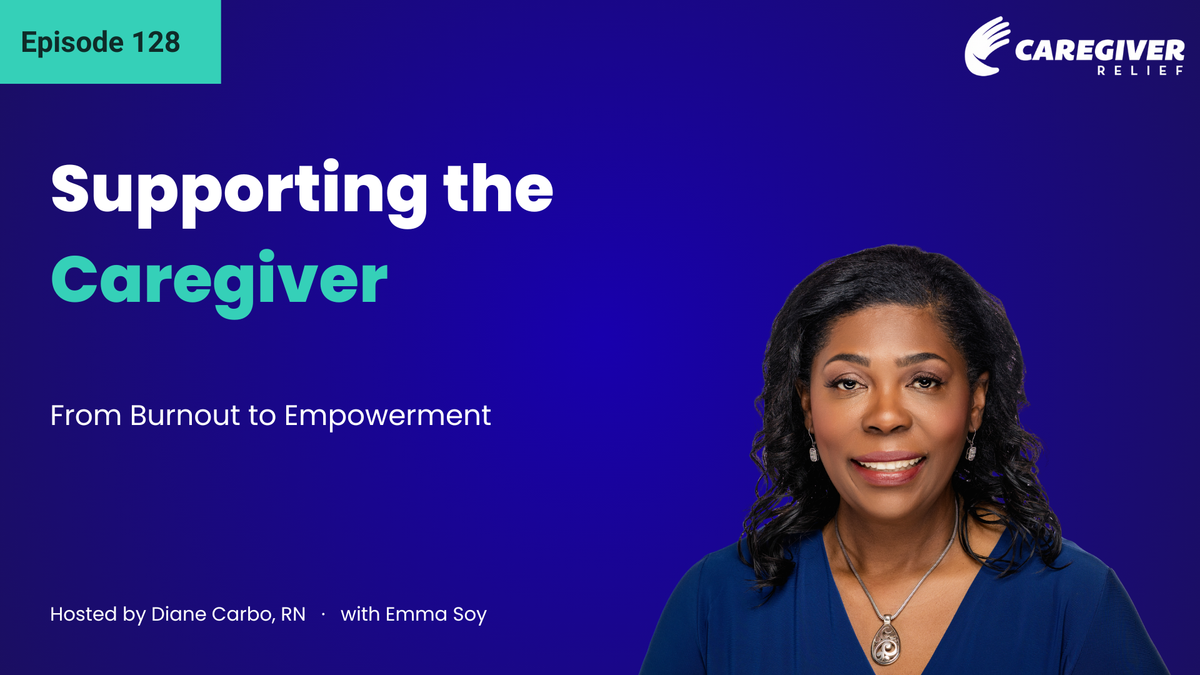
Supporting the Caregiver: From Burnout to Empowerment with Emma Soy, RN, BSN, MA - Episode 128
Caregiving is a journey of immense love, but it can also be one of overwhelming stress and exhaustion. We often focus so much on the person receiving care that we forget a crucial truth: for a loved one to thrive, their caregiver must thrive first.
In this powerful final episode of our three-part series, Diane is joined by the insightful Emma Soy, founder and CEO of Gentle Shepherd Care. They shift the spotlight entirely to YOU, the caregiver. This isn't just a conversation; it's a lifeline for anyone feeling stretched thin, unseen, or on the verge of burnout.
Ready to transform your caregiving journey from one of survival to one of empowerment? You don’t want to miss this.
What You'll Discover in This Episode:
This conversation is packed with wisdom, practical advice, and heartfelt understanding. Here's a glimpse of what Diane and Emma discuss:
- 👩⚕️ Sick People Can't Care for Sick People: Emma opens with a powerful truth about why the caregiver's health is non-negotiable. They explore the unique challenges faced by different types of caregivers, from spouses to adult children.
- 🎓 Bridging the Knowledge Gap: Discover why the education family caregivers receive upon a loved one's discharge from the hospital is often inadequate. Emma’s caregiver coaching program was inspired by seeing families struggle without proper training or understanding of medical terminology.
- 💔 The Reality of an Unsafe System: Diane and Emma have a candid discussion about unsafe hospital discharges, the financial burdens forcing families to take on complex care, and how reimbursement policies are impacting the quality of care available.
- 📜 Advanced Life Care Planning: An Act of Love: What does it mean to plan how you want to age? Emma explains why making decisions about your future care—how you want to age, where you want to age, and how it will be paid for—is one of the greatest gifts you can give your family, relieving them of an immense burden during a crisis.
- 🏡 Aging in Place by Design, Not by Chance: It’s not enough to say you want to stay home. Learn why 99% of American homes are built for young bodies and what practical changes (like walk-in showers and lever handles) you should consider in your 50s and 60s to make your home safe for your future self.
- ** boundaries Boundaries, Boundaries!:** Setting boundaries is not selfish; it's essential for survival. Learn why establishing clear limits with your loved one and other family members is critical for sustainable caregiving. Emma shares how a family caregiver contract can formalize expectations for breaks, respite, and financial contributions.
- ✨ A Final Message of Hope: Emma’s most important piece of advice for every caregiver listening? It's okay to get help. It's not just a suggestion; she emphasizes it's a "life and death situation".
Your Next Step to Empowerment
If you're a caregiver, you are the most important part of the equation. Without you, it all falls apart. This episode is a reminder to be gentle with yourself, practice self-care, and never be afraid to ask for help.
You can connect with Emma Soy and learn more about her revolutionary services at her website, gentleshepherdcare.com. She generously offers a free 30-minute consultation to help you identify gaps in your care plan and find a path forward.
Don't wait for a crisis. Take the first step toward a more sustainable and empowered caregiving journey today.
Podcast Episode Transcript
Diane: Welcome to the Caregiver Relief Podcast. I'm Diane Carbo, rn, your host today.
Diane: Emma, it's so wonderful to have you back for the final episode in our three part series. In the last two episodes, we explored the heart of person-centered care and disease specific strategies that bring real hope. To families, but today we're shifting the spotlight because this episode is all about the caregiver, and I love that.
Now as the founder and CEO of Gentle Shepherd Care, you not only revolutionize how care is being provided to seniors, but you're also recognizing something so many, in fact, it's. Everybody overlooks that the caregivers must thrive in order for their loved ones to thrive. So in this conversation we're gonna talk about your caregiving coaching program, the five key areas that reduce overwhelm and how advanced life care planning can be a gift of love, and how caregivers can build a support system that's truly sustainable.
I wanna thank you. I know you're really busy right now. Welcome, and I'm looking thank you. Forward to this.
Emma: Thank you for having me. Thank you for having me for three, coming back three times in your show,you're a
Diane: shining light in the home care, atmosphere. right now I'm just, you have a philosophy and I love it.
So why is caregiver health just as important as the health of the person being cared for?
Emma: Diane, one of the things that I always say, if you, if sick, people can't take care of sick people. Exactly. So if somebody's not well, it's very difficult for them to be able to provide care adequately to the person who needs the care.
Diane: 100%. I agree. Yes. Yes.
Emma: And so one of the reasons that I believe. and it's a battle. It because it's not easy to provide that kind of service because not everybody recognized that they need the help. Yeah. And so remember, caregivers could be, a family member. Caregivers could be a child of the older adult, and it can also be a spouse.
Of the older adults. Yes. And each of these caregivers have their own characters characteristics and they, each of 'em respond to care and respond to help differently.
Diane: And the other, thing that they're dealing with right now is we are, the Medicare medical delivery system is now prov. Forcing family members or the family caregiver, whoever that may be, to do, care, provide care and treatments and services once done by healthcare professionals.
Yes. And they don't have the training. They don't know what to look for. They don't know the resources. I know I've been dealing with this for a very long time, so I'm really excited. I'm interested in learning about your, caregiving coaching program. What inspired it and what are the key goals behind it?
Emma: So one of the, so several things, what's behind it? Number one, I have watched family caregivers taking their loved ones home and not having adequate training. Now, I know when I speak to discharge planners, a lot of them, that is part of their, discharge is that they do education. Yes, but I don't know.
But there are certain times a family, most of the families that I meet at home, they don't,I don't know whether they have the education, the training or not, but they don't, the education is not adequate.
Diane: It 100%. And what people don't understand is that you have to hear something six or seven times before you, it records in your brain.
So if they're showing somebody something once or telling them once, it's not sufficient education.
Emma: They need to hear it. They need to see it. Yes, they need to do it.
Diane: Yes, exactly. That's the nursing See one, do one, teach one even. Yes, exactly. So if they're
Emma: not able to do that and it has to be repetitive, they have to repeat the, because I think we take that, we take for granted that we are trained professionals.
Yep. Yep. That when someone tell us something, we already have a ground base. We already have a base education.
Diane: Yes.
Emma: That when we say things like even our terms. people are not familiar with terms and so I think sometimes we take for granted that they don't have that foundation for training.
So when we starting from there, sometimes that's the first time somebody's seeing that person is like, oh, that person, you gotta get 'em out of bed. How am I gonna do that? they watch 'em and said, oh, I can't do this. And then now you start teaching 'em, it's everything goes over their head.
Diane: And, I, and the medical terminology is something they're so unfamiliar with, and I find that as healthcare professionals, we are in tune to that because we're so ingrained in hearing those terms and these poor people and what's really.
What I, what frustrates me is the caregivers or the seniors even are afraid to ask what it means because it makes make them sound dumb. And I'm like, oh,
Emma: no. yeah. they don't ask, but they don't even know what to ask.
Diane: 100%. I will agree with that. Yes. they don't
Emma: know what to ask and so they don't ask number one.
So we talk about the different type of caregivers. So let's talk about the spouse, for example. So the spouse, for example, so you can have a, the husband and the wife. wives are natural caregivers. Yes. They natural caregivers. And they feel like when they're taking care of their husbands, they feel that they've always done things.
for example, they are. Couples, they do everything for their husbands anyway. the older adults. Exactly. The older couples, like they're 90, they are so used to do things for their husbands. And their husbands are so used to just sit back and watch their wives, do everything for them.
today's generation is different.
Diane: Yeah.
Emma: But the older generation, they are used to receiving and the wife is. is used to giving.
Diane: Yes. And that's a problem.
Emma: So they do everything anyway for them. Even like their pills, their this, their socks. They do all these things for them. Yep. And so the pro, they used to that.
So it's harder to take that away from them.
Diane: Exactly. When you
Emma: bring in care or when they feel, when you tell them that they need help.
Diane: Or if it's reversed and all of a sudden the wife that has been caring for her husband for their whole entire life becomes ill. And now he's this person who's expected to be able to provide care for.
Her and he doesn't know anything about No providing care. He's lost. Else. He's lost. He's totally lost.
Emma: he's overwhelmed and the first thing he's looking for is is there a nursing home to put my wife? Is there an assisted living? Yep. Is there this, is there that? Yep. They are easy. it's. No blame.
It's not a blaming game. Oh. But they just don't know what to do. And they,
Diane: and they're not qualified and they don't feel, they're afraid. They're living in fear that they're gonna do something wrong.
Emma: Yeah. Yeah. And they're overwhelmed. and the, and you have the wife who actually wants to do everything and even to the detriment of their own health.
yes. I had a client. especially if the spouse has, chronic diseases that is, that, that is, when they starting to decline functionally. Yeah. Like they can't walk or, they can't get up, they can't do this and that. And so you have a wife that's close to their age group, right?
Uhhuh, you have a husband that's 90, you have a wife that's 88, 87. Yeah. Who's doing this now? That, that, that becomes a problem because. They literally, they can't lift this man. They can't do these heavy things. And they don't know which part of the job they need to have other people do. It's very hard, and I
Diane: just had a client, her husband is 80, she's 78.
She has bad knees. He just was released home from the hospital. It was an unsafe discharge to home it. I'm seeing a lot of that, and I know you are too, I'm sure of it, but here she was. They told her he was a good transfer. she tried to put him on the toilet. When he first got, he was only home an hour.
Not only did she drop him and he fell, she injured herself. He had to go back into the hospital and have surgery because he re-injured the surgical area. He had surgery on his back and head injury.
Emma: yes. But the, unfortunately, the reason, one of the reasons that. you and I talk about unsafe discharges.
Yes. one of the reason for the unsafe discharges is the re reimbursement because these things are not being reimbursed for, do not get, people don't get re we don't get, we don't get reimbursed for these kinds of services.
Diane: you know what, I'm, I've been arguing with a few CEOs in hospitals because all of a sudden, all patients are ready to go home within 20 days after being dis, after being admitted to the hospital, whether they're ready or not.
And then if they have managed care, they're going home in 11 to 14 days. And I, they say, they meet. Medicare criteria. I said, I thought we had a hundred days of coverage, and I said, it used to be that you kept everybody to a hundred days because the reimbursement was so good. Now all of a sudden, because after that 120, or after that first 20 days, or 11 to 14 days on managed care.
They are not getting reimbursed. In fact, they get a higher level of reimbursement to not provide therapy. So we have a big issue here and that's why I'm so excited about telling people about your home care platform because it is revolutionary and it's just what we need at a time where we have a public health crisis going occurring.
Emma: but the thing is that unfortunately though, I have the service available and we know what is needed. Yes. And we know that it's a gap in care. Yes. and it becomes, the challenge is getting people to accept that ca that service. Yeah. Because of their financial burden. Because of the financial challenges that they currently have.
And so you'll have, people are willing to take on their loved ones, even they know they're not adequately. A train did not adequately. Able to do it because financially it's, the burden is too heavy on them and there was no reimbursement for that
Diane: company. the Medicare Advantage plans are expecting 200 to $500 a day copay.
that's a lot of money and it. To deter use of benefits. So what's happening is they're being forced to take these people home because they don't have the financial ability or Have the financial ability, but don't wanna spend the money. And that's the issue that we really need to address because I'm telling you right now, it's home care benefits alone have been cut.
So badly that we're not even getting, the nurses aren't getting reimbursed for their visits, so the nurses aren't going out for things. I had recently had a client come home who had a new seizure, medications, just found, discovered seizures and was having UTIs. She came home, fell as soon as she got home.
And they had not done any home care visit at all. She had stairs to go up, was sitting, no bed to sleep in downstairs. Had no way to get upstairs. They said she was independent, but they sent her home with a wheelchair. None of it made sense. Yes. Yeah. And what I'm seeing is that they are just sending them home and just hoping and praying that it works.
Emma: Yeah. But unfortunately, I. FA because families have to pay for services. Yes. They are looking at it like, okay, so what are you gonna do for me? They can't see the value Yes. Of having the presence. Yes. Of a professional in the home. If I can't dictate, for example, I'll give you an example.
I go to a home, I come in there with a professional pair of eyes. I see care completely different than the family caregiver. I see it completely differently. So I go in there, I'll give you an example. I go in there, I see,a male, a spouse laying in the bed. Okay? And his wife just got him ready for the.
But the minute he's at the edge, he's way at the end of the bed. He's discombobulated. Yep. The minute I walk in, I'm like, okay, this is not good In my head, that's the pro, that's the presence of the professional in your home. Yes. So you may not think you can think of something for me to do for you, but I come in there automatically.
So I said, oh. He is sliding off the bed like, he's slid and she's yeah, I can't get him up. He is too heavy. I can't, so she's trying to move him up, but he, she can't wait. But I got, I got skilled so automatically I'm like, what she need? She needs a pool sheet. She has a pool sheet under him.
So automatically I rolled up, I said, give me a, do you have an extra sheet? She's for what? I said, just gimme an extra sheet. She gimme an extra sheet. I, make a pool sheet, roll it over under him. And I scoop him up and she's that's the. Value of having someone who's a professional to be able to notice it's little things
Diane: that we see.
In fact,I went to a home, to do an evaluation a few years ago. I, it was a very, this couple was, she had Parkinson's, she was an LPN, he was a. Retired teacher with dementia and they were so over the top in love. I mean it's so cute to see them, but they were still in the, their bed, the big king size bed and I said to his daughter, this isn't gonna work anymore. We need to get two hospital beds in here. the aid that was there says. They don't need hospital beds. Meanwhile, she was gonna be getting a feeding tube and And all these things. And I said, you know what, I'm sorry, but. I know what I'm talking about.
I've done rehab for years. and she insisted she was, she was a, an aide. That felt that she knew everything and it was very challenging for me to teach her how to transfer them property and And, get a, the beds in there, we just put the two beds together. It's not hard.
So that they could hold the hands or whatever, but We,I just, here's a perfect example of what you're telling me. I, this lady that had her husband fall When he came home from the toilet on the toilet He had a stage three theCUBE on his heel. And the facility.
Didn't even know he had it and he was in acute rehab. I'm like, are you kidding me? But this is what, what's happening? They're putting sent, and he was a severe diabetic. He may lose that foot. We don't know yet. But here we are, we're dealing with the facilities aren't providing the quality of care that they need to because the reimbursement is no longer there.
Yeah. Yeah. how do you not do skin checks? Yeah. other thing I'm learning and this will make your head explode. 'cause it did mine. They're saying patients have rights now. Yes, they do. To a point. Yeah. Yeah. But we're going into facilities and they're saying, oh. If you don't want turned, we won't turn you.
And then they're developing the cubitus. They're brush your sores on their butt and their heels or whatever. Yeah. And I'm like, oh my gosh, you're causing harm. Yeah. There has to be a point where I'm the boss and yes, I know you're not on, you're not happy with this, but I'm doing what's in your best interest, otherwise you can cause harm to yourself.
Yeah.
Emma: Yeah. Patient rights doesn't go to when the person is harming themself.
Diane: Exactly.
Emma: Just if that person couldn't talk for themself, the family wanted to do something and that was gonna be harmful. Somebody has to advocate. It's the same way you need to advocate for this person who's unaware, who doesn't.
Exactly. the reason the person doesn't wanna is because it's inconvenient. It's hurting or something, but I'm not, that doesn't, yeah. those are the kind of things that we see in the home with caregivers. Not only not trained. But unaware don't have the knowledge to be able to know what they don't know.
Yes. and then the other issue is the reimbursement issues. That who pays for all this? Who pays for this? that's the first question. Who pays for this?
Diane: I will tell you right now, Medicare has moved to a cost sharing plan, and with all the changes, they think this is going to be so good for our healthcare.
What's happened is the government policy makers are now our doctor. The doctors aren't included. They're told what they can do, when they can do it, and how they can do it, and then. the rich will absolutely pay for whatever care. The middle class will end up still doing the second mortgages or reverse mortgages.
They will sell their assets to get the recommended care and the poor. I'm sorry, but I've seen this for decades and people don't realize that this, they do without. Yeah. I've seen it for decades. 'cause I've done all avenues of all kinds of, arranges of nursing care and I've done home care. Yeah. And I know that they're not getting the care that they need.
They don't. So nothing has changed.
Emma: No. And over the years it's always been reimbursement direct care.
we learn in school. The stuff we learn in school is very, is night and day from the actual. You know what we do? Yes. because when you were in nursing school, you think you were gonna go out there and change the world.
and you get out there, it's whoa, I can't change the world because there, they didn't tell me about these people. yes. Blue Cross Blue Shield. They didn't tell me about the government. They didn't tell me about Medicare. They didn't tell me. These people is actually the people who direct the care, not me.
Unfortunately that this is what it is. Diane, over the years, the other side is that we've never taught, people how to take responsibility for their own health.
Diane: I, a hundred percent agreement, so that's
Emma: why people don't think they should pay for care. Yes. Okay. yes, actually, even some of the care that we are talking about, even, for four hours a day, $120 a day, people don't feel that they need to pay for care when they're actually paying for things.
they don't even think about much more than that. And so because people don't really think care is something that they need to pay for, they don't take responsibility for their, they think someone else should be doing it for them. Like the government should pay for it. The insur, yes, we should, we pay for insurance.
I think we should have better care than that. me, Medicare, I think older people deserve much, much, much better care than that. Yes. But what if they don't? So who's supposed to take responsibility for that?
Diane: it's on the family and,I like to tell everybody, 63% of family caregivers become seriously ill or die.
Yeah. Before the person, they're caring for passes. And that's really a serious statistic because what's being. Pushed and forced on family caregivers now is going to come back and it's going to be a hundred percent because the stress. And that's why when you say, $120 for four hours, I'm like, oh my gosh.
That gives a caregiver four hours. Hours. Yeah. Yes. Of relief that they know somebody's gonna be there and they can go grocery shop and see their own doctor, get a massage, whatever they need to get. To get the breaks that they need so that they can thrive.
Emma: So let me tell you about a client that I have. I had this week or last week, I went to do an assessment.
The client, the patient has Parkinson's, the wife is the primary caregiver now. He has had Parkinson's for about 14, 15 years. And so now he's declining? Yes. Okay. He's, he is pretty young because he is still in his seventies, upper seventies. But he's declining. Okay. And she's in her seventies, so that means, the body doesn't, cannot take care.
somebody like that. So she's doing her best. So she calls me and she wants some help because the husband is declining. And, after I talk to her over the phone, she took a look, how much the care is. She called me back, she said, no, I think I'm gonna hold up. She moves in a newer place. She called me back immediately the week after.
She said, I don't think I can. I need help. He fell the fir, we just move in here. He fell in the afternoon. His mobility's worse. I, and I can't get him up. I can't lift him. yes. I said, okay. I go in there and talk to him, to her while I was there. one of the things that with Parkinson's, for him in the afternoon, the, morning, they have more energy.
The afternoon get worse.
Diane: Big,
Emma: he's really hard to move. While I was there for about an hour, they also have the urge constantly to stand up. He has the urge to get up. Urge to get up. he can't get up. So it takes me and her trying to get him up because otherwise he gets all frustrated and things.
Okay. I said, okay, let's set up. And so it take both of us to get him up. to stand up. So what happened when I'm not there? So she has, she doesn't have a gate belt. She doesn't have the proper equipment to, to help. She doesn't have the skill to use his, his pants to, she doesn't have the skill to be able to get him up.
Yeah. and she probably doesn't have the strength either. She doesn't have the strength, she doesn't have the skill, the proper skill to get him up. Yeah. And he can't get up and he has to because that's gonna get him really frustrated, right? Yes. So she, so she get me there and I said, okay, those are the kind of things that I will, we will do it for you.
and she said, that's the time I need the afternoon. I said, great. We have the caregivers in the afternoon, because that's when he's worse. So during those four hours, he'll be there. If she wants to get up, we'll get him up, even walk, we'll walk with him. she said, okay. So we got the care plan all set up.
The next day the caregiver is scheduled to go and,she's gonna go for four hours and then at that time she's gonna go, she can go shop grocery shopping, she can go do something, a bit of air. And she's I'm so excited. Did you know when the time come for the caregiver to come the minute that she was ready?
The husband said, what? You leaving me? I can't do this. You can't leave me alone. Yep. Yep. You can't leave me by myself. You leaving me with her? I don't even know her. Yep. She sent the caregiver away.
Diane: I, you know what? I've had that happen so many times and it's so frustrating. yes.
Emma: It broke her heart too.
When he says, no, you can't leave me alone with her. I can't do that. Now, remember, I just told you physically. Those are the hours that she needs help. She
Diane: cannot do it. Yes. And that's when you manage by crisis because he's gonna fall, hurt himself really bad. End up in the hospital or even have unfortunately situation Yeah.
Where he'll pass away and never be able to return to the home again.
Emma: And so my goal with my caregiver, coaching Yeah. Is For it is for those caregivers to have me as someone that they can dial. Someone. That they can call. Yes. Yes. Number one, yes. Someone that can anticipate what those things are going to be like to have someone like me in their lives that they can, I can anticipate, like for me.
I cannot force care to her. But if she's my coach, if I'm her coach, I will tell her blank. I don't sugarcoat it. I don't sugar coat it either. So I tell 'em exactly what it is. I'll tell 'em. Exactly. Let me tell you, you continue to do this. You're gonna find yourself laying in the hospital because your back is gonna give out on you.
You are not 30 years old. Yeah. you are. Your back is not too up to that. You don't have the skill to properly do bo good body mechanics to get this man up every 10 minutes in the afternoon for the next, for four hours and every day. Yes,
Diane: you can't
Emma: do it. Okay. Okay. So you need a younger group of person. Not only during that time will give you train you proper bo body mechanic.
It's not something you just learn, it's something that you actually learn and do.
yes. How many times as nurses, we have learned good body mechanics and we still break our own backs.
Diane: Absolutely. a patient's spasms or they slip all of a sudden and you're injured.
Emma: And you, because you're not thinking Yeah.
During that time. Yeah. You are thinking about, picking up the client, not your body mechanics.
Diane: Yeah. And
Emma: so it is something that you have to practice all the time. Yeah. Like before you, me, as a professional, before I get. I do anything for patient. First of all, I sit there and I think about what is going to be happening.
I practice that in my head, okay, I'm gonna get this person out. This is what I'm going to do. I'm a professional. I've been doing this for forever. How many family caregivers are doing that?
Diane: Yeah. I also, I talk through it with my patient before I do it, and then during, yeah. This is what we're going to do first.
Yeah. And then tech them. I spoonfeed them each step. Yeah. So that I know and they know and that they're prepared. And family caregivers don't do that. they learned to do that? No. and it's not their fault. It's not, I'm not putting blame on anybody. I'm just saying we have knowledge and experience take advantage of our knowledge and experience.
Yes. Because we can make your caregiving journey so much easier. So much
Emma: easier. Yeah. And the other thing that I tell family, caregiver, and Diane, when people know what to expect, they respond differently. So I usually tell family caregivers, remember. Your husband is going to respond to your care differently than if I was giving the care.
Diane: Yes. Hell yes.
Emma: because they know. They know I know what I'm doing. They know you don't know what you're doing. They already know that.
Diane: and you know what I find, and this is my personal experience is they will, the person that's needing care will lash out at the perverse that is providing care, because they know that they can get away with it and still be cared for.
Yeah. And they'll be mean and cruel or whatever. And it just breaks down the heart of every single family caregiver. After a while, it gets tiring and that's why I always encourage, get help in the home. You really need it. Yeah.
Emma: And especially if they are alert, they are not only, even though they can't get up, but they telling you what to do.
Diane: Yes. Yeah. So they're
Emma: telling the fa the wife, they're telling the family caregiver what to do, even though they can't do it. Yeah. And so now you, they're not, listen, like for me as a provider, as a professional, I'm telling them what to do. I'm gonna, I'm going to tell 'em, put your feet down.
Diane: Yes,
Emma: we going to lock your knees and my knee. We are going to do this. We're gonna do this. But the family caregiver doesn't, do all these stuff and so they don't trust and they have very low confidence that this person is gonna transfer them safely.
Diane: Exactly.
Emma: And so there is this tug of war.
So I teach the family caregivers all these things. And during, during, that's why the coaching is important. It's not just to teach you things, but it's to walk it with you.
Diane: Exactly. Now I wanna talk about advanced life care planning because you call it an act of love. And what do you mean by that?
Emma: I call it an act of love because
if you, when you don't do advanced care planning You leave it to someone else to do for them, it's a very difficult decision for other people to be making for you
Diane: explain advanced life care planning to, the audience.
Emma: So advanced life care. This is where, this is, where this come from, Diane.
I do care management. And then I added home my home care services. When I added home care services, what I discovered was number one. Nobody, I don't wanna say nobody, but very little. the majority of people, yes. Do not plan. Number three things, how they want to age. Yep. Where they're going to age, how much aging is going to cost.
yes. And so because they don't plan ahead. Yes. They, all of these become a burden for your loved one. Exactly. Because you will get to the place where you can't do it on your own. Yep. So when you don't do it, you can't do it on your own, then it becomes the other person's responsibility.
Yep. To make decision how you should age. Yes. To make the decision where you are going to be. Yep. And to make that decision how much it's gonna cost. If what if you don't have the money to cover the cost. Yes. So where are we gonna get the cost? So all of that is a responsibility of your Yeah. Of for your loved one.
Now, what if all of that was already decided upon? What if you have already had it so much all planned out?
Diane: Yes.
Emma: What if it's not in your head? But it is written. It is formal. All this, all your, all they have to do, your daughter has to do is pick up your book, your care plan and look and say, okay, this is what my mom wants.
Yeah. And this is what she wants. Okay. This is what we are going to do. They just have to execute your plan. Yes. They have to do the decision for you. That's what I mean by it is an act of love because you relieving that person of that burden.
Diane: Yeah,
Emma: because caring for your loved one is stressful enough.
You are not the only thing they have to do. They still have to take care of themself. They still have to take care of their own children, their own family. They, a lot of those family member caregivers, they have grandchildren that they wanna be able to spend time with, they wanna do all, and on top of that, they have to take care of, decide how you gonna age, where you gonna age, and how much that gonna cost.
That's a lot. Yeah.
Diane: and the other thing, every caregiver out there has some extended family member that's judging their care and their decisions and or an uninvolved siblings doing the same thing. Yeah. So when a person, an aging adult, puts things in writing Making clear, concise ideas of what they want, when they want, how they want it, and where they want it.
It takes away the burden of judgment and guilt that a family caregivers are gonna feel. And also it's, it's added stress not only because of not, it wasn't done and in writing, and now you're trying to figure out, but you have all these people judging you and they're abusive to the family caregiver.
They beat them down horribly.
Emma: Diane
Diane: over and over.
Emma: But Diane, if you don't have the plan, that family caregiver is gonna need to, is gonna make decision when under crisis. Yes.
Diane: yes. '
Emma: cause it's not planned. Yeah. So they go into, like all of a sudden you are in the hospital, they have to make all these plans.
They, and these are the words, I've never been here before. I've never done this before. I don't even know where to start. those are the words I hear from family caregivers all the time now. Having a living will is great, but that's not it.
Diane: Yes, exactly. It's not, that's not it.
Emma: Nope.
having a will, having a living will, having a, it's just part of it having a,a power of attorney. Yeah. that's just part of it. That's just part of it. Yeah. It still doesn't tell me, how do you wanna age? What do I mean by how do you wanna age? Diane, how do you wanna Age is something that you start to do in your fifties and your sixties.
Yes, exactly. Don't decide how you're going to age when you turn 80. Yes. So how you wanna age is looking at knowing what numbers are important. Yeah. I tell people aging doesn't kill people just because you age, that doesn't, just because you 90, you a hundred nobody die of aging. Yeah. You die of the chronic diseases things.
Yes. Okay. That you are suffering or living with, those are the thing that kills you. It's not because you 90. yes. And so knowing. The numbers, the things like, for example, biological age and chronological age. Yep. Those are those, I, we were not talking about these things 10 years ago, but today we're talking about them.
Diane: Yes.
Emma: Because of advancing technology, it is possible knowing these things, taking it, it shows responsibility. oh, what? The first time I heard about biological aging, I'm like, what? What does that mean with that? Like they said,if you 70 and you actually, that's chronological, and then biologically you 90, that's, that means you going closer to the grave because, so that means it's the biological age that takes you to the great that your chronological age.
Yes. And then they said, you can actually reverse that. I'm like, whoa. And so that's what I mean when I say, how do you want to age? Do you wanna age where you just watch yourself decline, watch yourself this, and that. And then the world says it's because you 90 years old, you be, or do you wanna take control?
Of your health, do you wanna take control of your, of what's going on with you? and that's what I mean, so I can take care of someone who's 80, but they're living well.
Diane: Yes. I have a lady that's 104 in New Jersey that she has somebody come in seven or eight hours a day. They go shopping, they go, they do activity.
She goes to the senior center with her. She has a, and she home alone in the evening, but they have her meals prepared for, and she's living really well. She is living. That's because she's hundred four. She doesn't need to
Emma: be in an assisted living or nursing home. She can be at her
Diane: own home. Exactly. I wanna bring one more point to that.
When you're in your F forties, fifties, or sixties, and you're planning on how you wanna age, you also have to understand the majority of homes. In fact, 99.9% of the homes in America are made for a young body, not an aging body. And if you're going to remodel the home, yeah. Make it so that if you're, if you wanna stay in this home, the rest of your life, and I hear this all the time, they're gonna take me out with feet first,
And I'm like, it doesn't work that way, but,get the house. Talk to a certified agent and place specialist and make changes to the home. Get high toilets when you have to get, replace the toilet, make, get lights to cha, the light switches down, and make them levers, not the buttons, or make the handle so that their levers not to grab because arthritic cans don't, do knobs very well.
there's, the important
Emma: thing
Diane: is
Emma: shower. The important thing is yes. It's move a walking shower. Oh my god. Because you, someone can have a stroke at 50 60 and all of a sudden you don't have, you cannot get in the shower because you don't have a walking shower. So if you're gonna make all these changes, make changes that make sense because you're gonna spend the money already.
Diane, I have a couple that was about less than five or six years ago who bought a new house and I went to their house and because I'm a home care nurse. You know those lights, bulbs? Yep. In my head, and I went to their house. They were in their seventies, and the minute I go in there, they have all these stairs.
I said,do you guys have a first floor bedroom? They're like, no. Yep. I said, oh, you guys just bought, they built this house. They just built, they moved from wherever they came and they came here to North Carolina. They built a house.
Diane: Yeah. They're
Emma: in their seventies, Diane, and they don't have a first.
Floor bedroom. I'm like, whoa, that's not nice. It wasn't long later, the wife became, had some issue, had a foot ulcer in her foot. Uhhuh took her to the doctor. She has cancer in her feet. Okay. So she had surgery, yada, she can go up there. Husband became with dialysis and he's two week.
I'm thinking, yeah. Oh yeah.
Diane: You know I, I see this all the time. In fact, I go into some over 55 communities and I think I wanna shoot the person that built these, because they'll have steep steps. They have everything. So high is within reach. What makes it over 55? It's not because it was a well bit.
Built, home for an aging body. Not at all. Yeah. And I just have, I have so many seniors now here in, in Myrtle Beach that buy these, RVs. they're dropping big bucks on these amazing RVs, and you have to climb in them, and then they have steps and Oh my God. And I'm thinking, these are people in their seventies.
And they're not well. If they were, it's another story. Okay? You might have a few good years, but it's like, how are you going, you're not gonna be able to use it long.
Emma: What is going on with those showers? that's my thing. Why do we have these? Little hump in front of those showers, we cannot wheel you in there.
Diane: yes. And that's the other thing I tell people when you're thinking about aging and you're remodeling, get a certified agent in place, specialist there because you know that little lip, that you have is, can be detrimental to getting you into the shower. And it's the same, I like the idea of the walk in.
tubs that they have. But you have to be able to get into it, get in there independently. And it's not realistic for so many seniors Over time. And they don't think about that thing. So it's very frustrating for
Emma: me. Yeah. It's very frustrating. So those are all the things that I teach.
Yes. By family caregivers that they don't think about. They may not think this is valuable, but those are things that you don't think about. They're gonna come and bite you later, I'm telling you.
Diane: Yes. what is the right time to seek professional help, whether it's home care, respite care, or therapy?
Emma: Okay. as a family caregiver, I feel, it's my opinion. I recommend that anytime you dealing with. you a caregiver issue, like you have someone now diagnosed with a chronic disease. Yeah. You need to get professional help.
Diane: Yes.
Emma: Yes. Because the thing is the teaching is not only teaching you what going on right now, but also what's to anticipate so you can make good decision.
Diane: And doctors don't take time to give people that information. They don't have time to give. I forgive 'em. They don't
Emma: have the time.
Diane: No. And it's, they have 15 minutes and, they have to do, assess, diagnose, treat, and document. and
Emma: the resources are so short. They're so short of resources. They are. And that's why it's really
Diane: important.
And I'm in total agreement. When somebody gets diagnosed with a new diagnosis or a condition they need to call somebody such as yourself and say, you know what do I need to anticipate for my future? and a lot of doctors, I'll tell you, with somebody with dementia stuff, they have no idea what to tell you.
The doctors, because they know one thing and one thing only. We've lost our ability to have holistic care, whereas you and I are taking a holistic approach to care.
and that's a lost art in our medical delivery. Totally. Because we don't have
Emma: time for that.
Diane: No. Nobody has time. And that's why we're so valuable and important.
And, people need to know what you're offering.
Emma: And the other thing is the reason that they need to get, because there are different phases of care.
Diane: Yes. Okay.
Emma: There was a phase. There are phases there. The beginning, they're middle and they're towards the end. And each of them are different.
Each of them are different. And you need different equipment for each phase.
Diane: yes.
Emma: And so you need to know, what do I need now? What do I anticipating for later? And what do I need to look forward to? Yeah. So you can face the challenges much better with less stress. The whole thing is stress. Yeah, how do I manage?
And when you plan ahead like this, the stress, not because you're not gonna have stress, but at least you'll have the tools, you'll have the support already in place. You'll have the services already in place
Diane: Yes.
Emma: That you could just access.
Diane: Caregiver burnout's real.
Emma: Oh, wow.
Diane: it's so real. and people, in fact, it gets to the point where the person providing care becomes angry.
And the anger actually causes them to have more stress and develop chronic illnesses themselves.
Emma: So they're angry. They can get big guilt, they can have guilt. They have anger, they have resentment depending on the relationship that they have with that person, because if that person was not a nice person, now they have to do this.
That is very hard for that person. So they can have resentment. They can have guilt, they can have anger, they can have denial. Sometimes they are in denial to accept that my loved one is turning into this person. I don't even know this person. Yes. and so they could go to the different stages of grief.
and they don't even know that those are the different stages of grief.
Diane: yes. Now, because they're expected to do so much, one of the biggest issues that caregivers lack is the ability to set boundaries. Yes. what role do boundaries play in sustainable caregiving, especially within families
Emma: boundaries?
so you have the family care, the family, the care recipient, Uhhuh. Okay. For example, you have the daughter who. You have the mother who thinks everybody should drop everything they have in their lives to come and do this. Okay.
Diane: That's 99% of them.
Emma: and I don't need someone else from outside. I have seven children.
Yeah. They all need to do whatever they need to do to take care of this person. Yeah. and they don't have, so you have to know. When do you, and then they use guilt. They use guilt. So when do you say, no, mom, this is what needs to be done. This is what, so boundaries like that, recognize when the person is being using manipulation to get you to do things.
So you do it out of obligation, not out of love. Yes. so you have to, if, when you recognize that, that's one thing. the other boundaries is husband. It's the husband or the care recipient who doesn't want you to leave, who doesn't want you to. Simple things like I just gave you the example that she wants to take one once a week, take four hours.
Yeah. Four hour, break from the husband and when the time come, the husband is crying and said, you are leaving me alone. And then she gives in. That's no set. Not setting boundaries. The boundaries is no, John. Once a week, I am going to take the time because I love you and I really wanna still be able to take care of you to the best of my abilities, but I need some time off and that is why I'm like to be able to verbalize that.
Diane: Yes. I tell every family caregiver, that I work with and it makes them crazy because they feel insulted. But I think that every family caregiver, whether they're a spouse or not, should put a family caregiver contract in place. They need to look at this like a job and And if they do that.
Hey, when you start a job, you get breaks, you get vacations. Yeah. You get days off. Yeah. Yeah. And when you do have all these uninvolved, extended family members that are judgmental and or, uninvolved siblings, then you have written in, you have in writing, I will do these things. But when I, you get to a point, if you are incontinent.
I don't feel comfortable providing personal care. Yeah. Yeah. Or if you become aggressive, I don't feel good. Yeah. I don't wanna be fear for my safety. Yeah. Or if you're sexually inappropriate and it does happen. Oh yeah. To me, feel uncomfortable. So I will stop that. That's when I will no longer be able to provide care.
Yeah. But. With the, here's the other caveat to that. Every family caregiver should have days off and time off. Yeah. if they have all these extended family members and uninvolved siblings, those people should be able to provide respite breaks and it needs to be done in writing. I need you for this many hours on these days.
And if they are not willing to provide. Physical help, then they need to contribute financially so that she or he, that family caregiver can get the necessary break,to be able to thrive and keep on providing that care.
Emma: Correct? Correct. now, again, Diane, that's where someone else. Someone outside like me or you come in That we are able to put these contracts together
Diane: 100%. The
Emma: family caregiver who's involved in it, it's so much harder for them. Yeah. Their siblings make 'em feel bad, like their siblings all like sometimes the family caregiver who, the person who become the family caregiver sometimes. Sometimes fall into it and the other people thinks, you don't do what I do.
My job is important. I, yes. I have this, my stuff is important, but, so the reason that you need to do this is because you got nothing going on. You single you this, you that. So it takes someone like me who says, no, not really. It doesn't work that way. Uhhuh, this is your mother, this is your father.
This is how this contract should work. Yeah. And so when someone else outside come in and put that in front of them, then they have nothing to say. 100%
Diane: correct. I, when you're the only
Emma: one putting that contract out, you're gonna get a lot of pushback. A lot of people say, no, Diane, why don't you just do this?
what's wrong with you? You always wanna take this the easy way out. You always, but when they, all of 'em are taking vacations, they're traveling, they're doing all this stuff, and you are at home and mom, and then that build a lot of resentment.
Diane: Yep. the other thing is they're not building up their social security.
They're not doing, yeah. They're not gonna be who's gonna take care of them? And I will tell you, I lose two to three caregivers every year to serious illness or death. Yeah. Yeah. It's a real thing. And then everything falls apart for the care.
Emma: can I tell you something, Diane? I met a nurse.
Couple years ago, and she took care of her mom. She was the mom, family caregiver, and I was in a retreat and she says, I finally, this is the first thing that I've done for myself for years. She said, and that was after her mother died. And she said to me, she said to me for the past, whatever the time she was taking care of her mom, she was, she didn't have a mother like her.
She, that was not my mother. She says I was, I had a total different title. I was a caregiver during now that my mom passed away, I'm like grieving, like I didn't do the things that I needed to do as a daughter.
Diane: With
Emma: my mother. So I tell family caregivers, you need me, you need my service. Because it's important for you to remain in your role as a wife, to remain your, in your role as a daughter, to remain in your role because you don't know how long you have, if you have the next two, three years with that person.
Yeah. Why don't we build memories? Yep. Why don't we spend time building memories and those, and these, those ends of times instead of spending all that time building, as a caregiver with a completely different title that you could hire someone to do. You cannot hire me to be your mom's daughter.
Diane: Exactly. And you know what? Everybody has the right to be a daughter, a wife, a brother, or a husband. And, not always be the caregiver. 'cause that's a totally different role and it's an unfair role to put somebody in on a regular basis
Emma: 24 7.
Diane: 24 7 for and caregiving. The average length of stay or average journey is six to seven years.
Yeah. And some go as long as 20 years.
Emma: Yeah. 10, 20 years depending on the chronic disease.
Diane: Yeah. there's a lot of issues that need to be discussed and and
Emma: depending on the chronic disease, Diane, it's very hard when someone is dealing with cognitive issues. Yes. That is very difficult. Yep. Yep.
When you are living with someone with Alzheimer's dementia, physically, who's
Diane: yes. And
Emma: mentally is not well.
Diane: Exactly, yes. it's really hard. Emma, what's one message or piece of advice that you want every caregiver listening to you to come away with today?
Emma: It's okay to get help.
Diane: It's not only okay, but it's necessary.
It's a stable technique.
Emma: it's life and death. It's a life and death situation. It is very important.
Diane: And that's not being dramatic at all. That is I'm very
Emma: true. That is very true because
Diane: I've seen it so much. And, Emma, how do people find you?
Emma: People can go to my website, gentle Shepherd care, ww dot gentle shepherd care.com.
And who should reach out to me? who should reach out to me? Anyone, first of all, who's listening to this podcast? Who has a loved one? And who is dealing with any type of chronic disease, any type of chronic disease, Parkinson's, Alzheimer's, dementia, whatever, the chronic disease, and you are responsible for that person, number one.
The question that I wanna ask you, do you have a plan for that person? Does that person has a plan? If that person doesn't have a plan, you ha you go ahead, give me a call and I would love to talk to you and give you 30 minutes of my time and, during that time, number one, I will, talk to you about what's going on.
I will get a, an assessment of what is going on with that person. What are your plans, what are your dreams? And then I will see what the gap is, what is missing, and give you recommendation of how you can go forward and put a plan together.
Diane: we're goal setters, so we help people identify goals and try to reach them long term and short term.
So I really that, to my family, caregivers out. You are the most important part of the caregiving equation. Without you, it all falls apart. So please learn to be gentle with yourself. Practice self-care every day. Ask for help. Call Emma, ask for help. Are are worth it.
Emma: don't wait until it's too late. Don't wait for crisis. Call me now. Exactly.
Caring for a loved one can be overwhelming — but you're not alone. If you have questions, big or small, our expert team is here to help.
👉 Click here to Ask the Expert
Our Resource section can help you find the information and tools that you need. We have courses, videos, checklists, guidebooks, cheat sheets, how-to guides and more.
You can get started by clicking on the link below. We know that taking care of a loved one is hard work, but with our help you can get the support that you need.
Click here to go to Resource Section now!
You might also like this article:
 Diane Carbo
 Diane Carbo