Real Talk on Long-Term Care Insurance with Matt McCann, CLTC - Episode 88

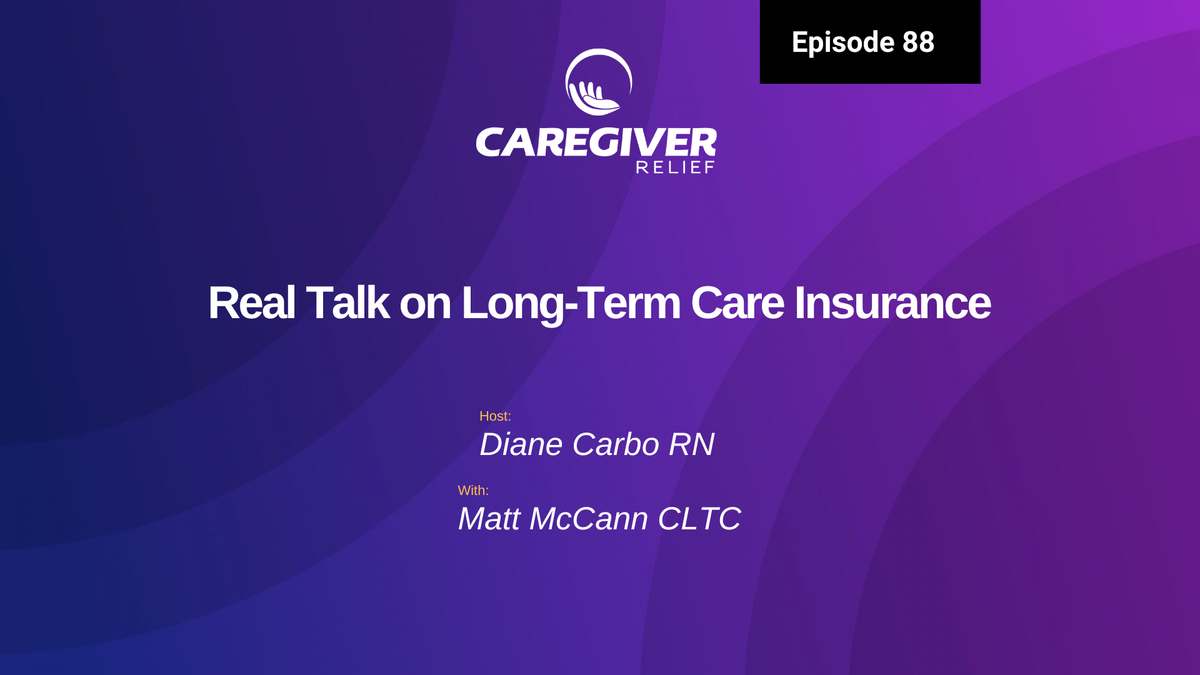
Tune in to the latest episode of the Caregiver Relief Podcast, where host Diane Carbo sits down with certified long-term care planner Matt McCann to discuss a topic many families put off until it's too late: long-term care planning. 👵🏽👴🏽
Matt, one of the nation's leading experts in long-term care insurance, shares his personal story of navigating the caregiving world for his mother, which became his calling. He emphasizes that long-term care planning isn't just about insurance; it's about having a crucial conversation with your family before a crisis occurs.
Key Discussion Points:
- Matt's Personal Journey: Matt's career was shaped by his experience as a caregiver for his mother, who began needing long-term care at age 59. He saw firsthand the financial and emotional toll it takes on families, and this inspired him to help others prepare.
- Common Misconceptions: The episode debunks common myths about long-term care insurance, such as the idea that it's only for nursing homes or that it's too expensive. Matt clarifies that most long-term care is delivered at home or in assisted living facilities, not nursing homes.
- Medicare Advantage vs. Traditional Medicare: Diane and Matt discuss the challenges with Medicare Advantage plans, noting that they can lead to high copays and "unsafe discharges" from facilities. Matt, who is turning 65 soon, shares his choice to opt for a regular Medicare supplement plan to maintain control and choice over his healthcare.
- Traditional vs. Hybrid Policies: The conversation breaks down the difference between traditional long-term care policies, which solely cover long-term care, and hybrid policies that combine life insurance or an annuity with a long-term care rider.
- The Importance of Inflation Riders: A crucial point is the need for a cost of living rider, as policies purchased decades ago without one may not cover the current high costs of care.
- Planning Sooner Rather Than Later: Matt stresses that the ideal time to get long-term care insurance is in your 40s and 50s, as part of retirement planning. He also highlights that younger individuals can need care due to accidents, strokes, or cancer treatments.
- Filial Responsibility Laws: Diane brings up a serious point about filial responsibility laws in 26 states, which can hold family members financially responsible for a loved one's care costs.
- How to Choose a Specialist: Matt advises listeners to find a genuine long-term care specialist who represents multiple companies and has extensive experience with claims and underwriting. He warns against agents who don't ask detailed questions about health, family history, and finances.
- Affordable Options: Matt assures listeners that there are affordable options for middle-income families and that "something is always going to be better than nothing". He compares the cost of long-term care insurance to everyday expenses like cell phone bills and streaming services to put the cost into perspective.
- A Call to Action: The episode ends with Matt urging listeners to take action now, whether it's by talking to a specialist or having a conversation with their family about their wishes. He emphasizes that planning for long-term care is about "improving your quality of care for you and providing a better peace of mind for those you love".

Don't miss this eye-opening conversation! This episode is a must-listen for anyone thinking about their future or currently navigating the caregiving journey. For more resources, visit caregiverrelief.com and myvitalvault.net.
Listen to the full episode on the Ghost CMS page now! 🎧
Podcast Episode Transcript
Diane: Welcome to the Caregiver Relief Podcast, where we shine a light on the challenges and solutions facing caregivers and aging families every day. I'm your host Diane Carbo, a registered nurse and a passionate advocate for aging in place. Today we're diving into a topic many families put off until it's too late.
Long-term care planning, and if you've ever wondered how to protect your family, your assets, and your peace of mind as you age or support a loved one through the process.
And don't forget to join us@community.caregiverrelief.com, a space where caregivers come together for connection, education, and support from people who truly understand.
Visit me@caregiverrelief.com and share your journey.
And if this episode resonates with you, please like, share, and subscribe. It helps us reach more caregivers who need to know they're not alone.
Diane: I'm honored to be joined by Matt McCann. He's a certified long-term care planner, one of the nation's leading experts in long-term care insurance
With over 25 years of experience, Matt has helped thousands of families across the country understand their options and prepare for the future with confidence. But what makes Matt truly stand out is the personal story behind his mission. Matt's journey into this field begin when his mother at just 59 years old, starting showing signs of needing long-term care.
Over time, she required home care, assisted living, and eventually nursing home support. And like so many adult children, Matt was thrust into the complex and emotional world of caregiving, navigating care decisions, financial strain, and the emotional toll that comes with watching a loved one decline. That experience just didn't shape his career.
It became his calling, and today he brings the same compassion and hard earned insight to every client he serves. Matt specializes in designing long-term care plans that are not only personalized and affordable, but also grounded in real life experience. He knows what works, what doesn't, and what truly matters when your family is facing the realities of an aging and caregiving.
So whether you're already caring for someone or simply wanting to avoid placing that burden on your loved ones in the future, this episode will give you the tools and knowledge you need to start planning today. Let's get into it. Matt, thank you so much. I wanna welcome you to our podcast. I know you're a very busy man, and I'm so excited because.
We have challenges in our Medicare system right now and, this is a very timely topic. can you tell me a little bit about your background and how you got into long-term care planning specifically?
Matt: absolutely first, Diane, it's great to be on your show. I really appreciate it. I never expected to be in long-term care, much less insurance.
I was in radio since I was, gosh, age 14. and I was gonna be in, in the radio and TV field. And I was, until the event with my mom, we were living in San Antonio at the time. We quit our jobs, moved to the Chicago area to help my brother and my sister in their families and trying to deal with my mom.
And of course, she did not have long-term care insurance. she did have the ability after, my dad passed away, still have his, police department pension, so she did have income coming in, which made a catastrophic situation a little bit more manageable. Yes. When we finally were able to convince her to go to assisted living, she was fighting it like a lot of people do by day three.
She was the queen of trivia pursuit. She had her friends in her quality of life dramatically improved. but, she wanted to be home. We tried to make that work. And then she moved in with my brother and his family, and they tried to make it work. And, there was the day that, she stole the car from the driveway.
Went to the grocery store. Of course she had not driven in years and shouldn't have done that, So there were challenges, both for her and everyone else. Yeah. And it did present a crisis. And that's the thing that I always tell people, that when you don't think about it, it creates a crisis, a family crisis.
a crisis that doesn't have to be that way if people just talk. And that doesn't necessarily always mean by insurance, right? But people have a conversation before the crisis occurs.
Diane: I really encourage all my caregivers to have that conversation, and I can tell you it's challenging and it may, I tell them to start early.
I recommend my, my, my followers and my listeners to when they're approaching their family member that's aging. Do it as a personal, Hey, mom or dad, I'm looking at this for me. And I was, trying to get my advance directive and power of attorney in place. And, I was wondering what do you want?
and maybe, just gimme some direction for me as well as I wanna know your thoughts for myself in case something happens to you. And it, sometimes, Immediately they'll shut down or they'll go, rah, rah, rah, rah. But I encourage, bring it up. it used to be I told people, cut out articles of the newspaper.
Oh, look at what happened. we need to address this and, let's talk about this So it doesn't happen to us. It's not as easy today because people don't have the newspapers, but they have the internet. And it might be good to just print something off the local community newspapers, even online will have stories that will make, will give you an opportunity to have, the conversation and, and I will tell you right now, I'm gonna tell my listeners this is so important to address right now because we are being challenged with the changes in Medicare, which we will discuss as we move on.
Matt, can you tell me what is the most common misconception people have about long-term care insurance?
Matt: I think there's numerous ones. I'll give you the first one is that I don't wanna go to a nursing home. why would I buy insurance for a nursing home?
Matt: most long-term care is not delivered in a nursing home.
Now, obviously in Medicaid situations, they still push people into nursing homes. As the patient staff ratio is really challenging, resulting in, a quality of care issue. And this is even in nice Medicaid facilities with people who really care and wanna do the right thing when they have so many people to take care of.
They're only human beings and the robots have not yet, been staffed into these facilities yet.
Diane: it's coming.
Matt: It's coming, but it's not there yet. So long-term care insurance helps people stay out of a nursing home, stay in their own homes, or if they need a facility. Assisted living where most people will have a much better quality of life.
Yeah. And the second misconception is it's too expensive.and there's a variety of reasons for it. The internet is probably the number one, two and three reason for that because there's a lot of misconceptions on the internet as to the cost of long-term care insurance. Financial advisors who show these huge, what we call hybrid policies, which combine life insurance and long-term care, and they're showing these premiums of, $10,000 a year for 10 years, or they have a place, don't get me wrong, but not everyone has the ability or cash flow to buy a policy like that.
So you have to do your homework and you have to talk to someone. Who is a real long-term care specialist, and a lot of people can call themselves specialists. I can also call myself a, PhD. That doesn't make me a PhD and I'm not,
Diane: yes,
Matt: but, you can call yourself anything you want.
But there are very few people that actually specialize in long-term care that represent all the major insurance companies and have a real experience doing it. And they can be found on the internet. There's more than just me. But there's not a ton of us. Yes, and it doesn't matter where you live anymore.
I am licensed, for example, in every state in the District of Columbia. We talk to people on the phone, and screen sharing on the computer is really easy. And there's other people like me who can help you, in whatever process you are in getting education.
Diane: And I will tell, I want my listeners to know right now that if you have a Medicare Advantage or your loved one has a Medicare advantage, the copays for long-term care, like everybody at one time in their life.
One point in their life is going to be put in a skilled facility for rehab. those days of a hundred days of rehab are no longer covered. And what we're recently seeing is a lot of unsafe discharges to home. And it's frightening because families are being told, with the Medicare Advantage plan that they have anywhere from a 200 to a $250 a day copay beyond the.
The, if they wanna stay in the facility and it's causing some really unsafe discharges to home. And the other issue we have is families don't understand the difference between skilled care at home versus companion care or, what's the name of it? For just, coming in to do home housekeeping or eating or cooking or whatever, making beds, just plain
Matt: custodial care.
Help with everything living. That's activities of daily living, and Thank you. Thank you. Exactly.
Diane: I couldn't remember that word at the time, but for those that are unfamiliar, can you break down what long-term care insurance is? And what it isn't
Matt: absolutely, but I do wanna mention something about Medicare Advantage because, I am going through this right now.
I'm gonna be 65 in September.
Diane: Yes.
Matt: so I'm getting the, all the mass marketing
Diane: Yes.
Matt: For Medicare Advantage.
Diane: Yes.
Matt: I bought myself a regular Medicare supplement. Now I sold it to myself. Yes, but the marketing on these Medicare Advantage, and I'm not gonna say that every Medicare Advantage plan is terrible and not appropriate.
Diane: I will.
Matt: You can say that, but I'll suggest, I'll highly suggest that it is misleading.
Diane: Yes.
Matt: And, there are certain people, depending on your financial situation, that might be good. And there are better Medicare advantage plans, than others, depending on Yes. which HMO group is running the particular program.
Exactly. But if you want choice and you don't wanna necessarily change your doctor or your hospital, you're gonna get a regular Medicare supplement. And there are plenty of insurance agents that do that. but the big push is to, Medicare Advantage. and, you give away a whole lot of control, when you do that.
So if you are in that age group, or going to be getting into that age group. You wanna be careful. So with long-term care insurance, you're typically buying that, before you are 65. most people get long-term care insurance in their forties and fifties. As part of their retirement planning.
Yeah. And because of federal regulations, there's more similarities than there are differences. Now I mentioned federal regulations 'cause there's a lot of insurance products. That don't meet federal regulations under Section 77 0 2 B of US code. and that'll be on the test, so you should take notes for that.
But, what that means is any policy that meets federal guidelines has the consumer protections, the regulated benefit triggers, and the tax incentives, and they all kind of work the same way. There's a lot of products. That are legally not long-term care. They're not supposed to be marketed as long-term care, but are by insurance agents or financial advisors.
Most of them probably don't know better and you wanna avoid that. That's why, again, you talk to a real specialist that's all they do. So what I'm gonna be talking about is products that meet federal guidelines. And they cover and are comprehensive. They cover all areas and types of in-home care, whether it's skilled, semi-skilled, or homemaker and companionship services.
It covers adult daycare. Now, some of your listeners may be adult daycare. Yeah. Childcare for, people with gray hair. Yeah. and it really allows two things. Number one, people don't wanna remain at home longer. They drop off during the day when their needs are bigger. Yes, and they have socialization, which obviously as is extremely important.
They go home at night. To their own home when their needs are less and maybe family
Diane: will be
Matt: there and kind of help them.
Diane: I encourage family, especially working caregivers, yes. To consider adult daycare because it allows them to stay, in their jobs longer. 'cause so many people are leaving their jobs and being financially devastated.
the loss of income. And the average family caregiver spends about 25% of their income. On providing, stuff financial support, right, to keep their family member at home.
Matt: It's part of that family crisis that I referred to exactly earlier. There's no plan. Family has to step in. so whether you have insurance or not, adult daycare is a wonderful, if you don't have long-term care insurance, adult daycare can and even supply that respite care.
Exactly, or that family caregiver who has to have time off, for their own physical and emotional wellbeing. But policies will cover home care, adult daycare, assisted living, memory care, rehab, and your traditional nursing home. So they're comprehensive. And the important thing Diane, remember is once you qualify for benefits, the decisions and how you use.
Those benefits will always be left up to you and your family and not to some pencil pusher at an insurance company.
Diane: Yes. That
Matt: means that control, that independence stays with you and your family. You're not losing control. And to me that is a really important aspect and it does also then give your loved ones time to be family as opposed to running around trying to figure out what to do next.
Diane: Yeah. One of the things I am seeing is.
the shiny new object. And they think they're getting all this free stuff. there's the silver sneakers, they get dental 1500 a year or something, and they may get even eyecare, but what they don't realize is not. Not only do those things not matter as much as what you need when you really need to see a specialist and you have to pay huge co copays.
I literally took a course to sell insurance recently.
Matt: Okay.
Diane: Now I had done it. I was a, licensed agent for a program called evercare. This is 20 or 30 years ago. And it was wonderful 'cause it was for when you were in the nursing home and it was lovely. They put a nurse practitioner in the building after so many.
After so many clients signed on, or, but at least they had a daily visit by a nurse practitioner, and it was meant to keep patients in the nursing home instead of being sent out to the hospital all the time. And I took it again recently. I had an opportunity to do it. I didn't test out or anything. It was, it's not something I wanted to do, but I wanted to know what's going on in the insurance industry now.
And one of the most, frightening things that, and shocking to me was they blatantly sl say the Medicare advantage, the Obamacare, programs, they all have high deductibles, high copays, and even high lifetime out-of-pocket expenses to deter use of benefits. That makes no sense to me. And so it's not, to me, we're only allowed, we're having an illusion of healthcare and not getting it, getting healthcare at all.
And it's nothing's changed. The rich will absolutely pay for whatever the recommended care is. The middle class will continue to sell their assets or, take a second mortgage out on their home to get the care that they are being recommended and for decades. And I can tell you as a nurse of 50 years, I have seen this, that for decades the poor, are denied, care.
They are delayed denied. nobody wants to take them. They don't wanna take, the doctors don't wanna take Medicare, Medicaid now they don't even wanna take Medicare because they've cut reimbursement rates and, facilities, home care, even organizations like the visiting nurses. 'cause I worked for them and I was shocked they did not want Medicaid clients.
And if they wanted, if they took it, it was only a one visit and then you're out of there. And it's all about money. It has nothing to do about being altruistic or anything. It's not about caring about the client. And that's, frightening to me. So that's why I took it. And I want people to know it's financial.
So you prepare for your future.
Matt: There was a lot of good intentions. Yes, we say that a lot with government stuff, but yes. When the Bush administration put this together, there was a lot of good intentions. Absolutely. Went down the road. Yep. And these health organizations who get this nice big check from Uncle Sam.
Yep. And now they control your healthcare. And are they gonna refer you out? No, because they'd have to write the check. They want to keep stuff in house. So they manage the care and, you wanna avoid that. You wanna keep as much independence and control as at all possible.
Diane: Absolutely.
Matt: but people don't think about that, just like they don't think about long-term care. and certainly with long-term care denial Yes. That anything will ever happen. And I've heard every excuse, there is yes. from, well, I'm just gonna die to, I'm extremely healthy. and as we just don't usually die anymore.
No. It's hard to die. Yep. And the healthier you are, the bigger risk for long-term care. You are. You're just kind of rolling down the road a little bit further. You're gonna be old and frail. You'll have a bigger risk for dementia because of aging. Yeah. so people have to get out of their cocoon and embrace that.
Okay, longevity is a gift that's wonderful, but you need to prepare for longevity. And part of that equation is going to be healthcare. Yeah. and long-term care insurance obviously can be a key part of that. but you have to think about it. You have to have the conversation about it. And you have to be willing to understand that yes, I'm not immune.[00:21:00]
You are not Superman or Superwoman.
Diane: We're seeing people age beyond a hundred. Now, I recently had a client whose mother turned 104, and she's still at home, living in her own home. And, they have eight hours of care given to her every day they help bathe her and dress her. And, they even take her out for socialization and they make meals for her.
But at 104, she needs help. And it's, hopefully, I pray that someday she'll just not wake up. But people don't understand falls are the number one. Yes. falls are the number one problem for seniors. they are, they rob them of their independence and while one fall, can keep them from ever returning to their homes.
So that's why I think it's so important. Matt, can you tell me what's the difference between traditional long-term care policies and the hybrid asset-based plans that you talked about?
Matt: So, traditional long-term care insurance, basically covers long-term care. There's no death benefit. Okay. some critics say, let's use it or lose it.
okay. I have auto insurance and I don't wanna use it. I have homeowners insurance and I don't wanna use it. Yep. and with long-term care, obviously the risk of long-term care is much greater than a major claim on your car, or your home. But that's the criticism of traditional long-term care insurance.
'cause you're either gonna use benefits or you won't. Yeah. Now some policies have a return of premium. It's not really a death benefit. It increases the premium substantially. Usually for most people, that's not worth it. Hybrids take a life insurance or an annuity, and put a qualified rider on long-term care.
Now I mention that because there's a lot of life insurance and annuities that are sold as being long-term care, but again, they have rider that don't meet federal guidelines and that puts all sorts of barriers in receiving care and added costs. And you wanna avoid generally those types of products.
But the true hybrids, are filed as long-term care policies. They have a qualified rider, and you're either gonna get long-term care, a death benefit, or a combination thereof. They are more expensive. But on the other hand, there, now this is a rumor. Diane, you might wanna be able to confirm this for me.
I heard a rumor that there's a hundred percent chance of death. Is that true? I, I don't know. I cannot confirm it on my own. It's just a rumor, but
Diane: I just did a podcast on the art of dying. Well,
Matt: but there are people who like that idea. Yes. And at certain ages, yes. Or just a little bit more. You have that freedom.
Yes. And there's a couple of those hybrids that have all cash benefits and there's some flexibility with cash. Someone famous one said cash is as good as money. and as we're getting back to talking to a true specialist, is important. A lot of financial advisors, they only sell the hybrids because they know life insurance.
Maybe only one company, or a long-term care specialist will have all the companies and all the long-term care solutions because every insurance company has their own underwriting criteria. Yes. every insurance company has their own pricing and you need help from someone who can. Figure out based on your age, your health, your family history, which is the most affordable way to address the physical, emotional, and financial burdens that long-term care and ag brings on you
Diane: Matt, I've been a nurse for 52 years and a lot of times I did care management or, and I didn't have the actual hands-on experience, so I would stay, I would do agency nursing and I was often called to say, Hey, a long-term care company has a client that is at home or in a nursing home or assisted living, and would you please check out and re reevaluate them to see if we should continue their benefits?
And I have to tell you, one of the things that I'd like you to address is the cost of living rider because I have. Clients that thought, oh, they were going to get all this care and it was gonna be covered and it was gonna, they didn't have to worry about a financial burden. And then all of a sudden, because they thought the cost of living rider was way too expensive, they chose not to take it.
And now the policy they bought 20, 30, 40 years ago. Is reimbursing at the rate they purchased it out, and that's a huge different from today. And, they still had a financial burden to take on. So can you explain that? Because I'm telling anybody and everybody out there, if you're going to do this, do it right, because you could be living to a hundred or beyond and you definitely want to have that coverage at the rate of the cost of care in your present time, not in the past.
Matt: Yeah, absolutely. ideally when you need care between your long-term care insurance and like part of your social security check will pay for care without changing your lifestyle or creating a burden on your family. There's no need to overinsure. Okay. Over insuring only benefits, the insurance company and the agent, and no one wants to benefit either.
Okay. But in the old days, the typical policy, first off, policies didn't have inflation, riders going way back. but once we start gunning, getting into the mid, nineties, policies had inflation riders. But insurance agents just did a hundred dollars a day, five year benefit period.
Or even at that time, maybe unlimited benefits. Yeah. No inflation. So now those people are receiving care. They have an ocean of money, but only a trickle coming out of the faucet.
Diane: That's a good way to put it.
Matt: What were they thinking? And I'm not blaming usually the policy holder, it was the insurance agent or the financial advisor.
Okay. Because they, good point. Never processed a claim. Yeah. Okay. Most of them, sell multiple products. This is just one of many they sell. So today inflation is important, but because of the extreme low interest rate environment that we've been dealing with now forever, cost of inflation rider are expensive.
Yes. And depending on your age, there are situations where we can intentionally overinsure without an inflation rider. So basically you're buying it in advance and it's less expensive than buying a lower benefit with an inflation rider. And again, it depends on your age. Okay. If you're 42, that's probably not a good idea.
Okay. If you're 62. Okay. Now that probably makes sense. Your fifties. Okay. That's the gray area where we have to play with those benefits. Where you live, where you planning on living. So the first thing we have to find out is what is the average cost of long-term care services where you either live today or you plan on retiring to in the future?
And there's a variety of different sources out there. The one I use is from LTC News at LTC it is, I think, the most accurate and they actually survey more people, more organizations. so it, you're really getting good information, but no matter what, it's a tool for you and your long-term care specialists to develop a plan to take a catastrophic situation and make it manageable.
for example, let's say you are a teacher and you're going to have a pension. Most of us don't have pensions. Some people do. Teachers are a good group of people that will retire with a defined pension, meaning they'll have income for the rest of their lives, okay? In some places where I live, those teachers are retiring with six figure, pensions.
Great. In Alabama, maybe it's not that great. So we take a look at that income, and that includes your future social security check and develop, a plan that between your long-term care insurance and part of that pays for care without having a high premium, changing your lifestyle or having to dip into savings.
And that's gonna be different with every individual. I say that 'cause a lot of insurance agents, they have their cook cookie cutter plan. It's the exact same plan, whether you're 42 or 82. Yeah. Doesn't matter. They don't ask questions. They don't even ask health questions.
Diane: Yep.
Matt: And then they can't figure out why.
Oh, I'm sorry, Mr. Client. Mrs. Client, you got declined. Yeah. Well, yeah. You didn't ask any health questions. And it's important to be honest, when you talk to the long-term care specialist about your health. 'cause again, every insurance company has their own underwriting criteria. There's a new product that's, available now it's on an annuity chassis.
It's a hybrid. But everyone's approved. The interesting, everyone. Okay. And they do the underwriting based on a video call, based on your mobility. And, the better you are, the bigger the benefit you have. and then there are what we call short-term cash indemnity policies, which pay care over a year or two.
the underwriting there is a little bit more broader. It's not comprehensive. It is not a complete solution for long-term care. If you're healthy, it is not appropriate. There are insurance agents to sell it 'cause it's easy, because the underwriting's easy. But that's why you have to talk to a real specialist that has all these solutions and will ask you detailed, and I say detailed questions about your health, your family's history, your finances.
by law we have to determine whether this is suitable. Sometimes I, get a response, why are you asking about my finances? this might not be suitable. It's state law plus. Let me, I'm gonna put you on the spot, Diane. Okay. Are you familiar with the long-term care partnership program?
Diane: I am not.
Matt: Okay, so most states,
Diane: but I know somebody who is, oh, good. I'll talk
Matt: to them. Get them on the phone. We'll get them on right now. so the partnership program, which, was expanded to almost all the states under, the Bush administration started under the Clinton administration provides what we call additional dollar for dollar asset protection, or what a state bureaucrat would refer to as asset disregard.
So if you were to exhaust all the benefits in your long-term care policy, you'd be able to legally shelter, party, or estate based on the total amount of benefits paid out by the policy and still qualify for Medicaid. In other words, you don't have to be poor to be on Medicaid. Now the goal, by the way, is not to go on Medicaid.
Yes. The goal is to ensure that. In a catastrophic and less likely long-term care situation, you guarantee because you plan that you would not lose everything. So even a relatively small policy packs a huge punch. And again, most financial advisors you say, do you know about the partnership program? no.
Yeah, yeah. And so there are several good solutions. You just have to be willing to a, admit that you need to plan. Yeah. then find a specialist, learn about your options, and then execute that plan and the peace of mind. I'll tell you what, the clients tell me this all the time. The peace of mind, once they get that policy in the mail that they enjoy
Is hard to describe, especially if they've had a family history and have lived through it themselves and they know. The impact of having a parent needing long-term care, and they don't want that on their kids.
Diane: Matt, I'm gonna make you aware of something. I don't know if you're aware of this or not, you probably are, but I'm gonna bring it up for my listeners.
There are filial responsibility laws on the books in 26 states, and that allows the facilities to go after the extended family members, if the bill's not paid. And, with the Medicare Advantage plans, it's really going to get ugly. So I wanna tell people, my listeners, when you're filling out forms, read the fine print.
If it says, you will take responsibility for the, payment of, that is not covered by insurance or whatever, or even the managed care, copays. don't click on that because facilities with a baby boomer tsunami, we have a silver tsunami coming. It's here
and states are actually starting to go after.
People, with filial responsibility law, and if you look it up, they'll say it's rare. But the fact that they're doing it now occasionally, and with the silver tsunami and the inability with the cuts in Medicare, they're just putting a more and a more financial burden on the family. So that's something that, you may not have been aware of.
Matt: Oh, yeah. No, I've been aware of it and I think states will be forced to start acting. Here's the issue. Exactly. And every state has this problem. Yes. There are too many people Yes. That have gray hair. Yeah. And whether they color it or not, it doesn't matter. And what I mean that we are living in an aging society.
Yes. Yeah. and the problem is too many people are living longer. End up needing long-term care, spending down all their resources and ending up on Medicaid. And obviously there are people that start immediately on Medicaid 'cause they were unfortunate to not have a lot of assets to start with.
Exactly. Medicaid was never designed for long-term care. Yes. It has become the number one payer of long-term healthcare in the United States. That is absolutely frightening on a number of counts. But if you're state government okay, and you see that Medicaid is growing and growing and as a state, where's this money coming from?
Exactly. It's gotta come from somewhere and it's a absolute huge issue. And that's why there's about a dozen states right now that are considerably considering following the state of Washington in taxing individuals age 18 and older that do not have a qualified long-term care policy.
Diane: Wow.
Matt: Washington has, well, they're, I think in year two now.
They will come on and say, Matt, it's not a tax. Yeah. they're getting long-term care. And my response is they're getting 30 some thousand dollars. That is not long-term care. It just allows you, Mr. member of the state legislator to say It's not a tax. It is a tax. Yeah. It smells like a tax.
It acts like a tax. It is a tax.
Diane: and that, I just wanted to make you aware, I worked, I was a regional manager for two of the biggest long-term care, providers. And they, and it was 99% Medicaid in the country. And it's not the staffing is awful. The food's awful. They are the aides because the reimbursement is so low for Medicaid in these facilities, aides are expected to take care of 12 to 15 patients a shift.
That's crazy and it's not possible. And the nurses have, nurses right now on the units are passing pills for 30 patients at a time. And it's not sustainable. It's not, it you can't provide the quality of care that people deserve. And actually, I will tell you, this is 20 years ago and I know they would like it.
It's even worse now that facilities will. They don't want Medicaid. They do not want Medicaid. And, what they will do is if you have, that's why I tell families if you have money and you need, you're thinking about going into a nursing home, I will tell you right now, you definitely want three years of coverage because then all of a sudden you're valuable to them and you're in a better quality, a quality, a higher quality of care environment than if you were in a facility that takes Medicaid.
Matt: Long-term care insurance gives you access to your choice of quality care in the setting that you desire. Wow. Without destroying all your assets or placing a burden on those you love and you deserve quality care and your family deserves time to be family. And it gets back to being prepared. Okay.
Diane: Exactly. Don't prepare well, you have to prepare for death. you should be preparing for death, with advance directives and power of attorney and trusts and wills and all that. So you need to prepare for aging now as well.
Matt: it's be being prepared for life. Life is aging. Life is longevity.
Yes. Thank Yes. Okay. Yes. And it's, you can't get away with it because you are healthy. You're at higher risk, you're not gonna die as easily. Okay. Yeah. there's an epidemic of Alzheimer's and dementia. Yes. And it's not really, you can't catch Alzheimer's and dementia. It's not a true epidemic from a medical standpoint.
There's just an epidemic of older people. Yeah. and you can't say, no one in my family ever had dementia, Alzheimer's. Okay. No one in your family, lived past 75. Exactly. So today, that's not realistic. Yes, and you just have to get it outta your head that you're gonna be the exception to the rule.
And if you are, thank God.
Diane: Yeah. Matt, I'm gonna make you aware of a very grim statistic for family caregivers. 63% of family caregivers become seriously ill or die before the person they're caring for because of the chronic stress and lack of respite care. And it's ugly. And I want you to know, I started my first website was 20, 25 years ago.
It was called aging home healthcare.com. In those days, I was shocked because that statistic was 50%. And over the 20 years, it's now as high as 63%. And my thoughts are, that's why I think this conversation is so important is it's gonna be a hundred percent because we're discharging people way too early.
We have, is just an ugly time in our world. We don't have enough youth to take care of our seniors. And what's happening is the burden of care is being placed on the family caregiver.
Matt: So let's talk about that for a second, because I will often get a response from someone I'm talking to. my daughter will take care of me.
Okay. Once in a while. It's the son, but mostly it's usually the daughter.
Diane: Absolutely.
Matt: And so I go, how is that gonna work? How old's your daughter today? Okay. She's 34 years old. Does she have a job? Oh, she has growth. Does she do for a living? Do you have grandkids? Oh, she has three kids. What are the ages of the kids?
Yeah. Is she married? Oh, she has a spouse. Yeah. So how's this gonna work? And then I shut up and they're an you, they're trying to figure it out and it's not a sales gimmick. I'm not really a good sales.
Diane: It's reality.
Matt: It is reality. How is it going to work? How do you juggle a career?
Okay. And women work outside the home. Yeah. All the time. Yep. And sometimes because they have to, but a lot of times they want to. Yes, they have professional careers today. This is not 1952. Yes. Okay. So they're gonna, Dr. Juggle their career, their spouse, their kids, family, vacations, other community activities with being a caregiver.
Diane: Yes. That's why
Matt: the second thing is we're not trained. We're not prepared.
Diane: Exactly. So how will we, and one of the things that the, you should make sure that your clients understand that the family caregiver now is expected to do the things that were once only provided by healthcare professionals. And people don't understand that, but I'm seeing people come home with wound care.
there, they have equipment that, there's IVs are done at home now, not with Medicare right now, because Medicare's making people go into outpatient facilities. But, there's, G-tubes, feeding tubes, there's trach care. There's things that were only once done by, the healthcare providers that is now being forced on people who have no clue at all what's needs to be done and how to do it.
Matt: it's something that has to be prepared for. And it's no one's quote unquote fault.
Diane: No, no. There
Matt: is no healthcare professional that's trying to do a bad job on, on
Diane: purpose. No, no.
Matt: And even the system. The system is intended with all good intentions to provide access to quality care.
Yeah. but the problem is, there's a lot of people putting access on it. Cost of care is expensive. Someone has to pay for it. Yes. part of the cost of any type of healthcare is the cost of litigation. Okay. Yeah. I mean, how many times are you listening on the radio or watching TV and then the know the law firm, your so and so been hurt in a nursing home or by a caregiver, or has your doctor done this?
Exactly. Okay. And so that's a real thing. And yes, doctors make mistakes. I understand that. Yeah. But that all goes into the cost of care. Okay. Yeah. And so there's tons of pressure. Then on the other side, we have people that say, healthcare should be free. Okay, that presents a problem because there is nothing free.
Yes. And, not to get into another topic, but anytime there's free, there's utilization issues. Okay. whether it's Canada, whether it's England, for example. Yeah. They have strong utilization controls to cap costs. so my sister lives in Ireland, okay? she actually works in a facility.
now she has access to private health insurance. So her and her husband, use that. and she sees how people who are on the public program in Ireland, which is very similar to NHS in England. unless it's bleeding and it leads. Yep. You often have to wait. Same thing with Canada. Yes. heck, when we lived in San Antonio, my, wife, worked at a well-known cardiologist in San Antonio.
There were people coming from all over the world Yep. To get heart surgery. 'cause they had a weight in their home country. Yes. Okay. there were even people coming from Canada and you talk about border states, a lot of people who have the money, who can come and do a knee replacement, hip replacement, heart surgery, so all this costs money.
And long term care is no different.
Diane: Literally taken care of Canadians coming here to get care for 50, all the 50 years of my nursing career. and people don't understand that. And what's happening with they're imploding. The universal healthcare in those countries are imploding because what's happening is, and this is happening here too, and people don't understand, the government tells you what you can do, what you, what the doctors can do, what they can't do, they pay them very poorly.
The same with nurses. Yep. And what's happening is people are not going into care. So they have a shortage of doctors. since Obamacare, has brought us to our knees because they use the same, length of stay and what they call DRGs, diagnostic rule, DRGs groups, the diagnostic groups.
And so if you have a, let's say you have pneumonia, pneumonia in is the length of stay is, seven days and then you're home. but that doesn't work anymore. In fact, I will tell you right now, this is how bad it's getting with managed care. I just talked to a nurse yesterday that is in home care and her clients are, they do Medicaid, God bless them, they do Medicaid coverage.
And they had this company, one of her clients and 80-year-old lady calls up, she's all upset. The insurance company called me and they took, talked to me for an hour, and they're asking questions, how long does it take you to take a shower? How long does it take you to. Eat your meal, how long does it take you to do certain things?
And they were very specific. And these are these, this organization has not made it, aware to these elderly people that isn't, they could have answered those ca did not have to answer those questions. But my point is how dare they do that because hu we're humans and what may be one day you're may take a little longer another day or they're not well or whatever.
But these are bean counters, not people that actually work. And that's what we have a problem with is government policy makers are making decisions based on times and their being counters and they're not considering the human condition.
Matt: Correct. 'cause when you have a government control situation, that's the only way they can really do it.
Diane: Exactly. Exactly. So here they are trying to find a way to cut, cut, cut. Yes. More benefits.
Matt: and it impacts adversely on quality control and independence. Exactly. And that's why long-term care planning is so important. Exactly. even for instance, in Canada, everyone thinks long-term care is free in Canada, no, it's not.
For some people it is, but for most long-term care, you gotta pay for it. There is long-term care insurance in Canada, by the way. So it comes down to planning. you wanna be able to have the most control and access to quality care and you don't wanna be dictated to.
Exactly. And when you allow Medicare Advantage, for example, is control. It's a, that's the whole process of they can do these things at a lower cost, sometimes a free premium. Again, nothing's free, right? A free premium. But now they get you in control and they're gonna dictate everything. And again, do you really want that?
If you wanna go to Mayo to see a cardiologist or Cleveland Clinic, or John Hopkins, you should be able to do that. And if you are needing long-term care and wanna stay home, or you wanna go to, this nice assisted living facility down the street then you should be able to do that. It's either gonna cost money or you plan, but if you don't do either you're gonna create a crisis and then you're gonna lose control.
Diane: And you know what, that's, you with long-term care planning should be, it should be a time for the family to talk about end of life planning as well. Absolutely. Yes. put those things in writing of what you want and what you don't want, because that also gives you the ability to be in control thinking that you're gonna go out the, feet first, and that's gonna be your last time you return to home.
Outta your house is, a fantasy in today's world. It's just not real.
Matt: No. and that reminds me of a story. today, I meet clients, on the telephone screen, sharing on the computer, that sort of thing. But back in the day, saw people in person. Okay. And so I'd be sitting at this kitchen table, and I remember this couple and we're talking, the guy's got his arm folded.
He is just kind of glaring at me. The wife's really engaged and very interested in all the important reasons why you should have some kind of plan for long-term care. So his name's not Fred, but I'll call him Fred. And I go, Fred, you look like you're kind of not agreeing with anything we're talking about.
I've got my long-term care plan. Fred, you didn't tell me what's your plan? So he takes his hand to his head and the, to look like a gun. And then,
Diane: yeah.
Matt: Bang.
Diane: I've heard that too. Yeah.
Matt: And then I go, Fred, you are in luck.
And he
kind of goes back in his chair and he goes, I just got my Smith and Wesson franchise.
I got samples in the trunk. Let me get one and you can try one.
Diane: Oh, that's hilarious.
Matt: Yeah. The wife almost fell on the floor laughing.
He turned as white as a ghost.
Diane: Yep.
Matt: And I said, if you can't wipe your butt or remember your name, how are you gonna be able to take the gun and do it.
Diane: Exactly. Exactly.
Matt: They got a policy. Yeah. again, it has to be realistic. You gotta be realistic. It doesn't have to be morbid. when you think about control, independence, access to choice, these are good things.
Diane: Absolutely. And that's what aging people really want. They want to be in control, but they don't realize that their coping mechanisms of denial are harming them in the future.
Matt: And there's another part of denial that we should talk about. Okay. And those are people with long-term care insurance that want to save it for a rainy day. And I'll give you a recent example. So I got a phone call. She from an older woman identified herself as one of my clients from, 2002. And, her two daughters are on them and she's explaining how her husband, had a stroke.
And we need to start processing for, claims for the long-term care insurance. So I'm getting some information. I just say, when did the stroke happen? Thinking that it was, fairly recent, recent long pause three years ago. I go three years ago, what have you been doing for the last three years?
And then the two daughters said they were taking time off work, taking turns being caregiver. Exactly. And I go, why didn't you call me three years ago? And they said, we wanna save the policy for a rainy day. And I'm thinking it was pouring three years ago. Yes, yes. There is never a good reason to delay receiving benefits from a long-term care policy.
Diane: I just had that same experience. a gentleman did not want to use his benefits and while he, they, it's the family, literally financially struggled with providing the care for him, and they quit their jobs and did everything to appease this father. And he goes up and dies eventually.
And they never once used his policy. Now, of course, the insurance companies are saying hot damn good. Yeah. But, we made money on you and, but I don't understand. And that's another, thing that, you have to really address, with people is, use it when you can. 'cause you don't know if tomorrow's coming.
Matt: Yeah. Access to quality care will improve your quality of life. And there is. The only day that God promises us is yesterday.
Diane: Exactly. Exactly. And people don't realize that. I know people, denial is a very strong coping mechanism. I see it all the time, but it causes more harm than good in people. And we talk about, I will tell you the path of the.[00:54:00]
Good intentions are the are
Matt: oh, the road. Yeah. the road of good intentions is paved in whatever. I think that's where you're gonna get it.
Diane: Matt, we are talking about all this using benefits, not using benefits. And the healthcare system right now is really severely broken.
I'm seeing unsafe discharges to home like I've never seen before. Families are having to pay extraordinary amounts of money for that care. So at what age, I know you discussed this earlier, but I really wanna point this out. At what age should someone seriously start considering long-term care insurance?
Matt: Most of my clients are in their forties and fifties. I think the average age of my client base is about 54. ideally it's six months before you need long-term care, but unless you have that crystal ball Yep. it is best because of medical underwriting and pricing to do it sooner than later.
Diane: Sooner than later. And
Matt: even though, quote unquote, you may pay more years, you will still pay less. And the other thing is, and we com we sat here and complaining about the healthcare system. It is still better than anything else out there. Yes. And it is difficult to die. And the need, you don't have to be old to need long-term care.
The youngest client I had gone claim is 27. Wow. My mom needed to care at 59. I have people on claim at a variety of different ages. Yes. So you don't know when you'll need care or why, 'cause it could be an accident. It could be something catastrophic like a stroke. Exactly. We see strokes at younger ages today.
Okay. there's people need long-term care 'cause of cancer, not because of the cancer, because of the treatment for cancer.
Diane: I worked at a cancer center, a world renowned cancer center, and people don't understand that when they're trying to get that quality of, they're fighting death.
I always, I find that a little absurd because death is always gonna win, but, they wanna do everything they can to, fight dying. And, so they'll take every treatment and what they don't realize is that the treatments can cause them more harm. In fact, one of the statistics that people look at me and say, why do you even know that?
But. People that go on hospice versus choosing to take therapy. Cancer, treatments live two weeks longer than the person that's taking the treatments because, and I, two weeks is not a lot, but it is something because the body can only handle so much, trauma to it. Right. And cancer treatments can be so harmful that, you're in and out of the hospital, all type in fighting death.
You're actually just lowering the quality of your life longer. And people don't understand that.
Matt: But I wanna make sure that if you're listening to this, that we're talking about some heavy stuff here.
Diane: Yes, we are.
Matt: And not all long-term care situations are a result of this kind of heavy stuff.
Absolutely. Most of it is a result of just aging and frailty. Yes. And you can still have a quality of life while you are receiving long-term care. Let me repeat that. Yes, you can still have and enjoy a quality life while receiving long-term care, especially if you get quality care. 100%. You seek care when you need it and not delay.
Yes. my mom's quality of life improved dramatically because she was an environment where she was getting the proper attention. Yes. She had the proper socialization, she was having fun. Again, it was costly. They did not, she did not have long-term care insurance. That's why I got into the business. but it was worth every penny.
Now it spent down a lot of her assets. Yeah. And you can be very wealthy and go through a lot of money. So even wealthy people need long-term care planning, but nonetheless, don't think of this as a terrible thing. It is unfortunately, a part of life, but we plan for life. this is not about death.
This is about life and improving your quality of care for you and providing a better peace of mind for those you love.
Diane: 100%. And when I've worked in the most, prestigious, upscale assisted livings in the country, and I can tell you that, people with long-term care can enjoy it. and it's being covered for a certain period of time and a lot of families.
that don't have long-term care are paying anywhere from five to $10,000 depending on what unit they're on and stuff. a month to stay. A month. Yes. And people go, really? And it's all private pay. they don't have, insurance doesn't pay for you to be in an assisted living and long-term
Matt: care insurance will though.
Diane: I know. Yeah. I was just gonna say that. So that's why I think people have to really understand, what's going on. and
Matt: here's the thing about that, okay? Mm-hmm. People complain, oh my, I'm gonna spend $1,800 a year on this long-term care policy. Or $2,100 a year. Yep. Oh my god. That's expensive. Really?
What's your cell phone bill? Yeah. How much do you spend on streaming services? Yes. Yes. your car. Are you spending $500 a month on your car? And you're talking about 1800, $2,100 a year for a long-term care policy in your forties or fifties. Yep. It can be less, it can be more depending on the benefits and your age and your health and all that.
But my point is it's a matter of perspective. Exactly. Without that insurance, without that bill, every year you're gonna spend 60, 70, 80, 90, a hundred thousand dollars a year. Yeah. Someone's gonna pay for it, someones gonna make the decision. Someone will be in control of your plan of care. You lose everything.
Diane: 100% at 100
Matt: choice.
Diane: So I have a question for you. How can long-term care insurance, protective families, income and assets, because people don't understand, in the process to spend down to Medicaid means, you have assets that you're going to use to pay for care. So explain that to,
Matt: Medicaid is the medical welfare program.
it pays for long-term care. for those who have no more than $2,000 of assets, they're not gonna kick a healthy people, a healthy spouse out of the house. They will take title, they'll go back and reimburse the state afterwards. But you have to have limited financial resources. Mm-hmm. So let's say you don't have long-term care insurance.
You've got, $600,000 in your, ira, 401k, and you need long-term care and now you're down to 200 thou, or two $2,000. Now you can qualify for Medicaid, okay? Mm-hmm. you just went through all your savings, okay? you can keep a little bit of income if the other spouse, they can keep their income, but you're basically giving up most of your assets.
Now, if you have very little assets to start with, that's fine. That's what the program's there for. Okay. But if you have savings, you either have too much or you're never gonna get to Medicaid. Exactly. it'll still hurt. Yep. A lot. Okay. but you're not gonna get the Medicaid if you're in the middle.
That's where that partnership program, where it gives that ability to shelter that dollar for dollar asset protection. So even if you're Ronald Reagan and need nine years of care, you're not gonna have to worry about it, even if you run out of all your long-term care insurance benefits. So when we talk about long-term care insurance, protecting income and assets, it's income that pays for care.
Okay? so you got social security, maybe you have a pension, otherwise it's gonna be earnings off investments. And if your bills are higher than your income, now you're gonna have to sell off assets. The problem with that is it's going to create a taxable event, And even if the market is down, it's usually still a capital gain.
Okay. So for instance, the big oh eight crash, market lost a ton. There were people that had to sell off assets. A loss is not a loss until you sell, so you lock in the loss. But unfortunately, a lot of those losses were still based on tax basis at capital gain. So now you're paying Uncle Sam and the state.
Okay. so your cost of care is gonna be higher because of tax ramifications. And then your loved ones gonna have to make all the arrangements with long-term care insurance. They're gonna pay you a monthly or daily benefit, and they're gonna pay for that care. That takes that pressure off your income and assets.
Exactly. Which is really helpful for a couple, because if a guy needs care, typically first. That woman may still live another 10, 15 years beyond that. Yeah, and if you take and drain most of those assets, what's gonna happen to the wife? Of course, it doesn't always work that way. Then with my family, my mom needed care first, but the point is that long-term care insurance provides a safety net that safeguards income and assets and gives you access to quality care and allows your family the time to be family and keeps you in control.
Diane: I like that. that's really important. I hope my listeners are really paying attention to what you're saying because, the spend down process is painful and, they have to see what their look back period is. People don't understand what the look back period is to qualify for money
Matt: five years.
You can't give away your money, by the way. Yeah.
Diane: some states are going to seven years and there's talk about 10 years, going back 10 years that it's a, it's being con discussed because of the silver tsunami we have and
Matt: absolutely. just giving you away money and saying, Hey, I'm poor, that doesn't work.
That's doesn't work. That's not a plan. Doesn't, okay. and if you're wealthy Yep. Wealthy people have a problem too, because their money is tied up. It's tied up in businesses and not just, in stocks and mutual funds and all that, they're actually tied up in businesses. It's not easy to sell off a company to pay for long-term care.
I have a lot of very wealthy individuals, some that you would know by name, I can't tell you because of hipaa, but Right. and I had one guy, now this is a guy you would definitely know, and this was back when I saw people in person. So I went to his mansion, and we were at his conference room that he had in his, mansion.
and I was going over the policy and he, gives me the check to pay for the policy and then he takes the check away and puts it up, takes his glasses off, and said, son. I spend triple this on a weekend of golf.
Diane: Oh my Lord,
Matt: this 2200 bucks I'm not gonna miss. But it guarantees my family doesn't have to worry about this anymore.
Diane: Wow, wow.
Matt: And it was a wonderful perspective because a lot of wealthy people don't think they have a problem. Yeah, you do. Exactly.
Diane: Yeah. Oh, they absolutely do. I've been in some of the, some very wealthy homes, they have multiple homes. they have house managers and I've been in them.
And, when it comes to care, they are challenged as well with, paying for care. Yeah. And, it does put a big. Dent in their assets.
Matt: certainly, but from a, think about it from a personality standpoint, if you're a very successful businessman or businesswoman
Diane: mm-hmm.
Matt: You're gonna be the person in control all the time.
Diane: Yep.
Matt: by not planning, you've taken yourself out of the equation. You're not gonna decide what account to liquidate. You're not gonna decide which caregiver or which facility you're going to. Someone else will, will they make the same decisions? You will, yes. You may love your son and daughter, but when it comes down to the nitty gritty, would they really make the exact same decisions you would?
Yeah. You don't know.
Diane: You dunno.
Matt: Hopefully they would make decisions in your best interests, but they may not make the exact same decision as you would. Yes. Policy gives you the control so they don't have to think about it, they just, they care mom and dad and say, great, the caregivers are here. Their bills are paid.
We don't have to worry about it.
Diane: As somebody who has taken care of some very wealthy people as well, I have to tell you that, they are hard to provide care for if they don't get their way. Oh yeah. I'm just gonna say surprise, surprise. What a surprise. Matt, what are some of the biggest challenges or mistakes people make when choosing a policy?
Matt: they don't talk to me. No,
Diane: that's a good one.
Matt: they don't talk to a long-term care specialist. I that is mistake number one. They just talk to a financial advisor or some insurance agent. Okay. That is a mistake. there is maybe a hundred, 150 real long-term care specialists out there, that do this on a full-time basis, represent all the major companies.
there's people who dabble in it. Some do it, okay, but talk to a real specialist. Ask the specialist. Does he or she represent all the major companies, or at least most of them? do they have experience in claims? Have they ever processed a claim?
Diane: Mm-hmm.
that makes How many
Matt: clients do they have?
Diane: Yep.
Matt: I have about 82, 8300. Okay. so if they have 10 and clients with long-term care, that's not a lot of experience. Okay. a real specialist is, gonna help anywhere from 50 to a hundred people a year. A year. and yeah, there's people that are new into the industry and maybe are very smart, and that's fine.
But you want someone ideally with experience and if they tell you, I've got a guy, or I've got a gal who's my specialist, and I have to talk to them before I get you the quote. Now you know that you're talking to the wrong person. Okay.
Diane: Exactly.
Matt: and often the quote unquote person they're taking you to is not really a specialist either.
Diane: Exactly.
Matt: So avoid the middle man and woman and get right to the, this specialist. Ask them direct, what is their level of experience? And by the way, time is not experience. I wanna repeat that. Time is not experience. Okay. Exactly. There have been people in this industry that have worked 30 years that helped 10 people a year.
That is not experience. Okay. Well said. All right. So yeah, understand experience is actually helping people. Okay. Getting policies, understanding underwriting, understanding policy design, understanding claims. every insurance company has their own underwriting criteria. That can vary dramatically if you're talking to an insurance agent or financial advisor, and they don't spend, 15, 20, 25 minutes sometimes.
Just on health and family history. Yeah. End the conversation. End the conversation.
Diane: That's a good point. That's a really good point.
Matt: if they're into the sales pitch and they haven't asked you questions, detailed questions about your health, family history, retirement plans, finances. No. Just end the conversation.
Say next.
Diane: Well said. Now Matt I wanna cover, I know most of mine are gonna be middle income families and they're thinking, oh, he says they're affordable plans and stuff out there. what are affordable options for middle income families or those with existing health conditions?
That's a big question that I often get asked.
Matt: And the answer is that yes, there is. Okay. Yes. Now age has a big factor on it. If you're coming to me at age 80, it's going to be expensive. Yes. I might be able to find something if you have reasonable health at age 80. Mm-hmm. But, but if you're, most people are in their fifties, late forties, fifties, early sixties.
we can design a plan that, often is still less than your cell phone belt. I, unbelievable. I pay at and t way too much money. and a lot of people do. And then you start adding the, hey, the cable
Diane: networks are making a mint,
Matt: and then you add the cost to streaming services, and then on top of your cable, your satellite, I've got it all.
And of course I got, I like my football and basketball and foot, baseball packages and all that. You're spending a lot of money and a lot of stuff. Some of it, is it a waste? Yes. Your long-term care insurance is often going to be substantially less. there is, on a variety of websites, LTC News is one of those where, they give you at various ages, estimates, based on age and gender.
Keep in mind that, premiums are based on age, gender, in some cases, family history and your health. Yes. And of course the amount of benefit you choose and that amount of benefit is gonna vary dependent on where you live. Cost of care varies dramatically depending on where you live. Okay? So if you live in San Francisco, it's expensive, but Yep.
If you live in San Francisco and plan to move to Alabama for retirement, guess what? Cost of care in Alabama is a lot less. Exactly. And these are part of the questions that I ask people. Okay? You're sitting here in Chicago, in Boston, in Richmond, Virginia, wherever you are, is that where you're gonna retire to?
You think you're gonna relocate? Okay. Some people have had plans. Alright, where is it? Yes. Okay. Some people have no clue. Okay? If you have no clue, we're going to base it based on, where you are. And that, cost of care calculator on LTC News, you can put in your zip code and you'll see the median cost of home care, adult daycare, assisted living, memory care, nursing home.
And the idea here is not to necessarily cover every potential cost to take a catastrophic situation and make it manageable. and with partnership plans, even a small policy covers a overwhelming amount of peace of mind and asset protection because of the dollar for dollar asset protection.
so how much does it cost? We can make it affordable. And the one thing I will tell you that it is true. The only bad policy. Is the one that is not enforce at the time you need it.
Diane: Exactly.
Matt: Something is always going to be better than nothing. And that doesn't mean you buy cheap just to buy cheap. Right.
That's not what I'm saying. But if you can only afford, a hundred thousand dollars of benefits and $4,000 a month and 1% compound inflation, is that gonna help take a catastrophic situation and make it manageable? Absolutely. Okay. now very good. if you live in a well to do neighborhood and are you used to the best things in life, are you gonna want to go cheap?
Probably not. Okay. But you get to make those decisions. Yes. The specialist will help make those decisions with you. so you can then determine what is best for you and your family.
Diane: So Matt, one last question before I let you go. 'cause I know you're a very busy man and I appreciate the time.
This has been a lot of valuable information for the caregivers or the seniors out there that listening to this today. What one action can they take right now to start planning and protecting their family's future?
Matt: if you're talking about, planning for long-term care, I think you, you go, online and you can type in long-term care insurance quotes, that'll give you a whole bunch of stuff.
you can go to, radio ltc.com and that'll take you to my website. But, if you just put long-term care insurance quotes, you'll see a whole bunch of ads. And they're gonna ask you to put in your information. And yes, you will get a phone call. That is not the end of the world because they're gonna have to ask you some pre-screening questions.
Okay? Okay. If you're calling from the nursing home and expect to buy long-term care insurance, not going to happen.
Diane: Exactly, exactly.
Matt: So people hate to be contacted anymore. And why? 'cause I get 23, calls a day of, foreign call centers. Okay? Yes. Yeah. But the people that will call you is gonna be a licensed agent.
Okay? That's gonna ask you some questions to pre-screen you. Okay? So you've gotta put in your information and then that gives you the ability to ask them questions. The first one is, are you a long-term care specialist? How many people had, did you help last year? Get long-term care insurance? How many companies do you represent?
How many claims have you processed? someone gets declined. Are you gonna help appeal or find me another company, Uhhuh. And if they're not answering those questions properly, say thank you, and then go elsewhere. Okay. so there are other people other than me is hard. It's hard to believe that is true.
it is true. But all of us will ask you detailed questions about health, family history, your finances, and you have to be honest in providing that input. Yeah. Some people don't wanna talk. Yeah. that's like going to the doctor and say, heal me, but then well, what's wrong?
Diane: Yeah.
Matt: nothing.
Diane: I recently had, somebody send me a picture of a mug, a coffee mug that said I'm a nurse, I'm not a magician. Exactly. It's the same concept.
Matt: you gotta, you yes. You gotta talk. Okay. Yes. You can't get away from talking. You need to be honest. Okay. Yeah. Doesn't you No good to lie to the long-term care specialist.
The insurance company will find out. Exactly. so tell the specialist everything 'cause they can maneuver Yes. From there. Yes. and don't be afraid of the phone call, asking you to, get information and then, don't expect them to be able to give you a quote in a ten second telephone call.
Okay. Yeah. They're usually going to schedule a time where you and a spouse and you both have to be there. Well, well, I know everything about my wife's health. No, you don't pal. You don't. Okay. Now sometimes the women know a little bit more about the guy's health.
Diane: Okay. But not always because men hide things.
Well, this is
Matt: true too. And I, you need to know the prescriptions and what are you taking it for and your surgical history and all this kind of stuff. And I've been doing this a long time. And most spouses don't know those details. They know the headline. They know headline news. Yes. Sometimes they don't know the headline news, but they know headline news.
They don't know family history. Yeah. They don't know about Uncle Bud's stroke when he was 67.
Diane: Exactly.
Matt: Exactly. So that's why both spouses, if it's a couple need to be there. Most specialists will do evening appointments, we'll do Saturday appointments. A lot of people are during the available during the day now.
Okay, great. We can do it at, nine o'clock in the morning, and have that conversation. Okay. Yes. Don't always think of this individual that you're talking to as well. They just wanna sell me something. Yes. A real specialist isn't worried about their next sale. Yeah. Okay. They're not, they make enough.
They need information to give you enough information to make the proper recommendations. Okay. Right. And usually 99% of the time they'll be able to show you your recommendations right away, unless you have some unusual health where they're gonna have to talk to underwriters. Yes. Yes. Most specialists know the underwriting criteria of all the country, companies enough that they can right there on the screen.
Let's go shopping right now. Let's design the plan here is company A, B, C. Yeah. And there you go. Then understand, the most you can do is apply to see if and get approved. No one can sell you a policy. You have to help qualify for it. Okay? And that's a process. There's an online application, okay?
they're gonna get some kind of medical record. You're probably gonna go through a telephone interview. If you're over 60, you'll go through a cognitive assessment. Word recall, word association, general orientation, simple math. Okay. And believe me, that agent, if they're smart, if they're a specialist, is making a determination based on how you're acting and how you're answering questions. There are unfortunately times where I say, no one's gonna take you. Yeah. This is, or this is inappropriate for financial reasons or whatever. Yes, yes, yes. and I have to tell that to people sometimes. sometimes have to say, Fred, has anyone ever talked to you about your memory? Ah, kids joke about it, but I'm fine.
Well, Fred, we've been talking an hour and I'm not sure you would pass a cognitive assessment. Exactly, exactly. those are sad conversations to have. Yeah. And that's why you act sooner than later.
Diane: Yeah. I was just gonna say, Fred waited too long.
Matt: Exactly.
Diane: Exactly. Yeah. Matt, how do people get ahold of you?
you've given us this time, people are gonna have a relationship or feel like they know you after having this conversation. How do they get ahold of you?
Matt: you can go to radio ltc.com. That will immediately redirect you to my website. All my contact information is there. Okay, good. the other website for a lot of information is LTC news.com.
The federal government has long-term care. long-term care.gov. There's a lot of basic information, there. there's the American Association for Long-term Care Insurance. but yeah, radio ltc.com will get you directly to me and I am licensed in every state and the district at Columbia.
Diane: to my family caregivers out there, you are the most important part of the family caregiving equation.
Without you, it all falls apart. So please learn to be gentle with yourself. Practice self-care every day because you are worth it.
Caring for a loved one can be overwhelming — but you're not alone. If you have questions, big or small, our expert team is here to help.
👉 Click here to Ask the Expert
Our Resource section can help you find the information and tools that you need. We have courses, videos, checklists, guidebooks, cheat sheets, how-to guides and more.
You can get started by clicking on the link below. We know that taking care of a loved one is hard work, but with our help you can get the support that you need.
Click here to go to Resource Section now!