No One Talks About This: The Hidden Stages Every Caregiver Experiences with Dr. Regina Koepp - Episode 175
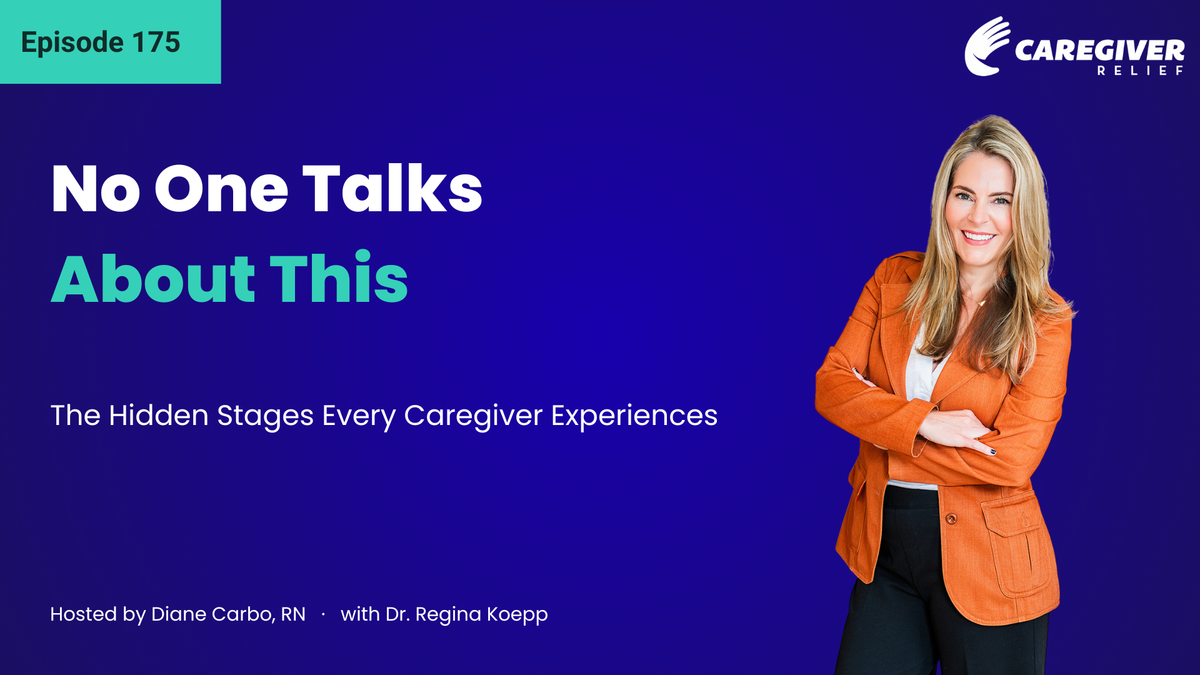
In this deeply personal and enlightening episode of the Caregiver Relief Podcast, host Diane Carbo, RN, sits down with Dr. Regina Koepp, a Stanford-trained board-certified clinical psychologist and geropsychologist. Together, they pull back the curtain on the emotional journey no one prepares you for: the developmental stages of being a caregiver.
Whether you are just starting to help a parent with finances or you are in the thick of 24/7 care, this episode offers a roadmap for your heart and mind.
📍 What We Cover in This Episode
- The 6 Developmental Stages of Caregiving: A breakdown of the journey from "Pre-Caregiver" to "Rebuilding" your life after loss.
- The Reality of "Ambiguous Loss": Understanding the grief that occurs when a loved one is physically present but fundamentally changed, often seen in dementia care.
- Breaking the Stigma: Why depression and anxiety are not a normal part of aging and how to seek professional help.
- The "Fire" Quote: A powerful reminder that you aren't required to set yourself on fire to keep others warm.
📋 The 6 Stages of the Caregiving Journey
1. The Pre-Caregiver Stage Before care is needed, you and your loved one are independent adults. The goal here is to optimize your relationship and take stock of family dynamics before a crisis hits.
2. The Ambiguous Caregiver Stage This is the "now I’m helping, now I’m not" phase, common in early dementia. It is filled with uncertainty about when to step in and when to back off, and Dr. Koepp recommends working with professionals during this stage to get medical clarity.
3. The Caregiver Stage There is no denying the role anymore. You are providing hands-on support, such as help with toileting, dressing, or finances. This stage requires "scaffolding"—building a support team of friends, family, and resources like Meals on Wheels.
4. The Steward Stage Often occurring at the end of life or when a loved one becomes nonverbal, you become the protector of their wishes and an advocate for their rights.
5. The Bereaved Stage Following the death of a loved one, you process the loss of the person and the sudden "vacancy" of your caregiving role. You may feel "dethroned" if your primary identity was tied to their care.
6. The Rebuilding Stage This is the conscious process of reclaiming your life and choosing how to fill the time and space left behind after caregiving ends.
💡 Key Takeaway for You
"You're not required to set yourself on fire to keep others warm." — Dr. Regina Koepp.

✨ Why You Should Listen
If you have ever felt guilty for losing your temper, resentful of your responsibilities, or isolated by your role, this episode is a professional guide and a warm hug rolled into one. Dr. Koepp and Diane share their own raw histories with caregiving, proving that no one should have to do this alone.
🔗 Connect with Dr. Regina Koepp
- Instagram: @drreginakoepp
- LinkedIn: Regina Koepp, PsyD, ABPP
- Facebook: Dr. Regina Koepp
- Website: mentalhealthandaging.com
Don't do this alone. 💜 Click the player above to listen to the full conversation and learn how to protect your mental health while caring for the ones you love.
Podcast Episode Transcript
Diane: Welcome to the Caregiver Relief Podcast. I'm Diane Carbo, rn, your host, advocate, and supporter on this caregiving journey. Today's episode is one that I know will resonate deeply with so many of you. We talk a lot about medications, medical systems, assisted living, and dementia care and safety. But today we're going to talk about you, the family caregiver.
The emotional toll, the identity shift, the stages no one prepares you for joining me is Dr. Regina Koepp, a Stanford trained board certified clinical psychologist and jero psychologist. Founder and CEO of the Center for Mental Health and Aging. Dr. Koepp has trained therapists across the country to better meet the mental health needs of older adults and their families.
She serves as an assistant professor at Emory University's Department of Psychiatry. Worked at the Atlanta VA Healthcare System for over a decade and has been featured in the New York Times, N-P-R-A-A-R-P and more. Today we're talking about the hidden emotional stages, every caregiver experiences and why understanding them can protect your mental health.
Diane: Dr. Koepp, thank you for joining me today. I know you're really busy. may I ask what first drew you to specialize in mental health and aging?
Regina: Sure. I grew up in a family with mental illness, so my mom had severe mental illness and was hospitalized. Throughout my life. And, so I had early exposure to mental health concerns and also to resiliency.
So on one hand, my mom had, mental health conditions that required hospitalization, stabilization, medication, psychotherapy, family therapy, and on the other hand, she. Was incredibly resilient that we, my brother, I have four brothers and my brothers and I could get separated from each other. When my mom was in the hospital and I grew up in the seventies and eighties when hospitalizations were very long.
Diane: Yeah,
Regina: generally for mental health concerns. So my brothers and I would be fractured, sent to other homes to live for a couple of months. My mom would be in the hospital, get sta. We didn't know our dads. She would get stable, get us all back together. And when I was a kid, the message I would get was, mental illness was shameful and highly stigmatized.
And how could a woman be on welfare with five kids? and just all the shame on my mom. and I internalized a lot of that shame. And at the same time I protested it because I would think, but you, y'all don't see the other side of the coin that this woman, and I don't think I had all of this.
Insight when I was a child, but I knew something was amiss.
and I would think she's so terribly misunderstood and I'm misunderstood as a child of somebody with mental illness and so I would protest this is a multidimensional person. She has a incredible resiliency to get all of her children back together.
And so when it fast forward, when it became time for me to go to, I knew I wanted to be a psychologist from a very young age, though I didn't go right into grad school from undergrad, I took some time and explored, traveled around the world and did my thing. And, when it came time to specialize, I knew I wanted to work.
With older people for a few reasons. One is that I didn't have any access to older people when I was growing up, and I think that I was magnetically drawn to people who could be my grandparents because I didn't have exposure to what the arc of the human experience. Was like the whole human experience I didn't have exposure to from birth to end.
And so I, I was drawn in that way because I needed to know and I didn't have any access to it spiritually, psychologically. And then on the other hand, I wanted to work with people who are misunderstood, who might have vulnerability and at the same time, incredible resilience. And we all know as we age.
Yeah, there's more and more physical vulnerability and we do our best to stay healthy. But it's just the luck of the draw, and it's just what's gonna happen with wear and tear and mortality. And at the same time, my patients taught me time and again, that you could be living with profound vulnerability, medical vulnerability, be dying, and have tremendous resilience and personal strength.
At the same time, and I thought, this is where I wanna live professionally. I wanna be with people who are multidimensional and where we can value the many dimensions that we as humans have.
Diane: you were meant to be on this path. You absolutely were. I come from a big Irish family and I can tell you, I can remember my great-grandfather getting last right.
Seven times. And the re Yeah. You talk about resilience. So I, I just have been around the elderly my whole life, so I've had a, an the opposite experience and that's why I have always worked with the elderly because they all have a story to tell and I find it. Fascinating.
Regina: Me too.
Diane: so you talk about the stages of caregiving.
Why is that important for caregivers to understand that it's actually a developmental journey?
Regina: Oh, Diane, you put it so beautifully. tell me. can I ask you some questions too? I would love to talk. Oh, absolutely. I dunno if I can answer them. will you, have, you talked about your caregiving journey here.
Have you been a caregiver?
Diane: I've been both a caregiver to my mom at between 16 and 18. my father and I've been a caregiver to my son who later committed suicide.
Regina: Oh.
Diane: He was a disabled vet. So I've been through, oh, sorry. I've both a professional and a, personal caregiver. Yeah.
Regina: Yeah. And have known tragedy.
Diane: Yeah. my caregiving story with my mom is, and I know there's, so many young people out there that are caring for a parent that either has addiction issues or alcoholism or, my mom actually was diagnosed with lung cancer. So what I went through at 16, I had a father who was a functional alcoholic and when he couldn't deal with my mom, I was the oldest of four.
when she was going through her treatments, he was also a workaholic. So he was a letter carrier and he had all these outside jobs. I was the one that was left to take care of my brothers and sisters and my mom. And it was, frightening. So I'm interested in hearing your stages of caregiving because I'm sure that I've gone through them. It was painful. I was frightened, I was angry. my mom literally had, gone through cancer treatments in those days. Now this is in the seventies. She had burns on her skin from radiation. She had a thoracotomy, which is an incision in her chest where gallons of fluid would come out.
And she goes to the oncologist's office and I'm in nursing school across the street and he says, Louise, you beat cancer. And when she saw excited coming across the street to tell me about her and, good news, and she threw a pulmonary embolism in the elevator on the way down and died in intensive care that night.
Regina: Oh my. Gosh, Diane.
Diane: So I've been in the rollercoaster ride of emotions, but, with my family members. But that experience there has changed my life forever. Of course. so I wanna hear about your stages of caregiving because I know I've been through 'em. I just don't, didn't realize it at the time.
Regina: And how old were you? You said you were
Diane: 16.
Regina: 16. And then how many years were you caregiving for your mom and siblings?
Diane: Just
Regina: two. Two. Just
Diane: two.
Regina: So you started nursing skill school young.
Diane: Yeah. you know what? I was,18 and yeah, I went to a diploma school, where, it's, you're there seven days, five days a week, and working on the floor, slave labor on the floor.
but, yeah, it was hard. Yeah, I actually moved home after my mom died and drove to school every day.
Regina: Wow.
Diane: I wanted my mom, everybody wanted me to quit. School, and I don't want this to be all about me, but I didn't quit school. I stayed in school and became the tyrannical mother over my brothers and sisters too.
That hate me to this day.
Regina: I can relate. I was an over-functioning, yeah. Kid in my family and sometimes that beast comes out with my own kids.
Diane: Yep. Yeah. My kids call it the dime monster.
Regina: you bring up. it is developmental for sure. And you as a 16-year-old, it was out of order. Your caregiving journey was out of order.
And I think that is relevant too, as we're talking about. It's, it, as we're talking about development because your caregiving didn't come. And the right sequence of events as the way it usually does when it's developmentally more appropriate to be a caregiver because you're at a stage in life.
That's my world.
Diane: Yeah.
Regina: It doesn't, you don't fit the mold. Yeah, because.
Diane: Go ahead. I'm sorry. Go ahead.
Regina: Oh, you tell, you, tell us.
Diane: I just know that there, there is a whole ton of kids out there taking care of, and they're becoming the adult and there's stages of caregiving are totally out of order too.
And there's nobody there to support them or help them.
yeah.
Regina: And the reason it's Relevant. the sort of stage of life you're at when you become a caregiver does also influence your caregiving journey and experience. And that is, because you likely won't have peers. Who are also caregiving when you're 16.
and this is not everyone, right? I'm gonna speak in general terms, but we have to acknowledge that each person has their unique experience in this world. So while caregiving can be a universal experience, what is, Rosalyn Carter? former First Lady, said there are only four types of people in this world.
Yep. Those who are caregivers, those who will become caregivers, those who will need caregivers. And I forget the fourth, but basically we are all gonna be in the caregiving, realm at some point. and as a 16-year-old being a caregiver, you're. Off course in quote off course. And the challenge is you're at that stage of life.
You're supposed to be preparing for you to launch. And instead of preparing for you to launch and your mom's saying quit school. And, you moved back home though. You'd still prepared your lunch because you continued in school, but I imagine it was quite a conflict. And these sort of conflicts are not typical at that stage of life when you're 16, 18.
And are more typical and you have more of the psychological, emotional, spiritual, financial tools later in life to navigate that. And also more medical literacy later in life. you just have more exposure to things to help you navigate all of that. and your own limitations at 16 year learning, you're discovering your limitations and developing your identity.
the stages of caregiving though, while it was off course for you in terms of your life course
the stages might be very similar to what you went through and, I imagine you just might have been a little, who knows more rattled than somebody and less rattled than somebody else. But, so there are generally considered six stages of caregiving.
There's the pre caregiver stage, and I'll break these down, but there's the pre caregiver stage. This is before you even become a caregiver. Then there is the ambiguous caregiver stage, and this is the stage where, this is more common when people have a dementia disorder. The ambiguity is clear.
I not clear, but it's, more prominent or sometimes I'm helping, sometimes I'm not. Sometimes I'm stepping in, sometimes I'm not. Now they need help with finances, but they don't need my help with medical. Issues. Yeah, so there's a lot of ambiguity. Now I'm helping, now I'm not, how much do I step in? When do I take over?
How much do I back off? And that's the ambiguous stage. Then there's the caregiver stage, and then there's no denying it. You're a caregiver, you're helping the person toilet dress. Maybe you're helping with finances. Maybe they move in with you. Maybe you're visiting them daily at a long-term care community, maybe, all sorts of.
There's no denying it. There's no questioning. Am I a caregiver or not? You are a caregiver. If you didn't show up, likely something would go wrong. Somebody would wander if they have dementia and get hurt or be vulnerable to exploitation or. or not get toileted or not have clean clothes or whatever the case, so there's no denying it.
I'm a caregiver. That's the third stage. Then there's the steward stage, and this is often at end of life where maybe the person is nonverbal, maybe they're. On hospice care and they're not able to express their wishes. And you are the steward. You're, you are speaking and the are the steward of your loved one's wishes and advocating for their needs and rights.
and then generally after the steward stage or during the steward stage is when the person you're caring for. Dies, and then you are the bereaved, and so then you're in the grieving stage of caregiving. And then the sixth, that's the fifth stage. And then the sixth stage is the rebuilding stage. How to reclaim and rebuild your life after caregiving.
Diane: At 72, I'm still trying to do that.
Regina: Congratulations. There's no expiration date. Diane.
Diane: I keep telling people I don't know what I wanna be when I grow up, so I keep looking for something.
Regina: You're curious.
Diane: Yeah, I, yeah, I am. what is typically the first emotional stage caregivers enter after a, they hear a diagnosis or a major health event occurs?
Regina: I don't know about emotional stage. I think it also depends on the diagnosis. I think, concern, fear. I also, when I talk about caregiving and development, what's interesting is caregiving is inherently a relationship. That's dev also. In motion. So you're an individual caregiver and you're going through these stages, but you're caring for somebody who's also going through stages and then in a relationship that is complicated.
So I like to say that the quality of the relationship before you start caregiving really influences. The quality of the relationship after caregiving. And so if you were in a family where people were open and honest and there was not a lot of betrayal or no secrecy and people showed up for each other and cared for each other and was by and large, healthy, the caregiving journey's gonna be much easier.
Even though it's not gonna be easy, it might be a lot more, Fluent in how your family communicates about things. You might trust the medical information your loved one gives you, but if you grew up in a family where your, the person who's gonna be needing care was very secretive, or there was a lot of betrayal, or that lied, and the information they gave you was not accurate.[00:17:00]
The information they give you now, you may begin to question and wonder, do I have all the information I need? So it's tricky to say what's the first emotional, experience. 'cause it really, I think, has to do with the quality of the relationship before the illness or whatever this the issue is that the person's requiring care for.
And then. and how that might influence caregiving down the road. So I've worked with a lot of caregivers who were estranged earlier in their life from their loved one. Yeah. Get pulled in. Yes. There's a crisis. Hospital calls. You're the next of kin. There's no emergency contact on file or something.
You're the next of kin. They get called in. And then the person is a, potentially a reluctant caregiver. I don't wanna be in this role, or I don't wanna give up my life for somebody who wasn't there for me, except I, except it's a strong value system of mine to show up for people when they're in need, or there's part of me that needs to repair this relationship and I don't quite understand it. And so I don't really know what my role is, but I'm thrown back in here. And so it really has to do with the quality and the family dynamics before. And then after.
Diane: One of the things I witness when, people become caregivers is, like you said, one of them shows up and feels like they, they are thrown into it.
they're reluctant or. Whatever, but they're the ones that's going to be, it could be the middle child is trying to make, everybody love them again and that kind of thing. But the family dynamics, even if you haven't lived with somebody for 20 years and you've lived all over the country, once you converge on that caregiving, journey.
With your, whether they're involved siblings or extended family members, those old family dynamics come and play a huge role in, it is just like you didn't leave the house ever, if you were the one that was like, I'm the bossy older sister, what a surprise, I used to feel hurt by that.
Now I like embrace it. It's okay. Yeah. I'm a know it all. Okay. I know what I know because of all the years in nursing, but what I don't know. I know how to find it. but yeah, we all have our places in, and when you were talking about this, I grew up in a big Irish family. So every, I was a caregiver from a young girl because I cared for my brothers and sisters and my cousins. We all did. We all, it was a big community and we all stuck together. many caregivers don't have that. in fact, like you said, they feel unexpected. One of the biggest, challenges are the, of my group that, follow me, are they're looking for help when they're providing care for a narcissist, a narcissistic parent.
And that's, they really do suffer, terribly 'cause they're still wanting to love that parent, to love them. And they go through, I think, the most emotional trauma of trying to be accepted no matter what.
I wanna ask you, you talk about grief. many caregivers start to anticipatory grief occurs.
Like,I did it with my mom. I didn't know then. That's what it was. But not only was I. Grieving the loss of my childhood. Like I was thrown into some very adult situations that n nobody should be put into. And I took them on because that's what was expected of me. But, you are, you have always, you've been expected to do the care.
that, and I was grieving my childhood, but I was also grieving the loss of my mother and our relationship. I had a very close bond with my mom, but I was becoming her caregiver. And at a time when I needed her to be there for me in so many ways. can you talk a little bit about, how anticipatory grief is different from traditional grief?[00:21:00]
Regina: Yeah. so anticipatory grief is just like you were describing, Diane. It's, anticipating that your loved one will die and that you'll not have them anymore. And so you're saying goodbye to them ahead of time and you're beginning to process emotionally. What you know, you will lose and what you know, you have already lost.
And so for you, you were talking about the relationship with your mom, you and the role in the family. You move from child to grownup and, grieving the loss of your childhood. but these role change. And so your mom is still alive, but your role has shifted. And so there's grief in that transition because it's a marker of things will never be, she'll never return.
Potentially to being mom and caring for us. Like a nurture. Maybe she was emotionally nurturing, but yes. Being there for us and in this physical caregiving way. and so there was grieving the role that you had, especially as, because we started this by talking about aging. There are lots of. Losses and grief that come with aging that we don't often talk about.
and so this is similar. There's some anticipatory grief here that we don't often talk about. We're already saying goodbye to the thing we know we're going to lose or what we have already lost in the process. I'll also say there's another type of loss that doesn't get enough attention to, and that's ambigu.
that's, ambiguous loss. And I'm, I was hesitating 'cause I'm like, wait, did I get that wrong? But no, it is ambiguous loss and this is the loss where your loved one is physically there, but they are fundamentally different. And so this is very common with dementia that your loved one is physically they look like your parent.
They smile like your parent. They look like your spouse. They smile like your spouse, but they are fundamentally different. They don't recognize me anymore. They don't know I'm their daughter. They don't know I'm their partner. They don't even know I'm their caregiver.
Diane: Yeah.
Regina: and that loss where the person is still physically there but fundamentally changed, the personality has changed.
They're, they can't hold the memory of your relationship anymore. And that has changed. That's called ambiguous loss. And that is such a deep and profound loss. That's why they call, dementia the long goodbye, because you're constantly saying goodbye to bits and pieces of your loved one, and at the same time, honoring them.
Diane: Yeah,
Regina: and trying to advocate for them. And advocate for rights, and advocate for resources, and it's so complicated to hold your experience as a caregiver and also the dignity of your loved one and advocating for them. It's a very complex thing that caregivers have to do to honor their own needs and boundaries, and also the needs and boundaries of somebody else who maybe can't articulate them in the way that they used to or need to.[00:24:00]
Diane: We have a public health crisis occurring right now in this country. We have more seniors than youth. We have a silver tsunami coming and we have no one to provide care for them. we are seeing, and Medicare right now has cut the budget so that they're rationing care for, long-term care, like for skilled care.
facilities make more money if they don't provide services for rehab, so the family caregiver is now having more things placed on them. Than ever before. they're expected to do treatments and provide services once provided by healthcare professionals. And, I don't know if you're aware of this or not.
you most likely are, but 63% of my family caregivers become seriously ill with a chronic illness or die before the person. They are caring for passes and I literally use lose two to three caregivers. Every year to death or chronic illness of some sort where they're unable to move forward in their caregiving journey.
And a lot of that happens be, the role reversals there. psychologically a child becomes a caregiver for their parent. And they, or the spouse is taking care of their, once, their partner and lover, and now they're their caregiver. And, it's exhausting for them,and hard for them to change their roles.
Where does that come in on your, ladder of, stages of grief or guilt
Or caregiving?
Regina: Uhhuh. a couple of thoughts. I have so many thoughts. One is we are indeed, we are the people 65 and older are the fastest growing age group in the United States. And at some point we'll need care and are also providing care.
So I'll say that, not all people 65 and older are medically ill, like Ill to the point where they need care and, and that, that older adults are also making significant contributions. to society. So I would say that it's not only that it's a public health crisis. People are older people, 65 and older are also contributing.
Profoundly to economy, yes to systems work, volunteer community, and, and so that I think is really important to remember. I think policy is not doing us any favors currently. And, not only with Medicare cuts, but also Medicare cuts in terms of, ratios of staff to residents in nursing homes and long-term care.
So that's. Complicated. And then to your point, the majority of people in the United States who are over 65 who need care do not live in long-term care communities or assisted living communities or nursing homes. It's less than like 7%. And so,it is majority family members who are caregiving, not professional caregivers.
And in some states, every state is different in terms of their funding. In some states. You can get paid to be a caregiver for your family member. and that might be changing too with administrative and policy changes, but it's worth looking into and you can call your local area Agency on Aging to find out what's available in your area for compensation for caregivers.
I think all of that is adding to the burden on caregivers that, and then because we're cutting all of these resources and programs, it also sends an implicit message to the caregiver about how we value them and how we value people who are medically vulnerable, which is that we don't, we discard them.
And then caregivers, family caregivers who are doing. This incredible work, which is making incredible sacrifice in their own life, making incredible contribution to their loved one also then goes undervalued. Not seen, not heard, not respected. And then because the person with the illness is getting discarded through policies, through, just put them away.
Don't bring them out to this gathering. Then the caregiver bite. By proxy gets discarded and devalued. And so we have a lot of work to do to shift the framework around how we're valuing older people, how we're valuing people with medical vulnerabilities, how we're valuing caregivers. And that's some of the work that we have to do.
And so for caregivers, I would say do not internalize. Those messages that you are not important, that your work doesn't matter, that your contributions aren't as valued as somebody who's making a hundred thousand dollars a year in a typical nine to five. I would say that you, because society is not doing it, you have to remind yourself of the incredible contribution that you're making to society by providing care for your loved one.
And, so many caregivers I've worked with will say. It was the hardest thing I've ever done to caregiver and I would do it all over again. Not every caregiver says that, but many do. And I also have separate from what you were sharing, Diane, I have, seen research on that. Caregivers actually. Have higher rates of resilience than non caregivers and that even though they, might have higher rates of stress and caregiver burden that I have seen research that shows that they don't die sooner than the person that they're caring for. that's a rare phenomenon that typically the person that the caring for earlier.
there's a researcher named David Roth. And there's some research out of University of South Florida that looks at caregiving relationships and longevity. And so I think that might be interesting to your listeners as well.
Diane: I'm very interested in that because what I found is, people have change your perspective, you change your life.
And I find those with, faith-based, Perspective te tend to be a approach caregiving differently. And they're not angry as angry or upset about lack of services or whatever. And then of course there is the reluctant caregiver, but we the. Caregivers. The family caregiver is the single largest pillar of the long-term care industry, and they're actually, I was shocked to learn that the new high for unpaid care was $1.1 trillion a year.
And that shocks me. seniors have been discarded for decades. our Medicaid roles, I what I've seen, it shocked me. And how we treated our seniors and what the caregivers had to go through. Our Medicaid system is so cut so low. Nobody ever wants to take Medicare, but they do. And they always use the private pay side to, compensate for the low reimbursement.
Now we have. seniors that,the high reimbursement's gone, so there's no balancing. So we all mirror, the Medicaid system and you just do without you wait, delay, deny, or wait. And that's been. For a long time. our seniors have been, and they're rationing care. They are just rationing care.
And that's been going on for, towards working towards that for over 40 years. I worked for the very first private review organization, and that's where I learned. But, I know that caregivers suffer from the, they. They don't express themselves. I love that you say, you're a caregiver.
and that's the stage when you accept that you're a caregiver. you, there's things that you know you can move forward with on to the next level of, stage of caregiving. And I'm laughing because so many out there never even acknowledge they're caregiver. They don't see their. Value in the, intermittent, steps They take oh, I'm gonna go to mom's house every day to drop off dinner on the way home from work and check on her.
And that can go on for years. Yeah. Or,ma oh, mom's not, you, you go home at Thanksgiving time and piles of, bills that she hasn't paid, and, they realize, uhoh, we need to intervene here. the guilt and resentment are two emotions. Caregivers rarely admit out loud. they really do.
And they're very common. And I wish we could help caregivers overcome that some way, somehow. because they're definitely going, they're dealing with a lot of stress and un unusual amounts of stress and true burnout, but they have no respite care to help them. And, I would like to help them overcome their stress and burn and true burnout, by teaching them.
That's why here I am, I should be retired. And you were saying, your therapist, the average age is what, 73? Yeah, that's, I'm soon to be there. it shocks me. there's so much need for our services out there, and we're all working towards one goal, but we're, we have so much, it's overwhelming to so many of the caregivers, I think.
can you tell me what a caregivers, the difference between normal stress and true burnout is?
Regina: Yeah, I think, it might also be helpful to. Dive into the stages, because when you're talking about caregiver guilt and burden and,how do we differentiate from stress and burnout? I think what's helpful is if we can help the person optimize their experience in each stage, the risk for guilt, the risk for burnout, will.
Will go, will decrease. Okay. And and that's because. every stage has their unique need, and if the need for the caregiver doesn't get met, it will just add to the messiness of guilt. So generally, caregivers feel guilty because they've done, they've behaved in a way that's not aligned with their values.
I love this person and I know that they're ill or I love this person and I know that they have dementia and they can't remember what I tell them. And then I just laid into them yesterday. I just yelled at them like, I am so sick of this. Or Can't you just, yesterday you were able to do this and today you can't.
You're just, and yeah, you don't even say thank you, and so you like lay into them. And because you are overwhelmed and burned out and tired and you need a break and then you know you are the identified caregiver in this relationship because you are caring and I'm sure that's a value of yours.
And then when you do something like we all do yell. It's so misaligned with your values, then you start to feel guilty about it. And I think there's, what can happen is that there's healthy remorse and then there's guilt that just becomes pretty toxic. And so if you can forgive yourself as a caregiver and then say, this was an especially hard day, what do I need?
So that I can have a little easier time later today or tomorrow and then tune into yourself. 'cause so often caregivers are great at helping other people and they're not so good at or practiced at helping themselves and asking for help. And that's really, I think what it's about for caregivers too.
and these are like, The guilt is generally because of a behavior that's misal that you did, that's misaligned with your values, and every caregiver has done it. Yeah. Every caregiver has said to me, I threatened to move my loved one into a nursing home. And of course I'm not gonna do that. But I am just like, I've had it or I need nothing.
Who can help me? Nobody here can help me. He's not gonna let anybody else come into the home. there's all sorts of reasons that help can't be found. And, and so that can feel overwhelming. And then the person feels pressured, isolated, shrunk. Down, and the only way that they could get out of that box is to explode it open it feels
in the sort of stages of caregiving. I'm imagining Diane, your caregivers are in the thick of it, maybe in the ambiguous or the caregiver stage?
Diane: Yes. Yes. I would, I think so. I do work with seniors to help them age in their home. So I sometimes I get them in the very beginning where I try to ex teach them different things, like a caregiver contract to set boundaries and limit.
And create a care team, partner group, to have practical assistance to give them those short term respite periods. They need to go to the doctors or go to the gym or just go and have a cup of coffee with a friend. Yeah.
But basically, a lot of them are already in the throes and they're loss.
Yeah. They, so tell us about the different stages.
Regina: Yeah, so in the pre caregiver stage, your loved one doesn't need any care, and the two of you generally, are differentiated adults. You're both independent adults who aren't relying on the other person for life. For, to be free of exploitation, to be free of suffering and harm, and to have your basic needs met, then something happens like an illness.
Maybe a stroke or a dementia, like an Alzheimer's disease becomes more and more problematic or a cancer diagnosis. and these stages are at different paces for everybody in every illness. So really there's no, you'll be in this stage for five months that it doesn't work. that doesn't
Diane: work
Regina: out.
It could be a one stage for one day, right? You go from, yesterday they had an aneurysm, right? Or the pulmonary embolism, like it just happens. So fast. And you might be a steward for one day. Yes. so in this, you're. A pre caregiver, you just before you become the caregiver, the goal at this stage, if it's healthy for you, is to optimize the relationship with the person you think you might become a caregiver to.
Maybe that's your partner. Maybe that's a, parent. Sibling. So to optimize your relationship and take stock, like how did things go in our family before? How do we want it to go? And then begin to focus on how can we make this the healthiest relationship possible when you're in that ambiguous caregiver stage that now I'm helping, now I'm not.
Now I had to take over finances, but when do I start thinking about where the per the safest place for the person to live is? How do I help make that decision? There are all sorts of questions with no clear answers. That's the ambiguous caregiver stage. Now I'm helping. Now I'm not, when do I step in? When do I back off?
Sometimes I'm stepping in the right time. Sometimes I'm overstepping, and the person doesn't like that. So the struggle here is often there's not a lot of clarity about what the illness is. This is very common, long standing stage in dementia. There's like uncertainty about what do they need help with, what do they not need help with.
And so at this stage, the recommendation is that you work with professionals that help get clarity about what's actually going on. Is this a dementia disorder? Is this a vitamin deficiency? Is this sleep apnea? what is it that's causing this confusion or the inability of the person to manage their affairs or whatever it is.
And in this stage, often there's a lot, there are a lot of dilemmas that come up. they're, they can't manage their money anymore, but they're still driving. They don't drive at night, but I worry that they're gonna get into an accident. If they get in the accident and they have a diagnosis of dementia, will insurance cover them?
there's a lot of dilemmas and uncertainty, and so working with professionals to help you answer these questions so you as the caregiver, don't have to be the one. To answer all of these things, you it. The worst position to be in is to be the one to say you can't drive, and then to help the person pro out process that they can't drive to say you can't drive and then support them when they can't drive, emotionally.
So you want people with influence, like physicians or psychologists or other influential family members to help say, I think you need somebody else to manage your finances right now, or, I think it's time to stop driving. And then for you as the caregiver to be the one to help with the fallout, not the one to have to hold the frame and help with the fallout.
And And the, so the ambiguous caregiver has lots of questions, no clear answers. So you need professionals to help you contain that and get clarity. The caregiver, you need support. So the caregiver, this is where maybe adult day programs, maybe you have other family members call throughout the day.
So maybe it's not that there's a dementia disorder, maybe there's significant loneliness or isolation and you need people to visit or call. And so you need scaffolding is what I call it like, like a building gets, when it's under repair. And so you need help. And so getting access to resources and help Meals on Wheels.
and this is also where, shifting your view of what value comes from being a caregiver, that you're making an incredible contribution to the relationship to your loved one and to yourself and the people who are, and if you have children. To the next generation who are watching you and seeing how you value somebody who's ill or vulnerable, and then how.
You value yourself in this process. So I think that's a really important accomplishment for this stage of caregiving is shifting how you value yourself and your role in this relationship. And the steward stage. it's tricky. Generally, the steward stage is briefer because this is when the person is active, generally more actively dying or nonverbal.
And so it's really having clarity about what your loved one's wishes are and for you to have support, hopefully from other family members on honoring your loved one's wishes. and then the bereaved, the struggle for many caregivers when their loved one has died is that, off sometimes when your loved one has died, somebody else might be the executor of the will.
And so you might feel dethroned. If you were always the point person in your loved one's care, and then all of a sudden you've been dethroned and you don't have a role anymore, you're not only grieving the person who's died, you're grieving your relationship, your role, and how important that role was, and there's a suddenly vacancy.
What do I do with this time? And then the rebuild. That's pretty self-evident. Then it's consciously choosing how you want, what you wanna do, how you wanna fill that vacancy that's created with the change of role and the loss of the loved one.
Diane: Yeah. Caregivers, are not only dealing with their own emotions, but the co uncooperative or, senior that's in denial.
they're gonna stay in that home forever. And caregivers say, mom, I'll our dad, I'll help take care of you. we'll stay in the home. you'll be here till your last breath. And then they have a situation where it's impossible. they can't. Do it. And there's so much guilt. And, then there's rage from the caregiver because they're expected to take, they made a promise they didn't know they couldn't keep.
And there's a lot of that too. But it's. The dynamics of caregiving are very challenging and,I really, I propose, that family caregiver contract not only to, I have 101 questions you ask before you even start your caregiving journey, or you go through be if you are in the middle of your journey and you have no idea what to do, and in that you can learn how to get paid, set limits and boundaries because.
Caregivers are terrible at doing that. And then the other thing I want them to do is build that care team partner support group, and that is people like you said, that are resources. Your physician, your nurse practitioner. Your, your people in your church. I always encourage everybody to even find somebody who loves to do arts and crafts and activities, because one of the biggest challenges of caregiving is getting that respite break.
And if you have a, a senior that loves to do something, I've taken care of some crotchety old men that, if you just sat and talked to the ah. And you get them to talk about their youth and what they did, whether they were in the war. 'cause so many of the seniors, have been in, in battles and stuff.
you get them to talk about that. you actually have a human behind them. You find the human and the connection there. But it takes time and caregivers are so overwhelmed that activities are something they absolutely. don't take advantage of. So they need to help have somebody to help them do that.
where in the stage does a caregiver begin to find meaning or growth, even in the midst of the hardship of caregiving?
Regina: I think
Diane: how do we help them find meaning?
Regina: how do we help caregivers find meaning?
Diane: Yeah. Yeah.
Regina: I think it could really come at any stage. Honestly, I don't, I think that's a, what the individual is available to and for, are they just, are they just in a, I need to check these items off the list, and I don't have room right now for making meaning of this yet.
I think it's important to respect that person's process. I think if another person is in the place where they begin to question,I think how it might come up for some caregivers is I feel like I'm putting my life on hold.
for caregiving, and I feel like I'm missing out on my life and I wanna be sure my loved one has everything they need.
To live their best life with what they have left. But I don't wanna give up my life in the process. And so I think that could be, a time when a caregiver is talking like that. Like I feel like my life is on hold. I feel like I've given up so much. I feel like, I don't, I'm not doing anything for me.
And, everybody else gets primary voice. My voice is never heard. And so when a caregiver is talking like that, I think that is beautiful time to talk about, oh,let's talk about,you talk about,it's remarkable that you want to help your loved one live their best life with the time they have left, and also yours, there's the, and what does a good life mean to you, even if you keep caregiving.
Diane: Yes. Yes.
Regina: Even if, and and what would it mean if you value to be valued a little bit more, and what would that look like and what would it feel like in your body and what would that mean to you now and how would that look in your life? Maybe that would be 20 minutes of a walk a week. like maybe it's tiny and honestly, and I've worked with caregivers for more than 25 years.
Yeah. care. I have never met a caregiver. Ask for too much. Usually I'm like, that's all.
Diane: Me neither. Me neither.
Regina: Yeah.
Diane: one of the challenges we have, and I know you from your end, more about this than me, the lack of availability of, mental health support for seniors as well as their caregivers.
Regina: Yes.
Diane: How do we help them with that?
Regina: so that's, what I'm trying to do is build a movement of licensed mental health providers who are trained to meet the mental health needs of older adults and caregivers. And, and so what you could do about that, a few things. One of the reasons older adults are not getting the mental health care that they need.
Our stigma, like we talked about at the beginning, like the messages that we get about mental illness, that there's a message that we get that the person is defective, which is not true. and so to begin to challenge the stigma is one, and then also to challenge the myths about mental health problems.
So there are a lot of myth. About mental health problems and aging. There's a myth that it's normal to have depression or anxiety, and that is depression and anxiety are not normal with aging. Yeah. And so if you see signs of depression or anxiety, to encourage the person to meet with their primary care provider to rule out anything medical that could be causing that, or medication related that could be causing that metabolic related, like the labs are off that could be causing that.
And then also to get the person connected to mental health care. There are therapists that can help, and it really does help, even if a person has mild cognitive impairment and depression, which makes them a very vulnerable group for dementia. Even treatment with an antidepressant helps to delay the onset of dementia in that very high risk group.
So What we do with mental health is as important as physical health, and so also depression, social isolation, drinking. These are all risk factors. They've been identified as causes. Of dementia, not just correlated causes, and that if we treat depression, we address substance use. And substance use is treatable at every age.
Yes. Depression is treatable at every age. So to take it seriously like you would any other person. That it's, to know that it's not typical, that it's treatable and that there are people that can help and then get people connected to care.
Diane: If you could give every caregiver one piece of psychological advice to carry them through each and every stage, what would it be?
Regina: I love this quote. It's not mine. It's, I don't know who came up with this quote, but it's, you're not required to set yourself on fire to keep others warm. Oh wow. You are not required to set yourself on fire to keep others warm, that your life matters too. and I get that you're at a season in your life where caregiving is the primary role that you will have, but find ways to honor yourself, even if this is the season of life that you're in, like honoring your own relationships or your own developmental needs.
Even while you are caregiving and to be mindful of this slippery slope of setting yourself on fire to keep others warm, that, your boundaries will make this sustainable for you. Without the boundaries, it won't be sustainable. You'll have more moments of, frustration acting in ways that are not aligned with your values.
The more boundaries you have, the more you'll be able to act in line with your values and the less hopefully guilt you'll have about the whole experience.
Diane: So how do people find you? My listeners, find you or find a therapist that you've trained in mental health and aging?
Regina: Yeah, so you can, we have a national provider directory of licensed mental health providers who specialize with older adults and families.
It's at mental health and aging.com. So it's mental health and aging.com. And you can look for provider directory. I have lots of resources there too, on depression, anxiety, dementia, everything.
Diane: Thank you so much for your time. I really appreciate it. you've, I didn't realize there were stages to caregiving and I've been a caregiver so many times and now I've, I realize that, there's a lot of work I could have done.
Regina: we're all a work in progress.
Diane: yep. Yep. My nursing helped some of it over the years, but, Anyway, to my family caregivers out there, you are the most important part of the caregiving equation. Without you, it all falls apart. So please learn to be gentle with yourself. Practice self-care every day because you are worth it.
Caring for a loved one can be overwhelming — but you're not alone. If you have questions, big or small, our expert team is here to help.
👉 Click here to Ask the Expert
Our Resource section can help you find the information and tools that you need. We have courses, videos, checklists, guidebooks, cheat sheets, how-to guides and more.
You can get started by clicking on the link below. We know that taking care of a loved one is hard work, but with our help you can get the support that you need.
Click here to go to Resource Section now!