Near-Death Experience in the ICU: Caregiving Lessons, Survival, and What Happens at the End of Life with Kathy McDaniel - Episode 205
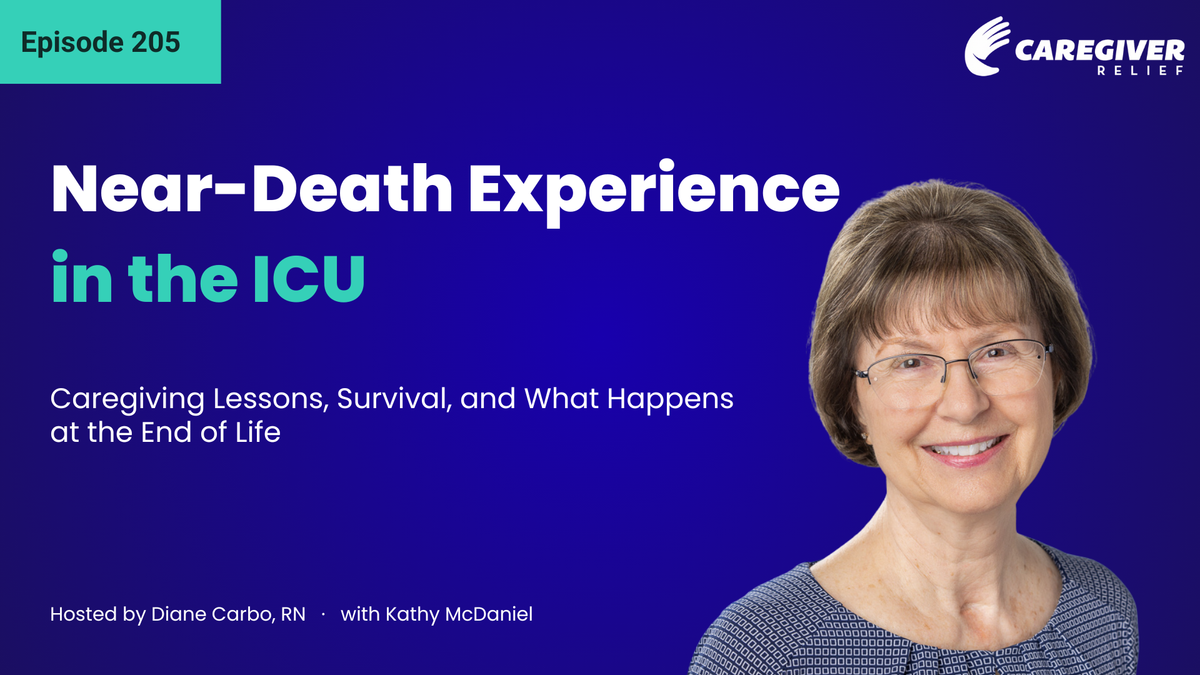
In this gripping episode of Caregiver Relief, host Diane Carbo sits down with Kathy McDaniel, author of Misfit in Hell to Heaven Expat. Kathy shares her remarkable journey surviving a terrifying drug-induced coma, navigating a dark near-death experience (NDE), catching a glimpse of absolute heavenly bliss, and the life-altering lessons she brought back about caregiving, compassion, and our true purpose.
🎧 Episode Highlights & Key Takeaways
- The Perfect Storm: How a grueling nine-month stint as a first-time caregiver for a friend with leukemia left Kathy's immune system depleted, ultimately triggering acute respiratory distress syndrome (ARDS) and a critical 18-day coma.
- Making Sense of a "Dark NDE": Kathy candidly breaks down her terrifying journey through a distressing, multi-segmented NDE and explains why "Catholic guilt" and personal life traumas may have triggered it.
- A Glimpse of True Bliss: The turning point where singing a Christmas carol threw her out of darkness and into an indescribable state of pure love, joy, and a reunion with her late friend.
- The ICU Reality Check: Kathy discusses the vulnerability of being an ICU patient, highlighting the profound need for medical staff and caregivers to treat non-verbal, immobilized patients with dignity and deep compassion.
- Life After the Brink: How surviving a long-term coma and a grueling physical rehabilitation transformed Kathy's perspective on life, death, and human suffering.
🗺️ Episode Outline & Timeline
Diane introduces Kathy McDaniel and poses the age-old question: What actually happens at the end of life? From Caregiver to Patient Kathy shares her life before the crisis, the immense stress of caring around-the-clock for her former fiancé who passed away from leukemia, and the subsequent lung failure (ARDS) that forced doctors to "take her brain offline" in a drug-induced coma.
Kathy details the terrifying segments of her distressing near-death experience—a place of absolute blackness, eerie fogs, and haunting reenactments of past traumas.
A Christmas Carol & Heavenly Bliss
On "Christmas Day on Earth," Kathy sings a carol to irritate a tormenting entity, instantly catapulting her into an overwhelming dimension of unconditional love, marble cathedrals, and a profound message from her late friend: "You've got too much left to do."
The Humiliating Road to Recovery
Waking up 18 days later weighing only 86 pounds. Kathy reflects on the frustration of being unable to speak, the loss of all muscle mass, and having to completely relearn how to walk, talk, and turn over.
What Patients Wish Healthcare Workers Knew
Kathy shares raw, eye-opening experiences of neglect and rough handling by ICU staff, prompting an urgent discussion between Diane and Kathy on the critical decline of basic bedside nursing care and patient advocacy today.
The CARE Framework for Caregivers
Kathy breaks down her practical acronym designed to help family caregivers support their loved ones without destroying their own health.
Demystifying the "Life Review" & Beyond
A comforting and witty look at what awaits us on the other side. Diane and Kathy share beautiful personal signs from their own departed loved ones, reminding listeners that those we lose are never truly gone—they just transition to a different dimension. 🕊️
💡 Kathy’s CARE Framework for Caregivers
If you are currently caring for a loved one, Kathy urges you to remember this simple acronym to maintain your boundaries and protect your well-being:
📌 C – Consider & Commit: Honestly consider what you are logically capable of doing, and commit to only that so your loved one knows what to expect.
📌 A – Always Ask: Respect their autonomy. Do not just blindly "do" for people; ask them first and truly listen to their wishes.
📌 R – Respect & Respond: Treat their dignity as sacred. Remember, you are not required to respond to or enable self-destructive demands.
📌 E – Encouragement & Easing: Give them your absolute best encouragement, but know exactly when to ease off and step back before caregiver burnout makes you sick too.
🌟 Words of Comfort for the Fearful
"Spirit is just... we’re just going to a different dimension. They're all there and everybody looks about 35. It's great! They're still there, they're not gone. They just transitioned." — Kathy McDaniel
🔗 Connect with Kathy McDaniel

If Kathy's story resonated with you, or if you have experienced a distressing near-death experience of your own, reach out and join her community:
- Website: misfitinhelltoheavenexpat.com (Leave a message to connect directly!)
- Facebook: Connect with her under her writing name, M. K. McDaniel.
- Book: Misfit in Hell to Heaven Expat 📖

Podcast Episode Transcript
Diane: Welcome to Caregiver Relief. I'm your host, Diane Carbo, registered nurse, and this podcast is dedicated to supporting family caregivers as they navigate the emotional, physical, and spiritual challenges of caring for those they love.
Before we begin today's episode, I want to ask you a question. Have you ever wondered what happens when we die? Near-death experiences are reported by thousands of people who have come close to death and returned with powerful stories of what they saw, felt, and experienced. But what happens when that experience isn't just light and peace, but something far more complex?
Today we're exploring one woman's remarkable journey through a dark near-death experience, her survival in the ICU, and the profound lesson she learned about caregiving, compassion, and what truly matters in life. My guest today is Kathy McDaniel, author of the book Misfit in Hell to Heaven Expat, where she shares her powerful story of a dark near-death experience, a glimpse of heaven, and life-changing lessons that followed.
After surviving a critical illness that left her in the ICU and rehabilitation for months, Kathy began reflecting deeply on what patients experience, what caregivers need to understand, and how compassion can transform the healthcare journey. Her book and message have resonated with many people seeking hope, understanding, and peace around life, death, and caregiving.
You can learn more about Kathy at her work at misfitinhelltoheavenexpat.com and connect with her on Facebook as well.
Diane: Kathy, I am really excited that you're here to join us today and share your experience and your story.
Kathy: Thanks, Diane. I'm really happy to be here. I really am.
Diane: Before we talk about your near-death experience, can you tell us a little bit about your life before the event and what led to your medical crisis?
Kathy: Sure. I had a pretty normal life. I was a Catholic, from day one, so I had those, spiritual, instincts that would later, show up in my near-death experience, I believe. But anyway, I was asked by my best friend, former fiancé to come help him up in Seattle because he had leukemia and he needed a couple caregivers.
I had just retired from being a property manager. I had my own company and, had the time and of course the inclination since we were still very close. So I came up to, Seattle, and they said it would about be a three to five, month ordeal. And there was two of us, and it was around the clock care.
I had never been a caregiver before, just a mom, and eh, there was a lot of work to it . We didn't sleep much. There was a lot of stress. And, he finally passed away, which broke my heart. And so here we are nine months into this no sleep, lots of stress stuff. So when, I went to a concert over Christmas with a friend, I caught this COVID-like flu that was going around in Southern California.
And so by the time I got back, I was deathly ill literally. And by the time I got myself to, an emergency, one of those little emergency doc in the boxes, my friend had taken me there, and I passed out and woke up in the hospital. they said my heart had stopped, but they got it going. And, I had what they considered ARDS, acute respiratory distress syndrome, also known as lung failure.
And I was 52 years old, had been in good health, and now, they said, "Boy, you got a slim chance of pulling through. We really don't know how to treat it. It's not really a, an illness. It's something that doesn't respond to, medication, so we're going to have to put you in this drug-induced coma.
We'll throw the book at you medically speaking and cross our fingers. Everybody on, on base?" My whole family had gathered from all over the country and then it was the consensus that was the only thing to do. So the last thing the, physician told me was, "We're gonna take your brain offline, and you're not gonna be able to remember anything that happens, and you will or will not wake up."
And, I said goodbye to the family and off I went. It did go black. But then I woke up, and I thought, "Wait a minute. where am I?" It was totally black. There was no sound. I had no idea what was going on, and I was afraid to move, so I just hung out. And, not too long of a wait and all of a sudden I, saw this kind of reddish fog start happening in front of me, and I thought the sun was coming up.
I'd be able to see where I was. And then it was smelling really bad. It got a little too warm in there, and then I started hearing, noises. Screaming, people wailing. And I thought, "Oh, gosh. This can't be good." And then all of a sudden out of this fog came this voice, "Do you know where you are?" my good Catholic upbringing- turned on a light bulb and said, "Hell?" And that thing just wah, laughing. So I took off into the darkness. To shorten this up, it was a very long experience that was, made up of segments, Diane. the lights would go out, I'd stop wherever I was, and then the lights would come up, and I'd be in some strange situation.
Like the first one was this bombed out city with zombies walking around and people screaming and fires and everything. And then I came to a part there where I thought I was going... I fell, and I thought I was gonna die, and the lights go out. I'd freeze wherever I was, which was in darkness, and the lights had come up.
And there would be a time I was having a very pleasant, let's see. How would we call that? That would be some sort of a discussion with a demon-like character who wanted me to cut down a, entire field of blackberry bushes, and he'd help me get out. When I went to do that, it was an impossible tasks, the lights went out.
The lights came up. There was this road that I was walking on a lot of the time. It was just, a road that just to nowhere. It went east or west, north or south. I had no idea. There was just, no stars, no moon, nothing, just darkness. but this reddish glow at the horizon that looked like maybe a fire coming up.
And, I'd walk, walk- Kept walking. I did had no idea, where I was. It really didn't cross my mind that I wasn't, dead. you don't feel dead. And, there was unpleasant things that happened there. There was a, it went on and on. Finally, I got to the last... I didn't know it was gonna be the last one, but I was at this horrible situation with these poor women.
We'd all been abused, and they were gonna make it worse. And so I said, "Gee whiz," to the demon lady that was in charge of us, I've been here a long time, and it's a really particularly nasty day. Anything I should know?" She says, "Oh, it's Christmas on Earth. That's always the worst day in hell."
And I thought, "Hell?" oh, my gosh. And, being the brat that I am, I thought, "Oh, this'll get her," and I started singing a Christmas carol, which did irritate her. And then when I got to the part of, "Away in a manger, no crib for His bed, the little Lord sh-" Got to the next word, was not out of my breath, and then I was thrown out again.
But this time it was into this incredible bliss. You can't describe it. It... There's no words. The... you're rolling in, this love and joy, and nothing exists but this joy in you, which is all one. And, as I tumbled in this, you don't want it ever to stop, and but it seemed like the clouds were coalescing and it turned into, this, I don't know, cathedral-like room.
There was no cross or anything like that, just marble. And there was my friend, the one that had died, the month before. He looked great. Oh. he didn't look like he died of leukemia. He looked younger. He looked, instead of 53, looked about 35. He was wearing a sweater I'd given him. He was happy.
And I thought to myself, "Oh, criminy. He doesn't know he's dead." And then he started laughing, and I thought, "Now, I didn't say that out loud. Oh, Lordy." And then I thought, "Wait a minute. He was showing me something." There was a book, big book, on a table, and it was about halfway open. And he was showing me all this stuff in there.
And I said, "Oh, no, no, no, no. That's gonna be too hard. I want to stay here with you." So then I said he said, "Now..." And he got a little bit closer and he says, "Now, Mary Kay," that's my name, Mary Kathleen, "you've got too much left to do." And I thought, "Oh, my gosh. They're throwing me out?" And I thought, "No, you have no idea how hard it was to get here.
No." I just stamped my foot, crossed my arms, and just reiterated, "No." Lights went out. Lights came back up. Now there's people milling around. It's too hot. I can't ... I can hardly talk. I look, and then my daughter turns around and says, "Mom's back." And I thought, "What? What? What?" And, I had been in this coma for 18 days.
The doctors had given up. They said that, "She's not gonna make it. Say your goodbyes." And then all of a sudden I was back. And, thank God I had the trach in and I couldn't talk because I was very angry. I thought ... They said, "Oh, Mom, we've been praying for you. We brought you back." And I thought, "Oh, you terrible people.
I was- I was in heaven with my best friend, and you drag me back to this?" but I couldn't say anything. I could move one finger. The next day the doctor came through. And,18 days in a coma is not a good idea. I can go, I'll go onto that in a little bit, but that's what happened.
It took me another ... Oh, gosh, it took a while to get off the ventilator, and then I had weighed 86 pounds, so I had no muscle mass. I had to, go to a physical rehab facility for a month, where I had to learn how to walk and talk and walk, go upstairs and turn over and do everything again.
I was like a baby. It was very humiliating because I had no muscle mass, no muscle memory. So I did that for a month, and now, I am a shell of myself. I've had this horribly disturbing experience, and nobody wants to talk about it.
Diane: Oh. Kathy, at what point did you realize you were having a near-death experience?
Kathy: I did, it took 10 years Oh. Yeah. Nobody would I had nobody to talk to. my therapist said, "Gee whiz, I'll put, PTSD on your chart, hon, but that's all I know what to do with." So I struggled. I wrote it. I kept writing it out, the whole thing out, thinking it would go out of my mind. it doesn't because when you're on the other side, that's your spirit.
It's not your, it's not your human brain that's remembering it. You're really experiencing that. And so it took 10 years and a series of synchronicities, that's what we call them when it's time, I found my way up to Seattle, which is an hour away to, an IANDS meeting, International Association for Near Death Studies, where they, that's all they do.
They study NDEs. And the dark or distressing is what they call them now, were not very well studied. So they were anxious to hear my story. and then I started finding other people that had this dark experience that they couldn't talk to anybody about. And in IANDS I started a, a sharing group once a month for people that have had these experiences, and that was about four and a half years ago, and we've had hundreds of people come through.
And if you, Diane, when you look on the internet there's at least three, groups that are for coma survivors.
Then in addition to that I ran across a book called Coma and Near Death Experience by Alan and Beverly Pearce. And they're, they've done extensive, oh, all kinds of, research, abilities they have that have, determined that people that have, these dark or distressing near death experiences, many of them have been in long-term comas.
And if you are in a long-term coma you have a sincerely high rate of these experiences. He has turned it around from what a, a lot of people determine was, oh, you were a bad person. You went to hell, which is ridiculous and not true. And number two, there is no hell. we all have free will, and we're all part of God who is all-loving and all-forgiving.
Ask any of the thousands of people that have had these experiences. And, Anyway, his, research has been very mind-blowing to me so I'm really going down that path now with him and IANDS and, a lot of other people to try and stop having, there's ways to have, comas, very much shortened or you can not be, put into a coma.
Like in, I guess it's Salt Lake City at the Mormon Hospital, they have some wonderful program there where they keep people awake. So the thing about distressing your death experience is nobody really has figured it out. We're in the middle, I think. It used to be just accepted that you were a bad person and went to hell, but that's out the window now.
Diane: The first thing I thought of, I am also a Catholic vand the first thing I thought of is purgatory.
Kathy: Yeah.
Diane: I really did. And I do you know, I know, I have, I worked in, physical rehab and, there are people that are in comas for long periods of time, and I have never, had anybody tell me about this dark experience.
But, I want to ask you, did your perception of time or reality change during this experience?
Kathy: Oh, yeah. Up, up there it's an eternal now. There is no time. That's a little hard to get used to, but, just the experience in heaven was just so real, so awesome. I still get choked up talking about it.
It's definitely home. It changes everything when you get back and realize that we're just here for a short time. Most people understand that we are a part of God. We come down here, on purpose. We plan our lives, the things we want to experience. we go home, and there's a life review but it has nothing to do with punishment.
It is just you get to see your life as it plays out, kind of like a movie, and then they turn it around and you get to see it again and feel what it was like to interact with you. So it's not quite a karma thing, but yeah, what you put out you get to feel back. So if I'm been nasty or whatever to somebody, somebody asks for money, they're homeless, and I kick them, and, I will get to feel how that person felt.
If I'm a kind, nice person, I'll get to feel that too, and that's an only, it's not a report card, but it's just, the way we get to understand what my, our lives meant.
Diane: Wow. How did the experience change your understanding of life, death, and the purpose of being here?
Kathy: Now I if something weird or bad, quote, unquote, bad ha- happens to me, I don't r- rail at God and say, "Why do you keep doing things like this to me?"
I say, "Oh, okay, I planned that. There was a lesson in it for me. Let me consider what's going on there." And that's a huge thing to think that you've planned your life. Okay, I've been divorced three times. My... I've got problems with my kids. All that stuff, we all agreed that's what we were gonna do.
I agreed to be my children's mother, and even though I knew they were gonna go through some tough times, I signed up for it. I signed up to have that near-death experience, the coma, the recovery, all of that so that I could help other people.
Diane: Wow.
Kathy: So instead of, again, thinking why me, it's okay, I have a purpose.
You feel so much better coming back and living here and having a purpose. You, Diane, have a purpose, and you're fulfilling that. And it, I bet you it feels good.
Diane: I lost my mom at 18 years old, and I was angry at God for a long time. I have since understood that, maybe it was meant to be, 'cause I feel like,
I have to tell you, Kathy, I see people say they're fighting cancer, they're fighting, fighting, and, I look at them as my experience is my mom had lung cancer. She had just left the oncologist's office. Going to the elevator she was gonna tell me the doctor said, "Louise should beat lung cancer.
You're gonna have a great Christmas with the kids." I was in nursing school just in the freshman group. I'm walking. She's pushed, goes in the elevator to go down and tell me the good news, and we were going to go Christmas shopping. And she threw an, a pulmonary embolism and died that night in intensive care.
Kathy: Wow.
Diane: So my perception of fighting cancer, and I've seen this played out over and over again, in my... I even worked at a cancer center for a while. And actually, I got fired because I told a patient that they should consider hospice, and you don't say that in a cancer center. But, she did choose hospice the next day, but I got fired because that skews their research numbers,
Kathy: Oh, my gosh.
Diane: I'm cynical about some things. I really am. But now, you spent time as a patient in ICU and rehab. What did you observe about the way patients are treated? That was very interesting to me.
Kathy: This has been 26 years ago. I don't know how much it's changed, but, It's worse oh, God. that's terrible. two experiences I had. it felt like I wasn't a person. it felt like I was this blob, on the bed that was, when I was out of the coma, couldn't move, couldn't eat. I had a nasal tube. I had IVs. I had the catheter. The whole thing. I'm all wired for sound there.
I'm a pitiful thing. And, one time a nurse came in and, she was between me and the IV, stick, whatever that, with all the different and she was fiddling with this and fiddling with that and she leaned back and, my IV, I guess it was my feeding tube- ... was hooked on a button on her sweater.
Oh. And I couldn't talk. So she's moving, and I can hear this, feel this thing coming up my throat. And so finally I just went, ah," and she turned around and said, "What?" And when she turned around, zip, that thing came sailing out of my throat, out of my nose, and she picked it up and looked at me and said, ah, and came at me like she was gonna put it down in my nose.
And I thought, "Wait a minute. I think they do that under sedation." And I just went, And she said, then you better learn to eat." Oh. not a I'm sorry, nothing. So I couldn't tell anybody. I tried to memorize their name but you know how you are when you get back. Yes. The other lady, this was like a couple days later, 'cause, she came in and, I was laying on a pad.
I guess I was, urinating on the pad. I have no idea. I was just this little rag doll laying there, and she lifted me over to the side and said, "Ugh, I'd like to put you on a bedpan." And I couldn't say anything. I... And so she- Yeah ... went and got that, that hard porcelain thing or whatever it is
and stuck it under my back, and then rolled me back on top of it. So my back was thrown upwards and it hurt like hell. Yeah. And I couldn't say anything, and she says- ... "I'll be back in a couple of minutes." I watched that clock. It was hours. I'm trying to do, ESP with at the nurse's station.
Yes. Anybody would walk by. Totally. Nobody came in. Yeah. Finally I just, I thought, I'm gonna be paralyzed now." So anyway, she came back a little later and she saw me crying. I had tears just running down my face. And she says, "What's wrong? Oh my God." She goes over and she pulls me over, and she pulls it and she's rubbing my back.
She says, "Oh, I don't think it broke the skin. you'll be fine," and flops me back down. Oh. Ugh. So I thought, when I get out of here, I'm gonna write something," and that's why I wrote my little How to Be a Successful Caregiver book, pamphlet, because that's, it's not okay. Ugh.
Diane: Kathy, you would be shocked to learn that, nursing has really taken a massive decline, and I know people that are listening to this are going to be upset I'm talking about it this way.
But, our government policy makers have just deemed that patients have rights. I get that, I really do, but now they have a right to fall. They have a right- Oh ... to develop pneumonia. They have a right to develop, decubiti. They have a right to develop, thrombosis from, or clots in their legs, because if they choose to. They, it makes no sense. Oh, my. They are, and nurses, this is what makes me shocked Oh Nurses are walking away instead of educating the patient on the complications of immobility and saying-Yes ... "You're doing harm to yourself. We can't take no for an answer. This is for your better, for you.
It's for you to have a successful recovery without complications." They're just walking away and leaving them. Oh. I am seeing... And we also now are having the most unsafe discharges to home than I've ever seen before. The changes in reimbursement in Medicare for therapies has really negatively impacted our healthcare.
The therapies, a facility, rehab or skilled care, gets a higher level of reimbursement for not providing therapy. So they are sending people home, and I have seen patients come home and they've had to be sent right back to the hospital. And recently the most astonishing thing to me was not only was the patient sent home from the hospital within an hour because he fell, he injured his wife falling on her, he had to have surgery again on his back because he hurt himself, but they also found in the emergency room he had, and he's a severe diabetic, stage three wounds on his heels and his buttocks, and there was no documentation of it anywhere on, in his charts.
Kathy: Oh, isn't that awful?
Diane: Yes. and this is truly happening because
Kathy: Oh my gosh
Diane: they are pushing nurses. we don't really have a shortage of nurses, we have a shortage of nurses who are willing to work in unsafe conditions.
Kathy: Oh.
Diane: And we've also given away the best part of nursing, the knowledge that we have when we go to nursing school about treating a patient, and preparing them right for, doing skin care and massages- and stuff like that, has gone by the wayside. And w- we la- allow aides to be our eyes and ears now, but they're not trained to know what to look for.
Diane: And it's really sad. So I want to know what do you wish doctors and nurses
Kathy: Ah
Diane: better understood about patients during, while you were in a coma and in rehab?
Kathy: The good thing again is, another synchronicity. I ran across this book, I told you, Coma and Near Death Experience by Alan and Beverly Pearce. And, there are, that there is a hospital where they are, letting the patients stay awake instead of putting them in a coma, and just teaching them how to deal with whatever is, they're, it's been happening to them.
They walk around, they are allowed to interact with their families. this is he said one person walked by and saw a guy playing table tennis there are new ways of handling that. And you're going to save so many people so much grief just from the near-death experience aspect of it.
But they get in the hospital and they get out sooner. It's going to be cheaper in the long run for the medical profession, so I don't understand it.
Diane: They have a movement to move hospitals in the home.
Kathy: Oh.
Diane: It, you know what my concern is, yes, there'll be doctors overseeing it, and there'll be, with via televisits or whatever.
But who is going to be providing the care is the family caregiver. Right. Now, here you were in a situation providing care for your friend that was dying, and did anybody teach you about turning him and bathing him and giving him skin care and mouth care and all of that?
Kathy: No. No. We were told to keep the place clean.
We had to Clorox the whole place down every night, and he couldn't have, certain
Diane: And that makes me fruits and vegetables.
Kathy: We had, and the, that wasn't good for our lungs, all that, No. No ... ammonia in the air. Goodness. Yeah. No. The, it was just, it was sad. It's just so sad. Yeah. and so I'm glad you've got this program, and we've got to speak up.
Something's got to change here. I know taking care of my mom now, she's got dementia, and she's had it for several years. And for a while, I live in California. she lives in California. I live in Washington. I was going down, twice a month and then I was, I got pneumonia twice, from flying back and forth and all this other stuff.
So I had to stop that. I had nine I went once a month. That was too much. Every other month, excuse me. I went every other month. And now, it was once a month , every six months, and now it's once a year because she's gonna be 99. But I talk to her every night, and we got her a full-time caregiver.
Now, that's $22,000 a month. Yeah. And so thank God my dad had amassed some money that we didn't know about. But, it's expensive.
Diane: Wow
Kathy: It's very expensive. Yeah. I don't know. I just, it's just gotten out of control.
Diane: And we have, we also are in a serious situation right now where we have more seniors than youth.
We have no one to prepared to take care of our seniors, and in the next... We have 63 million family caregivers in the country now. That's gonna double in the next four to five years when the baby boomers finally, the youngest of the baby boomers retire.
Kathy: Right.
Diane: We have no professional staff that wants to take care of them.
we're having to look at computers and, robots to provide care, and I just don't know how that's gonna work. But we are, we're going to have to go into communal living and stuff because
Kathy: I think so
Diane: We just don't have it. Now, you have powerful advice for families with loved ones on ventilators or in comas.
What should caregivers know?
Kathy: In my little successful caregiver, thing, I said remember the word care. C is for consider and commit. Consider what you can do, logically, and then commit to it so that person knows what they're gonna have. A is for always ask. we don't just go in and do for people.
We have to ask first and listen to what they want, and then go forward and give them that which whatever you can. You've gotta respect and respond. That's the R. Respect their dignity. come on. And then you're not required to respond to, a respect someone says, I've got lung cancer but I want a pack of cigarettes."
You don't have to respond in that way. That's not being a caregiver. And then encouragement and easing. You've got to, encourage them, and then you know when to ease off. When it's too much for you, you've gotta be able to pull back and say, "Look, this is beyond what I can do." Otherwise, you're gonna end up sick also.
Diane: Yes, and that's a big challenge. 63% of our caregivers become seriously ill or die from chronic stress-
Kathy: Yeah
Diane: Before the person. I believe that. They, in fact, ... There's a new study that came out that people that provide care, they're saying that they lose eight years of their life in with illness and, or they cut off eight years of their life.
Kathy: Yeah.
Diane: And when you're ... And so when you're telling me we decide this I'm like, how can that be? But
Kathy: Yeah. But, I was told, you get back from an experience like this and you're changed, man. you have been there, done that.
And, you have a new understanding of your life, which is I'm here for a purpose. And I was ... You get this voice that you can hear that sounds like your conscience, you know that said, I said, "All right." This is, this conscience was talking. I said, "All right. Enough. I need to know, what to do."
I was a good Catholic girl, ended up what I thought was hell at the time, but it wasn't really hell. It was just a wake-up call. But,the, it came back, "You are to be loving and kind, merciful and forgiving, encouraging, grateful, non-judgmental, and useful. Useful, Kathy." So- That became my mantra. I was able– I had a plan.
I had a way to go forward and it's so interesting just being loving and kind to people instead of grouchy it's contagious. they, they feel heard and you ... They were grouchy and you were nice, and they it's contagious. that's a good thing. the non-judgmental is, was hard for me because it's so easy for us to look at somebody else and criticize what they're doing.
But the useful, I, boy, there's a quote here that I got, "Usefulness is the greatest joy in life." and once you find your purpose, it doesn't matter about the rest of it. You're gonna do the job that you chose to do, and you wouldn't know the focus, you wouldn't know the direction if these things hadn't happened.
So they were like, they were little signposts along the way that you planned. It just changes everything, Diane. I love my life now. I've done almost 200 of these podcasts. I've helped a lot of people that have had the distressing and, near-death experiences. I'm working with Alan Pearce and some nurses.
We're gonna start doing, presentations or help nurses to learn more about comas and try and get this long, term coma thing back where the, they used to use leeches for bloodletting, It's time to give that up. It's not working.
Diane: So you're talking about, drug-induced comas because they do Because I've had patients- with head injuries and
Kathy: Oh, no. That's not their fault. That's never
Diane: No. no, no. Goodness.
Kathy: That's not. But when they do that just to make it easier for the nurses
Diane: Yeah
Kathy: to take care of, more patients when you're just dealing with almost cadavers they don't see that, because you're three weeks in a coma, you're gonna have four weeks in rehab just to learn how to walk and talk again.
Kathy: Yeah. They don't see that. And that's, that destroys your image of yourself. Your family gets sick of it. It's just ridiculous. So yeah. Well it needs an overhaul
Diane: In the olden days of nursing
Kathy: Yeah.
Diane: I did rehab at Sister Kenny Institute in Minneapolis. I was there for several years.
And I can tell you, that was a really awesome place. They were the only rehab center at the time. Now they're everywhere. but I would... We had many patients in comas, and we were told, "Talk to that patient all the time," and we did. Oh. When we turned them, we would say, tell them we're turning them, or we were gonna brush their teeth, or, and we were gonna clean them up or whatever.
And, you just talked to them all the time. and, eh, I'm a talker anyway, so I'll come in to help, and I just know some of these people in comas are saying, "Oh, shut up, please."
Kathy: I don't remember anything that, that anybody said. My mom said we did this. We talked to you about this and that.
And I think it's a good vibe,
Diane: Yeah.
Kathy: Yeah. I think that's a comforting vibe. But you're really somewhere else. Yeah. most of the time. I was,
Diane: I'm wondering if your dark vibes came from negative experiences that were happening with your body, like a nurse that, was not turning you, or you were in pain and you weren't getting, any treatment.
I'm just curious.
Kathy: I think that could be part of the trigger. What we've all decided is, we made our own hell. being a Catholic and I knew I was gonna go to purgatory when I died, and there really isn't one, so I made my own. and it was, it had to do with all these terrible experiences that I have actually had in my life.
I was in an earthquake, when my town fell down, and that was the first scene. Oh, my lord. I had been raped, so there was a rape scene. there was all and so after that, I've talked to a lot of people, and they, most of them say, "Yeah, I had segments. And I listened to what you said, and I can trace those all back."
Diane: Wow.
Kathy: And 85 to 90% of the people I talk to that have distressing NDEs are Catholics. Yeah. Oh, God. Hey, Catholic guilt's real, girl. I, I'm- It's real not making this up. It and I just laugh every time I tell this story and ask any Catholics and, everybody's hand goes up. it's because you believed that shit, excuse my French.
Diane: I don't ... You know what? I'll tell you what, Kathy, I tell people I'm a recovering Catholic and just-
Kathy: Yes, recovering Catholic. I am. Yes.
Diane: Yes. Yeah. I do. I-
Kathy: You come back and you can't ... I think a lot of people, quote, "lose their religion"
Diane: Yeah
Kathy: because it's not what's really happening out there,
Diane: Teligion is something different to me than spiritual.
I mean I'm spiritual. I believe in a higher power. I believe in a forgiving God or universe
Kathy: Oh, yeah
Diane: or higher power. You know I don't think there's ... there's too many, too much suffering here on Earth to think that, we're going to die and go to hell. I just Yeah ... I just can't, you know-
Kathy: No, no believe that.
Diane: And I- Yeah ... I do believe that people that are, criminals, that kill people or hurt people in some way will have an, maybe an experience like yours for a while before
Kathy: Oh, no. Actually, it's the life review.
What about Hitler?" I says, if Hitler gets the joy of experiencing every bit of terror and pain and tragedy that he inflicted on millions of people," I think he's probably only halfway through his life review about now. What else can you do to the guy? That is true. you give it right ... It's karma. You put it out, you get it back, baby. So that's why I just say put out the good stuff, folks. Love ... yes. oh, I love that. I love- Yeah. And that's not God doing it, that's just no ... that's just your, that's what you put out and that's what you get back. So I spend a lot of time being nice.
Diane: I really do. I try. I'm ... Even though I'm imperfect sometimes, but- But we all are,
Kathy: but- Yeah, but you keep it in the back of your mind. I want this on my life review. I want to
Diane: Oh, I love that, a life review. Yeah. that is awesome.
Kathy: Yeah.
Diane: Now, for people who are afraid of dying or- Yeah
losing someone they love, what message would you like to share?
Kathy: They're still there. Your ... My dad is right here. he's been gone, I don't know, six years or so, but whenever I need him, he's there. he'll flash lights for me, he'll find things I lost. Spirit is just, we're just going to a different dimension.
They're all there and everybody looks about 35. It's great. but- They're still there. they're not gone. They're just, they transitioned. They went to that other,
Diane: I, you know what, when I lost my oldest son to suicide, he was 35, and I always say he's been forever 35.
He had a terrible pain condition. Yeah. And I lost my mom, to a complication of cancer, and I have had periods where they visit me. I know people think I'm a cuckoo, but
Kathy: No, it's true
Diane: It's not the same visit as you would think. I don't wake up and they're standing there talking to me.
No. But, here's a perfect example. I'm walking on I walk on the beach often, in Myrtle Beach. And, it's a beautiful day. it's, I'm feeling down. In fact, I was walking on the beach that day because it was Jeff's birthday, July 21st.
Kathy: And
Diane: I was, I go to the beach, 'cause we were in the water together, so I figure- our cells are there somewhere, so every once in a while it's just a way to connect with him. And I still wear some of his shirts and stuff. it's just and it's 15 years, gonna be 15 years in September. Anyway, this young man comes up to me, and he's got a bike, a bike he can ride on the sand.
And he goes, "Ma'am, would you take my picture at the, at," but with the pier behind it, and I said, "Sure." He goes, "I'm on a ride for veterans who completed suicide." And, to this day I still get weepy about that. it brought me to my knees. Here it is, his, it's been 10 years, and this young man shares this story.
We don't know who- each other at all, and
Kathy: Oh, wow
Diane: His best friend was a soldier that also completed suicide.
Kathy: Oh my gosh.
Diane: And we both cried ... in that moment, and it's just like that was Jeff saying to me- Yes ... "I'm still here."
Kathy: Yeah. Or a song comes on, and you- Yes. yeah ... you just stop and you- Yeah
or you find something that you go, "Wait a minute," "That wasn't there yesterday,"
Diane: Yeah. Yeah. Yeah.
Kathy: They're right there. Yeah. They are waiting for you.
Diane: Yeah ... yeah, saving a place. and all my pets. I want all the pets and dogs I've ever interacted with to be there to greet me.
You, you got it.
Kathy: That people... I love the story of the lady that went up there, and she's walking on the beach, and all of a sudden she sees dust and all this commotion coming toward her, and she got scared, and it was all... She was a dog breeder. Every dog she'd ever had. She said it was just this flock of dogs, and they're all jumping up and barking and she was just, she they all went for a walk, and she woke up, and she said, "Oh, I want to go back there." Yeah. "All my dogs are waiting."
Diane: Yeah. And that's true. Yeah. That's what I believe. I have no fear of death.
Kathy: Yeah.
Diane: I fear how I'm going to die, but that's another story. But-
Kathy: Oh, I love what you- Alan, he says, "I'm not afraid of death, but I just don't want to be there when it happens."
Diane: Exactly. Exactly. Kathy, it's been such a joy to talk. And, I have so many clients, and patients over the years that have such a fear of death. and I would love to have them learn more from you. How do they find you?
Kathy: Facebook is a good way. It's M. K. McDaniel under my, writing name.
the, my,
Diane: What's your website?
Kathy It's www.misfitinhahelltoheavenexpat.com, and there is a place to leave a message, and I always get back to people.
Diane: Yeah. I will, put that information on... I create a permanent page. Great. And, I will have all your links too so that others can find you. And, to my family caregivers out there, you are the most important part of the caregiving equation. Without you, it all falls apart. So please learn to be gentle with yourself. Practice self-care every day because you are worth it.
Caring for a loved one can be overwhelming — but you're not alone. If you have questions, big or small, our expert team is here to help.
👉 Click here to Ask the Expert
Our Resource section can help you find the information and tools that you need. We have courses, videos, checklists, guidebooks, cheat sheets, how-to guides and more.
You can get started by clicking on the link below. We know that taking care of a loved one is hard work, but with our help you can get the support that you need.
Click here to go to Resource Section now!