Medical Cannabis for Seniors: What Caregivers Need to Know About Pain, Sleep, Anxiety, and Safe Use with Honey Smith Walls - Episode 240
Honey Smith Walls, host of the Cannabis Truth Podcast and author of Healing Beyond High, explains how cannabis education can help caregivers ask better questions about pain, sleep, anxiety, safety, and quality of life.
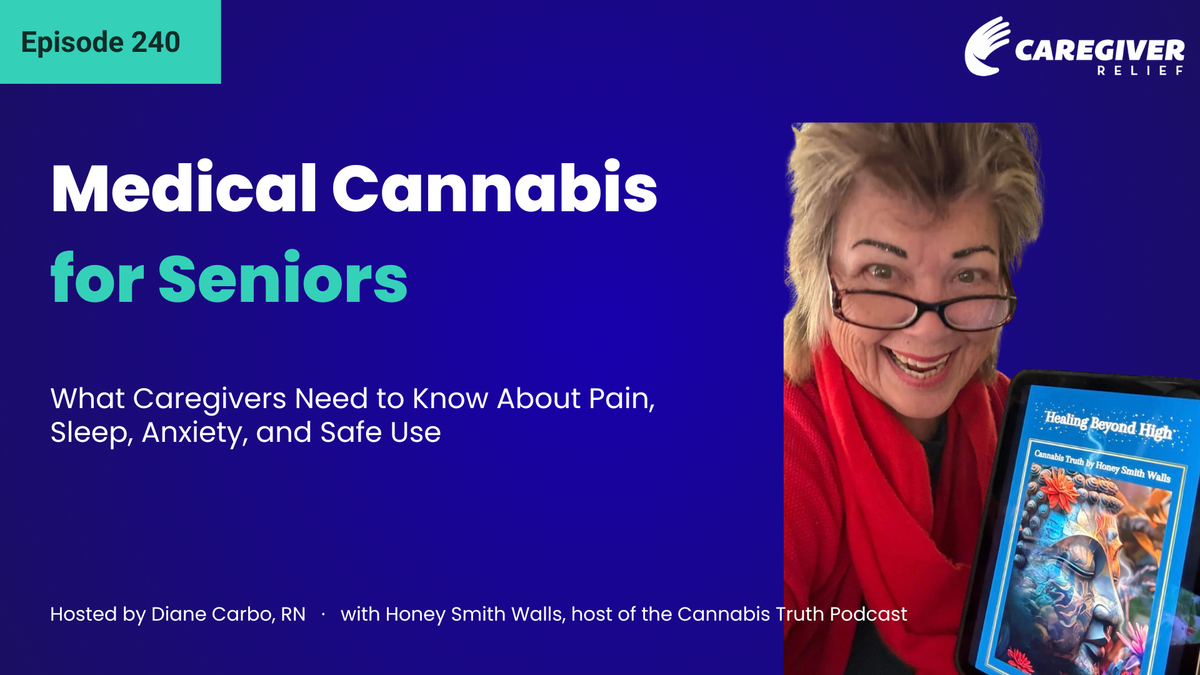
On this episode of the Caregiver Relief Podcast, host Diane Carbo, RN, sits down with Honey Smith Walls—host of the Cannabis Truth Podcast, certified cannabis educator, and author of Healing Beyond High: Cannabis Truth.
Together, they demystify the science behind cannabis, break down the fear of "getting high," and share essential safety tips for caregivers navigating chronic pain, anxiety, and sleep issues in older adults.
Episode Outline & Key Topics
- Intro & The Stigma Around Cannabis: Host Diane Carbo opens up about why caregivers are curious about cannabis, the risks involved, and why education is crucial for senior safety.
- Honey's Journey: Author Honey Smith Walls shares how cannabis helped her navigate personal trauma and manage chronic pain and anxiety.
- The Science of the Endocannabinoid System: Why humans and animals are naturally wired with receptors that interact with cannabis compounds.
- Healing Beyond High: Addressing the primary fear of seniors—falling or getting addicted—and explaining how cannabis can offer pure therapeutic relief without impairment.
- THC vs. CBD vs. Full Spectrum: Breaking down the difference between cannabinoids, the strategy of microdosing, and why full-spectrum products work best.
- Shifting Regulations & Legal Changes: What the move to Schedule 3 classification means for doctors, insurance, and future clinical studies.
- Takeaways & Responsible Use: Final advice on retaining autonomy over your healthcare, doing independent research, and finding trusted products.
Key Highlights & Takeaways
- 🧬 We All Have an Endocannabinoid System: Humans and animals have built-in receptor systems throughout their DNA, bones, and body that bind naturally with cannabinoids to reduce pain, inflammation, and anxiety.
- 🎯 Relief Without the High: Seniors don't have to fear falling or getting loopy; microdosing or using balanced, full-spectrum compounds targets acute pain without causing head euphoria.
- 🔬 Full-Spectrum Strategy: Using full-spectrum products creates an "entourage effect," bringing multiple plant compounds (CBD, THC, CBG) together to orchestrate whole-body recovery.
- 🩺 A New Era for Medicine: With legal scheduling changing to Schedule 3, medical schools are training standard doctors in "cannabinoidology," paving the way for future insurance coverage.
🎧 Listen to the Full Episode Below!
Ready to clear away the myths and get the facts? Click the player below to listen to the entire conversation, and learn how to safely approach medical cannabis with wisdom and confidence!
Connect & Learn More:
- Check out Honey’s book and resources at healingbeyondhigh.com.
Get your free PDF: The Cannabis Recovery Kit

Podcast Episode Transcript
Diane: Welcome to the Caregiver Relief podcast. I'm your host, Diane Carbo, RN. Today, we are opening the door to a topic many caregivers are curious about but may feel uncomfortable asking about: medical cannabis. For years, cannabis has been surrounded by stigma, confusion, and misinformation. But as regulations change and research expands, more families are asking whether cannabis or cannabis compounds may have a role in supporting comfort, sleep, pain relief, anxiety, appetite, and quality of life.
But this is also where caregivers need to be careful. Cannabis is not a one-size-fits-all product. It is not risk-free. It can interact with medications, affect balance, thinking, mood, and safety, especially in older adults. That is why education matters. My guest today is Honey Smith Walls, host of Cannabis Truth Podcast, a certified cannabis educator, and the author of her new book, Healing Beyond High: Cannabis Truth.
Honey is passionate about helping people move beyond fear and hype so they can make informed and intentional decisions Honey has interviewed medical professionals and experts who are helping families understand the science, the myths, and the real questions we should be asking about cannabis.
Diane: Honey, thank you so much for joining me today. I'm very excited about this topic. I have clients that ask me all the time, should I do this? Is it safe? And I, of course, I have to refer them to you because I have no idea.
Honey: Diane, it's wonderful to be here with you. Thank you so much for helping me spread the good news about cannabis to our audience.
I hear you. I understand what you must be going through in this confusing era, this confusing cannabis moment in our time, in our society right now. And so I had some issues that I wanted to clear up, and I began using cannabis for myself when I realized, oh my goodness, this is more than just a quick little fix for, one moment.
This is so much more, and helped me through some pretty traumatic events in my lifetime. So once I figured that out for myself, of course, big blabbermouth me, I gotta tell everybody about it. And I'm also a bit of, a researcher, so I just sat back in my armchair for years and years and studied this plant and, all the people, the scientists who were studying it to begin with, when it, really before it became legal and available to them, So, now that the laws are changing again- Yes in the favor of cannabis, we are finally going to see some real clinical testing, and that will develop into a new, mode of operandi, if you will, because cannabis doesn't fit nicely into the American Medical Association of Pharmaceutical prescriptions that they have at their fingertips for all of our ailments and aches Yep and pains.
Diane: Yeah.
Honey: And as you said earlier, it's not a, one-stop shop for everybody. It's very individualistic, and that's what we want our audience to understand. It is so individualistic that no two people will ever have the same effects or feel the same or respond internally the same way that your friend does, your husband does
Diane: Yeah
Honey: your mother does, your child does. And yes, did I say child? Yes. Cannabis is a medicine, and we use it for all ages, and we use it also for all animals. Now, here's what I really want your audience to understand, and this may help, turn the key in their mind. All humans and all animals have a receptor system in their body that binds perfectly with all the hundreds of cannabinoids and terpenes and other compounds in the cannabis plant.
And so what that means is that when we use cannabis and ingest it, it spreads throughout our body, targeting the areas that needs it most. And when you discover that this receptor system runs throughout your entire body, in your bones, this receptor system is in your DNA, and same for animals, then you begin to realize that, that the cannabinoids, the compounds inside cannabis, will affect all kinds of issues for anxiety, inflammation, and acute pain relief. Now, those are three typical Ailments for all humans and animals that cannabis, what we consider to be a weed on the planet Earth
Diane: Yeah
Honey: will alleviate all kinds of pain for And once you start getting into the science of cannabis, not only is it absolutely fascinating, but you begin to feel hope for yourself. I didn't even know I was an anxious woman until I was in my 60s and realized that the cannabis that was settling my nervous system down made me understand finally that my head didn't have to be in the chaos that I had lived in all my life, and that anxiety was not a normal mode for a human to live in.
It's a state of fight or flight, and I had been living in fight or flight all my life until I got a hold of some cannabis and realized with the relief what calm felt like, what lack of pain felt So it was an absolute awakening for me, and then I couldn't wait to tell all my old girlfriends.
Diane: You know, I'm laughing because, I learned of... I never heard about the endocannabinoid system. I'm in New Hampshire helping... During COVID, I went up to New Hampshire to help my son open his first ketamine clinic, and, he took me to a dispensary. As a nurse, I had never we were afraid to get tested and stuff, But I have some stories I will share.
But anyway, Casey took me to my first dispensary, and we were laughing because, like I was like, I was open-minded to it because when I started, because he, Casey says, "Mom, if you read about the endocannabinoid system, you'll understand." And like you, I started doing research on it, and I loved it. But I wanna talk about your book, Healing Beyond High: Cannabis Truth. What does healing beyond high mean to you?
Honey: Well, I'm so glad you asked, because elders, as you probably realize, especially from the elder care that you're involved in
Diane: Yeah
Honey: are not looking to get high. They're looking for relief.
Diane: Yes.
Honey: But their main fear is falling. Because if you fall as an elder
Diane: Yeah ...
Honey: you're likely to break something, and that changes your entire world and everybody around you.
Diane: 100%, yes.
Honey: And so we're very, very anxious over the fall.
Diane: Yeah.
Honey: And that means that because of the bad reputation of cannabis, we're afraid we're gonna get high and fall.
Diane: The other concern my dad had, and I'll share that story later, is he was gonna get addicted.
Honey: Yes.
Diane: Yeah.
Honey: And so we just don't know anything about
Diane: yeah
Honey: this plant other than what we've been spoon-fed by our government, which
Diane: Yes
Honey: is just not the truth.
Diane: Yes, yeah.
Honey: And so I don't like going into conspiracy, but
Diane: Yeah
Honey: truly that is the background of this plant. they wanted to use this plant to incarcerate people of color.
Diane: Yeah.
Honey: And to maintain, a network of, I wanna say police society
Diane: Yeah Police state.
Honey: Yeah, and police state so that they could, Well, anyway, that is a whole nother story.
Diane: yes.
Honey: And I give you a little bit of that in my book, but not enough to feel too much pain over, because it's painful to watch when our government wipes something out and away from use that would be helpful or beneficial to society.
Diane: Now that just made
Honey: Let me give you another example of something like that happened in our American society. There was a car by a man named Tucker, the Tucker. And it came out before the Rolls-Royce, and it was a fabulous car. But the guy was a small operator. The big operators closed him down. They shut out. They bought up all of the parts companies where he bought h- the car parts from.
And they wouldn't sell to him anymore. So his car went by way of, you know,
Diane: This it's extinct.
Honey: it went extinct like the dinosaurs
Diane: Yeah
Honey: because there was a conspiracy surrounding him to get
Diane: Yeah
Honey: rid of him. His car was too good.
Diane: Yeah.
Honey: and they didn't want him. They didn't want him in the game.
Diane: Yeah.
Honey: So they shut him out. Cannabis by Big Pharma
Diane: Yes
Honey: cannot be contained easily. There are too many compounds in it, and Big Pharma has a problem with a shelf life for cannabis. And when they found that making pressed pills out of, you know, the other, laboratory, compounds that they can create in a lab was so much easier than trying to, extend the shelf life of a live plant.
Diane: Ah.
Honey: So you see the difference.
Diane: Yeah.
Honey: Big Pharma didn't wanna mess with all the live plant cannabinoids and terpenes, and there was no study, when they could just create a fresh, new, synthetic compound in the laboratory and dispense it, as much as they wanted.
Diane: Yes, yes.
Honey: So, the reason I named my book Healing Beyond High is because of the bad reputation of cannabis.
Diane: Yeah.
Honey: Most elders think that you're just gonna get high on cannabis, and that's all there is to it, and they don't wanna just get high.
Diane: Yeah.
Honey: They want relief for their pain, for their anxiety, for their inflammation, and that's what cannabis is precisely perfect for. Pain, inflammation, and anxiety, all three of those, for either humans or animals. Once you realize the key to finding help for Pain or help for inflammation or help for anxiety or help for all three of those at the same time, then you realize what a brilliant compound, this plant has in it, many of them. This plant has many compounds in it, and how easily it can help you throughout your lifetime of needing pain relief.
Diane: Yeah. In the '70s, honey, I was working as an RN at a big city hospital. And the head nurse, we all loved her. And she was young. young as in her 40s, you know, when we were all in our 20s. Right. Okay?
Honey: Yeah.
Diane: So we're working at this hospital, and she was diagnosed with cancer, and the treatments were horrific in those days.
Honey: Yep.
Diane: And she had severe nausea and vomiting. And we used to sneak weed into her into the hospital so she could because we, they couldn't stop her vomiting. They just couldn't. And it, and nausea. So this actually was, we brought it in and, I didn't do it. I wasn't
Honey: What form? Was it, like, in food?
Diane: we actually brought it so she could... And I could tell you, I've smelled pot in hospital rooms my whole entire life.
Honey: Oh, funny. But- So she smoked a joint.
Diane: She smoked a joint, and- Nice it helped her so much.
Honey: Instantly
Diane: And I will tell you, I told, I'll tell this story too. My dad was diagnosed, it was in the '90s, and he was diagnosed with, pancreatic cancer, and his blood sugars were all over the place. His appetite would be good, then it would be bad. He had waves of nausea and stuff. So I go to my brothers and sisters and say, "Hey, can you get some pot for Dad?" Well, they all did drugs, but they were, like, working employees and really upstanding members of the community, So they refused to help me. So I go to the local neighbor kid, and I got some, for my dad, and I took it to him.
And my dad- He says, "What if I get addicted to it?" and he was all upset about it. And I said, "Dad, you're dying." He was on hospice. And I said, "Dad, you're dying. What do you care if you get addicted? If it helps you feel better, if it helps stop that nausea and vomiting, and even increases your appetite so you can eat, what do you care?" He flushed it down the toilet after all of that work.
Honey: Oh, my goodness.
Diane: But it was his fear, and, I felt so bad because you know, I have not done drugs because I was always afraid to be tested. And, I became very open to it when I was, exploring things like my son's ketamine. People think that's a terrible drug, and it's
Honey: Yeah
Diane: absolutely not. It's an amazing drug that does amazing things. But again, it's the, it's been given a bad rap,
Honey: Right
Diane: by the media or even our government, I guess. I don't know.
Honey: Any alternative therapy
Diane: Yeah, it, yes
Honey: outside of the American sick care system.
Diane: Yes. Yeah.
Honey: and big pharma, you look on any television commercial that's big pharma, and it will tell you the joys of taking these, their pharmaceuticals. And then you listen to the side effects.
Diane: Side effects, I know.
Honey: As they read them very quickly. Very You gotta listen very fast.
Diane: Yes.
Honey: Yeah. To all the deadly side effects.
Diane: Yeah, yeah.
Honey: Deadly.
Diane: Yes, yes.
Honey: well- I'm just shocked.
Diane: I, yes.
Honey: Cannabis doesn't cause death. There's no known recording of any cause of death by cannabis on the planet.
Diane: Okay. I just know that I am, I've learned a lot about it, and that's why I thought it was so important to have you on today. Now, this is going to be a new topic to many of my listeners out there. Can you explain the difference between THC, CBD,
Honey: Yeah
Diane: cannabinoids, and the cannabis plant itself?
Honey: Yeah, and people are also confused about hemp and marijuana.
Diane: Yes,
Honey: yes. okay. So it's not addicting. It is not addicting. It, won't kill you.
Diane: Okay.
Honey: Can't die from using too much cannabis. you can get nauseated and feel badly from using too much THC.
Diane: Okay.
Honey: If you overuse THC, it can make you nauseated. It can make you feel, weird and have, and maybe feel like you're paralyzed. You're not, but it can make you feel like that, make you think you are.
Diane: So THC is the psychoactive component
Honey: THC is that amazing compound in cannabis that gets you high. It's called Delta-9-tetrahydrocannabinol, otherwise known as THC. Now, here's what you don't know. You never have to get high on THC. Although it can make you high, you never have to get high on it if you know what you're doing, and that's called microdosing. We're not in the teenage realms of wanting to smoke a joint and smoke our brains out.
Diane: Yeah.
Honey: That's not us. No. We're a different era. We want relief.
Diane: That was us when we were younger. My generation was definitely about that.
Honey: Me too, and I loved getting high.
Diane: Oh.
Honey: But I save that for my own private, special, celebratory moments.
Diane: Yeah, yeah.
Honey: and what I want is something that I can use daily starting first thing in the morning
Diane: Yeah
Honey: 'cause my hands hurt like hell when I first wake up from neuropathy in my fingers and terrible arthritis. So I need something first thing. and then I don't want to be, I don't wanna be high in the morning. I have to get too many things done.
Diane: Yeah, yeah.
Honey: And so, when we try to use cannabis for acute pain
Diane: Yeah
Honey: like my hands first thing in the morning I'm not using so much THC that it's gonna make me high. I'm using enough THC combined with other cannabinoid compounds to tame that THC. That tame,
Diane: Yeah.
Honey: And to keep me from going into any kind of, of head euphoria. That's not where I wanna be. I wanna be able to function, go make breakfast, fix chow for the dogs, get ready for my work day and be able to write with a pen, to make my hands and my fingers work again.
Diane: Yes. Yeah.
Honey: Yeah. And so, just being able to bend over and put my socks on, that's, you know, first thing in the morning you're tight. Having, relief in my heart, not feeling anxious over my own medical conditions.
Diane: Yeah.
Honey: That's a real joy. And so I'm using cannabis all day long, but I use it specifically in, in certain ways, and that means I use it as a tincture in drops. Just a few drops at a time. Or I use it, later, I'll smoke a joint because I'm an old hippie, and I like the hand-to-mouth thing. And smoking a joint gives you instant, relief from nausea. So,if when you ingest cannabis, like eating it or swallowing a tincture, it might take 30 minutes to an hour before you feel it. So there's strategy in how you use cannabis. And I use it in different forms all day long, not getting high.
Diane: Yeah.
Honey: Just microdosing enough so that I have absolute pain relief, and I can smile and be happy and feel joy in my heart.
Diane: Yeah. That you
Honey: I don't have
Diane: have a better quality of life.
Honey: That's right. I don't have pain in front of every thought.
Diane: Right. Right. and I, as a person who lives with chronic pain, I can tell you that it's very frustrating. And I can't take medicines. That's why I started CBD oils. And I want you to talk about CBD oils, explain those a little bit because they have really helped me in a lot of ways.
Honey: So are you using a full spectrum CBD
Diane: Always
Honey: oil?
Diane: Yes.
Honey: So let me tell the audience what that means.
Diane: Yes.
Honey: There are, there's new terminology that you'll learn once you start using cannabis, and, we use the clinical term cannabis to mean marijuana or hemp
Diane: Yes
Honey: see, because it's really the same plant grown differently for different effects. So CBD is a cannabinoid that grows in the cannabis plant. When hemp is grown, more CBD grows in hemp, so that's where people are getting their CBD from mostly because it's more available. And CBD, which is a cannabinoid called cannabidiol, had to get cannabinoid and cannabidiol separated in my mind. Cannabidiol is a very, helpful compound because it completely reduces inflammation. And it does it very, very fast. But it also handles anxiety, and when we have pain, our anxiety level grows exponentially. The more pain we have, the more anxiety
Diane: That's true
Honey: So CBD is one of the most well-known compounds in cannabis, and mostly they take it out of the hemp plant because it grows,much more in the hemp plant than it does in the marijuana plant. They're both cannabis plants, but marijuana grows more THC, that compound that gets us high.
And so it's easier to get THC out of a marijuana plant, and CBD out of a hemp plant. But both of those plants have all of the compounds in it. And what I meant by saying, by asking if you were using a full spectrum hemp plant, that means it's got all the compounds in it, not just CBD and a little bit of THC, but also CBG and CBC and CB- all the other cannabinoid and terpene compounds. And there's esters and alcohols. There's just, probably thousands of compounds in the plant that we have yet to discover. But CBD, cannabidiol, and, THC, are the two compounds that we know the most. What we're finding out now is that CBG, cannabigerol, which is the mother of all of those compounds, every single one of the compounds come out of CBG, cannabigerol, it too has a marvelous effect on neuropathy.
So I am really trying to get my CBG in with, the other compounds. And you can do that when you use full spectrum products. So when you go to a dispensary, and you were about to tell us about your adventures there with your son, really what most dispensaries sell up here in Michigan are recreational THC products that are very high in THC, and they're selling the high. When you go to a dispensary down in Florida, which is a medical only state
Diane: Yeah
Honey: you will see the difference in medical products. It's the same plant But it's cleaner. They have a certificate of analysis on that product that tells you exactly what compounds are in it and at what ratios, so that you can understand what you're taking and why it's affecting you the way it is.
Diane: Yeah.
Honey: So the reason we use full spectrum is because of that endocannabinoid system of receptors in your body. All those hundreds of compounds in a full spectrum product play nicely with your endocannabinoid system of receptors. And they shoot like a little shotgun blast of an army going into your body and helping you, recuperate and get past the pain, inflammation, and, anxiety that your body is feeling.
So using one compound Like CBD. Like taking an isolate of CBD and putting it in a jar, and you just using that one isolate, yes, you'll get help from that, but not nearly the help as if you had gotten a full spectrum product that orchestrates an amazing recovery throughout your entire body.
Diane: I bought, my first CBD experience, through Charlotte's Web, and they're very reputable, so I knew it was going to be a good product. And I did do the research, and I did get a full spectrum. Because it's very, confusing, 'cause there's Delta-9, Delta-8, Delta-P, Delta Can you talk about that just a little bit? Touch on it.
Like, what are these Delta products and the different ones? Are they isolates and they're not full spectrum?
Honey: So that's correct. And I would stay away from, all of that mess.
Diane: Okay
Honey: I do not recommend going into, recreational dispensaries to buy your weed if you can avoid it, because they sell isolates that are, really, really strong compounds. And there's no way for you to microdose. And that's what we wanna do as trying to get rid of our pain. We want to microdose just enough of a good product that we're not high, but we feel the pain relief.
Diane: Yeah.
Honey: And it's gonna be different for every single person.
Diane: Yes.
Honey: So stay away from all the nonsense and all that stuff that you just don't understand. Don't do it. Instead, pick up a book, turn on, you know Turn on, a, go to a dispensary, like a medical dis- look up medical dispensaries and see who their products are by. You mentioned a fabulous product, Charlotte's Web.
Diane: Yes.
Honey: Charlotte Figi was a little girl that was having several hundred, seizures a day when her mother, realized that a hemp product, hemp oil, would stop them, and that is what kicked off the great marijuana mothers migration to Colorado to help their babies with seizure conditions, stop seizing. And that's how Charlotte's Web became so famous. So we love Charlotte's Web, products, and, they are full spectrum and a really good place to start. If you want, if you want to look, to start with a good product, you can be assured
Diane: Yes
Honey: that's a great place to go.
Diane: And the CBD,in Charlotte's Web at this point in time is less than 3% THC in it. Is that correct?
Honey: That is correct. Okay.
Diane: The lowest, that's the highest amount the government will allow for, that to be in a, THC to be in a product right now
Honey: Yes, I was looking for the word arbitrary.
Diane: Yes, thank you.
Honey: That's the arbitrary number that our government decided to restrict us with.
Diane: Yeah.
Honey: So they need to just get their grubby little hands off of it, and let the scientists do the work and figure out how we can make this product available to humanity and the animal kingdom in such a way that we can really, utilize its value. So I'm sure AI is going to be helping us a lot with this process now that we have that. I think so. Yeah.
Diane: My first experience with, I only do tinctures. I can't smoke. I just can't do it. I don't know why, but I've never smoked. So I do tinctures, which are unpleasant, but, you just put them under your tongue. You don't even taste them until you're ready to swallow. But my first experience was I'm up in the Poconos with my girlfriend, and I'm looking out the window.
It's beautiful spring morning, and all of a sudden I realized, ooh, I'm a little loopy. Very light loopy, you know? And it was my response to the first time. And now I take it, it doesn't affect me at all, like that. But the first time and I thought, "What is going on? Why do I feel this way?" And then I called my son and he says, "Mom, that's what it feels like to be high." I went, "Oh. Oh, damn."
Honey: So
Diane: And it didn't last long
Honey: You've had alcohol before, right? Oh, yeah. That first sip.
Diane: Yeah. That first couple of sips. Yes, yes.
Honey: And you're high, but you're not really drunk yet, but you're a little tipsy.
Diane: Yeah, exactly.
Honey: it's that.
Diane: That's exactly what it was like. Yes.
Honey: Yeah. That. And it's not unpleasant at all, but it
Diane: No, no but if it's morning and you're a surgeon or But I was still able to function. I was still able to function and do things that day. I just was like, it was just like a, it wasn't an unpleasant experience, but I was just like, "Oh, wow." And I was disappointed because it, you get used to it, and I laugh because That's tolerance, yes You built tolerance. Yes. It's building a tolerance up, and that's why, you have to,I rotate my full spectrum products, so different products from different companies now so that I don't, always get adjusted to just one different product. But,
Honey: yeah, I've, that's a real good, plan of action too because you don't know how long a product is going to be in production
Diane: Yeah. Oh, there you go. Well, I didn't know that
Honey: And also, every harvest is different. I mean, I know they're making clones, but if that product, if two identical products from the same plant sit on the shelf just a few days different time, different length, one, they have a shelf life.
And if one is sitting in the sun and the other one is not, you're gonna get different compounds developing from the heat.
Diane: Oh.
Honey: Those compounds will change from one thing to another. For instance, THC has a compound precursor to it called THCA. It's the acidic version of THC. You can actually extract THCA and use it all day long, and you will not get high, because you cannot get high on THCA, the acidic version. But if that THCA product sits, on a shelf for too long, it will turn into THC and make you high as a kite.
Diane: So Well, see, I didn't know that. Now, there's changes in the cannabis regulations. What do you think seniors and my listeners out there should pay attention to over the next few years?
Honey: Oh, it's very exciting right now because, the scheduling was changed. It was a Schedule 1, which meant no medical use, worse than heroin, don't touch this, it'll kill you, to a Schedule 3, which is now what a lot of our drugs are on that we are prescribed by our doctors. So now, as a Schedule 3, theoretically, our doctors will be able to prescribe it for us, and that means insurance.
Diane: Interesting. I did not realize that
Honey: Right. Okay. So what we have to do now is get our doctors educated about it. There's only a few schools that have opened up for cannabinoidology. The, Boston School of Pharmacy is one of them. They have a cannabinoidology master's, and there's one out in California. And so the universities are starting finally to open up to it, and give master's education in cannabinoidology. So those are the people that I've been hanging out with, those scientists and nurses and doctors who are interested in learning more and more about this plant, and getting it to the people.
And that's why I wrote my little book, Healing Beyond High, because it's very hard to understand what the doctors are trying to tell us in their medical speak.
Diane: Absolutely.
Honey: So I wrote a little primer that helps you understand what they mean, and what's good for you, and what you should avoid, and what the strategies are at this point, and how you can find a product for yourself in doing just what you're doing. You are using several different products, which gives you a huge variety of compounds.
And that's really great, and you have researched those products to make sure that they are what they are intended to be.
Diane: Yes. Yes. What is the most important message you want my listeners to take away from your book and your work?
Honey: That you can learn something that will benefit your health for the rest of your life in less than a two-hour read And for less than the price of dinner at McDonald's. And then you can pass that information on to your friends and family, and you can show your doctors that this is a good plant and that you want to retain autonomy over your own healthcare. You are not subject to just the American Medical Association for your healthcare. There's all kinds of worldly alternatives that we should investigate. Chiropractics healing teas
Diane: I, I use
Honey: all kinds of things
Diane: I use Class 4 laser therapy to manage my pain as well, and light therapy, and that's an alternative thing, too.
Honey: I've used light therapy. I love light therapy.
Diane: Yeah. I do too.
Honey: There's sound therapy.
Diane: There's all there's so many different. And the thing is, baby boomers are demanding alternatives.
Honey: Yeah.
Diane: They absolutely are. They want east meets west approach to their healthcare.
Honey: Definitely.
Diane: and, I'm living in Myrtle Beach, that you know, it's illegal here at the present time, for anybody to use you know, have a dispensary or anything. We're, I don't know if we'll get there. It's just, thoughts, people's mindsets have to change.
But- That's it ... honey, I just really appreciate your time. Thank you so much. I recommend that people, How do they contact you?
Honey: Oh, just go find me on Facebook or look up healingbeyondhigh.com. Awesome. And you'll find all kinds of interesting information there at your disposal for free. Healingbeyondhigh.com. And it's been so wonderful to be here and just chat about all of this with you openly and freely. We were afraid to talk about this just a few years ago out in the open.
Diane: I had people that were critical of me for using CBD.
Honey: Yeah.
Diane: Oh, my Lord. But you know what? it's fear.
Honey: Yeah.
Diane: It's, of the unknown. it we've been fed a line of, story about this that was wrong.
Honey: Yeah.
Diane: And we just need to be open-minded and look at alternatives and find out what's right for you. But Agreed ... do it responsibly.
Honey: Yeah. Agreed. Yeah. Agreed. Absolutely.
Diane: Thank you so much.
Honey: Don't, also, just one other thing, don't believe everything you think.
Diane: Yeah. Yeah
Honey: Just Yeah ... just don't. Expand your mind. Your thoughts are inside a brain, and we don't know, there's so much more to learn about this world
Diane: Yeah. Yeah
Honey: and ideas. So don't believe everything you think. Go ahead and do research and find out from trusted sources, and you'll recognize trusted sources when you see them. You'll hear them because they'll explain why they should be trusted and how you can trust them, why it's, why their trust is worthy of your attention. do your homework, do your research, and, start with my book and start with, Charlotte's Web if you're looking for a good product, and go from there.
Diane: Thank you so much, honey. To my family caregivers out there, you are the most important part of the caregiving equation. Without you, it all falls apart. So learn to be gentle with yourself, practice self-care every day, because you are worth it.
Caring for a loved one can be overwhelming — but you're not alone. If you have questions, big or small, our expert team is here to help.
👉 Click here to Ask the Expert
Our Resource section can help you find the information and tools that you need. We have courses, videos, checklists, guidebooks, cheat sheets, how-to guides and more.
You can get started by clicking on the link below. We know that taking care of a loved one is hard work, but with our help you can get the support that you need.
Click here to go to Resource Section now!