How to Know When Death Is Near: A Hospice Nurse’s Guide for Caregivers and Families with Barbara Karnes - Episode 256
How do you know when death is near? Hospice expert Barbara Karnes explains the signs of dying, stages of end-of-life, and what caregivers should expect in the final days.
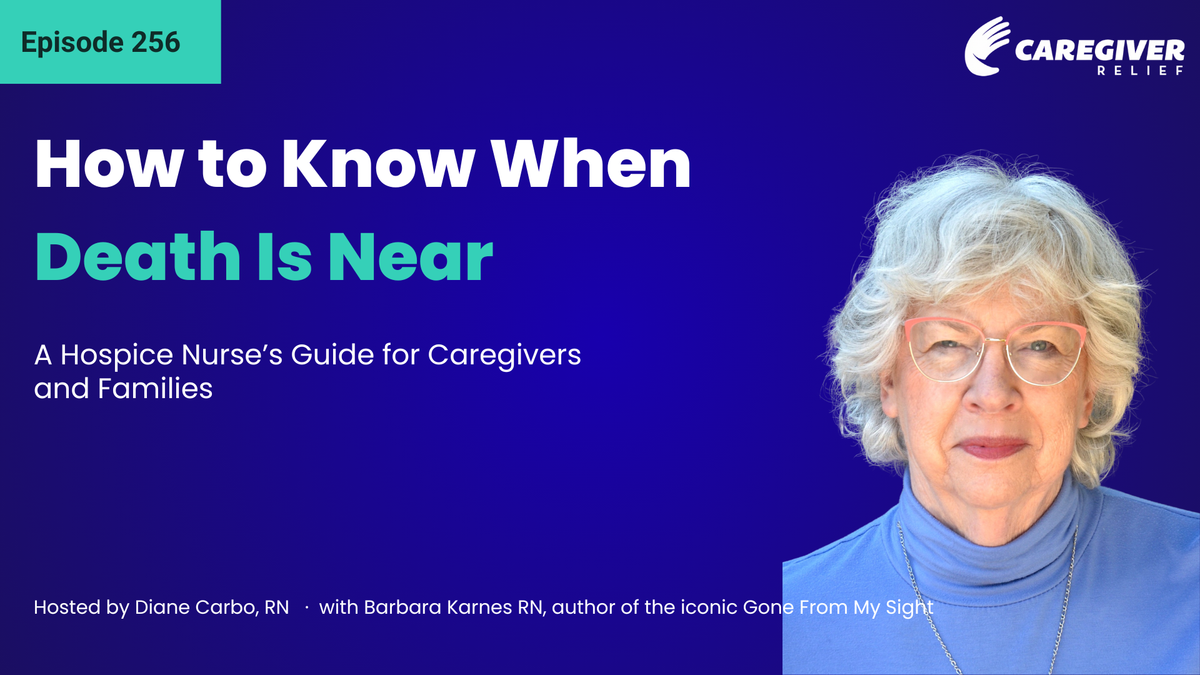
In this compassionate and eye-opening episode, host Diane Carbo, RN, sits down with Barbara Karnes, a pioneer in hospice care, end-of-life educator, and author of the famous booklet Gone from My Sight. Together, they bring clarity, comfort, and peace to one of the most emotional and misunderstood stages of caregiving.
✨ Key Episode Takeaways
- 🕊️ Dying is a Natural Process: Just as our bodies go through labor to enter this world, there is a natural, reverse labor process to leave it. It is sad, but it is not pathological or bad.
- 🍲 Why Food & Drink Stop: As the body shuts down, it naturally lets go of its anchor on this world. Stopping food and liquids is normal—forcing artificial feeding at the end of life can actually cause more discomfort and complications.
- ⏳ The Timeline of Dying: Learn the subtle physical and behavioral changes that happen months out, weeks out (when "labor" begins), and during active dying (the final hours to days).
- 💊 Pain Management & Medications: Disease causes pain, not the dying process itself. Discover why stopping standard routine meds while continuing (and often increasing) pain meds is necessary as blood flow slows.
- ✨ The "Spiritual Rally": Why loved ones sometimes suddenly perk up, request a full meal, or ask for an old suit right before active labor begins—and how families can navigate this moment.
- 📖 Preparing in Advance: Why reading end-of-life resources before you need them is the greatest gift you can give yourself and your family.
📑 Episode Outline & Timestamps
- Introduction to EP 256 and guest Barbara Karnes, RN.
- Barbara’s origin story: From nursing school in 1962 to studying with Elisabeth Kübler-Ross and joining the first hospice in Kansas City.
- Diane shares a personal story of setting up hospice in Hawaii for her father.
- The Mirror Image of Birth: Understanding how the body reverses its arrival process at the end of life.
- The two ways to die: Fast vs. Gradual, and the key early signs that labor has begun.
- Truth about feeding tubes, appetite loss, and why forcing nutrition causes harm.
- Managing medications during end-of-life and why pain medication must be carefully adjusted.
- Breathing changes, physical labor, and peeling loved ones off the ceiling during Cheyne-Stokes breathing.
- Terminal agitation: What causes it, how to manage it, and creating a calm environment.
- What does "Active Dying" actually mean?
- The "Surge of Energy" or Rally: What it means when a loved one suddenly perks up.
- How caregivers can cope with anticipatory grief and overcome fear.
- The vision for End-of-Life Doulas in healthcare settings.
- When is the right time to refer to hospice? (And why self-referral is vital).
- Barbara’s books: Gone from My Sight & The Eleventh Hour, and where to find her work.
💡 About Our Guest: Barbara Karnes, RN
Barbara Karnes is an internationally recognized end-of-life educator and hospice pioneer. Her iconic blue booklet, Gone from My Sight, has guided millions of families through the death and dying process with grace and clarity.
- Website: bkbooks.com
- Resources Mentioned: Gone from My Sight & The Eleventh Hour (a companion guide explaining what to do step-by-step during the end-of-life transition).
Podcast Episode Transcript
Diane: Welcome to Caregiver Relief Podcast. I'm your host, Diane Carbo, RN. When you're caring for someone you love, there is no handbook for the moment when you realize time may be running out. That quiet question in the back of your head is this the beginning of the end? That can bring fear, confusion, and even panic.
Today, we're bringing clarity to one of the most emotional and misunderstood parts of caregiving, the death and dying process. I'm honored to be, to welcome Barbara Karnes, a true pioneer in hospice care and end of life education. Her work has guided millions of families, and her booklet, Gone from My Sight, has become one of the most trusted resources in understanding what happens at the end of life.
Barbara, thank you so much for joining us today. This is a really difficult subject that most people avoid, and I love the topic Gone from My Sight. having lost several family members, that it is. they're out of my sight, but they're still in my heart.
Barbara: Absolutely. I remember trying to figure out what to call this booklet that I was putting together, and at the end, I found this, I think, beautiful poem, which is Gone from My Sight, and talking about the ship.
Diane: Yes
Barbara: and I thought that's perfect
Diane: Yes
Barbara: for this little booklet. It's gentle, and I think it fits. I think
Diane: Barbara, you've been a nurse for a long time. what led you to go to hospice?
Barbara: Okay. I'm gonna take you way back. I graduated from nursing school 1962.
Diane: I'm 74. Okay. So I get it, we're from the Dark Ages.
Barbara: Okay. So I thought, "Oh my goodness, I've made a huge mistake. I should have never been a nurse. I should have been a social worker." So I got married, and I never worked as a nurse.
Diane: Oh, wow.
Barbara: Raised families. And in the '70s, Elisabeth Kubler Ross
Diane: Yes
Barbara: came forward and started talking about dying and how we weren't dealing with
Diane: Yep
Barbara: death and
Diane: Yes
Barbara: dying and death. And I thought, "Oh my goodness, this really appeals to me and is interesting." I spent a week with her in a workshop in California.
Diane: Oh, wow.
Barbara: Yeah.
Barbara: And when I finished that workshop, it was, "This is what I want to do." So I had to go back and take a refresher course in nursing.
Diane: Yeah. Yeah.
Barbara: Hospice, at this time, people couldn't even say the word,
Diane: Yeah.
Barbara: They didn't know anything about it. So I went to volunteer. My idea was I will volunteer, and get a feel for what this is about.
Diane: Yep.
Barbara: Talk about divine order. I figure it's divine order. I went... We moved. I went to a church, group, study group on world religions.
And you know how in these groups, people, you go around the room, and you introduce yourself, and you
Diane: Yes
Barbara: say a little of what you're, And I said, "I'm interested in hospice. I would like to be a volunteer." In that group was the volunteer coordinator for the first hospice in Kansas City.
Diane: You were meant to do that, girl.
Barbara: I was meant to do that. He came over and he said, this goes even a step further. We are looking to hire a nurse right now."
Diane: Oh, no.
Barbara: And I said, no. I can't take on a full-time RN position." My thinking is I don't know enough to take on that. I wanna volunteer and learn.
So I said, "But I'll tell you what. I'll volunteer 20 hours a week."
I figured that was school.
Diane: Yes, yes.
Barbara: And after four months, they brought me on, as a paid, position as a nurse.
And what I find the most interesting is no one knew what dying was like.
Diane: Yes.
Barbara: No one knew, other than the movies, how people died.
And the five years that I was a hands on, in-the-home hospice nurse it was the patients that taught me how to
Diane: Yep
Barbara: all about end of life and about death.
Diane: Yes. Yes.
Barbara: They were my teachers.
Diane: My experience, I wanna share this with you and with my listeners. My dad was told he was, he had pancreatic cancer, and he's in the hospital.
And, I was in my 40s, so that's 30-some years ago, and the doctor tells him, "Lee, you have pancreatic cancer. You have less than six months to live." And my dad went to Hawaii. he was a letter carrier, so he wasn't a wealthy man or anything, but he had this timeshare in Hawaii, and he would go every other year for six weeks.
He'd put back three weeks and three weeks together, and he could stay there for six weeks. And this was the year he was supposed to go. and by then I'm a seasoned, old, crotchety, old nurse, and my dad, the first thing out of his mouth when the doctor told him that, he goes, "Oh, I'm gonna have to cancel my trip to Hawaii."
And I just said, you just forget how brash you can be. I know I can be, but I said to my dad, you're not dead yet." "How about if you feel well enough, we'll, you, we'll still plan on getting you to Hawaii. And if you die over there, is that gonna be bad for you?
And are you gonna mind?" And he said no. So I set up hospice for him in Hawaii.
Barbara: Fabulous.
Diane: Yeah, in those days you could do that. Now they would take him off hospice and stuff. But they didn't, did take him off hospice 'cause he wasn't well when he first got there, but after the first week, for the full six weeks he was there, he did amazing.
They took him off hospice and, they checked once a week and called him and stuff. The day or two before he was to come home, he started feeling sick. So they provided him with some meds. Hospice, opened it up again, provided him with some meds for traveling, 'cause it was from Hawaii to Pittsburgh, Pennsylvania.
He came home and a few, about six weeks later he passed
Barbara: What a gift you gave him
Diane: I know, and you know what? I just, and people, like, are horrified when I say that. But I'm like, "Well, you're not dead yet," And I see hospice as a way to control everything about your life up until the very end.
Barbara: And to help you live that life
Diane: Yes, yes
Barbara: the very end.
Diane: Yes. Now, here's my dad, a letter carrier in Pittsburgh, Pennsylvania, and when he lay, gets laid out, that's what we call it at, in Pittsburgh when you're, you're having your funeral arrangements and visitations. My dad had a Hawaiian shirt and a lei.
Yeah. And I get to giggle about that because Yeah he would never have done that. But it, but that was his wish, and I love it. I just love it.
Barbara: Oh, I do, too. I will say to you that my mother, wanted to, and we did, bury her in a bathrobe. She bought a beautiful bathrobe, and she said "I'm gonna be asleep for a long time. I ought to be in this bathrobe."
Diane: Oh, I love it. You know, and those are simple things that, hospice helps us work on and provide for us. I, I'd like to know, you've been at the bedside of hundreds of people at the end of life. What patterns did you begin to notice that led you to your work?
Barbara: What, in those five years, what I learned is that people don't die like they do in the movies.
Diane: Yes.
Barbara: That there is a process to dying.
Diane: Yeah.
Barbara: Just like there is a process to entering this world
Diane: Yes
Barbara: there is a process in leaving it, and that process is really, I think, amazing. When you think about, it's reversed.
Diane: Yes.
Barbara: We go through labor to get here. We go through labor to leave.
Diane: Yeah.
Barbara: If you take the food that we eat when we come into this world and how
Diane: Yeah
Barbara: gradually we go from milk to soft and reverse it when we're leaving.
Diane: Yes.
Barbara: We go from eating, stopping eating meat and
Diane: Yes Yes
Barbara: anything that requires energy to digest.
Diane: Yes.
Barbara: And eventually we get to where we're just drinking water and then nothing. The same with socialization, the same with
Diane: Yep
Barbara: sleep. so I learned that process by being at the bedside
Diane: Yes
Barbara: for months, weeks, days, and being there at the moment of death.
Diane: Yes.
Barbara: So I learned it.
Diane: Many caregivers ask, how do I know when death is near?
What are the earliest signs families should be aware of?
Barbara: Okay, there's two ways to die. You either die gradual or fast.
Diane: Yeah.
Barbara: Fast death, you're alive one minute, you're dead the next.
Diane: Yeah.
Barbara: Gradual death from disease or old age
Diane: Yeah.
Barbara: has a process.
Diane: Yeah.
Barbara: For disease, that process starts months, two, three, four months before death comes.
Diane: Yeah.
Barbara: And you notice, the eating changes, the sleeping, the socialization.
Diane: Yeah.
Barbara: Then about one to three weeks before death labor begins. and that has its own set of signs, that tell you labor have, has begun.
Diane: Okay.
Barbara: The key one is the person will start sleeping with their eyes partially open.
That's something that I look for, in that they're sound asleep and their eyelids are at half-mast. But you also have random picking, restlessness.
Diane: Yeah.
Barbara: there... It's a whole list of signs that say labor has begun. And then there's other changes that say the birthing into this other world, is happening and it's happening now.
Diane: I love the way you presented that, the birthing into the next world.
Barbara: The world. And
Diane: That's beautiful. That's a concept we can grasp.
Barbara: This whole birthing From one world to another.
Diane: Yes. I think
Barbara: helps us see, that nothing bad is happening.
Diane: Yes.
Barbara: Mom's doing what people do when they leave this world.
Diane: Yeah.
Barbara: It's sad. It's very sad. But it's not bad.
Diane: Yeah.
Barbara: Nothing pathological is happening.
Diane: Yeah.
Barbara: This is how the body dies. And we're all going to do it.
Diane: One of the biggest things that I have dealt with is, the feeding tube, feeding a person and the tube feeds.
I have, there's, there are actually Facebook groups that say, "Hospice is killing my family member." And, and it's just total lack of knowledge of the death and dying process. And it doesn't make sense because hospice doesn't get paid after you die. So you would think they would extend how long you can live, right?
So can you explain what happens with eating and drinking at the end of life, and why this is so misunderstood?
Barbara: The body is shutting down.
Diane: Yeah.
Barbara: The body is letting go of its hold on this planet, and that's what food does for us. Yeah. That's the anchor that keeps us here. So when the body's preparing to die, then all by itself it will cut...
It will slow down, cut back, and eventually totally stop eating. Food is the gas we put in our car to make it run.
Diane: Yes. Yes.
Barbara: The body's preparing to die. It doesn't want the food. It doesn't want the energy that food brings. It's normal and natural. And what we don't tend to understand, and that's our medical model
Diane: Yes
Barbara: Is that, oh, he's not eating. We've got to do some tube feeding. We've got to do artificial food feeding.
Diane: Yes.
Barbara: As end of life approaches, that actually is more uncomfortable
Diane: Exactly.
Barbara: Yes than it is for that person to naturally stop eating. It's not a choice.
Diane: Yes.
Barbara: They're not choosing to not eat. Their body doesn't want the food.
They can't eat.
Diane: Yes. Yes. You know, I, have taken care of people that have the tube feedings up until the moment they die, and, they don't know how cruel that is because they have to sit up all the time. And some people and this is what makes me crazy about the medical delivery system. we eat three meals a day, and then we rest.
Some tube feedings are 24 hours a day, just drip, drip, drip, and it's... That's not normal. And your body, as you get older, especially in your death and dying process, is continuing. It, people then have, have it back up into their esophagus and get pneumonia. And there's so many things wrong with this.
And then the chronic diarrhea that occurs with it as well. There's so many things that family members don't continue. But they also have a hard time, Barbara, stopping medications Again, that's about, oh my God, we're killing my parent or my loved one.
Barbara: Yes. Now, I continue medication until labor begins
Diane: Okay which is one to three weeks before death comes.
Diane: Okay.
Barbara: When labor starts, and they're eating hardly anything
Diane: Yeah
Barbara: in fact, they're, you're doing good if you can get an Ensure down them,
Diane: Yeah
Barbara: or even some water. So, that's when I stop all medication except pain medication.
Diane: Yes. Yes, yes.
Barbara: So disease causes pain.
Diane: Yes.
Barbara: Dying is not painful in itself.
Diane: Yeah
Barbara: but disease causes pain. So that disease and the pain is gonna be there until the person's last breath.
Diane: Okay.
Barbara: In fact, the, the medicine needs to be increased, the pain medicine needs to be increased
Diane: Yeah
Barbara: as death approaches during labor because the body's not working.
Diane: Yeah.
Barbara: It's not processing the medication. The circulation, the blood flow is slowing down, so nothing works right, and you end up having to increase that pain medicine, and you give it until the person's last breath.
Diane: Yes.
Barbara: But the key to pain management is education.
Diane: Yes.
Barbara: is educating the caregivers, the watchers
Diane: Yeah
Barbara: about the dynamics of dying end of life, the body shutting down, what it can and can't do and pain.
Diane: Yeah.
Barbara: And understanding it's all, 90% of our work at end of life is education.
Diane: Yes.
Barbara: Education.
Diane: One of the biggest fear is changes in breathing. What is normal and when caregivers, as soon as they see a change in any kind of breathing process, they panic. How do you help them with that?
Barbara: I explain that labor is like the little chick that's working to get out of its shell, and they work really hard to get out of their shell. And that's what we're doing when we're dying. We work really hard to get out of this body, and that's what we're watching is that hard work.
They're so removed in the weeks, one to three weeks before death, they're so removed from their physical body and from this world. They're just concentrating on getting out of the body. And so
Diane: Yeah
Barbara: they're not really in touch with what's going on around-
Diane: Yeah
Barbara: and about them. And in those hours to minutes before death, you're watching that chick, you're watching that struggle
Diane: Yeah
Barbara: to get out of the shell. It's not like Maggie Smith on Downton Abbey.
Diane: Yes.
Barbara: After she says something profound and then closes her eyes and it's beautiful.
Diane: Yeah.
Barbara: But because we don't know that
Diane: yes
Barbara: and dad's doing something that's messy and loud and we think something's wrong.
Diane: Yes. I know one of the most challenging things to deal with is terminal agitation.
And, you know, families panic and they can't, cope with seeing the anxiety their loved one's going through. And so can we address that? Because not everybody has terminal agitation, but when somebody does, the, the family feels helpless and they feel trauma dealing with this.
Barbara: Well, and again, it really tends to come out in the labor, one to three weeks, and that's the restlessness, the picking of the
Diane: Yeah
Barbara: ear, the can't get settled.
Diane: Yeah
Barbara: when that is severe
Diane: Yeah
Barbara: and I'm afraid they're gonna fall out of bed
Diane: Yeah
Barbara: I'm gonna get some, anti-anxiety
Diane: Yep
Barbara: Ativan something
Diane: Yeah
Barbara: to address that restlessness.
Diane: Yes.
Barbara: If it is not creating a problem
Diane: Yes
Barbara: then I'm just going to explain to the family.
Here's what's happening and here's how you deal with it. Want to keep him safe, you've got the bed rails on the bed. you're gonna talk to him, play some soft music, play his favorite Rod Stewart, whatever.
Diane: Yes.
Barbara: But create, a calming environment.
Diane: Yeah.
Barbara: Which is hard to do when the watchers are scared.
Diane: Oh my... You know what? I just, I'm thinking. I was in my 30s and, no, actually in my late 20s, and I was working on a hospice case, of a young Italian man who was passing, and he was passing at home. And, I just remember how the family was he had terminal agitation, and I was trying to do like you said, calm him.
But I needed to medicate the family. You know? And I was there. Actually, they hired me full time to be there, through his death and dying process, and it was challenging. And I've seen this so many times at the end of life where the family is m- challenging. And, in hospice nowadays, the family doesn't have...
A hospice nurse isn't always there. you have to reach them by phone. it's very disappointing, because so many families, they feel, a, frightened and alone. But, and that's why I was excited to be able to, share your knowledge of your book with my, listeners, because maybe this will also help them as they face the death and dying process.
I'd really like to talk about, and have you explain, what does active dying mean?
Barbara: Oh. Well, for me and you know, I can't define it for what other people think.
Diane: Yes.
Barbara: To me, active dying implies the minutes to hours before death.
Diane: Yes. Yeah.
Barbara: the months before death, there are changes. The weeks before death, there's labor.
To me, active dying is those final moments.
Diane: Yes.
Barbara: And those final moments can be hours.
Diane: Yeah.
Barbara: The person is generally non-responsive.
Diane: Yeah.
Barbara: they may be talking, they may be moving, but they're not making any sense. They're not Yeah ... relating
Diane: Yes
Barbara: to this world. Their breathing is going to change.
Diane: Yeah.
Barbara: They're sleeping with their eyes partially open still. Yeah. but their breathing is gonna get slower
Diane: Yeah
Barbara: and slower
Diane: Yeah
Barbara: and slower, until you think they're not gonna take another breath, and they do.
Diane: Yes.
Barbara: You have to scrape everyone off the ceiling.
Diane: Yes.
Barbara: But there is, The way that we naturally let go of life.
Diane: Yeah.
Barbara: And as I said, 90% of our work, in end of life is education.
Diane: Yes.
Barbara: And you mentioned about caregivers and hospice.
Diane: Yes.
Barbara: And what I feel so strongly about is that end of life work is not just working with the patient.
Diane: Exactly.
Barbara: End of life work is working with the watchers
Diane: Yeah
Barbara: the caregivers as much as, and many times if not more than what we actually do for the person that's dying.
Diane: I'm in 100% agreement. I've been at, pro I worked hospice, but I didn't do it very long, but I've been at end of life bed or the bedside of several patients, many patients that had died whether they were in the hospital or, I did private duty and they were working through their end of life, And, I had my dad on hospice, so I knew. My dad did great, and two, two days, 48 hours before his, he, his life ended, he went into a coma and he wouldn't respond. And yeah, his eyes were half open. And we sat vigil for those. You know, we turned him and, did all those things. And family members, this is when you have to bring the family around to say, "Say your goodbyes.
You know, they can still hear you. It's the last sense they lose." And, for my dad, he had a very peaceful death. I know that not everybody has that. Eventually, it becomes peaceful, but those that go through restlessness and agitation first, or even with Cheyne-Stoking, the breathing pattern that we talked about, where you're, they breathe rapid, and then they slow down, and then they stop breathing for l- what we think is an interminable amount of time.
And then just as we think, "Oh, they're, they've passed," they'll take another breath. And you're right. You just peel people off the walls, off the ceiling because that was a shock to them. And that can go on for several hours before they pass. and families, and that's why I felt it was so important that we talk about your work and the book that you wrote because, you know, we are getting, the family caregiver is being more and more responsible for providing services once provided by healthcare professionals.
And even in hospice, I've never seen this so much as I do right now where, somebody with dementia or a long-term illness, has a period of time where they're not declining. They take them off hospice, and I'm like, "That confuses me." they're still dying, They're just not going as fast as you want.
And I know it's all about financial, but it also gives a mixed message to the family, that gives them hope that oh, they're gonna be around for a while. And, but that's on our government and the policies that they make. What are some of the most common mistakes or misconceptions family have during this active dying process?
Barbara: Okay, that there's often, and I think this throws people off, and you touched on it, there is, like, and I don't know if I want to use the word revival, but there's in the often the days before labor
Diane: Yeah
Barbara: Dad gets up and he says, "I want a steak dinner with a baked potato, and get me out into the living room."
Diane: Yeah.
Barbara: And the watchers, all of the family go, "Oh"
Diane: Yes "the
Barbara: miracle has happened."
Diane: Yes, yes, yes.
Barbara: And then the next day labor begins and, you know
Diane: Yeah
Barbara: 24 hours later, Dad's dead. Yeah. And it's like, what happened? I want to go back to the importance of supporting caregivers during
Diane: Absolutely
Barbara: this time.
Diane: Yeah.
Barbara: Because as I said, it isn't like Downton Abbey. And that we can help the family
Diane: Yeah
Barbara: have a beautiful, sacred memory
Diane: Yes
Barbara: of Dad dying.
Diane: Yes.
Barbara: If there's someone there to guide them, to be this conductor
Diane: Yes
Barbara: a quiet conductor, but nevertheless guiding all those at the bedside during active dying.
Talk to them. Encourage each person, as you mentioned, to go in
Diane: Yeah
Barbara: and say goodbye, and talk about the good times, and talk about the challenging times.
Diane: Yes.
Barbara: To clean that slate,
Diane: Yeah
Barbara: before the person leaves. They're processing their life on so many different levels.
Diane: Yes.
Barbara: So by us sharing our perceptions of our life and relationship with them
Diane: Yes
Barbara: it's giving them another piece of the puzzle, and they're processing their life right up until their last breath.
Diane: Yes.
Barbara: So we can encourage family during those hours to minutes
Diane: I had a great grandfather. My grandfather Bachman is my dad's grandfather. They had... We're Catholic, and he received last rites seven times.
Barbara: Oh, okay.
Diane: And I will tell you, I can, to this day I can remember every single time my grandmother and her sisters, I called them my little aunts 'cause they were all under five foot, would bring out the silver tea service, and everybody in the family would come over. Kids were running around.
Grandpap was in the, the dining room in a bed they had put in down there for him. And I'll never forget, they had pocket doors in this house, 'cause it was an old house, and they would close the pocket doors. And I can remember we kids would be playing on the steps on the other side of those pocket doors, and every once in a while we'd open up and peep in to see what was going on.
And they were all talking and crying and stuff like that. And then of course there were... We were kids. We would open up the doors, we would run through. We would run through the, the circle to the dining room where my granddad was, my grandpap was, great-grandfather, and through the kitchen and back down the hall and around again.
And, my grandfather had bought a suit, and he had taken it to the tailors to get ready. This is his, you know, I'm gonna be in a suit. I'm going in high class, And he had been in a coma for a few days and, we're all, everybody's at the, you know, everybody's...
We were sitting around and sitting vigil. And I'll never forget, he woke up and the first thing he asked my grandmother is, "Did you guys pick up my suit?"
Barbara: Wonderful.
Diane: And it just... And we went through that several times with him. And people can do that. They can rally. Like my dad, I call it a spiritual rally, because he loved Hawaii, and he was happy there, and he enjoyed his last days before he got, went into his active dying process.
And we have the ability to do that if we choose to.
Barbara: We do. I mean So much depends, how can I word this? The way that our individual death occurs
Diane: Yeah
Barbara: is going to depend upon the watchers. It's going to depend upon everyone there and how they respond and how active and how much, they participate
Diane: Yes
Barbara: in this experience. It is a sacred moment, but oftentimes the medical model interferes with that sacred
Diane: I agree, I agree.
Barbara: by trying to forestall the moment of death, knowing that it's going, they're not going
Diane: It's inevitable
Barbara: to change anything.
Diane: Yes.
Barbara: So we interrupt that sacred moment.
Diane: Yes. Yes. it's such an emotional time. How can caregivers cope with the anticipatory grief while they're still providing care?
Barbara: You just have to put your big girl pants on
Diane: Yeah. Yeah. Yeah
Barbara: And you get through it.
Diane: Yeah.
Barbara: It's sad. It's hard work. It's a part of life.
Diane: Yeah.
Barbara: And you just do it.
Diane: When, you know, that's my response as an old nurse. You just do it. I, I like your analogy, though, of birth and labor, and when you put it that way, which I've never heard before, when you put it that way, I think caregivers can understand and cope with that better, knowing that this is the labor process to move, to transition to the next world.
And, that's a beautiful way, because then they we have death doulas now, just like we have, birth doulas. And, I think that's an industry, again, it's private pay, but if you can have a death doula or end of life care specialist help you through the process because the, the hospice companies aren't providing, they're providing access by phone so many times, and the nurse isn't coming in as often as we would like.
It's all about reimbursement. I encourage you to get a death doula or a, end of life care specialist that can help you through that process.
Barbara: And if you can't afford
Diane: Yes
Barbara: then educate yourself now.
Diane: Exactly.
Barbara: Before you need it.
Diane: Yeah.
Barbara: you know, we should all, 'cause we're all gonna die someday
Diane: Yep
Barbara: understand how death comes
Diane: Yeah
Barbara: before we need it. And as caregivers
Diane: Yeah
Barbara: has family, if we would read some material
Diane: Yeah
Barbara: listen to some podcasts, learn about death and how we approach death before we need it, because then we'll kind of store that away
Diane: Yeah
Barbara: and knowledge will come forth, when we need it.
Diane: And the other thing I want to bring up is don't let your own fear of death and dying interrupt your loved one's, transitioning labor process. you have to overcome that, because everybody has a different experience. I want to ask you, what does a good death look like, and how can families help create that peaceful experience?
Barbara: I think a good death is Having those people that we care about
Diane: Yeah
Barbara: with us.
Diane: Yes.
Barbara: I'm taking it out of the realm of physical and how everything physical happens. Because that, as death approaches, isn't the focus.
Diane: Yeah. Isn't the important part.
Barbara: Yeah.
Barbara: The important part is unfinished business.
Diane: Yes.
Barbara: The important part is feeling loved and supported.
Diane: Yeah.
Barbara: So to me, that's a good death.
Diane: Yeah. It's having people that I love and care about there with me.
Diane: Yes. Yes. And that's, I believe that too. I know, one of the things in some of the nursing homes, some of the seniors don't have anybody with them as they transition, and it makes me crazy because in the nursing home, a one RN has 30 patients on average.
It's a little more or a little less, but not much, and all you're doing is passing meds. And, the aides don't have time to sit. I love some of the, communities like the Masons and, the Quakers. They actually have families that if somebody is alone, they sit vigil with them.
And that is, that to me is such a, it's a blessing, and it's so necessary. 'Cause I don't think anybody should have to die alone. And I know that It happens, and it always makes me sad, but that's just my personal view. But, I love where some of the communities, the religious communities, do have a service where those in the community will sit with that person as they go through their death and dying process.
Barbara: What I would like to see, one of, one of my dreams, is that nursing facilities and hospitals have on staff an end of life doula.
Diane: I love that.
Barbara: And that doula works with the patient and the family
Diane: Yeah. Yeah
Barbara: as death is approaching, and is there
Diane: Yeah. Yeah
Barbara: following the death.
Diane: I know financially it's never gonna happen.
It's just our medical delivery system is all about finances. And one of the biggest concerns I have right now are for the solo agers and the childless, couples that are going to go through this process. And that's why I think that seniors that are, alone and don't have a lot of extended family, or have lost their spouse and don't have children should really plan for an end of life specialist or death doula to spend time with them as they go through their process because it's just, it just, it's not going to assure a better death, but it's going to, you don't have to be alone.
Barbara: Exactly.
Diane: and I love, I feel that's really important. now hospice, when is the right time to call them in? Because people, one of the things I have a hard time with, Barb, right now is doctors wait way too long, and I know it has to do with finances. It's about money. They lose their ability to charge for visits and stuff when hospice kicks in.
I'm seeing patients that are referred one day and then die the next, and it's really sad, but families can self-refer.
Barbara: Exactly.
Diane: Yeah. Let's talk about that.
Barbara: Number one, you talk to your doctor. When the doctor says, "I can't fix you," and unfortunately they tend to put a number on it, which I don't think we can put a number on
Diane: Yeah
Barbara: how long someone has to live. but when a person is showing sign, the beginning signs months before death
Diane: Yeah
Barbara: food, sleep, socialization. That's the time to have the hospice referral.
Diane: Yeah. '
Barbara: Cause when you wait until the person is actively dying
Diane: Yes ...
Barbara: you've missed an incredible opportunity
Diane: Yes
Barbara: to help facilitate this sacred journey.
Diane: Yeah.
Barbara: to neutralize the fear. That starts with physicians being honest.
Diane: Yeah. And that's not gonna happen, I'm telling you. I'm gonna be the bad guy here because you may not be able to say this, but I can, because I worked in a, world-renowned cancer center.
You do not say hospice in those facilities. I actually got fired for encouraging a person, a young person that was actively starting her death and dying process, to go on hospice. She did the next day, but I was fired because I recommended that. And especially in the cancer units because the research dollars are on those studies of so many of these patients.
So I'm gonna be the bad guy and say they will treat you up until the, your very last breath, if you want to what they say, fight cancer or fight a disease. But, death's always gonna win, and it, you have to decide, when it's time for you. But I prefer an earlier, referral to hospice, like you're saying, because it just, you, there's so much you can prepare for and, and you don't want to miss opportunities.
People all, you know, when they're... It's just grief is hard, and anticipatory grief, you're there waiting, and waiting, in anticipation that they're going, they may die. And some people even feel guilty, Barb, after the person dies because they're relieved they died.
And I think that's when, those times are when hospice can really help.
Barbara: It can. I want to back up to something that, You mentioned, which is so important, and that is how physicians deliver the information
Diane: Yes
Barbara: you have a life-threatening illness.
Diane: Yes.
Barbara: But I can't fix you. I believe and would like to see, physicians being honest, giving a choice. Yeah. And the choice has to begin with honest choices.
Diane: Yeah.
Barbara: And saying, "You have cancer of whatever."
Diane: Yeah.
Barbara: "And the chances of us fixing this
Diane: Yeah Barb
Diane: one of the things I recommend my listeners and my followers is you have to actually go into the doctor and say, "If I have a diagnosis that means that I may not have my life very long," or, "Will you be honest with me and tell me when it's time to stop treatment and consider hospice?"
Because unless you openly say that, doctors are always gonna look at it as you want to continue your life, up until the end, and you and many don't even have a, a DNR or advanced directive in place. and I always feel sorry when they're getting their chest pounded and IVs put in and, they're, it's really hard, and it's even harder on the families then because, sometimes they're in a room when all this is going on.
They haven't been told to leave because of all the excitement, and they're watching this horror show of people trying to save a life that, in all honesty, should not have had that treatment at all.
Barbara: Exactly. Yeah. And we expect because of television and the movies
Diane: Yes
Barbara: that you do the CPR and my goodness it works. And
Diane: Yeah
Barbara: most of the time it doesn't work.
Diane: Yes. Exactly. I read a statistic many years ago that shocked me, that people that are going through cancer treatment, because they will treat you up until your last breath if you want, they actually have if they're on hospice, live two to three weeks longer on hospice than they would if they continued treatment.
And I know that sounds silly. Two, only two or three weeks, what's the difference? To somebody who's trying to extend their life as long as they can, that, those three weeks, is precious to them.
Barbara: Yeah. Yes.
Diane: It really is
Barbara: Most treatment is really, do I use the word poison to the system?
Diane: Yes. Yes.
Barbara: Yep That is, is trying to get rid of something
Diane: Yes
Barbara: in the body.
Diane: Yes.
Barbara: And not only the bad cells, but the
Diane: Yeah
Barbara: good cells are affected also.
Diane: Yes. Yeah. when that treatment, and I put that in quotes
Diane: Yeah
Barbara: stops, many times there's a period of ease and, feeling better
Diane: Yeah
Barbara: and actually having a little quality
Diane: Yes
Barbara: before death comes.
Diane: Yes. I agree.
Barb, you have tremendous experience. I'm so grateful that, first of all, that you wrote the book because that is, I think that it's desperately needed at a time where baby boomers are soon to the biggest of us are going to, the oldest of us are going to be hitting 80 very soon, and the youngest are going to be hitting retirement age, and we're going to have an infl- death and dying, it's gonna be very common.
And I think that this book is one that will help caregivers at least, I think, see, physicians should read it. But, the, it will help them get a better understanding. So how do people find you and get your book?
Barbara: Okay. Get me back to this in a minute, 'cause I want to say we also have a companion to Gone from My Sight.
Gone from My Sight tells the signs of approaching death.
The companion is called The Eleventh Hour, and I wrote it to go with Gone from My Sight.
Diane: Okay.
Barbara: The Eleventh Hour says, "Here's what you do while all of this is happening." Oh. So I would read them as a pair.
Diane: Yes.
Barbara: Here's what's happening, here's what you do while it's happening.
Okay, so
Diane: That's beautiful. A road map for death and dying.
Barbara: Yes, yes.
Diane: Oh, it's wonderful because I've never... I hear road maps for all kinds of things, but not for death and dying, so I love that.
Barbara: Well, you can go to, bkbooks.com which is my website. I also write a weekly blog, and from the website you can sign up for that.
There's no charge, and every week I write something about end of life.
Short, they're not long. We don't have the energy today to read long, long
Diane: No
Barbara: so it's a short read, but it's informative and it's really you're doing yourself a favor
Diane: Yeah
Barbara: in life if you read all this before you need it.
Diane: I think you're absolutely correct. Thank you so much for sharing your knowledge and your wisdom and your life experience with us because it's gonna make a different in some, difference in some lives, especially at the end of life. So thank you for that. To my family caregivers, you are the most important part of the caregiving equation.
Without you, it all falls apart. So please learn to be gentle with yourself. Practice self-care every day because you are worth it.
Caring for a loved one can be overwhelming — but you're not alone. If you have questions, big or small, our expert team is here to help.
👉 Click here to Ask the Expert
Our Resource section can help you find the information and tools that you need. We have courses, videos, checklists, guidebooks, cheat sheets, how-to guides and more.
You can get started by clicking on the link below. We know that taking care of a loved one is hard work, but with our help you can get the support that you need.
Click here to go to Resource Section now!